Is this the last chance to grab these cheap UK shares at a discount?

Demand for cheap UK shares is heating up as investors seek refuge from volatile US tech stocks and tension over President Trump’s tariff plans.

Since 1 January, the FTSE All-Share Index has risen 4.4% as investors have rotated into undervalued London Stock Exchange companies. The FTSE 100, meanwhile, has sprinted to new record highs near 8,680 points.

Price drivers

Predicting the near-term direction of stock markets is extremely challenging. Share prices are influenced by a wide range of interconnected economic factors. As we saw during the Covid-19 pandemic, crises can also appear out the blue that drive share prices through the floor in a matter of days.

Yet there are good reasons to believe the upturn in British stocks that begun last year could continue. These include:

  • Economic and geopolitical turbulence in the US that drives demand for overseas equities.
  • Sustained US dollar weakness that boosts earnings of companies with US exposure that report in sterling.
  • A rise in merger and acquisition activity (like Aviva‘s takeover of Direct Line Insurance, and Hargreaves Lansdown‘s private equity buyout) that pushes valuations higher.
  • Growing confidence in the UK’s political landscape following last year’s general election.
  • Sustained demand from global investors for value shares.

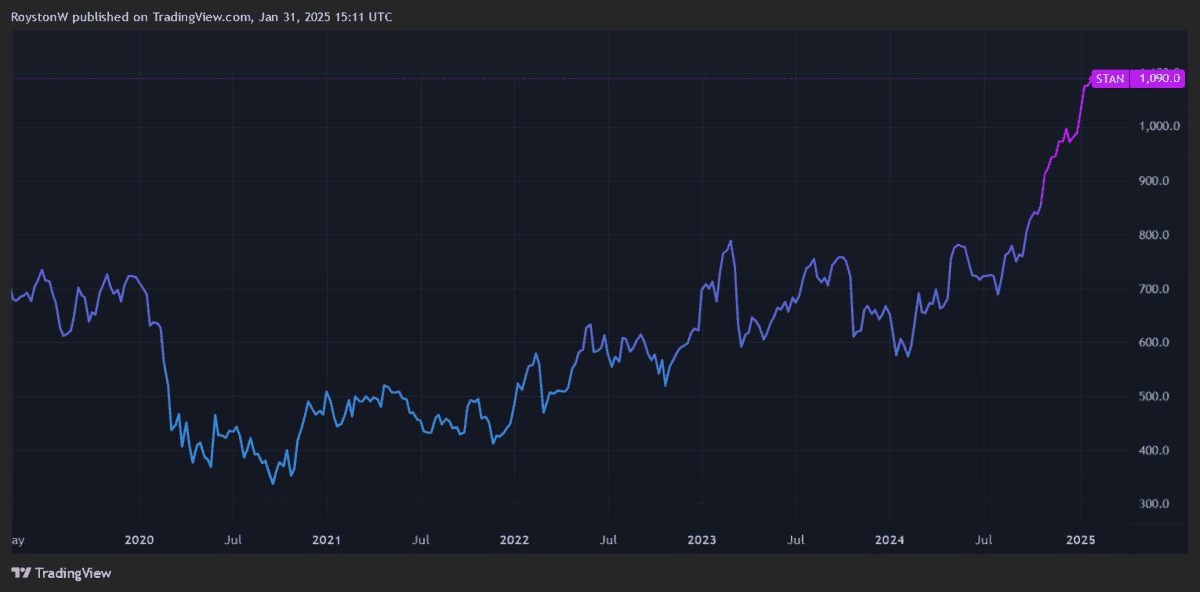
FTSE 100-listed Standard Chartered (LSE:STAN) is one UK share that’s continued rocketing in value since the start of 2025. Here’s why I think investors should consider buying it today while it’s still dirt cheap.

Brilliant bank

Source: TradingView

At £10.90 per share, the emerging markets bank looks like a bargain based on a variety of value metrics.

The bank’s price-to-earnings (P/E) ratio for 2025 is 7.6 times, while its price-to-earnings growth (P/B) ratio is just 0.6. Any reading below one suggests a share is undervalued.

On top of this, Standard Chartered’s price-to-book (P/B) ratio is also below one, indicating the bank trades at a discount to the value of its assets.
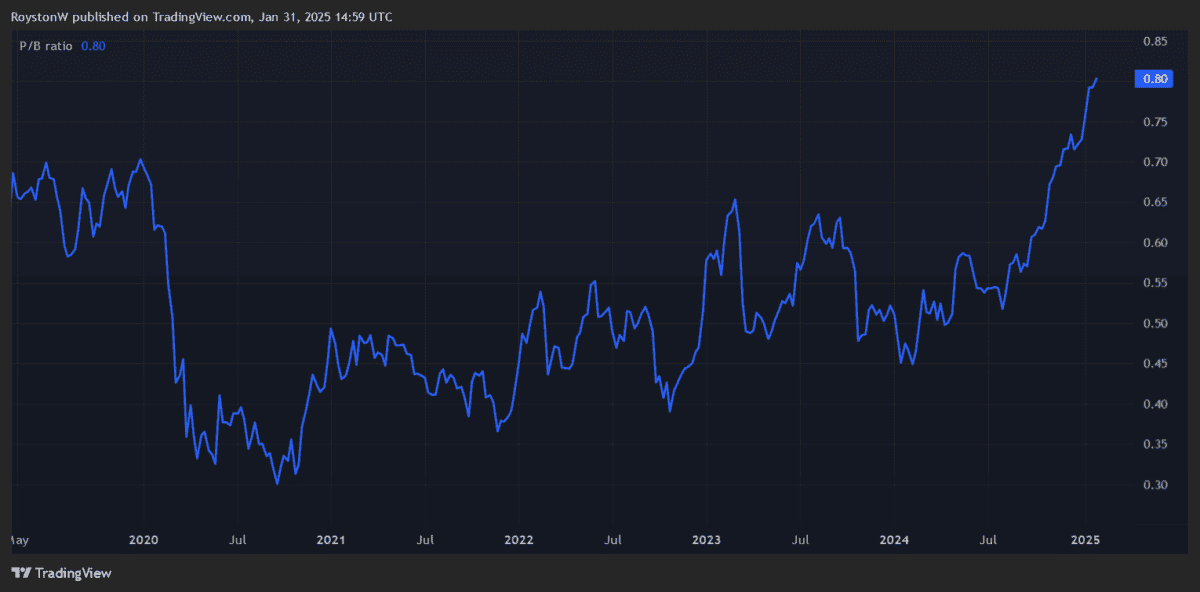
Standard Chartered's P/B ratio
Source: TradingView

Banks are highly cyclical, and during economic downturns revenues can slump and loan impairments rocket. In the case of Standard Chartered, investors need to be aware of the risks posed by China’s economic slump, and especially weakness in the property market. The bank has already had to heavily write-down the value of some of its Chinese assets.

But I believe these risks are baked into the banking giant’s valuation. Also, from a long-term perspective, the earnings outlook here remains extremely bright.

In Asia and Africa — regions from which Standard Chartered sources 70% and 16% of profits respectively — financial services demand is soaring, driven by a mix of personal income growth and population increases. This is a growth opportunity the bank could mine for decades.

What’s more, Standard Chartered’s strong balance sheet gives it firepower to pursue further investment in fast-growing areas like wealth management. The group’s common equity tier 1 (CET1) capital ratio was 14.2% as of September.

It also means investors can expect healthy dividend growth along with further share buybacks. The bank launched another share repurchase programme worth $1.5bn last summer.


2 cheap FTSE 100 stocks I think could keep rising in February!

The FTSE 100 leading index of stocks has enjoyed a strong start in 2025, extending the impressive gains it enjoyed last year and reaching fresh peaks around 8,600 points.

I think bullish investors seeking Footsie momentum stocks should consider these blue-chip bargains.

Persimmon

Housebuilder Persimmon (LSE:PSN) has risen thanks to a raft of impressive market reports. The latest of these, from Zoopla on Thursday (30 January), showed house price growth at three-year highs at the start of 2025.

January’s data is a very good omen for London’s listed homebuilders. According to Zoopla, “the first few weeks of each year tend to provide a clear indication of how the rest of the year will unfold“.

Zoopla also noted that 17% of homeowners are looking to move either now or within the next two years, which bodes well for Persimmon not only in 2025 but beyond.

Strong trading numbers from Persimmon itself have boosted the market buzz and lifted its share price. In mid-January, it announced a 7% rise in completions in 2024, beating expecations.

It’s possible that the setor rebound could stall if interest rates fail to fall much further from current levels. Yet on balance, I think investors can be optimistic of further Bank of England rate action that boosts buyer affordability and maintains the market’s momentum, prompted by steadily falling inflation and a stalling UK economy.

Persimmon has ambitious plans to capitalise on a sustained recovery, too. It plans to have 300 sales outlets up and running over the medium term, up from 270 at the end of last year.

Today, Persimmon shares trade on a price-to-earnings growth (PEG) ratio of 0.9. Given that this is below the value watermark of one, I believe the builder has room for further gains in the weeks and months ahead.

Scottish Mortgage Investment Trust

Despite recent volatility, Scottish Mortgage Investment Trust (LSE:SMT) has enjoyed double-digit share price gains so far in 2025. I’m optimistic that it can continue its rapid ascent.

The technology-focused trust has endured a rocky patch in more recent days. Striking performance numbers from DeepSeek’s R1 artificial intelligence (AI) model have rocked profitability expectations for the US tech sector. It’s feared the Chinese system could provide stiff competition for the likes of Microsoft and Alphabet, and sap demand for high-end microchips from Nvidia and its peers.

It’s too early to state the long-term impact of DeepSeek’s progress. But I’m encouraged by Scottish Mortgage’s recovery as US technology shares have rebounded.

It’s perhaps easy to see why appetite for Magnificent Seven shares has recovered so quickly. Aside from AI, these shares have a multitude of exciting growth opportunities to exploit, including:

  • Quantum and cloud computing
  • Cybersecurity
  • 5G, and the emergence of 6G
  • Blockchain
  • Robotics and automation

It’s why global investors have piled back into the sector following its recent pullback.

Today, Scottish Mortgage shares trade at a near-11% discount to the value of the trust’s assets. This leaves scope for more price gains, though it’s worth considering that any fresh DeepSeek-related news could cause fresh price volatility.

£20,000 invested in this dividend stock could generate a passive income of…

For those looking to invest in dividend stocks, Aviva (LSE:AV) shares might be one of the best in the FTSE 100. Its dividend yield of 6.8% puts it among the highest-yielding stocks in the index. So let’s see how much annual passive income an investor could make if they put £20,000 into its shares.

So how much?

Aviva shares are currently trading at £5.07. Therefore, with £20,000, an investor could buy 3,947 of its shares. Now in the last year, the company’s paid out dividends of 34.2p per share. If we assume the dividend won’t grow or be cut in the future, then an investor could make £1,349.87 annually by buying its shares. That’s not too bad at all.

I understand that having £20,000 to hand isn’t possible for a lot of people, and they would also want to keep their portfolio diversified and balanced. But it’s still interesting to see, especially as you could start with a smaller amount and build it over time.

Moreover, investors should keep in mind that dividends aren’t guaranteed. However, I believe my figures above are actually an understatement of how much passive income could be made.

Aviva’s steadily been growing its dividend from 2021. Back then, it paid out 21p per share. Therefore, the firm’s dividend’s grown an incredible 63% over the last four years. It might not necessarily grow at this rate over the next few years, but its track record suggests dividend growth’s likely.

Sound financials

In order to assess whether a company’s in a good position to maintain and grow its pay-out, it’s important that investors assess its profitability and balance sheet. In the case of Aviva, it’s showing great evidence of achieving this.

For example, in its last quarterly results, earnings grew 59%. Furthermore, the firm has a sound balance sheet, with cash of almost £17bn and debt of only £6.3bn. Therefore, it should be in a safe position to increase its dividend pay-out over time.

There are risks to holding its shares. As a financial services firm, it’s heavily exposed to the fortunes of the UK economy. There are concerns that businesses will cut jobs and raise prices to offset measures in the recent Budget. This could hinder economic growth. In turn, this could hurt Aviva.

The risk of waiting too long

I’d also like to touch on one more point. There’s a risk of waiting too long in buying dividend stocks. Aviva shares have done well over the last month, rising 8.8%. While this is good news for current shareholders, those interested in its dividend now have to pay 8.8% more to obtain it.

While it’s no guarantee the share price will continue rising from here, I believe there are catalysts for it to do so. Even though the economy may pose some problems, the ageing UK population could benefit Aviva. This is because elderly people are more likely to make use of the kind of products the company offers, such as retirement and wealth services.

Therefore, investors may want to consider buying some of the company’s shares. This is especially the case if they like its dividend and also see the share price rising.

Here’s the growth forecasts for BT shares through to 2027!

Hopes of recovery have driven BT Group (LSE:BT.A) shares sharply higher in the past year. Up 28% on a 12-month basis, the telecoms giant’s risen, in part on expectations that interest rate cuts will prompt a turnaround.

However, the release of latest financials on Thursday (30 January) has reminded investors of the severe challenges it continues to face. Following the trading statement, it was the FTSE 100‘s third-worst-performing share on the day.

Is this just a blip in BT’s recent share price recovery though? And should investors consider buying BT shares for their portfolios?

Recovery expected

A series of setbacks have kept BT under pressure for around a decade. These range from rising competition across its product segments, tough economic conditions, regulatory issues, and the high costs of its fibre rollout programme.

As a result, it’s reported whopping earnings drops in four of the past five years. But while City brokers predict another bottom-line reversal this fiscal year, they expect BT to begin a tentative recovery from the new financial year, beginning in April.

Year To March Predicted EPS Annual growth P/E ratio
2025 17.83p -4% 8.1 times
2026 18.06p +1% 8 times
2027 18.82p +4% 7.7 times

How realistic are these forecasts? Many people — myself included — aren’t exactly convinced following third-quarter trading numbers last week.

Another weak update

BT’s fresh update showed adjusted revenues down another 3% between October and December, to £5.2bn. This was caused by continued weakness at its Consumer and Business units, where corresponding revenues both dropped 2%.

Combined, these units make up 86% of group sales. At Consumer, poor smartphone demand damaged the top line, while revenues elsewhere dipped due to weak trading overseas.

In better news, Openreach recorded a 1% revenues improvement over the quarter. Turnover rose as BT’s infrastructure arm added a record 472,000 customers to its full-fibre network in the December quarter.

On another positive note, adjusted EBITDA rose 4%, to £2.1bn, in part due to ongoing cost-reduction measures. BT slashed its total workforce by 3% between April and December, to 117,000. It also managed to trim energy costs by the same percentage.

Tough times ahead?

On balance though, BT gave the market little to celebrate with last week’s update. Further cost-cutting and moves to become a more UK-centric business could help earnings. But the outlook still remains pretty bleak, in my opinion.

The major issues that have dogged it since the mid-2010s remain very much in play. And it continues to creak under massive debt, casting a shadow over future growth and dividends.

Net debt rose to £20.3bn as of September, due largely to its expensive fibre rollout programme and extra contributions to its pension scheme.

While it’s up more than a quarter since early 2024, at 143.9p, BT’s share price is still a long way from the 417.9p it was trading at 10 years ago. Given that the firm continues to struggle with the same challenges, I think it’s in danger of plunging again before too long.

Despite its low price-to-earnings (P/E) ratio of around 8 times, this is a FTSE 100 share I’m not even touching with a bargepole.

Up 10% in a month! Is the abrdn share price set for the biggest comeback since Lazarus?

When I last wrote about the abrdn (LSE: ABDN) share price on 20 December, I was pretty scathing about the FTSE 250 investment manager. It’s been a textbook case of value destruction ever since its ill-fated 2017 merger. 

What a difference a month makes. Abrdn’s shares are suddenly back from the dead, after climbing 10% in January. So is this the beginning of a long-awaited recovery, or just another false dawn?

Let’s not get carried away. The stock is still down 9% over one year and nearly 50% over five years. But the last month does suggest investors are seeing reasons to be cheerful again. 

FTSE financials are fighting back

I’ve noted a resurgence in interest for UK financial stocks, as investors anticipate falling inflation and interest rates. My personal plays on the sector, FTSE 100 asset managers Legal & General Group and M&G, both climbed 6% in January.

abrdn’s revival isn’t just due to a sector shift. Investors also reacted to positive Q4 results, released on 15 January. Finally, there were some genuinely encouraging signs.

Assets under management and administration rose 3% in 2024 to £511bn, helped by a 1% gain in Q4. 

Most notably, the group’s Investments division, long a source of painful outflows, posted a net £500m inflow in the final quarter. 

Institutional & Retail Wealth returned to a net inflow of £300m for the year, a huge improvement from the eye-watering £17.9bn net outflow in 2023.

Interactive Investor, the star performer in abrdn’s portfolio, continues to shine. Customer numbers grew 8% to 439,000 in 2024. Net inflows nearly doubled year on year to £5.7bn, proving its worth as a smart acquisition.

Abrdn still has a battle on its hands. Its adviser platform remains on the rack, with £3.9bn of outflows last year. Equity outflows remain a concern, particularly in Asia and emerging markets, where conditions remain challenging.

A stunning rate of income

Last but not least, there’s the dividend. At 9.4%, it’s one of the most attractive yields on the FTSE 250. abrdn has frozen its payout at 14.6p per share for four years. Shareholders payouts are covered just once by earnings, maybe less.

I’m sure the board will be desperate not to cut it, especially as things look to be picking up. But it can’t be ruled out. The board insists its cost transformation programme will provide a “solid base from which to grow”.

I’m hoping for a string of interest rate cuts in 2025. If we get them, that could breathe fresh life into financial stocks. The Bank of England is expected to cut base rates to 4.75% on Thursday 6 February. Thereafter, it’s anybody’s guess. But abrdn’s sky-high yield will look even more attractive if returns on cash and bonds do fall.

UK equities might regain favour after DeepSeek’s AI breakthrough rattled US tech giants, prompting investors to take a second look at the FTSE dividend payers.

Things are looking up but we’ve been here before with abrdn. Personally, I’ll stick with Legal & General and M&G. But I’m intrigued to see how abrdn fares. There’s life in it yet.

Can the Rolls-Royce share price be a top performer again in 2025?

The Rolls-Royce (LSE: RR.) share price has been on fire lately. Shares in the aerospace and defence company have climbed from £0.93 per share at the start of 2023 to £6.07 as I write on 31 January. That represents a gain of over 550% in the space of just over two years.

Investors have been clambering to buy in and the company’s market cap has swelled to over £50bn in the process. Having nearly doubled in value throughout calendar year 2024, can the Rolls-Royce share price do it again?

Surging valuation

CEO Tufan Erginbilgiç has been busy making changes. He has embarked on a mission to slash costs, boost efficiency, and increase profitability since taking over in January 2023.

In October last year, the company announced 2,500 job cuts in pursuit of these objectives. The company’s half-year operating margin rose by 4.4% to 14%, with the biggest gain in its civil aerospace unit, which delivered an operating profit margin of 18%.

Investors appear to be the beneficiaries, with the company announcing a dividend for the first time since 2020. Management upgraded guidance for full-year underlying operating profit of between £2.1bn and £2.3bn in 2024, potentially some £300m above its own February predictions.

Up, up, and away?

So, it’s been a strong couple of years for the Rolls-Royce share price. I think there are a few key factors that could propel the company’s market cap further in 2025.

If the recovery in travel continues, that would be good news for the engine maker and its revenue potential. Of course, higher revenues is just one piece of the puzzle.

Management will need to keep trimming the fat to keep costs under control and deliver more profitability. Further profit upgrades, or increases to its forecast dividends, could also boost the share price.

In terms of medium-term growth, I think the company has some exciting initiatives in the wings. One of them is its next-gen UltraFan engine with its new architecture and lightweight design combining with the world’s most powerful aerospace gearbox to create a potential game changer.

At the forefront of technological change, commercial deals for this and other technologies like nuclear energy could represent lucrative future growth avenues.

Key risks to growth

Of course, no investment is without risk. Management has made no secret of the supply chain challenges it is facing at the moment. Further or worsening disruption could impact on profitability and be a nasty surprise.

Then there’s the macroeconomic environment. Global geopolitics is delicately poised and economic uncertainty is rife, with concerns around inflation and interest rates. This means there could be an unexpected decline in demand, which investors would surely view unfavourably.

My verdict

Rolls-Royce has been a big winner, but it’s no longer the cheap turnaround play it was a couple of years ago. Investors need to decide whether the company can keep up its impressive momentum.

If it keeps improving profitability and pushing into new markets, the share price could keep climbing. But if challenges mount up and the Midas touch escapes Erginbilgiç, 2025 could be a bumpier ride.

I’m not currently invested in the stock. I don’t have the spare funds to invest at the minute, but I think I’ll be putting any spare cash to work in other defensive sectors like pharmaceuticals before I jump on the Rolls-Royce train.

Should I eat some humble pie and buy Tesla stock?

Tesla (NASDAQ: TSLA) stock continues to make lower-case fools out of Fools like me.

Back in November, I questioned whether it had become a meme stock at $320. I ended with, “I continue to admire Tesla as a business, but not the stock at $320, which I reckon is demonstrating meme-like qualities. As such, I think there are other more attractive growth shares for my money“.

Since then, the share price has risen 30% and now trades at $415!

Like Elon Musk’s superhuman work schedule, Tesla shares often defy logic. I knew that. More fool me.

So, should I eat some humble pie and just invest? Let’s dig in.

High multiples

Tesla shares are currently trading at a price-to-sales (P/S) multiple of roughly 15. In other words, investors are paying $15 for every $1 of Tesla’s revenue. The forward price-to-earnings (P/E) ratio is around 120.

I’d be a hypocrite to pompously say that I would never invest at such ridiculous multiples. I recently took a small position in language learning firm Duolingo when the stock was trading at 20 times sales and a forward P/E above 100.

However, Tesla has stopped growing, at least for now, whereas Duolingo has been growing at a 40% clip.

Of course, I’m comparing apples to oranges here. But my point is that it might be a long time, if ever, before Tesla returns to posting top-line growth of 40%. Or the long-term 50% annual compound annual growth rate (CAGR) it was projecting in early 2021.

To some extent, that’s understandable, as Musk previously admitted in late 2023: “Yeah. I mean, at the risk of stating the obvious, it’s not possible to have a compound growth rate of 50% forever or you will exceed the mass of the known universe.”

However, Tesla is valued like a ultra-high-growth company, which it isn’t anymore. This is why I’m reluctant to invest.

But it’s all about the robots, silly

Musk says the company will be churning out robotaxis in 2026. Then potentially humanoid robots after that.

To be sure, these are mind-boggling massive market opportunities, ones which I’m excited about, despite the technical and regulatory hurdles that need to be surmounted. It’s hard not to be excited after watching the Optimus Bot bartender pouring draft cocktails at the recent Tesla AI event! 

Clearly, it is the future potential of these projects that forms the basis of the company’s high valuation today. However, it leaves me wondering how much of this is already priced in.

To give an opposite example, look at Alphabet stock, which trades at just 23 times forward earnings. Arguably, investors buying that stock are getting the core search, cloud, and YouTube businesses, which are all still growing, then all the other futuristic bets bundled in for free. That includes Waymo robotaxis (already doing thousands of driverless trips per day), quantum computing, and more.

Again, Tesla is the opposite of that. It is valued on the futuristic bets much more than the core EV and energy storage businesses. That doesn’t strike me as very attractive, which is why I’m going to give the stock a swerve.

After falling 6% in a week, should Microsoft be on my list of stocks to buy?

It’s not been a good week for Microsoft (NASDAQ:MSFT). But with OpenAI looking like the firm’s answer to Meta’s Reality Labs and Cloud growth slowing, should I add it to my list of stocks to buy?

The stock is down 6% since the start of the week. And while a forward price-to-earnings (P/E) multiple of 27 isn’t obviously cheap, it’s hard to remember investors being this pessimistic about the stock.

OpenAI

Let’s start with DeepSeek. The Chinese AI startup has launched its own large language model (LLM) and it appears to be outcompeting OpenAI’s ChatGPT – at least, for now. 

There are those who are sceptical of claims about how much it cost to build and what computing power it had access to. But Satya Nadella – Microsoft’s CEO – isn’t one of them. 

One reason is that innovation is almost inevitable in the tech sector. The best firms adapt to change, rather than fending it off, and Microsoft has been as good as anyone at doing this over time.

Nadella expects more of the same with AI. The idea is the growth of LLMs will lead to them becoming commodities, so that customers won’t care about which one they get.

In general, this isn’t a good thing for an industry because it makes it harder to raise prices. But in this situation, having lower costs is more important – and Microsoft’s scale gives it a big advantage.

As Nadella pointed out, this is essentially what has happened with cloud computing. And the winners from this have been Microsoft, Alphabet, and Amazon – the big US tech companies. 

Azure

On that subject, another reason the stock has been falling this week is because investors were unimpressed with its latest results. Specifically, its Intelligent Cloud division fell short of expectations. 

This could be a bigger problem than the risk of OpenAI not getting a good return on its investments. Intelligent Cloud contributes 43% of the firm’s total revenues and 45% of its operating income.

Revenues from Azure’s division were up 19%, which sounds good. But in the context of a unit that has been growing at above 30% on average over the last couple of years, it’s a disappointment.

Microsoft put the problem down to the fact it hasn’t been able to ease supply constraints. Specifically, it hasn’t managed to build enough data centres to meet customer demand.

The slow revenue growth is set to continue for the next quarter. But the firm is expecting this to get back to 32% after that as it works through its capacity issues. 

One of the key things to watch in the week ahead will be how Alphabet and Amazon are faring. Both companies report earnings and I’ll be looking carefully at how fast their cloud divisions are growing. 

A buying opportunity?

I think the market’s reaction to the emergence of DeepSeek has been something of an exaggeration. Whether or not it’s good news for Microsoft, I think its stake in OpenAI is small in context. 

The faltering in its Intelligent Cloud division, however, looks more significant. So while the share price coming down isn’t enough to convince me to buy the stock yet, I’ve added it to my watch list.

Up 7%! Here’s 1 AI growth stock that had a surprisingly good week!

What a crazy week for artificial intelligence! I doubt what’s happened was on many folks’ bingo cards, but it’s safe to say the world of AI has been turned upside down – and many AI growth stocks are looking like a much worse bet. 

My own view of the situation is that a stock I have owned for some time may have been put into a supremely good position. I’d even buy more of the shares if I had the funds to do so today. 

Sputnik moment

Firstly, a little background. With the exception of a few folks living under rocks somewhere, we all know AI has become a major battleground. 

ChatGPT sparked the craze, showing a glimpse of what might be the greatest economic miracle since telephones or railroads. 

Crazy predictions got thrown around, like the first person to make a sole trader billion-dollar company has already been born. 

The arms race was centred mostly around the US tech sector where vast sums were being invested. OpenAI earned a $350bn valuation on negligible revenue. New President Donald Trump earmarked $500bn for AI. Google was ordering nuclear power plants to keep up with the energy demand!

Then on Sunday, along came what some are calling a ‘Sputnik moment’ in reference to when Russia stunned the US with an orbiting satellite in the 1950s. 

This time, the rival is China, where a Hangzhou startup released a large language model (LLM) with performance close to that of ChatGPT. They claim it cost only $6m. That’s million, by the way, with an ‘m’.

Biding time

So they slashed the perceived cost of making LLMs with some clever efficiency tweaks. They also revealed a path to LLMs being able to run off something as small as a smartphone. 

Who might benefit from such a development? The maker of the best-in-class smartphones, Apple (NASDAQ: APPL), is the name I have in mind. 

It reminds me of when the first smartphones were released. Apple took its time, waiting for the technology to mature just enough. When it did, the previous contenders were left in the dust – anyone remember Blackberry?

Could Apple do the same thing with AI? Well, the markets are bullish. Apple shares are up 7% this week, gaining a quarter of a trillion dollars in market cap. All this while AI stocks are floundering. Nvidia is down 15%, losing over half a trillion!

I’m not banking on anything, though. AI has a long way to go to prove it can be as useful as the claims, and Apple has a long way before it becomes a leader in the field. 

But I think this is an avenue that could provide a lot of growth for a stock that some have said has already reached its mature phase. I’d look at increasing my position if I had the spare cash to do so.

Which FTSE 100 bank stock is the best value right now?

There have been some big FTSE 100 index winners over the last 12 months. The UK large-cap index has gained 13.7%, rising to 8,673 points as I write on 31 January.

One of the strongest sectors over that period has been financial services. A high interest rate environment has helped increase net interest income for the banks and boosted share prices.

NatWest (LSE: NWG) is one such stock. Its share price has rocketed 92.9% higher over the past year to £4.34 per share on 31 January.

I wanted to explore what’s driving the company’s market cap higher and evaluate where it sits among its UK banking peers.

Bumper year for banking stocks

While the Bank of England has begun cutting rates, all indications are that the US Federal Reserve and other central banks will be slower than expected in cutting rates. High interest rates have increased bank revenues, while loan defaults have remained subdued, boosting net interest income.

In the third quarter of 2024, NatWest outperformed analyst estimates by reporting a 25.7% increase in pre-tax operating profit to £1.7bn.

Bank revenues increased to £3.8bn as management upgraded its annual return on tangible equity (ROTE) forecast to over 14%. Additionally, deposits grew by £2.2bn, and lending increased by £8.4bn during the quarter, which all helped boost the company’s share price higher.

It was a similar story for many of the other UK banks. Barclays (LSE: BARC) has gained 100% to £2.98 per share, and HSBC (LSE: HSBA) gained 37% to £8.48 per share, to 31 January.

Valuation

I thought I’d take a look at some common valuation metrics. The first one is the price-to-book (P/B) ratio, which measures a company’s market cap against the net book value of its assets held on the balance sheet.

NatWest’s P/B ratio of 0.93 is fairly comparable to HSBC’s ratio of 1, while Barclays appears the most undervalued. Bear in mind, though, Barclays is undergoing significant change at the moment with £10bn capital forecast to be returned to shareholders and focusing on a smaller investment banking division.

NatWest’s dividend yield of 4% sits neatly in the middle of Barclays (2.8%) and HSBC (5.7%). I do think the HSBC dividend is one to be a touch wary of given the transformation underway at the bank.

NatWest currently has a 9.1 price-to-earnings (P/E) ratio, which is marginally higher than HSBC’s 8.8 times multiple. Barclays, after its strong recent gains, is trading at a P/E ratio of 11.9 times and looks a touch expensive.

Verdict

The relative valuation metrics above present something of a mixed bag. All in all, I feel as though NatWest is undergoing perhaps the least change among the three banks discussed.

That could work in its favour by doing more of the same and continuing to grow its book, while its peers look to fundamentally transform their businesses. I’m not looking to add these banking stocks to my portfolio right now, but Barclays is the one that I think is most worth considering among the UK bank stocks.

While the bank has a long transformation journey ahead, I think it is showing promising signs of it working, and the potential growth trajectory may justify a higher P/E ratio.

Financial News

Daily News on Investing, Personal Finance, Markets, and more!

Financial News

Policy(Required)