£5,000 invested in this penny stock 1 year ago is now worth…

A penny stock’s a share that’s trading for less than £1 with the underlying company sporting a market capitalisation of less than £100m. They’re generally considered riskier investments as companies meeting this definition are usually smaller and in the earlier stages of growth.

However, those who invest in penny shares typically do so because they believe they’ll be compensated more if the company becomes successful. And with a share price of 37.4p and a market-cap of £72.7m, Topps Tiles (LSE:TPT) is an example of a UK penny stock.

Let’s see how much £5,000 invested in it a year ago would be worth now.

A year of disappointment

Over the last year, Topps Tiles shares have fallen by 17.26%. Therefore, a £5,000 investment’s now worth only £4,137 today. Investors would have lost £863.

This is just a snapshot of a broader decline over the long term. Investors who put money into its shares five years ago would have lost 52.1% of their investment. For context, our £5k would only be worth £2,398 today, representing a loss of £2,602. That’s over half the value gone.

So why has this happened? Well, it’s easy to see from the company’s recent results.

Group revenue declined by 4.1% to £252m in 2024. Moreover, the firm flipped from a profit before tax of £6.8m in 2023 to a £16.2m loss. Cutting its final dividend in half didn’t help matters. There’s also some pessimism about its ability to bounce back from this situation. Following the recent Budget, staff costs are set to rise. Competition from rivals like B&Q is also a concern for the firm.

Dirt cheap valuation

While Topps Tiles has a lot of improvements to make, its low valuation could already be set to change. It’s currently trading with a forward price-to-earnings (P/E) ratio of 10. But analysts are projecting that the company will return to revenue growth in 2025 and continue this into 2026. In 2025, the average estimate is for sales to grow 16.3% to £293m. It’s then expected to grow by a further 6.4% to £311m.

This makes its shares seem like a bargain, even when factoring in last year’s poor results. It therefore seems as though a lot of the aforementioned pessimism is already baked in.

Now what?

Even after reflecting on its valuation, I’m still not so sure about Topps Tiles’ long-term prospects. I think it’s safer and more stable than many other penny stocks. And as it’s responsible for every one in five tiles sold across the UK, I don’t believe investors should worry about the company disappearing any time soon.

After falling 52.1% in the last five years, I also don’t think it can fall much further, especially with revenue predicted to start growing again. However, it’s a tile company. Its business fundamentally doesn’t excite me over what it can achieve in the next five to 10 years. A lot of its success will depend on the demand for tiles, which I don’t think will grow at an eye-catching rate.

Overall, if an investor puts £5,000 into Topps Tiles for the next year, I wouldn’t be surprised if they made a return. However, I also don’t think it would be that much. Therefore, I don’t think investors should consider its shares.


This passive income plan is boring and unimaginative. That’s why it actually works!

Passive income plans can come in all sorts of weird and wacky forms.

But the whole point of passive income is that should be (more or less) effortless.

Learning about a new business and setting it up does not seem passive to me. Nor is it guaranteed to generate income – in fact, it could eat up money instead of producing it.

So my own approach is based on a few basic principles – I want it to be passive and I want to have a strong chance of earning income.

Why reinvent the wheel?

Many businesses already know how to generate income.

In fact, they generate so much more income than they need for their own business needs that they give some of it to shareholders on a regular basis, in the form of dividends.

An example is Games Workshop (LSE: GAW).

At the start of June, it had £108m of cash and cash equivalents. Over the next six months, its operations generated £133m of cash. Even after spending on product development and sending a cheque to the taxman, Games Workshop divvied up £61m among its shareholders.

Yet it still ended the period with around £18m more in cash and cash equivalents than it began with.

In recent years, the FTSE 100 company has paid shareholders five dividends a year. All they need to do is spend money buying the share, sit back, and let the money roll in.

Taking a smart approach to income generation

But there are risks. Games Workshop’s concentrated manufacturing footprint means that if a key factory goes offline for any reason, sales could fall sharply. It plans a new factory in Nottingham, due to be completed next year.

Even a great, proven business can run into difficulties. So the savvy investor spreads money across multiple businesses to help mitigate the risk that one will do badly and reduce or cancel its dividends.

That does not necessarily take a lot of money – it is possible to buy shares even with a modest budget.

How much money could someone earn?

I use this strategy myself but I do not own Games Workshop shares, even though I think its fantasy universe and intellectual property are excellent competitive advantages.

Why? The share looks pricy to me.

It also has a dividend yield of 3.6%, meaning that if I invest £1,000 today I would hopefully earn £36 per year of passive income.

That is not bad: in fact it is in line with the FTSE 100 average. But I am earning much higher yields owning other shares, like 8.6%-yielding Legal & General and M&G, with its 9.5% yield.

Those are different companies to Games Workshop and each has their own risks as well as positive points. But by carefully selecting a diversified range of companies, I earn passive income from the hard work and proven business models of large blue-chip firms.

That need not be complicated.

An investor can start with how much they can spare, set up a share-dealing account or Stocks and Shares ISA then – having learnt something about key stock market concepts like valuation – start looking for income shares to buy.

These FTSE 100 stocks could catapult forward as AI gets cheaper

DeepSeek — the Chinese artificial intelligence (AI) lab responsible for market chaos on 27 January — looks set to make AI cheaper and more accessible. This will likely hasten the development of AI-powered platforms and the adoption of this revolutionary technology. Having seen Nvidia and other ‘picks and shovels’ stocks surge, it’s likely time for FTSE 100 companies to benefit.

Let’s not forget that the overarching objectives of AI, at least for businesses, is productivity gains. This means companies should be able to achieve more with fewer resources. Lower headcounts, higher output, and hopefully, stronger earnings.

So, who could benefit? Well, in the long run, I’d expect this revolution to touch every company as AI extends into robotics. However, there could be some near-term winners of cheaper AI, including Sage Group (LSE:SGE) and Experian (LSE:EXPN).

Sage Group

Sage, a leading software company known for its accounting and payroll solutions, has been actively integrating AI into its products. With the advent of more cost-effective AI models like DeepSeek’s — or at least using some of DeepSeek’s innovations — Sage could significantly enhance its offerings without incurring substantial costs. The introduction of its Copilot tool exemplifies this, allowing finance teams to quickly identify budgeting errors and improve efficiency.

Moreover, as AI becomes cheaper and more accessible, Sage can leverage these advancements to further develop its AI capabilities, potentially attracting new customers and retaining existing ones. The company’s recent 20% share price jump following promising full-year results indicates strong market confidence, which could be bolstered by the integration of more affordable AI solutions. This positions Sage well to capitalise on the growing demand for intelligent business tools in an increasingly competitive market.

However, given it trades at 34 times forward earnings, investors may wish to tread with caution. Personally, I think Sage is an interesting proposition, but the valuation coupled with the approximately 15% growth rate isn’t overly tempting.

Experian

Experian, a global leader in data analytics and consumer credit reporting, stands to benefit from the rise of cost-effective AI technologies as well. The company relies heavily on data-driven insights to provide value-added services to its clients. With new models enabling cheaper and more efficient data processing capabilities, Experian could enhance its analytics services significantly.

Moreover, the ability to deploy advanced AI at lower costs and in greater numbers allows Experian to refine its predictive models and improve risk assessment tools, which are essential for financial institutions and businesses alike. As the demand for sophisticated data analytics continues to grow, Experian’s enhanced capabilities could lead to increased market share and revenue growth.

Interestingly, Experian stock trades with very similar multiples to Sage. And at 34 times earnings, even with a decent earnings growth rate of around 15%, investors may want to investigate more before making a decision. Personally, I’m adding Experian to my watchlist, but I’m not buying at the current multiples.

Forget Nvidia — this UK stock uses AI and has a 9% dividend yield too!

In an age of artificial intelligence (AI), UK translation company RWS Holdings (LSE:RWS) looks like the equivalent of dial-up internet. As a result, the stock has fallen 76% in the last five years.

This, however, could be a huge mistake – revenues are growing and the company has an AI product that generates real value for customers. On top of this, the stock comes with a 9% dividend yield.

AI

At first sight, the rise of AI should spell big trouble for RWS – automated solutions should be able to translate documents more quickly and more cheaply. And that’s why the stock has been going down. 

However, a big part of the company’s revenues come from specialist translations in areas like law, healthcare, or finance. These are often highly technical and the cost of an error can be huge. 

That makes outsourcing translation to AI to try and save some cash a big risk. By contrast, RWS has translators with specific expertise in these areas to try and avoid these costly errors. 

Risks

Make no mistake about it – this is a risky stock. As the recent performance of Nvidia has shown, anything to do with AI is hard to forecast for even the best analysts. 

On top of that, RWS has seen revenues fall over the last couple of years. The company doesn’t see this as a feature of permanent disruption, though – it’s attributing it to a cyclical downturn in end markets.

Profits have also fallen due to impairment charges relating to its acquisition of SDL (an AI-enabled translation business). These are declining but there’s an ongoing risk with other recent acquisitions.

There’s no doubt the stock comes with risks and these can’t be ignored. But there are also some very attractive potential rewards for investors to consider – most notably, a 9% dividend.  

Rewards

When a stock comes crashing down – and ‘crashing’ is the word for RWS – it’s always worth a closer look to see whether the dividend is in danger. But there are some strong reasons for thinking it isn’t.

The first is sales aren’t declining any more – the firm reported a return to growth in 2024 and is expecting this to continue. That supports the idea its recent challenges are temporary, at least in part.

Another is that – despite its difficulties – RWS has consistently increased its dividend over the last few years. So with things picking up in the underlying business, this looks likely to continue.

The third is that it has been incorporating AI into its recent products. And its customers are seeing genuine results from this, with up to 65% improvements in efficiency across supply chains. 

Should I buy the stock?

It’s easy to get swept along by a narrative of a business whose core product is being replaced by AI solutions that do the same thing faster and cheaper. But the reality is much more complicated.

If the market is prematurely writing RWS off, there could be a huge opportunity for investors here. I’m still trying to work out whether a 9% dividend is enough to entice me to take the risk.

1 FTSE 100 dividend stock I’m planning to hold for the next decade

The FTSE 100 company I’m writing about today is unknown to most UK investors, despite increasing its dividend every year for 30 years.

However, I think this could soon start to change. In fact, I’m so excited about this opportunity that I recently bought more shares for my personal portfolio. Here’s why.

A £5bn business no one talks about

Irish group DCC (LSE: DCC) was founded in 1976 and floated on the London Stock Exchange in 1994. Since then, the company’s annual operating profit has risen from €21m to €636m. That’s an average growth rate of 12% per year, for 30 years.

Even more impressively, shareholders have seen a corresponding increase in their dividend income. DCC’s payout has risen from 6.1p per share in 1995, to 197p per share last year. That’s also equivalent to an average growth rate of 12% per year.

I can’t think of many other companies with such an impressive record.

What does DCC do?

DCC’s main focus is its energy business. This generates nearly 75% of group profits.

DCC Energy supplies liquid fuels and off-grid gas to business and residential customers in the UK, Western Europe, and US. It’s a big player in many of these markets and is now expanding into renewable energy and broader energy management services.

The remainder of DCC’s profits come from two separate businesses. One of these is healthcare distribution and the other is audio-visual product distribution, mainly in the US.

However, this is about to change. In November, the company announced plans to sell its healthcare and technology units over the next couple of years.

Splitting up makes sense

While DCC Healthcare and Technology are not bad businesses, they don’t have the scale or market leadership the company enjoys in energy. They aren’t as profitable, either.

According to management, DCC Energy generated a return on capital employed of 17.4% last year. Healthcare and Technology each managed less than 10%.

I think a split makes sense. When DCC is focused solely on energy, I think shareholders could benefit from an increase in surplus cash and a higher valuation.

Growth rates may also improve. In 2022, the company set a target to double energy profits by 2030. Progress so far looks promising to me – energy profits rose by 25% between 2022 and 2024.

I think DCC shares are too cheap

DCC’s share price has drifted in recent years. The stock is now around 25% below the record high of £75 seen in 2018. That’s left the stock trading on just 11 times 2025 forecast earnings, with a 3.8% dividend yield.

I think that’s too cheap, but of course there’s no guarantee the market will agree with me.

DCC’s growth strategy involves regular acquisitions. Historically, these have been small and low risk. But the deals are getting larger and more varied. I think that could make them harder to integrate successfully.

As the energy transition gathers pace, other risks could emerge too.

Even so, DCC’s energy products and services are an essential part of daily operations for nearly 2m customers.

I think there’s a good chance this business will remain profitable and successful over the coming decade. I expect to own my shares for many more years.

Why the low price of Lloyds shares is a double-edged sword

After hitting a post-pandemic high last October, Lloyds (LSE:LLOY) shares then saw a sharp 15% decline. Investors sold off as fears mounted over its motor finance dispute, which could result in a hefty fine and impact the bank’s earnings.

Nonetheless, the stock’s since rebounded by a whopping 17%, as Chancellor Rachel Reeves looks to intervene, which has lifted sentiment. However, I’m approaching this development with cautious optimism.

Litigation nightmare

The UK’s Financial Conduct Authority (FCA) found Lloyds guilty for supposedly overcharging customers for car loans due to discretionary commission arrangements (DCAs). These arrangements allowed brokers to adjust interest rates on loans. This then allowed them to increase their commissions – and this wasn’t fully disclosed to customers.

But the bank has since appealed with the ultimate decision left to be made by the Supreme Court. As such, management’s allocated £450m aside to cover the potential charges. A final decision’s yet to be made by the Supreme Court. A hearing and verdict are expected before the autumn at the very latest. In light of that, a great amount of uncertainty looms over the outlook for Lloyds shares.

A hopeful outcome

According to RBC, the FTSE 100 stalwart could incur charges that could rack up as high as £3.9bn. In such a case, the lender would end up incurring huge litigation charges. This would undoubtedly affect its bottom line and growth trajectory.

The knife’s edge is that markets seem to have only priced in charges of £1.6bn-£2bn, and not the worst-case-scenario of £3.9bn – almost double of the priced-in estimate. Thus, a heavier-than-estimated fine could result in a further sell-off in Lloyds shares. On the other hand, a lower estimate could spur a relief rally, which has been seen recently.

This comes as the Chancellor wrote to the Supreme Court that it be allowed to give evidence in the case. Reeves stated that an unfavourable ruling could “cause considerable economic harm” to the wider economy. And given Reeves’ already delicate position as Chancellor given the recent spike in borrowing costs, she’s likely to try her best to sway the ruling in the favour of lenders.

Solid income strategy

In such an event, Lloyds shares would be a splendid investment to consider, in my view. The company’s structural hedges are set to provide a meaningful tailwind to its income from 2025 onwards, which will lift its revenue and earnings. This is because a huge chunk of Lloyds’ hedges will renew onto higher yields, thereby increasing its margins. And with rates coming down and a recession looking avoidable, the outlook for Lloyds looks rather bright on that basis.

Having said that, it’s also worth remembering that only less than £2bn worth of remediation charges have been priced into the stock. Hence, if the ruling turns out to be unfavourable, this could decimate the stock’s earnings. This would, therefore, imply a price-to-earnings-growth ratio (PEG) of 1.3. Given that the sector’s current PEG’s 1.3, that would suggest limited share price appreciation on that basis.

Nevertheless, having taken the amount of influence the chancellor has on the final decision, as well as Lloyds’ history of getting more favourable outcomes in litigation, I remain bullish on Lloyds shares and may consider adding more to my portfolio.

2 brilliant thematic ETFs to consider for a Stocks and Shares ISA or SIPP in February

Thematic exchange-traded funds (ETFs) can be great investments for a Stocks and Shares ISA or Self-Invested Personal Pension (SIPP). With these products, investors can get diversified exposure to high-growth industries that are shaping the world such as artificial intelligence (AI), robotics, and renewable energy.

Here, I’m going to highlight two theme-driven ETFs I like the look of right now. I think they could be worth considering for a diversified investment portfolio in February.

An ETF for the AI revolution

While AI stocks have experienced some turbulence recently, I continue to like the theme. Over the next decade, this technology‘s going to transform nearly every industry, creating a lot of opportunities for investors.

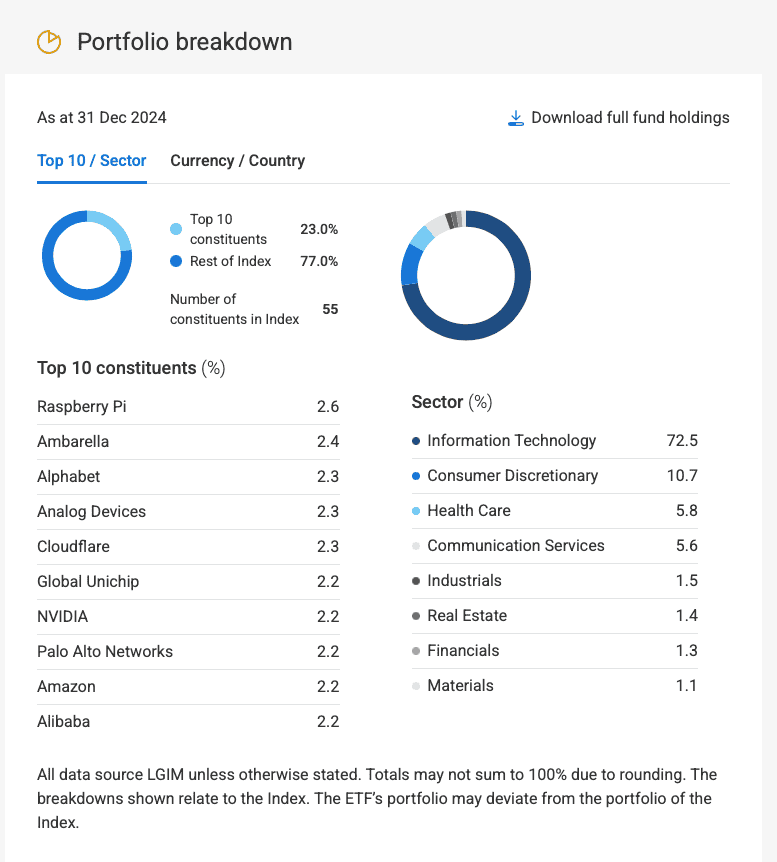
Now, one ETF that offers exposure here is the L&G Artificial Intelligence UCITS ETF (LSE: AIAG). This is a niche product from Legal & General that’s focused purely on AI stocks.

In total, it provides access to around 55 different companies. And I see that as a huge plus because, right now, we don’t know for sure who the real AI winners are going to be.

Another key feature of this ETF is that it doesn’t have massive weightings in specific stocks such as Nvidia or Alphabet (Google). This reduces risk for investors.

Source: Legal & General

There are plenty of risks to consider, of course. One is that the AI industry is moving at a rapid speed and new companies/technologies are continually popping up. We saw this recently with Chinese AI start-up DeepSeek. Its emergence sent a lot of US AI stocks down.

Taking a long-term view however, I think this ETF will do well. Ongoing fees are reasonable at 0.49% a year.

Cybersecurity just became more important

Now, the emergence of DeepSeek’s low-cost AI model has definitely created uncertainty in some areas of the AI sector. For example, there are now some question marks in relation to long-term demand for Nvidia’s high-powered AI chips.

However, one thing we can be certain of is that, looking ahead, demand for cybersecurity will remain high. If anything, the emergence of Chinese AI models will actually increase demand for sophisticated cybersecurity solutions.

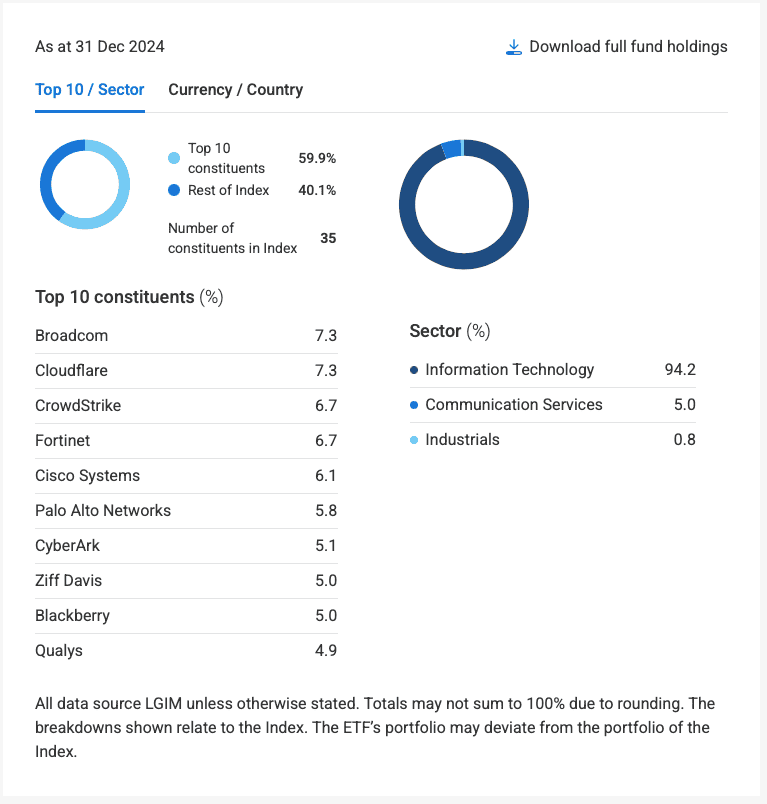
One ETF I like for exposure here is the Legal & General Cyber Security UCITS ETF (LSE: ISPY). It provides broad, global exposure to the cybersecurity industry. Overall, there are around 35 stocks in the ETF. At the end of 2024, top holdings included Broadcom, Cloudflare, and CrowdStrike.

Source: Legal & General

It’s worth pointing out that this ETF’s been around for a while now. And it’s done pretty well over the long run. For the five-year period to the end of 2024, it returned 71% (in US dollar terms), or 11.3% a year. However, past performance isn’t an indicator of future returns.

If the tech sector was to experience a major pullback for some reason (eg rising interest rates), this product could underperform. There’s also some company-specific risk here as this ETF does have quite large weightings in certain stocks.

I believe it’ll do well over the next five years on the back of the growth of the cybersecurity market however. Ongoing fees are 0.69% a year.

Can the NatWest share price replicate its 2024 rally in 2025?

The NatWest (LSE:NWG) share price stood out in 2024 as it shot up by a whopping 82%. This came as large stock buybacks, lower impairments, and rebounding margins led to healthy multiple expansion. But given the monumental rise, the question begs as to whether it can match returns of such calibre in 2025.

A buyback machine

It may come as a surprise that the NatWest share price rose by so much in 2024. After all, both its revenue and profits actually declined on the back of lower interest rates.

So what caused the shares to shoot up so monumentally then? The answer lies in the massive stock buybacks which occurred between the bank and the UK Treasury. This resulted in 173.3m of on-market share buybacks and 392.4m directed buybacks from the Treasury, as the UK government continues to reduce its stake in the bank following the 2008 financial crisis bailout.

The Treasury’s intention is to get its stake down to 0% by 2026. As such, further buybacks are on the cards. It’s worth noting that the government’s current stake is now below 10%, so this should serve as a supportive trend for further earnings per share (EPS) growth. Consensus estimates see the share count reducing to 7.5bn by the end of 2026, from 8.3bn today.

Confidence is in the doldrums

That said, fundamental earnings growth will still have to come from loan and income growth. The positive is that deposit outflows have stabilised. This means that NatWest can now issue more loans and earn interest/income from those loans. However, this is easier said than done. Further growth for its business will be contingent on the state of the UK economy.

It’s crucial to highlight that unlike its closest peer in Lloyds, NatWest has a bigger exposure to business loans. 38% of its loans come from the commercial and institution side. This, therefore, exposes the FTSE 100 stalwart to a greater level of risk given the latest economic developments.

UK business sentiment’s in the doldrums after the latest Budget saw taxes increase for businesses, with the cost of borrowing now also at multi-year highs. Therefore, this could push the UK into a recession which could stifle loan growth from businesses and, worse still, impact mortgages – NatWest’s main income stream.

A valuation conundrum

But before jumping to conclusions, I’m determined to see whether such a gloomy scenario has been priced in. Taking a look at the latest consensus estimates, EPS is projected to rise by 6.5% in FY25 to 52.7p.

Moving forward to FY26, analysts then estimate a bigger jump of 15.2% to 60.7p as the impact of structural hedge income and cost savings begin to materialise. This will also be helped by lower interest rates by then, which will aid loan growth and income for the firm. This is then forecast to lift EPS to 63.5p in FY27.

This implies a price-to-earnings-growth (PEG) ratio of 1.1. In the context of its banking peers’ median of 1.3, this implies further share price growth for NatWest. On that basis, I remain bullish on the stock, although I doubt a similar performance akin to its 2024 return can be beaten this year. It’s certainly a stock I’m going to keep a close eye on.

Here’s how I’m trying to build an ISA that gives me £5,000 passive income each month

All portfolios can generate a passive income. However, unless there’s a fairly substantial amount of money in the pot, it’s not likely to be a life-changing passive income. In fact, the average size of a Stocks and Shares ISA in the UK is £9,000, enough to generate around £450 annually, or just less than £40 a month.

This alone tells us that in order to earn £5,000 a month in passive income, I’ll need a pot of money worth at least 100 times more than the average size of a UK Stocks and Shares ISA. To be precise, assuming a 5% dividend yield, I’d aim for £1.2m invested to earn £60,000 a year, or £5,000 a month.

What’s more, an ISA income’s tax-free. As such, a £60,000 ISA income is the equivalent of a £90,000 taxable salary.

Please note that tax treatment depends on the individual circumstances of each client and may be subject to change in future. The content in this article is provided for information purposes only. It is not intended to be, neither does it constitute, any form of tax advice. Readers are responsible for carrying out their own due diligence and for obtaining professional advice before making any investment decisions.

Consistency’s key

I imagine I may have lost some readers’ interest when I noted that an investor would need £1.2m in an ISA to generate the stated passive income. However, the path to £1.2m’s a bit more simple and more achievable that many people would anticipate. The answer lies in consistent contributions to an ISA and a research-driven investment strategy.

And by constantly contributing and registering modest returns year after year, I can benefit from compound returns. Over time, this steady growth can significantly amplify wealth, turning small gains into substantial long-term rewards.

So let’s do the maths. If I were to invest £500 a month over 30 years and achieve 10.3% growth in my investments every year, I’d have £1.2m at the end of the period. Obviously, the stronger the investment and the longer the period, the more I’d have.

The building blocks

Of course, all of this is hypothetical without a real investment. And if I were starting afresh today building towards £1.2m, I’d first look to achieve some diversification. And a great way to do this is through an exchange-traded fund (ETF).

One stock I’ve bought for my daughter’s Self-Invested Personal Pension (SIPP) is Edinburgh Worldwide Investment Trust (LSE:EWI). This Baillie Gifford-operated trust focuses on growth-oriented companies, initially targeting those with market-caps under $5bn, now expanded to $25bn. I find its portfolio fascinating, albeit a risky, with SpaceX as the largest holding at 12.3%, followed by PsiQuantum and Alnylam Pharmaceuticals.

What excites me most is Edinburgh Worldwide’s exposure to cutting-edge sectors like space exploration and quantum computing. However, I’m well aware of the risks involved. Many of these early-stage companies, despite their potential, have limited public financial data. The trust’s performance has been volatile, with a 24% share price return in 2024, but a -33.5% return over three years.

Despite recent challenges, I’m drawn to the ETF’s long-term growth potential. Its focus on innovative companies at the forefront of technological transformation aligns with my investment strategy, and its diversification provides some relief in a sector where many company’s fail. The trust’s current discount to NAV of 4.9% also makes for an attractive entry point.

However, investors should be wary of this ETF’s volatility. Big brother ETF Scottish Mortgage would be a more sensible option to consider for low-risk investors.

Here’s a handful of cheap stocks that could turn red hot in 2025, according to analysts

Major institutions, brokerages, and banks issue price targets for companies within their surveillance. And while this isn’t the only way to identify cheap stocks, retail investors like us can learn a lot from these price targets. After all, it can be wise to use other people’s research as a starting point at least.

Standout undervalued stocks

Some of the cheapest stocks, according to analysts, tend to be early stage biotech or pharma companies. For example, micro cap Tempest Therapeutics trades 2,200% below its share price target. However, I’d be wary not to be drawn in by these figures as these stocks are typically only covered by one or two analysts. The reality with early stage biotechs is they are more likely to crash and burn than they are to be the next big winner — and that’s not reflected in the price target.

So, ignoring those anomalies, here are some companies that stand out:

Stock Discount to average share price target
Abercrombie & Fitch 55.5%
Currys 35%
Microstrategy 65.9%
Scorpio Tankers 78%
VinFast 55.9%

Just a starting point

These share price targets should be seen as a starting point. It’s worth recognising that analysts don’t update their outlooks all the time, and as such, there can be something of a lag. However, if I were looking to make investments in these companies, I’d certainly find this consensus data encouraging.

It may also pay an investor to pick holes in these high price targets. For example, will Currys’ shareholders look to take profits after the recent rally or are tanker stocks the right place to be as oil demand pushes lower?

Focusing in on Scorpio Tankers

Having said this, one stock investors may consider looking more closely at is Scorpio Tankers (NYSE:STNG). After retreating from previous highs, the refined petroleum shipper now trades at attractive valuations, with a trailing price-to-earnings (P/E) ratio of 3.62 as of January 2025 — 56% below its decade-long average. Analysts project modest P/E expansions to 4.75 times for FY 2024 and 6.3 times in 2025 based on consensus estimates, suggesting room for revaluation if operational strengths persist.

The company boasts a 20% return on capital employed (ROCE), outperforming industry peers by nearly 70%, while strategically expanding its market position through a recent $131.5m stake increase in VLCC operator DHT Holdings. However, there are some risks, including falling hydrocarbon demand in the near term, which could be exacerbated by climate policies.

Offsetting these concerns, Scorpio’s modern fleet (average age 8.6 years) positions it to capitalise on tightening tanker supply, with shipyard backlogs limiting new vessel deliveries. Scorpio’s fuel-efficient LR2 tankers are better equipped than most peers for emissions regulations, meaning it‘s also better positioned to bid for prime contracts. Last time I checked, I couldn’t buy this stock through my brokerage, but it’s one I’m watching closely nonetheless.

Financial News

Daily News on Investing, Personal Finance, Markets, and more!

Financial News

Policy(Required)