Is the Nvidia share price now trapped in a bursting bubble?

The Nvidia (NASDAQ:NVDA) share price has fallen 20% in the last seven market days. A fall between 10% and 20% is typically dubbed a correction, with more than 20% often considered a crash. Nvidia is down 23% since its 52-week high.

The AI chip maker has lost around $600m in market cap, or about three times the value of Shell. It’s still at more than $2.9bn though, which is an eye-watering amount. Have the past 12 months seen a huge over-inflating bubble, and is it deflating rapidly now? We need to look closer at what’s been happening.

Chinese competition

The release of the latest DeepSeek artificial intelligence (AI) model from China caused a huge upset, when the developers claimed they’d trained it for less than $6m in only two months. It also uses older and less expensive Nvidia chips, as exports of newer ones to China are restricted.

So, the Chinese can do it without spending billions, and using cheaper chips? That’s bad news for AI pioneers like OpenAI, Meta and the rest — or is it? Microsoft and OpenAI are hot on the track of claims that DeepSeek cheated, with suggestions that individuals were seen “exfiltrating a large amount of data” from the OpenAI API.

It could be a while before the dust settles on this dispute. In the meantime, Alibaba has launched its own new AI offering, claiming it’s better than DeepSeek and OpenAI’s ChatGPT. But whoever gets the software right, it all still needs huge numbers of Nvidia ships, right?

Trump Tariffs

The US was already blocking some chip exports to China, and President Trump’s new import tariffs suggest Chinese developers might look elsewhere. It’s still a short-term thing, and it’s hard to tell whether this new trade war will last for four days or four years. But with retaliation seeming inevitable, there’s added impetus for global developers to drive technology progress outside the US.

AI silicon, however, is quite a tricky thing to get into. If it wasn’t for its decades of parallel-processing graphics chip history, Nvidia wouldn’t be leading the field today.

And despite the stock’s fall, we’re still looking at a forecast price-to-earnings (P/E) ratio of 42, dropping as low as 22 by 2027 based on rising earnings forecasts. Is that a bubble stock valuation? Not in my books.

Sentiment shift?

I wonder if we’re at a pivot point in ‘father of value investing’ Benjamin Graham‘s observation that “In the short run, the market is a voting machine but in the long run, it is a weighing machine.” Sentiment-driven momentum can dictate stock prices in the short term. But the longer we wait, the more markets turn to rational analysis.

The long-term threat to Nvidia surely has to come from AI chip developments from competitors like Intel and Advanced Micro Devices. And maybe Chinese technology. CPU leadership changed multiple times in past decades, and the same could happen with AI chips.

In the long term, I’m cautiously bullish over Nvidia even with the competitive risk. But I reckon anything could happen in the next few months. I’ll stay out, at least for now.

Trump coin leads tumble in meme cryptocurrencies as tariffs rock global markets

foreground of header

Watch Daily: Monday – Friday, 3 PM ET

TrumpCoin cryptocurrency price on Binance website is displayed for illustration photo. Krakow, Poland on Januar 20th, 2025 (Photo by Beata Zawrzel/NurPhoto via Getty Images)
Beata Zawrzel | Nurphoto | Getty Images

Meme coins plummeted over the weekend as President Donald Trump signed long threatened tariffs on Mexico, Canada and China, kicking off a trade war that caused investors to dump risk assets worldwide.

Trump’s own meme coin, dubbed Official Trump, launched a little over two weeks ago, was last down 15% to $17, according to CoinGecko. It rallied to a high of about $73 dollars the weekend of its launch before crashing 50% on inauguration day.

The biggest and most popular meme coins, dogecoin and Shiba Inu, lost about 14% each. Pudgy Penguins was down 13%, while dogwifhat tumbled 26%.

Meme coins as a group have dropped 17% in the past 24 hours, according to CoinGecko.

The drop began Saturday evening after Trump signed an order imposing 25% tariffs on imports from Mexico and Canada, as well as a 10% duty on China. The U.S. does about $1.6 trillion in business with the three countries.

“Every coin that recently rallied through January, including memes like [dogecoin], have essentially handed back most of their gains,” said James Davies, CEO and co-founder at trading platform Crypto Valley Exchange.

“Crypto is fundamentally about freedom to make and conduct trades, which runs counter to the global political narrative of the last week,” he added.  “As a community, we are pro free-trade … when that is being restricted many investors are risk-off in terms of their holdings. This massively impacts the alt coin market.”

Meme coins were some of the biggest winners after the U.S. presidential election, with some traders seeing it as a green light for a new crypto craze. Others have become worried that the latest Trump fueled meme mania was becoming too hot, however, and was likely to result not just in pain for investors but misallocation to less valuable projects in the industry.

Bitcoin losses Monday were relatively modest compared to meme coins and other smaller cryptocurrencies further out on the risk curve. It was last lower by just 3%, though it could see more pain in the short term as the trade war triggered by Trump’s tariffs plays out.

Don’t miss these cryptocurrency insights from CNBC Pro:

Greggs isn’t the only FTSE 250 stock I’m considering buying if markets keep falling

The possibility of a full-blown trade war erupting between the US and seemingly every other country has made for a nasty start to the month for markets. But since I always love to take advantage of short-term jitters, I’m giving a lot of thought to buying a few FTSE 250 stocks if the selling pressure continues.

One example is an old favourite.

Lucky escape

It’s rare for me to sell a winning investment. That said, I jettisoned my position in Greggs (LSE: GRG) last autumn. At the time, the valuation just felt a little too rich for my liking.

As it happened, this turned out to be one of my better moves. The stock is down roughly a third since then.

This huge drop isn’t completely unwarranted. Sales growth began to slow in Q3. Bad weather was blamed, as was economic uncertainty in the run-up to Chancellor Rachel Reeves’s first Budget. Of course, we’ve since learned that UK businesses — including Greggs — face a big increase in National Insurance Contributions from April.

A less-than-tasty trading update in January (and signs that 2025 will be challenging) compounded investors’ pain.

On sale?

On a more positive note, this has left the valuation looking much more palatable.

Before markets opened today (3 February), the company was trading at a forecast price-to-earnings (P/E) ratio of 15. That’s roughly the average among UK stocks. And Greggs is far from an average business, in my view. Margins and returns on capital have long been stellar. The brand loyalty it has among office workers and shoppers can’t be overlooked as well.

This might explain why analysts at HSBC are taking a contrarian view. They have a target price of 2,500p, believing that ‘peak Greggs’ is still some way off.

The question is when the stock will stop falling. I’m tempted to wait until full-year numbers arrive in March before making a move.

But my ‘trigger finger’ is already twitching.

Risky bet

Another FTSE 250 member I’m considering is Allianz Technology Trust (LSE: ATT). Its shares are currently heavily down on the day, no doubt in anticipation of volatility in the US market.

As its name would suggest, the trust is super-concentrated in many of the US tech titans. At the end of last year, over 10% of assets were invested in chip maker Nvidia, for example. A passive fund tracking global equities would have around half this exposure.

The Technology Trust’s portfolio is stuffed with quality stocks. But being overly-invested any sector requires requires careful consideration. What if the ‘story’ changes, even if only temporarily? DeepSeek, anyone?

Long-term winner

Naturally, judging the Allianz trust on anything other than a reasonably long timeline would be incredibly harsh. The shares are still up 124% in the last five years. By contrast, the FTSE 250 index is down almost 5% over the same time period.

Can this momentum continue for decades to come, despite the odd wobble? I think it can. For better or worse, I struggle to fathom how technology won’t continue to be a key theme for investors going forward, even if the the ‘main players’ change.

Owning a managed fund means higher fees. But this trust’s outperformance to date suggests it’s worth the cost.

My top US growth stock for 2025 is already up 18% this year

Late last year, The Motley Fool writers such as myself were asked to choose our top US stock to consider buying for 2025. I went with an under-the-radar growth stock – Snowflake (NYSE: SNOW).

Now, the year is still in its infancy, of course. But so far, this stock is doing well. In January, it rose 18%. That compares to a gain of 3% for the S&P 500 index.

An introduction to Snowflake

Snowflake specialises in data storage and analytics solutions. So, it’s having a lot of success at present on the back of the artificial intelligence (AI) boom.

If a company is interested in applying AI to its own data, the first step is to get that data structured properly. And that’s exactly what Snowflake can help firms do.

New AI products

But it offers much more than this. It also offers its own solutions such as ‘Cortex AI’. This allows customers to build generative AI applications using fully managed large language models (LLMs).

Via Cortex AI, customers can access high-powered models from Anthropic. It’s one of the leaders in the generative AI space with its ‘Claude’ models (which are similar to ChatGPT).

DeepSeek integration

It’s worth noting that in January, Snowflake made the move to offer DeepSeek (the new Chinese generative AI app) on its AI model marketplace. This pushed its share price up significantly.

Snowflake said that it weighed the potential risks of hosting Chinese AI technology before ultimately deciding to offer it to customers. “We decided that as long as we are clear to customers, we see no issues supporting it,” said Christian Kleinerman, executive vice-president of product.

I remain bullish

Looking ahead, I remain optimistic about this tech stock. I believe it’s worth considering for a portfolio today.

And I’m not the only one who’s bullish here. Recently, Wedbush technology analyst Dan Ives – who has an Outperform rating on the stock – lifted his price target to $210. That’s roughly 16% above the current share price. Ives believes the company’s momentum will continue in 2025 as more businesses look for secure, cloud-based data platforms and experiment with AI.

We believe Snowflake represents a strong 2nd derivative player in the Al revolution that is well-positioned to capitalise on elevated demand for Al use cases especially as more enterprises move more workloads to the cloud over the next 12-18 months in order to power Al tools and products.
Wedbush Securities analyst Dan Ives

A high-risk, high-reward play

OK, at first glance, this stock looks really expensive. Currently, the price-to-earnings (P/E) ratio is 188. But there’s a reason for this — the company is just turning profitable now. So, it needs some time to grow into its P/E ratio.

Nevertheless, the high valuation does add risk. If growth slows or is lower than expected (revenue growth of 23% is expected this financial year), the stock could be volatile. And it may not grow sufficiently into that P/E ratio.

Taking a long-term view, however, I remain upbeat. I continue to believe this is a top US stock to consider for 2025 and beyond.

At a 52-week low with a P/E of just 7.3 – is this among the best shares to buy now?

I’m now wondering whether one of the best shares to buy on the entire FTSE 100 is one of its worst performers.

The company in question is JD Sports Fashion (LSE: JD) and I should add a warning here. I bought the stock on three occasions last year and every time the shares only fell further. My bargain hunting efforts have left me nursing a 20% paper loss so far.

I’m not the only one hurting. The JD Sports Fashion share price is down nearly 25% over 12 months and 45% over five years. Quite a comedown for this former FTSE growth hero.

Can the shares fight back?

Margins and sentiment have been squeezed by two disappointing Christmases in a row, troubles at key partner Nike, and Labour’s Budget hikes to employer’s National Insurance Contributions and the minimum wage. 

Currently trading at less than 87p, the stock has just hit a 52-week low. The price-to-earnings (P/E) ratio is a lowly 7.3. That’s roughly half the FTSE 100 average of around 15 times.

Despite my disappointing return, I’m still cautiously optimistic about the company’s future prospects. I don’t have any spare cash right now, otherwise I’d buy more. Will I never learn?

JD Sports shares were creeping up in recent days, but this morning (3 February) they’re down 2.5% as markets digest the latest Donald Trump tariff threat. It’s hardly the only victim. Just four stocks on the index were up at last count.

The retailer has made a big move into the US, after buying Alabama-based athletic fashion retailer Hibbett for about $1bn last spring. The group’s diverse product range includes European brands like Adidas, so it could get hit by tariffs, even if Trump spares the UK.

Its most recent trading update, published on 14 January, showed like-for-like revenue decreased by 1.5% during the nine weeks to 4 January. Lower footfall was only partially offset by a higher average transaction value. Heavy discounting by rivals, particularly during November and Black Friday, hit performance.

I still think it’s a FTSE 100 bargain

JD Sports reported organic revenue growth of 3.4%, with a particularly strong December. Yet it still downgraded profit expectations to between £915m and £935m at most. That’s down from a previous range of £955m to £1.03bn.

I’m impressed by the board’s bold decision to maintain pricing discipline, even in a promotional market. With luck, this should underpin its brand integrity and long-term profitability. It could pay off when market conditions improve. Whenever that is.

JD Sports’ global expansion efforts and strong relationships with key brands also provide a solid foundation for future growth. Unfortunately, everything is up in the air right now.

Buying JD Sports shares is undoubtedly a risk. It’s still a £4.5bn enterprise despite recent slippage, so the glory growth days may never return. The yield is a threadbare 0.7%. Consumers are struggling. Are trainers the force they were?

Yet I’ve noticed that whenever the market shows sign of life, so do JD Sports shares. So yes, I still think it’s one of the very best FTSE 100 shares to consider buying today. The problem is I thought that last year too.

I think this FTSE 250 tech retailer could skyrocket in 2025

The FTSE 250 is awash with undervalued stocks. Personally I put this down to a combination of factors, including concern about the UK economy, a lack of available data for retail investors, and the outperformance of US stocks, which draws capital stateside. This can mean stocks need to be exceptional in order to stand out to investors. Currys (LSE:CURY) is one such stock that has stood out. The shares are up 89% over 12 months and over 100% from their nadir. Despite this, it still continues to trade below its pandemic-era highs.

What’s behind the rise?

Currys stock has surged 89% over the past year, reflecting a significant recovery driven by improving financial performance and strategic positioning. The company’s Q3 trading update highlighted a 2% rise in like-for-like sales during the Christmas period, with strong demand for gaming and premium computing products offsetting weaker TV sales. Notably, gross margins improved due to disciplined inventory management and growth in higher-margin services like credit and solutions.

Moreover, management’s upwardly revised profit guidance, now projecting adjusted pre-tax profits of £145m-£155m, exceeded market expectations. Additionally, reduced costs in depreciation, amortisation, and leasing further supported this outlook. Investors were also encouraged by the announcement of a dividend return after a two-year hiatus.

Looking ahead, Currys’ dominant market share in AI-enabled laptops positions it well for future upgrade cycles, such as the 2025 Windows refresh. This strategic advantage underpins optimism for sustained growth despite near-term challenges.

Still good value

The stock remains attractively valued despite its impressive recovery. Currently, it trades at a trailing price-to-sales (P/S) ratio of 0.1 and a price-to-earnings (P/E) ratio of just 5.2, signalling deep value compared to the global consumer discretionary sector median P/E of 18.6.

Forward-looking metrics also highlight its affordability. While the forward P/E is expected to rise to 10.8 times due to one-time earnings in financial year 2024, this figure still represents a significant discount to the sector average.

Importantly, Currys boasts a forward price-to-earrings-to-growth (PEG) ratio of 0.4, well below the sector median of 1.7. This reflects its incredibly robust projected earnings per share growth of 29.7% throughout the medium term.

The bottom line on Currys

Analysts are optimistic, with the average price target sitting at 119.5p, around 30% higher than the current share price. In fact, the highest share price target of 170p is a full 80% higher than the current market value.

Nonetheless, there are risks to bear in mind. One of which is the strength, or lack of strength, of the UK economy. Interest rates should continue to fall, but any upshift in inflation and a plateauing of interest rates could seriously harm consumer sentiment and potentially dent sales.

However, I like stocks with momentum and this is certainly one of them. It’s one I’m going to consider buying. There’s clearly some evidence it could push a lot higher.

What should investors do as the stock market sells off?

The UK stock market is heading lower this morning (3 February) and things don’t look much better across the Atlantic. US tariffs are weighing on share prices virtually across the board. 

There are some exceptions, but the sell-off is broader than last week’s decline in artificial intelligence (AI) stocks. So what should investors do?

Is it actually that bad?

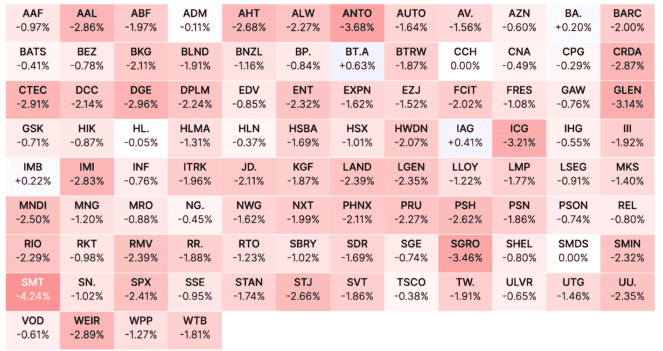
A quick look at the FTSE 100 this morning indicates share prices are heading lower across the board. And while there are a few outliers either side, the median stock seems to be down around 2%.

FTSE 100 heatmap 3 February 2025

Source: Hargreaves Lansdown

First things first – investors need to keep this one in context. For example, Diploma (LSE:DPLM) shares have fallen almost 3%, but they’re still trading above where they were a week ago. 

Sudden movements in stock prices can make ups and downs feel more dramatic than they are. When a stock climbs or falls steadily for five days, it can be hard to notice, compared to a similar-sized jump or fall in a day.

That’s not to say stocks can’t fall further from here. They absolutely can, but investors should be careful about overreacting to a decline that might feel bigger than it actually is.

What if it gets worse?

US tariffs are the reason share prices are falling this morning and I wouldn’t like to forecast what the outcome will be. It might cause inflation, currency fluctuations, neither, or both.

In these situations, I think the best thing to do is to hope for the best and plan for the worst. In terms of the stock market, that means focusing on shares in quality companies.

If things get worse, the best businesses are the ones that are the most likely to prove resilient. And if they get better, the strongest operations should be able to find ways to take advantage. 

With share prices falling across the board, I believe that focusing on whatever they think the highest quality companies are gives investors the best chance of doing well over the long term. That’s what I’m doing. 

Diploma

Diploma is a distributor of industrial components. The risk of sales faltering in a weak manufacturing environment is one to take seriously, but there’s a lot to like about the way the business is set up.

The company attempts to distinguish itself from other distribution businesses by adding value for customers. One of the ways it does this is by holding a huge inventory. 

This is convenient for customers, who know they won’t have to go looking around when they need something in a hurry. And the company’s scale means it can get parts delivered quickly and reliably.

As a result, Diploma is able to maintain strong margins while expanding further through acquisitions. This makes it a very difficult business to disrupt and one I think is worth paying attention to.

What to do?

Seeing shares selling off across the board can look like a huge buying opportunity. But rushing into buying stocks can be dangerous, especially when prices are still higher than they were a week ago.

Diploma is a great illustration of this. The falling share price makes me tempted to jump in, but I’m being careful to keep an eye on the bigger picture at the moment.

2 popular UK income stocks I wouldn’t touch with a bargepole right now

The FTSE 100 is packed full of top income stocks and I’m looking to add a couple more to my portfolio.

I’ve a spread of dividend shares, including Lloyds Banking Group, Legal & General Group and M&G. Clearly, I’m too heavily concentrated in the financial sector and need to spread my wings. So I decided to size up a couple of utilities instead.

United Utilities Group (LSE: UU) jumped out at me. As a regulated water utility company, United Utilities has predictable earnings due to consistent demand for water services. This should help fund a stable yet growing stream of second income.

Should I buy?

The stock currently yields a thirst-quenching 4.87%. Last Wednesday (29 January), the board announced plans to increase dividend payments in line with inflation over the next five years. That would give me a hedge against rising living costs. Any share price growth would be on top.

Regulator Ofwat approved the dividend hike but this actually triggered a credit rating downgrade by Moody’s to Baa2/Stable. This could raise borrowing costs.

That’s a worry given that United Utilities is investing £13bn between now and 2030 to clean rivers and upgrade infrastructure, in what CEO Louise Beardmore called “the largest investment in water and wastewater infrastructure in over 100 years”.

Privatised utilities are controversial right now. United Utilities has been attacked by clean water campaigners over sewage discharges into Windermere in the Lake District. It’s also drawn fire for hiking household bills 32% over five years starting April.

With the United Utilities share price down 4% over one year and flat over five, I can’t work up much enthusiasm. Especially given its price-to-earnings (P/E) valuation of more than 30. That’s double the FTSE 100 average. Time to deploy my bargepole.

It’s a while since I looked at renewables-focused power giant SSE (LSE: SSE). So is this more tempting? I remember when the stock routinely paid income of around 6% so was surprised to see the trailing yield down to 3.7%.

The SSE dividend was cut last year

Then I remembered SSE rebased its full-year dividend per share for 2023/24 to 60p last May. That was down from 96.7p the previous year, a 38% drop.

The board’s planning generous targeted increases of between 5% and 10% a year to 2026/27. It says this “aligns future dividends with SSE’s ambitious growth profile”, but I’m not sure that aligns with my own income needs. The SSE share price is down 3% over the last year. Over five, it’s up a modest 8%, plus dividends.

The rebasing was designed to keep shareholder payouts affordable while SSE pumps money into infrastructure. Its transmissions business now plans to spend almost £32bn by 2031 to connect offshore wind farms to the power grid.

On 20 January, Citi warned that SSE also needs to address its long-term funding structure and warned “the lack of immediate action given the pending change of management and ongoing RIIO ET3 review is unlikely to delivery this clarity”.

SSE doesn’t grab me either. Even though its shares look much better value than United Utilities, with a P/E of just over 10 times. Luckily, I’ve still got my bargepole handy.

£5,000 invested in Scottish Mortgage shares 6 months ago is now worth…

Scottish Mortgage Investment Trust (LSE:SMT) shares are a favourite with UK investors looking to gain exposure to the fast-moving technology sector. The trust’s shares are known to be fairly volatile — for a trust — but the long-term performance has been excellent.

So what’s happened over the past six months? Well, the FTSE 100 stock’s actually up 25.5%. This means £5,000 invested just six months ago would now be worth a little over £6,250. That’s a very good return for an investment trust.

What’s led the shares higher?

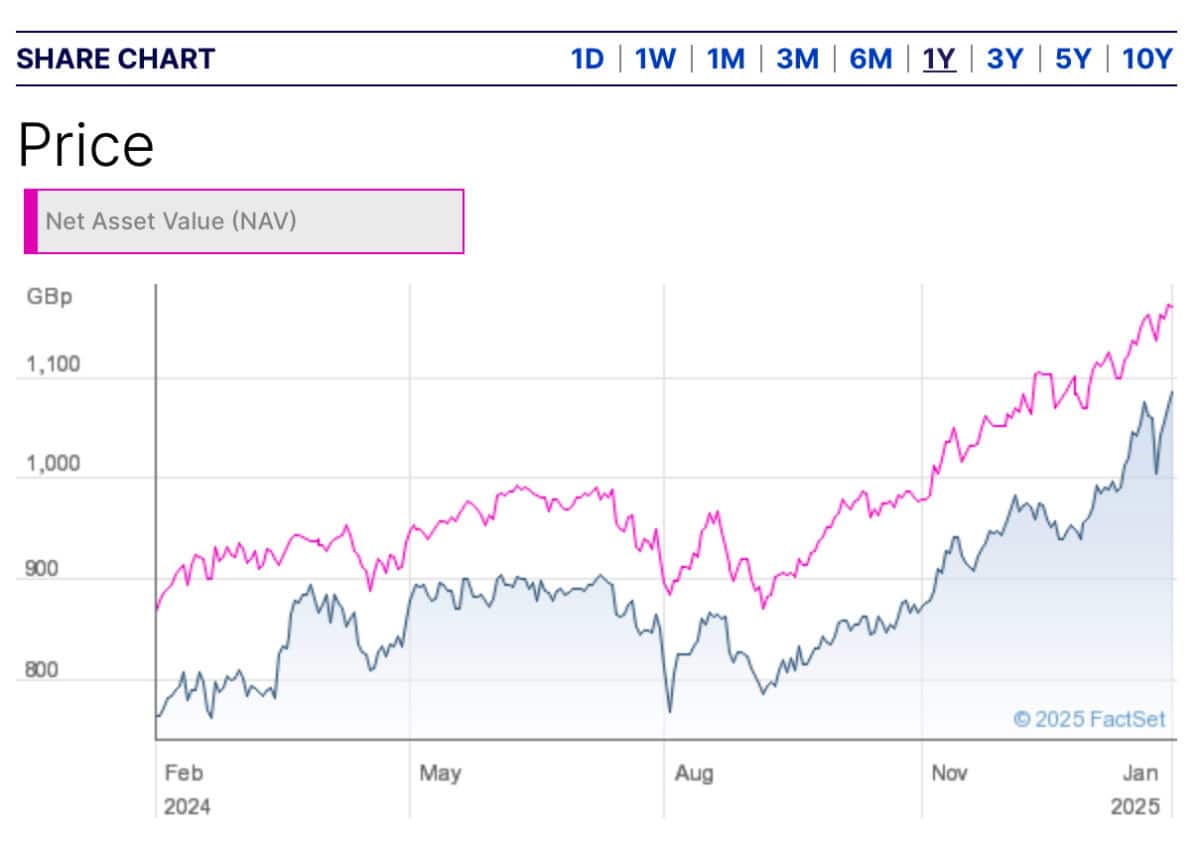
The Scottish Mortgage share price reflects the value of the company’s holdings — this is typically referred to as the net asset value (NAV). And as we can see from the below graph, Scottish Mortgage’s NAV has surged since August/September.

Source: Hargreaves Lansdown

This is likely driven by the broad appreciation of its holdings, but it’s possible to identify a few key drivers. One of which is likely to be SpaceX. The Elon Musk company now represents 7.5% of the Scottish Mortgage portfolio, and is the largest single holding. In June 2024, the privately-held space exploration business was valued at $240bn. In December 2024, that figure was reported to be $350bn.

While this is definitely not the only reason the NAV’s pushed higher, it’s certainly a strong contributing factor. Other major holdings including Meta and Tesla have performed well. As the graph shows, the share price — indicated by the blue line — has increased broadly in line with the NAV, while maintaining a discount to the NAV.

Overvalued or undervalued?

Of course, the fact that the shares trade at a discount to the NAV suggests that the stock is undervalued. However, it’s not quite so simple. The NAV reflects the market value of these stocks and unlisted companies. And investors may simply disagree with these valuations.

It’s certainly the case that some valuations within the tech sector are getting a bit frothy. Tesla, for example, is trading at 135 times forward earnings, and has a price-to-earnings-to-growth (PEG) ratio of 13.2. Obviously, some investors will point to Musk’s very long-term strategy in robotics and autonomy, but others won’t touch the stock with a bargepole.

I’m no different. I look through the portfolio and see stocks I think are overvalued, and some others undervalued.

It’s the track record

Despite holding Scottish Mortgage shares, I’ll admit that some of the valuations of the largest holdings aren’t attractive. I’d add that the presence of unlisted stocks also adds a degree of danger. However, the trust’s management has a great track record of picking the next big winners. While big tech will remain a large part of the portfolio, I’d expect to see some of the smaller holders drive the portfolio in the coming years.

Personally, I’ve continued to top up my holdings in Scottish Mortgage at regular intervals. I may consider buying more soon.

£2,000 invested in penny share Angle just 3 months ago would now be worth…

A penny share called Angle (LSE: AGL) has roared back to life at the bottom of my portfolio. I remember it did this at the same time last year, before slumping beneath a £50m market-cap. Must be a new-year optimism thing.

As I write, it’s priced at 16.4p, which is 111% higher than at the start of November. This means a plucky investor who put two grand into this penny stock back then would now be sitting on about £4,220. Nice.

Valued only in the hundreds of pounds though, my holding’s worth well below that. However, I won’t complain, and I’m optimistic the share price could head higher, over time.

What’s the angle?

This small cancer diagnostics company specialises in liquid biopsies — non-invasive blood tests that can detect cancer cells or tumour DNA. These can help doctors diagnose cancer, assess treatments, and monitor to see if the disease has returned. 

Angle’s pioneered the Parsortix liquid biopsy system. This device separates cells and captures circulating tumour cells (CTCs) from blood samples. It’s increasingly being seen as a game-changing technology in the emerging field of personalised cancer care.

There are a few interesting interesting things to note here. Firstly, the company’s CTC-harvesting technology’s patent-protected and already cleared by the FDA for use in breast cancer. So this de-risks the investment case with regard to the company’s core technology (it works).

In 2024, it signed two deals with AstraZeneca and one with Japanese pharma firm Eisai. This is to support clinical trials and cancer drug development.

Angle is also working on next-generation capabilities for an even more comprehensive view of cancer progression. On 29 January, it announced successful results from a new dual workflow, using biotech company Illumina‘s platform. Consequently, the DNA-sequencing giant has assigned its entire European Association for Cancer Research webinar on 6 February to Angle’s findings!

CEO Andrew Newland commented: “We see a substantial opportunity for both Angle and Illumina to work closely together.”

Finally, the global liquid biopsy market’s already large and growing. According to Fortune Business Insights, it’s projected to grow from $9.63bn in 2024 to around $58bn by 2032.

Risks galore

Now, there are also significant risks here. Although it expects 2024 revenue to have increased 31% year on year £2.9m, it’s also guiding for a loss of £14m (down from £20.1m in 2023).

And while the loss-making company holds £12.6m in cash, enough to last until 2026, another share offering remains possible. That would potentially dilute shareholders like myself.

Asymmetric investing opportunity

Still, I’m excited to see what the future brings as Angle pivots from selling instruments to providing services for blue-chip pharma companies like Astra.

According to current forecasts, revenue’s expected to grow 49% in 2025 to £4.3m, then 68% to £7.26m in 2026. However, if cancer trials using its technology advance to larger, late-stage studies, revenue could explode.

Indeed, Angle says that landing a single Phase 3 contract could immediately push the company into cash flow-positive territory.

My thinking here is that I can handle losing a few hundred quid if things turn pear-shaped. But if the firm’s technology’s successfully commercialised, the rewards are potentially very large for this penny stock.

Financial News

Daily News on Investing, Personal Finance, Markets, and more!

Financial News

Policy(Required)