£20,000 invested in Scottish Mortgage shares just 3 months ago would now be worth…

A chart showing Scottish Mortgage Investment Trust (LSE: SMT) shares between early 2020 and mid-2023 resembles a Himalayan mountain. There’s the tech-fuelled rise during the pandemic. Then the steep drop starting in late 2021 when rising inflation and interest rates came to the fore.

However, since bottoming out at 628p in May 2023, the stock has been on the up again. Now at 1,040p, it has real momentum, gaining 19.1% in just the past three months, far outpacing the FTSE 100‘s 5% rise.

This means a £20k investment made at the start of November would now be worth around £23,850 (including a small dividend paid in December). That’s a cracking return in such a short space of time.

Skin in the game

Despite the name, Scottish Mortgage has little to do with Bonnie Scotland or home loans. Its strategy is to invest in and hold the world’s most exciting and disruptive growth companies, wherever they are found, in both private and public markets.

Many of these businesses are founder-led (over 80% of the portfolio). As the trust points out: “Founder leadership isn’t a cure-all or a must-have, but it often indicates a company aligned with our long-term goals.”

According to a study by Bain & Company, founder-led S&P 500 companies between 1990 to 2014 delivered total shareholder returns more than three times higher than their non-founder-led counterparts. 

Why? One reason the trust says is that professional managers find it hard “to match that sense of priority and to make transformative decisions that push the whole organisation to change. Not least because their incentives are often a performance bonus tied to earnings.”

Scottish Mortgage’s long-term investing philosophy has been influenced by Amazon founder Jeff Bezos. In his quest to build the most customer-centric company on earth, he famously made counterintuitive decisions.

For example, he allowed negative customer reviews on Amazon’s platform. That was a pioneering move that would have got a traditional retail CEO fired. Negative reviews might harm sales, some investors wrote to Amazon.

When I read that letter, I thought, we don’t make money when we sell things. We make money when we help customers make purchase decisions.

Jeff Bezos

6 Scottish Mortgage holdings run by founders

Company Founder-CEO What it Does
SpaceX Elon Musk Space rockets and satellites
Meta Platforms Mark Zuckerberg Social media
Nvidia Jensen Huang Semiconductors and AI computing
Shopify Tobias Lütke E-commerce platform for businesses
Spotify Daniel Ek Music streaming platform
MercadoLibre Marcos Galperin E-commerce and financial services in Latin America

Trump’s tariffs

As far as I can tell, no FTSE 100 company beyond Pershing Square Holdings (run by Bill Ackman) is led by its founders today. Naturally then, the trust’s hunting ground for ideas is across the pond or in China.

Looking ahead, the threat of a global trade war triggered by Donald Trump’s tariffs is real. This could cause a spike in inflation, jeopardising the downwards trajectory of interest rates. The risk in this scenario is that it could make growth stocks less attractive to investors, impacting the value of Scottish Mortgage’s portfolio and creating heightened volatility.

Having said that, I don’t expect a repeat of 2022’s near-50% plunge any time soon. The portfolio looks robust, with more emphasis placed on firms generating positive earnings. Three of its most recent purchases — Meta, Taiwan Semiconductor Manufacturing (TSMC), and Nu Holdings — are all solidly profitable.

Meanwhile, there has been more disciplined profit-taking from stocks that have had amazing runs (Nvidia, for example).

I think the trust is worth considering for long-term investors.

£10,000 invested in Greggs shares 3 months ago is now worth…

I’m going to be honest. I’ve never understood the hype around Greggs (LSE:GRG) shares. Driven by sausage rolls and steak bakes, the company registered robust sales growth in recent years and appeared to benefit from the cost-of-living crisis as Britons enjoyed Greggs’ attractively-priced, high-calorie treats.

However, business is slowing and the share price has responded accordingly. The stock’s down 21% over three months. As such, a £10,000 investment three months ago would be worth £7,900 today. That’s a really poor outcome. In fact, the stock would need to surge 26.5% to get back to £10,000.

What went wrong?

Greggs stock fell despite it surpassing £2bn in annual sales for the first time in 2024, as investors reacted to a slowdown in like-for-like (LFL) sales growth during the fourth quarter. While total sales rose 11.3% for the year, LFL sales in company-managed shops grew by just 2.5% in Q4, down from 5.5% for the full year. This deceleration was attributed to weaker consumer confidence and reduced high street footfall amid a challenging economic environment.

Although Greggs opened a record 226 new shops and maintained confidence in its growth strategy, concerns about ongoing headwinds, including subdued spending and high street challenges, likely weighed on market sentiment. Investors may have been cautious about the company’s ability to sustain growth in the face of these pressures, despite its value-oriented positioning and expansion plans. This mix of positive long-term outlook and short-term challenges likely contributed to the stock’s decline.

No value in sausage rolls

I appreciate many investors won’t agree with me here, but I don’t attribute much value to a Greggs sausage roll. Here’s what I mean by that. As societies become wealthier — which hopefully we all will — I believe consumers tend to shift towards healthier, higher-quality food options. Moreover, there are some very low barriers to entry in baked goods. It’d be wrong to assume Greggs won’t go unchallenged in the sausage roll and baked goods market.

What’s more, despite its gimmicky sit-down restaurants, it’s unlikely to benefit from an improving restaurant scene. This doesn’t mean the business model doesn’t work — clearly it’s a leader in food-to-go. It simply highlights my concerns for the future. Ultimately, Greggs’ future success will likely depend on its ability to continue innovating and adapting to evolving consumer preferences while maintaining its value proposition in an increasingly competitive market.

There’s better value elsewhere

Greggs may offer excellent value on the high street, but I don’t see that on the stock market. I may be wrong though and it could go on to rebound as it’s a beloved brand.

The stock’s trading at 16 times forward earnings. This falls to 15.5 times for 2025, based on projected earnings, and 14.3 times for 2026. Coupled with a modest 3.1% dividend yield, I believe the value proposition’s fine, but it doesn’t whet my appetite.

Simply put, I’d rather consider other options on the FTSE 250.

Down 24% or more, I think these FTSE 250 shares could surge again in 2025!

The FTSE 250‘s risen 9% in value over the past year. But it’s not been good news for all of the index’s constituents. Even some top-quality mid-cap shares have slumped due to recent pressures.

These two UK shares have endured double-digit falls in the last 12 months. But the cream rises to the top, as they say. So I think they may rebound sharply, perhaps by the end of 2025, so could be worth considering before this happens.

Here’s why.

B&M European Value Retail

Down 34%, B&M European Value Retail‘s (LSE:BME) one of the FTSE 250’s biggest fallers over the past year. It actually started 2024 in the FTSE 100 before tumbling out of the blue-chip index just before Christmas.

This represents a solid dip-buying opportunity to me. With a forward price-to-earnings (P/E) ratio of 9.2 times, it trades at a healthy discount to the broader blue-chip index (14.5 times).

Investors were spooked by B&M’s lack of forward guidance in June’s full-year trading statement, and the company’s shares haven’t recovered since. Fears that falling inflation would draw shoppers away from low-cost retailers hasn’t helped the share price either.

However, a series of robust trading updates since then suggest investors are being too pessimistic. Latest financials (9 January) showed group revenues at constant currencies up 3.5% and 2.8% in the financial year-to-date and third quarter respectively.

Pleasingly, like-for-like sales at its core B&M UK business returned to growth in December. And the company said this positive momentum had continued at the start of 2025 too.

This is a retailer with significant growth potential, driven by an ambitious expansion programme (it’s on track to open 73 gross new stores this fiscal year alone). I think B&M’s share price could rebound as investors wise up to its value.

Safestore

Safestore (LSE:SAFE) — like many real estate investment trusts (REITs) — has plummeted over the past year. As I type, it’s down 24%, pressured by fears of sticky inflation and what this could mean for interest rates.

Please note that tax treatment depends on the individual circumstances of each client and may be subject to change in future. The content in this article is provided for information purposes only. It is not intended to be, neither does it constitute, any form of tax advice.

Higher rates mean greater borrowing costs, lower property values, and weaker demand for rental space. This toxic mix was evident in the firm’s latest financials (16 January), which showed like-for-like sales down 0.5% in the 12 months to October 2024, and borrowing costs up by almost a third.

That said, I think there’s good reason to believe Safestore shares could rebound soon. Interest rates are tipped to fall steadily in 2025, reflecting the broader direction of domestic inflation and the state of the UK economy. A resurgent housing market — which is crucial to the self-storage sector — also bodes well for the share price.

As a keen income investor, I’m considering adding the property giant to my own portfolio. Recent share price weakness has turbocharged Safestore’s dividend yield. At 5.1%, it comfortably outstrips the broader FTSE 250 average of 3.3%.

This adds extra appeal to what I already consider to be an attractive passive income share. Under REIT rules, the firm pays out at least 90% of rental earnings each year in the form of dividends.

Here’s what an investor needs in an ISA to earn £5,000 of passive income a month

A Stocks and Shares ISA is a powerful tool for building long-term wealth and generating passive income. With tax-free gains and dividends, it provides an efficient way to grow investments without losing returns to HMRC.

Over time, compound growth can significantly enhance wealth, making ISAs ideal for those seeking financial security. Whether investing in dividend stocks for passive income or growth shares for capital appreciation, the ISA’s tax advantages and flexibility make it an essential component of any UK investor’s portfolio. So, let’s put a figure on it. In order to receive around £5,000 in monthly passive income from an ISA, I believe an investor would need around £1.2m in the ISA pot.

Please note that tax treatment depends on the individual circumstances of each client and may be subject to change in future. The content in this article is provided for information purposes only. It is not intended to be, neither does it constitute, any form of tax advice. Readers are responsible for carrying out their own due diligence and for obtaining professional advice before making any investment decisions.

Here’s the formula

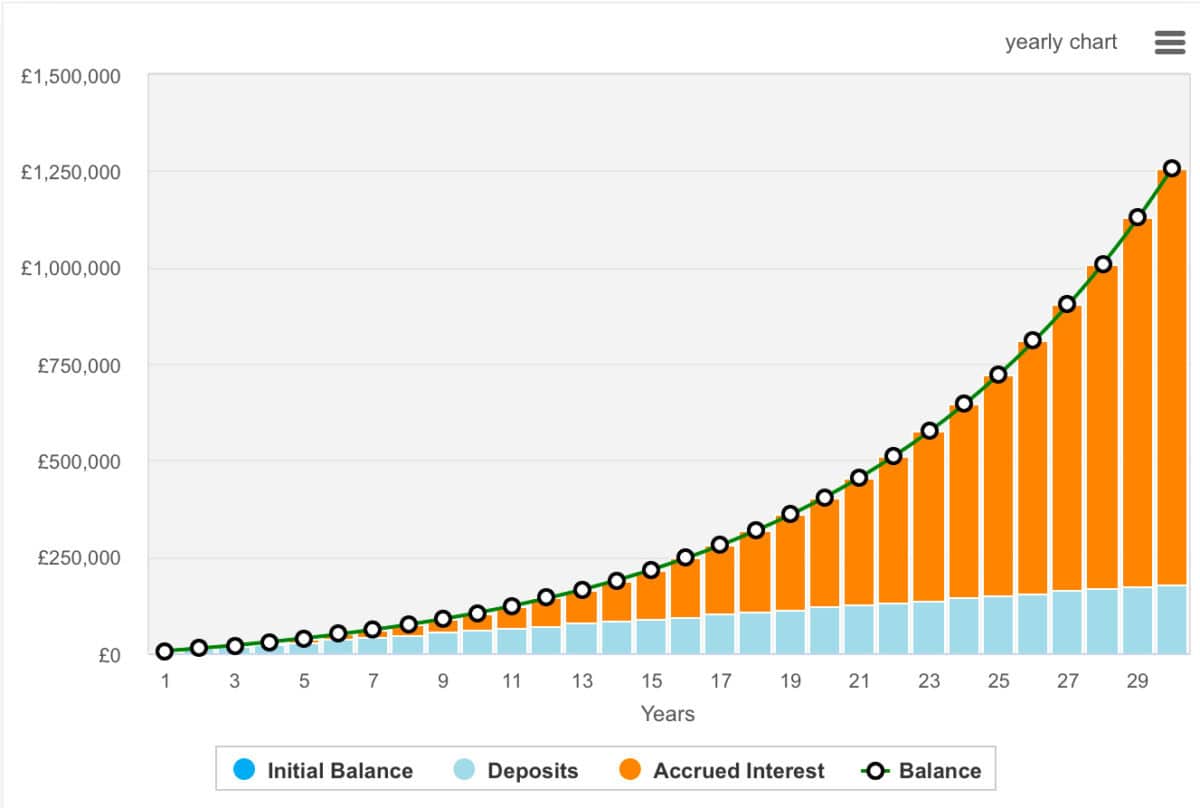
Building a £1.2m ISA pot from scratch takes time, patience, and regular investing. The key is consistency and the power of compound growth. With a fixed amount invested each month, returns start generating returns of their own, accelerating wealth accumulation. For instance, assuming a 7% annual return, investing £1,000 per month for 30 years could grow to around £1.2m. Increasing contributions or extending the timeline further boosts the chances of hitting the target. The earlier investing begins, the less heavy lifting is needed later to achieve financial independence.

Moreover, more successful investors can reach their targets faster and typically with less capital. For instance, £500 of monthly contributions for 30 years growing at a compound annual growth rate (CAGR) of 10.5% would also reach £1.2m.

Source: thecalculatorsite.com

Another important thing to note is the impact of compound interest. As the investment grows, the rate of growth appears to increase too. In the 30th year, the investment would grow by £124k versus £297 in the first year.

Finding diversity

As someone with a relatively mature portfolio, I prefer to pick my own stocks. I have around 25, meaning my portfolio is relatively diversified. But if I were starting afresh I’d look to achieve some diversification by investing in exchange-traded funds (ETFs) or trusts.

With that in mind, investors may want to consider The Monks Investment Trust (LSE:MNKS), which offers a compelling opportunity for long-term capital growth through its diverse global equity portfolio. The trust’s holdings include tech giants like Microsoft, Meta Platforms, and Amazon, alongside innovative companies such as Nvidia and Prosus. This mix of established and growth-oriented firms across various sectors provides a balanced approach to global investing.

With a significant portion invested in the US and smaller allocations in countries like the Netherlands, Japan, and China, Monks also offers broad geographical exposure. The trust’s relatively low ongoing charge of 0.44% makes it an attractive option for cost-conscious investors seeking actively managed global equities.

Moreover, its patient investment strategy, focusing on companies with enduring competitive advantages, aligns well with those looking for sustained value creation. The trust’s long-standing history since 1929 further underscores its resilience through various market cycles.

But while diverisification offers us protection against some risks, investors should note that some of its largest holdings, including Meta and Amazon, have fairly lofty valuations. This may put some investors off.

However, it’s a stock I’ve bought for my daughter’s SIPP.

Trump signs order establishing a sovereign wealth fund that he says could buy TikTok

  • President Donald Trump signed an executive order that outlines plans to for a government-run sovereign wealth fund to serve as an economic development tool and perhaps be used to buy TikTok.
  • Though the idea of such a U.S. fund has been brought up before, the vehicles are generally used by smaller nations with vast natural resources as well as fiscal surpluses to deploy.
US President Donald Trump speaks to reporters in the Oval Office of the White House on Feb. 3, 2025, in Washington, DC. 
Jim Watson | AFP | Getty Images

President Donald Trump on Monday signed an executive order that outlines plans to for a government-run sovereign wealth fund to serve as an economic development tool and perhaps be used to buy TikTok.

Among the aims for the fund would be developing infrastructure such as airports and highways, and it could help the U.S. extend its influence in areas such as Panama and Greenland.

“We’re going to stand this thing up within the next 12 months. We’re going to monetize the asset side of the U.S. balance sheet for the American people,” U.S. Treasury Secretary Scott Bessent said during a media parley. “There’ll be a combination of liquid assets, assets that we have in this country as we work to bring them out for the American people.”

There were no other details for a fund Trump said during his campaign could back “great national endeavors.” He has said tariffs could help provide funding. Other nations use taxes on natural resources, financial transactions carbon use as funding mechanisms.

A discussed deal in which the U.S. would become a partner in social media platform TikTok would be one potential use, Trump said. The app was taken offline briefly amid security concerns, but Trump signed an order allowing it back for a 75-day period during which it likely will have to divest itself of Chinese interests.

Though the idea of such a U.S. fund has been brought up before, the vehicles are generally used by smaller nations with vast natural resources as well as fiscal surpluses to deploy — unlike the U.S., which has been running massive budget deficits.

Nations with the funds include China, Norway and Singapore. A U.S. fund could help it compete with those countries and might make the government less dependent on issuing Treasury debt to raise money.

Norway has the largest sovereign wealth fund, with more than $1.7 trillion in assets, according to the Sovereign Wealth Fund Institute. The China Investment Corp follows with $1.3 trillion.

These funds are involved in global financial markets through investments in stocks, bonds and real estate, along with stakes in infrastructure and private equity. Critics say a lack of transparency can lead to conflicts and corruption if there are not strict governance rules.

Where could the Rolls-Royce share price go in the next 12 months — see the latest forecasts

The Rolls-Royce (LSE: RR) share price has been on an extraordinary run, doubling in the last 12 months and soaring 475% over two years. Investors who bought at the lows have seen staggering returns, but it can’t maintain this breakneck pace forever.

Rolls-Royce shares look expensive with a trailing price-to-earnings (P/E) ratio of 44 times. That’s well above the FTSE 100 average of 15 times. The danger is that stellar past performance blinds investors to future risks.

Can this FTSE 100 flyer keep going?

Analysts expect strong earnings growth to bring the P/E down to 28.6 times in full-year 2025, based on a consensus earnings per share (EPS) forecast of 21p. By 2027, EPS are forecast to hit 29.3p. That would reduce the forward P/E to around 20 times. So while the stock is pricey today, it could grow into its valuation if the company continues executing well.

But if it falls short? That will hurt. Transformative CEO Tufan Erginbilgiç has navigated the “burning platform” phase successfully, but must now ensure the company runs at full speed to keep investors happy.

Financial performance has been impressive. Half-year results for 2024 showed revenue rising from £7bn to £8.2bn. Underlying operating profit leapt from £670m to £1.15bn. Margins expanded from 9.7% to 14%.

Where will the stock go next?

Debt, once a major issue, is no longer a pressing concern. At the end of 2022, net debt stood at £3.3bn. At last count, it was down to just £820m. Free cash flow is expected to range from £2.1bn to £2.2bn for the full year, strengthening the company’s financial position. Dividends are back, though with a modest forecast yield of 1.1%.

The 15 analysts covering Rolls-Royce have a median 12-month price target of 640p. That’s a 9% increase from today’s 592p. Nobody is going to double their money this year, I’m afraid.

Predictions vary widely though. The highest estimate is 850p, a potential 44% gain. The lowest is 540p, implying a near 9% drop. As with any stock, it could go anywhere in the short run.

Analyst sentiment remains strong. Of 17 analysts, nine rate it as a Strong Buy, two as a Buy, four as a Hold, and only one recommends selling.

Rolls-Royce got another boost on 24 January, announcing the eight year £9bn Unity contract with the Ministry of Defence, designing and supporting nuclear reactors for the Royal Navy’s submarine fleet.

What could hold it back?

Despite these positives, risks remain. Any earnings disappointment could hit the share price hard. External threats, such as a global aerospace slowdown, technical issues with aircraft engines, or a return to inflation could squeeze performance. Geopolitical tensions, including a potential trade war under Donald Trump, add further uncertainty.

The company’s improving profitability, strong cash flows, and major defence wins suggest a bright future. Investors will get a clearer picture when Rolls-Royce publishes full-year results on 27 February.

I’d still buy Rolls-Royce, but only with a minimum five-year view, as things may get bumpier from here. Since I already own the stock, I’m holding.

Vanguard announces fee cuts for nearly 100 funds, including ETFs with billions of dollars in assets

  • Vanguard announced fee reductions for 168 mutual fund and exchange-traded share classes across 87 funds.
  • The move will save investors roughly $350 million this year.
  • The asset manager’s wide fee cut comes less than a month after Vanguard agreed to pay more than $100 million to the Securities and Exchange Commission over alleged violations involving its target date retirement funds.
Pavlo Gonchar | SOPA Images | Lightrocket | Getty Images

Asset management giant Vanguard announced broad fee cuts for many mutual funds and ETFs on Monday, reinforcing its standing as one of the cheapest options for investors.

The move reduces fees on 87 different funds, and 168 total share classes of those funds. The average fee cut is 20% per share class. Vanguard said this is its biggest fee cut ever and will save investors about $350 million this year, based on current asset levels.

“We’re proud to build on Vanguard’s legacy of lowering the costs of investing—which we have done more than 2,000 times since our founding—by announcing our largest ever set of expense ratio reductions. Lower costs enable investors to keep more of their returns, and those savings compound over time,” Vanguard CEO Salim Ramji said in a press release.

The list of cuts includes actively managed and index-based products, with many of the funds representing billions of dollars. Stocks, bonds and commodities products are all included in the reductions. Some of the funds on the Vanguard list include:

Fund fees for mutual funds and ETFs are assessed as an annual percentage of total assets under management for the share class.

The fee cuts to VEGBX and some other actively managed bond funds is notable because active fixed income is emerging as a growth area for the exchange traded fund industry. The booming popularity of ETFs, which can be purchased more easily than many mutual funds, is often cited as a key factor in driving down management fees for stock funds in recent decades.

Vanguard said its actively managed fixed income funds and ETFs have a weighted average expense ratio of 0.10% versus an industry average of 0.53%.

Vanguard has long been a leader in lowering fees among asset managers, a tradition dating back to its founder Jack Bogle. Monday’s announcement is a sign that the trend could continue under Ramji, who took over as CEO in 2024 and previously worked at rival BlackRock.

The fee cuts come less than a month after Vanguard agreed to pay more than $100 million to settle charges related to disclosures around some of its retirement products.

3 dividend stocks to consider buying for passive income as a trade war erupts

The market reaction to Donald Trump’s decision to impose tariffs on Canada, Mexico and China has been swift and unsurprising. Whether this marks the beginning of a sustained fall in global share prices or just a temporary wobble remains to be seen. But I can see a few dividend stocks UK investors might want to consider buying for passive income if the former proves to be the case.

Tesco

Supermarket giant Tesco (LSE: TSCO) looks attractive when it comes to generating extra cash. Its domestic market focus means it’s shielded, to some extent (but not completely), from the impact of international tariffs.

Based on analyst forecasts, Tesco stock changes hands at a forecast price-to-earnings (P/E) ratio of 13 for FY26 (beginning in March). That’s not cheap for a consumer defensive stock. But it’s still reasonable relative to the UK market as a whole. A near-4% dividend yield is also more than investors would receive from a fund that simply tracks the FTSE 100.

Sure, ongoing and intense competition means this will always be a low-margin business. Higher National Insurance Contributions and an increase to the Minimum Wage from April are additional headwinds.

Yet Tesco has not only managed to hold on to its crown but grow its market share in recent years. That speaks volumes. And regardless of what President Trump does next, we all still need to eat.

National Grid

Power-provider National Grid (LSE: NG) might be another option to consider. While it does have exposure to the US, its primary role is operating the UK’s electricity and gas transmission networks. Again, this is something we simply can’t do without and helps to explain why the shares are actually up today (3 February).

Of course, no investment is ever without risk. And existing holders of National Grid certainly didn’t react well to news last May that the company would be reducing its payouts to help fund its transition to renewable energy sources.

Still, the forecast yield for FY26 currently stands at 4.8%. And having already cut the payout once, I suspect management would be unwilling to do so again.

Debt is (very) high but the predictable nature of what the Grid does helps to soothe any concerns about this.

MONY Group

Price comparison website operator MONY Group (LSE: MONY) is a third stock worth pondering. As things stand, analysts have the FTSE 250 member down to yield a mighty 6.8% at the current share price.

Unfortunately, at least some of the latter is down to the poor performance of the shares. A good dollop of this can be blamed on “persistent soft market conditions” in its Home Services division. The surge in wholesale energy prices has meant a lack of competitive deals and fewer people switching providers.

Full-year numbers from the owner of Moneysupermarket.com are due on 17 February. I’m not expecting fireworks. But any slight improvement could make the valuation — just 11 times forecast FY25 earnings — look like a bargain.

Regardless of what happens, the underlying business has quality hallmarks. Thanks to its online-only nature, we’re talking sky-high margins and above-average returns on the cash management puts to work.

Could this be yet another UK company that gets snapped up on the cheap?

Steelmakers may benefit from Trump trade salvos, but Wall Street warns of longer-term headwinds

  • On Saturday, Trump slapped 25% tariffs on imports from Mexico and Canada and a 10% levy on those from China.
  • Although the tariffs on Mexico were delayed for a month early Monday, the levies are expected to make foreign steel more expensive in the United States.
  • U.S. companies hope the result will be a boost in U.S. production and an opportunity to raise prices.
Bundles of steel from Nucor Corporation sit for sale at Thompson Building Materials in Lomita, California, on Aug. 30, 2012.
Patrick Fallon | Bloomberg | Getty Images

U.S. steelmakers should be beneficiaries of President Donald Trump‘s new tariffs, but Wall Street warned that there are some risks in the longer term.

On Saturday, Trump slapped 25% tariffs on imports from Mexico and Canada and a 10% levy on those from China. On Monday, the U.S. agreed to pause tariffs on Mexico for one month in return for President Claudia Sheinbaum sending troops to northern border.

Those decisions the stock market’s early slide. The Dow Jones Industrial Average was recently lower by about 200 points after buckling 600 points as the trading day began.

Steel stocks waffled, after seeing some gains in the premarket. Nucor shares were up about 2% and U.S. Steel moved 1% higher in morning trading, while Steel Dynamics was lower.

Stock chart icon

hide content
Nucor shares over the past year.

The levies are expected to make foreign steel more expensive in the United States. Companies hope U.S. production will rise as a result, and give them an opportunity to raise prices.

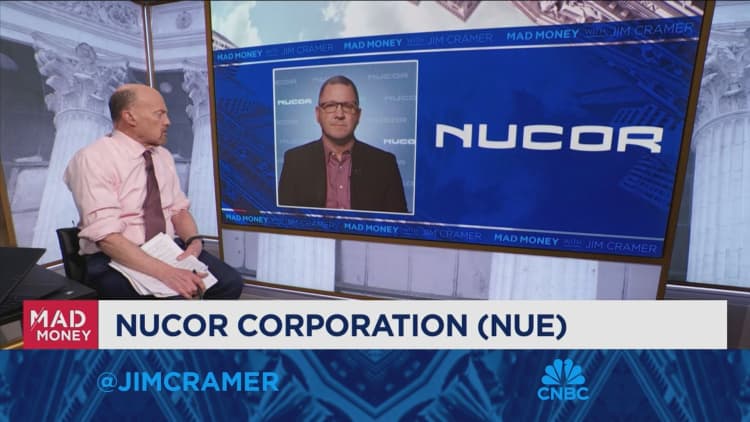
The industry has been battling cheap foreign imports for years, thanks to illegal dumping into the U.S. market, Nucor CEO Leon Topalian said in an interview with CNBC’s “Mad Money” last Tuesday. Dumping refers to when a foreign country exports products at a lower price than in its home market or below production costs.

“It’s the illegal dumping, the subsidization of steels and the currency manipulation that creates a very unbalanced and unlevel playing field that has hurt the steel industry for decades,” Topalian told Jim Cramer.

Canada is the top steel exporter into the U.S., while Mexico is the third-largest, according to the Census Bureau. The countries were initially targeted in the first Trump administration’s tariffs, but eventually reached a trade deal that included an exemption.

Morgan Stanley sees a direct impact on the pricing power for U.S. steel companies.

“We believe prices are beginning to recover after a challenging 2024, supported by protectionist trade measures,” analyst Carols De Alba wrote in a note Monday. “We project prices to improve further in 2026 as tariff implications flow through the U.S. economy.”

However, those price increases will be tempered by limited dampened demand. The Wall Street investment bank anticipates “modest” steel demand growth of 1.6%.

In addition, De Alba downgraded U.S. Steel, saying he no longer sees meaningful upside to his price target, assuming U.S. Steel remians independent and isn’t acquired. His target of $39 per share implies 6% upside from Friday’s close.

Stock chart icon

hide content
U.S. Steel

The planned acquisition of U.S. Steel by Japan’s Nippon Steel was blocked by the Biden administration in January. Nucor is now partnering with Cleveland-Cliffs in a potential bid for U.S. Steel, sources recently told CNBC’s David Faber.

Meanwhile, UBS also sees higher steel prices if the tariffs are imposed and kept.

“Trade disruption should drive prices higher in the near term and support U.S. steel equities, but low demand and capacity additions will offset these gains in major products in the medium term in our view,” analyst Andrew Jones wrote in a note Monday.

Bank of America Securities also highlighted future headwinds, despite the benefit the steelmakers will see from more expensive imports.

“Longer term, we see downside risk to the US steel stocks from the potential for materially reduced auto production, around 25% of U.S. steel demand,” analyst Lawson Winder wrote in a note Monday.

How much in a Stocks and Shares ISA could bring in £990 of passive income each month?

A Stocks and Shares ISA is a popular way to earn passive income in the UK. By taking advantage of the dividends paid by many British companies, investors can aim to build a second income stream. Furthermore, no tax is levied on gains from the annual £20,000 investment limit.

Please note that tax treatment depends on the individual circumstances of each client and may be subject to change in future. The content in this article is provided for information purposes only. It is not intended to be, neither does it constitute, any form of tax advice. Readers are responsible for carrying out their own due diligence and for obtaining professional advice before making any investment decisions.

There’s a wealth of information online to help investors choose the ideal Stocks and Shares ISA for them. After all, there’s no point earning passive income from dividends only to lose a lot of it to account fees.

Defining goals

It’s important to set realistic targets about how much can be invested and the expected return. The return depends on the average yield the ISA can achieve from the cash invested in it.

For example, a 5% yield on £100 invested would return £5. Initially, the amount may be small but over time, the miracle of compounding returns could grow the investment exponentially. Eventually, even a small yield could return a decent amount of passive income.

Yields don’t remain fixed. They move inversely to the company share price and can change at any time. So it’s best to choose companies with a track record of reliable and stable dividend payments. This makes calculations more accurate. Still, any future projections are only rough estimates.

A share to consider

For example, British American Tobacco (LSE: BATS) currently has a 7.5% yield. It’s been paying an increasing dividend for 20 consecutive years, so its track record is good.

Tobacco stocks have lost popularity lately due to ethical concerns about smoking. Fortunately, the company aims to become predominantly smokeless within the next decade.

New legislation to limit smoking has also hurt the company’s profits and the transition to less harmful products is expensive. This is an ongoing risk the company must navigate if it hopes to remain profitable.

The share price is down 7.3% over five years but recovered 34% in the past year. 

This is likely due to positive results in the first half of 2024, with revenue at £12.34bn and earnings of £4.47bn. Analysts expect earnings to grow a further 17% in the next H2 2024 results.

It’s just one of many high-yield dividend shares investors may consider on the UK stock market.

Building up an investment

A portfolio of 10 shares with stable yields between 5% and 9% could achieve an average yield of 7%. It’s also important to include the price growth as this will compound the investment further. The FTSE 100 average is around 5%.

To earn £11,880 a year in dividends (990 x 12) using the above averages, an investor would need around £738,270 invested. That’s way over the £20k annual ISA limit so it’ll need to be built up over a long period.

For example, by starting with a £20k lump sum and contributing £320 a month, the pot could grow to around £738,270 in 30 years (with dividends reinvested). Investors could also withdraw cash from the pot to increase their income. However, this would reduce the annual dividend over time.

Financial News

Daily News on Investing, Personal Finance, Markets, and more!

Financial News

Policy(Required)