Up 10% today, I think this FTSE 250 growth share could continue to surge!

I’ve long argued that Babcock International (LSE:BAB) shares have been unjustly overlooked as investors have piled into industry peers like BAE Systems. But the FTSE 250 share is having its moment in the sun today (6 February) after releasing another robust market update.

At 500p per share, Babcock’s share price is currently up 10.4% in Thursday trading. It’s been driven by a strong Q3 statement and upgrades to earnings forecasts.

And I believe the defence giant has much further to go. Here’s why.

Forecasts bumped up

Babcock provides support, engineering and training services to armed forces chiefly in the UK, Australia and South Africa.

It also provides services for the civil market. That includes building nuclear power plants and cargo handling systems for commercial shipyards and shipowners.

Right now, it’s on a roll across both sides of the business.

On Thursday, it said a strong H1 “continued throughout the third quarter of the year,” adding that “the preliminary view of performance in the month of January is also encouraging.”

A majority of revenue for the financial year (to March 2025) is under contract. And having reviewed its delivery forecasts, it “expects both revenue and underlying operating profit to exceed the top end of the range of analyst expectations.”

Full-year sales of £4.9bn are expected. Underlying operating profit is tipped at the higher end of between £327.1m and £339.7m.

Civil and defence strength

Babcock’s recent success is thanks chiefly to strong trading at its Nuclear and Marine divisions.

At Nuclear, it said “growth is driven by increased newbuild and decommissioning work in civil nuclear, as well as increased submarine support activity and higher than originally expected infrastructure revenues.”

Marine growth is being boosted by “higher LGE [liquified gas equipment] volumes as well as the ramp-up of the Skynet programme.” It took over the operations and management of Skynet — the UK’s military satellite communications system — last March.

Robust outlook

Today’s update underlines the benefits of Babcock’s wide range of services and its excellent record of execution. As well as reducing reliance on one sector, its presence in civil and defence markets provides the firm with exceptional growth opportunities.

It’s benefitting from soaring arms spending across the globe. This is a trend that looks set to continue as the geopolitical landscape becomes more fractured and new dangers arise.

Roughly three-quarters of its portfolio is geared towards defence applications. Meanwhile on the civil side, I’m expecting strong demand for its nuclear services to continue as the UK switches away from fossil fuels.

City analysts are confident too. They think the company will follow a 42% earnings rise this financial year with increases of 13% and 10% in fiscal 2026 and 2027, respectively.

After recent momentum, I wouldn’t be surprised to see these short-to-medium term forecasts upgraded either.

A FTSE 250 bargain

Despite today’s rise, Babcock shares still look dirt cheap on paper. A sub-1 price-to-earnings growth (PEG) ratio of 0.4 leaves plenty more scope in my opinion for more share price gains.

Risks here include supply chain problems across the defence sector and intense market competition. But on balance, I think it looks in great shape to keep rising. So I believe it’s worth serious consideration from savvy share investors.


The AstraZeneca share price jumps 5% on today’s strong results – but is it too expensive?

It’s a good day for the AstraZeneca (LSE: AZN) share price, up 5% on 6 February as investors give the thumbs up to its full-year 2024 results. 

The UK’s largest company continues to demonstrate resilience and growth under CEO Pascal Soriot. Yet when looking to add a pharmaceutical stock to my portfolio last year, I chose underpowered FTSE 100 rival GSK. That may seem odd, given that it’s played second fiddle for years.

But I thought AstraZeneca was too expensive, while GSK looked better value. So what do I think today?

This stock has done the FTSE 100 proud

So far, it’s been a losing bet. AstraZeneca is up 7% over the last 12 months, GSK is down 15%.

Yesterday (5 February) GSK’s shares jumped 7.5% on positive results but AstraZeneca isn’t taking that lying down. This morning (6 February), it reported a 38% jump in pre-tax profits to $8.69bn at constant exchange rates (26% actual).

Soriot was happy, hailing “a very strong performance in 2024 with total revenue and core earnings per share (EPS) up 21% and 19%, respectively”. Sales of cancer, lung and immunology treatments were notably healthy.

He promised more to come as AstraZeneca embarks on “an unprecedented, catalyst-rich period for our company, an important step on our Ambition 2030 journey to deliver $80bn total revenue by the end of the decade”.

The all-important drugs pipeline remains robust. AstraZeneca completed nine positive first Phase III studies in 2024 and anticipates another seven this year.

Soriot can’t afford any slips. The shares now trade on a staggering trailing price-to-earnings ratio of 65. That’s way above the FTSE 100 average of just 15 times. GSK is at a lowly nine times,

To hit that Ambition 2030 target, Soriot must increase revenues from $54.1bn in 2024 to $80bn. By my calculations, that’s a compound increase of almost 7% a year. 

That looks eminently doable given 2024’s huge 21% increase, but AstraZeneca won’t continue rattling along at that speed. It forecasts sales growth will slow this year, to a high single-digit percentage.

Strong growth but low income

It also faces issues in China. Last October, the president of Astra’s Chinese business and other senior executives were held over suspected unpaid importation taxes of $900m. It could be fined up to five times that if found liable.

The news knocked the group’s market cap from £200bn towards £170bn. It’s now crept back up to £181bn. October was a good time to buy.

Net debt rose in 2024, from $22.5bn to $24.6bn, as the group poured money into R&D. It still generated enough cash to lift the dividend, but the 2.2% forecast yield isn’t exactly stellar.

Another concern is that AstraZeneca generates 44% of its sales in the US, and could be hit by Donald Trump’s trade wars, or the anti-big pharma stance by Trump’s health secretary Robert F Kennedy.

The healthcare sector undoubtedly offers a massive opportunity as the world gets older and sicker, and medicine more marvellous.

Richard Hunter, head of markets at Interactive Investor, says AstraZeneca remains the “preferred play in the sector, given its prospects for the foreseeable future”.

GSK has got a lots of catching up to do, but given lower expectations and lower valuation (and higher 3.9% yield), it’s still the one I’m holding on to.

Is this my chance to buy Alphabet shares?

Plans to invest $75bn into artificial intelligence (AI) mean suddenly fewer people seem to want to buy shares in Alphabet (NASDAQ:GOOG). So is this a big problem or an opportunity?

The stock has fallen 7% since the company released its earnings report for the last three months of 2024. But things might not be as bad as they look. 

The cloud

One thing analysts are pointing to as a source of disappointment is the sales growth coming from Google Cloud, which came in at 30%. By itself, that doesn’t look too bad. 

On closer inspection however, the growth rate is lower than it was in the previous quarter, when sales were up 35% from the previous year. So maybe there’s justification for disappointment. 

Despite this, 30% growth is the division’s second best quarterly result in the last 10 quarters. And it’s roughly in line with what Microsoft reported last week from Azure. 

Both companies reported being constrained by their data centre capacity. Which brings us to the main event…

AI

Alphabet’s move to ramp up its spending also seems to have come as a surprise. But it’s hard to see why – it’s not as though the company is the only one doing this. 

Both Meta ($65bn) and Microsoft ($80bn) have announced plans to increase their AI capital expenditures significantly in the year ahead. So Alphabet is by no means an outlier. 

As Warren Buffett says though, the fact that everyone else is doing something isn’t by itself a reason to do it as well. And there are clear risks involved with investing heavily in AI. 

In 2024, Alphabet’s operating cash flow was around $125bn. So a move to deploy 60% of this into AI – mostly in infrastructure – is a significant outlay that really needs to work out.  

Timing

It’s especially bold given the current view of AI models. Analysts are wondering whether products like Google’s Gemini are ultimately set to become mere commodities with no competitive advantage. 

If they are, then a $75bn investment looks like a questionable idea. But CEO Sundar Pichai is sticking to what seems to be the prevailing view among US big tech executives.

The idea is that declining costs should lead to greater usage, resulting in higher demand for computing power. And this means big investments AI infrastructure will ultimately pay off.

Over at Microsoft, Satya Nadella has a similar view. If this is right, then the chance to invest $75bn and earn a decent return on it is a huge opportunity for Alphabet.

A buying opportunity?

Alphabet shares trade at a price-to-earnings (P/E) ratio of 25 – lower than Microsoft (33) or Meta (29). But the company has the AI spending power to match its rivals. 

Despite this, the stock comes with risks beyond its spending. The ongoing battle with the Department of Justice is a threat to take seriously – whether investors want to or not.

To my mind, there are currently more obvious opportunities in stocks that have fewer analysts looking at them. So I’ll keep watching Alphabet shares, but I’m not making a move right now.

£10k in savings? Here’s how an investor could aim for a monthly second income of £1,200

A second income is a common goal, providing financial security and the ability to relax once retired. It’s an opportunity to pursue long-forgotten hobbies, travel to dream destinations and spend time with loved ones.

There are many ways to earn extra income, some more passively than others. One of the most popular methods is investing in dividend shares. These shares pay a percentage of company profits to shareholders regularly. 

The percentage of the share price paid out is called the yield. By calculating an average yield, an investor can figure out how much capital’s needed.

An example

If the average yield of a 10-stock portfolio is 8%, then £10,000 will return £800. So to bring in £1,200 a month, what percentage is that? Since the yield’s represented annually it needs to be multiplied by 12 first, to get £14,400. That would be 8% of £180,000.

Ooof, that’s a lot!

Not many people have that kind of cash lying around. Fortunately, through the miracle of compounding returns, it’s possible to build that amount. How long it takes is unique to each investor. Naturally, starting sooner’s better and the more invested, the quicker it compounds.

Picking the right stocks is also key. A well-diversified portfolio might include a mix of growth and dividend shares from Europe and the US. A savvy investor may be able to secure a portfolio with an average return of 10%, combining dividends and growth.

With £10,000 invested in that portfolio, it would take around 29 years to reach £180,000. By contributing an additional £200 a month, it could shave the time down to around 18 years!

This would also require using a dividend reinvestment plan (DRIP) to accelerate the growth. Depending on market conditions, it could take more or less time.

A diversified portfolio

The average annual price return of the FTSE 100 has been 6.8% since 1984. US indexes like the S&P 500 have done better, with an average of 11.65%. A mix of stocks is a good way to achieve both growth and stability.

Some examples of high-growth US stocks include Shopify, PayPal and Nvidia. In the UK, popular dividend stocks include Tesco, Legal & General and Vodafone (LSE: VOD).

Vodafone’s been struggling for years, with the stock down 56% since 2020. Even though revenue and adjusted earnings grew 5% and 2.2% respectively, regulatory changes led to a drop in revenue in Germany. 

With debt already high, any risk of further losses could force it to cut dividends – again! The 8.4% yield looks very attractive but last year’s dividend cut shook investor confidence.

In an attempt to reverse its fortunes and revamp the company, Vodafone made two key business decisions last year: the sale of its Italian division and a merger with fellow UK telecoms firm Three. The proceeds from the Italian sale have helped fund a €2bn share buyback programme, reconfirming its commitment to shareholders. 

If things come together, it could make a solid recovery. With a high yield and low price-to-earnings (P/E) ratio (8.5), I think it’s an undervalued stock worth considering for passive income.

2 cheap shares to consider buying in a £20k ISA for income of £1,000 a year

Buying cheap shares rather than expensive ones isn’t a foolproof strategy. Sometimes stocks are cheap for a jolly good reason. And they may remain cheap, for years. Or even get cheaper, as performance flounders and investors give up.

Yet I don’t think that applies to the following two FTSE 100 companies. Both look good value to me. They also offer reliable-looking dividend yields of more than 5%.

An investor who divided this year’s £20,000 Stocks and Shares ISA contribution limit equally between these two could secure income of more than £1,000 a year. And there’s a fair chance that will rise over time.

HSBC offers dividends and growth

Asia-focused bank HSBC (LSE: HSBA) has a trailing dividend yield of around 5.9% a year. It looks attractively valued too, with a price-to-earnings (P/E) ratio of just under nine. 

I’m surprised by that low P/E, given how well the shares have done. HSBC’s share price has climbed by 33% over the last year. Over five, it’s up 45%. 

The board’s also been proactive in returning capital to shareholders through share buybacks, spending a thumping $3bn a quarter.

In its Q3 results for 2024, HSBC reported a profit before tax of $8.5bn, up from $7.7bn the previous year. Revenue also increased from $16.2bn to $17bn.

Yet the board isn’t resting on its laurels. It’s now winding down its investment banking arm as CEO Michael Roberts shifts to a “more competitive, scalable, financing-led model”. It will also have a tight Asia focus.

HSBC faces being the meat in a superpower sandwich, as the US and China face off. It’s clearly chosen its side. That’s not the only risk. If interest rates fall, that could squeeze net interest margins. The transitional process brings execution risks.

Greater exposure to China isn’t a one-way bet either, given the country’s property crisis. Donald Trump’s trade war won’t help. Yet I still think HSBC is well worth considering both for income and growth, with a long-term view.

Investing £10k in HSBC shares at the current yield would provide an annual income of £590.

My second income growth pick, cigarette maker Imperial Brands (LSE: IMB), boasts a trailing yield of about 5.5%. So £10k in that would deliver income of £550. That’s total income of £1,140, which I’d expect to rise over time as profits grow (no guarantees though).

Imperial Brands has rocketed this year

Imperial Brands also looks good value, with a P/E ratio of around 9.3. That’s despite the company’s share price surging 47% over 12 months, although it was volatile before that. Investors can’t expect the share price to simply plough on.

In its full-year results for 2024, Imperial Brands reported a 4.5% increase in operating profit to £3.55bn. That was despite a slight decline in total revenue. 

Net revenue from next-generation products, including tobacco alternatives like vapes, grew by 26%. They now account for 8% of total revenue.

Cigarette stocks are inherently risky. Basically, companies are pushing a product that kills. They face constant regulatory pushback. Rising revenues from smokeless alternatives could trigger stiffer rules.

No investment is without risks. These two certainly aren’t. But their high income and growth prospects make both well worth considering. But only with a minimum five-year view. And ideally a lot longer than that.

Is it worth me buying Lloyds shares for 61p after a 49% rise?

With Lloyds (LSE: LLOY) shares having risen, I wanted to find out whether there is any value left in them. And the first part of my price evaluation was to compare Lloyds’ key valuations with its peers.

The ‘Big Four’ UK bank trades at 8.3 on the price-to-earnings ratio bang in line with the 8.3 average of its competitors, but higher than three of them. These comprise NatWest at 7.7, Standard Chartered at 7.9, HSBC at 8, and Barclays skewing the number at 9.8. 

So, Lloyds looks slightly overvalued on this basis.

It appears fairly valued on the 0.8 price-to-book ratio – the same as its competitors’ average.

And it seems slightly undervalued on a price-to-sales ratio of 2, against a peer average of 2.3.

Now for an assessment accounting for future cash flow forecasts. This is the acid test in my experience as a former investment banker and private investor for 35 years.

A discounted cash flow analysis shows Lloyds shares are still 53% undervalued. This is despite their sizeable price rise from their 13 February 12-month traded low of 41p.

Therefore, a fair value is technically £1.30, although they may go higher, or never reach that level.

Does the business support a bullish view?

I think a principal risk for Lloyds is declining UK interest rates if inflation continues to fall. This could dent its net interest income (NII), which is the difference between interest received on loans and paid on deposits.

Indeed, over the first nine months of 2024, underlying NII fell 8% year on year to £9.6bn. Underlying profit declined 12% to £5.4bn.

Q3 2024 was a little better, with underlying NII falling 6% and underlying profit dropping 8%.

That said, Lloyds showed a statutory profit before tax of £1.823bn. This outstripped market expectations of £1.6bn, although it was 2% lower than Q3 2023.

Will I buy?

It is crucial in stock picking to appreciate where one is in the investment cycle, in my experience.

Basically, the younger an investor is, the more time a chosen share has to recover from any pricing shocks. Consequently, younger investors can afford to take greater risks on a stock than older ones.

I am aged over 50 now, which means two things for me. First, I have reduced my risk tolerance for new stocks and I have sold stocks that were at the higher end of the risk curve.

Second, I am focused on shares that generate a high dividend income. This should allow me to continue to reduce my weekly working commitments.

Lloyds shares are still priced under £1, which means every penny represents 1.6% of the stock’s entire value. This is way too high a pricing volatility risk for me to accept.

And on the dividend income front, the stock only pays 4.5%. This is way off the 7%+ annual return I demand from my high-yield picks.

Consequently, it is not worth me buying Lloyds shares right now.

That said, if I were younger I would consider them, based on their undervaluation and forecast rising dividends.

In this latter regard, analysts forecast Lloyds’ dividends will increase to 3.29p in 2025, 3.8p in 2026, and 4.76p in 2027. This would give respective yields on the current share price of 5.3%, 6.2%, and 7.7%.

I think this FTSE 100 fashion stock could skyrocket in 2025

Not everyone on the FTSE 100  was popping champagne when it hit a new all-time high of 8679 points last Friday (31 January 2025).

Major fashion retailer JD Sports (LSE: JD.) had little to celebrate. Its share price is down 50% over the past five years. Despite several attempts to relive previous highs, the stock continues to struggle. 

Now at only 83p per share, it’s a far cry from the dizzying all-time high of 233p achieved in November 2021.

The most recent collapse mirrors that of 2022. By late October that year, shareholders were staring in disbelief at a stock down 60%. Three months later, those who bought the dip were celebrating 98% gains.

So why does the stock experience such mind-bending volatility? And is there an opportunity in it for investors?

Slow and steady wins the race

If JD Sports were a marathon runner, it would be an abject failure. It seems to have no ability to maintain a slow and steady pace, stopping and starting more frequently than my first car. The reasons for this are three-fold: a slew of executive changes, constant supply chain disruptions, and a large dollop of stubborn inflation.

When a £4.7m regulatory fine led to the departure of long-time CEO Peter Cowgill in 2022, the issues had already begun. A moderate recovery hit a wall in 2023 when high inflation – compounded by supply chain issues – sent the shares tumbling again. 

The ongoing fallout from this triple threat has built up over the years, punctuated by two profit warnings issued since November 2024.

Back on track

Through it all, JD Sports has continued to perform well, with earnings beating expectations four years in a row. It also completed the recent acquisition of Hibbett in the US, boosting its international credentials. 

Consequently, the disparity between price and performance has given the stock an attractive valuation. Sales are more than double the stock’s value and the price is only 8.6 times forward earnings. That’s well above average on both counts.

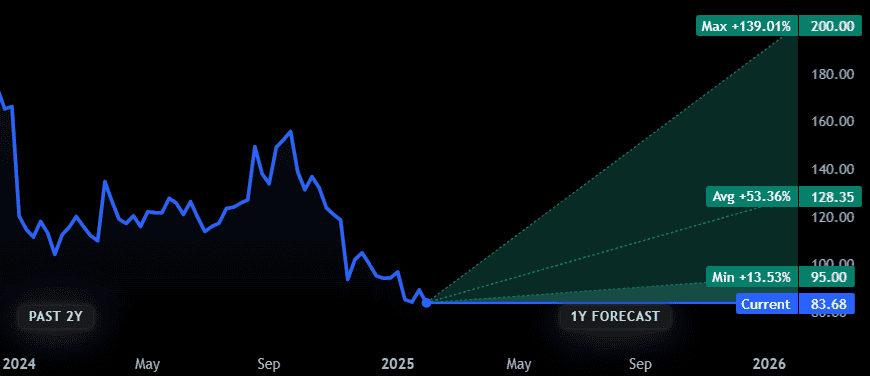
The majority of analysts are bullish about the stock, with an average 12-month target 53% higher than today’s price. Even the most bearish analysts expect a 13% rise, while the highest forecast expects a huge 139% gain. While it’s true that broker forecasts are overwhelmingly positive, seldom are they that good. 

Screenshot from TradingView.com

So what makes them so confident?

Good stock, bad situation

Inflation, while still stubborn, has been tipped to drop this year if the Bank of England cuts interest rates. And with tensions in the Middle East subsiding, the Red Sea supply chain issues are improving and may continue to do so. 

These developments are likely the core reasons for the hopeful sentiment. 

Of course, it would be unrealistic to suggest the risks are entirely overcome. Trump’s trade war has become a key issue that could send markets into turmoil this year. And supply chain issues remain an ever-present threat that could re-emerge.

In its simplest form, JD’s situation amounts to a company that’s performing well but has been beaten down by external issues. Remove the problems and what’s left is a quality stock at a low price. That’s why I think it’s a heavily undervalued stock that’s worth considering in 2025.

Down 13%, this FTSE gem delivers a 9.4% yield and looks 57% undervalued to me!

Shares in investment manager M&G (LSE: MNG) generate one of the highest yields in any FTSE index – currently 9.4%. And they are down 13% from their 21 March 12-month traded high of £2.41.

Such a drop flags a potential bargain-basement buying opportunity for me to add to my existing stake in the firm. This would allow me to lower the average price of that holding.  And a bigger stake would significantly increase the dividend income I could make from the shares.

Alternatively, the share price fall might indicate the company is fundamentally worth less than it was before.

Either way, some action on my holding is required so I ran the numbers to find out what that should be.

How does the core business look?

Earnings growth is essentially what drives a firm’s share price and dividend over time.

A risk to M&G’s is a resurgence in the cost-of-living crisis if inflation significantly picks up. This could cause customers to cut back on expenses, including policies with the firm.

That said, analysts forecast that M&G’s earnings will increase every year by a stunning 26.7% to end-2027.

Its full-year 2023 results saw adjusted operating profit before tax soar 28% year on year to £797m. Operating capital generation jumped 21% to £996m, giving a total of £1.8bn over this and the previous year. Such funds can be a powerful engine for growth.

So are the shares undervalued?

The first part of my stock price assessment process involves comparing a share’s key valuations with its competitors.

M&G trades at a price-to-book ratio of just 1.3 – bottom of its peers, which average 3.7. The group comprises Man Group at 1.9, Intermediate Capital Group at 2.9, Legal & General at 3.5, and Hargreaves Lansdown at 6.4.

So, it looks very undervalued on this basis. And the same is true of its 0.8 price-to-sales ratio compared to its competitor average of 4.4.

However, on the price-to-earnings ratio it looks overvalued at 29.3 against a peer average of 23.1.

For further clarity on the valuation, I ran a discounted cash flow analysis – the second part of my assessment process. This evaluates the price at which a stock should be trading, based on future cash flow forecasts.

In M&G’s case, it shows the shares are 57% undervalued at their present price of £2.09. So their fair value is technically £4.86.

Market forces may push them lower or higher than that, of course. But it confirms to me how extremely undervalued the stock looks right now.

What about the dividend income?

Investors considering a £10,000 holding in M&G could make £15,506 in dividend income after 10 years. And after 30 years this could rise to £155,935.

Adding in the initial £10,000 would give a total value of the M&G holding of £165,935. On the same 9.4% yield, this would generate £15,598 a year in dividend income.

The figures are based on the dividends being compounded and on an average yield of 9.4%.

Yields can move down and up, depending on share price and annual dividends paid. But for M&G analysts forecast its yield will increase to 10% in 2025, 10.3% in 2026, and 11% in 2027.

Given its strong earnings growth potential, extreme undervaluation and huge yield, I will be buying more of the shares very soon.

At £26.46 Shell’s share price is down 10% from its 12-month traded high, so should I buy more now?

When Wael Sawan became CEO of Shell (LSE: SHEL) in January 2023, he highlighted how its share price had suffered compared to its fossil-fuel-focused competitors.

Shortly after, the oil and gas giant adopted a more pragmatic approach to its previously uncompromising energy transition strategy.

It reduced its net carbon cut by 2030 from a minimum 20% to 15% compared to 2016 levels. Additionally, it scrapped its 45% net carbon reduction target for 2035, while remaining committed to a 100% reduction by 2050.

However, it pledged to keep oil production at 1.4m bpd until 2030. And it promised to expand its liquefied natural gas (LNG) gas business based on forecasts that demand will increase 50%+ by 2040.

Shell already has major LNG projects in 10 countries. And it has access to around 38m tonnes of its own LNG capacity from 11 liquefaction plants.

That said, a major valuation gap with its key US and Saudi Arabian fossil-fuel-focused peers persists.

How undervalued are the shares?

On the price-to-earnings ratio Shell trades at just 12.6. This is bottom of its group of competitors, comprising ConocoPhillips at 13.1, ExxonMobil at 14.2, Chevron at 15.6, and Saudi Aramco at 16.3.

So, Shell looks very undervalued on this basis.

The same is true on the two other ratios I most rely on – price-to-book and price-to-sales. On the former, Shell is at 1.1 against a 2.7 peer average. And on the latter it is at 0.7 compared to an average of 2.2 for its competitors.

To translate these undervaluations into share price terms, I ran a discounted cash flow analysis using other analysts’ figures and my own.

This shows Shell shares are 42% undervalued at their current £26.46 price. So the fair value for them is technically £45.62.

They may go lower or higher, depending on market vagaries. But it underlines to me how cheap they may be right now.

Potential catalysts for an upward revaluation?

Shell has focused on expanding its fossil fuel production in recent months to try to close this valuation gap.

Most recently, 9 January saw it begin oil production at its Gulf of Mexico ‘Whale’ facility. This has estimated recoverable reserves of 480m barrels of oil equivalent (boe). Forecast peak production is 100,000 boe per day (boe/d).

January also saw CEO Sawan meet with Iraq’s Prime Minister Mohammed al-Sudani to underline Shell’s readiness to increase its investments in the country. Along with Saudi Arabia and Iran, Iraq has the cheapest oil in the world to produce at just $1-$2 per barrel.

On 15 December, Shell additionally agreed to begin production at the giant Bonga North deep-water project off the coast of Nigeria. It has estimated recoverable reserves of 300m+ boe and will reach peak production of 110,000 boe/d.

Will I buy more shares now?

A risk for the stock is that oil and gas prices switch into a long-term bearish trend. That said, analysts forecast its earnings will grow 7.4% each year to end-2027. And it is these that ultimately drive a firm’s share price higher.

Consequently, I will be adding to my existing Shell holding very soon.

I’ve got a queasy feeling about the Diageo share price

Usually I take it on the chin when one of my portfolio holdings takes a hit, but it’s a different story with the Diageo (LSE: DGE) share price. Something about it makes me feel uneasy.

I bought the FTSE 100 spirits giant in January last year, a couple of months after its first profit warning in November 2023. That was triggered by falling sales in its Latin American and Caribbean markets, as cash-strapped drinkers traded down from Diageo’s premium bands to cheaper local rivals. Inventory blunders didn’t help.

I decided that was a one-off, and the board would quickly turn things round. But over the last 12 months, Diageo shares have fallen another 20%. They’re down by a third over two years.

Is this FTSE 100 stock in serious decline?

This feeds a worry that struck me shortly after buying Diageo. I was reading a newspaper article about the rising popularity of weight loss drugs like Ozempic, which are known to curb appetite.

The journalist pointed out that many users had also gone off booze. In fact, they touted weight loss drugs as a potential treatment for alcoholics. Even if they’re not used for that, Diageo may still have a problem. The market for Ozempic and the like is huge. Diageo will struggle if millions lose their appetite for alcohol as a by-product.

Throw in reports showing Gen Z’s cutting back on drink, and I felt my shares faced a double whammy. Of course, this could just be Gen Z reacting against their boozy parents. Kids do that. If they react against their own parents’ sobriety, we might end up at square one. But it’s a danger.

Can Diageo crack low-alcohol spirits? I don’t think that will be easy. Competition will be fierce. Plus it loses its hard-won brand advantages.

The last thing Diageo needed was a trade war too. President Trump imposing 25% tariffs on imports from Mexico and Canada poses a significant threat to premium tequila brands like Don Julio and Casamigos, and well as Canadian whisky label Crown Royal. Tariffs could potentially slash operating profits by up to $200m.

A bumpy long-term hold

A trade war also threatens to disrupt supply chains and inflate costs at a time when customers may struggle to swallow price hikes. Diageo’s responded by scrapping its medium-term sales growth target of 5-7%, and switching to more regular near-term guidance.

Tuesday’s (4 February) interim results were mixed. Reported net sales dipped by 0.6% to $10.9bn. That was mostly due to unfavourable exchange rates though. Organic net sales actually grew 1%. 

Operating profits fell 4.9% as margins were squeezed. North America’s showing some sparkle, but Latin America remains a drag. At least Guinness is flying.

I’m telling myself it’s normal to have doubts when a stock heads south. If the economy picks up, the Diageo share price may follow. Trump may be bluffing. Gen Z looks like it needs a drink. So for now, I’m holding. But I can’t shake that queasy feeling.

Financial News

Daily News on Investing, Personal Finance, Markets, and more!

Financial News

Policy(Required)