Looking at Tesla stock? Consider this Warren Buffett-held EV rival instead

Tesla (NASDAQ: TSLA) stock continues to be a popular investment. And I can understand why – currently it’s nearly 50% off its highs.

For those looking to invest in electric vehicles (EVs) and autonomous vehicles however, I think it’s worth considering another stock. This one’s held by legendary investor Warren Buffett, and today it trades at a far more attractive valuation than Tesla.

BYD’s sales are surging

The stock I’m talking about is BYD (OTC: BYDD.Y). It’s a Chinese EV manufacturer that has stock market listings in both China and the US.

You may have seen BYD’s EVs around in recent years. They are pretty slick, and becoming very popular with consumers. This popularity is illustrated by the company’s recent sales figures. In 2024, the company sold 1.76m EVs, an increase of about 10% year on year. Overall, it sold a record 4.3m vehicles in 2024, up 41% year on year.

As for Tesla, it sold 1.79m cars in 2024 (all EVs), a decrease of about 3%.

Here in the UK (where it launched its EVs in March 2023), BYD sold 9,271 cars in the first quarter of 2025. That figure exceeds the company’s entire 2024 UK sales volume. So its cars are clearly popular with Britons. Turning to Tesla, its UK sales have been weak this year – in January they were down 7% year on year.

Zooming in on revenues, BYD’s are surging. For 2024, its top line jumped by 29% to CNY777bn ($107bn). This topped the $97.7bn reported by Tesla. Note that Tesla’s 2024 revenue was only up 1% year on year.

A lot to be excited about

Looking ahead, there are plenty of reasons to be bullish. Recently, BYD launched a low cost model (the Qin L) to take on Tesla’s Model 3. Meanwhile, earlier this year the company launched new battery charging technology, which can charge an EV in just five minutes. It also announced that its advanced driver-assistance technology (‘God’s Eye’) would be available free in all its models.

Low valuation

Perhaps the best thing about BYD stock however, is its valuation. Currently, it trades on a price-to-earnings (P/E) ratio of 25, falling to 21 using next year’s earnings estimate. That’s a much lower valuation than Tesla has, which is currently trading at 98 times this year’s forecast earnings and 73 times next year’s.

So on a relative basis, there appears to be a lot of value here.

Risks to consider

Of course, there are plenty of risks to consider with BYD. One is competition from other manufacturers. Today, pretty much every major auto manufacturer is producing EVs and competition’s intense.

Another is tariffs. EU tariffs on its passenger cars, and US tariffs on its buses and trucks could hurt profits. A major global recession is another risk. When economic conditions weaken, consumers tend to hold off on the purchase of new vehicles.

All things considered however, I think this stock has a lot of potential and is worth looking at. For me, it’s a safer bet than Tesla.

Up 18% in the past week, I think this FTSE 100 share could keep soaring!

It’s no shock that Fresnillo‘s (LSE:FRES) been one of the FTSE 100‘s best performers over the past week. The Mexican miner’s risen 17.8% as heightened macroeconomic fears have driven gold and silver prices through the roof.

Can Fresnillo share prices continue to take off, however? Let’s take a look.

Leveraged play

Fresnillo’s most famous as the world’s largest silver miner, producing 56.3m ounces of the stuff last year. But its range of gold assets has helped it to deliver a better return than silver so far in 2025, up 53.2%.

Gold’s hit new peaks of around $3,245 per ounce in recent days, another new high. It’s up 23.1% in the year to date, while silver’s also risen a healthy 11.5%.

You’ll notice, however, that the Fresnillo share price has risen far more sharply than both these precious metals in 2025. This is because miners provide leveraged exposure — in other words, when commodity prices appreciate, their profit margins rise more rapidly as their fixed costs mean any revenue inceases have an outsized impact on earnings.

Operational strength

Fresnillo’s rocketing share price also reflects the company’s robust operating performance in recent times. Revenue and EBITDA leapt 29.3% and 136% respectively, in its latest year, results which perfectly demonstrate the ‘leverage’ effect in action.

The bottom line was bolstered too by $40m worth of cost savings, which pulled adjusted production costs 2.6% lower. On the production front, both silver and gold output rose, the latter by 3.6% and beating expectations.

Fresnillo also continued to demonstrate its reputation as an impressive cash creator, which meant it finished 2024 with net cash of $458.3m. It had recorded net debt of $304.4m a year earlier.

As well as giving it financial headroom to invest for growth, this is also allowing the business to furnish investors with some tasty dividends.

Fresnillo raised the ordinary dividend on its shares to 32.5 US cents per share from 5.6 cents in 2023. It also delivered a special dividend of 41.8 cents.

Risk vs rewards

This is not to say everything’s is perfect at the FTSE 100 miner.

Operational issues at Peñoles‘ Sabinas mine impacted Fresnillo’s proceeds under the ‘Silverstream’ contract last year. It’s possible that the contract’s book value could be substantially reduced later in 2025.

It’s also important to remember the complexity and unpredictability of metals mining, and that while the company is thriving today, the threat of production outages, soaring costs, and disappointing exploration results are a constant threat.

Yet on balance, I’m optimistic Fresnillo’s profits (and therefore its share price) can keep soaring. This is thanks chiefly to favourable conditions that could continue fuelling precious metal prices.

Tension over global trade wars — the primary driver for gold and silver more recently — isn’t likely to go away any time soon. Concerns over intensifying inflation and their impact on interest rates could also worsen, while growing geopolitical instability and escalating military conflict also looms in the background.

While it’s not without risk, I feel Fresnillo could be one of the best stocks to consider in the current climate.

2 top growth stocks to consider buying for the next phase of the AI revolution

 
In late 2022, ChatGPT was released into the world and ignited the generative artificial intelligence (AI) boom. This immediately benefitted many growth stocks on the hardware side, especially chipmaker Nvidia, whose shares are up 659% since January 2023.

The second foundational layer of the AI revolution is made up of platforms that enable the technology. Think cloud giants such as Amazon Web Services (AWS) or Microsoft Azure.

Now though, we’re increasingly seeing companies integrate cutting-edge AI into their products. This application phase is where transformative impacts are likely to emerge. Here are two growth stocks that are rolling out impactful AI-powered products. Both are worth a look, in my opinion.

Axon

The first is Axon Enterprise (NASDAQ: AXON). This company is best known for its Taser stun guns and body cameras used by law enforcement agencies.

However, the secret sauce is that these devices are connected through a public safety operating system. Indeed, Axon now has over 1m software users.

In Q4, the firm’s revenue grew 34% year on year to $575m, representing its 12th consecutive quarter of 25%+ growth. Q4 was also when it released its AI Era Plan, which bundles existing and future AI products into a single subscription service.

One is Draft One, a generative AI tool that transcribes audio from Axon’s body cameras and produces draft reports within minutes of an incident. While police officers are required to review the AI-generated reports before submission, this still holds the promise of game-changing productivity gains.

In February, CEO Rick Smith said: “These [AI products] are the fastest-growing adoption products we’ve ever had, and it’s not by a small margin.”

One risk here is wide-ranging US budget cuts, which could hurt Axon’s ability to win further federal contracts.

However, the stock’s fallen 20% inside two months. While that doesn’t make it cheap — it’s still trading at a lofty 88 times forward earnings — I reckon the pullback’s worth considering.

Duolingo

The second stock is Duolingo (NASDAQ: DUOL), the online language learning leader that now has over 116m and 40m monthly and daily active users respectively.

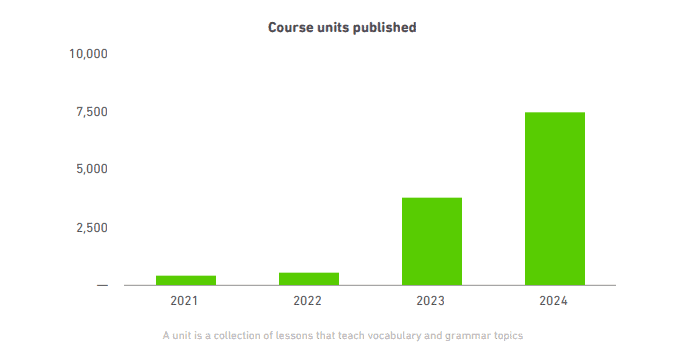
Generative AI is benefitting Duolingo in a number of ways. For starters, it is using the technology to massively accelerate content generation at minimal extra cost. In 2024, it deployed 7,500 course units, up from just 425 in 2021. 

Source: Duolingo.

Second, it has launched an AI-powered video call feature that enables learners to have real-time, spontaneous conversations with a virtual character. This addresses two common challenges in language learning: the lack of opportunities to practise with native speakers and removing the embarrassment when making errors with human tutors. 

The video call feature is available exclusively to Duolingo Max subscribers (its highest-priced tier). Yet it already accounted for 5% of paid subscribers in Q4. And it’s proving a hit with English language learners, who often need real-world English speaking skills for work or study.

As for risks, a potential global recession could cause some users to downgrade from premium subscriptions. So this is worth monitoring.

Longer term though, there is an enormous opportunity with English learners. They represent roughly 80% of the 2bn or so language learners worldwide, but only 46% of Duolingo’s 40m daily active users.

After a 25% fall since mid-February, I think the stock is worth further research.

Will the Lloyds share price be a winner or loser from the tariffs turmoil?

The stock market has been volatile over the past couple of weeks, mostly due to the uncertainty created by the US administration’s imposition of global tariffs. One of the most popular stocks for UK investors is Lloyds Banking Group (LSE:LLOY). So far, the Lloyds share price has jumped both higher and lower, but ultimately remaining virtually unchanged compared to a month ago. Here’s what I think will happen next.

Not too exposed

Let’s start with the most straightforward consideration: Lloyds is a UK-focused bank. Over 95% of its revenue comes from the UK, and it doesn’t have significant operations in the US. So, from that angle, the tariffs won’t impact the business directly.

The other point is that Lloyds predominantly serves corporate clients in the UK that also operate domestically. So again, the risk here of a sharp slowdown in activity is low. Of course, it does have clients that trade out of the UK with the US. But even in this case, the current tariff rate of 10% isn’t crazy, with the UK looking to pursue a trade deal. A trade war with the UK isn’t high on the list of priorities for the US.

From those angles, the Lloyds share price could be a winner when considering the broader FTSE 100. This is because other FTSE 100 peers are international companies, with operations in China and the rest of Asia, as well as the US. In this case, there’s a lot of risk due to the tensions between China and the US. Investors will have noticed this. If they have spare cash to deploy right now, I’d imagine stocks like Lloyds could be a lot more appealing than businesses that trade globally!

A barometer for the UK

Despite the potential for Lloyds stock to rally, there are more indirect concerns to flag. As it’s a domestic bank, the firm is seen as a bellwether for the broader UK economy. If higher tariffs hit the UK, it could dent UK export performance causing business confidence to weaken. This could hurt UK consumer sentiment too.

This matters to the bank because it could see transactional spending dry up and lower demand for loans and mortgages. The share price could fall as investors decide to move away from domestic UK companies and try to diversify with those less exposed to the UK.

Key results ahead

On balance, I think Lloyds could end up being a net winner from the market turmoil. When zooming out, the banking stock is up 31% in the past year. The following quarterly results are scheduled for the beginning of May, and I think this will provide some key commentary on how management see the tariffs impacting operations. Therefore, I’m going to wait until then before making a final decision on whether to buy or not.

Aston Martin: is there a real risk the FTSE company goes bust?

It has been a tough couple of years for Aston Martin (LSE:AML), with the 24% fall in the past month indicating that there are still problems at the luxury car manufacturer. The FTSE stock hit all-time lows last week, with issues, meaning that a friend of mine asked if the company could actually be at risk of going bankrupt this year. Here are my current views.

Serious problems

The business has struggled financially for the past few years. For the 2024 financial year, it recorded a post-tax loss of £323.5m, an increase from the £226.8m in the previous year. Demand is lower, with total wholesale volumes dropping from 6,620 vehicles in 2023 to 6,030 vehicles last year.

If you’re selling fewer vehicles, revenue is going to fall. If the business can’t make a profit at the moment and has a bleak outlook, it’s going to be really tough to make a profit this year or next. Investors aren’t stupid; they can realise this. So the 61% fall in the last year (and even over a longer time period) reflects the view that Aston Martin as a company isn’t where it needs to be.

Another issue that has become evident since January is tariff risk from the US. The new US president is using tariffs as a trade tool, with Aston Martin getting caught in the crosshairs. The exact percentage tariff for exports to the US keeps changing, but I’d imagine it’ll settle around 10-25%. Given the company’s gross profit margin of 36.9%, this is clearly going to be a big hit! The business doesn’t have production in the US, so it can’t just flip manufacturing away from the UK easily.

Managing concerns

One reason why I don’t see a short-term risk of the company going bust is due to liquidity. As of the end of last year, it had cash of £360m and available credit facilities of £154m. At the end of March, chairman Lawrence Stroll announced he was investing another £52.5m. With other forms of debt already in place, the company has enough cash flow to prevent any sudden issues that could stop operations.

Another bright spark comes from the revamped vehicle line-up. The new Vanquish sports car has won various performance awards, which could help drive better sales this year. Given the continued price increases (the average selling price in 2024 was up 6% to £245k), this could aid cash flow.

Not for me

Even though I don’t believe the business will go bankrupt this year, I’m staying well away from investing. The problems it faces are substantial. It’s worth noting that it has filed for bankruptcy on several occasions, with the last being in 1987. I think an investor can find better value stock options to consider elsewhere.

2 crackerjack growth shares to consider buying as the dust settles

The FTSE 100 is down almost 7% over the past month. Yet there are some early indications that the dust is starting to settle after a manic few weeks. The 90-day tariff pause and exemptions for certain products have provided some relief for investors around the world. Even though we might not be out of the woods yet, here are two growth shares that I think look attractive right now.

Primed for success

The first idea is Plus500 (LSE:PLUS). The FTSE stock has rallied by 51% over the past year. It has even managed to move higher over the past month despite the volatility. One key reason for this is that the whipsaw price action in different asset classes is good for business.

The trading and investing platform makes money in several ways. Yet the largest driver is making a small spread on each transaction placed by clients. So, the more trades that get placed, the more profitable Plus500 becomes. Typically, when there’s not much going on in the stock market, it’s bad for business as no one is really buying or selling. But last Wednesday (April 9), we saw approximately 30bn shares traded across US exchanges! This marks the highest single-day volume on record.

I believe the huge interest in markets right now will translate into strong company results. Even though the dust might settle in the short term and dent its business, we still have several years ahead of President Trump, providing ample time for volatility to spike again.

One risk is that the sector is becoming increasingly competitive. FTSE 250 peers like IG Group and CMC Markets do basically the same thing. They are all focused on gaining market share from the others.

Resetting expectations

A second growth stock to consider is Raspberry Pi (LSE:RPI). Although its share price has tumbled 28% in the past month, it hasn’t been publicly listed for a year, but it’s currently still trading comfortably above the IPO price of 280p.

One reason the stock has fallen is that 2024 results released at the start of April didn’t meet investor expectations. Revenue for the year fell by 2% compared to 2023, with operating profit down 4%. Even though this might not seem terrible, it’s meant to be a growth stock and a darling of the UK tech space. People were looking for year-on-year gains, which wasn’t the case.

Despite this disappointment, as people calm down I think the dip will get bought. A total of 22 product launches happened in the year, and “given the planned product release schedule and mix of sales, gross profit per unit is expected to increase year-on-year.” The company laid the foundation in 2024 and it should see the financial benefit in 2025.

The results also spoke of a “number of promising direct discussions with major prospective OEM customers”. If a few of these can progress, I’d expect the share price to spike when updates get shared with the public.

Of course, the high bar of expectations means that if results aren’t brilliant, the risk going forward is a further share price fall. Yet I think the recent move reflects a reset, with the valuation more attractive now for investors to consider.

I’ve been investing in the stock market for 25 years. Here are 4 tips to navigate the current volatility

The stock market has been incredibly volatile recently. Last week, America’s S&P 500 index registered its worst four-day streak since 2008.

Now, as someone who’s been investing since the early 2000s, I’ve seen this kind of market activity before. With that in mind, here are four tips to get through the current turbulence.

Stay calm and stick to your strategy

When markets are tanking and there’s fear in the air, it’s crucial to stay calm and stick to your investment strategy. If you panic, you could end up making an irrational move that you’ll come to regret down the line.

Remember that market volatility is a normal part of investing. While stocks tend to provide great returns in the long term, they never go up in a straight line.

Think ahead

Speaking of the long term, now’s a good time to focus on it. Instead of thinking about what’s going to happen over the next month, think about where stock markets could go over the next decade (they almost always go up over 10-year periods) and how you could potentially set yourself up financially by making the right moves today.

It’s worth pointing out here that if you have a long-term horizon, you’re much better off buying shares at lower prices instead of higher ones. And right now, share prices are much lower than they were a few months ago.

Focus on big themes

As well as taking a long-term view, it could be smart to take a thematic approach to investing. Think about the industries that are poised to get much bigger in the years ahead and consider allocating some capital to them now while prices are low.

One industry that I believe is set for massive growth in the years ahead is cybersecurity. With cyberthreats continually becoming more sophisticated, I reckon spending on this area of technology is going to boom over the next decade.

Now, there are many stocks in this industry that could be worth considering today including the likes of CrowdStrike, Palo Alto Networks, and Fortinet. If someone is looking for broad exposure to the industry however, they may want to consider the Legal & General Cyber Security UCITS ETF (LSE: ISPY).

This provides exposure to a range of leading businesses in the cybersecurity industry. Overall, there are around 35 stocks in the ETF (including the three I mentioned above).

This isn’t a product I’d put my life savings into. Cybersecurity is a dynamic industry (threats are always evolving) meaning companies’ growth can fluctuate. Meanwhile, a lot of companies in this industry have high valuations. So, their share prices can be more volatile than the broader market.

Taking a long-term view, however, I believe this ETF has a lot of potential.

Manage risk

Finally, my last tip is – think about risk and don’t try to be a hero.

Consider drip-feeding capital into the market bit by bit (buying mainly on days when the market is down). This will ensure that if stocks fall further, you can still capitalise.

Remain diversified. ETFs like the one above can be a good way to spread out your capital.

And focus on high-quality companies that are going to be around in the future. Now isn’t the time to put your life savings into a speculative penny stock that could go bankrupt if economic conditions deteriorate.

£10,000 invested in Tesla shares a fortnight ago is now worth…

What a fortnight it’s been in the stock market. The S&P 500 had its worst day since 2020, then its best week since 2023. But investors should pay attention to Tesla (NASDAQ:TSLA) shares.

After all that volatility, a £10,000 investment in the stock two weeks ago is now worth… £9,733. It’s almost as though nothing happened – but it hasn’t felt that way. 

Share price movements

A £10,000 investment in Tesla from 31 March has taken quite the scenic route to go almost nowhere. To start with, ‘Liberation Day’ tariff announcements sent the stock down almost 22%. 

Shortly afterward, news of a 90-day window for trade negotiations saw the stock bounce back to above where it was two weeks ago. And since then, it’s settled just below that level.

The volatility has been extreme and very difficult to predict. But investors who were able to keep cool heads have found that things have turned out just fine. This is often the way with the stock market. Share prices move up and down, but if nothing major changes with the underlying business, things tend to work themselves out over time.

Businesses vs stocks

From an investment perspective, I don’t think anything much has changed with Tesla. As I see it, everything hinges on the company’s ability to launch and scale its robotaxi business. The biggest obstacle to this is regulation. But the company’s ability to overcome this doesn’t – in my view – have anything to do with the tariff news that has been moving the share price.

That’s not to say Tesla is entirely unaffected by higher import costs. If this leads to inflation, US consumer spending could come under pressure and this won’t be good for car sales. 

From an investment perspective though, I don’t think this is the most important thing. It’s very hard to see how car sales justify the current market-cap – it comes down to robotaxis.

An investing lesson

The last couple of weeks have presented an important lesson for investors. When the Tesla share price fell 22%, it must have been tempting to sell in case it went any lower. This however, would have been a mistake. Not just because the stock bounced back to recover its losses, but because not much had changed with the underlying business.

Tesla’s share price over the last fortnight is an unusually extreme example, but almost all stocks fall sharply at some point or other. The best ones however, recover. It’s a general feature of the stock market that the best days often follow hot on the heels of the worst ones. Investors need to try and make sure they’re in a position to benefit.

Stock market volatility

Staying the course isn’t always straightforward. For various reasons, both institutions and individuals can find themselves having to sell stocks when prices are low. Investors however, give themselves the best chance by being able to hold onto stocks for the long term. Over time, shares in quality companies tend to overcome sudden downturns.

Tesla’s share price is an extreme example. But it’s one that investors should pay attention to when thinking about how to do well by investing in the stock market.

3 FTSE 250 shares to consider for a well-diversified portfolio!

The FTSE 250 offers a world of opportunity for investors seeking to diversify their portfolios. Building a well-balanced mix of shares, funds and investment trusts is critical at any stage of the economic cycle. But with trading conditions threatening to become much tougher for many companies, diversification is taking on greater importance as a risk-management tool.

Owning different categories of equities can also help generate a stable return over time. Growth and value stocks can provide significant long-term capital gains, while dividend shares can provide defensive protection during economic downturns.

With this in mind, here are three shares from each category I think would be worth considering as part of a balanced UK stocks portfolio.

Growth

Increasing digitalisation, accelerating online threats and growing regulation means cybersecurity companies like NCC Group (LSE:NCC) have significant room for long-term growth. According to Fortune Business Insights, the global market will grow at an annualised rate of 12.9% between now and 2032, at which point it will be valued at a stunning $562.7bn.

NCC offers a wide range of services in this field, including consulting, attack detection and assurance. This gives it multiple ways to capitalise on this booming market.

Be mindful however, that sales cycles have been lengthening in recent months, and this could continue if the global economy cools. At the moment City analysts are tipping earnings growth of 53% and 30% for the next two financial years (to May 2025 and 2026 respectively).

Dividends

Real estate investment trusts (REITs) such as Tritax Big Box (LSE:BBOX) are popular picks for investors seeking passive income. This is because they tend to have their tenants locked down on long-term contracts, the rental income from which can be doled straight out to shareholders.

As well, REITs must pay at least 90% of the profits they make from their rental operations out in dividends.

Please note that tax treatment depends on the individual circumstances of each client and may be subject to change in future. The content in this article is provided for information purposes only. It is not intended to be, neither does it constitute, any form of tax advice.

Tritax is an exceptionally robust REIT, in my opinion. The weighted average unexpired lease term (WAULT) was 10.6 years at the end of 2024. It also has a wide array of blue-chip companies on its books like Amazon and Tesco.

The firm has a solid balance sheet too, with a loan-to-value (LTV) of 28.8% at the end of 2024. The trust’s forward dividend yield is a huge 6.2%.

I think it’s worth a close look, even though the potential for interest rate rises are a constant risk.

Value

FTSE 250 retailer B&M European Value Retail (LSE:BME) isn’t without its share of risks. Even sellers of cheaper goods like these aren’t immune to ongoing pressure on consumer spending, as recent disappointing trading updates here have shown. Group revenues rose just 2.8% between April and December.

While things could remain tough, I think B&M’s rock-bottom valuation more than reflects this possibility. The former FTSE 100 share now trades on a forward price-to-earnings (P/E) ratio of 8.3 times.

With a 7.2% forward dividend yield too, it offers solid all-round value, in my opinion. A robust longer-term outlook for value retail — combined with B&M’ ambitious store estate expansion plans — makes this fallen angel worth a close look, in my opinion.

Down 38% over 12 months, is the BP share price the bargain of 2025?

BP’s (LSE: BP.) share price has taken a major hit recently. Year to date it’s down around 16% while over one year it’s down about 38%. Is there value on offer after this double-digit percentage pullback? Let’s discuss.

A value stock?

At first glance, shares in the oil giant do look quite cheap right now. Currently, City analysts expect BP to generate earnings per share (EPS) of 54 cents in 2025. That forecast places the stock on a forward-looking price-to-earnings (P/E) ratio of just eight. That’s well below the UK market average and miles below the P/E ratios on US-listed energy giants Chevron (13) and Exxon (14).

A few other metrics are also worth highlighting here. One is the stock’s free cash flow yield. Last year, BP’s free cash flow was 71 cents per share. That puts the trailing free cash flow yield at about 16%, which is very high (a high ratio can signal that there’s value on offer).

Then there’s the dividend yield. It’s currently about 7.5%. That’s also high. Often, cheap stocks sport high yields.

Cheap for a reason?

However, before we rush out and buy the oil stock because it looks cheap, there are a few issues to consider. Often, cheap stocks are cheap for a reason.

One major issue to be aware of is that US President Donald Trump wants to bring oil prices down (oil is already down about 7% over the last month). His goal is to boost US production (his mantra is ‘drill, baby, drill’) and he hopes this will lead to lower prices.

Now, lower oil prices would have a negative impact on BP. They would most likely lower revenues, cash flows, and earnings (pushing the P/E ratio up and making the shares look less cheap).

Another major issue is the possibility of a global recession in the near future (which is looking increasingly likely given the uncertainty surrounding tariffs). This would most likely reduce demand for oil, which wouldn’t be good for BP.

A third factor to be aware of is investor sentiment, which is weak right now and could remain depressed for a while. The issue here is that a lot of major investors aren’t happy with BP’s shift away from renewable energy.

One such investor is Legal and General, which is currently BP’s seventh-biggest shareholder. Recently, it said that it was “deeply concerned” by the company’s decision in February to reduce its focus on clean energy in favour of oil and gas.

This kind of negative sentiment could keep the stock depressed. Because large investors can be influential when it comes to share prices.

What now?

So, where does this leave us?

Well, there’s certainly a chance that BP shares could deliver solid returns from here (especially considering the high dividend yield). So, they could be worth considering.

However, my personal view is that there are better shares to consider buying. I’d rather put my money into a company that has more attractive long-term prospects.

Financial News

Daily News on Investing, Personal Finance, Markets, and more!

Financial News

Policy(Required)