A top FTSE 100 share to consider for a Stocks and Shares ISA starter portfolio!

Tax-efficient Individual Savings Accounts (ISAs) have saved investors and savers a boatload of cash down the years. Latest projections show that users of products like Cash ISAs and Stocks and Shares ISAs likely enjoyed a stunning £6.7bn of tax relief in the 2023-2024 tax year alone.

I own both a Cash ISA and Stocks and Shares ISA. I own a Lifetime ISA, too. But the majority of my money is tied up in my shares-based ISA, given the superior returns that equity investing tends to generate.

For investors building a portfolio from scratch, here’s a top share from the FTSE 100 to consider buying today.

A top trust

Investment trusts can be great stocks to buy when starting out on on investing journey. These financial vehicles invest in a portfolio of assets, which allows investors to diversify without having to purchase lots of stocks straight away.

Of the hundreds of trusts to choose from today, I’d consider parking cash in the F&C Investment Trust (LSE:FCIT). This is the oldest trust in the world, dating all the way back to 1868.

Its holdings span more than 400 companies across the globe and a range of sectors. Around two-thirds is in North American equities, and roughly another 19% and 6% in European and Japanese shares, respectively.

This focus on developed markets helps provide the trust with stability over the long term. However, with 8% of the trust invested in emerging markets, it also gives investors exposure to faster-growing economies.

Tech exposure

Another reason I think F&C Investment Trust is worth serious consideration is its high weighting of US technology stocks. The so-called Magnificent Seven shares (namely Alphabet, Amazon, Apple, Meta, Microsoft, Nvidia, and Tesla) have significant long-term growth potential as global digitalisation grows.

On the downside, fresh developments with DeepSeek could work against the trust, given its substantial tech exposure. Chinese progress in artificial intelligence (AI) could pose various dangers, from reducing microchip demand to providing direct competition to US systems.

But on balance, the outlook for the US tech sector (and consequently F&C’s investment trust) remain extremely robust in my opinion. After all, these companies are market leaders across a variety of growth segments, from quantum computing and autonomous cars to cybersecurity and cloud computing.

Trading at a discount

Through a combination of share price gains and dividends, the F&C Investment Trust has delivered a healthy 10.1% average annual return since the beginning 2020.

To put that into context, the broader FTSE 100 has delivered a corresponding return of 7.3%. Past performance isn’t a guarantee of similar returns in the future. But I’m confident the trust will keep delivering better returns than the Footsie given its broad global composition and large weighting of growth stocks.

At £11.80 per share, the trust also currently trades at an 8% discount to its net asset value (NAV) per share. For new ISA investors looking to limit risk, I think it demands a very close look.


I asked ChatGPT to name the best 5 UK shares to build wealth over 50 – and here they are!

I like to get a second opinion when buying UK shares, even an artificial one. So I called in AI chatbot ChatGPT.

I asked it to create a balanced retirement portfolio of five FTSE 100 stocks. I had to substitute two of my robot buddy’s choices, because I’ve covered both a lot lately. I’ve highlighted my stock substitutions below.

As my robot buddy said, “when it comes to building wealth over 50, a sensible strategy involves balancing growth potential with steady dividend income”. Who needs Warren Buffett when I’ve got blinding computer insights like?

My mechanoid mate started by tipping Legal & General Group, a stock I love and own. On being pressed, it switched to insurer Prudential (LSE: PRU), which I don’t.

Prudential has underperformed

Prudential has made a much-applauded transition from Europe to Asia, hoping to tap into the huge and growing Asian middle class. So far, it hasn’t paid off.

The Prudential share price has plunged 20% over one year and 50% over five. China’s economic troubles have hit investor appetite, while higher interest rates and market volatility squeeze insurers generally.

The shares look good value with a price-to-earnings (P/E) ratio of just 9.5 times. The yield is a disappointing 2.7%, way short of Legal & General’s 8%. ChatGPT was right to pick that first. I’d do the same.

One day Prudential could rally hard, but I’ve been saying that for a long time now.

I also asked ChatGPT to find a substitute for its next pick, pharmaceutical giant AstraZeneca. Unsurprisingly, it picked rival GSK.

GSK has been trailing AstraZeneca for years, but in my view looks better value today. It yields almost 4%, roughly double Astra’s income. And it’s incomparably cheaper, with a P/E of around nine times against AstraZeneca’s hefty P/E of 65 times.

I didn’t have any issues with ChatGPT’s third pick, consumer giant Unilever. “As the owner of household brands like Dove, Persil and Ben & Jerry’s, it enjoys steady demand regardless of economic cycles”, ChatGPT drooled.

The yield is modest at 3.1% but Unilever typically hikes shareholder payouts by 5% every year. The shares are up 18% in 12 months. It’s sprawling, ill-focused operations need banging into shape, but it still looks like a solid long-term buy and hold to me.

Investing for income and growth

I certainly can’t argue against AI’s final two picks – utility giant National Grid and cigarette maker British American Tobacco (except on moral grounds in the latter case).

As a regulated utility, National Grid enjoys predictable income streams, ChatGPT tells me, with an attractive 5.8% trailing yield. The shares look good value with a P/E below 12. My worry is that National Grid has to invest heavily in the energy transition. That’s driving up debt and could one day squeeze dividends.

British American Tobacco is under constant regulatory attack and operates in a declining market. Yet it boasts top brands like Dunhill, Lucky Strike and Vuse, while “pricing power and brand strength allows it to maintain high profit margins”, ChatGPT enthuses.

The trading yield is 7% with the shares up 40% in a year. It’s also cheap with a P/E below nine.

Any investor considering these stock should ensure they work well with existing holdings. They should also take a long-term view. Even over 50, there’s still a long way to go.

£10k invested in Scottish Mortgage shares after the DeepSeek crash is now worth…

Scottish Mortgage (LSE: SMT) shares have had a blistering run. Yet it looked like the fun might stop when cut-price Chinese AI upstart DeepSeek popped up.

The fact that DeepSeek could deliver a product that apparently matched ChatGPT on a shoestring budget sent shockwaves through the S&P 500.

Chipmaker Nvidia crashed by $600bn on 27 January, the largest one-day drop in US stock market history. The US is pouring trillions into AI, money ill-spent if China can do the same job for pennies.

That was a blow to Scottish Mortgage too. The FTSE 100 investment trust is a huge play on the US mega-caps and disruptive tech generally. Amazon, Meta Platforms and Nvidia itself number among its top 10 holdings. And Taiwan Semiconductor Manufacturing is in its top 15.

This FTSE 100 stock bounced back

The Scottish Mortgage share price also fell on 27 January, a drop of 5% from 1,059p to 1,004.5p. It could hardly do anything else.

I thought that was modest. Nvidia plunged 17%. I expected further volatility in the days that followed, but was in for another surprise.

The Scottish Mortgage share price bounced straight back, to 1,090p. That’s above its pre-dip price. If anybody had been nippy enough to take advantage of the sell-off, they’d be sitting on a return of 8.5%. If they’d pumped in £10,000, that would be worth £10,850 before charges.

They’d have had to be fast though. I suspect most were sitting back, dazed, wondering what all this might mean. I was.

At The Motley Fool, we think timing the market is a mug’s game. But we’re not against taking advantage of a market dip to buy cut-price stocks. The aim then is to sit back and hold for the long term, rather than carry on trading for short-term gain.

I’d have held on to my Scottish Mortgage shares even if they’d taken a far bigger beating and taken a lot longer to fight back. I’m glad they didn’t though.

Nvidia has further to go

Nvidia is on the up too. It’s also climbed 8.5% since slumping to around $118 on 27 January. But at $128 it’s well below its recent peak of $147.

Sell-offs are to be expected when investing in shares, especially high-growth ones.

Scottish Mortgage crashed by half in 2022, when we saw a far bigger sell-off. Despite that, it’s still up 75% over five years. Over 12 months it’s grown 40%.

The Magnificent Seven US tech stocks surely can’t ride roughshod over their rivals forever. There’s always a surprise out there. With inflation still a menace, and US interest rates likely to stay high, they may struggle to grow from here. Donald Trump’s trade tariffs are a threat too. The Chinese may have more tricks up their sleeve.

Yet I won’t be selling. The trust plays an important role in my portfolio, giving me diversification from FTSE 100 dividend stocks, my main focus. They’re having a moment right now. As ever, diversification is the best defence.

1 ex-penny stock up nearly 400% in my Stocks and Shares ISA! 

Butterfly Network (NYSE: BFLY) was a penny stock trading for less than $1 in August. Now, it’s up to $4.40 and a $1bn market cap after a sizzling 368% surge in just six months. Given that I hold the shares in my ISA, surely this is a cause for celebration, right? Well, not quite.

Rather than a beautiful butterfly spreading joy across my portfolio, this one’s been more like a moth gathering dust at the bottom of it. You see, I didn’t invest at $1, or even $2 or $4. I bought shares of this digital health firm for $13 a pop back in 2021!

Therefore, even after this massive rally, I’m still down by around 66%.

Should I keep holding to see if the stock finally metamorphoses into a wining investment? Let’s take a look.

What the company does

Butterfly Network has developed the world’s first handheld, whole-body ultrasound probe (Butterfly iQ). This offers high-quality imaging at a fraction of the cost of those traditional (clunkier) machines in hospitals. 

Built on patented Ultrasound-on-Chip technology, it has miniaturised the technology onto a single semiconductor. These devices connect seamlessly to smartphones and hospital computer systems, making ultrasound more accessible, portable, and affordable. Butterfly Network’s cloud-based platform stores the data.

Beyond hospital diagnosis and pregnancy scans, they’re used by medical students and vets to conduct examinations in-clinic, on farms, or even in wildlife conservation settings.

What went wrong?

When the company went public in 2020, it said it aimed to “disrupt a large and expanding total addressable market” valued at $8bn. It projected that revenue would grow to $122m in 2022, up from $44m in 2020.

At that time, interest rates were still close to 0%. Then post-pandemic inflation struck and rates soared. The stock dropped 80% between February 2021 and 2022 as investors quickly dumped loss-making growth firms like Butterfly Network.

The company’s growth also disappointed. In 2022, revenue was $73.4m (not $122m), and then it fell 10% to $66m in 2023.

This is the main risk here. The company needs to grow a lot in future, and this isn’t certain. Meanwhile, it raised $76.5m by selling shares last month, so further shareholder dilution can’t be ruled out.

Growth is back!

Investors have warmed back up to the investment case because CEO Joseph DeVivo, appointed in 2023, has reignited the growth engine. In Q3, revenue jumped 33% year on year to $20.6m — the fifth consecutive quarter in which it met or exceeded expectations.

The growth is being driven by its next-generation Butterfly iQ3. This AI-powered device contains a much more powerful semiconductor chip that produces faster image processing and higher-resolution ultrasound scans.

Another exciting development is Butterfly Garden, a platform enabling third parties to create custom AI applications using its imaging technology. Since launching in August 2023, it has attracted 17 partner companies, expanding Butterfly Network’s chip licensing potential.

Looking ahead, the company aims to achieve cash flow breakeven by the end of 2027 and to exceed $500m in revenue by 2030. For context, revenue is expected to grow 20% to $90m this year. That translates into a forward price-to-sales ratio of about 10.

Given the company’s vastly improved growth outlook, I’m hanging on to my shares. I think it’s worth considering for risk-tolerant growth investors with a stomach for volatility.

The FTSE 100 index hits new highs! But will Legal & General shares outperform it in 2025?

The FTSE 100 leading index of shares shows no signs of slowing down after its blistering performance of 2024.

After hitting repeated record highs last year, the Footsie continues to break new ground at the start of 2025. In recent days it struck new all-time peaks around 8,767 points. It’s up 5.4% since New Year’s Day.

The FTSE 100’s gains are thanks to improved optimism over interest rate cuts, solid corporate earnings news, and fresh weakness in the UK pound. Lower sterling boosts overseas profits for the index’s multinational companies.

Yet some individual blue-chip stocks have performed even more strongly than the broader index. I’m confident some of them will continue outpacing the FTSE, too.

Legal & General (LSE:LGEN) is one such company I believe can keep climbing.

Buyback boost

Up 7.7% since 1 January, the share price has mainly been boosted by news of a major upcoming divestment.

It announced on Friday (7 February) the sale of its US protection business to Japan’s Meiji Yasuda for a total £1.8bn. In addition to this, Legal & General said it will cede a 20% stake in its pension risk transfer (PRT) business to the Japanese company.

As for the proceeds, £400m will be shuttled into the new PRT arrangement, while a further £1bn will be made available for share buybacks following completion.

As a result, the firm said it “now expects to return the equivalent of [roughly] 40% of its market cap to shareholders over 2025-2027 through a combination of dividends and buybacks.”

Room for growth?

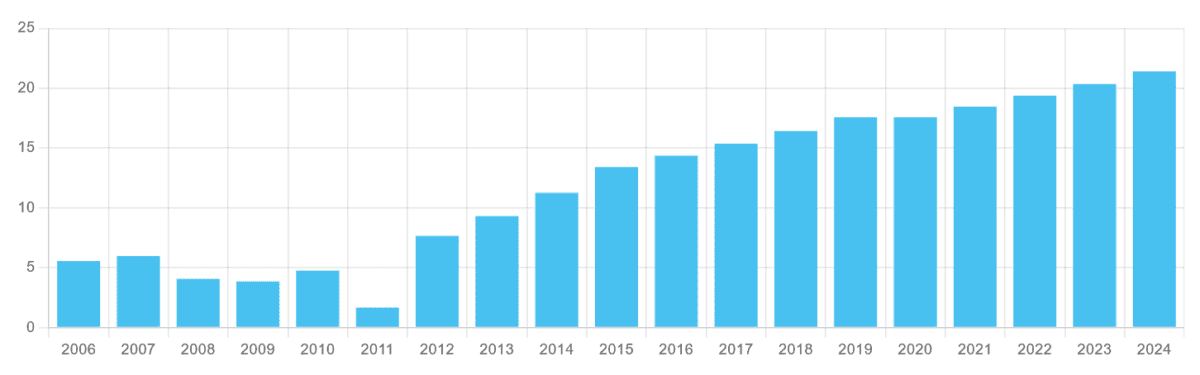
Thanks to its exceptional cash generation, Legal & General is famed for its huge dividends and ambitious share repurchase plans. For 2025, analysts expect a 14th year of dividend growth out of the last 15, which in turn drives its yield to 8.8%. Friday’s buyback news puts another layer of icing on the cake.

Source: DividendMax

Legal & General’s share price has been under pressure over the past year. But boosted by lower interest rates and growing structural demand for financial planning services, I’m optimistic it may continue its recent rebound this year, providing a blend of healthy capital gains and dividend income.

The company’s cheap valuation certainly leaves plenty of scope for fresh gains, in my opinion.

For this year, it trades on an undemanding price-to-earnings (P/E) ratio of 10.3 times. What’s more, its price-to-earnings growth (PEG) for 2025 is a modest 0.3.

That’s some distance below the benchmark of 1 and below that indicates a share is undervalued.

Looking good

Being able to accurately predict near-term share price movements is exceptionally tough. This is no different with Legal & General, demand for whose shares could sink amid fresh signs of weak economic growth and sticky inflation that impacts revenues.

But on balance, I think things are looking pretty bright for the financial services giant. This view’s shared by City analysts, who expect sustained earnings growth of 33% and 10% in 2025 and 2026 respectively.

Regardless of its share price, outlook for this year, I think Legal & General shares are a top FTSE 100 share to consider. I own it in my own portfolio and plan to hold it for the long haul.

Up another 8% in a week! So what’s stopping me from buying IAG shares? 

Is there no stopping International Consolidated Airlines Group (LSE: IAG) shares? It doesn’t look like it.

The British Airways owner is up another 8% in the last week. It’s up 22% over one month, 64% over three months and a massive 145% over the year.

It may be an airline stock, but it’s behaving like a space rocket. No pilot would allow a passenger plane to climb at this speed.

Which poses a problem for investors like me. Momentum stocks always do. There’s a risk that I hop on board, just as they stall. Then drop.

This is the first FTSE 100 stock I want to buy

This has happened to me a lot lately. Even FTSE 100 defence manufacturer BAE Systems, which I once described as the ultimate no-brainer plunged days after I added it to my portfolio last March. I’m still down 10%. In today’s dreadfully warlike world, nobody should lose money on BAE. I have. On paper.

I’m almost too ashamed to admit I bought Nvidia shares for the first time on Friday 17 January. On Monday 27 January it suffered the single biggest stock market loss in US history, falling $600bn as DeepSeek threw down its cut-price gauntlet. There’s no hope for me.

And I’m not going to share how I fluffed the Rolls-Royce growth miracle.

Despite those dire omens, I still want to buy IAG today. I think there’s plenty of fuel still in the tank. The IAG share price still looks good value with a price-to-earnings (P/E) ratio of just 8.6 times.

Yes I know that’s roughly double the P/E of three or four times it traded at a year ago. But it’s still roughly half the FTSE 100 average of 15 times. Which isn’t bad given that it’s the highest flyer on the index over the past year.

I think there’s more growth to come

The early rapid growth stage is over. I’ve missed that, I accept it. Pandemic lockdown hell is now a fading memory. Although it has left IAG with roughly €6bn of debt. That will take a few more years to whittle away.

Airlines are highly sensitive to economic conditions. If a recession hits, demand for air travel could plummet, hurting revenues and profitability. We’re waiting to see how Donald Trump’s mooted tariffs could hit business growth – and their transatlantic travel plans.

Fuel price volatility is a constant concern. Carbon taxes and emissions targets could drive up operating costs. IAG faces a tough balancing act between improving service quality, especially at BA, while competing with budget carriers on price.

Yet I can’t argue with its momentum. Only one thing is holding me back, and no, it isn’t my experience with BAE, Nvidia and Rolls-Royce. I just haven’t got any cash in my trading account.

So I have a second decision to make. Which stock to sell? With the FTSE 100 breaking new all-time highs, I don’t want to ditch anything. Although I’ve got my doubts about spirits giant Diageo

The Bank of England’s slashed its growth forecast but the FTSE 100 doesn’t seem to care!

The FTSE 100 saw a record closing high on Thursday (6 February). This was despite the Bank of England dramatically cutting its 2025 UK economic growth forecast from 1.5% to 0.75%.

Some of this optimism can be explained by the decision earlier in the day to reduce the base rate by 0.25%. This means it’s cheaper for companies to borrow.

However, at first sight, it seems odd that investors reacted so positively to the forecast downgrade.

But according to Goldman Sachs, 78% of the revenues of the FTSE 100’s members were earned overseas. Problems with the domestic economy are, therefore, likely to have less impact.

And falling interest rates will probably lead to a weaker pound. This means overseas earnings will be worth more when converted back into sterling.

These factors could explain why the outward-looking FTSE 100 has never been higher.

However, this global reach could be a double-edged sword. If President Trump carries through on his election pledge to impose tariffs on most imports into the US, the prices of those goods will rise. The sales and earnings of the UK’s largest exporters could then fall.

For now at least, it looks as though Footsie investors have put these thoughts to the back of their minds.

A possible option

But in these uncertain times, I think there’s one FTSE 100 stock that investors could consider adding to their portfolios — Airtel Africa (LSE:AAF).

As its name suggest, its only exposure is to Africa, which means it’ll fall outside the scope of any Trump tariffs. And the telecoms and mobile money provider isn’t reliant on the fragile UK economy.

According to the United Nations, the population of Africa will nearly double by 2050, to 2.5bn. By then, it’s estimated that approximately 25% of the world’s population will be living on the continent.

Over the coming decades, Africa’s also likely to see some of the fastest-growing economies in the world. And as disposable incomes rise, the demand for mobile phones is likely to increase.

The company recently reported its results for the nine months ended 31 December 2024. These revealed a 7.9% increase in its customer base — to 163.1m — during the period. Importantly, data usage per person increased by 32.3%.

Investors were impressed. On the day, the stock closed 9% higher, at 145p.

Barclays has set a price target of 175p on the stock. Of course, this is just one opinion but it does show that the company has some influential supporters.

Possible issues

However, as with any investment, there are potential risks.

Customers pay in their local currencies, which can be volatile. For example, Nigeria’s naira has devalued by more than 40% over the past 12 months. Based on customer numbers, the country is Airtel Africa’s most important.

Also, telecoms infrastructure doesn’t come cheap. To support its growth plans it’s had to borrow. At 31 December 2024, net debt was $5.27bn, an increase of $1.99bn (60%) on a year earlier.

And doing business on the continent can be difficult due to political uncertainty.

However, with its strong growth potential, lack of exposure to the UK — and because it’s likely to avoid any Trump tariffs — I think Airtel Africa’s a stock that investors could consider buying.

£5k in savings? Here is how an investor might target a £354 monthly passive income

The stock market is a capricious beast. It jumps up and down hundreds of times a year and no one has much of an idea how things will play out. For example, the Trump tariffs kicked in this week. A market crash? Not at all. The opposite, in fact. Most indexes are up. But despite its unpredictable nature, there isn’t really any other investment with such a proven track record of taking a pool of savings and building it into an amount that can spit back a lifelong passive income. 

Simple answer?

An investor wanting to get started might worry about such things. Is this stock the right one? What about that one? Or this other one everyone’s talking about? 

There is a simple answer to all such questions — no one knows. Not until after the fact, anyway. 

But one way to try to smooth out those erratic ups and downs is to diversify, investing in different sectors and different companies. A simple way to do this is with investment funds, where experienced money managers pick the stocks for you – for a fee of course. 

One that I invest in and also think is worth considering for any investor looking for a passive income is Scottish Mortgage Investment Trust (LSE: SMT). For one, the fees are low. Just 0.35% a year. 

The fund covers 30 companies at present which means one or two bad eggs will get smoothed out through all that diversification. 

Supermassive

But where it shines is its focus on growth. The fund seeks out exciting growth companies, often in the technology sector, which offers the chance of supermassive asymmetrical returns. 

Past winners include Tesla or Nvidia – bought well before the hype. Scottish Mortgage can boast of a 20 times return this century thanks to investments like that. Not many other stocks on the FTSE 100 can say that. 

There are risks to any stock, and with Scottish Mortgage it’s easy to get blinded by technology’s recent overperformance. Big tech isn’t guaranteed to beat the rest of the market, even if some seem to think it is.

And because valuations look frothy, some of the funds’ constituents have a long way to fall. That’s one reason why an investor might be better served supplementing this with other investments. 

Imagine an investor with £5,000 to spare. The money goes into Scottish Mortgage to support other shrewd investments. As this cash is aimed at hitting those big numbers, a 12% yearly return could snowball into £85,000 after a 25-year investing period

Rebalancing into dividends aimed at 5% leads to £354 a month, all from that initial stake. 

No guarantees here, of course. But as part of a broad investing strategy, I think this is one an investor might want to consider. 

Legal & General shares jump 8% as investors celebrate buyback and dividend bonanza!

Legal & General (LGEN) shares have surged 8.25% as I write this on Friday (7 February), and I couldn’t be happier. I’ve been waiting a while for this moment. In fact, I was digging in for a much longer wait, so this is an early bonus.

At first, I thought the FTSE 100 insurer and asset manager had published a bumper set of full-year results, but those don’t land until 12 March. 

Instead, we got a blockbuster announcement: Legal & General is selling its US protection business to Japanese mutual insurer Meiji Yasuda for $2.3bn. In return, Meiji Yasuda will take a 5% stake in L&G.

Legal & General CEO António Simões called it a “transformative transaction” that brings both strategic and financial benefits. 

It’s top of the FTSE 100 leader board!

It’s certainly transformed the Legal & General share price. It’s been sluggish for years, falling 5% over 12 months and 25% over five years. That’s despite a well-received update in December outlining £5bn to £6bn in Solvency II capital generation between 2025 and 2027.

Back then, I wrote that “I love my Legal & General shares even more after today’s exciting update”. Now, my devotion is being reciprocated.

FTSE 100 financials have struggled with stock market volatility, UK economic concerns and high interest rates. The latter made cash and bonds more attractive, but investing is cyclical, and that’s changing. 

With the Bank of England cutting rates three times since August, and with more likely, cash and bond yields will fall. By contrast, Legal & General’s dividend yield still stands at a staggering 7.8%.

I’ve reinvested every dividend, building my stake more of the recovery. That happy day seems to be getting closer.

Under today’s deal, Meiji Yasuda will take over Legal & General’s US protection business and gain a 20% stake in its US Pension Risk Transfer (PRT) unit. Legal & General keeps 80% through reinsurance arrangements.

Legal & General plans to use £400m to fund US PRT reinsurance and – drum roll – pump a chunky £1bn into a new share buyback programme. That dwarfs the recent £200m one. The rest of the proceeds will be reinvested into the business, hopefully driving further growth.

I’m getting income as well as growth

Between 2025 and 2027, Legal & General expects to return around 40% of its market cap via dividends and buybacks. Given today’s £15bn cap, that’s £6bn. This should also ease concerns about dividend sustainability. High yields often signal trouble, but that doesn’t appear to be the case here.

One sticking point is valuation. The stock looks surprisingly expensive, trading at 32 times earnings. In August, Legal & General reported a 40% drop in half-year post-tax profit to £220m. Core operating profit edged up just £5m to £849m. It’s not firing on all cylinders yet. Maybe it never will.

Legal & General operates in a mature, competitive market at a tricky time for the global economy. Donald Trump’s trade tariffs threats and a potential UK recession risks add uncertainty. Buying today risks profit-takers pouncing.

I still see the long-term case strengthening. I bought L&G three times in 2023. My shares are up just 12.5% since then (most of that today), but my total return, including dividends, is closer to 25%.

No guarantees, of course. But if Legal & General delivers on its promises, today’s rally could be just the start.

What would £10k invested in the FTSE 250 last year be worth now?

The FTSE 250 is a list of 250 mid-cap UK stocks that aren’t quite big enough for the top 100. Market caps on the index range from £300m to £4.3bn.

The FTSE 100 lists all the larger, more well-established stocks, most of which are household names. Meanwhile, the 250 contains some that may have dropped out of the FTSE 100 as their valuations have fallen, but is also awash with lesser known companies brimming with potential. To some degree, it provides a sneak peek into what the future may hold for the UK economy.

Lately however, it’s been a bit of a downer. UK investors, unable to resist the bright lights of Silicon Valley, increasingly shy away from domestic stocks. The cost-of-living crisis combined with Brexit trade challenges and high inflation make it difficult for local businesses to thrive these days.

Consequently, the index has delivered below-average performance.

Investors who sunk £10,000 into a FTSE 250 index tracker at the start of 2024 wouldn’t be too overjoyed. With growth of only 7.5%, the £750 in returns would barely beat a good fixed-interest savings account.

That’s near the low end of the average 7% to 10% returns that UK investors typically achieve and somewhat below the FTSE 100 and MSCI World return of around 9.5%.

Looking across the pond, the S&P 500 and Nasdaq 100 achieved upwards of 23%.

Unearthing value on the FTSE 250

All things considered, the index doesn’t appear to be a great investment right now. But individual opportunities still exist, particularly when it comes to dividends. 

One I like the look of is B&M European Value Retail (LSE: BME). Sure, it’s down 37.6% over the past year, which doesn’t look great, but it’s recovered from large dips like this in the past.

If that trend continues, the current price, at only nine times earnings, is attractive. The factors that drove the recent dip may also be coming to an end — notably, inflation. On Thursday, 6 February, the Bank of England cut UK interest rates to 4.5%.

If inflation falls further, as is the hope, that could revive B&M’s fortunes. The 4.7% dividend yield adds an attractive incentive, providing value even if the price is slow to recover.

On 9 January, the group posted Q3 results that hinted at a moderate recovery. Like-for-like sales are growing again and constant currency revenue was up 3.5% in the prior nine months.

The low price combined with improved performance seems to give analysts confidence in the stock. The average 12-month price target of 509p is almost 60% higher than today’s price.

The company stands at a risky junction though, with £2.27bn of debt weighing heavily on future performance. If stubborn inflation halts a recovery, it may struggle to meet its debt obligations, limiting further growth. It also faces stiff competition in the UK discount retail sector, with the likes of Asda, Primark and Wilko vying for market share.

In both 2022 and 2023, earnings missed expectations, so its full-year 2024 results will be telling. If they come out positive, the stock could emerge as an unexpected success story in 2025.

Until then, I’ll keep it on my watch list.

Financial News

Daily News on Investing, Personal Finance, Markets, and more!

Financial News

Policy(Required)