Is this a turning point for the Diageo share price?

Down 40% in three years, I have to admit the Diageo (LSE: DGE) share price is starting to look tempting to me.

Brands such as Johnnie Walker, Guinness and Gordon’s have been around for over 200 years. They seem like safe long-term performers to me. After all, unlike tobacco, alcohol consumption has been the norm in much of the world for 1,000 years, or more.

However, the fact that Diageo shares are trading at levels first seen eight years ago is a painful reminder that this situation isn’t quite so simple.

One too many (problems)?

Recent headlines have focused on the possible impact of US tariffs on Diageo’s sales. The company imports much of its US product from Mexico and Canada. Hard-pressed American consumers might not welcome price rises.

Market conditions are already a little slow. Sales fell 0.6% during the six months to 31 December, while volumes were 0.2% lower. In the US market, which generates about 40% of sales, volumes fell 3% during the half year.

The company has now abandoned its previous guidance for medium-term sales growth of 5-7% a year. This target no longer had any serious credibility with the market, so it’s a sensible decision, in my view. But it’s also a reminder of an uncertain outlook.

Will we stop drinking?

There are fears among some investors that Diageo’s post-pandemic slowdown’s only the start of a broader reduction in alcohol consumption. Younger generations are said to be drinking less than older cohorts.

For existing drinkers, new weight-loss drugs are said to be proving helpful as a way of reducing problem drinking. Veteran fund manager Terry Smith cited this factor as one reason for his decision to sell his fund’s Diageo shares last year, having held them since 2010.

It’s perhaps a sobering statistic to realise that in the US, research suggests that half the alcohol sold each year is consumed by just 10% of drinkers. If they cut back, it could have a noticeable impact on demand.

Diageo: a contrarian opportunity?

Fundamentally, I reckon Diageo remains a high-quality business. Although debt levels are higher than I’d like to see, I still think the shares are starting to look interesting at current levels.

One valuation measure I use is to compare a company’s earnings before interest and tax with its enterprise value (market-cap plus net debt).

On this measure, Diageo shares trade on a profit multiple of 14. That’s a level I consider to be reasonable value for a growing business. And that’s the big question.

Ultimately, I think Diageo’s attraction as an investment today depends on whether alcoholic drinks are going to become a legacy business that’s in decline, like cigarettes.

If alcohol follows tobacco then I would say Diageo share are still too expensive. But if the drinks market returns to growth in line with pre-pandemic norms, I think the shares could offer value at current levels.

Are Diageo shares at a turning point today? I think we’re close, but I’m not quite convinced. This business will stay on my watchlist for now.

As the FTSE 100 hits record highs, should I sell my shares and buy an index fund?

As I write, the FTSE 100‘s trading at 8,760, within a few points of its all-time high. The Bank of England’s decision to cut interest rates on Thursday (6 February) helped nudge the UK’s blue-chip index higher.

But in reality, the big-cap index has been performing well for a while, up by nearly 6% in 2025. It’s risen by 14% over the last 12 months, plus dividends (around 4%).

I don’t mind admitting that my own portfolio lagged the big-cap index last year. One reason is more of my shares are mid-sized FTSE 250 companies. Some of these haven’t done so well recently.

Things could turnaround for me in 2025. Or they may not. There’s a risk my shares will continue to lag the market. And maybe I’m just buying the wrong shares.

Should I give up stock-picking?

I spend a lot of time researching investments and managing my portfolio. I enjoy it. But the reality is that there’s a chance I could make more money to support my retirement by simply investing in an index tracker fund. I’d have had more time for other hobbies too…

Given this risk, should I stop buying individual shares and simply put my money in a FTSE 100 fund? This is a personal decision, but for me the answer’s no.

One reason is that I enjoy researching shares and learning how businesses work. The second reason is that I’ve decided to accept the risk of underperforming, so I have the opportunity to find out if I can beat the market.

Here’s an example

One share in my portfolio I have high hopes for at the moment is £500m translation and localisation specialist RWS Holdings (LSE: RWS). This business is a market leader in this sector. It serves customers in areas ranging from consumer goods through to regulated markets like law and medicine.

RWS shares have had a terrible run since 2022, falling by more than 60%. Some of this is justified, I think. The company’s suffered from a slowdown in several important markets. Profits are down by around 25% since then.

There’s also a bigger risk that some of the company’s services could be made redundant or devalued by general artificial intelligence (AI) services. Although RWS has always used computer translation, new-generation AI services are seen as more of a threat to the business by some investors.

Of course, RWS is developing its own AI services. These combine the latest technology with other useful features for business customers, such as content management and human oversight.

I’ve spent some time looking at this before investing. My view is that over time, many of the company’s customers are likely to continue using RWS to provide a guaranteed, enterprise-quality service.

Right now, it’s too soon to be sure. RWS is having to invest heavily in IT to develop its new AI-led services, and there’s no guarantee this spending will pay off.

However, the stock now trades on a 2025 forecast price-to-earnings ratio of seven, with a 9% dividend yield that’s still covered by earnings. If RWS can deliver as hoped, I think its shares could be very cheap at this level and are worth considering.

£10,000 invested in Lloyds shares 6 months ago is now worth…

Lloyds (LSE:LLOY) shares are up 11.3% over six months. So a £10,000 investment then is now worth £11,130 today. Sadly, an investment made exactly six months ago would miss out of the dividend cut-off. Nonetheless, it’s not a bad return.

More broadly, we can see long-term investors are being rewarded for their loyalty after the stock’s underperformance during the Bank of England’s rate hiking cycle. Shares are up 8% over five years, but 45% over 12 months, highlighting the volatility we’ve seen in recent years.

Long-term underperformance

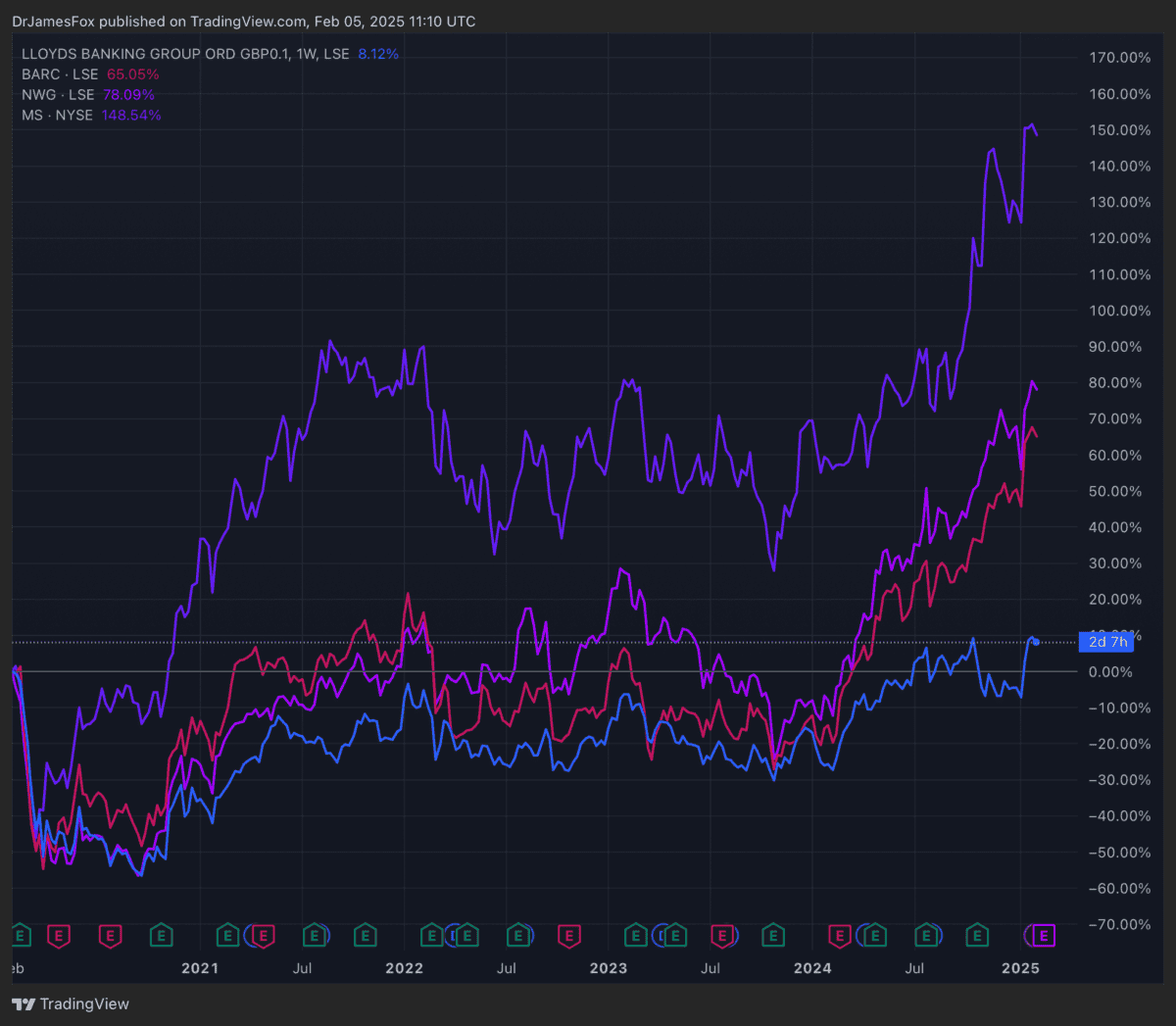
The graph below shows us how Lloyds has underperformed its major UK and US peers (such as JP Morgan) over the past five years. Once the darling of the FTSE 100 — albeit nearly 30 years ago — this bank no longer appears to have the same pulling power as its competitors.

Created at tradingview.com

So why is Lloyds not as popular as its peers? Primarily UK-focused, the bank lacks the global diversification and investment banking prowess of its competitors. Its heavy reliance on the domestic mortgage market makes it vulnerable to economic fluctuations, limiting growth potential. While stability’s a strength, investors often seek more dynamic financial institutions with broader revenue streams.

The absence of a significant international or investment banking arm can constrain Lloyds’ ability to generate higher returns. This conservative approach, though prudent, means the bank often appears less attractive to investors seeking more aggressive growth strategies in an increasingly complex and competitive financial landscape.

A risk worth taking?

The FCA’s investigation into Lloyds’ car finance practices presents a significant risk and opportunity for investors. The bank’s £450m provision may be insufficient if the Supreme Court rules against it, potentially leading to charges up to £3.9bn. This uncertainty has created a volatile situation for Lloyds shares.

However, a favorable outcome could trigger a relief rally. The chancellor’s intervention, citing potential “considerable economic harm,” may influence the ruling. If Lloyds prevails, investors will be keen to point out supportive trends emanating from falling interest rates.

In fact, Lloyds is already benefitting from falling interest rates, as evidenced by lower impairment charges in its most recent financial report. The bank’s structural hedges are set to provide a meaningful support to its income from 2025 onwards, which will lift its revenue and earnings.

Despite a slight decline in net interest margin, Lloyds’ loan book growth and stabilising consumer behaviour regarding savings accounts are positive indicators. Moreover, the bank’s ability to beat profit expectations amid softer economic conditions demonstrates its resilience and adaptability to changing market dynamics.

Some valuation uncertainty

Looking at the data, there appears to be some uncertainty among analysts around earnings. This, I assume, is because analysts are trying to forecast in which year the possible fine could fall. The result is an unclear price-to-earnings trajectory. The bank’s currently trading at 9.5 times forward earnings, this rises to 10.7 times for 2025 and then falls to 7.4 times for 2026.

Nonetheless, I’m here for the long run. I’m bullish on Lloyds and may consider buying more.

£20,000 in savings? Here’s how investors can aim for a £4,000 monthly second income

Turning £20,000 into a second income through investing is easier than many think. With the right approach, these savings can grow over time and eventually deliver a potentially life-changing passive income. Dividend stocks, index funds, and growth-oriented investments offer simple ways to build wealth, while reinvesting earnings helps accelerate progress.

New investors must remember that market ups and downs are normal, but a long-term mindset makes all the difference. Even small gains can add up, providing extra financial security. Investing isn’t just for the wealthy — it’s a powerful tool for anyone looking to boost their income.

There’s never a better time to get started

Time’s one of the critical components of investing. The longer money stays invested, the greater the potential for compounding returns. Compounding’s why reinvesting dividends and allowing profits to grow can turn modest amounts into substantial wealth over time. Starting early and staying invested is key. In fact, time in the market matters more than trying to time the market.

Seeing’s believing

£20,000 would be an amazing starting point for any new investor. However, if an investor wants this to grow into something substantial, they should consider making a monthly contribution from their salary. These things really do add up over time.

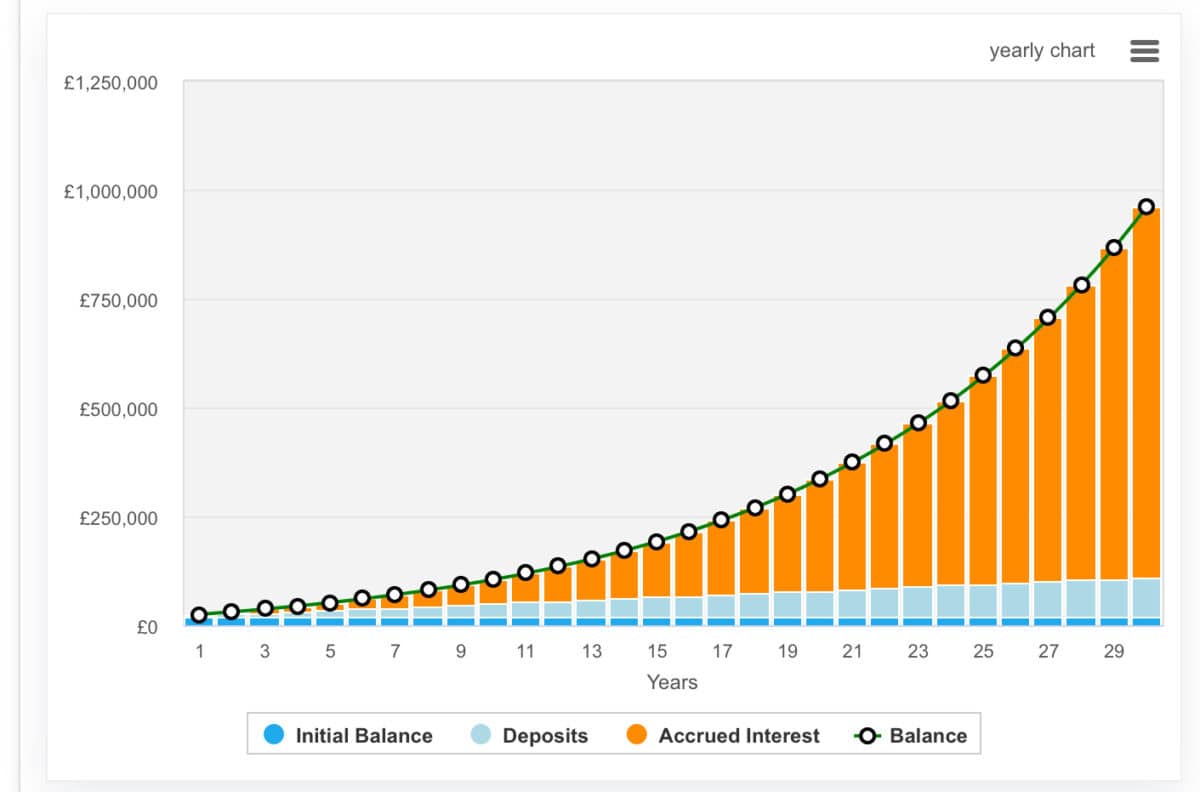
So let’s crunch the numbers. Starting with £20,000 and adding £250 a month, an average annual return of 10% over 30 years could grow the investment to an impressive £961,000. And with £961,000, I’d be able to generate around £48k annually — or £4,000 monthly — if I invested my pot in dividend-paying shares with an average yield of 5%.

Created at: thecalculatorsite.com

Where to consider investing

Many social media influencers will recommend investing in global index trackers to obtain maximum diversification while growing wealth. I can’t disagree that these vehicles are excellent for diversification and the long-run performance is strong, beating savings accounts by some distance.

However, investors may also want to consider a more growth-oriented approach through Scottish Mortgage Investment Trust (LSE:SMT). This FTSE 100 stock’s delivered impressive long-term performance, with a 10-year total return of 365.1% compared to the Global AIC sector’s 236.6%. 

The trust focuses on high-growth technology and tech-affiliated stocks, with top holdings including SpaceX (7.5%), Amazon (6.3%), and Meta Platforms (4.6%). Despite its strong track record, investors should be aware of potential risks such as economic slowdowns and trade tariffs, which could disproportionately affect the tech sector. 

Nonetheless, the trust’s diversified approach, with 95 different holdings, helps mitigate some of these risks. Currently trading at a discount to its net asset value, Scottish Mortgage offers investors exposure to both public and private companies in the fast-growing technology sector.

This stock could help multiply wealth and help investors actualise their second income goals faster.

This British wine-producing penny stock might just be vastly undervalued

Chapel Down Group‘s (LSE:CDGP) a penny stock and it’s offers investors a unique and fairly compelling investment opportunity.

While the share price has collapsed over the last 12 months, the stock offers a combination of tangible assets, premium brand value, and strategic growth in the English wine sector.

However, investors must also weigh operational risks tied to agricultural volatility and market dynamics.

A potential undervaluation

In 2023, Chapel Down reported £34.3m in net asset value — this is where a lot of my interest lies. This includes high-quality, appreciating assets such as 1,023 acres of planted vineyards (414 hectares), with over 595 acres on Kent’s chalk-rich North Downs — a terroir comparable to Champagne.

Interestingly, the board noted that book values likely understate market prices for these strategic land holdings and production infrastructure.

The company’s recent £32m Canterbury winery expansion, approved despite its Area of Outstanding Natural Beauty status, will boost production capacity to 9m bottles annually by 2032. That’s up from 1.5m in 2021. The group’s assets include £22.6m in wine stock.

This is all particularly intriguing given the company’s currently valued at £57m. Subtracting the net debt position (£9.2m) from the company’s assets (which will have appreciated given the debt-funded planting of 118 acres in Buckwell), the actual value of operations is around £30m.

Is the business worth more than £30m? Well, there’s a lot of maths to do here and some unknowns. Will it need to take on more debt to reach that 9m bottle target for 2032? However, assuming modest debt growth, my feeling is that the brand’s undervalued, based on asset value, potential earnings growth in the 2030s, and its very strong brand value — Chapel Down enjoys unrivalled brand prestige in English wine.

Risks: agricultural volatility and market pressures

Nevertheless, there are some risks that need to be accounted for. Wine production remains a very climate dependent operation and the harvest for 2024 is expected to be half the size of that achieved in 2023. Management has already downgraded its sales guidance.

This adds a degree of jeopardy to the company’s expansion plans. What’s more, the firm has abandoned plans to put itself up for sale, putting some downward pressure on the stock — buyouts typically lift shares higher. Moreover, even after a blowout harvest, the stock was trading around 50 times earnings. Clearly, this business is valued on future earnings potential.

A risk worth taking?

Chapel Down combines scarce, appreciating agricultural assets with a luxury brand positioned to benefit from English wine’s global emergence. While exposed to sector-wide climate risks, its scale (largest UK producer), vertical integration, and brand equity create margin advantages versus peers.

It’s certainly an interesting proposition. What’s more, with 2,000 shares (£700’s worth at the current share price) I’d get 33% off all full-priced wines bought directly from Chapel Down. Needless to say, if you serve it at your wedding, which I did, this shareholder benefit can pay for itself.

Bring this all together, and weigh the risks involved in the expansion, the stock could be vastly undervalued. It’s one I’m considering carefully at the moment.

2 ways to target big riches with FTSE 250 stocks!

Investing in FTSE 250 stocks can be a great way to aim for substantial long-term wealth. With this in mind, here’s a top stock and a low-cost fund for savvy investors to consider today.

The growth AND dividend stock

Alongside plenty of top growth stocks, the FTSE 250 is also home to many big-paying dividend shares. Bank of Georgia (LSE:BGEO) is one I think deserves serious attention right now.

The large dividends it’s famed for could give investors a steady stream of income to invest, accelerating wealth growth through compounding. For 2025, the bank’s dividend yield sits at a fatty 5.2%. This reflects the firm’s capital distribution policy, which targest a payout ratio in the range of 30% to 50% of annual profits.

Bank of Georgia shares provide a way for investors to tap fast-growing emerging markets at the crossroads of Asia and Europe. The business, which is a leading player in Georgia’s financial services industry, also has a growing presence in Armenia.

This dual approach is giving revenues and profits growth an additional boost. In the nine months to September, pre-tax profits here leapt 44% year on year.

As these results show, Bank of Georgia has considerable appeal as a growth share as well as a dividend stock.

Since 2018, Bank of Georgia’s provided an average annual return of 16.6%. Political turbulence in the country could impact future returns. But on balance, I’m still optimistic about the company’s long-term outlook.

As ratings agency Fitch recently commented: “the elevated political and governance risks that threaten banks’ liquidity and local-currency stability are reasonably balanced by the banking sector’s resilience to current political risks, with many credit metrics exceeding historical averages“.

The risk-reducing fund

Purchasing an exchange-traded fund (ETF) could be another lucrative way to target the FTSE 250. Tracker funds like this can harness the index’s growth and passive income potential while reducing investors’ risk.

The Xtrackers FTSE 250 UCITS ETF (LSE:XMCX) is one such fund I think’s worth considering. With an ongoing charge of 0.15%, it’s one of the cheapest vehicles out there tracking the UK mid-cap index.

By giving exposure to the whole FTSE 250, the fund spreads risk across hundreds of companies in different sectors and sub-sectors. To give you a flavour, some of its largest holdings include fashion house Burberry, financial services provider IG, and real estate investment trust (REIT) Tritax Big Box.

With a 3.3% dividend yield, too, and a structure than facilitates dividend distribution, it can also provide a healthy passive income for reinvestment.

The fund’s not delivered as strong a return as Bank of Georgia shares have in recent years. However, its index-tracking approach has still provided a solid annual average return of 5.7% since its creation in 2007.

Despite its risk-mitigating qualities, the fund could still underperform during broader stock market downturns. Yet on balance, I think it could still be a great long-term asset to own in a portfolio of FTSE 250 shares.

Please note that tax treatment depends on the individual circumstances of each client and may be subject to change in future. The content in this article is provided for information purposes only. It is not intended to be, neither does it constitute, any form of tax advice.

How much would I need in an ISA to earn a £1,000 monthly second income?

Different people have different goals when it comes to utilising a Stocks and Shares ISA. While I like the idea of owning shares that go up in value over time, I also appreciate the passive income potential offered by an ISA. By compounding dividends within the ISA, I can potentially set up a future second income stream in a tax-effective manner.

Please note that tax treatment depends on the individual circumstances of each client and may be subject to change in future. The content in this article is provided for information purposes only. It is not intended to be, neither does it constitute, any form of tax advice. Readers are responsible for carrying out their own due diligence and for obtaining professional advice before making any investment decisions.

Understanding how much income an ISA can generate

The size of the second income I might earn depends essentially on two things: how much money is in the ISA; and the dividend yield I could earn from it.

Even being aggressive about yield – say double the current FTSE 100 average, so 7.2% — investing my full £20k annual Stocks and Shares ISA allowance would earn me £1,440 in dividends a year.  That equates to a second income of £120 each month.

That would be welcome. But it is a long way from £1,000 a month!

How taking the long-term approach can help

Still, if I had the right timeframe I could hit that target even while putting no more than £20k a year into an ISA.

Say I (or any investor) put £20,000 into an ISA each year and it compounded annually at 7.2%, then after just six years it would have enough money in it that a 7.2% yield would generate over £1,000 in monthly income.

Indeed, although not necessarily using my full allowance each year, that is the approach I take. I could still get to a monthly £1,000 second income using it, although if I contribute less each year than in my example, it will take me longer.

Finding shares to buy

How realistic is a 7.2% compound annual gain? I think in the current market an investor could potentially achieve it while sticking to proven blue-chip shares. To reduce risk, diversifying across multiple shares would be a simple but smart approach.

As an example, one share for an investor to consider for their Stocks and Shares ISA is British American Tobacco (LSE: BATS). Its current yield of 7.1% is very close to my example. On top of that, the prospective yield may be higher if the tobacco maker keeps increasing its dividend per share annually as it has done since the last century.

Whether that happens, only time will tell. The company plans to keep growing its dividend but, in reality, no dividend is ever guaranteed.

One big risk here is that as fewer people smoke cigarettes in many markets, revenue and profit will decline at the company. Indeed, that is exactly what happened last year.

Still, the company is a massive cash generator and helps a lot of shareholders as they build a second income. Cigarette use is declining but remains substantial.

It is a business with high profit margins and the product’s addictiveness combined with British American’s premium brand portfolio gives it pricing power.

Looking to get ‘ISA rich’? Here’s one top strategy to target huge wealth

The Individual Savings Account (ISA) is a fantastic tool to help Brits build long-term wealth. As a saver or investor, I don’t pay a penny in tax on interest, capital gains, or dividends, which in turn could potentially boost my retirement fund by tens — or even hundreds — of thousands of pounds.

Having said that, not all ISAs are created equally. Put simply, the difference in returns one can expect to make from a Cash ISA and a Stocks and Shares ISA is colossal.

And over time, the choice I make between these two can have a significant impact on my standard of living in retirement.

Cash vs shares

Holding money in a savings account has some big advantages, no doubt. It’s hassle free — savers don’t need to trouble themselves with researching and then buying shares, trusts, funds, or other exchange-traded assets.

On top of this, cash savings offer security, as they are immune to the volatility of stock markets.

Having said that, these benefits come at a huge price. According to AJ Bell, the average rate of return for a Cash ISA over the last 10 years is 1.2%.

To put that in context, the corresponding return on a Stocks and Shares ISA towers over this, at 9.6%.

Let’s see the difference these differences could make on an investor’s wealth-building capabilities over the long term.

If someone was to invest £300 in a Cash ISA each month, they would — after 30 years — have £129,921 in their retirement fund. That’s far below the £622,924 that a Stocks and Shares ISA could have made over the same period.

A top fund

As I say, a Cash ISA allows individuals to essentially eliminate capital risk and volatility. Yet it’s critical to note that Stocks and Shares ISA holders can also, with the right approach, effectively manage risk to their money.

This can be done by building a balanced portfolio of shares spanning different industries, sub-sectors, and geographies.

A quick and easy way to achieve this can be by buying an exchange-traded fund (ETFs) that holds a basket of assets. Based on past performance, the iShares FTSE 250 ETF (LSE:MIDD) could be a top one to consider.

Since its creation almost 21 years ago, this fund’s delivered an average annual return of 8.5%. Combined with some ‘riskier’ individual shares, investors could have a good chance of hitting (or even exceeding) that 9.6% Stocks and Shares ISA average return.

This iShares ETF provides investors with attractive growth and dividend potential. Its focus on mid-cap stocks has produced healthy capital gains driven by earnings expansion. A forward dividend yield above 3% also provides a healthy passive income.

At the same time, its 250-odd holdings spanning sectors like financial services, consumer goods, and real estate help to diversify risk by reducing exposure to any single company or industry.

The fund this can still dip when economic conditions worsen and broader stock markets dip. But while past returns aren’t a reliable guide to the future, I’m optimistic it will keep providing a Cash ISA-beating return over the long term.

2 flying penny stocks to consider that could turbocharge an investor’s ISA!

Looking for the best penny stocks to consider buying? Here are two soaring UK shares I think are worth a closer look from ISA investors.

Alternative Income REIT

While most penny stocks are geared for growth, Alternative Income REIT‘s (LSE:AIRE) aim is to provide a reliable stream of dividends.

Like all real estate investment trusts (REITs), it’s designed to pay at least 90% of annual rental earnings to shareholders. This is in exchange for breaks on corporation tax.

As a result, the company’s forward dividend yield‘s an eye-popping 8.9%.

After a bumpy start to the year, Alternative Income’s bounced back and climbed more than 12% in the last two weeks. It’s risen as the Bank of England cut interest rates and signalled that several more could be coming. Lower rates boost REITs’ profits by lowering borrowing costs and supporting net asset values (NAVs).

I think this particular property giant could be worth considering because of its diversified model. The trust owns a portfolio of cyclical assets like hotels, retail parks and industrial units. Given the gloomy outlook for the UK economy, this leaves the door open for rent collection problems and occupancy issues.

Yet having said that, Alternative Income’s substantial exposure to defensive sectors (like gyms, power stations and residential property) means it exposes investors to far less risk than many other REITs.

At 73.2p per share, it trades at an 11% discount to its estimated NAV per share of 81.8p. This could leave room for additional impressive share price gains.

Please note that tax treatment depends on the individual circumstances of each client and may be subject to change in future. The content in this article is provided for information purposes only. It is not intended to be, neither does it constitute, any form of tax advice.

Pan African Resources

At 41.2p per share, Pan African Resources‘ (LSE:PAF) share price is up 16% since the start of 2025. I think it could have much further to go as gold prices shoot through the roof.

After printing 40 new record highs last year, the yellow metal’s off to a flyer in 2025 and hit new peaks around $2,885 an ounce this week. A push through $3k seems inevitable, in my opinion, a key technical level that could itself prompt further price rises.

Of course there’s no guarantee that bullion prices will remain ascendant, adversely impacting profits at gold stocks like Pan African. A rising US dollar could pull the precious metal lower, as could resurgent demand for riskier assets from traders and investors.

But on balance, the outlook for safe-haven gold continues to glisten. Tension over US President Trump’s policies — from new tariffs that could stoke inflation, to discussions about invading Greenland and more recently Gaza — looks set to persist.

Other price drivers include strong central bank gold buying, worries over growth in key economies, and a new geopolitical world order.

Pan African Resources is one of my favourite gold stocks right now. With production also ramping up, City analysts expect earnings to soar 82% this financial year (to June), and another 43% the following year.

As a consequence, the miner trades on a forward price-to-earnings (P/E) ratio of just 6.7 times. This leaves plenty of scope for further price increases if gold, as I expect, keeps charging northwards.

Time to buy Nvidia shares before fresh all-time highs?

Nvidia (NASDAQ: NVDA) shares have taken quite the nosedive. A 17% drop in a single day grabbed most of the headlines, but the stock has been down 22% at its lowest, after kicked off 2025 at an all-time high. The $116 share price was one some talking heads said we’d never see again. Is it time to buy the dip before new all-time highs? Or could this one have further to crash?

AI dominance

To understand the appeal of Nvidia shares, it’s worth taking a moment to assess just how dependent large language models (LLMs) are on its chips. 

When ChatGPT launched, Nvidia made the best GPUs for it. It had a head start. And that resulted in 90% or so of the chips used being from Nvidia. 

But ChatGPT debuted, if you can believe it, nearly two and a half years ago. Tonnes of rival LLMs have hit the market, like Claude, Grok, and Gemini. Surely Nvidia’s competitors have had a chance to catch up? 

Well, not really. The percentage of Nvidia’s chips is thought to still be around 85%. Nvidia is halfway down the track while its competitors haven’t even finished tying their shoelaces.

It’s the kind of seemingly unassailable lead that easily explains why Nvidia shares have multiplied 11 times in value since LLMs burst onto the scene. AMD shares haven’t even doubled. Intel shares are down 38%. Crikey.

Why did the stock drop?

So what’s this drop about, then? A 22% fall is nothing to sniff at. Is it a sign that Nvidia’s dominance has an end in sight? 

Well, the basic story is that a Chinese startup named Deepseek made an LLM for a fraction of the cost of all the others. The relevant point to Nvidia is that it doesn’t need as many chips, which could make a long-term dent in sales.

The counterargument goes that this has kicked the door wide open to widespread adoption of AI. We might see custom models running on the smartphones we all have in our pocket.

If that’s the case, then Nvidia could come out on top again. After all, their chips are still the best in class. The hubbub around Deepseek could end up increasing sales. 

My opinion

Personally, I don’t think the investment case has been harmed much in the last week. An investor lacking exposure to the benefits of AI may want to consider buying in at the discounted price. 

What is informing my decision is the valuations – currently a price-to-earnings ratio of 48 with a forward P/E ratio of 30. Those aren’t cheap, though they aren’t astronomical either for a company with such good growth prospects. 

The issue is that earnings have been elevated thanks to the AI gold rush. It is rumoured that most of the sales come from four or five megacap tech firms. Combined with my exposure in other areas, that seems like too much risk for me.

Financial News

Daily News on Investing, Personal Finance, Markets, and more!

Financial News

Policy(Required)