Here’s why I’m buying FTSE 100 shares not S&P 500 stocks

The S&P 500 index of leading US companies includes some that have seen massive success in the past few years, from Nvidia to Apple.

I owned Apple shares several years ago and both it and Nvidia are on my shopping list if they become available again at what I think is an attractive valuation.

in recent months though, I have bought some FTSE 100 shares but not S&P 500 ones. Here’s why.

Buffett on the circle of competence

A basic but important consideration is that, like billionaire investor Warren Buffett, I think I can give myself the best chance of stock market success by sticking to what I know and understand. Buffett refers to it as a circle of competence.

I understand a fair bit of the US economy and do invest in some US stocks. But overall, I have a better handle on what is happening in the UK, so feel better able to spot some investment opportunities here.

Take JD Sports Fashion (LSE: JD) as an example. When it announced last year that it was taking over US rival Hibbett, I was already very familiar with JD — but had never heard of Hibbett.

Attractive valuations

In fact, JD is one of the FTSE 100 shares I have been adding to my portfolio lately and I feel it is worth other investors doing further research into it too.

That may seem surprising. Its share price in the past five years tumbled 49%.

Nor is its yield of 1.1% even that attractive for a FTSE 100 firm.

The average yield in the blue-chip index right now is 3.6%, so the JD one is much closer to the S&P 500 average of 1.2%. While JD may not be a good illustration in this regard, juicy yields in general are also an attraction of many British over American shares to me at the moment.

But the key attraction for JD as far as I am concerned is its valuation. That share price fall combined with long-term business growth means that it now trades on a price-to-earnings (P/E) ratio of 13. Knocking out exceptional items (JD is investing heavily in expanding its store network) the valuation looks even cheaper.

That is close to the average P/E ratio of FTSE 100 shares, currently at 15. That is half the S&P 500’s P/E ratio of 30.

I think that means British shares are much better value, but I could be wrong. If I buy a share that looks undervalued, the business may perform well but the valuation gap will not necessarily close (it could even get wider). A lot of investors prefer to invest in the US than the UK at the moment.

Exchange rate risks

Another point I consider when buying shares is any exchange rate risk. If I bought an S&P 500 share today, I could see its (dollar) price grow but end up losing money when I sell if the exchange rate moves unfavourably.

The reverse could also happen though, and I might benefit from currency fluctuations.

On top of that, though a share like JD is denominated in sterling, a lot of its revenues are in US dollars since the Hibbett takeover and indeed other currencies. It also sources internationally so has exchange rate risk in its supply chain.
Will Tesla stock keep going downhill?

Over the past year, Tesla (NASDAQ: TSLA) has doubled in value. But while that 100% growth is incredible, has the tide turned? Tesla stock has crashed 22% from where it stood barely a week before Christmas.

For a company with a market capitalisation north of a trillion dollars (still), that is a big fall. Is this a buying opportunity for me, or just the start of a rapid downhill road for Tesla stock?

What to look at here

I do not know where the share will go from here. Nobody does. But quite a few things are making me nervous right now about whether the business merits that valuation (or anything like it).

First is the company’s car business. After years of strong growth, sales volumes last year declined (albeit only slightly).

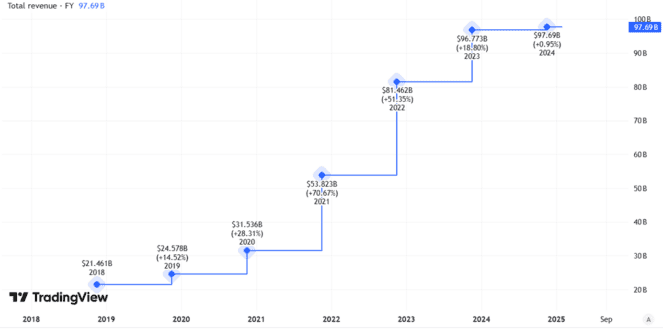
But the market overall is still growing. Tesla is increasingly being outpaced by rivals such as BYD. So while the company’s total revenues grew last year (and are substantial) that growth was small.

Created using TradingView

Even if the car business should plateau – or sees sales falling this year, which is a risk given growing competition – Tesla has more than one string to its bow.

It has used its energy storage expertise to build a business in that field. It is expanding rapidly and I see strong further growth opportunities.

But surely the recent Tesla stock price cannot be justified just by the car business and energy storage opportunity? I think Wall Street has been factoring in a big premium for the potential dangled by two things: self-driving taxis and robotics.

A tough environment and getting tougher

Tesla has good opportunities in both areas. But so do multiple competitors. Alphabet subsidiary Waymo is already pulling ahead of Tesla in rolling out self-driving taxis.

In any case, the business model for that market remains to be seen. If it is too crowded, players may compete on price and turn self-driving taxis into a money pit not a money maker. Uber is profitable now, but for a long time it burnt cash like nobody’s business.  

In robotics too, Tesla is eyeing a crowded field. Not only does the business model remain to be proven but I am unclear that Tesla has a unique competitive advantage to set it apart from other robotics manufacturers.

Things could get worse

If we ignore valuation for a moment, I see a lot to like about Tesla. While the car business looks like it may be running out of steam for now, it is still huge and simply maintaining current sales should be enough to make serious money.

The energy storage business is growing well and Tesla has strong expertise. Other ventures such as self-driving taxis can be seen as potential growth drivers.

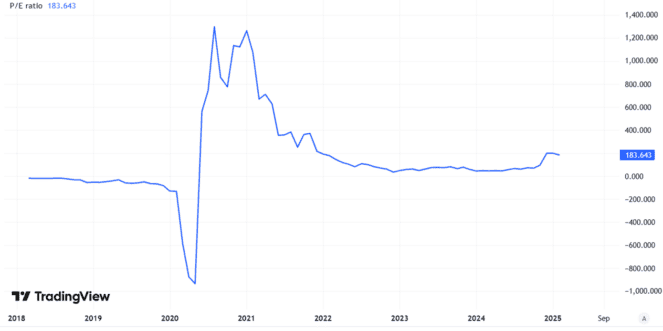
As an investor though, I cannot simply ignore valuation. Tesla stock is selling on a price-to-earnings ratio of 184, which strikes me as very expensive. Sure, it has long looked expensive.

Created using TradingView

But having been expensive in the past does not mean that being expensive now equals a reasonable price.

Growth prospects in Tesla’s car business look worse than previously. Other ventures like self-driving taxis are interesting opportunities at this point, but not proven businesses.

I think Tesla stock looks badly overvalued and have no plans to buy.

This US growth stock crashed 99%… then soared 6,398%!

I had never come across US used car sales platform Carvana (NYSE: CVNA) until several years ago when someone told a story about selling an old secondhand car for more than they had bought it for. That struck me as odd and so I looked into the growth stock and its business model.

Clearly, I was not the only one who struggled with the commercial logic. Between August 2021 and December 2022, Carvana stock lost 99% of its value.

At that point, I am sure a lot of investors must have wondered if things were over. Far from it. In little over two years, the growth stock has soared 6,398%.

What on earth’s going on with this valuation?

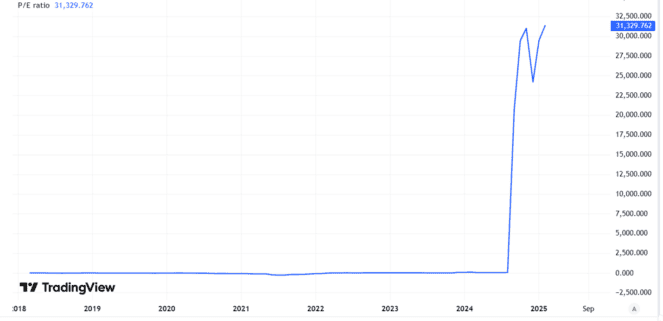
That means Carvana is now trading on a price-to-earnings (P/E) ratio of over 28,000. Yes, you read that correctly.

Created using TradingView

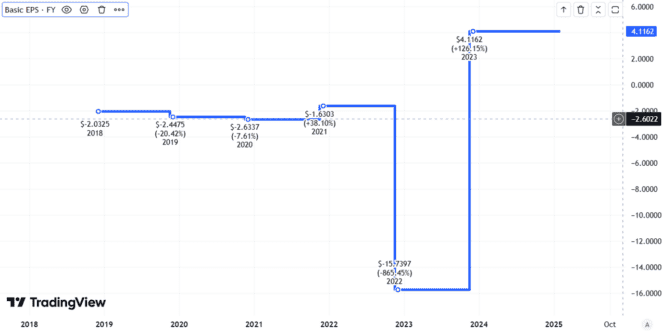
Still, at least it made a profit last year. That came after many years of losses.

Created using TradingView

But… a P/E ratio in tens of thousands? Has the US market gone totally mad?

Not necessarily. Carvana has a market capitalisation of $55bn. Clearly there is some serious money invested here.

The company has developed an innovative business model at scale. In its most recently reported quarter, it sold 109,000 cars and generated revenue of $3.7bn.

When the growth stock crashed that reflected a number of risks: volatile pricing in the second hand car market, concerns about the quality of Carvana’s loan book, its ability to keep servicing it, and the company’s losses at that point.

Now, investors seem to be looking from the other side of the lens. Carvana is profitable and growing fast. It has economies of scale that in a platform model like this can be a virtuous circle.

The more buyers and sellers it serves, the better it understands the market and the stronger its offering for consumers becomes. (Although the business model is different, this sort of platform-based virtuous circle can be seen on this side of the pond at Auto Trader).

I’m not going anywhere near this

However, while the 99% crash now looks overdone in retrospect, I also am sceptical that the 6,398% share price growth is reasonable.

Although Carvana is profitable, that is on an accounting basis. It was still lossmaking at the operational level in its most recent full-year results.

Seeing this purely as a car trading platform (similar to, say, eBay) misses a large part of what attracts investors – and also what I think is a key risk.

Carvana’s model is as much (or more) about being a financing company as it is about buying cars, reconditioning them and selling them on.

That large book of auto loans concerns me. Carvana has been heavily reliant on reselling them to one buyer (Ally Financial). That causes a big concentration risk, should the relationship between Carvana and Ally sour.

Even beyond that though, US car loans historically have higher default rates than some other types of borrowing like home mortgages.

In a weak economy I expect used car loan default rates could grow, making it harder for Carvana to offload its loans onto Ally (or anyone else) at an attractive price.

The risks here are well above my comfort level, even for a US growth stock. I have no plans to invest.

3 brilliant pieces of investing wisdom from Warren Buffett

It can be easy to see Warren Buffett’s investing experience as different to our own. After all, he lived in what may now look like glory days of cheap valuations and little-known local gems.

In fact though, the vast majority of Buffett’s money has been made in the later part of his career. A lot of the approach he applies can be used even by a novice private investor on a tight budget.

Here are three great nuggets of investing wisdom from Buffett that I use myself.

1. Don’t bank on management alone, always look at the business model

Buffett has a lot to say about management. Like this: “When a management with a reputation for brilliance tackles a business with a reputation for bad economics, it is the reputation of the business that remains intact”.

From another angle, he said: “I try to invest in businesses that are so wonderful that an idiot can run them. Because sooner or later, one will”.

Buffett attaches great importance to having the best management possible. Nonetheless, his thinking is clear: good management is a bonus and cannot always be expected in practice.

Investing in a business that can survive even bad management is the smart approach.

2. Invest for the long term

Buffett has said that his preferred holding time is “forever”. In practice, he does sometimes sell shares. But clearly, he buys into the approach of being a long-term investor.

His investment in Coca-Cola (NYSE: KO) helps illustrate the potential benefit. In seven years up to 1994, his firm spent $1.3bn buying shares in the soft drink maker. Now, it gets over half as much as that every year in dividends – and the stake’s value has ballooned to over $25bn.

The business model is excellent. Coca-Cola makes a proprietary syrup at low cost that it can sell at attractive profit margins, thanks in part to strong branding and a developed distribution network.

Over time, the benefit of marketing spend accumulates to build customer loyalty and the company could reap the commercial benefits for years, or even decades.

3. Pay attention to risks, not just rewards

Coca-Cola was already a long-established and successful business decades before Buffett invested. While there is a lot to like about it, it does face risks.

Consumer concerns about sugar’s impact on health remain a risk to revenues, while competition is growing from companies launching non-traditional soft drinks such as non-alcoholic gin substitutes.

Risk looms large in Buffett’s analytical approach to making investments (or not). As he said: “The first rule of an investment is don’t lose money. And the second rule of an investment is don’t forget the first rule”.

Of course, sometimes even Buffett loses money. But the point I think he is making here is that he spends a lot of time trying to weigh risks carefully. He focuses at least as much on what might go wrong if buying a particular share at a certain price as what may go right.

With just £5 a week to spare, here’s how someone could start investing – and aim big!

When money is tight, it can feel difficult to think about investing. But my own approach is to invest through thick and thin. So if I had even just £5 a week to spare, I would happily put it into the stock market.

Not only do I think regular contributions are a useful approach for me now – I would do the same if I was to start investing for the first time. In fact, I think most people could do that.

Here is how someone with no stock market experience could start buying shares for a fiver a week.

Putting aside money regularly to invest

Five quid a week may not sound like a lot. But bear in mind two things.

First, over a year, it would add up to £260. Across a decade, that would amount to £2,600. In other words, little contributions can be the foundation of something more substantial over the long run.

Secondly, £5 is simply a start. Over time, if an investor has more spare money, they could speed things up by raising their regular contribution.

How to put that money to work? Buying shares requires an account such as a share-dealing account or Stocks and Shares ISA. Setting one up can be easy and quick, though as there are lots of options available I think it makes sense for an investor to spend some time comparing those options.

Aiming high over the long run

How much might someone make from such an approach? Imagine they start investing today with £5 a week and achieve compound annual growth of 10% (which of course is not guaranteed) via a mixture of share price growth and dividends.

By 2050, the portfolio could be worth over £26,700. Of that, just under a quarter is the £5 a week and the rest is all stock market return.

Incidentally, if instead of £5 a week the investor doubled the contribution to £10 a week from the beginning, after the same time period of 25 years the portfolio would be worth over £53,000.

Finding shares to buy

I think a 10% compound annual growth rate is achievable, but it is not easy. Share prices can go down as well as up and dividends are never a dead cert.

One share I think is worth considering for a beginner is British American Tobacco (LSE: BATS).

It has a 7.2% yield and has raised its dividend annually for decades. The share has soared 39% in the past year, although over five years it has fallen 5%.

I think that long-term performance reflects a big risk: declining numbers of cigarette smokers could hurt revenues and profits. Indeed, last year the company’s cigarette sales volumes fell significantly.

But its portfolio of premium brands such as Lucky Strike give it pricing power. Although declining, the cigarette market remains substantial and I expect it to remain that way for decades.

On top of that, the company is using its brands and distribution network to grow its non-cigarette business at speed.

2 retirement shares that long-term investors should consider for steady income

Picking the right retirement shares is a tricky business. Dividends can help fund plans well into the future, but even the most reliable payouts can be cut, delayed or even scrapped entirely.

Of course, diversification is key when building a portfolio for the long haul. Reducing single-stock risk in a portfolio is a bit of an easy win, and can help to weather the storm as the market has its ups and downs over time.

However, there are still a couple of large-cap stocks I like as retirement portfolio prospects. Both companies have strong business models, are industry leaders and have a history of stable or growing dividends.

I think investors who are building up their retirement portfolio with a long-term view should consider if either of these two are right for them.

Consumer goods giant

Unilever (LSE: ULVR) is the first of my retirement shares to consider. With a dividend yield of 3.2%, the stock pays a solid if slightly-below-average payout compared to the wider FTSE 100 index.

What I really like is the diverse brand portfolio across verticals like personal care, home cleaning and food products. This broad range gives Unilever access to a huge customer base with diverse tastes and helps to steady demand even when times get tough.

Management has shown a willingness to pay a reasonable and sustainable dividend over time. In fact, Unilever hasn’t paid a quarterly dividend of less than 30p per share since March 2017.

While Unilever is a globally recognised brand and industry leader, it’s not without its risks. Being consumer-facing can be a tough business, particularly if the economy slumps. While the product range can help, the consumer goods business is fiercely competitive. Shifting consumer habits, combined with ever-present cost pressures, could impact future profitability and limit dividend growth..

Pharmaceuticals giant

AstraZeneca (LSE: AZN) is another income stock that has caught my eye. Pharmaceutical stocks are often seen as a defensive play, and AstraZeneca is a prime example. I think the firm’s cutting-edge drug pipeline and global footprint position it well for sustained long-term growth.

The company’s dividend yield of 2.1% isn’t the punchiest on the market. However, I like the non-cyclical nature of the industry it operates in, which could help to deliver consistent payouts through the economic cycle.

Like Unilever, it is also recognised as a global leader in its field. The company’s valuation in excess of £170bn also makes it the largest company in the Footsie by market cap.

Significant reinvestment in research and development has helped to boost revenue growth and I think the company is well-positioned to deliver future dividends to investors.

That said, there are no guarantees in the pharmaceuticals business. Competition is rife, drugs are subject to rigorous trials, there are regulatory hurdles, and patents don’t last forever.

Research and development costs are high but returns can take years to materialise (if at all). That means future earnings can be uncertain despite the more defensive nature of the industry.

Verdict

Both Unilever and AstraZeneca offer attractive qualities as possible retirement shares.

While their yields aren’t the highest, their defensive nature and consistent performance make them potentially appealing and worth considering. Spreading investments across multiple shares can help to build a balanced portfolio, reducing overall risk and providing greater peace of mind.

With a 10.1% yield, should I buy this FTSE 250 income stock?

Ashmore Group‘s (LSE:ASHM) a relatively unknown income stock that tends to keep a low profile. In 2024, it only made 20 stock exchange announcements. If the mandatory releases about shareholdings in the company — and changes in directors — are removed, the number falls to nine. It really does fly under the radar.

What does it do?

The company makes its money by charging fees for managing investments in over 70 emerging markets. Of the assets it looks after — mainly equities and fixed income securities — 96% come from what are described as “institutions”. These include central banks and pension funds.

Ashmore claims these markets have better growth potential than more developed ones. In 2025, these economies are expected to have a 2.6% higher growth rate. The company argues that the world’s estimated $100trn of assets are underweight in emerging markets. It claims the developing world offers better value than, for example, US tech stocks.

The company says it has a “distinctive” business model. There’s a “no star culture” with its 100+ investment professionals judged on performance rather than reputation. The company also claims its costs are well controlled, which means its operations are easily scalable. And it has a strong balance sheet with no debt.

For the year ended 30 June 2024 (FY24), the company generated revenue of £187.8m. Its earnings per share (EPS) was 13.6p. This means the stock at 7 February trades on a historically low multiple of 12.4.

And the company’s one of the most reliable dividend payers around. It’s maintained a payout of 16.9p for the past five fiscal years. Before that – from FY15 to FY19 – it paid 16.65p each year.

Based on dividends over the past 12 months, it’s the third highest-yielding stock in the FTSE 350. It presently offers a yield of 10.1%.

A worrying long-term trend

However, despite these positives, I’m not going to invest in the company. That’s because its assets under management (AuM) have been steadily declining in recent years. At the end of FY20, it was responsible for $83.6bn of investments. Four years later, this was $49.3bn. And the company’s latest results reveals a further fall – at 31 December – to $48.5bn.

Ashmore blames this on a sharp rise in inflation, a rapid tightening of monetary policy, global inflation and the pandemic. Whatever the reasons, a fall in its AuM’s going to put pressure on its income and, ultimately, could threaten its dividend.

Also, if I’m honest, the only reason this stock caught my attention is because of its generous yield. Turn the clock back five years, its dividend was the same as it is today. Yet it was yielding a more modest 3%.

The reason for the impressive yield’s due to a fall in the company’s share price rather than a rise in its payout.

The reduction in client funds is clearly a concern for investors. And having a dividend higher than its EPS isn’t sustainable. In recent years, it’s been able to maintain its payout by selling some of its own relatively modest investment portfolio.

For these reasons, I don’t want to include Ashmore Group’s stock in my portfolio. However, my review of the company is a useful reminder that apparently generous dividend yields should be treated with caution.

Up 23% in a month, can this FTSE 100 stock continue to soar?

Airtel Africa‘s (LSE:AAF) been the top-performing FTSE 100 stock in the last month. The share price is up 26.85% – enough to generate a £268 return on a £1,000 investment.

There are also a lot of potential growth opportunities ahead of the company over the long term. So should investors think the stock can keep climbing for a long time to come?

Opportunities

Airtel Africa’s success hasn’t just come in 2025. Over the last five years, the share price has almost doubled as the company has increased its subscribed base by just under 50%. 

The company provides mobile phone, data, and mobile money services in 14 African countries. And despite its impressive growth since 2020, there’s still a big market available.

The total population of the countries Airtel Africa operates in is 500m. And mobile penetration’s below 50% in some of those countries, while less than 30% of people have a bank account.

These are countries where the median age is around 20 and the population”s growing. So it’s easy to see why there could still be a long way to go for the company and the stock.

Currency

There are however, some big risks that come with investing in this type of business. The most obvious is the currency risk. 

Over the last five years, the value of the Nigerian naira against the British pound has fallen by 75%. And if this continues, it could significantly weigh on profits.

With other currencies – like the US dollar – investors might think the risk of fluctuating exchange rates is small enough to ignore. But I don’t think that’s so easy to do in this case. 

Forecasting exchange rates isn’t easy. But given the potential significance, I think the continued decline of the Nigerian naira is something Airtel Africa shareholders have to plan for. 

Capital intensity

The other big risk with Airtel Africa is that providing mobile services requires a lot of infrastructure, such as mobile towers and fibre optic networks. And this is expensive to install and maintain. 

In general, investors need to be wary of businesses that have high ongoing capital requirements. This can cut into the cash that’s available for things like dividends and share buybacks. 

Companies like BT in the UK and Verizon in the US generally haven’t been great stocks to own. And their constant need to maintain their infrastructure has been a key part of this. Arguably however, this is because they haven’t had same growth prospects as Airtel Africa. And a weaker Nigerian naira actually has the effect of making ongoing expenses less onerous.

Is there more to come?

With a huge market still to address, Airtel Africa arguably has better growth opportunities than any other FTSE 100 company. What that means in terms of investment returns however is less clear. 

I wouldn’t be surprised to see the stock continue to climb. But there’s too much uncertainty for me to want to buy, especially when I think there are more obvious opportunities elsewhere.

£20,000 in savings? Here’s how an investor could use it to target an eventual £980 of passive income each month

Passive income plans come in all shapes and sizes. One I use is putting spare money into the shares of blue-chip companies with proven business models. Then sitting back and twiddling my thumbs while they pay me dividends.

Such an approach can also be lucrative, for those with some patience. Here is an example of how an investor with £20k could target an average passive income of £980 each month.

Letting dividends earn dividends

I say patience is important because the essence of this plan is not just earning dividends from that £20k, it is also then earning dividends from those dividends.

This approach is called compounding and it can be great at creating wealth, but it takes time to work. So imagine the investor put the £20k into shares yielding an average of 7.1%. After one year, that would produce £1,467 of dividends. Adding them to the investment, the second year’s haul should be £3,041. And so on…

Compounding like this for 30 years, the portfolio would be worth over £167,000. At a 7.1% yield, that would generate over £980 a month in dividends.

Smart principles of investing

I think 7.1% is achievable in today’s market, although it is well above the FTSE 100 average of around 3.6%.

Focussing only on yield can be dangerous though, as dividends are never guaranteed to last. So instead, I try to buy shares in great companies at attractive prices, only then considering the yield.

An investor should also follow other principles of good investing, such as reducing risk by diversifying. £20k is comfortably enough to split across five to 10 different companies.

One example to consider

When I say 7.1% is achievable, I have quite a few shares in mind. As an example, one FTSE 100 firm I think investors should consider is British American Tobacco (LSE: BATS). At the moment it offers a 7.1% yield.

The business is simple but highly profitable and cash generative. Cigarettes are cheap to make. But as they are addictive and British American owns a portfolio of premium brands, it has what is known as pricing power.

That has helped it push up prices and generate lots of cash to pay dividends even while cigarette sales volumes fall. I see declining cigarette smoking as a big risk for the firm over the next decade or two.

It could hurt the dividend prospects. British American does aim to keep growing its payout per share annually though, as it has done since the last century.

Choosing a way to invest

With the right approach and a long-term approach then, I think an investor could realistically target £980 of passive income each month from £20,000.

The first move today would be choosing a share-dealing account or Stocks and Shares ISA to use for the purpose.

£10,000 invested in the S&P 500 at the start of 2025 is now worth…

Unusually, the FTSE 100‘s been faring better than the S&P 500 so far this year. US stocks were up 3.66% in the beginning of January – enough to generate a £366 return on a £10,000 investment. 

That’s not bad, but the FTSE 100’s up 5.66% in the same time. It’s unusual to see UK stocks faring better than their US counterparts, but the question for investors is, how long it can last? 

What’s been happening?

It might be a bit of a surprise to see the FTSE 100 outperforming the S&P 500. Especially when the US index has Palantir in it, which is up 46% since the start of January.

The FTSE 100 has nothing that’s up that much this year. But there’s a big reason why the success of Palantir – and some other stocks generating similar results – hasn’t pulled the S&P 500 higher.

The stock only accounts for around 0.5% of the overall index, so a 46% move higher in the share price translates into a shift of less than 0.23% for the S&P 500.

By contrast, over 7% of the index is accounted for by Apple (NASDAQ:AAPL). And the stock, down 4.36% since the start of the year, is more than enough to offset the gains from Palantir. 

Diversification

The issue’s actually worse than this.The seven biggest companies (by market-cap) make up around a third of the US index, but they’re also very similar businesses.

A prominent theme over the last week has been the stock market reacting negatively to companies proposing heavy investments in artificial intelligence (AI). And that’s an issue for the S&P 500.

This has been the case with Alphabet, Amazon, and Microsoft, which collectively make up around 15% of the index. When those stocks fall together, it’s hard for anything to offset this. 

The usual reason for investing in an index fund instead of buying individual stocks is diversification. But the benefit’s questionable when one stock going up 46% doesn’t offset another losing 7%.

Apple

Not all of the S&P 500’s big tech companies have been investing heavily in AI. Apple hasn’t – but the company arguably has other problems to deal with at the moment.

The latest earnings report indicated revenue growth of less than 2%, which doesn’t look strong. In fairness however, things are more impressive further down the income statement.

Sales in the Services division grew faster than the Products side of the business. And continued share buybacks meant earnings per share climbed 10%, which is more impressive.

The big issue the company’s facing however, is declining iPhone sales – especially in China. If that continues, it’s difficult to see how Services growth can continue indefinitely. 

US stocks

I have a more positive view about Apple shares than a lot of investors at the moment. Despite the slow sales growth on the Products side of the company, I think the stock’s worth considering seriously.

By contrast, I don’t see the S&P 500 as an attractive option for me. The index doesn’t currently offer the benefits of diversification, so I’d rather achieve this by building a portfolio of individual stocks.

Financial News

Daily News on Investing, Personal Finance, Markets, and more!

Financial News

Policy(Required)