I’ve been watching the easyJet share price like a hawk. Here’s what it did last week

The easyJet (LSE: EZJ) share price is stuck on the runway while British Airways-owner IAG takes off like a rocket.

Over the last year, IAG has soared 150%, while easyJet shares fell 6.5%. That’s a stark contrast. So why is easyJet so underpowered? More importantly, can it make up lost ground?

Judging by its low price-to-earnings (P/E) ratio of just 8.6, there’s a potential bargain to consider here. That’s well below the average FTSE 100 P/E of around 15 times.

Like every airline, it was hammered by the pandemic. IAG is over that. EasyJet isn’t. Why?

Can this FTSE 100 stock fight back?

It’s missed out on a key revenue driver that’s been boosting its rival – the transatlantic trade. EasyJet, being a short-haul European airline, isn’t benefitting in the same way.

The UK and European economies are both struggling, as the cost-of-living crisis drags on. easyJet’s customer base could feel the pinch. Budget airlines rely on strong demand, and any economic downturn could make people think twice about discretionary travel. Now they have Donald Trump’s trade tariffs to contend with too.

That’s a worry, with the Bank of England forecasting consumer price inflation will head towards 3.7% later in the summer.

easyJet’s Q1 results published on 22 January showed a £61m headline loss before tax for the three months to 31 December. However, that’s roughly halved from a £126m loss a year earlier. Lower fuel prices helped. Group revenues rose 13% to £2.04bn.

Bookings for summer 2025 look strong, suggesting demand remains resilient. Especially in its fast-growing holidays segment. easyJet says it’s still on track to hit its medium-term target to deliver more than £1bn of profit before tax.

A little income, a lot of potential growth

Last week, the shares climbed 3.5%. That’s a welcome move in the right direction, but IAG still beat it, growing 8%.

I expect easyJet shares to fly at some point. Investors who consider getting in before they take off should bag the best returns. But they may have to withstand some short-term volatility. Operating margins are forecast to drop from 10.3% to 7.1%. Volatile fuel prices remain a concern.

There’s a dividend, but it’s modest. The trailing yield is 2.3%. That’s forecast to hit 2.7% this year. Plus it’s comfortably covered 4.9 times by earnings, which suggests sustainability.

There’s plenty of optimism out there. The 20 analysts offering one-year share price forecasts have produced a median target of just over 705p. If correct, that’s an increase of around 33% from here. I fancy some of that.

Of the 21 analysts tracking the stock, 12 call it a Strong Buy, two say Buy and seven say Hold. None suggest selling.

I share their optimism. But I still think easyJet shares could be a bumpy ride. Investors considering the stock should take a minimum five-year view.

A £10,000 investment in Nvidia stock 6 months ago is now worth…

Nvidia (NASDAQ:NVDA) stock’s started to plateau after delivering some huge returns in recent years. Over six months, the stock’s up around 20%. This means £10,000 invested then would be worth £12,000 today, plus a little extra given the depreciation of the pound.

However, the trajectory certainly hasn’t been smooth. Six months ago, in early August, artificial intelligence (AI) stocks experienced one of their first confidence crises amid some broader economic concerns. Nvidia, among others, pulled back from their highs.

So what’s being going on?

Nvidia’s navigated a dynamic six months marked by strategic advancements and market turbulence. The company accelerated production of its Blackwell GPU architecture, designed to dominate artificial intelligence (AI) workloads, with CEO Jensen Huang announcing plans to deploy these chips “in every data center in the world“.

However, supply chain challenges emerged as analysts predicted Blackwell’s volume ramp might be delayed to mid-2025 due to power consumption and interconnect optimisation requirements.

The stock faced a seismic 17% single-day plunge in late January after Chinese AI startup DeepSeek unveiled its cost-efficient R1 mode, though Nvidia later partnered to offer DeepSeek-R1 through its inference microservices platform.

Political concerns arose as President Trump proposed semiconductor tariffs following Huang’s White House meeting, while US economic growth hit 3% in Q2 2024, bolstering broader market confidence.

Despite these challenges, Nvidia shares demonstrated resilience, recovering from August 2024 lows and a $600bn valuation drop during the DeepSeek crisis to post a net 20% six-month gain.

Analysts attribute this rebound to strong Blackwell demand projections and Morgan Stanley‘s reaffirmed $152 price target citing the sell-off as a buying opportunity. The company maintains leadership in AI hardware while adapting to evolving geopolitical and competitive landscapes.

Is this a real opportunity?

Many analysts think Nvidia’s recent DeepSeek-induced dip presents a compelling buying opportunity. Currently, analysts are projecting an average 12-month price target of $172.28, ranging from $120 to $220. This target suggests significant potential for price appreciation from the current price of $128.68.

And while Nvidia’s forward price-to-earnings ratio of 43.6 times is 69.6% higher than the sector median, it’s 8.9% lower than its own five-year average, indicating relative value compared to historical levels. More notably, Nvidia’s forward price-to-earnings-to-growth (PEG) ratio of 1.14 is 38.4% below the sector median and 39.6% below its five-year average, suggesting attractive growth prospects relative to its valuation.

Given Nvidia’s dominance in AI and upcoming Blackwell GPU launch, the current price may offer an entry point for investors to consider seeking exposure to the booming AI market.

Risks remain

The market appears to have brushed off some of the concerns about the DeepSeek model, which promised to deliver AI at a fraction of the price and using old Nvidia chips. I still have some concerns that there will be another DeepSeek revelation, but time will tell.

Up 200%, my Nvidia shares are already well-represented in my portfolio. For now, I’m not buying more.

4 reasons Ferrari could continue to be a stock market winner

Ferrari (NYSE: RACE) shares have performed wonderfully since listing in 2015. We’re looking at 720% rise overall, and 177% in just the past five years.

The stock raced 8% higher this week, which means it’s up around 126% since I first invested in 2022. However, I reckon it can keep climbing in the years ahead and is worth considering. Here are four reasons why.

Truly unique

As arguably the world’s premier ultra-luxury brand, Ferrari has a unique business model. It involves limiting supply to keep demand and prices incredibly high (exclusivity).

CEO Benedetto Vigna has said that seeing a Ferrari out on the road should be like encountering a rare and exotic animal. And unless you live in Monaco, Dubai or Beverly Hills, it probably still is for most people.

Warren Buffett once remarked: “If you gave me $100bn and said ‘take away the soft-drink leadership of Coca-Cola in the world’, I’d give it back to you and say it can’t be done.” 

This also applies to Ferrari, if not more so. The Prancing Horse brand possesses a rich heritage and has a legendary history in motor racing, both of which make it truly unique.

Incredible pricing power and margins

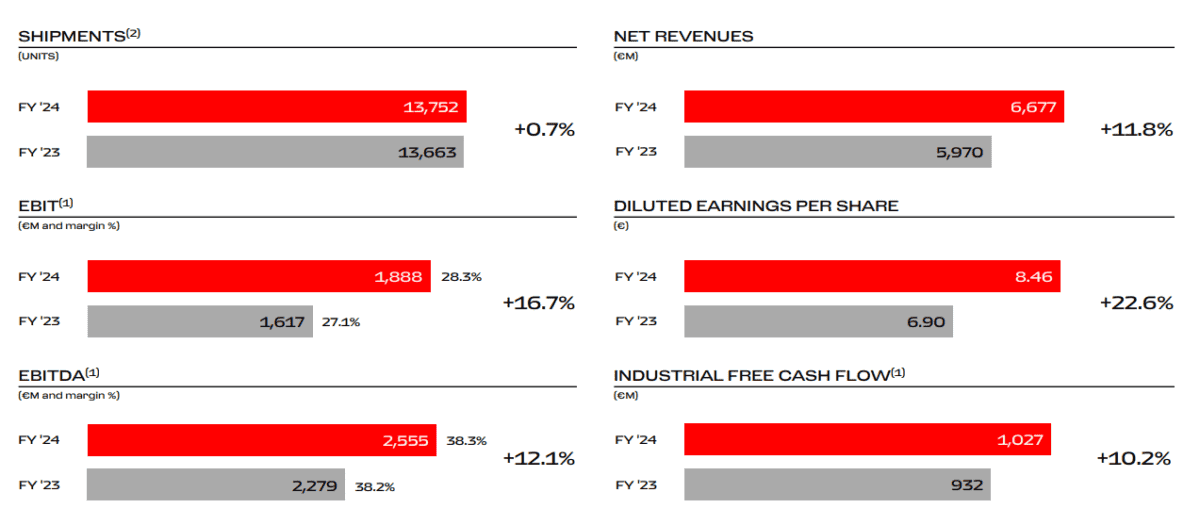
In 2024, the company shipped 13,752 vehicles, which was just 0.7% more than the year before. Yet revenue increased 11.8% year on year to €6.7bn while net profit jumped 21.3% to €1.5bn. Annual industrial free cash flow topped €1bn for the first time despite capital expenditure peaking at just under €1bn.

How’s this possible with such little volume growth? The answer is almost unlimited pricing power, along with insatiable demand for vehicle personalisation among its uber-wealthy customers.

Quality of revenues over volumes: I believe this best explains our outstanding financial results in 2024, thanks to a strong product mix and a growing demand for personalisations.

Ferrari CEO Benedetto Vigna.

The average selling price of a Ferrari is now above $500,000, up from $324,000 in 2019. And at 28.3%, the company’s operating margin remains industry-leading.

Ferrari FY 2024 investor presentation.

A history of outperformance

Another reason I’m bullish is that the Italian luxury carmaker has a habit of beating Wall Street’s estimates. Case in point was Q4, where revenue of €1.74bn topped expectations for €1.66bn. Earnings per share also rose 32% to €2.14, also higher than anticipated.

Indeed, management now anticipates reaching the high-end of its profitability targets for 2026 a year ahead of schedule! 

Scarcity

Currently, the stock’s forward price-to-earnings ratio’s 49. That’s certainly a premium valuation.

Meanwhile, the company’s set to release its first fully electric car later this year. But this is new territory for Ferrari and could present real challenges if customers aren’t entirely satisfied. It might damage the brand. So this risk’s worth monitoring.

Looking ahead however, I see a final reason why the stock should head higher. That’s basic supply and demand. Last year, 81% of sales were to existing clients. So less than 3,000 people are getting their hands on a new Ferrari for the first time each year.

As the number of high-net-worth individuals grows worldwide, demand should continue to outstrip supply, bolstering pricing power. I intend to hold the stock long term, adding to my holding on share price dips and occasional market panics.

5 perfect starter stocks to consider for a Stocks and Shares ISA in 2025

After opening a Stocks and Shares ISA, it can be quite unnerving as a new investor to see all the options available. What on earth to buy first?!

Personally, I think it’s smart idea to stick to established businesses and the principle of diversification. With that in mind, here are five starter stocks that I think are worth considering for a freshly-minted ISA.

Diversification

First up is the Vanguard FTSE All-World UCITS ETF (LSE: VWRL). This low-cost exchange-traded fund (ETF) tracks the performance of the FTSE All-World Index.  

What does that mean? Well, the index is comprised of 3,654 large and mid-sized stocks in developed and emerging markets. So this ETF immediately gives a portfolio exposure to thousands of companies from around the world.

That said, there is a natural bias towards the US, where most of the world’s largest companies are listed. The top holdings are Apple, chipmaker Nvidia, Microsoft, and Amazon.

Indeed, around 65% of the portfolio is in US stocks. Therefore, if the US market was to take a tumble — due to a slowdown in AI spending, say, or Donald Trump’s proposed tariffs — then this ETF would likely underperform for a while.

Longer term, however, I think this should provide a solid foundation and drive decent returns.

Going for growth

Sticking with the diversification theme, another option is Scottish Mortgage Investment Trust (LSE: SMT). This large FTSE 100 trust is managed by professional stock-pickers who have an excellent long-term track record of beating the global index highlighted above.

Naturally, this isn’t guaranteed to continue, as the managers could start picking more duds than winners. Still, I love the look of the 94-stock portfolio today. It includes e-commerce giant MercadoLibre, which continues to outcompete Amazon (another holding) in Latin America, and Instagram owner Meta Platforms.

Two other holdings that are crushing it are Netflix and Spotify. The first continues to engage eyeballs far and wide, while the other is rapidly capturing the world’s ears.

Additionally, the trust has investments in private companies that investors cannot otherwise access, including rocket pioneer SpaceX and TikTok owner ByteDance.

Admittedly, these unlisted firms do add a bit of risk to the portfolio because they are harder to reliably value. Indeed, one holding — Swedish EV battery maker Northvolt — quickly imploded last year due to mounting debts and an EV downturn.

Nevertheless, I expect the trust to deliver strong returns over the long run.

Growth and income

The final three stocks are all FTSE 100 blue-chips that offer a blend of stability, growth, and dividends.

First is AstraZeneca, which is a global leader in oncology. In 2024, revenue spiked 21% year on year to $54.1bn on a constant currency basis, while pre-tax profits surged 38% to $8.7bn.

While late-stage drugs trials results can always disappoint investors, the company has a massive pipeline and spends a tonne on research and development to stay ahead.

The other two shares are Coca-Cola HBC — bottling partner to the US beverage giant — and financial services group Legal & General.

Both firms could suffer during a recession if customers reign in spending (on branded soft drinks and insurance, respectively). But they also have very strong competitive positions, large customer bases, and offer dividends.

In fact, Legal & General stock carries a massive 8.9% dividend yield!

Thinking about buy-to-let? Consider these UK stocks instead

Buy-to-let investors have been clobbered by higher interest rates more recently. But as the Bank of England reduces lending rates, individuals may be considering rotating out of other assets like UK stocks to get into the residential rentals market.

Owning buy-to-let property gives investors a regular passive income, along with a way to exploit long-term house price growth. Yet there are also significant drawbacks, including high upfront costs, adverse tax changes, ongoing repair costs, and potential tenant problems.

There’s also the problem of ever-growing sector regulation. Just this week, the government unveiled new energy efficiency targets for landlords that could, on average, add between £6,100 and £6,800 to their costs by 2030.

Two top UK shares

I think a better way to consider tapping the residential rentals market is by buying UK stocks. Grainger (LSE:GRI) and The PRS REIT (LSE:PRSR) are a couple that allow individuals to profit from soaring tenant rents in a potentially simpler and more cost-effective way.

Grainger is the UK’s largest residential landlord currently listed on the London Stock Exchange. Its portfolio is worth a whopping £3.4bn and comprises some 11,100 homes.

PRS REIT is no small player, either. It had 5,437 properties on its books as of December.

Thanks to their strong balance sheets, both firms are expanding to capitalise on the lucrative trading environment too. Grainger’s £1.4bn development pipeline comprises a gigantic 5,000 homes.

Pros and cons

Both companies face the same problems of increased regulatory loopholes and associated costs. But they also enjoy significant economies of scale that private landlords don’t, which in turn limits the impact of such expenses on profits.

Other advantages these shares offer over buy-to-let include:

  • Lower upfront investment costs for investors.
  • No property management responsibilities.
  • Superior risk mitigation through a diversfied portfolio of thousands of properties.
  • UK shares can be sold more quickly and cost effectively than bricks-and-mortar assets.

One downside is that shareholders in these companies don’t have control over which properties to hold. Another is that they have some discretion over the levels of passive income they pay out.

Yet on balance, I believe the advantages they offer to investors outweigh the cons.

And in the case of PRS REIT, it only has limited control over dividend decisions. This is thanks to real estate investment trust (REIT) rules, which specify that at least 90% of rental income must be paid out each year.

Please note that tax treatment depends on the individual circumstances of each client and may be subject to change in future. The content in this article is provided for information purposes only. It is not intended to be, neither does it constitute, any form of tax advice.

Tonnes of choice

Another reason why I like the idea of UK stocks over buy-to-let is the range of options they provide. In other words, investors don’t just have to limit themselves to residential rentals and can seek large returns elsewhere.

It’s something I myself have sought to take advantage of. Primary Healthcare Properties and Tritax Big Box — companies which invest in medical and logistics facilities, respectively — are two I currently hold in my Stocks and Shares ISA.

In total, there are more than 50 REITs listed on the London Stock Exchange. I think potential buy-to-let landlords should give them a close look before investing any cash.

Here’s a plan to target £7,500 a month in passive income

Generating sizeable passive income is a dream of many people. But barring an enormous starting sum, it isn’t going to happen overnight. The reality is that it’s going to take years of consist investments to build up a portfolio large enough to regularly throw off oodles of cash.

The good news though is that it is perfectly possible to achieve. Moreover, by building the portfolio inside a Stocks and Shares ISA, there will be no tax liabilities on contributions up to £20k a year.

Please note that tax treatment depends on the individual circumstances of each client and may be subject to change in future. The content in this article is provided for information purposes only. It is not intended to be, neither does it constitute, any form of tax advice. Readers are responsible for carrying out their own due diligence and for obtaining professional advice before making any investment decisions.

A smorgasbord of opportunity

Anyone starting their investing journey quickly realises just how much choice there is. Below are four types of investments that many UK investors use to build up their portfolios:

  • Dividend shares: companies that pay regular dividends to investors (e.g., BP, HSBC).
  • Growth stocks: businesses focused on expanding rapidly (Amazon, Nvidia, etc.).
  • Exchange-traded funds (ETFs): these track a market index like the FTSE 100, S&P 500, or a specific sector like technology.
  • Investment trusts: closed-end investment companies that trade on the stock market (e.g., Scottish Mortgage Investment Trust, F&C Investment Trust).

This smorgasbord of options provides plenty of opportunities to generate solid long-term returns.

Balanced approach

For someone investing £750 regularly each month, one approach could be to split the amount into two of the buckets above. For example, consider investing £375 into a US growth stock and £375 in a UK dividend share. Then the same the next month with an ETF and investment trust, and so on.

Investing this way would build a balanced portfolio after just a few months.

One FTSE 100 stock I think is worth considering is Coca Cola HBC (LSE: CCH). Not to be confused with the Coca-Cola, this is a bottling partner for the US beverage giant.

It operates in 29 countries across Europe, Africa, and Asia, selling Coca-Cola brands like Sprite, Fanta, and various water, juices, energy, and coffee drinks (including Costa Coffee). These range from developed markets like Italy and Greece (where tourism drives sales) to emerging ones like Egypt and Nigeria.

Revenue has increased from €6.6bn in 2018 to an expected €10.7bn last year. Analysts expect that to tick up to around €13bn by 2027.

The company is also solidly profitable, with the dividend growing nicely over the years. While the forward yield of 3.2% might be nothing to write home about (and dividends aren’t guaranteed), I think the combination of steady growth and income potential is attractive.

The valuation is also reasonable, with the stock trading at 13.8 times this year’s forecast earnings. That’s broadly in line with the FTSE 100 average.

Looking ahead, a global spike in inflation is a risk to sales growth, while a fair few Muslim consumers continue to boycott US brands in Egypt.

Nevertheless, the stock looks good value to me, making it suitable as a potential starter share.

Dividend income

With a portfolio including stocks like this, I think it’s realistic to aim for an average 10% annual return.

Investing £750 a month then, it would take just under 30 years to reach £1.5m (excluding any platform fees and with all dividends reinvested). That’s starting from scratch!

At this point, a £1.5m portfolio yielding 6% would be generating roughly £90,000 a year — or £7,500 a month on average — in dividends. Happy days.

5 FTSE 250 stocks Fools are backing for promotion to the FTSE 100 this year

In the last FTSE reshuffle, St James’s Place, Games Workshop and Alliance Witan were promoted to the Footsie, while Frasers Group, Vistry (LSE:VTY) and B&M fell into the FTSE 250.

Here, five Fool.co.uk contract writers put forward their candidates for FTSE 100 promotion in 2025!

IG Group

What it does: IG Group is a global financial technology company, providing online trading platforms for clients.

By Paul Summers. At the time of writing, IG Group’s (LSE: IGG) valuation puts it near the top of the FTSE 250. While it will still take a fair bit of good news to push it into the FTSE 100, I don’t think this is beyond the realms of possibility. 

Part of IG’s appeal is that it makes more money when markets are volatile. Put another way, clients are more active in times of uncertainty. With military conflicts rumbling on and many economies around the world struggling to grow as inflation bounces back, I’d say that’s where we currently are. And although IG operates in a very competitive space that is often a target for regulators, the stock remains cheap relative to the UK market as a whole. That’s despite rising over 30% in 2024.

A chunky dividend and strong balance sheet could also bring more people to invest here in 2025.

Paul Summers has no position in IG Group.

Investec

What it does: Investec is engaged in investment banking, specialised finance and wealth management, mainly in the UK and South Africa.

By Alan Oscroft. Investec (LSE: INVP) is towards the top end of the FTSE 250 market capitalisation range, so it might not have far to go to reach the FTSE 100.

And I’m seeing signs of upbeat sentiment towards banks, especially ones with international and investing banking aspects.

There’s a fall in earnings expected for the year to March 2025, so that could keep the shares low at least until we see how the next year starts off.

But from then on, forecasts show earnings growing at a pace that could drop the price-to-earnings (P/E) ratio as low as six by 2027.

The South Africa operations present some geographic risk, I think. And the tight economic outlook could keep investors away from smaller financial stocks like this with their inherent higher risks.

But if Investc can grow its dividend as predicted, I reckon a run to the FTSE 100 in 2025 might really be on.

Alan Oscroft has no position in Investec.

Monks Investment Trust

What it does: This Baillie Gifford trust invests in a diverse range of growth stocks including Microsoft and Nvidia. 

By Dr James Fox. The Monks Investment Trust (LSE:MNKS) is the lesser known sibling of the Scottish Mortgage Investment Trust. Managed by Baillie Gifford, the trust is a constituent of the FTSE 250 and currently has a market cap around 25% below the smallest company on the FTSE 100. 

The trust’s stock is trading at a 10% discount to its net asset value (NAV) – the value of the investments held by the trust – and that’s a good starting point. And while the trust’s largest holdings are Microsoft and Amazon – both around 4% – it also holds shares in smaller growth-oriented companies, many of which haven’t performed as well as the Magnificent Seven in recent years.

Yes, the US market is running hot and there’s a lot of volatility at the moment, but large parts of the market remain overlooked. Going into 2025, this trust’s selective growth-oriented approach could position it for outsized returns in a market driven by artificial intelligence, possible interest rate cuts, and US-led growth. 

James Fox does owns shares in Monks Investment Trust.

Polar Capital Technology Trust

What it does: Polar Capital Technology Trust invests in quoted companies (mainly in the US) with long-term growth potential.

By James Beard. Due to an impressive rise in its share price over the past 12 months, Polar Capital Technology Trust (LSE:PCT) looks certain to enter the FTSE 100 at the next reshuffle. Much of this growth has come from its holdings in Nvidia and other artificial intelligence (AI) stocks. The trust also has large stakes in MicrosoftMeta Platforms and Apple.

And with the trust’s shares trading at a 10% discount to its net asset value, now could be a good time for me to buy.

But the bursting of the dot.com bubble is a reminder that the tech sector can be volatile. And it’s still unclear who the AI winners will be.

However, for those (like me) that see this new technology as a potential game-changer, this could be a good way of obtaining a wide exposure to the industry through a single investment.

James Beard does not own shares in Polar Capital Technology Trust.

Vistry

What it does: Vistry is a UK housebuilder that looks to sell to registered partners and authorities, instead of the open market.

By Stephen Wright. Vistry found itself ejected from the FTSE 100 at the end of last year when its stock crashed 56%. But I don’t think it will be too long until it has made its way back again.

The issues concern incorrect costings in its South Division. But the company has made moves to address this, including an independent investigation.

Looking beyond this, I like Vistry’s business model. Its strategy of selling to established partners means it has less exposure to the open market than its peers – and more guaranteed offtake. 

That sets it apart from other UK housebuilders. But one thing it has in common with them is it’s being investigated by the Competition and Markets Authority. 

I have no idea what that will unearth, which is why I’m not buying the stock. But I wouldn’t be at all surprised to see it back in the FTSE 100 this year.

Stephen Wright does not own shares in Vistry.

How much would an investor need in a Stocks and Shares ISA to earn a £1,000 monthly passive income?

Passive income can be as simple as buying shares in blue-chip FTSE 100 companies in a Stocks and Shares ISA, sitting back, then letting the dividends roll in.

To show how this works in detail, I will use the example of an investor who wants to target £1,000 each month (on average) in passive income.

How dividends are calculated

Not all shares pay dividends, even if they have in the past. A company decides whether to declare a dividend and if it does, it will pay that amount per share to each person who held the shares on a specified date.

Those dividends are paid for as long as someone owns a share, so they could still be earning passive income decades after buying the share.

Dividends are given as an amount per share, but as share prices vary a lot, that can be confusing for comparison. So investors talk about dividend yield – how much they earn per year in dividends as a percentage of what they paid for the shares.

That means two investors might earn different yields on the same share if they bought at different prices (in fact, I earn different yields myself on the same share in some cases, where I have bought on multiple occasions at different prices).

How much passive income can be earned a year therefore depends on two factors: how much is invested and at what yield.

£1,000 a month takes this much

To keep things simple, let me use an example yield of 5%. That is above the current FTSE 100 average of 3.6% but below what I earn from some FTSE 100 shares such as Legal & General and M&G (LSE: MNG).

£1,000 a month is £12,000 a year. At a 5% yield, that would require £240k invested (well above the annual contribution allowance for a Stocks and Shares ISA).

But – and this is important – that does not have to be right now. For example, a patient investor could drip feed money into an ISA over time, initially reinvesting dividends to build the value up to £240k. Starting with zero and investing £200 a week, that approach would take under 16 years.

Building the right income portfolio

As I said, I hold M&G shares and see it as an option investors should consider for passive income. The market for asset management is huge and it is likely to stay that way over the long run.

Having a big addressable market can be both good and bad. It is good because it means M&G can find customers – it has millions. The large sums involved mean even modest fees can add up. That helps M&G generate sizeable surplus cash generation, which in turn funds a generous dividend.

The yield is 9.2% right now and M&G aims to maintain or increase the payout per share annually (though that is never guaranteed).

But a big market can be bad as it attracts competition – lower-cost rivals are a risk to M&G’s profitability. Still, I see the firm’s strong brand as a competitive advantage.

Making the first move

To start putting this passive income plan into motion, an investor needs a way to put money into the stock market. So comparing the many choices of Stocks and Shares ISAs available strikes me as an obvious first step.

I asked ChatGPT for the best UK penny stocks to buy and it said this…

AI bot ChatGPT has grown like wildfire since being unleashed into the digital wilderness in late 2022. Even Ireland’s newly appointed minister for AI oversight reckons she’ll get round to using it one day! Recently, I asked the chatbot to name me penny stocks to buy.

Let’s see what it spat out…

Houston, we have confusion

ChatGPT Plus is comfortable rattling off blue-chip stocks like Rolls-Royce and Nvidia to consider. My theory is that it just goes by the largest listed companies whose share prices have been performing strongly and names them.

But it seemed to have a problem coming up with UK penny stocks. Two it named weren’t even penny shares at all, based on the widely-used definition of a market cap beneath £100m and share price below £1.

The first was Foresight Group Holdings, an investment manager with a £433m market cap and £3.75 share price. Moreover, this firm is a member of the mid-cap FTSE 250 index!

Granted, the London Stock Exchange is struggling with delistings and attracting new IPOs. But if the FTSE 250 had to start including sub-£100m market cap penny stocks to make up the numbers, then times really would be hard.

The bot’s second pick was less off-mark, as it went with Secure Trust Bank. However, while the market cap is £84m, this bank’s share price is even higher (£4.45).

The AI assistant had a bit of an amusing meltdown when I pointed this out, finally stating that my set task “can be challenging, as these parameters often result in a limited selection“. Of course, this is nonsense, as the UK market contains loads of penny stocks.

Finally, a stock

Anyway, with a bit of cajoling with the prompts, I finally got it to name me one a bit closer to what I was asking for. It went with Renold (LSE: RNO).

Now, the market cap here is above the technical threshold at £114m, but I didn’t want to quibble any more.

Renold is a manufacturer of industrial chains, gearboxes, and related power transmission products. According to ChatGPT, the firm’s “global presence, innovative product offerings, and strategic acquisitions position it well to capitalise on trends such as onshoring, re-industrialisation, automation, and defence“. Sounds good to me.

Renold stock is up 247% in five years, yet still trades very cheaply. The forward price-to-earnings multiple for FY26 (starting in April) is just 5.7.

It also points out that analysts have set a median 12-month price target of 88p, suggesting potential gains of 75% from its current 50p. Well-spotted, though I’d add that price targets often don’t come to much.

One thing it fails to mention is that the company has quite a bit of debt on the balance sheet (around £42m net debt). So this adds a bit of risk here.

ChatGPT ends with: “Investors seeking exposure to a resilient UK industrial firm with growth potential may find Renold an attractive consideration.”

I’d second that. In fact, I wrote in July that Renold was a “small-cap stock is worth considering” as its “profit margins are expanding“. Earnings per share are expected to rise around 39% next year.

I agree with the bot. I think Renold is a very cheap small cap worth considering and have put it on my watchlist.

With £100 to invest, is it better to buy 26 Tesco shares or 159 shares in Lloyds?

The Tesco (LSE:TSCO) share price is currently £3.89, while shares in Lloyds Banking Group (LSE:LLOY) trade at less than 63p. So someone with £100 to invest has a decision to make.

Obviously, other stocks are worth considering, but for the same amount of cash that it takes to buy 26 shares in Tesco, an investor could buy 159 Lloyds shares. So is the decision a no-brainer?

Not so fast

Unfortunately not. While £100 buys a lot more Lloyds shares than Tesco’s, there are a couple of reasons why the investment equation isn’t quite as straightforward as this.

The first is there are around 60bn Lloyds shares in the world, compared to just under 7bn Tesco shares. That means £100 actually buys a larger stake in the retailer than in the bank. There’s definitely something satisfying about owning a large number of shares in a firm. But investors need to keep in mind that the total number of shares also matters. 

So is it better for an investor to consider owning a smaller part of Lloyds than a larger part of Tesco? A lot of the answer comes down to how the businesses are going to perform over the long term.

Similarities

Despite operating in very different industries, the businesses actually have some important things in common. In both cases, their size and scale gives them an advantage over competitors. 

For Tesco, having more stores than its rivals gives the supermarket more buying power. And this puts it in a stronger position when it comes to negotiating terms with manufacturers and suppliers.

With Lloyds, its scale allows it to attract more consumer deposits than other banks. This gives it an advantage when it comes to financing the loans it makes to customers in the form of mortgages.

Whether it’s banking or retailing, size can be a big advantage for a business. But there are also some important differences that investors should pay attention to when it comes to Lloyds and Tesco.

Differences

One of the biggest differences is stability. The amount of food and cleaning products people buy doesn’t tend to change whether the economy’s growing or contracting. 

As a result, Tesco tends to benefit from relatively stable demand even in more difficult economic conditions. Lloyds however, doesn’t – demand for loans can fall sharply when interest rates rise.

This makes the chance of interest rates being lower over the long term a risk with investing in the bank. But it doesn’t automatically mean the supermarket’s a better choice. 

Banking comes with much higher barriers to entry than retailing, which is a risk for Tesco. And the likes of Aldi and Lidl arguably provide much more competition than other banks do for Lloyds.

Which stock should investors consider buying?

Given the difference in sensitivity to interest rates, I think the most important thing for investors is their view of future macroeconomic growth. This isn’t easy, but it’s crucial.

For those who are confident in the underlying economy, Lloyds shares could be worth a closer look. But for anyone who’s less sure, considering the stability of Tesco might be a more attractive proposition to consider.

Financial News

Daily News on Investing, Personal Finance, Markets, and more!

Financial News

Policy(Required)