40 and no pension? Here’s what £400 a month in a Stocks and Shares ISA could become

A Stocks and Shares ISA is a popular option for UK investors looking to build extra income for retirement. The tax-free allowance means investors can sink up to £20k per year into the account with no tax on the capital gains.

That’s probably a bit more than most people can afford to squirrel away each year. But no worries, even £400 a month can quickly add up to a lot due to the miracle of compounding returns.

Here’s one strategy a late but highly motivated investor could use to aim for a comfortable retirement.

Please note that tax treatment depends on the individual circumstances of each client and may be subject to change in future. The content in this article is provided for information purposes only. It is not intended to be, neither does it constitute, any form of tax advice. Readers are responsible for carrying out their own due diligence and for obtaining professional advice before making any investment decisions.

Diversified risk

A self-directed ISA brings with it a certain level of responsibility regarding risk. Unlike a Cash ISA, the investor needs to navigate their own path to ensure positive growth.

However, the potential for higher returns is much greater. The key is to balance risk and reward. One way to do this is through a diversified mix of stocks, funds, and investment trusts.  

Take Scottish Mortgage Investment Trust (LSE: SMT), for example. This highly diversified trust provides exposure to almost 100 stocks from a range of different countries.

Its core focus is on leading tech giants such as Nvidia, Meta, and TSMC. However, it’s also enthusiastic about global e-commerce, opting not only for popular choices like Amazon and Shopify but also smaller outfits like Sea Limited, DoorDash, and even private equity like Rappi.

Being heavily weighted towards US tech stocks is a moderate risk and one that’s resulted in volatility before. Since suffering a sharp drop in 2022, the fund has been trading at a discount to its net asset value (NAV). That means investors get exposure to all listed stocks at a price cheaper than buying them individually.

In February 1995, the shares were changing hands at a meagre 42p a pop. Fast-forward 30 years and they’re now valued at 1,087p. That equates to an annualised growth of 11.45%.

That’s somewhat higher than average for UK stocks. However, it’s realistic to aim for annual growth of 10% with a decent portfolio of stocks. After all, the FTSE 100 returned 9.5% last year.

Retirement goals

By investing £400 a month into an ISA with an average return of 10%, the pot could grow to over £535,000 in 25 years. That’s from only £120,000 invested (£400 x 12 x 25). At that point, the investor could begin drawing down approximately £53,500 a year — a sizeable pension pot to live off!

Even if performance tapered off to a below-average return of only 5%, it could still grow to nearly £240,000. In a strong portfolio of dividend stocks with an average 7% yield, that would return £16,800 a year.

Most likely, the final amount would fall somewhere in between these two extremes. In a standard rate Cash ISA, the pot would barely grow to above £200,000.

The above example shows how a lack of pension at 40 is not a life sentence. It’s never too late to start working towards a comfortable future. However, it will require a dedicated savings plan and a large monthly contribution.


The BP share price jumps 8% as activist shake-up may loom — time to consider buying?

The BP (LSE: BP) share price is smashing the FTSE 100 today (10 February), jumping 8% on news that hedge fund Elliott Investment Management has taken a significant stake in the oil giant.

This is exactly what many investors have been crying out for. There’s a view that BP has lost direction and needs a shake-up as it navigates the green transition. Activist investor Elliott may give it a push.

BP shares have also lacked direction. They’re down 9% over the past year and 7% over five years – despite the energy price spike in 2022.

That’s exactly why I bought the stock a couple of months ago. BP was trading at just six times earnings, with a yield pushing 6%. Even with oil prices under pressure, I thought that was great value. Although I was braced for plenty of short-term volatility along the way.

Can this FTSE 100 stock find its way?

I don’t trade shares based on takeover speculation. I had no idea how the group would unlock value – or who might step in to force change. So, I’ll treat today’s surge as a welcome surprise.

It comes at a time when the oil industry is gearing up for a boom under US president Donald Trump. Many believe BP (and Shell) would be worth far more if traded in New York – or potentially broken up.

Typically, once Elliott takes a stake in a company, it pushes for strategic changes, break-ups or disposals. Investors seem to like the sound of that.

There’s no doubt BP’s share price would be stronger if oil prices were higher, but the big issue remains net zero. Former CEO Bernard Looney pledged to “reinvent” the company and reach net zero carbon emissions by 2050. It backfired – like much of what Looney touched – and forced a pivot back to fossil fuels.

Now the board appears rudderless. Enter Elliott, which is likely to be plotting a new course. As yet we don’t know where.

Dividends and buybacks

BP’s current CEO Murray Auchincloss has been preparing to unveil a new company strategy on 26 February. Now, most of the questions will likely be about Elliott, rather than his plans.

He’ll need to provide some convincing answers, especially with Q4 underlying profits dropping from $3bn to $1.2bn.

Auchincloss has been pushing ahead with a $2bn cost-cutting plan, involving a 5% global workforce reduction and the sale of a refining site in Germany. This comes at a time when the UK government is in disarray over its net zero policies. Energy Secretary Ed Miliband seems keen to shut down the Jackdaw gas field and Rosebank oil field in the North Sea. Press reports suggest that PM Keir Starmer now takes a different view. This kind of uncertainty doesn’t help.

I’m glad I already own BP shares. I can watch events unfold while quietly reinvesting my dividends and waiting to see the impact on the share price. Any share buybacks will be welcome too. They’ve had plenty of those.

The shake-up was coming – and needed. No doubt more share price volatility will follow. I’d just be careful of buying on the spikes, like today’s. This story has a long way to run so investors may want to consider a cautious approach.

Are my ultra-high-yielding Legal & General shares going to jump in price after new US deal?

Legal & General (LSE: LGEN) shares have been a key holding in my passive income portfolio for years.

These stocks were chosen to give me a high level of income from dividends so I can reduce my working commitments. This is done with minimal daily effort from me – hence the ‘passive’ element relating to these holdings.

Last year, the financial services giant paid out 20.34p a share, which yields 8.5% on the current £2.40 stock price.

So, an investor considering a stake of £11,000 (the average UK savings) in the firm would make £935 in dividends this year. This would rise to £9,350 over 10 years on the same average yield. And after 30 years on the same basis, the dividends paid would reach £28,050.

The power of dividend compounding

This return is much more than can be had from a standard UK savings amount. But it could be vastly greater if the common investment practice of ‘dividend compounding’ was used.

This simply involves reinvesting the dividends paid by a stock straight back into it.

Doing this on the same average 8.5% yield (which is not guaranteed) would generate £14,659 in dividends after 10 years, not £9,350. And it would increase to £128,617 after 30 years, rather than £28,050.

Including the £11,000 stake, the holding would be worth £139,617 by then. This would pay £11,867 a year in passive income.

Yield forecast to rise

A stock’s yield changes as its price and annual dividend alter.

In Legal & General’s case, analysts forecast that it will increase its dividend to 21.8p in 2025, 22.3p in 2026, and 22.6p in 2026.

This would give respective yields on the current share price of 9.1%, 9.3% and 9.4%.

A risk here is the intense competition in the sector that may squeeze its profit margins.

However, analysts forecast that its earnings will rise 25.1% each year to end-2027.

And it is growth in these that ultimately powers a firm’s dividend – and share price – higher.

Are the shares undervalued right now?

My favoured method to get to the bottom of a stock’s valuation is the discounted cash flow (DCF) method.

This evaluates where any share price should be, based on future cash flow forecasts for a firm.

The DCF for Legal & General shows it is 21% undervalued now. So the fair value for the stock is technically £3, although the market may push it lower (or higher).

What’s the new deal?

Japanese insurer Meiji Yasuda will purchase Legal & General’s US protection business and become a strategic partner in its US Pension Risk Transfer (PRT) business.

The PRT market involves a company being paid by other firms to take over the running of their pension schemes. Legal & General is already a top 10 provider for this in the US. And there is enormous potential there, as around $3trn of defined benefit pension schemes have yet to be transferred.

Of the sale’s $2.3bn (£1.8bn) proceeds, Legal & General will use £400m to fund its US PRT expansion. And £1bn will be returned to shareholders in a buyback, which tends to support share price gains. The remainder will go into bolstering its already-healthy Solvency II ratio.

Given this deal and earnings growth forecasts that should push its share price and dividend higher, I will be buying more of the shares very soon.

Are Diageo shares a falling knife?

One of the toughest decisions any value investor faces is assessing the likely length of time a stock will remain out of favour with the market. After being in a steady decline for over two years, I’m now asking myself should I swing my bat and buy some Diageo (LSE: DGE) shares for my Stocks and Shares portfolio?

Consumer squeeze

In 2024, what really hurt the company’s share price was cash-strapped Latin American consumers downtrading to cheaper brands. On the face of it, this looked like a potentially localised, transitory issue. But this turned out to be anything but.

Far too many investors fret about headline numbers when it comes to inflation. That’s not the way to look at it though, in my opinion. Over time, consistently elevated levels of inflation alter consumer behaviour. Consumers don’t care about government-measured levels of inflation. Each person’s perception of inflation is based on their individual basket of goods and services.

This fact really matters to Diageo. What’s becoming abundantly clear to me is that brand loyalty matters less when disposable income’s in a downward trend.

Tariff wars

As consumer spending patterns have altered in the face of cost-of-living pressures, the prospect of a trade war could be disastrous for the business. Following President Trump’s decision to impose tariffs on Canadian and Mexican imports, in its H1 results released on 4 February, it announced it was removing forward guidance. This clearly spooked the market.

The immediate threat of tariffs has of course receded. This is unlikely to be of any comfort to investors though. In the US, (its biggest market) 45% of its sales are derived from products that must be produced in either Canada or Mexico.

What we do know is that last time the business had to navigate tariffs, it pushed through 100% of the resulting costs in additional pricing. Should tariffs come, I don’t envisage it will repeat such a move.

The business has for some time been undertaking detailed planning against such a contingency. Inventory management would certainly be a lever it would pull to ensure additional costs weren’t borne solely by consumers.

A falling knife?

Another way to think about a falling knife, is by means of a value trap. Identifying value traps are not that easy though. Many, including me, believed Rolls-Royce was one such trap in 2020, and lived to regret that decision.

At a fundamental level, what I’m looking to assess is whether an event or series of events has the potential to change the trajectory of an entire industry.

So what do I know? Well, outside of consumer psychology dynamics discussed above, I see evidence of an emerging trend around reduced alcohol consumption. This is particularly prevalent among Gen Z.

Of course, it’s far too early to draw any conclusions from such a narrative. My initial point of view is that this moderation trend plays in to the notion that people want to drink better, not more.

After being a runaway success for over 20 years, I expect Diageo’s share price to exhibit greater levels of volatility going forward. I don’t rule out an investment but will sit on the sidelines for now.

Are Aviva shares worth me buying above £5 after a 23% rise over the year?

Aviva (LSE: AV) shares are up 23% from their 12 February 12-month traded low of £4.15.

Some investors might avoid the stock for fear that it may only lose ground from here. Others may buy it for fear of missing out on continued bullish momentum.

I think if there is significant value left in the stock then I will consider adding to my existing holding.

What’s behind the share price rise?

Aviva shares have long struggled to break and hold decisively above the key £5 level. So, I am treating the recent move higher with caution.

That said, it appears to reflect positive factors surrounding the intended purchase of rival insurer Direct Line. Due to be completed mid-year, this will give the combined entity a 20%+ share of the lucrative motor insurance market. It will also allow for efficiency savings at Aviva and effectively control a significant competitor.

I see the main risk for Aviva being a failure to maximise synergies between the two firms. A broader risk is that inflation picks up again, reigniting the cost-of-living crisis. This could prompt insurance customers to reduce or cancel policies to save money.

However, analysts forecast that Aviva’s earnings will increase 5.4% each year to the end of 2027. And it is this growth that drives a firm’s share price and dividend over the long run.

Are the shares undervalued?

The first element in my appraisal of any stock price is to examine its key valuations with its competitors.

Aviva trades at a price-to-earnings ratio of just 10.7 against a competitor average of 28.6. So, it is very undervalued on this basis.

The same applies to its price-to-book ratio of 1.5 against a 3.8 peer average. And it is also true of its 0.6 price-to-sales ratio compared to the 1.7 average of its competitors.

The second part of my assessment is to look at where a firm’s stock price should be based on future cash flow forecasts. The resultant discounted cash flow analysis for Aviva shows the shares are 52% undervalued at their present £5.11.

Therefore, their fair value is technically £10.65, although market unpredictability might move them lower or higher.

How much passive income can be made?

Aviva shares currently yield 6.5% a year in dividend income. After 10 years on this average yield, investors considering a £10,000 holding would make £9,122 in dividends. And after 30 years on the same basis this would rise to £59,918.

This is based on the yield averaging the same and on the dividends paid being reinvested back into the stock (‘dividend compounding’).

That said, yields change in tandem with share price moves and yearly dividend payments. Analysts forecast that Aviva’s yield will rise to 7.4% in 2025, 7.9% in 2026 and 8.2% in 2027.

However, even on the current 6.5% average, the £10,000 holding above would pay £4,545 a year in dividend income after 30 years.

Consequently, I think it is worth my buying more of the stock, which I will do very soon.

A 25-year-old investing £100 a month in a Stocks and Shares ISA could have this much at 50…

An awful lot of young people would probably baulk at the idea of opening a Stocks and Shares ISA right now. Just being able to cover the rent’s already a significant challenge, thank you very much.

However, a few quick sums shows just how brilliant such a move might be for anyone concerned about setting themselves up for a comfortable middle-age and beyond.

Let’s use an example of a 25-year-old. How much could they have by 2050 in exchange for sacrificing £100 a month beginning today?

Long-term focus

Well, experienced investors would probably say ‘It depends on what they buy’. Others would add that ‘we can’t know the future anyway’. And, of course, they’d be right on both counts. Returns depend on what assets are owned and in what proportion. There’s also nothing to say that past performance will be repeated.

But we can still provide a ballpark figure based on historical data. We know, for example, that returns from stocks and shares — our wealth-building weapon of choice — have returned an average of 7-10% a year over the long term. My point is more to show the opportunity cost of not getting started from an early age.

No experience required

After 25 years at 7%, our now-50-year-old would be sitting on £81,000. If we use 10% instead, we’re talking almost £133,000. Thanks to the ISA wrapper, all of this is free of tax.

Now consider the strong possibility of salary rises as the years pass. If more of this goes into the stock market, the outcome could be even better.

The beautiful thing is that this won’t require any special knowledge or skills — just a cheap exchange-traded fund that tracks thousands of stocks. The real test is being able to completely resist the temptation to meddle, especially when markets crash.

Risk on

Of course, there’s a way of trying to generate even greater returns. That’s to buy and hold shares of individual companies. The snag is that this involves more risk.

Electric vehicle (EV) company Tesla‘s (NASDAQ: TSLA) a great example. Rising inflation and a significant fall in sentiment around tech stocks saw the company’s value tumble in 2022. Despite recovering (and then some), CEO Elon Musk’s decision to begin backing now-President Donald Trump looks to be coming back to bite him. Recently-announced results show a big reduction in sales of his vehicles in Europe as car buyers also grow increasingly wary of the former’s involvement in politics.

But regardless of individual feelings about Musk, it’s impossible to deny that anyone buying into his vision just five years ago will have enjoyed a wonderful payback. The stock has now climbed almost 625% in that period. And when the firm’s involvement in energy storage and robotics are taken into account, there’s an argument for saying there’s a lot more growth to come.

Get moving

Finding the next Tesla in a sea of stocks is easier said than done. Let’s not discount the role of luck either. But a 25-year-old also has more of the greatest commodity going, namely time.

This means they can theoretically endure the rollercoaster ride with far more composure than someone approaching retirement. The key point is to recognise this before it’s too late.

Here’s why this FTSE 100 gem still looks a huge bargain to me despite a 94% rise this year

FTSE 100 bank Standard Chartered (LSE: STAN) is up 94% from its 12 February 12-month traded low of £5.71.

However, as a former senior investment bank trader and private investor, such a rise does not deter me from potentially buying it. I know that price and value are not the same thing.

How does the valuation look?

I always start my value analysis by comparing a stock’s key ratios against its main competitors.

Beginning with the price-to-earnings ratio, Standard Chartered currently trades at 8 against a peer average of 8.6. These peers comprise NatWest at 7.8, HSBC at 8.1, Lloyds at 8.4, and Barclays at 10.

So, Standard Chartered is undervalued on this measure.

This is also the case on the price-to-book ratio, on which it trades at 0.6 compared to a 0.8 competitor average. And it is true as well on its 1.7 price-to-sales ratio against a peer average of 2.4.

To translate these relative undervaluations into share price terms, I used the second part of my standard assessment process. This evaluates where any stock price should be, based on its future cash flow forecasts using other analysts’ figures and my own.

The resultant discounted cash flow (DCF) analysis shows Standard Chartered shares are 56% undervalued at their current £11.07 price.

So the fair value for the stock is technically £25.16.

Market forces may push it lower or higher than that, of course. However, the three key relative undervaluations and the DCF confirm to me that huge value remains in the stock.

How is the bank handling falling interest rates?

I have long seen Standard Chartered’s key risk as being a slide in its net interest income (NII). This is the difference in interest charged on loans and paid on deposits.

This threat to earnings applies to banking operations in countries that are reducing interest rates as inflation declines.

Some banks have sought to offset falling interest rates by lending more. Others such as Standard Chartered have focused on increasing their business from fee-based rather than interest-based activities.

In Q3 2024, it delivered an underlying operating income of $4.9bn (£3.92bn). This was 12% up year on year and was the best quarter since 2015.

Crucially here, underlying NII was up 9%, while underlying non-NII increased 15%. This latter category was driven by a record quarter in the fee-based Wealth Solutions and Global Markets operations.

Will I buy the stock?

It is earnings growth that powers a company’s share price and dividend higher over time. In Standard Chartered’s case, analysts forecast its earnings will rise 5.6% each year to the end of 2027.

I think this will drive the stock closer to its fair valuation level and enable the bank to keep increasing its dividend. In 2023, this was 27 cents (fixed at 21p), giving a current yield of 1.9%.

Consequently, if I did not already own shares in HSBC and NatWest, I would buy Standard Chartered shares as quickly as possible. I believe it is worth investors considering.

Investing £3.33 into an ISA every day from 22 could result in a £60,000 passive income

I already had a Stocks and Shares ISA when I started work at 22, and it was topped up by inheritance and sporadic gifts. However, it wasn’t until much later that I started making regular contributions to my ISA.

At 22, the rationale for not contributing was simple: “I’ll be earning more in the future, so why now?” But this mindset can mean missing out on the power of compounding. The key advantage for young investors isn’t how much they invest, but how long their money has to grow. It’s all about time in the market.

The rationale

Investing £3.33 per day is the equivalent of investing £100 per month. That would have been about 5% of my first paycheque. It might not sound like a lot, especially as it would now take me more than three months to afford one Tesla share, but it adds up over time. Plus, investors can use fraction shares to gain access to more expensive stocks.

The secret ingredient is compounding. This is what happens when investors keep their money invested over the long run. It’s like a snowball that, as it gets bigger, can pick up even more snow.

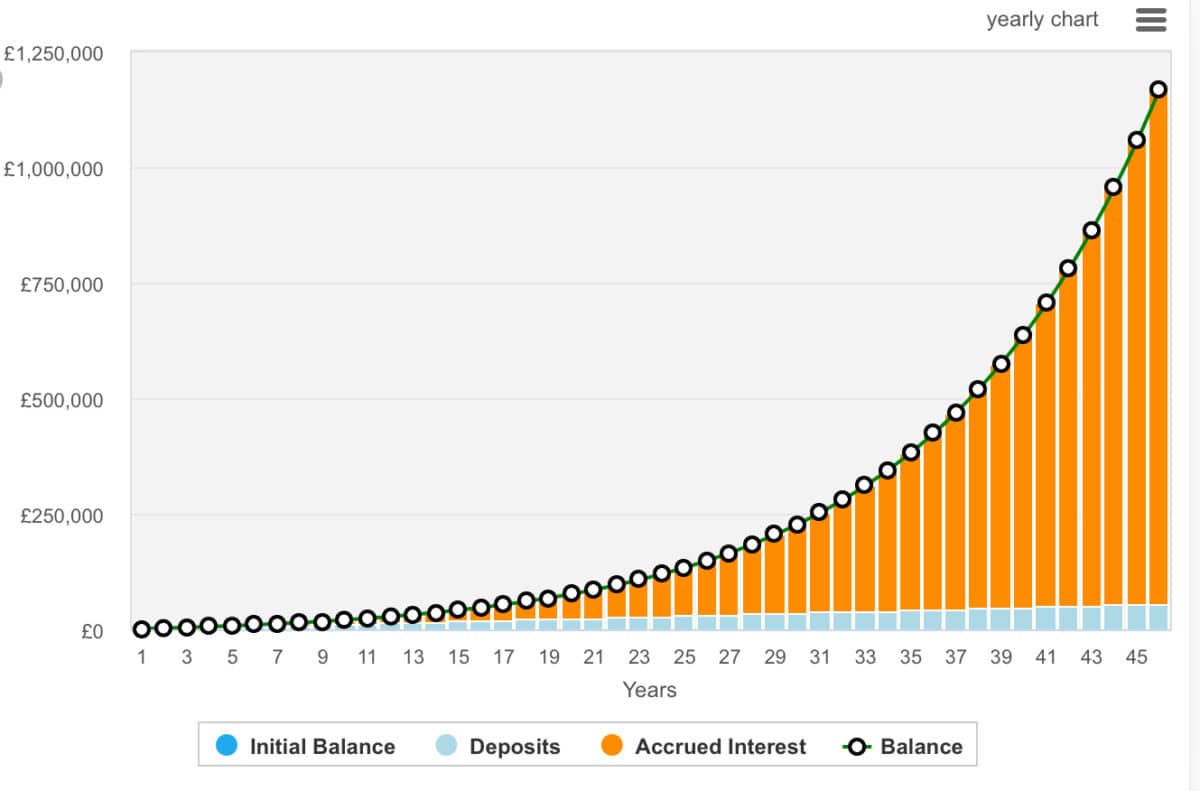
As we can see from the below graph, £100 really starts to compound after 15 years — this example assumes a growth rate of 10% annually. Towards the end of the 46-year period, £100 of monthly contributions should seem very affordable, while the portfolio will be growing at an impressive rate.

Why 46 years? Well, that’s the number of years between me starting work at 22 and my predicted retirement age at 68.

Source: thecalculatorsite.com

Getting there

So, we’ve got the formula. But how can we actually turn £3.33 a day into a small fortune? Well, many novice investors will invest in index-tracking funds. This is a wise move that provides diversification and relatively low risk.

Another option could be an exchange-traded fund (ETF) or even a conglomerate like Berkshire Hathaway (NYSE:BRK.B). Warren Buffett’s holding company provides exposure to a broad mix of businesses, from insurance to consumer goods, with a proven track record of compounding shareholder value.

Buffett’s value investing approach, focusing on undervalued companies with strong fundamentals, has proven successful over decades. However, investors should consider risks such as Berkshire Hathaway’s large size potentially limiting future growth opportunities, the challenge of finding attractively priced acquisitions in the current market, and the eventual succession of leadership as Buffett ages.

Despite these concerns, Berkshire Hathaway’s strong balance sheet, cash-generating businesses, and proven investment philosophy make it an attractive option for long-term investors seeking stability and growth potential. Over 10 years, the average return is 12.3%. This is one I’m adding to my daughter’s pension.

The passive income part

In the above example, £100 a month would grow into almost £1.2m over 46 years. Now, with all that money invested in stocks, funds, and bonds with an average yield of 5%, an investor would receive around £60,000 a year or £5,000 monthly.

Of course, there’s a caveat. £60,000 in 46 years will likely feel like £20,000 in today’s money. However, when using the ISA, this would be entirely tax free and would nicely complement a pension.

Please note that tax treatment depends on the individual circumstances of each client and may be subject to change in future. The content in this article is provided for information purposes only. It is not intended to be, neither does it constitute, any form of tax advice. Readers are responsible for carrying out their own due diligence and for obtaining professional advice before making any investment decisions.

2 resurgent cheap shares that could skyrocket in 2025

The FTSE 350 and AIM markets are packed full of cheap shares. The truth is, there has been incredible innovation and share price appreciation happening in the US. This, coupled with political and economic issues in the UK, has drawn capital away from British companies and into American listed ones. It’s unlikely, however, that this trend will last forever. For example, I’ve invested heavily in US stocks, myself. But with valuations getting frothy stateside, I’m increasingly looking for bargains at home.

Travel sector winner

Jet2 plc (LSE:JET2) stands out as a potential gem in the FTSE AIM. The company’s financial position is remarkably strong. Its net cash is expected to grow from £1.7bn to £2.8bn in coming years. This robust financial base provides a degree of protection against volatility. It also supports the company’s expansion plans and fleet renewal. It has £5bn worth of aircraft on order to be delivered over the next six years.

Given this net cash position, the company’s valuation metrics are particularly attractive. Its forward enterprise value-to-EBITDA (earnings before interest, tax, depreciation, and amortisation) ratio is projected to decrease from 2.01 in 2024 to just 0.53 by 2027. That’s significantly lower than industry peers like low-cost easyJet, which trades at around 4.3 times. What’s more, even when we don’t factor in the cash position, Jet2 trades with a price-to-earnings-to-growth (PEG) ratio of 0.77 because of its medium-term growth rate of 9.6%. This is a clear sign that it is undervalued.

However, investors should bear in mind that changes in fuel prices can have an outsized impact on earnings. Fuel costs typically represent around 30%-40% of operating costs. What’s more, the fleet is a little older than some peers at 13.9 years, hence a slightly greater need to procure new planes. easyJet’s average fleet age is just 10 years.

Nonetheless, my optimism is also reflected in the average share price target, which is 38% higher than the share price today.

If you spend too much time on social media, you’ll have noticed that Currys (LSE:CURY) is doing rather well with some impressive engagement statistics. What’s more, the business is doing really well too.

The company’s recent performance has been encouraging, with a rise in like-for-like sales during the crucial Christmas period and improved gross margins due to disciplined inventory management. This has been reflected in a surging share price.

But the rally probably isn’t over. Analysts have upped their share price targets and the average now sits at 119.5p, about 31% higher than the current share price. This comes off the back of rising profit guidance from management and some exceptionally attractive earnings multiples. In fact, the forward PEG ratio sits at just 0.4, indicating a deep value opportunity.

However, investors should be mindful of the risks associated with the consumer discretionary sector, particularly given the uncertain economic environment. Any deterioration in consumer sentiment or unexpected upward shifts in interest rates could impact Currys’ sales and profitability.

My verdict? These are two stocks I’m looking very closely at buying.

How much does an investor need in a Stocks and Shares ISA to earn £1,000 a month in passive income?

Above the £500 allowance, basic rate taxpayers have to pay 8.75% on dividends. For someone earning £12,000 a year, that’s £1,006, but a Stocks and Shares ISA allows them to avoid this. 

That can make a big difference to the amount someone needs to invest to collect £1,000 a month in passive income. And this is something investors shouldn’t underestimate. 

Dividend yields

Interest rates in the UK are currently 4.25%. So I don’t think investors looking for dividend income should buy stocks that they don’t expect to provide a better return than this over time. 

That’s not to say they shouldn’t consider something that’s going to offer less than this in the short term. One example I think’s worth considering is Unilever (LSE:ULVR), a stock with a current dividend yield of 3.15%.

Without the tax advantages of a Stocks and Shares ISA, to earn £1,000 a month in passive income someone would need to buy 8,891 shares. That involves an outlay of £417,523, which is a lot. 

Using a Stocks and Shares ISA however, the required amount comes down to £380,952 – or 8,112 shares. That’s a significant reduction, but it would still take an investor years to get that into an ISA.

Please note that tax treatment depends on the individual circumstances of each client and may be subject to change in future. The content in this article is provided for information purposes only. It is not intended to be, neither does it constitute, any form of tax advice. Readers are responsible for carrying out their own due diligence and for obtaining professional advice before making any investment decisions.

Time

With stocks like Unilever however, there’s an advantage. The company’s increased the amount it’s distributed to shareholders as dividends consistently over a long time. Over the last decade, the rate of dividend growth’s been just over 5%. If this continues, investors who buy the stock today will be receiving twice as much per share 15 years from now.

That could bring down the amount of shares needed to earn £1,000 a month to 4,056. And at today’s prices, this would cost £190,476. That’s still more than someone could invest in a Stocks and Shares ISA in a year. But it shows that time can be a good substitute for cash when it comes to investing. 

Growth

The big question, of course, is whether or not Unilever can continue to grow its dividend at that rate over time. And while there are no guarantees, I think there’s a decent chance of this happening.

As I see it, the biggest risk is the threat of competition. The company operates in an industry where customers can switch products easily and it has to contend with rivals with lower price points. 

Investors shouldn’t forget though, that Unilever’s some important and durable strengths. These include its brand portfolio and the scale of its distribution network. 

On top of this, the company’s been reducing its share count steadily over the last five years. And this should help it increase its earnings per share over time, even in a competitive environment. I feel it’s worth considering.

Passive income

The most important thing with investing is buying the right stocks and owning them for a long time. But not having to pay tax on dividends is a big advantage.

A Stocks and Shares ISA can make a big difference to an investor’s overall returns. And it can cut the amount someone has to invest to earn £1,000 a month in passive income significantly.

Financial News

Daily News on Investing, Personal Finance, Markets, and more!

Financial News

Policy(Required)