I asked ChatGPT to build the perfect passive income portfolio and here’s the result

Everyone has their own opinion on which are the best UK stocks to buy for a great passive income portfolio. The subjective nature of stock picking allows for a variety of choices. Further, some investors like to take on higher or lower risk than average, which impacts the potential yield on offer. I decided to get ChatGPT to objectively pick what it believes to be the ‘perfect’ portfolio, with some very interesting results!

Details of the bot’s choices

To begin with, the AI-powered bot told me that an investor should focus on high-yielding, resilient stocks across different sectors that are growing dividend payments. The main reason for this is that it ensures diversification, steady cash flow, and long-term sustainability. I regularly preach about these points, so I’m glad AI does too!

The portfolio provided aims to target an average dividend yield of 5%-6%. I thought this would be the case. The average dividend yield across the FTSE 100 is 3.46%. It makes sense that with some active stock picking, an investor could target an above-average yield. Yet at the same time, it’s not a super-high-risk goal. Some might want to target a yield of 7%-8% instead, being happy to buy some riskier stocks where the income maybe isn’t as stable.

Perhaps what impressed me the most was how ChatGPT split up the allocation into areas such as stability (suggesting National Grid and Unilever) and stocks with growth potential (BP, Legal & General and Tesco). It also suggested including some high-yield options selectively, such as Vodafone.

A stable inclusion

One suggestion it made was to consider buying Segro (LSE:SGRO) for long-term growth potential. The FTSE 100 real-estate logistics stock is down 17% over the past year. This is one factor that has pushed the dividend yield up to 4.01% right now.

The business owns and manages warehouses, distribution centres, and urban logistics hubs across the UK and Europe. The main way it makes money is via rental income from the leases. It has some large clients, such as Amazon, where long-term agreements provide a steady source of cash flow.

The share price should also reflect the property portfolio’s net asset value (NAV). Over time, the properties should appreciate in value, providing another source of potential profit.

As such, Segro could be considered a smart inclusion to a passive income portfolio, more on the steady but stable side. It hasn’t missed a dividend payment for over two decades!

However, there are risks involved. The latest half-year results showed that the valuation of the portfolio was flat, which isn’t great. Further, even though the company has no major debt maturities until 2026, the fact that interest rates could remain higher for longer is a concern for future financing needs.

The building blocks

In reality, there’s no such thing as a perfect income portfolio. After all, future dividends aren’t guaranteed. Yet based on my view of the stocks selected, ChatGPT did a surprisingly good job of picking ideas. Further, the principles of diversifying exposure and buying companies from different sectors was a key message it provided, which is exactly what I try to stick to with my investing. I still prefer to pick my own stocks though!
£20,000 to invest? Here’s how the FTSE 100 could deliver a £2,040 passive income

The FTSE 100 is home to a vast array of high-quality dividend shares.

The UK’s leading share index may lack the razamatazz of the tech-led S&P 500. However, its large weighting of ‘boring’ stocks — those that operate in traditional, mature industries rather than high-growth sectors — makes profits and cash flows far less volatile.

This brilliant blend is critical for investors seeking a strong, sustained, and growing passive income over time.

But dividends are never, ever guaranteed. So whats the best tactic for someone with a £20,000 lump sum to invest today?

Targeting stability

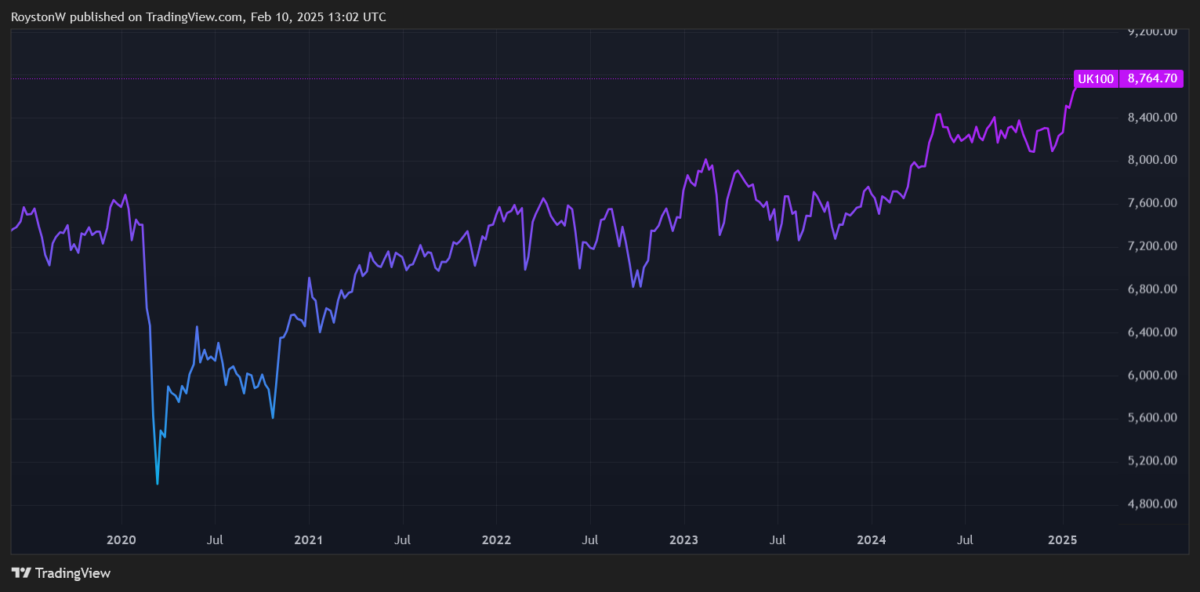
Source: TradingView

An increasingly popular option is to consider a FTSE 100-tracking exchange-traded fund (ETF), which can provide both capital gains and dividend income.

By holding the entire index, an ETF can help investors significantly reduce risk. If one or two companies experience trouble, the overall impact on an income stream can be smoothed out.

That said, there are several important caveats with this approach.

However…

Firstly, the price investors pay for this security is a pretty low yield.

At 3.5%, the FTSE 100’s forward dividend yield is lower than the current interest rate on most Cash ISAs. Someone who invested £20k in a Footsie ETF today would (if forecasts are correct) make a middling £700 passive income this year.

Secondly, while funds like this reduce risk the risk of poor dividend income, they don’t eliminate it entirely. This was apparent in 2020, when scores of blue-chip shares cut, cancelled or postponed dividends when the pandemic hit.

Finally, poor share price growth means the overall returns on FTSE-tracking ETFs have been disappointing in recent years. Since 2015, the index has delivered an average annual return of 6.5%.

A large dividend income is highly attractive. However, weak share price performance can erode passive income benefits over the long haul.

A £2,040 passive income

For this reason, purchasing individual shares might be a better way for investors to target passive income.

There’s no right and wrong answer in the ETF vs stock-picking argument. This depends on anyone’s risk tolerance and financial goals, along with one’s level of investing experience.

However, those seeking a large passive income today and market-beating returns should also consider buying specific shares as part of a diversified portfolio.

Let’s take Legal & General (LSE:LGEN) for instance. Considering a £20k investment here today would — if broker forecasts prove correct — provide a £2,040 passive income in 2025. That’s based on a 10.2% forward dividend yield.

Legal & General
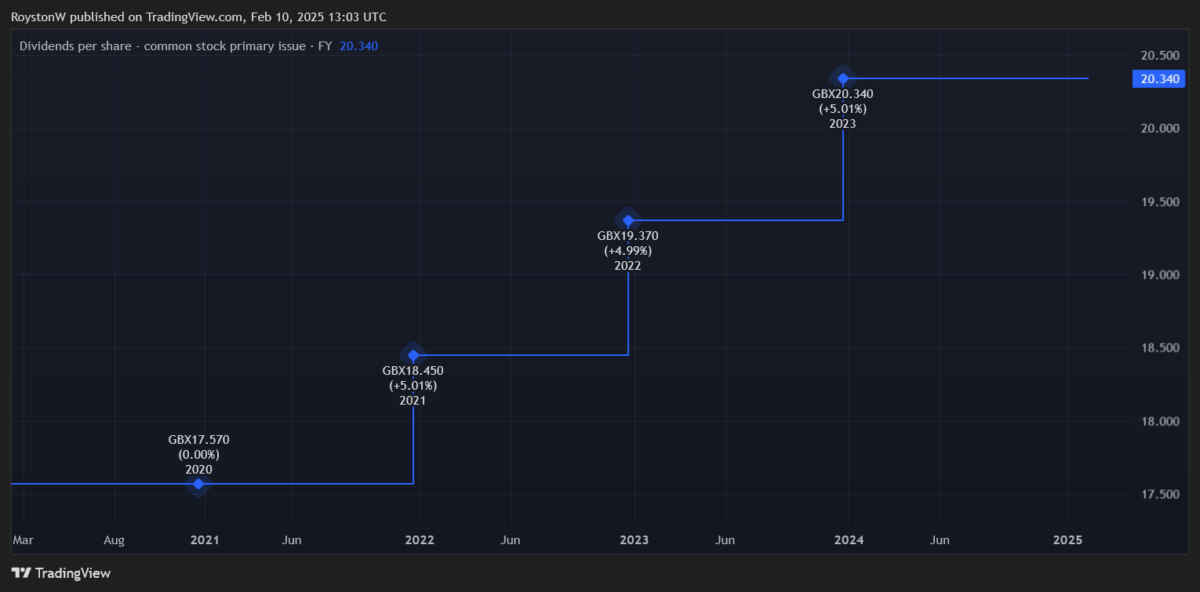
ource: TradingView

On top of this, investors can realistically expect dividends on Legal & General shares to keep rising over the short-to-medium term at least. The business, which has raised annual payouts in 12 of the last 13 years, is cash rich and had a Solvency II ratio of 223% as of June, more than double regulatory requirements.

Since 2015, Legal & General shares have provided an average annual return of 4%. That’s 2.5% below the return an FTSE 100 ETF could have delivered.

But I’m optimistic that overall returns, along with dividends, will beat the Footsie average looking ahead. Despite competitive pressures, I think profits could soar as financial services demand — and especially sales of retirement and wealth products –rapidly grows.

Steel and aluminum stocks surge on Trump plan to impose 25% tariffs on imports to U.S.

  • President Donald Trump told reporters Sunday that he will impose 25% duties on all steel and aluminum imports into the U.S.
  • U.S. Steel, Cleveland-Cliffs, Nucor and Alcoa Corp. surged.
  • The U.S. relies on imports for more than 80% of its aluminum needs, according to a note from JP Morgan.
A water tower at the U.S. Steel Corp. Edgar Thomson Works steel mill in Braddock, Pennsylvania, on Sept. 4, 2024.
Justin Merriman | Bloomberg | Getty Images

Steel and aluminum stocks surged in premarket trading on Monday after President Donald Trump said he will impose 25% duties on all imports of the metals into the U.S..

Cleveland-Cliffs surged about 8%, Nucor jumped more than 7%, Alcoa Corp. was trading nearly 4% higher and U.S. Steel rose more than 3%.

“Any steel coming into the United States is going to have a 25% tariff,” Trump told reporters on Air Force One on Sunday. The president said he will also slap 25% tariffs on aluminum imports.

The U.S. relies on imports for more than 80% of its aluminum needs, according to a note from JP Morgan. Canada supplies about 70% of raw aluminum to the U.S., according to the investment bank.

The aluminum tariff would add nearly 30 cents per pound to prices, not including transportation and other costs, according to JP Morgan. The bank expects domestic production of aluminum to increase as a result of the tariffs.

“Although existing stockpiles may provide a short-term buffer, the medium-term outlook suggests a modestly bearish impact on aluminum prices, due to potential declines in U.S. demand and a possible increase in domestic supply,” JP Morgan analysts led by Dominic O’Kane told clients.

Here’s how someone could start investing in 2025 with just £1,000

Before the internet, people needed a fair chunk of cash to start investing due to high brokerage fees. Today though, anyone can get going with modest sums. Technology’s democratised stock market investing.

Therefore, £1,000 is easily enough to get the ball rolling this year. 

Little acorns

With such an amount, the go-to option in the UK would be a Stocks and Shares ISA. This marvellous account shields returns — both dividend income and share price gains — from the taxman. Obviously, this enables a portfolio to grow and compound far more quickly.

The annual contribution limit is £20,000. But the good news is that it’s possible to build long-term wealth on nearly half that.

For example, someone who invests £1,000 a month would reach a £1m ISA in just over 23 years, assuming all dividends were reinvested and a 10% average return was achieved.

Please note that tax treatment depends on the individual circumstances of each client and may be subject to change in future. The content in this article is provided for information purposes only. It is not intended to be, neither does it constitute, any form of tax advice. Readers are responsible for carrying out their own due diligence and for obtaining professional advice before making any investment decisions.

Dividend stock to consider

The average ISA provider offers a world of investing options, ranging from US growth shares like Amazon to UK dividend stocks like Lloyds.

For cautious investors who like the idea of receiving dividends, I think Legal & General (LSE: LGEN) stock’s worth considering. It carries a towering 9% forecast dividend yield for 2025!

Of course, dividends are never guaranteed, and in a financial meltdown the insurance and asset management group could face increased liabilities and decreased asset valuations.

Nevertheless, I think the income potential looks strong, particularly after the firm just sold its US protection business for $2.3bn.

From this, it has earmarked £1bn for a new share buyback programme. And it plans to return the equivalent of 40% of its market capitalisation — over £5bn — to shareholders through dividends and buybacks by 2027.

Based on current forecasts, a £1,000 investment in Legal & General shares could yield roughly £152 in dividends over the next 18 months.

Growth stock to consider

For more adventurous investors, I think Nu Holdings (NYSE: NU) is worth a look. Commonly known as Nubank, this is Latin America’s leading fintech firm and the largest digital bank platform outside of Asia.

Incredibly, the Warren Buffett-backed company now has over 100m customers in Brazil alone, while also expanding rapidly in Mexico and Colombia. In fact, it’s doubled its customer base in Mexico over the past 12 months!

In 2024, revenue’s expected to have jumped 47% year on year to $11.8bn, while net profit rocketed 84% to $2.2bn.

Naturally, the branchless bank cannot grow at such a blistering pace indefinitely, and it faces above-average risks of hyperinflation and wild currency swings in Latin America. Such issues could knock earnings and dampen investor enthusiasm.

Still, analysts have annual revenue heading above $21bn by 2027, with profits growing at an even faster rate. And Nu is expanding beyond banking, recently launching mobile phone services in Brazil under the NuCel brand.

As we make progress in our execution, we are preparing ourselves to consolidate Nu as the world’s leading digital services platform, going beyond financial services. 

David Vélez, founder and CEO of Nubank.

Enticingly, the stock trades at 23.5 times forecast earnings for 2025, with the multiple falling to 17 by 2026. For a growth machine like this, I think the valuation looks far too cheap.

I’m looking to add more shares to my own portfolio before the summer.

I asked ChatGPT which UK stocks Warren Buffett might look to buy. It suggested these 5 names

This week, investors get to find out what Warren Buffett – or more specifically his investment vehicle Berkshire Hathaway – has been up to. Or at least, what they were buying and selling at the end of last year. 

However, the firm only has to disclose its US equities. With that in mind, I asked ChatGPT for some UK stocks that the Oracle of Omaha want to look at – and it had some interesting ideas.

5 UK stocks

The names it suggested are:

  1. Diageo (LSE:DGE
  2. Games Workshop
  3. Unilever
  4. Reckitt (LSE:RKT)
  5. Auto Trader

Of course, there’s no suggestion Mr B is actually buying them, this is just ChatGPT musing. But these are interesting ideas, although I think some are clearly non-starters. In 2022, Todd Combs – one of Berkshire Hathaway’s managers – set out three criteria Buffett uses in finding stock investments. 

One is trading at a forward price-to-earnings (P/E) ratio below 15. A second is having a 90% chance of making more money five years from now, and a third is a 50% chance of growing at 7% a year.

Auto Trader, Games Workshop and Unilever look like terrific businesses to me, but they clearly don’t meet the first condition at the moment. So they’re out, leaving Diageo and Reckitt. 

Growth

I think both Diageo and Reckitt have a decent chance of meeting Buffett’s second condition. The chanes of them making more money five years from now looks pretty high in each case.

While Diageo’s latest trading results show a 1% decline in revenues, this is partly due to unfavourable foreign exchange rates. Adjusting for these, the firm’s starting to emerge from a challenging period.

The big threat at the moment is the possibility of tariffs weighing on its US sales and profits. And investors need to consider whether these are a long-term threat or a temporary negotiating tactic. 

With Reckitt, I think the company’s strong brands are a very important asset. These give it a strong position in emerging markets where demographic trends are relatively favourable. 

Compounding

The last condition is having a 50% chance of growing at 7%. This one’s a little complicated with Diageo – until recently the firm was guiding for medium-term revenue growth of 5-7%. 

Management has withdrawn this due to uncertainty around tariffs. But investors should also consider whether other potential threats – such as the rise of appetite-suppressing GLP-1 drugs – could also limit future growth.

With Reckitt, things are a little different. Its most powerful brands have been growing at 7% a year since 2018 and the company’s looking to divest some of its weaker divisions to focus on these.

The biggest ongoing threat is legal liabilities (and not just in its infant formula division). The firm’s had to deal with several differing sets of international regulations and standards and this is a source of risk.

Could Buffett be interested?

As I see it, both Diageo and Reckitt look borderline cases in terms of meeting Buffett’s criteria. Whether anyone at Berkshire Hathaway has any interest in them however’s another question.

Investors aren’t likely to find out the answer to these questions this week. But I’m always interested in what unusually talented investors are doing and I’ll be paying close attention over the next few days.

Up 14% today! Here’s one growth stock that Elon Musk likes

Filtronic (LSE:FTC) is a UK growth stock that’s seen its share price increase by 184%, since February 2024.

The company develops and manufacturers radio frequency, microwave and millimetre wave technologies, which are deployed in mission-critical communications networks. Significantly, in April 2024, it entered into a strategic partnership with Space Exploration Technologies (SpaceX) for the ongoing supply of its innovative solid state power amplifiers.

By mid-morning today (10 February), Filtronic’s stock had soared 14%, after it announced another deal — worth £16.8m over the next two years — with Elon Musk’s company. On disclosing the order, the company said it’ll exceed current market expectations for both revenue and profit in its next two financial years.

Not surprisingly, investors were impressed.

The news added approximately £28m to the market cap of the company.

Reaching for the stars?

For those investors looking to benefit from the renewed interest in space, there are relatively few options.

SpaceX is privately owned and although an IPO’s expected at some point, the timing’s uncertain.

A number of investment firms have stakes in Musk’s company. For example, at 31 December 2024, it was the biggest holding in the Scottish Mortgage Investment Trust portfolio. Its position was valued at £1.1bn, and accounted for 7.5% of total assets.

But Filtronic has exposure to more than just the space market. Its products are also sold into the aerospace and defence sectors.  

However, there are some risks.

Possible issues

Despite the recent rally in its share price, it’s still relatively small. With a market cap of £226m, it doesn’t have the financial firepower to withstand a prolonged downturn.

Having said that, at 30 November 2024, its balance sheet didn’t contain any debt. And it had cash of £7.2m, although this wouldn’t be enough to cover a year’s staff costs.

I’m also concerned that it’s heavily reliant on just three customers. During the year ended 31 May 2024 (FY24), these contributed 84% of revenue. Although not disclosed in its accounts, I don’t think it’s hard to work out what the biggest one is. It accounted for 48% of revenue in FY24. With today’s press release, I suspect this concentration is likely to increase further.

What’s it worth?

But valuing a company like Filtronic can be difficult. As it’s growing fast, investors are more likely to pay a premium.

Prior to today’s announcement, Edison Group was expecting the firm’s earnings per share (EPS), for FY26 to be 2.93p. The stock was, therefore, trading on a weighty forward multiple of 31.7.

Based on its operating margin for the first half of FY25 (26%), the new contract could add £2.2m to Filtronic’s bottom line in each of its next two financial years. By my calculations, this would add 1p to EPS. Therefore, even with the 14% increase in the share price, the price-to-earnings (P/E) ratio has dropped to a more attractive 27.

However, I’m not going to invest in the company.

Its reliance on SpaceX is a double-edged sword. As long as the trading relationship continues, I think the company’s share price will do well. But if it were to lose the contract, I suspect it’s shares will tank as there are relatively few other customers in the sector that could replace the revenue. This is a risk that I’m not prepared to take.

I asked ChatGPT if the FTSE 100 would hit 10,000 this year. It’s feeling bullish!

The FTSE 100‘s on a roll. It’s just nudged to another all-time high of 8,735, having climbed 5.75% year-to-date. It’s up 15% over the last year.

Throw in the average yield of 3.5% and share buybacks, and that’s a total cash return of more than 20%. Who said the UK stock market couldn’t cut it?

This raises the question: how much further can it go? Another 3% will take us to 9,000. But what about 10,000? That requires a 15% surge from here.

Can blue-chip stocks keep flying?

I decided to ask ChatGPT. Artificial Intelligence (AI) can’t tell the future anymore than I can. But I was still intrigued to see what it would say.

The chatbot highlighted three big positives. First, the FTSE 100’s cheap compared to US markets with an average price-to-earnings (P/E) ratio of 15.5. The S&P 500 trades at 27 times. Those are my figures, not ChatGPT.

This could attract value-focused investors looking for bargains, it said, “If sentiment shifts in favour of UK equities, we could see a sustained rally“.

ChatGPT also suggested the UK might avoid the worst of Donald Trump’s trade tariff wars. We’ll see. Even AI can’t figure out the workings of Trump’s mind.

My robot buddy noted that the Bank of England has just cut interest rates to support the UK economy. It may cut again. “Lower rates tend to be bullish for equities, particularly those with high yields, such as many FTSE 100 constituents”, it noted.

I’d add that they’d also weaken the pound, which would boost overseas earnings when converted back into sterling. Note: 78% of FTSE 100 revenues come from abroad.

As ever, there are threats. While the FTSE 100 isn’t a direct reflection of the domestic economy, weak UK growth could still hit investor sentiment. “Stagnation or a technical recession could lead to market jitters”, ChatGPT cautioned.

How China has hit Glencore shares

Geopolitical tensions over Russia and the Middle East could add further market volatility. China’s economic struggles also pose a threat, ChatGPT said, noting: “Many FTSE 100 mining companies and consumer goods firms rely on strong demand from Asia“.

I’ve seen this with my stake in Glencore (LSE: GLEN). Commodity stocks have been punished by China’s struggles, which snapped up 60% of global supply for years.

The Glencore share price is down 10% over one year and 35% over two. Yet it looks good value with a P/E of 10 times. And it generated enough cash to cut net debt by $1.3bn between January and June last year. Debt’s now down to $3.6bn.

Glencore’s trailing yield of 2.9% doesn’t look great, but is forecast to hit 5.4%. Many assume the energy transition will drive demands for metals such as aluminium, zinc, cobalt and copper, but that’s not 100% certain. Innovation could deliver cheaper alternatives. Commodity stocks are cyclical. I’ll give Glencore time to swing round.

So what about that 10,000 target? AI concludes: “While I remain cautiously optimistic, a move to 10,000 will require a perfect storm of bullish catalysts”.

Personally, I agree. 10,000 is a stretch this year. But it’ll get there one day. While I wait, I’ll keep buying blue-chip stocks and reinvesting my dividends. They look terrific value today. That’s me talking. Not a robot.

Near 52-week lows, are these FTSE 100 stocks now unmissable bargains?

Despite a stellar start to 2025 for the FTSE 100 as a whole, some members of the index are having a nasty time of it. Today, I’m looking at two examples and asking whether they actually represent wonderful bargains buys.

Trump’s tariff torment

Drinks firm Diageo‘s (LSE: DGE) woes aren’t a secret. Falling sales in the wake of higher prices, lower consumption of alcohol among younger generations and the growing popularity of weight-loss drugs have collectively given management a severe hangover. As I type, the share price sits barely above a 52-week low.

Last week, medium-term sales targets were pulled due to uncertainty over possible tariffs imposed on Mexico and Canada by President Trump. Since then, the latter has agreed to press the ‘pause’ button until March. Quite whether they ever kick in is up for debate. If they do, profit at the owner of brands such as Johnnie Walker whisky and Tanqueray gin could be severely hit.

It’s not all bad

On a more optimistic note, sales of Guinness have been growing nicely. It might also be argued that £50bn cap firm’s global reach makes it a less risky pick than other top-tier stocks dependent on just one or two regions. The current price-to-earnings (P/E) ratio of 17 is far below the average over the last five years (23) too. This suggests Diageo shares might be cheap.

So far, however, the markets seems unconvinced that CEO Debra Crew can turn things around quickly. And until there’s clarification over those tariffs, the shares might continue falling.

An unmissable opportunity? As much as I still like this company and its bursting portfolio of brands, I’m not quite as convinced as I once was that it represents a great opportunity for new investors just yet.

This strikes me as one to consider only when chinks of light begin to appear.

Lower growth

Another FTSE 100 stock that’s suffering is Primark owner Associated British Foods (LSE: ABF). Its shares haven’t really stopped falling since the end of May 2024.

A poorly-received update in late January has only compounded investors’ pain. Disappointing trading over Q1 — including the all-important festive period — has pushed the company to cut its outlook on sales at the high street retailer. “Low-single-digit” growth is now expected in FY25.

News of higher theft and violence at retailers across the UK is unlikely to be helping matters. Oh, and there’s the small matter of the firm needing to pay higher National Insurance Contributions from April. It’s already expected that this will cost ABF “tens of millions of pounds“.

Don’t bet the house

Given all this, it’s perhaps not surprising to learn that the shares now change hands of a forecast P/E of just 10. That’s almost half its five-year average P/E of 18. It’s also tempting given that Primark is only one of several businesses owned by the company. At 3.7%, the dividend yield is decent if not spectacular and looks set to be comfortably covered by profit.

The big question is whether shoppers will become even more cautious in the months ahead if inflation bounces higher than expected.

With this in mind, Fools may only want to consider dipping their toes in for now.

Bill Ackman just loaded up on this top stock for his FTSE 100-listed fund

Pershing Square Holdings (LSE: PSH) isn’t your average FTSE 100 stock. This investment trust gives everyday investors exposure to the hedge fund run by renowned stock-picker Bill Ackman.

Despite a somewhat underwhelming 2024, the long-term performance of his fund (Pershing Square Capital Management) has been excellent. This is reflected in the trust’s share price, which is up 160% in five years.

Ackman is known for taking large stakes in a small number of US stocks (typically eight to 12). At the end of September, his largest holdings were Alphabet, asset manager Brookfield, Hilton Hotels, and Chipotle Mexican Grill.

On 7 February though, Ackman declared on social media that he’d been busy accumulating a boatload of shares of another well-known company.

Giant stake

The stock in question is Uber Technologies (NYSE: UBER), which Pershing started buying in early January.

Based on the current price of $74.60, the 30.3m shares it has accumulated are worth a little over $2.2bn. That means Uber is Pershing Square’s largest holding!

In a post on X, Ackman wrote: “We believe that Uber is one of the best managed and highest quality businesses in the world. Remarkably, it can still be purchased at a massive discount to its intrinsic value. This favorable combination of attributes is extremely rare, particularly for a large-cap company.”

I’ve been saying this for a while. Even after the recent spike, the stock is trading at 22 times next year’s forecast earnings, potentially falling to 17 by 2027. For a global platform leader, I think that’s a bargain.

Putting my money where my mouth is then, I took a position in the ride-sharing giant in September. And when a handful of writers from The Motley Fool were asked late last year to choose our top US stock to consider buying for 2025, I went with Uber.

The stock’s year-to-date return is 23.7%. So far, so good.

Cash machine

Uber also thinks its own shares are too cheap. In the Q4 results, CFO Prashanth Mahendra-Rajah said: “We believe we remain undervalued despite [our] strong fundamentals, and plan to be active and opportunistic buyers of our stock.”

Uber has the wherewithal to do so these days, generating free cash flow of $1.7bn in the last quarter.

Ackman also alluded to this: “Since he joined the company in 2017, Dara Khosrowshahi CEO has done a superb job in transforming the company into a highly profitable and cash-generative growth machine.”

I second that. Indeed, back in September, I wrote: “[Uber] is quickly becoming a cash machine. From negative cash flow in 2021, the company’s free cash flow is expected to approach $10bn in 2026. Talk about scaling up!

Robotaxi threat or opportunity?

Why is the stock apparently undervalued then? I think Wall Street is nervous about Uber being disrupted by the robotaxis of Waymo and Tesla.

Looking forward, I’d say that’s the biggest risk. And that equally applies to Pershing Square, given that Uber is now its largest holding.

My view is that self-driving taxis will eventually become commoditised, with many different players. And that instead of building their own networks, most will choose to partner with Uber to tap into its rapidly growing customer base (171m).  

I think both Uber and Pershing Square are worth considering for long-term investors.

Billionaire Bill Ackman has just made a huge bet on this S&P 500 growth stock

Billionaire Bill Ackman is one of the biggest names in the investment world. So, I always keep an eye on his moves. Last week, it came to light that Ackman has recently built up a substantial position in Uber (NYSE: UBER). I’m encouraged by this purchase as I have a large position in the S&P 500 stock myself.

A big buy

On Friday (7 February), Ackman – who runs Pershing Square Capital Management and has an investment trust on the London Stock Exchange – announced on X (previously Twitter) that he started buying Uber in January and now owns 30.3m shares. That’s roughly $2.3bn worth of stock at today’s share price.

Ackman said that he believes Uber is a high-quality business. And in his view, it’s currently trading way below its true value.

He also pointed out that the company has a great leader in CEO Dara Khosrowshahi. Ackman believes Dara has done a ‘superb job’ in transforming the company into a highly profitable and cash-generative growth machine.

We believe that Uber is one of the best managed and highest quality businesses in the world. Remarkably, it can still be purchased at a massive discount to its intrinsic value.
Bill Ackman

It’s worth noting that news of the hedge fund manager’s purchase pushed the share price up significantly. On Friday, the stock ended up 6.6%.

I’m bullish on Uber

Now, I share Ackman’s view on this stock. To my mind, there’s a lot of quality here.

Uber has a really strong brand, and in many countries it has a near monopoly in rideshare. It’s certainly the first name I think of whenever I need a ride to or from the airport or somewhere else.

It also has multiple revenue streams. Today, Uber generates revenue from rideshare, food delivery, plane/train/boat tickets, digital advertising, and more.

Additionally, its financials look very strong. Just look at the growth generated by the group last year.

2023 2024 Increase
Trips (m) 9,448 11,273 19%
Gross bookings ($m) 137,865 162,773 18%
Revenue ($m) 37,281 43,978 18%
Net income ($m) 1,887 9,856 *
Earnings per share ($) 0.93 4.71 *
Free cash flow ($m) $3,362 6,895 105%
* Percentage not meaningful

As for the valuation, I agree that it’s attractive. Currently, Uber trades at 30 times this year’s forecast earnings per share and 21 times next year’s. I see those price-to-earnings (P/E) ratios as very reasonable given the company’s market share and growth.

Is Tesla a risk?

Of course, there are risks with this stock.

One is short-term events that impact business operations. A good example here is the wildfires in California, which are likely to hit growth this quarter.

Another is regulatory intervention. Given this company’s disruptive nature, it’s often targeted by regulators.

There’s also Tesla and its robotaxis. Personally, I don’t think Tesla is going to capture the whole mobility market in the years ahead but there is some uncertainty here.

Overall though, I’m excited about Uber’s long-term potential. Given the quality, growth, and valuation, I’ve made the stock a top 10 holding in my portfolio.

Financial News

Daily News on Investing, Personal Finance, Markets, and more!

Financial News

Policy(Required)