382 shares in this FTSE dividend gem could make investors £2,849 a year in passive income!

The FTSE 100’s Imperial Brands (LSE: IMB) remains one of my key passive income holdings.

Passive income is money made with minimal effort, as with stock dividends. And in 2024, the stock paid 153.42p a share, yielding 5.3% on the current £28.76 price.

Analysts forecast that the dividends will increase to 164p in 2025, 171.4p in 2026, and 176.2p in 2027. This will give respective yields based on present share price of 5.7%, 6%, and 6.1%.

How much can be made?

£11,000 is the average amount of savings in the UK, which would buy 382 shares in Imperial Brands.

So, investors considering such a holding would make £583 in dividends this year based on the 5.3% yield.

Over 10 years on the same basis – ignoring projected rises in return – this would increase to £5,830. And after 30 years on the same average yield, this would rise to £17,490.

This is a lot more than would be made from a standard UK savings account.

Supercharging the returns through compounding

As good as these returns are, they could be vastly greater using the standard investment technique of ‘dividend compounding’.

This is similar to leaving interest in a savings account to gradually accrue over time. However, the effects of doing this with stock dividends can be extraordinary.

In Imperial Brands’ case, using this method on the same average 5.3% yield would generate £7,666 in dividends after 10 years, not £5,830.

After 30 years on the same basis, this would rise to £42,753 rather than £17,490.

Adding in the initial £11,000 investment, the holding would be worth £53,753. On the same 5.3% yield, this would pay £2,849 a year in passive income!

A potential share price bonus

When I bought Imperial Brands shares, they yielded much more than now. This is because a stock’s yield moves in opposite directions to its price. And this stock has risen 73% from its 5 March 12-month traded low of £16.62.

I think much of this has been down to ongoing share buybacks, which tend to support price gains. The firm has also posted some solid results over the past year.

Its 2024 numbers showed a 4.5% year-on-year rise in reported operating profit — to £3.55bn. Earnings per share jumped 19.1% to 300.7p.

That said, a stock can still have a lot of value in it despite such a price rise.

To find out if this is true with Imperial Brands, I ran a discounted cash flow analysis. Using other analysts’ future cashflow forecasts and my own, this shows the stock is 60% undervalued at £28.76.

Therefore, its fair value is technically £71.90, although market unpredictability might push it lower or higher.

Will I buy more of the stock?

A risk to the stock is cut-throat competition in the tobacco and nicotine replacements sector, which could squeeze its margins.

Nonetheless, the firm expects single-digit net revenue growth and mid-single-digit adjusted operating profit growth in 2025.

Additionally positive is the withdrawal of the US Food and Drug Administration’s planned ban on menthol cigarettes. These products comprise around 15% of Imperial Brands’ profits in the US. 

Given their solid financial forecasts, strong yield and extreme undervaluation, I will be buying more of the stock very soon.


2 shares that could instantly diversify a UK stock portfolio

One of the best ways of trying to limit risk in a portfolio is by investing in a range of different businesses. And there are a couple of UK shares that offer some instant diversification.

Investors can’t eliminate risk entirely in the stock market, but there are some things they can do to try and limit it. One of these is considering a portfolio that’s well-diversified.

Selling low

The worst thing for an investor is being forced to sell when prices are low. For example, the 2023 banking crisis was a really bad time for an investor to have to sell Barclays shares. 

The best way to try and avoid this is by owning a portfolio of shares unlikely to all be affected by the same events. That means finding businesses with different risk profiles.

BP, for example, was virtually unaffected by the banking crisis. The first quarter of 2023 was actually one of the best times to sell the stock in the last five years. 

Investing in a range of businesses is key to trying to limit the risk of having to sell when prices are low. And a few UK shares can really help with this.

Halma

Halma‘s (LSE:HLMA) one example worthy of further research. The FTSE 100 company is a collection of almost 50 smaller businesses, so investors interested in the stock could get to own part of these different subsidiaries.

The firm’s operations are focused around life-saving technology. They operate in a range of industries including fire safety, medical devices, and water pollution.

Investors who own the stock therefore get some automatic portfolio diversification. And as the firm keeps adding more businesses to its empire, it becomes stronger and more profitable.

Of course, this can be risky as even the best investors can overpay for acquisitions. But it’s hard to dispute that Halma has an impressive record when it comes to making intelligent investments.

Judges Scientific

While I’m a big fan of Halma, there’s another company I like even better. Judges Scientific (LSE:JDG) owns a collection of businesses that make scientific instruments. 

These include devices that test how materials burn, behave under pressure, and a lot more. And it sells into a diverse range of markets, from academic research to industrial settings.

This helps protect the firm from downturns in any specific industry. But there are risks, such as the fact its subsidiaries operate in niche sectors, which can mean limited scope for growth.

A high price-to-earnings (P/E) multiple means this is a serious consideration. The benefit of this type of business though, is that it can be very difficult to disrupt. 

Diversification

I’m a big believer in diversification, but that doesn’t have to mean evaluating a huge number of stocks. Companies like Halma and Judges Scientific own a lot of businesses under one roof.

More importantly, they’re both very impressive when it comes to exciting growth prospects. So even without the diversification benefits, I think either’s worth a closer look for investors.

2 cheap shares to consider for super-high income

Two things I look for when value investing are cheap shares and high dividend yields. That is, I like to hunt down shares that seem undervalued, but also pay out heaps of cash.

Thankfully, the UK’s FTSE 100 is packed with stocks consigned to the ‘bargain bin’ of global equities. Many of these companies are strong, well-established businesses with solid earnings and cash flow. Others are global giants doing well on the world stage.

Cheap shares and big dividends

That said, future dividends are never guaranteed and stressed companies do cut or cancel their payouts. This happened often during the Covid crisis of 2020-21. Nevertheless, most FTSE 100 firms pay out regular — and often rising — dividends to their shareholders.

As my wife and I both work, we don’t need dividends to spend today. Instead, we invest this cash stream into buying yet more cheap shares, thus turbocharging our future returns.

For example, here are two high-yielding Footsie shares frequently found in income-seeking portfolios that are worth considering.

1. Phoenix 

Phoenix Group Holdings (LSE: PHNX) is a consolidator in the UK long-term savings and retirement sector. It offers life insurance, pensions and savings products, while also profitably running off existing books of business. Today, this group is valued at almost £5.3bn.

Phoenix stock is known for its very generous cash payouts, making it a ‘dividend duke’ of the FTSE 100. At the current share price of 520.5p, the cash yield is 10.2% a year. That’s almost three times the wider index’s yearly dividend yield of 3.6%.

Over the past 12 months, the Phoenix share price has ranged from 473p to 581.22p, so it’s currently in the middle of this range. However, while this stock is up 6.4% over one years, it’s dropped by 32.6% over five years.

For the record, my family portfolio includes Phoenix shares, for which we paid 514.9p each. Though this holding’s value has risen by only 1.1% to date, we’re delighted with the double-digit income yield it delivers.

Of course, Phoenix operates in a fiercely competitive environment, dominated by much larger asset managers. Hence, it’s at risk from fee erosion and falling investment returns hitting future profits. Still, it might also become a potential takeover target. That’s why we’re happy to hold this stock for the long term.

2. British American Tobacco

And now for something completely different: British American Tobacco (LSE: BATS), another cheap UK share delivering a high dividend yield. Founded in 1902, this 123-year-old business is one of the world’s leading producers of cigarettes, tobacco and e-cigarettes.

Of course, its biggest-selling products harm and even kill their users (of which I am one). Also, tobacco smoking is declining in most major developed countries. Even so, smokers get through many trillions of cigarettes every year, helping to support the firm’s £74.8bn valuation.

The shares went on a tear in 2024 and have shot up 40% in the past 12 months. Even after this market-beating surge, this stock still offers a dividend yield of 7% a year — almost twice the FTSE 100’s cash yield. Then again, British American Tobacco shares are down 1.74% over five years.

The main reason these cheap shares are not already in my family portfolio is my wife is a vehement anti-smoker, despite that juicy dividend yield!

I asked DeepSeek AI to build me the perfect Stocks & Shares ISA, and here’s what it said

A Stocks and Shares ISA‘ s an unmissable vehicle for any investor building wealth. It allows investors to generate wealth and earn a passive income, and here’s the important bit, without being taxed on gains or earnings.

However, building the ideal portfolio within a Stocks and Shares ISA isn’t easy. So I turned to DeepSeek, the artificial intelligence (AI) lab that shocked the stock market a couple of weeks back.

DeepSeek’s R1 model’s surprisingly detailed, and upon being asked for the perfect Stocks and Shares ISA portfolio, started by highlighting different platform providers, tax efficiencies, and top performing strategies before providing me with a suggested asset breakdown.

Please note that tax treatment depends on the individual circumstances of each client and may be subject to change in future. The content in this article is provided for information purposes only. It is not intended to be, neither does it constitute, any form of tax advice. Readers are responsible for carrying out their own due diligence and for obtaining professional advice before making any investment decisions.

Here’s what DeepSeek ‘thinks’

While pitching Halifax as the best place to hold my investment, DeepSeek told me to invest 50% in a global ETF (exchange-traded fund), such as Vanguard US Equity (which isn’t actually global) and JP Morgan Global Growth. This is a fairly common strategy for new investors.

Next, DeepSeek told me to put another 30% into UK value shares such as Legal & General and B&M. These shares, it’s fair to say, haven’t performed overly well in recent years. Despite strong dividends, I’d be surprised to see either of these stocks take off in the coming years.

A further 15%, DeepSeek says, should go into bonds — it specifically notes UK gilts and corporate bonds. The remaining 5% should be invested in thematic funds, such as artificial intelligence (AI) or healthcare.

A world away from my own portfolio

Currently, my portfolio’s probably around 40% US stocks, 20% UK stocks, 5% bonds, and 35% cash. And while past performance is no indication of future performance, I prefer it my way. My portfolio — which includes around 25 investments — grew by around 80% over the past 12 months. My calculations suggest that the DeepSeek perfect portfolio would have grown by closer to 10%.

An alternative

Honestly, I’m not hugely keen on any of the recommendations made by DeepSeek. For diversification, I hold Scottish Mortgage Investment Trust (LSE:SMT) but I also like Berkshire Hathaway. I’m also considering companies such as Standard Chartered, Jet2 or Currys for UK value.

One of the above I think all new investors should consider is Scottish Mortgage. The trust’s shares have shown remarkable volatility in recent years. However, its long-term performance has been spectacular, with shares more than tripling in value over the last decade.

Some investors may be concerned that some of its largest holdings have rather frothy valuations, or appear expensive. But I’d suggest that growth may come from the lesser-known and smaller holdings. After all, management has a reputation for finding the next big winner before almost anyone’s heard of them.

What’s more, it’s currently trading with a 10% discount to its net asset value. In other words, the stock’s cheaper than its holdings.

Just released: February’s higher-risk, high-reward stock recommendation [PREMIUM PICKS]

Premium content from Motley Fool Share Advisor UK

Investors following the Fire style are accepting higher risk with the goal of attaining higher returns over time. So this approach requires a higher risk tolerance, and the willingness to accept significant volatility in share prices. In October 2019, we also expanded the range of our Fire shares to also include potential recommendations from the US stock market, which tends to include a better variety of “growth” stocks.

We suggest that investors that primarily buy Fire shares should be particularly mindful of diversification in their portfolios. With sufficient diversification investors should still be able benefit from any upside, while limiting the damage to their portfolio when situations don’t turn out as we hoped.

We don’t consider Fire investing to be gambling or a get-rich-quick scheme, though. We aim to be long-term owners of these businesses and reap the rewards from their success. Our investing time horizon for these shares is measured in years and decades, not weeks and months.

“We think it has now reached an inflection point where the massive sums invested in R&D and sales are finally starting to resonate with a wider audience.”

Ian Pierce, Share Advisor

February’s Fire recommendation:

Redacted

Want The Full Recommendation? Enter Your Email Address!

Ken Griffin says Trump’s ‘bombastic’ trade rhetoric is a mistake that’s eroding trust in the U.S.

Ken Griffin, founder and CEO of Citadel, speaks during The New York Times’ annual DealBook Summit in New York City, Dec. 4, 2024.
Michael M. Santiago | Getty Images

Citadel CEO Ken Griffin sent a stern warning against the negative impact from President Donald Trump’s combative approach to U.S. trade policy.

“From my vantage point, the bombastic rhetoric, the damage has already been done,” Griffin said Tuesday at UBS Financial Services Conference in Key Biscayne, FL. “It’s a huge mistake to resort to this form of rhetoric when you’re trying to drive a bargain because … it tears into the minds of CEOs, policymakers that we can’t depend upon America, as our trading partner.” 

The billionaire hedge fund founder’s comments came after Trump on Monday evening signed an order that would impose 25% tariffs on steel and aluminum imports. The president has already enacted a 10% duty on all Chinese imports, while pausing his 25% tariffs on goods from Mexico and Canada temporarily.

Griffin, who voted for Trump and was a megadonor to Republican politicians, believes the hostile dynamics caused by punitive tariffs could make long-term investments challenging for multinational companies and investors.

“It makes it difficult for multinationals, in particular, to think about how to plan for the next five, 10, 15, 20 years, particularly when it comes to long lead time capital investments that could be adversely impacted by a degradation of the current terms of engagement as amongst the leading Western countries when it comes to terms and trade,” he said.

Griffin previously cautioned that crony capitalism could be a consequence of tariffs. Crony capitalism is an economic system marked by close, mutually advantageous relationships between business leaders and government officials.

£20k to invest? How does a £1,730 passive income this year sound?

The UK stock market is home to a huge collection of companies offering large and growing dividends. Investors can find top passive income stocks to consider buying on the FTSE 100 as well as on its less-prestigious share indexes.

With this in mind, here are two of my favourites in early 2025. I think they’re both worth further research.

Dividends are never guaranteed. But if broker estimates are correct, a £20,000 lump sum invested equally in these shares would provide a £1,730 passive income this year alone.

What’s more, I’m optimistic they’ll keep growing cash rewards beyond 2025 as well.

Here’s why I think they’re worth serious consideration.

Medical marvel

Primary Health Properties is a real estate investment trust (REIT). As a consequence, it’s highly vulnerable to higher interest rates that damage profitability and weigh on asset values.

However, this FTSE 250 trust classification also has advantages for investors. Under REIT rules, the company must — in exchange for corporation tax perks — pay a minimum of 90% of annual rental profits out in the form of dividends.

Please note that tax treatment depends on the individual circumstances of each client and may be subject to change in future. The content in this article is provided for information purposes only. It is not intended to be, neither does it constitute, any form of tax advice.

There are more than 50 of these dividend-paying property trusts to choose from today. But I like this one as it offers a blend of security and growth.

Medical services demand remains stable over time, so — unlike some REITs — Primary Health can expect rents and occupancy levels to remain stable regardless of economic conditions. The business has more than 500 healthcare facilities (like GP surgeries) in its portfolio.

Finally, I think it could deliver impressive earnings growth over the longer term as the UK’s older populace ages and demand for medical properties grows. The number of Britons aged 65 and above is tipped to rise from 19% three years ago to 27% by 2072, the Office for National Statistics says.

FTSE 100 dividend star

Like Primary Health Properties, financial services providers like M&G stand to be big winners from a rising number of silver-haired citizens across the globe.

As a provider of pensions, annuities, protection and wealth management services, this FTSE 100 company can expect its customer base to continue growing. As of last June, it had 4.6m retail clients and 800+ institutional clients on its books.

Businesses like M&G also have a way to indirectly benefit from the UK’s soaring elderly population. The growing pressure this is putting on the State Pension (and other benefits older people enjoy) is placing greater importance on people to plan for their retirements.

As a passive income share, M&G has substantial appeal to me. Its operations are highly cash generative, and the firm has a strong balance sheet it can use to pay dividends while continuing to invest for growth.

As of June 2024, the company’s Solvency II capital was more than double regulatory requirements, at 210%.

Competitive pressures across its product lines are severe. But I believe M&G’s exceptional brand recognition helps to mitigate (if not eliminate) this threat.

How much is needed in an ISA for a £2k monthly second income

Generating a £2,000 monthly second income through a Stocks and Shares ISA is an achievable goal with careful planning and disciplined investing. Assuming a 5% withdrawal rate — achieved through dividend stocks — for portfolio sustainability, an investor would need an ISA valued around £480,000.

Scared already?

£480,000 might sound like a lot of money. And it is. However, building a portfolio this large is much easier than many Britons think. It simply takes time.

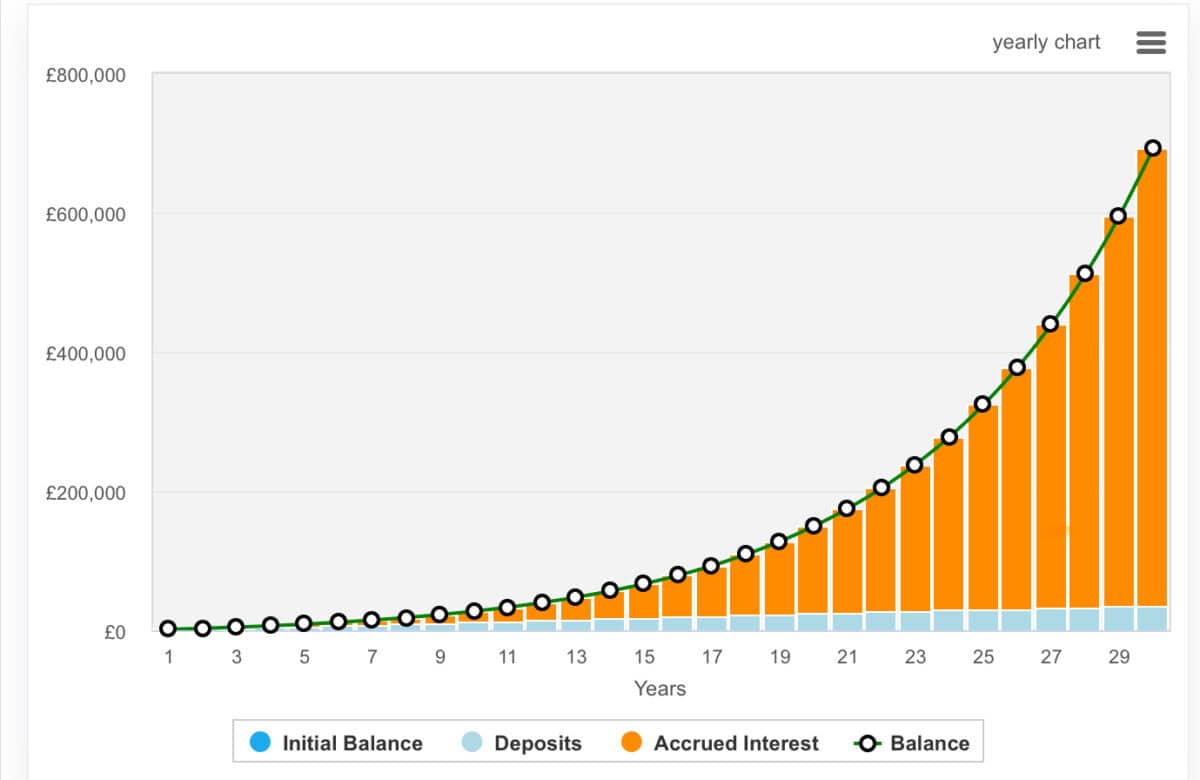
To illustrate, let’s consider a 30-year-old who starts investing £1,000 monthly in a Stocks and Shares ISA. Assuming an average annual return of 8% (which is in line with historical stock market performance), by age 55, their ISA could be worth over £480,000. This scenario doesn’t even utilise the full £20,000 annual ISA allowance.

It’s crucial to remember that consistency is key. Regular contributions, coupled with the power of compound interest, can turn seemingly small sums into significant wealth over time. Moreover, as one’s career progresses and earnings potentially increase, there may be opportunities to boost contributions, accelerating progress towards the goal.

However, it’s also important to highlight that some investors achieve much higher rates of return. My portfolio value has almost doubled over the last year and my long-term average is very strong.

For example, if a 15% rate of return was average over 28, an investor could reach this £480,000 mark with just £100 of monthly contributions. This is demonstrated in the graph below.

Created at thecalculatorsite.com

One stock to consider for the journey

Currently, I’m employing several different strategies for several different portfolios. The smallest of these is my daughter’s pension — as a one-year-old, her maximum contribution is around £240 per month, which is topped up by the government.

Despite a long time to maturation, I’m still following a growth-oriented approach. And because I’m investing relatively small figures, I’m preferring funds and ETFs to gain diversification, such The Monks Investment Trust, Scottish Mortgage Investment Trust, and Berkshire Hathaway (NYSE:BRK.B).

The latter presents an interesting opportunity at this moment. Berkshire has increasingly sold some of its prized holdings, including Apple, and now sits on $300bn in cash. This cash will likely be put to work on opportunistic acquisitions if the market goes into reverse.

However, this is a long-term investment into America. Warren Buffett’s conglomerate owns some of the most important parts of the American economy including banks, payment card services, railroads, and insurance.

Nonetheless, as with every investment, there are some risks. The conglomerate’s immense size may limit future growth opportunities, as finding acquisitions or investments capable of significantly moving the needle becomes increasingly difficult in today’s competitive market. 

2 cheap FTSE 250 growth shares for ISA investors to consider!

With the ISA deadline fast approaching, I’ve been scouring the London stock market for last minute additions. Today I’ve been digging through the FTSE 250 for the best undervalued UK growth shares to consider buying.

My research has unearthed the following bargain-basement growth heroes:

FTSE 250 stock Predicted earnings growth P/E ratio PEG ratio
Chemring (LSE:CHG) 25% 15.5 times 0.6
Spire Healthcare (LSE:SPI) 45% 15.7 times 0.4

As you can see, both of these FTSE 250 stocks are tipped to deliver double-digit earnings growth in the current financial year.

They also trade on a rock-bottom price-to-earnings growth (PEG) multiple below the value marker of one.

Here’s why I think they’re worth serious consideration from shrewd ISA investors.

Chemring

Chemring — which manufactures countermeasures and sensors for the defence industry — is thriving as arms spending accelerates in the West.

Its latest contract win last month was £26m, a multi-year agreement with “a major US prime contractor” to supply radar technology.

It follows news that revenues rose 8% in Chemring’s last financial year (to October 2024). Its order book also leapt to record highs of £1.04bn in the last fiscal period.

WIth geopolitical tensions rising and NATO budgets increasing, the FTSE 250 firm looks in good shape to win lots more business in the future. This should be supported by capacity increases for its countermeasures operations in the US and UK, and potential expansion in Norway (which it is currently exploring).

I’m also excited by Chemring’s improving presence in rapidly growing areas of artificial intelligence (AI), cyber warfare, and electronic security. These phenomena drove sales at its Roke unit 13% higher in financial 2024.

Supply chain issues in the defence industry remain a threat. And on the sales side, demand from the US could be adversely affected by spending reviews from Elon Musk’s Department of Government Efficiency (DOGE).

Yet on balance, I think Chemring’s a top stock for growth investors to consider. And particularly at today’s price.

Spire Healthcare

With its large footprint of 39 hospitals and 50 clinics (and other facilities), Spire is one of the UK’s largest private medical services providers. As a result, sales and profits are soaring as severe pressure on the National Health Service (NHS) drags on.

The reasons for this trading boom are twofold. NHS-related business is growing as the government pays private healthcare providers to clear patient backlogs. Revenues from this source rose 5.2% in the six months to June.

Trade is also booming as people sidestep long NHS waiting lists and fund their own treatments. Spire’s private revenues (through self-pay and private medical insurance) grew 5.1% between January and June 2024.

At the moment, there are 7.5m people waiting for NHS treatment. This will take a long time to clear, giving Spire excellent earnings visibility.

As Britain’s elderly population grows, healthcare businesses like this have significant profits potential over the longer term too. The Office for National Statistics believes one in four Brits will be aged 65 and older by 2050.

I think Spire’s a top stock to consider, even though medical staff shortages (and their impact on costs) remain a threat.

8% yield! Is this FTSE 250 REIT my ticket to a huge second income?

Shares in Warehouse REIT (LSE:WHR) currently come with a dividend yield of just below 8%. That means a £15,000 investment today could generate a second income of £1,170 this year.

The rise of e-commerce has created strong demand for warehouses, especially in the best locations. But, while I think this is here to stay, the overall situation is a bit more complicated.

Please note that tax treatment depends on the individual circumstances of each client and may be subject to change in future. The content in this article is provided for information purposes only. It is not intended to be, neither does it constitute, any form of tax advice.

Challenges

A high yield can be a warning sign – and there are risks with Warehouse REIT. Most obviously, the company is paying out 6.4p per share in dividends while making 5.4p in adjusted profits. 

Over the long term, that’s not sustainable and the firm has been making moves to rectify this. Part of this has involved divesting non-core assets, raising £74.4m over the last nine months.

It has also abandoned the development of a building project in Crewe after its pre-let tenant pulled out. And it’s in the process of selling this, with a view to bringing down its debt levels.

Strengthening its balance sheet should bring down the firm’s borrowing costs, boosting profits in the process. But in terms of growth, it isn’t particularly positive. 

Rent increases

Growth is often a challenge for real estate investment trusts REITs. They don’t have a choice about distributing their rental income to shareholders and this can make it hard to fund new investments. 

In its most recent update, however, Warehouse REIT outlined some pretty strong growth figures. The firm reported 25 deals, with rents up 32.5% on average.

By any standard, I think that’s very impressive. And it reinforces the point that demand is still strong for industrial properties in the best locations. 

This is Warehouse REIT’s biggest natural advantage – space in the best locations is limited and it can be hard to build new facilities. That makes assets in these locations extremely valuable.

Share count

One of the ways REITs finance their growth is by issuing stock. But shareholders need to look carefully at what kind of return the company is getting on its investment. 

Warehouse REIT is a complicated one in this regard. The number of shares in issue has increased from 166m in 2019, to 426m at the end of its last financial year.

That’s a 157% increase and during that time rental income has only grown by 57%. That’s not particularly impressive, but there’s more to the story than this. 

The company’s share count has been stable since 2022 and rental income has continued to rise. As a result, investors might think the equation is more attractive than it has been previously. 

Should I buy the stock?

With Warehouse REIT, the big risk is the lack of dividend cover. But the company is making moves to address this and the core of its portfolio appears to be doing well.

The threat of a rising share count is real, but things have been very stable recently. I might well buy the stock, but the risks mean I’m unlikely to make it a big part of my portfolio.

Financial News

Daily News on Investing, Personal Finance, Markets, and more!

Financial News

Policy(Required)