£10,000 invested in Greggs shares 5 years ago is now worth…

I’ve said this once or twice, but I never quite got the hype about Greggs (LSE:GRG) shares. The stock has been on two significant rallies since the pandemic, with its valuation looking incredibly stretched at points, especially for a purveyor of sausage rolls.

However, things aren’t looking so rosy anymore. After the firm released a less-than-inspiring guidance, the stock fell. In fact, Greggs shares are down 32% over six months. This also means the stock’s now down 11% over five years.

As such, a £10,000 investment five years ago would be worth around £8,900 today. But when dividends are taking into account, it may be a break-even trade.

Momentum wains and stock flops

Greggs performed particularly well during the cost-of-living crisis when Britons swapped eating out and more expensive food-on-the-go competitors for Greggs’ baked goods. Revenue gains were impressive and this was reflected in the share price.

Things aren’t looking so tasty anymore. On 9 January, Greggs’ CEO Roisin Currie reported subdued consumer confidence in the second half of 2024, leading to slower sales growth of 2.5% in Q4 and the subsequent share price decline.

Looking to 2025, the company faces increased cost pressures, notably the rising National Living Wage. Despite the potential benefits of increased consumer income, Currie highlighted that lower consumer confidence continues to affect spending and footfall.

She remains confident however, in Greggs’ ability to offer “value leadership” amid inflationary pressures.

Not a value stock

Greggs might offer good value on the high street, but even at today’s lower price, I don’t believe it offers value for investors. The company’s currently trading at 15.5 <a href="https://

“>times forward earnings — that’s a small premium to the index average.

Of course, that would be fine if Greggs offered the type of growth to justify this slight premium. But the forecasts suggest that earnings will only grow by 7% on average over the medium term.

In turn, this leads us to a price-to-earnings-to-growth (PEG) ratio around 2.2. Typically, a PEG ratio under one is reflective of an undervalued stock. Of course, there’s a 3% dividend yield to take into account.

However, even a dividend adjusted PEG ratio suggests that the stock could be overvalued by as much as 55%.

The bottom line

Metrics can be deceiving and sometimes analysts’ growth forecasts are simply incorrect. However, as it stands, the figures simply suggest that the stock’s overvalued.

Despite this, the majority of institutional analysts covering this stock are still upbeat on its prospects — 10 positive, one neutral, and two negative. However, sometimes analysts take time to adjust their forecasts. For now at least, the average share price target suggests the stock’s undervalued by 34%.

Personally, it’s not a stock I think is worth considering. There are far better options on the FTSE 250, in my opinion.


I’m getting nervous about the Lloyds share price

Earlier this week, I noticed that the Lloyds Banking Group (LSE: LLOY) share price was closing in on its 52-week high. As I write, shares in the Black Horse bank are trading at 63.68p, just 1.5% below their one-year peak of 64.67p, hit on 5 August 2024.

The Lloyds share price thrashes the FTSE 100

With the bank’s stock riding high, the group is now valued at £38.63bn, more than 2.5 times its five-year low during Covid-hit 2020. The recent price strength was boosted by a strong surge since 10 January 2025, when it leapt by more than a fifth (+20.4%).

As a result, the shares are up a mighty 53.8% over the past year — an outstanding performance from one of the FTSE 100‘s long-term laggards. That said, the share price has risen by only 12.5% over the last five years, trailing the Footsie‘s 18.9% gain.

We own this stock

For the record, my family portfolio bought Lloyds shares at the end of June 2022, paying 43.5p a share. Therefore, our stake is now worth 46.4% more. That’s a pretty decent return and broadly in line with what I hoped to make in our first three years of ownership.

What’s more, this capital gain is a big bonus, because we originally bought this stock as a pure dividend play. Even though the share price has since climbed, the shares still offer a market-beating dividend yield of 4.6% a year, ahead of the FTSE 100’s 3.6% annual cash yield.

Why would I worry?

As a long-term value/income investor, close to four decades of equity investing has turned me into something of a contrarian. Indeed, having lived through the stock-market crashes of October 1987, 2000-03, and 2007-09, I know too well that bull markets always end. That’s why I try not to fall in love with rising markets and individual stocks.

As a result, I get excited when share prices fall, because this allows me to buy into good companies at lower prices. Conversely, when share prices soar, I brace myself for the next tumble. Furthermore, while I’m keen to buy cheap shares, I also find it difficult to sell shares that may have become overvalued. Ho hum.

So should I sell?

I will say that I’m not a big buyer of Lloyds stock at current price levels. For me, there are cheaper blue-chip shares offering superior dividend and earnings yields. However, I don’t see myself selling our stake for the near future, either. I now view Lloyds as a ‘middle of the road’ stock, but with potential for further gains on good news.

Meanwhile, we will continue to reinvest our half-yearly dividends into buying yet more shares. I see this as a great way to increase the future value of our holding with no effort required.

Finally, there may be a rocky road ahead for the Lloyds share price, especially if UK inflation — the rising cost of living — continues to cool. This would allow the Bank of England to cut its base rate, bringing down borrowing costs for individuals and businesses. Lower interest rates means less interest income and lower lending spreads for banks. And this might hit Lloyds’ 2025-26 profits and cash flow!

Meta stock is up 17 days in a row! Time to buy this record-setter?

Meta Platforms (NASDAQ: META) stock has just set a couple of records. Yesterday (11 February), it rose for the seventeenth straight trading day, the longest winning streak for a Nasdaq 100 share since 1990. That’s also a record for any ‘Magnificent Seven’ stock!

Should I buy shares of the Facebook and Instagram owner for my Stocks and Shares ISA? Let’s take a look.

What’s going on?

Firstly, why has the stock been marching higher? As far as I can tell, there are three main reasons here.

Number one, the social media giant reported an incredibly strong fourth quarter at the end of January. Revenue jumped 21% year on year to $48.4bn, while earnings per share ($8.02) surged 50%. These figures demolished Wall Street projections for $46.9bn and $6.75, respectively. 

CEO Mark Zuckerberg, said: “We continue to make good progress on AI, glasses, and the future of social media. I’m excited to see these efforts scale further in 2025.”

Next, the company plans to invest up to $65bn on artificial intelligence (AI) infrastructure this year. However, unlike many other companies, Meta is already benefiting from AI in a tangible way, using it to improve targeted advertising and boost ad performance.

Advertising makes up nearly 98% of revenue, so it would appear that the technology is strengthening its core business. With a staggering 3.35bn daily users, the company’s platforms remain an advertiser’s dream.

Finally, TikTok might still get banned in the US, which would immediately benefit Meta as even more eyeballs and advertising dollars would shift over to Facebook and Instagram. Even if TikTok is bought by a US company, it would likely lose its competitive edge, as owner ByteDance is fiercely protective of the powerful recommendation algorithm that keep users so engaged. It won’t just hand it over to a competitor.

Valuation and risks

Despite the stock rising 235% in five years, it still looks reasonably valued to me. It’s currently trading at 25 times next year’s forecast earnings. According to this metric, Meta is cheaper than any other Magnificent Seven stock except Alphabet (18).

Looking ahead, analysts expect both revenue and earnings to grow 11%-16% in both 2026 and 2027. So despite its already massive scale, Meta is forecast to grow revenue to $239bn by 2027 (up from $135bn in 2023).

In terms of risks, I’d say a sudden slowdown in global ad spend is a big one. We saw this in 2022 when soaring interest rates and economic uncertainty led companies to slash marketing budgets and cut costs.

Also, the company has and is making massive investments in virtual reality and AI. If these don’t produce the returns that management thinks they will, then investors could turn bearish on the stock at some point.

Will I buy the stock?

The company’s market cap is now just under $2trn, making Meta the sixth-largest company in the world. While that doesn’t mean it won’t become more valuable in future (I think it will), I question whether it can deliver the kind of high returns I typically seek in a growth stock.

In other words, I prefer to invest in US stocks with smaller market caps (less than $50bn, usually). For investors interested in Meta stock though, I’d say it’s worth a look, even after rising so much.

4 good reasons why I’m avoiding cheap Lloyds shares like the plague!

There’s no doubt that Lloyds Banking Group (LSE:LLOY) shares offer tremendous value on paper.

It looks like a bargain based on predicted profits — its price-to-earnings (P/E) ratio is 9.3 times. The bank also offers decent value in view of predicted dividends, with its yield at a FTSE 100-beating 5.2%.

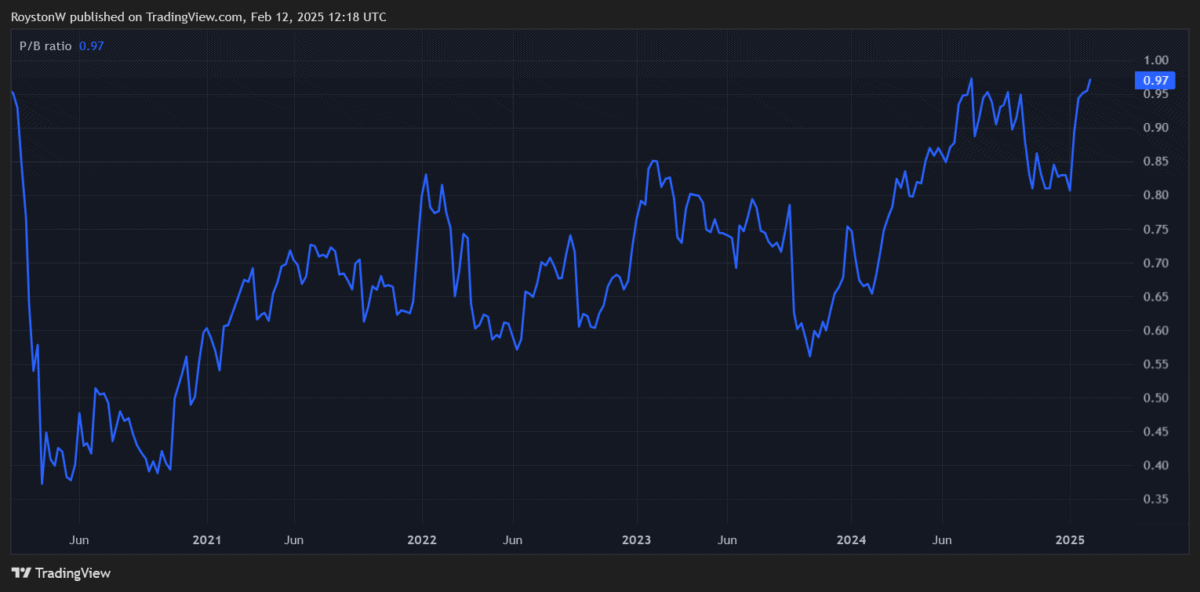
Finally, with a price-to-book (P/B) ratio below one, Lloyds also trades at a slight discount to the value of its assets.

Source: TradingView

But I don’t see Lloyds’ share price as a brilliant bargain. Rather, my view is that the bank’s cheap valuation reflects the high risk it poses to investors and its poor growth prospects looking ahead.

Here are four reasons I’m avoiding the Black Horse Bank today.

1. Growing mortgage competition

Signs of recovery in the housing market are great news for the UK’s largest mortgage provider. Home loan demand is recovering strongly as buyer confidence improves.

Mortgage approvals for home purchases leapt 28% year on year in December, government data shows.

However, margins in this key product segment are crumbling as competition intensifies. Santander and Barclays have sliced some fixed mortgage rates to below 4% this week, while others are also chopping amid a race to the bottom.

Lloyds will have no choice but to follow the herd, lest it loses new buyers and re-mortgagers to its rivals.

2. Margin pressures

The outlook for Lloyds’ margins is already pretty gloomy as the Bank of England (BoE) ramps up interest rate cuts.

Net interest margins (NIMs) at group level were wafer thin in the third quarter of 2024, at 2.94%. They dropped 21 basis points year on year, and could plummet more sharply if BoE rate reductions heat up as the market expects. This would leave little-to-no room for profits growth.

Experts suggest interest rates will decline to at least 4% by the end of December, down from 4.5% today.

3. Struggling economy

On the bright side, rate reductions will likely boost Lloyds by supporting credit demand and spending on other financial products. They could also reduce the level of credit impairments the bank endures.

Yet a gloomy outlook for the UK economy suggests it could still face issues on both these fronts. The BoE’s decision to cut its 2025 growth forecasts by half (to 0.75%) is a worrying omen.

With the central bank also tipping inflation to rise again, Lloyds faces a ‘stagflationary’ quagmire that may damage profits beyond this year. Major long-term structural issues for the UK economy include labour shortages, falling productivity, and trade tariffs.

4. Financial penalties

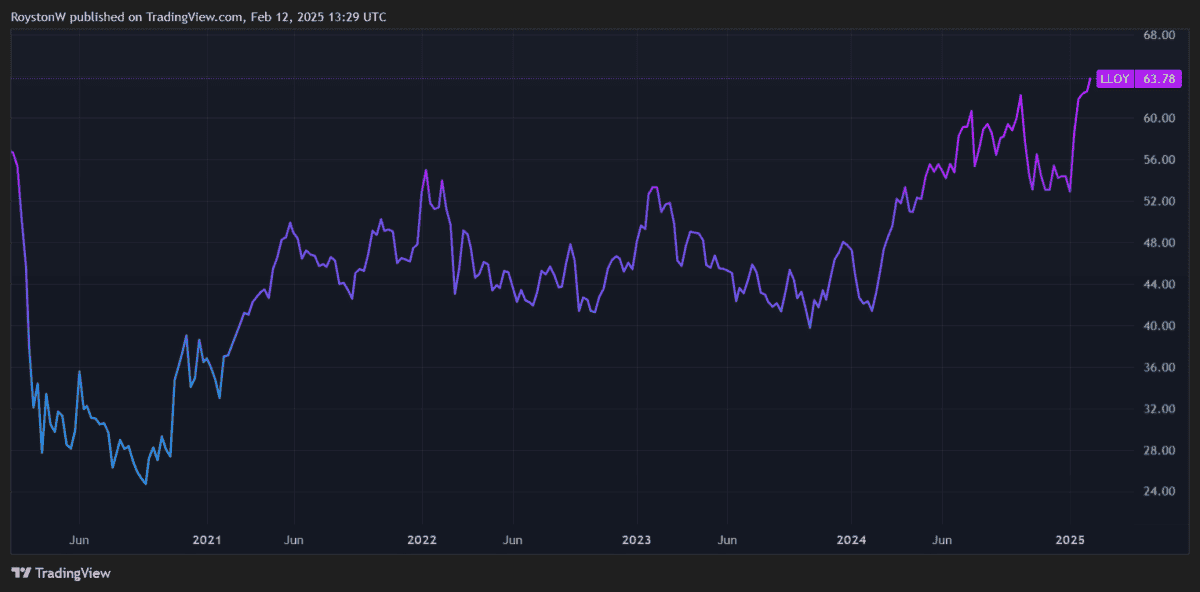
Lloyds share price
Source: TradingView

The final — and perhaps largest threat — to Lloyds’ share price in 2025 is the possibility of crushing misconduct charges.

To recap, the motor finance industry is subject to a Financial Conduct Authority (FCA) probe into potential mis-selling. Following a court case last September, analysts think lenders could be on the hook for tens of billions of pounds.

As the industry’s leading player, Lloyds — which made £15.6bn worth of car loans in the first nine months of 2024 — could be accountable for a large chunk of this. RBC Capital thinks the cost to the bank could be an eye-watering £3.9bn, though be aware that estimates have been moving higher in recent months.

31% revenue growth! This top growth stock just keeps powering on

Shopify (NYSE: SHOP) reported its fourth-quarter earnings yesterday (11 February). As is often the case, the e-commerce enabler’s numbers were mightily impressive, sending the growth stock up 3.1%.

This brings Shopify’s five-year return to 133%!

The flywheel keeps spinning

Shopify was founded to foster entrepreneurship by helping merchants build an online store and succeed. As the company does this, it also grows, fuelled by the success it enables (the flywheel effect).

Shopify now has over 12% share of the giant US e-commerce market — second only to Amazon! And it continues to expand rapidly in Europe and Japan, with international growth exceeding 30% for the second consecutive year in 2024.

In Q4, revenue accelerated 31% year on year to $2.81bn, marking the seventh consecutive quarter of 25%+ growth (when excluding the logistics business it sold in 2023). That beat Wall Street’s expectations for $2.73bn.

Full-year revenue jumped 26% to $8.9bn, with more than 875m unique shoppers purchasing something from Shopify merchants (an incredible one in every six internet users). Meanwhile, the free cash flow (FCF) margin expanded each quarter, finishing the year at 18%, up from 13% in 2023.

A final positive thing to note here was gross merchandise volume (GMV), which rose 24% last year to just under $300bn. That was 2.4 times higher than the pandemic-fuelled online shopping boom of 2020.

As a reminder, GMV represents the total value of all transactions processed through the company’s platform. And since being founded in 2006, it has now passed the $1trn mark in cumulative GMV!

All this tells us that Shopify’s growth engine is still purring, unlike many other e-commerce firms whose growth has slowed markedly after Covid (Etsy, for example, or eBay).

Harley Finkelstein, president of Shopify, commented: “With our proven track record, the agility of our platform, and our relentless focus on merchant success, we like our odds in this evolving technology landscape, and are excited about the opportunities it brings for Shopify and our merchants.”

Investing in AI

The company has been investing heavily in artificial intelligence (AI) products. It has created Shopify Magic, which is a suite of generative AI features that help merchants create product descriptions and transform product image backgrounds.

Additionally, it has launched Sidekick, an AI assistant that provides tailored advice and step-by-step guidance to help merchants optimise their businesses.

As a shareholder, I’m fully supportive of this relentless tech innovation. The AI features are attracting more merchants, solidifying Shopify’s position as the go-to platform for running an online store.

However, it looks like these investments will weigh on margins in the near term. Guidance for the current Q1 is for strong revenue growth (around 25%), but for the FCF margin to fall to mid-teens.

No rush

It’s hard not to be bullish long term, but this rosy outlook is reflected in the stock’s valuation.

Based on 2025 forecasts, it’s trading at around 14.6 times sales. This means the company will need to keep growing above 20% for some time to justify this premium valuation. If growth slows, the stock could pull back sharply.

Given the high valuation then, investors might want to consider building out a position on dips over time. There’s no rush to go all-in. After all, as Shopify says: “We’re building a 100-year company.”

Down 23% in a year, is Frasers Group a FTSE 250 bargain?

I like a bargain share in the FTSE 250 as much as the next investor.

After tumbling 23% in a year, retailer Frasers Group (LSE: FRAS) now sells on a price-to-earnings ratio of just nine.

That sounds fairly cheap, so should I buy?

Tough business, tough economics

I have some reservations as soon as I hear of a ‘cheap’ British retailer because I have been burnt so many times before.

Retail is a very competitive industry and even well-known brands with large customer bases can suddenly run into difficulties due to things like changing customer tastes and misjudging seasonal volumes when the weather changes.

Frasers is an odd business

Frasers has a wide range of retail operations and in its most recent financial year reported revenues of £5.5bn. That is a pretty big number for a business built on flogging badminton rackets and trainers. However, it was a 1% fall from the prior year.

Profits fell 21% year on year but still came in at over half a billion pounds. Frasers’ net margin was 9.2%, which is much better than many high street rivals.

But I find Frasers Group quite strange.

Is it a retailer? Is it a retailer that is trying to build up stakes in other retailers that could potentially become long-term takeover targets? Is it an investment group trying to snap up undervalued shares?

With its combination of wholly owned retailers like Sports Direct and stakes in firms from fast fashion firm boohoo to luxury handbag maker Mulberry, Frasers Group strikes me as an odd combination of retailer and activist investor.

I think this share could be a bargain

I do think the current Frasers Group share price could be a bargain.

The FSTE 250 company is solidly profitable. I think boohoo has untapped potential at its current value (I am a shareholder myself) and reckon the same is true for Mulberry.

But what is the strategy in all of this?

Running a discount sports retailer is already a consuming task. I wonder whether Frasers Group’s management has the necessary time and expertise to get profitably into the sort of investor activism it has done with its large boohoo stake.

Buying value shares and lobbying for boardroom change is a very different game to piling sports kit high and flogging it cheap.

I’m sticking to the Warren Buffett approach

Frasers Group has long been less than fully understood in parts of the City. That may help explain why the share price looks like a potential bargain.

But in fact I also am not sure that I properly understand the logic of the business model. Frasers Group owns some strong brands but in many cases they are heritage brands whose best days may be behind them in the absence of costly marketing support.

Meanwhile, buying shares in boohoo has so far unhappily been like trying to catch a falling knife for me. I see that as a risk for Frasers Group too. It could end up owning substantial stakes in weak businesses instead of using that capital to grow its own, proven retail operations.

Like Warren Buffett, I prefer to stick to what I understand when I invest. There are some FSTE 250 companies that fit that bill but Frasers Group is not among them. I will not be investing.

How much would someone need to invest in the stock market to retire and live off passive income?

Some people dream of quitting work and simply living off the dividends from stock market investments.

For others, that’s a reality.

So, how much would someone need to invest in order to quit work and live off their dividends?

Setting a financial target

The answer will depend on the specific investor’s needs and lifestyle.

For example, someone who retires young with an active social life and fondness for exotic travel may have very different requirements to someone who retires at an older age with a modest lifestyle and few spending commitments.

In this example, to keep things simple, let’s use the amount of £286 per week the government identified as the average 2023 weekly income for single male pensioners (markedly higher than the £259 figure for single female pensioners).

£286 per week is equivalent to roughly £14,900 per year so let’s say £15K.

If investing at an average dividend yield of, say, 7%, that would take an investment of £214,300 in the stock market.

Thinking about risks

But that might not be enough in practice.

Retirement can last for decades. Some years will likely bring unforeseen sudden expenses. Inflation will almost definitely mean that, a few years let alone few decades from now, the purchasing power of £286 will be less than today.

Dividend growth could be one solution to that (some shares like National Grid aim to grow their annual dividend in line with inflation) but, as with any share, dividends are never guaranteed.

If I threw a dart at the FTSE 100, I would say it is more likely that the share it hits cuts its dividend in the next 30 years than that retirees’ living costs fall during that period!

So diversifying the portfolio’s critical from a risk-management perspective. Ideally I think a smart investor will have an emergency fund of money or financial margin of safety to help deal with both life’s unexpected challenges and the corrosive financial effect of inflation.

Taking a staged approach

Besides that, at a bare minimum, putting £214,300 into the stock market today could do the trick.

But it’s also possible to aim for early retirement by building up a stock market pot over time, even from a standing start.

For example, putting £100 each week into the market and compounding it at 7% annually, an investor could have a Self-Invested Personal Pension (SIPP) or Stocks and Shares ISA worth over £214,300K in just two decades.

One share to consider

I think a well-known stock market name investors eyeing such an approach should consider is Legal & General (LSE: LGEN).

It yields 8.6% and plans to keep raising its dividend annually, as it’s done over recent years.

The company has a large and resilient target market it can compete in with its well-known brand and market expertise. Its large customer base and proven cash-generation capabilities appeal to me.

The FTSE 100 firm has cut its payout per share in the past. A recently announced plan to sell off a US business ultimately risks a lower long-term dividend per share once the initial sale proceeds have been distributed.

But I continue to hold Legal & General shares for the reasons I outlined above. As part of a big enough diversified portfolio, it could potentially help an investor aim to retire early.

This little-known technology company is now the 6th-largest business in the FTSE 100

Earlier this week, I was looking at the top 10 constituents of the UK’s FTSE 100 index. And one thing jumped out at me – RELX (LSE: REL) is currently the sixth-largest business in the index.

At present, this under-the-radar company has a market cap of £77bn. That means it’s bigger than BP, British American Tobacco, GSK, Barclays and many other well-known companies.

So, what does this company do? And more importantly, is it worth considering for a portfolio today?

A data powerhouse

RELX is a provider of information-based analytics and decision tools for professional and business customers. Its goal is to help customers make better decisions, get better results, and be more productive.

Today, the firm serves customers in four main areas – risk, scientific, technical & medical, legal, and exhibitions. Employing more than 36,000 people worldwide, it operates in around 180 countries.

In recent years, RELX’s share price has risen significantly. And it’s easy to see why.

In the coming years, businesses are increasingly going to turn to data and analytics to boost productivity. And RELX – which has recently been incorporating artificial intelligence (AI) into its solutions – could be a major beneficiary of this trend.

It’s worth noting that its databases currently house over 40 petabytes of information. If data is the new oil as they say it is, this company is akin to a gigantic oil well.

Worth considering?

Should investors consider buying the stock today?

Well, there is a lot to like about RELX from an investment perspective.

For starters, the company is expected to generate solid growth in the years ahead on the back of the data/AI boom. For 2025, revenue and earnings per share are projected to increase 7.4% and 11.1%, respectively (that’s a higher level of growth than a lot of FTSE 100 companies are generating).

I’ll point out that portfolio manager Nick Train – who holds the stock in his UK equity fund – said last year that he believes RELX has “transformative profit potential ahead.” Clearly, he’s bullish here.

Secondly, the company is very profitable. Between 2019 and 2023, return on capital employed (ROCE) averaged 23%. This is an important metric. Because history shows that companies with a high ROCE tend to be good long-term investments.

There’s also a growing dividend. This year, the payout is forecast to grow about 9%. That said, the yield is only about 1.7%. So, it’s not a stock for big income.

Additionally, the stock has a great long-term track record. Over the last five years, it has climbed about 100%. Over the last 10 years, it’s up about 250%. There are not many Footsie stocks with track records like that.

On the downside, the valuation is currently quite high. With analysts expecting earnings per share of £1.33 this year, the forward-looking price-to-earnings (P/E) ratio is about 31.

That’s not crazy for a data company. But it doesn’t leave much room for error (such as a slowdown in business growth or an unexpected drop in profits).

Another risk here is sentiment towards tech/AI stocks. If this was to deteriorate, we could see some profit-taking.

Given the valuation, I think it could be smart to consider waiting for a pullback for anyone interested in buying this stock. They might not have to wait long – full-year earnings are tomorrow (13 February) and these could potentially create some volatility.

Barratt Redrow shares spike 6% as profits forecasts hiked! Time to consider buying in?

Barratt Redrow (LSE:BTRW) shares have spiked today (12 February) after the builder raised its full-year profit forecasts.

At 461.8p per share, Barratt’s share price was almost 5% higher just after midday and the FTSE 100‘s biggest riser, having risen even further earlier.

So what’s been happening at the UK’s biggest housebuilder? And is now the time to consider investing?

Robust recovery

Improving homebuyer affordability has revilatised homes demand from the second half of last year. This is thanks to a mix of recent Bank of England (BoE) interest rate cuts and fierce competition in the mortgage market.

Encouragingly, Barratt Redrow’s trading update today shows that the upturn remains strong at the start of 2025.

Revenues rose 23.2% in the six months to December, to £2.3bn, while underlying pre-tax profit increased 6.4% to £167.1m.

Its net private weekly reservation rate improved to 0.6 from 0.45 in the same 2023 period. And reservations have remained robust since then, Barratt said, also averaging 0.6 between 30 December and 2 February.

Forward sales dropped to 10,903 homes as of 2 February from 11,460 a year earlier. But the value of these sales improved to £3.4bn from £3.1bn previously.

Now for the updates

Solid reservation activity since the New Year mean that Barratt now expects “to deliver total home completions of between 16,800 and 17,200” in the full financial year (to June 2025). Completions rose 10.9% in the first half of the year, to 6,846.

Pre-tax profit, meanwhile, is tipped to be “towards the upper end” of a market projection of £506m to £588m.

Elsewhere, the group said that it now expects cost synergies following last year’s Barratt-Redrow tie-up to be £100m, some £10m ahead of prior forecasts.

However…

Barratt’s news has been the pick of several robust housebuilder updates since the start of 2025. But while the business strikes a positive tone, the market still faces uncertainty as the UK economy stagnates and Stamp Duty changes from this April loom.

There’s also the ongoing problem of cost inflation, which pulled the firm’s adjusted gross margins down 1.1% in the first half, to 14.9%.

But on balance, things look good for Barratt as the BoE takes a more enthusiastic approach to interest rate cuts. As many as four rate reductions are currently expected by the market this year, pulling the central bank’s lending benchmark to 4% or even lower by the end of December.

Competition in the mortgage market also continues to heat up, which is good news for borrowers.

To buy or not to buy

Does all this make Barratt Redrow shares a good investment though?

The business is clearly making strong progress in an improving market. And the housebuilder’s long-term outlook remains robust, underpinned by the UK’s chronic ongoing homes shortage that’s supporting prices.

My concern, however, is that the good news is now baked into Barratt’s valuation. Following today’s gains, its price-to-earnings (P/E) ratio sits at a bulky 20.6 times.

This suggests to me that the good news may leave little room for further share price rises. A high P/E ratio like this may also prompt a sharp price reversal if trading conditions deteriorate again.

I plan to hang onto my own Barratt shares. But at current prices I’m not tempted to add more to my portfolio.

2 FTSE 250 stalwarts that could help if we enter a recession this summer

Tomorrow (13 February), preliminary data for UK GDP from Q4 last year will be released. Economists surveyed expect it to show a 0.1% fall. With early indications that the start to 2025 hasn’t been much better, another negative reading for Q1 would put the UK into a technical recession. For an investor concerned about this risk, here are two FTSE 250 stocks to consider.

Essential goods sold

The first company is B&M European Value Retail (LSE:BME). The business sells low-cost homewares, garden products, toys and more via big-box stores. It trades both with businesses and directly to the public.

Given the bulk-buy, just-about-essential nature of goods sold, it’s a defensive stock. What I mean by this is that if we get a recession, investors might sell riskier growth stocks and buy B&M shares to try and protect themselves. Demand for the goods should remain firm even during a downturn. Let’s be honest, even if finances get tight, we still need to buy things like toilet roll and dishwasher tablets!

The company could benefit from consumers trading down during tough times. For example, whereas a customer might now buy branded products, during a recession they might cut costs and buy from B&M instead.

The share price is down 35% over the past year. This is partly due to a recent lowering of the annual profit forecast as like-for-like sales in the UK fell by 2.8% in Q3. Even though this is a risk going forward, the business is still due to post an annual core profit of over £600m, so I don’t feel investors should be overly troubled by this.

If anything, the share price drop, which put the stock last month at the lowest level since November 2022, could represent a good value purchase.

Security from utilities

A second idea is Pennon Group (LSE:PNN). The firm is a UK-based water and waste management company, which primarily operates in through its subsidiary, South West Water. The stock is down 12% over the last year.

It makes money through the provision of the water and wastewater services to both residential and commercial customers. It’s a business model that has proven to be profitable over many years. As it’s a mature company, it does rely on paying out dividends to keep investors happy. At the moment, it has a generous 7.81% dividend yield.

Investors could find this defensive stock appealing, as even during a recession customers will still need water provisions. Even when I look at the pandemic period of 2020-2022, revenue didn’t materially fall. This makes sense, as the services provided are key, regardless of the economy.

The dividend payments are also appealing. If the stock market does fall during the recession, being able to pick up income in the process can help to offset losses elsewhere.

However, one concern is the fines over the past year due to sewage spills. The financial and reputational damage this can do is something the company needs to focus on.

I believe both stocks could be good for an investor to consider, if they are worried about the current state of the UK economy.

Financial News

Daily News on Investing, Personal Finance, Markets, and more!

Financial News

Policy(Required)