With an 8% yield and a P/E below 12, Taylor Wimpey looks in deep value territory

My Taylor Wimpey (LSE: TW) shares have taken a beating, plunging 22% over the past year. Yet when I crunch the numbers, they still look like they’re worth considering to me. But are they?

A word of warning. I first bought shares in the FTSE 100 housebuilder in 2023. In that relatively short period, they’ve been highly volatile. At one point, I was sitting on a 40% paper gain. Now I’m down 5%.

Higher interest rates have hit buyer confidence and made mortgages more expensive, hitting demand. And that’s on top of long-term affordability issues, not to mention the slowing economy. Higher inflation’s driven up labour and material costs, further squeezing margins. It’s a lot to take on.

Is this FTSE 100 stock truly a bargain?

Like many of its rivals, Taylor Wimpey reported a drop in property completions last year. The board responded by offering incentives and discounts to buyers, again shrinking margins.

Yet the balance sheet remains strong. Taylor Wimpey boasts a robust land bank, low debt and a disciplined approach to managing costs. 

With a price-to-earnings ratio of 11.6 times, the stock looks cheap compared to its historical average and peers. That’s a key reason why I see an opportunity here.

The UK still faces a chronic housing shortage, supporting demand. The Bank of England’s expected to cut interest rates two or three times this year. If it does, mortgage costs could fall and buyers return, boosting sales volumes and profitability.

None of this is guaranteed. Markets expected six interest rate cuts last year. We got just two. Inflation remains sticky. Donald Trump’s tax cuts and trade tariffs could keep it that way.

In its trading update on 16 January, Taylor Wimpey said full-year UK completions were towards the upper end of its guidance range, with operating profit in line with expectations. We’ll know more when final results published on 27 February.

The group ended 2025 with a solid £2bn order book, representing 7,312 homes. However, the board also cautioned that Budget hikes to employer’s National Insurance and the Minimum Wage will push up costs from April.

A brilliant dividend yield

I haven’t mentioned the dividend yet. That’s a huge selling point. The forecast yield for 2025 is 8.5%. The board policy is to pay 7.5% of net assets each year, typically around £250m. 

I don’t expect rapid growth. Last February, the board lifted the dividend by a fraction of a penny, from 4.78p to 4.79p. Given the sky-high yield, it’s hard to complain.

Taylor Wimpey remains cash generative. It’s weathered previous downturns while maintaining attractive shareholder returns. But if things get really bad, it could be cut.

The 16 analysts offering one-year share price forecasts have produced a median target of just over 148p. If correct, that’s an increase of around 27% from today. Combined with that yield, this would give me a total return of 35%. Fingers crossed!

For now, Taylor Wimpey remains a well-managed business with long-term growth potential. While risks remain, particularly around interest rates and consumer sentiment, its valuation looks compelling. I won’t buy though as I already have a big stake. But I feel the shares are worth investors considering.

Up 8% today, is this one of the FTSE 100 best growth shares to buy?

Shares in Coca-Cola HBC (LSE:CCH) have fizzed higher on Thursday (13 February) on an otherwise flat day for the FTSE 100 share index.

At £31.98 per share, the drinks bottler has leapt 7.7% to lead the UK blue-chip index higher. A forecast-topping set of financials for the last calendar year helped it rise.

Are Coca-Cola HBC shares ‘The Real Thing’ for growth investors? Let me give you the lowdown.

Strong numbers

The business bottles, sells, and distributes products for heavyweight drinks brands like Coke, Fanta, and Sprite. Their enduring popularity, combined with their strong records of innovation, support healthy sales growth even during economic downturns.

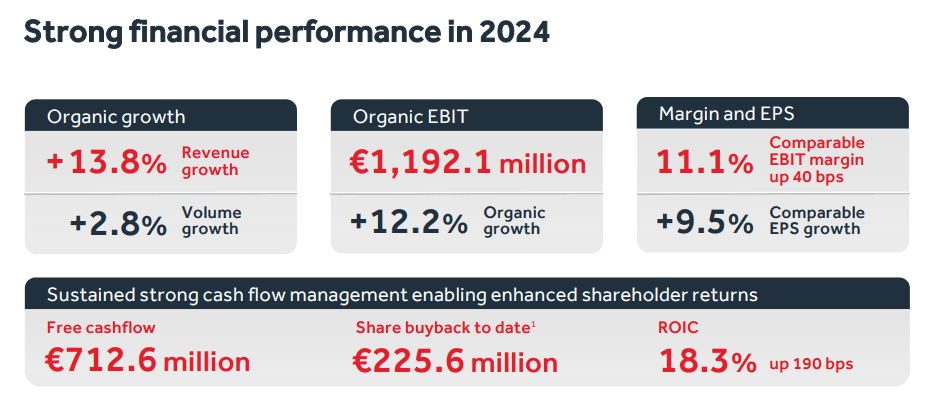
In 2024, the firm, which supplies its drinks across much of Europe and parts of Africa, reported organic net sales growth of 13.8%, to €10.8bn.

Coca-Cola HBC isn’t just about soft drinks, though. Indeed, the firm’s energy and coffee products stole the show again in 2024. Volumes across these categories soared 30.2% and 23.9% year on year.

Tasty value

Coca-Cola HBC shares have been one of the FTSE 100‘s biggest success stories so far in 2025. They’re up 14.8% since 1 January versus the broader index’s 5.7% increase.

Yet despite this, the company still offers good value compared to the Footsie’s other major consumer goods makers.

It’s forward price-to-earnings (P/E) ratio is 15.3 times, which is lower than Unilever and Diageo‘s corresponding readings of 17 times and 16.3 times, respectively. Its P/E multiple is also roughly in line with Reckitt Benckiser‘s for 2025.

Coca-Cola HBC’s valuation is all the more attractive given its superior trading momentum versus those other FTSE shares (Unilever’s share price actually slumped Thursday after it predicted soft first-half sales).

A top growth share?

I’m not saying that Coca-Cola HBC is totally risk free, of course.

The challenging economic landscape continues to cast a shadow, and the company has said it expects organic revenue growth to slow sharply, to 6%-8% in 2025.

Organic earnings (before interest and tax), meanwhile, is tipped to increase by 7%-11% this year, down from 12.2% last year.

A wide geographic footprint also leaves the company vulnerable to foreign exchange pressures. This proved the case last year as, on a reported basis, sales rose by a more modest (yet still respectable) 5.6%.

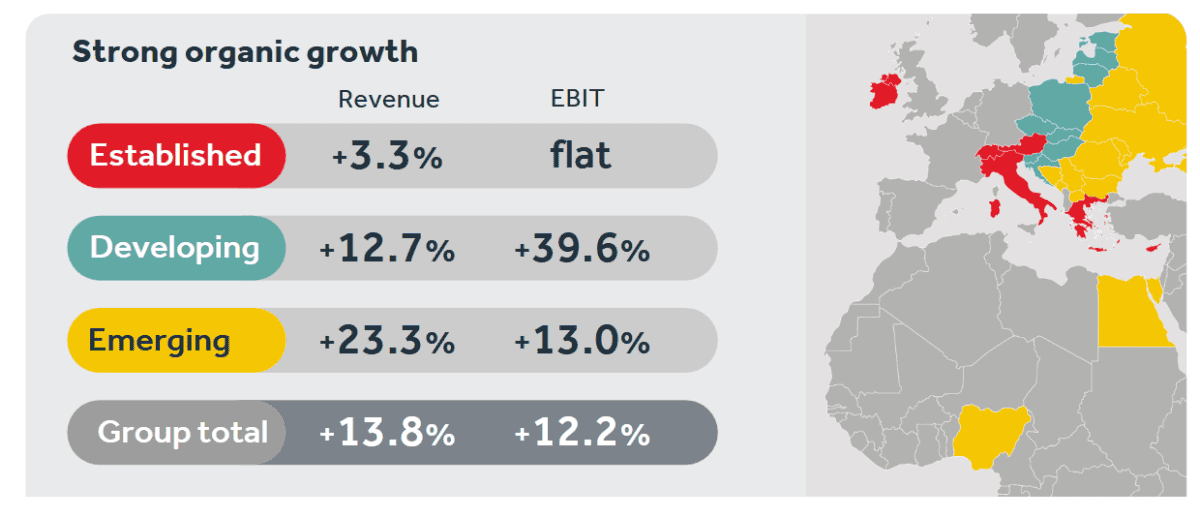
But context is everything, and those numbers are still pretty good in the current environment. It reflects in large part Coca-Cola HBC’s huge exposure to fast-growing regions: sales in its emerging and developing markets jumped by double-digit percentages in 2024.

Source: Coca-Cola HBC

Strong growth is also expected as the bottler executes its growth priorities. It plans to grab a larger share in the out-of-home coffee market, while further product launches in the energy category are likely (Monster Energy Green Zero was launched in another 16 territories last year).

City analysts expect group earnings to grow 11% in 2025 and another 10% next year. Given its market-leading labels, wide regional footprint, and strong record of innovation, I think it’s one of the hottest FTSE 100 growth shares to consider today.

With yields over 7%, here are two FTSE 100 dividend shares to consider in 2025

The UK stock market shows no signs of weakening as the FTSE 100 continues to climb higher, coming within a few percentage points of 9,000. Meanwhile, the pound has grown stronger against the dollar, rising 2% in the past month.

Typically, a rallying stock market leads to falling yields as the two factors move inversely.

However, many top-performing FTSE dividend stocks have maintained their high yields by increasing dividends. The insurance and property sectors are still two of the best places to look for high-yield UK shares. Stocks like Phoenix Group, M&G, and Taylor Wimpey all maintain yields above 8%, despite enjoying 8% to 10% gains in the past month.

But that’s not the only place where investors can find the best UK dividend stocks to buy in 2025. I’m more interested in the potential of two smaller FTSE 250 dividend stocks that I own. OSB Group (LSE: OSB) and Primary Health Properties (LSE: PHP) are two of my favourite UK passive income shares and I think dividend-focused investors would be smart to consider them.

OSB Group

Barclays recently cut its price target for OSB Group to 635p from 650p. However, it maintains an Overweight rating on the stock, with the target representing approximately a 50% gain.

The Kent-based challenger bank has a 7.7% yield, ramping up dividends at a rate of 16.4% over the past five years. For 2023, total dividends amounted to 32p per share, a figure that looks likely to increase for 2024.

Recent price activity has been muted, with the shares down 1.12% in the past year. The subdued growth reflects weaker performance, with earnings per share (EPS) falling from £1 per share to 75p in 2023. EPS for 2024 is expected to come in at 82p when full-year results are posted on 13 March 2025.

Overall, analysts remain optimistic about the stock. Nine out of 11 have a Strong Buy rating with an average 12-month price target of 553p — a 30% gain.

Primary Health Properties

Like OSB Group, Primary Health Properties has been trading sideways, with the share price down 0.7% in the past year. The real estate investment trust (REIT) focuses on buying and letting healthcare premises like hospitals and doctors’ offices.

REITs tend to be popular UK stocks with those looking for high yields as the rules require them to return 90% of profits to shareholders as dividends.

Please note that tax treatment depends on the individual circumstances of each client and may be subject to change in future. The content in this article is provided for information purposes only. It is not intended to be, neither does it constitute, any form of tax advice.

Labour’s sweeping budget reforms last October hit the REIT market hard, with prices falling across the board. But after hitting a five-year low of 86p last month, Primary Health took a surprise turn, gaining 7.3%. But it still has a long way to go to regain its five-year high of 168p.

Interest rates have been a key factor in the weakened performance, as the company relies on debt financing to fund property acquisitions. Recent rate cuts may have helped shore up the share price but it’s not in the clear yet. If the Bank of England’s rate cut plans don’t work as hoped, things could take a downward turn again.

Still, I think the FTSE 250 dividend stock, with its 7.6% yield and 20+ years of solid dividend growth, is one of the best for 2025.

Here’s why Coca-Cola HBC stock jumped over 9% in the FTSE 100 today

The Coca-Cola HBC (LSE: CCH) share price was on the move today (13 February), surging 9.3% to an all-time high of 3,246p. This made it the top riser in the FTSE 100 by some distance.

I’m relieved that I finally added this stock to my portfolio late last year. For months beforehand, I intended to invest but never got round to it.

Why is the stock up today?

For those unfamiliar, the company is one of the major bottlers for The Coca-Cola Company.

Based in Switzerland, it produces, sells and distributes beverages like Coca-Cola, Fanta, Schweppes, Sprite, and Monster across 28 markets in Europe, Africa, and Eurasia. Coca-Cola still owns more than 20% of the FTSE 100 firm.

Today, it released a strong annual earnings report for 2024, which is why the stock is up. Organic net sales rose 13.8% year on year to €10.7bn, which slightly beat the consensus estimate for 13% growth.

However, reported revenue growth was 5.6%, as this strong organic performance was partially offset by currency headwinds in emerging markets. 

Volumes increased by 2.8% on an organic basis, led by energy and coffee categories. Indeed, energy drink volumes grew by 30.2%, marking the ninth year of consecutive double-digit growth. Monster led the way, while Predator is growing strongly in Africa. Costa Coffee drinks are also doing really well.

Meanwhile, organic operating profit was up 12.2% to €1.2bn, while adjusted earnings per share increased 9.5% to €2.28. The dividend was hiked 11% to €1.03 per share, giving a forward yield of about 2.9%. 

Source: Coca-Cola HBC

Looking ahead to this year, Coca-Cola HBC forecasts organic revenue growth of 6%-8%, compared to market expectations of 7.3%. And it sees operating profit increasing 7%-11%, versus analysts’ prior anticipation for a 10.7% rise.

While the company is forecasting slower growth, many consumer-facing firms would snap your hand off if you offered them this level of anticipated growth in 2025.

A good mix

One thing to bear in mind here is that foreign currency changes can hit reported earnings. In 2024, the business saw a negative currency impact from the depreciation of the Nigerian Naira, Russian Rouble and Egyptian Pound.

So this is a risk, while there is an ongoing pushback against some Western brands in Egypt (considered a growth market, with a youthful population above 110m).

On the other hand, this diverse geographical footprint can be a strength, as weakness in one market (developed Europe, for example) can be offset by strength in another (most of Eastern Europe is growing strongly).

This applies to drinks too. For example, Coke Zero grew mid-single digits last year while Monster is growing much faster.

Overall, I really like the strong mix of markets and brands here.

What about valuation?

The stock is trading at around 15.5 times forecast earnings for 2025. I don’t think that’s particularly demanding for a high-quality company like this.

Also, an end to the Russia/Ukraine conflict would be a positive for Coca-Cola HBC. It still sells products in Ukraine while also operating in Russia, where it focuses on local brands. An end to the war might also boost consumer sentiment in neighbouring countries like Poland and Romania.

Despite the rise today, I still think the stock is worth considering for a diversified portfolio.

1 FTSE 100 stock an investor consider for a Stocks and Shares ISA if Cash ISAs get canned

Farewell Cash ISAs? Maybe not, but the idea of shelving these savings accounts is being talked about in the press. One reason is that thanks to the recent dismal UK growth projections, the government might need to drum up a bit of tax revenue and the sister of the Stocks and Shares ISA seems to have fallen squarely in the crosshairs. 

Personally, I’m not worried. That’s not because I don’t use a Cash ISA and not because I don’t think it’ll happen, but because I think there are much better places to grow a bit of spare cash. 

Why is this? Well, the Cash ISA is reliable and guaranteed, but also rarely pays back more than inflation. At the moment, the yield is 4% a year or so. That sounds fine, doesn’t it? Yes, but not when compared to the red-hot inflation of the last couple of years. You’d need 10% or so just to keep up!

A little deflating?

Studies highlight the issue. Data from Schroders showed the average return – in real terms – from a Cash ISA since 1999 was just 0.6% a year. The return in most of the 2010s was even negative thanks to inflation and almost 0% interest rates!

I know this phenomenon first-hand. I opened my first Cash ISA in that infamous 0% era. I chucked a couple of grand in one hoping to earn a few quid from it. When the statements came through, I was earning just a few pennies. 

All this might sound a little deflating, but actually I’m encouraged that the Stocks and Shares ISA seems safe. 

The government didn’t touch it in the Budget. In fact, it guaranteed it until 2030. And another reason the Cash ISA might get the axe is to encourage more investment in the stock market through the Stocks and Shares ISAs. 

To show the true benefits of these ISAs it might be worth looking at one of the stocks I own, Lloyds (LSE: LLOY). 

The bank paid a nice dividend of 4.62% on my stake last year, about what I might have expected in a Cash ISA all alone.

Dividends and gains

The yield as a percentage will fluctuate, of course, but whether it’s going up or down, the tax I pay on it won’t. That’ll always be 0% in an ISA. I’ll always get the full amount sent to me.

The share price looks low to me too. It’s still only 63p a pop despite multiple rounds of million-dollar buybacks which usually have upward pressure on the price. 

Other banks have been shooting up too thanks to various factors. Barclays is up 106% in the last year. Natwest is up 116%. 

If Lloyds shares follow that upward trajectory? The taxman won’t bother me. All shares held in an ISA are shielded from the capital gains tax imposed on such growth.

I should point out here that Lloyds is dealing with a legal battle around the misselling of car loans. No one can say quite how much the bank might be on the hook for and that will have investors worried. 

Overall though, I think Lloyds shares are one for any investor looking to add a quality stock to their Stocks and Shares ISA to consider, particularly if the Cash ISA might indeed one day join the choir invisible!

A 5.5% dividend forecast? £2k invested in Lloyds shares could earn an investor this much by 2027

Lloyds Banking Group (LSE:LLOY) has been increasing the dividend per share payment for the past few years, after cutting it completely during the pandemic. With the dividend yield currently at 4.54%, it’s already higher than the FTSE 100 average of 3.44%. Yet based on the dividend forecasts, there could be more income on the way.

Details of the payments

Typically, Lloyds pays two dividends a year. The first is declared as part of the annual results in February. The second is announced in July with the half-year earnings. Last year, the two payments amounted to 2.9p per share. Using a share price of 63.9p, this gives a yield of 4.54%.

The expectation is for a dividend of 2p next month, with 1.1p in July, totalling 3.1p for this year. For 2026, it’s forecast to be 3.2p, rising to 3.5p in 2027.

Given that the next dividend hasn’t even been declared yet, if an investor bought £2k worth of Lloyds shares now, they would be entitled to receive all the income this year. If I assume the share price by the end of 2027 is 63.9p, then the £2k could make an investor £322.51 in dividends over this period.

This assumes the dividends received are reinvested when paid, which helps to compound future returns.

Points to remember

The big factor to flag here is that dividends aren’t guaranteed. The projections are based on forecasts, in line with how the bank’s expected to perform financially. Yet there are factors that could negatively impact this. For example, if UK interest rates are cut faster than anticipated over the next year, it could reduce profit for the bank. A UK recession could cause customers to cut back on card spending, or increase loan defaults.

Further, the share price might not be the same in 2027. This could work either for or against an investor. If the stock falls in price, the unrealised loss would offset some of the dividends received. However, if the stock increases, then the capital appreciation would make it an even more profitable investment. Ultimately, future share price swings can’t be predicted.

Over the past year, Lloyds shares have increased by 54%. This is partly due to the financial benefits of interest rates remaining higher for longer. Yet even with this jump, the price-to-earnings ratio’s 8.41, below the fair value benchmark of 10 I use when trying to find cheap stocks.

Balancing the uncertainty

Planning for income payments gives investors a good idea of whether the reward for the risk of buying’s worth it. Of course, future dividends aren’t guaranteed, but I feel investors should consider adding Lloyds to an existing portfolio.

How much in savings would investors need to target a £3,000 monthly passive income?

UK shares can be an excellent hunting ground for regular passive income. Many FTSE shares offer dividend yields over 4%. In fact, almost a third of FTSE 100 shares do.

But dividends are only part of the equation. In addition, the underlying companies tend to grow over time. As an investor, building my pot is just as important as withdrawing regular income.

But just how big pot am I talking about? Let’s break it down.

Crunching the numbers

The rule of thumb for withdrawing money suggests that investors can take out 4% of their portfolio balance to avoid running out of money.

That means to earn £3,000 of passive income every month, investors would need savings of £900k.

I imagine most readers won’t have such a sum available right now. And if it sounds like a lot, let’s break it down even further.

I assume investors can earn 8% a year on their investments. I’ve picked this figure because 8%-10% is the long-term average gain for shares, although that isn’t guaranteed.

This means to build a £900k pot, I calculate that one should be able to do so by saving and investing £12,500 annually over 20 years. Or by starting earlier one could invest £8,000 every year for 30 years.

Investing for growth

Deciding what to invest in can often seem like a minefield. With seemingly thousands of potential options, it could be confusing.

For a simple approach, I think investors should consider splitting their investment strategy into two parts. First, the aim is to grow the pot. Second, I’d target a regular passive income.

For part one, I suggest a US-focused exchange traded fund. My low-cost preference is the Vanguard S&P 500 ETF (LSE:VUSA). With an ongoing charge of just 0.07% it’s one of the cheapest around.

US stocks comprise of many of the world’s growing technology companies. And their success is likely to continue in my opinion.

What I’d buy for passive income

For part two, when an investor is ready to start withdrawing a passive income, I’d suggest considering a dividend-focused fund. My top pick is City of London Investment Trust (LSE:CTY). It currently offers a 4.7% dividend yield. It also holds many household names that include HSBC, Shell and Unilever.

One of the most impressive factors about this fund is its dividend history. It has been distributing dividends to shareholders for a whopping 58 years back-to-back. Not only that. It has raised it every year too. That’s impressive.

While dividends aren’t guaranteed and companies can cut them at any time, City of London’s track record shows its experience in managing over time.

Right now, it trades at a 2.7% discount to their underlying investments. Although a discount can mean better value, it’s not always the case. It could also mean that its prospects aren’t so strong. That’s why I’d take investment trust discounts with a pinch of salt.

Overall, I’m optimistic my two-part strategy could be a recipe for a successful second income.

The average Stocks and Shares ISA turned £10k into £25k in a decade. I aim to beat that

The average Stocks and Shares ISA has delivered an excellent return over the last decade. According to Moneyfacts, it’s grown by 9.64% a year, on average.

By contrast, the average Cash ISA returned just 1.21% a year. I was converted to the glories of equity investing yonks back. But it’s nice to be reminded from time to time.

Let’s see what this means in practice. Say an investor had tucked £10,000 into the average Stocks and Shares ISA some 10 years ago. Today, they’d have £25,101, assuming all dividends were reinvested. By contrast, a Cash ISA would be worth just £11,278. 

The stock market has its ups and downs, but history shows it delivers superior long-term growth. Provided investors give it time.

That’s why I prefer equities

In the short run, share prices can go pretty much anywhere. Nobody should invest over a term below five years. Ideally, they should leave their money to compound over decades.

Here’s another figure I’ve stumbled across, from tracker manager Vanguard. It calculates that an investor who put £10,000 in the FTSE All-World Index in 1998 would have £59,825 by the end of last year. The average cash account would have delivered just £18,695.

These figures are slightly harsh on cash. Savings account took a beating when central bankers slashed interest rates almost to zero after the financial crisis. And everybody needs a bit of cash on easy access for a rainy day.

That 9.64% annual Stocks and Shares ISA return’s great, but I’m aiming to do a little better. Rather than investing in a broad index tracker, I pick individual stocks. This strategy carries more risk, but the potential for bigger rewards.

FTSE 250 insurer Just Group (LSE: JUST) is my most successful stock pick of the last year. Its shares soared 95% in that time.

The outlook remains bright. The group’s 2024 update, published on 15 January, revealed a 17% increase in new business profit to £246m. Adjusted operating profit climbed almost 45% to £324m, while its solvency ratio improved to 217%.

Just Group shares are a bit special

These figures demonstrate the company’s strong financial position and growing demand for its retirement products.

I don’t expect Just Group’s share price to double again over the next year. That kind of return is rare. The seven analysts offering one-year share price forecasts have produced a median target of just over 186p. If correct, that’s a modest 14% increase from today’s 163p. I get a small dividend on top. The trailing yield’s 1.3%.

Obviously, I cherry picked that stock. My portfolio also contains its share of losers (everybody’s does). I expect most of them to recover, given time.

There are no guarantees in any of this. I’ve no idea what the average return on my portfolio will be over the next decade. But I’ll be astonished if I didn’t beat cash.

Investing is never a guaranteed route to riches. But with patience, research and a diversified approach, I believe I can beat the average Stocks and Shares ISA over time. That’s my goal and I’m giving it my best shot.

As Barclays’ share price drops 5% on results, what should investors do?

Barclays‘ (LSE: BARC) share price dipped following the publication of its 2024 results on Thursday (13 February), but the numbers look fairly good to me.

With the stock still trading well below its book value, should investors consider buying the dip?

Solid results provide support

Barclays’ pre-tax profit rose by 24% to £8,108m last year, slightly above broker forecasts. Shareholders get a 5% dividend increase and have also benefited from £1.8bn of share buybacks over the last year.

I’m not always a fan of buybacks, but Barclays has been buying back its shares below their book value. For a healthy business, this can be good way to boost the share price. Having fewer shares in circulation increases a company’s book value per share, which can drive share price gains.

Barclays’ tangible book value per share rose by 8% to 357p last year. That’s more than 20% above the share price, at the time of writing. Chief executive CS Venkatakrishnan is planning more buybacks for 2025 too.

What to worry about

One area that’s causing some stress for UK lenders at the moment is motor finance – used car loans. Barclays stopped operating in this area in 2019, but the bank admits that “historical operations before this time” could be affected.

The UK regulator’s investigation into this sector is ongoing and no one knows what the outcome will be. But rival Lloyds (a much bigger motor sector lender) has already set aside £450m.

Another risk is the long-term volatility of profits from the group’s investment bank. This division’s performing well at the moment, as deal activity recovers. Profits rose by 18% to £3.8bn last year –nearly half the group total. But investment banking tends to go through weak patches periodically.

My verdict

I’m encouraged by what I’m seeing at Barclays. Most importantly, I’m happy to see the bank’s all-important profitability metrics are improving.

Return on tangible equity (RoTE) rose to 10.5%, from 9% in 2023. Management’s targeting a RoTE figure of 11% for 2025 and “greater than 12%” for 2026.

This is important because it’s probably the best measure of how much surplus cash a bank’s generating each year. All else being equal, higher returns on equity mean a bank will be able to invest more in growth or fund larger shareholder returns.

We can see the impact of this by looking at Barclays’ CET1 ratio, which is a regulatory measure of surplus capital. Despite returning £3bn of capital through buybacks and dividends, the bank’s CET1 ratio was almost unchanged at 13.6%, versus 13.8% a year earlier.

If Barclays can continue to hit its profitability targets, I think the shares should trade closer to their book value over time. Perhaps even above it. As I write, the shares are trading nearly 20% below their book value of 357p, on a 2025 forecast price-to-earnings (P/E) ratio of seven. There’s also a 3.2% dividend yield.

Barclays still looks decent value to me, and I’m reassured by the bank’s latest results. I think the shares are worth considering as a long-term buy.

Prediction: Scottish Mortgage shares will beat the FTSE 100 index in 2025

Scottish Mortgage (LSE: SMT) shares are having a good run at the moment. Year to date, they’re up about 15% versus a gain of 8% for the FTSE 100 index.

My prediction (and of course, it’s just my opinion) is that this year, returns from the growth-focused investment trust will beat those from the Footsie. Here’s my investment thesis.

A play on AI

One reason I’m bullish on Scottish Mortgage right now is that the trust has plenty of exposure to artificial intelligence (AI) stocks. I expect this area of the stock market to continue performing well in 2025 as AI technologies enjoy more adoption.

What I like about Scottish Mortgage is that it has exposure to different types of AI stocks. Not only does it own related infrastructure stocks such as Nvidia, ASML, and Taiwan Semiconductor Manufacturing Company (all involved in AI chips), but it also owns software/application stocks such as Amazon, Meta Platforms, and Snowflake.

This is important. Over the last two years, the AI story has largely been about the buildout. That’s why stocks like Nvidia have done so well. Now however, we’re entering a new phase where companies are rolling out AI solutions for their customers. In this phase, I think stocks like Amazon and Snowflake could do well.

It’s worth noting that the FTSE 100 doesn’t offer a lot of exposure to AI. There are a few Footsie companies that are rolling out solutions today, such as London Stock Exchange Group, Sage, and RELX but, in general, AI’s not a major theme for this index.

Top holdings could do well

Another reason I’m bullish on Scottish Mortgage is that I believe several of its top holdings have the potential to deliver substantial gains in 2025.

One such holding is Amazon, which at the end of January was 6.3% of the portfolio. It currently trades for around $230. However, in the last few weeks, many brokers have raised their price targets to between $265 and $290. That implies potential gains of around 15-25% from here.

Another is Nvidia (4.1% of the portfolio). Even though this company is more involved in the AI buildout, I think it has the potential to outperform in 2025. Currently, it trades on a forward-looking price-to-earnings (P/E) ratio of just 30. That’s a low valuation for this company.

Of course, there are stocks in the FTSE 100 that could perform well too. A few of the top 10 constitutions, such as GSK and HSBC Holdings, look cheap right now. I personally have more conviction in the likes of Amazon and Nvidia however. In my view, these companies have stronger long-term growth prospects.

I could be wrong

I’ll point out that there are risks that could derail my bullish investment thesis. One is a shift in sentiment towards artificial intelligence and consequently AI stocks. This could see Scottish Mortgage shares underperform the FTSE 100.

Another is an unexpected increase in interest rates. This could lead to weakness for tech stocks.

Overall, I’m still pretty optimistic about Scottish Mortgage’s prospects. I believe the trust is worth considering (as a higher-risk long-term growth investment) for a portfolio today.

Financial News

Daily News on Investing, Personal Finance, Markets, and more!

Financial News

Policy(Required)