What’s gone wrong with the FTSE 100’s ‘King of Trainers’?

Since November 2024, the JD Sports (LSE:JD.) share price has been the worst performer on the FTSE 100.

After two profits warnings, nearly 25% has been wiped off the market cap of the sports fashion retailer. As a shareholder, I feel the pain.

However, I’ve no plans to sell my shares. I believe the stock currently offers tremendous value for money. And I’m expecting big things over the next few years.

I’m not alone. In January, the company’s chief executive bought £99,000 of the stock at an average price of 90p.

What’s going on?

The retailer’s recent problems have been blamed on a “volatile trading environment”. The UK economy’s struggling to grow and consumer confidence appears low.

To compound matters, the increase in employer’s National Insurance Contributions will have a significant impact on the company’s bottom line. Ironically, the chairman of JD Sports was one of 120 business leaders who signed a pre-election letter endorsing the Labour Party’s economic policies, and calling for a change of government. As they say, be careful what you wish for!

The stock also appears to have been caught in the crossfire resulting from problems at Nike (NYSE:NKE). As the chart below shows, movements in the share prices of the two companies appear to closely mirror one another.

It’s believed that around half of JD Sports revenue comes from the sale of the American sportswear giant’s products. But a failure to innovate — and a poor decision to try and sell more product directly to consumers — has caused Nike’s sales to fall.

However, I think the worst could be over for the American icon. Although its stock is down 31% over the past 12 months, it’s ‘only’ fallen 6% over the past six.

The British retailer has recently bought Hibbett (in the US) and Courir (in Europe), which means it now has 4,451 stores worldwide. This should help reduce its exposure to the sluggish UK economy.

Amazing value

But I’m optimistic.

The company sells other brands — including Adidas — that are doing well.

It also refused to engage in discounting during the Christmas trading period. This helped improve its margins.

Encouragingly, in December 2024 — the most recent period for which the company has disclosed any information — like-for-like sales were 1.5% higher than for the same period in 2023.

And with the fall in the JD Sports share price, I think it could be the best bargain on the FTSE 100.

For the year that ended 1 February 2025, the company has been forecasting an adjusted pre-tax profit of £915m-£935m. At the lower end of this range, earnings per share will be 12p.

This means the stock currently (14 February) trades on a forward price-to-earnings (P/E) ratio of 7.3. This is low by historical standards. Less than four years ago, it was over 18.

I find it hard to believe that the stock’s only 16% higher than its post-pandemic low, a period when it was forced to close its doors and its future was very uncertain.

The sports leisure market remains huge. It’s estimated to be worth $220bn, with younger people being a key demographic. According to JD Sports, 16 to 24-year-olds consider sportswear as their number one choice when it comes to spending their discretionary income.

For these reasons, I think it’s an attractive stock to consider for bargain-hunting value investors.

Is it too late for investors to consider buying these outstanding FTSE 100 shares?

There are some terrific businesses listed on the UK stock market. Unfortunately, opportunities to buy shares in them at attractive prices don’t come around often. 

When a stock has been rising, it can look like the chance has gone. But this isn’t always the case — a growing business can be worth a high share price.

3i

3i (LSE:III) shares are trading at an all-time high, which suggests now isn’t a good time to consider buying the stock. But I don’t think investors should be too quick to conclude this. 

Five years ago, the stock was at an all-time high. And since then, the share price has climbed 250%, making it – without exception – the best-performing FTSE 100 stock of the last five years.

There are two reasons for this. The first is the private equity firm invests its own cash rather than taking in outside money, which allows it to buy when prices are low.

The second is its largest investment – a discount retailer called Action – has managed some very strong growth. But while these look like durable strengths, there are also risks.

To my mind, the most obvious risk is the possibility of the firm making a bad investment. 3i has shown exceptional discipline, but even the best investors make mistakes. 

With its competitive advantages intact, however, I think investors should take a close look at the stock. Dismissing it because the share price is high has historically been a bad idea.

Informa

Informa (LSE:INF) is another interesting case. The company runs some of the world’s largest trade shows, conferences, and exhibitions.

The names might not be familiar to industry outsiders, but attendance is essential for business owners. And these brand assets can generate significant cash for the FTSE 100 company.

Not owning the venues it hosts events in means Informa doesn’t have the maintenance costs of them. It also collects fees before settling its costs, giving it attractive working capital dynamics.

As a company that brings together international businesses, the threat of trade wars is a risk. And it should be obvious that this is especially relevant at the moment. 

Informa, however, has been through tough situations before. Covid-19 was arguably the biggest challenge an events company could have faced and the stock reflected this at the time.

Given this, investors might think the time to consider buying the stock has passed. But the quality of the underlying business means I think it’s still worth considering seriously.

FTSE 100 winners

Warren Buffett says that paying too much for a stock up-front can offset the effects of 10 years of strong business returns. And I think this is absolutely right. 

The fact a stock is trading at an unusual level, however, doesn’t necessarily mean it’s one to avoid. With 3i and Informa, I think these are worth considering despite their high prices.

The NatWest share price has doubled in 12 months. These FY results show us why

The NatWest Group (LSE: NWG) share price dipped a couple of percent in early trading Friday (24 February), even though the bank posted a strong set of full-year results and provided upbeat guidance up to 2027.

Still, it’s been one of the FTSE 100 success stories of 2024. And a lot of people will surely be taking some profit off the table.

The 2024 bottom line showed a 12% rise in earnings per share (EPS) to 53.5p. And the full-year dividend was lifted 26% to 21.5p. On Thursday’s closing price, that’s a price-to-earnings (P/E) ratio of 8.2, and a 4.9% dividend yield. Does that sound overpriced after the year’s doubling? Not to me.

Cracking returns

A 17.5% return on tangible equity (RoTE) stood out to me, boosted by a RoTE of 19% in the final quarter. It easily beat the 10.5% reported by Barclays this week, and the 13% that Lloyds Banking Group expects for the year.

NatWest guidance suggests a 15%-16% RoTE for the 2025 year, with at least 15% up to 2027. Add a Common Equity Tier 1 (CET1) ratio of 13.6%, expected to continue at 13%-14%, and I’m not seeing any likely liquidity problems.

The government’s stake, held since the bailout of what was then Royal Bank of Scotland, is now under 7% after the Treasury recently disposed of nearly 80m shares. CEO Paul Thwaite told us “2025 is also likely to be the year that NatWest Group returns to full private ownership.”

The prospect of continuing government offloading has been a threat hanging over the share price, but thankfully that’s nearing its end.

Rates and interest

Interest rates are a key thing for investors in bank shares to watch out for. After the Bank of England’s decision to cut base rates to 4.5%, a mortgage price war is already kicking off. Banco Santander and Barclays have announced limited offers of under 4%. And Nationwide says it’ll lower some rates.

Against that backdrop, NatWest shareholders should be buoyed by the bank’s 2.13% net interest margin for 2024. That’s one basis point above 2023 — not a lot, but not a fall. But it’s still something that could hamper bank profits in the coming year.

Bad debts are another threat, especially if we see inflation remaining stubbornly high. On that score, NatWest looks to have done well in 2024. It reported “a net impairment charge of £359m for 2024, or 9 basis points of gross customer loans, with levels of default stable.” Again, that’s reassuring, but investors need to keep their eyes open.

Cautiously optimistic

What about the lack of excitement shown in the NatWest share price in response to these results? It suggests to me that the market sees bank stock valuations as high enough for now. And with UK economic growth prospects still looking shaky, I suspect the market might have it right. Share prices might be in for a flat 2025.

I’m bullish about the long-term outlook for UK bank stocks. Right now though, I think there might be better yields for dividend investors to consider chasing.

This growth stock in my SIPP just crashed 33% in 1 day! Should I buy the dip?

Every investor has good days, bad days, and those that are just downright ugly. Yesterday (13 February) was the latter for my SIPP portfolio as one of my largest holdings — The Trade Desk (NASDAQ: TTD) — plummeted 33% in a single day.

Incredibly though, the stock’s still up 168% over five years, showing how well it’s performed historically. Nevertheless, this is a significant setback.

Should I buy more shares on this monster dip? Let’s take a look.

Uh-oh!

The Trade Desk’s platform enables programmatic ad buying, leveraging data to help brands and agencies reach target audiences more efficiently. For example, advertisers use The Trade Desk to place targeted ads on platforms such as Spotify or Roku.

The culprit for yesterday’s epic drop was the company’s fourth quarter. As soon as I read the report’s opening line, I had an ‘uh-oh’ moment: “The Trade Desk also announced an additional share repurchase authorisation, bringing the total amount of authorised future repurchases to $1bn.

In my experience, a share buyback announcement at the start of a growth company’s report is rarely a good omen. It suggests that management anticipates a share price sell-off and aims to reassure investors by signalling confidence through buybacks.

My fears were confirmed four sentences later when CEO Jeff Green added: “While we are proud of these accomplishments, we are disappointed that we fell short of our own expectations in the fourth quarter.” Oh dear.

The company beat earnings’ forecasts but its own guidance was for quarterly revenue of at least $756m. It came up short, posting $741m.

That might not sound like a big deal. But this was the first time in 33 quarters as a public company that The Trade Desk had missed its own guidance. And Q4 was the Holiday season/US election, a period when retailers were expected to double down on advertising.

For the first time in eight years, we missed the expectations we set, and it was our fault. 

Founder and CEO Jeff Green, Q4 2024 earnings call.

Softish guidance

Management blamed execution missteps in Q4, resulting in slower-than-expected adoption of Kokai, its new AI-powered ad-buying platform. That’s disappointing to hear, as the firm’s data-driven and should be perfectly positioned to harness powerful advances in artificial intelligence (AI).

Looking ahead, it sees revenue increasing by at least 17% ($575m) in Q1. While strong, that’s a slowdown from the 20%+ growth rates investors have grown accustomed to.

This highlights how growth stocks can sell off sharply when they don’t live up to investors’ lofty expectations every single quarter.

My move

Due to its high growth rates, the stock has always been pricey. Heading into the print, it was trading at a premium price-to-sales (P/S) multiple of 25. Even after the drop, the P/S ratio’s still 16.8. The risk with this high valuation is that if growth slows even further this year, there could be another sell-off.

Long term though, I remain bullish. The Trade Desk controls $12bn of ad spend in a $1trn global market. So the opportunity for further growth is massive.

I’ll see how the company gets on this year before committing any further money. But for investors wanting exposure to the fast-growing digital advertising market, the stock could be worth considering after this huge dip.

Considering a £20k ISA in this FTSE dividend star could mean a £170 monthly second income

With interest rates starting to fall, building a second income through dividends looks more attractive than ever. 

Banks and building societies are slashing rates on deposits, following the third Bank of England base rate cut on 6 February. Two or three more rate cuts could follow this year, and if they do, cash returns will fall further. So will bonds yields. With luck, dividend income will continue to rise.

Many FTSE 100 stocks offer solid value and sky-high yields, making them ideal for investors seeking passive income.

Can Phoenix dividends keep rising?

Dividends aren’t guaranteed though. Companies need to generate cash to fund them. This makes important to focus on companies with strong fundamentals. That means looking at revenue growth, customer retention cash flow and debt levels to assess whether the dividend is sustainable in the long run. 

While a high yield is tempting, it’s important to ensure the company can continue to pay – and hopefully increase – it in the years ahead.

One standout dividend stock to consider is Phoenix Group Holdings (LSE: PHNX), which currently boasts the highest yield on the FTSE 100 at a staggering 10.21%. 

For an investor who puts a full £20,000 Stocks and Shares ISA into Phoenix shares, that translates into an annual income of £2,040. Or £170 per month. 

Even better, forecasts suggest the yield will rise to 10.5% this year and 10.8% next, potentially boosting that income further.

So by 2026 our investor could be getting income of £2,160 a year, or £180 a month. And more thereafter, if the dividend holds. Plus any share price growth on top.

Phoenix is a specialist in managing closed life insurance funds, meaning it buys up policies from other providers and runs them efficiently using its economies of scale. 

This generates steady cash flow, crucial for maintaining that dividend. The board remains confident about its sustainability, recently reiterating its commitment to long-term shareholder returns. 

As with any high-yield stock, risks remain. While buying up life insurance books has worked well so far, any misstep in integrating new assets could strain cash flow and threaten dividends. Plus it needs to keep finding new books to buy. While making a success of diversifying into other areas.

Falling interest rates won’t necessarily work in its favour. Lower returns on cash and bonds could hit its investment portfolios, impacting profitability.

The FTSE 100 offers capital growth too

As with any stock, even a £5bn blue-chip, capital is at risk. Phoenix shares climbed 5% in the past year but are down 35% over five years. Long-term holders have seen much of their dividend income wiped out by capital losses.

Its shares now look decent value today, trading at a price-to-earnings (P/E) ratio of around 15, roughly in line with the FTSE 100 average.

Recent momentum has been positive, with the stock up 7% in the last month as falling interest rates revive investor interest. With US markets looking expensive, UK dividend stocks like Phoenix are attracting more attention.

No investor should put all their ISA into one stock, no matter how attractive the yield. A diversified portfolio is essential to spreading risk. While Phoenix offers a high income, a broader mix of stocks can provide a balance between dividend yield and capital growth, offering investors the best of both worlds.

ChatGPT told me this FTSE 100 stock might be the next Rolls-Royce

It gets a lot of stick, the FTSE 100. It might have been smashing record highs recently, but people aren’t all that optimistic on the index. FTSE 100 stocks are all about the dividends, they say. There’s been no growth since 1999, they note.

In among the doom and gloom, there are plenty of gems to be unearthed, however. Rolls-Royce (LSE: RR) is a notable example. The shares rose 10 times in value since a dip in 2022. I was quite pleased to see my own position grow with them, even if I didn’t quite catch the low point, and wondered what would be the next FTSE 100 stock to do the same thing. 

Why not, I thought, employ a little unnatural assistance with the help of everyone’s favourite dubiously veracious chatbot ChatGPT? So that’s what I did.  

Robot wizard?

Here’s the prompt I began with: “What FTSE 100 stock could be the next Rolls-Royce and grow 10 times in value?”

The text began with the usual disclaimers. Nothing is guaranteed. Careful analysis must be taken. All important stuff. 

I know such rapid growth is the exception rather than the norm but I’m looking to invest, not to gamble, so I can’t fault it on that front. After its precautionary preamble, it got to the meat of the issue.

“One company that has garnered attention in this context is Melrose Industries (LSE: MRO).”

ChatGPT then regaled me with talk of the engine and airframe parts Melrose produces along with highlighting its many patents (over 650) that create a high barrier to entry for competitors.

I found it curious how it jumped to another aerospace company. Melrose, like Rolls-Royce, operates in a sector that’s hard for a new company to enter. That creates a strong moat, or protection, around its sales and earnings. 

While that’s a real bonus for any company, it’s not a clear sign of rapid growth potential. 

The verdict

There are other similarities too. One aspect of Rolls-Royce’s growth story was a turnaround in falling revenues and sizeable losses. Melrose has also experienced revenue falling from £10bn in 2019 to £3bn last year reported. It was loss-making in all the years between too.  

Does that mean an equally terrific buying opportunity for me? I don’t think so. Another detail of the Rolls-Royce ascent was that it had fallen from 400p a share to 33p in just a few short years. That low was during the mini-crisis that was the 2022 mini-budget as well.

Melrose shares change hands for 623p which isn’t far from its own all-time high. A 10 times multiple on that would require Nvidia-esque growth

That’s not to say it’s a bad investment on the whole, but I don’t think it’s one where an investor like me might expect such rapid growth. 

That said, if Melrose starts shooting up soon then I will doubtless be running cap in hand back to the wise oracle of ChatGPT for more hot tips. 

Move over buy-to-let: here’s how to target a 6-figure passive income from a Stocks & Shares ISA

The Stocks and Shares ISA can make investors rich over the long run, assuming a sensible and informed investing strategy. That’s because it allows UK residents to invest and take their gains without paying tax.

While many Britons have elected to invest in buy-to-let property as a means to earn a second or passive income — and it certainly can be remunerative — I personally believe investing offers a much better way to make money.

It’s a very simple process: open a Stocks and Shares ISA, and then make monthly contributions while investing that money wisely. Keep it up for a long time and returns will compound heavily.

Sadly, investing isn’t something us Britons do well. In the UK, adults hold the smallest amount in equities and mutual funds of any G7 country at just 8%. In fact, UK has been bottom of the G7 league for investment in 24 out of last 30 years.

I genuinely believe that if this trend continues, we’ll become infinitely poorer compared with our international peers.

Please note that tax treatment depends on the individual circumstances of each client and may be subject to change in future. The content in this article is provided for information purposes only. It is not intended to be, neither does it constitute, any form of tax advice. Readers are responsible for carrying out their own due diligence and for obtaining professional advice before making any investment decisions.

A six-figure passive income

Across an entire portfolio invested in dividend paying stocks, it’s possible to sustainably, in my opinion, achieve an average yield of 5%. This is the money paid in the form of dividends and received by the shareholders, free from tax. As such, in order to earn £100,000 in passive income, an investor would need a portfolio worth £2m. That might sound like a tall order, but with time, it’s very achievable.

The answer lies in compounding. This is when the returns get larger and larger each year as the pot gets bigger. As such, the longer investors leave money in the market, assuming they can still match previous performance, the faster the money grows.

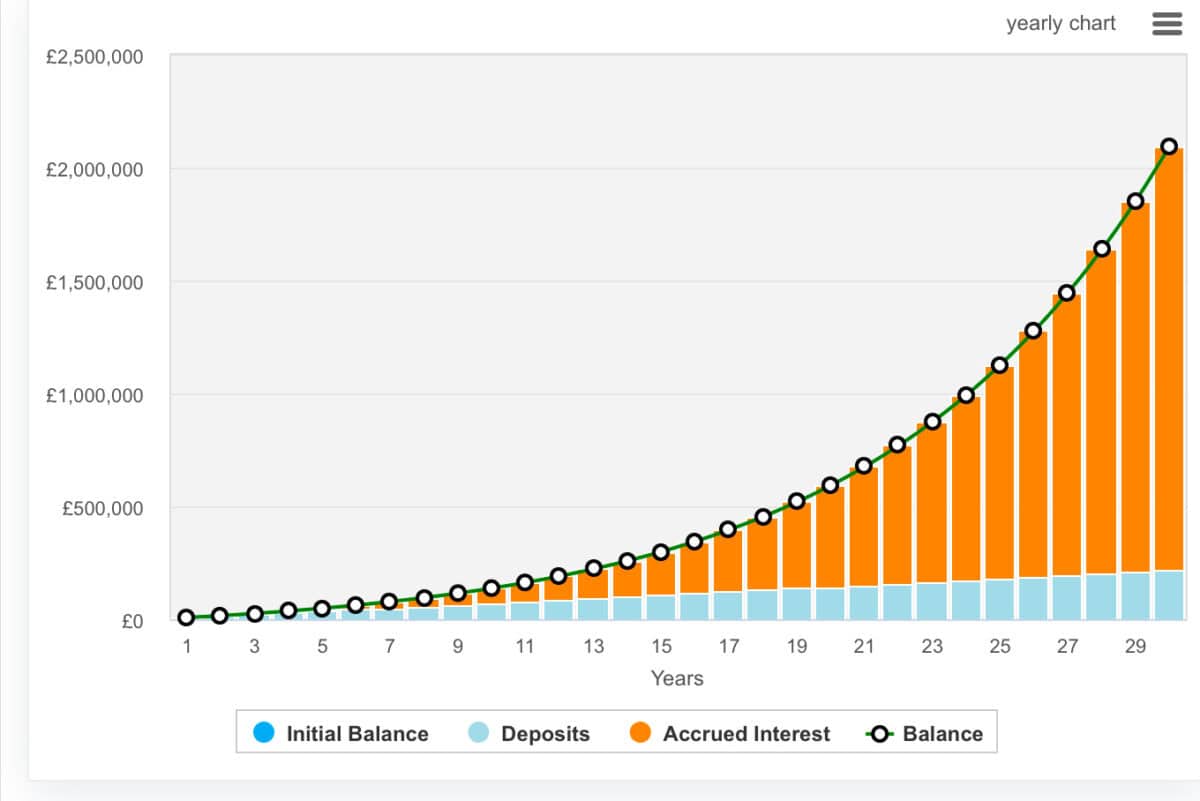
Just take a look at this example. Here, an investor puts aside £600 a month for 30 years while averaging a strong, but achievable, 12% annualised return. The growth towards the end of the period’s truly outstanding.

Created at thecalculatorsite.com

For further context, this portfolio would grow by £238k in the final year. Even in 29 years, that would still represent an impressive single-year wealth gain. Ok, it’s not guaranteed, but I’d need to earn over £500k in a salaried job to pocket that kind of money.

A stock for consideration

Hands-off investors may wish to start by considering funds or trusts like Scottish Mortgage Investment Trust. Or those seeking a more active approach may like to consider an undervalued stock like Jet2 (LSE:JET2). This AIM-listed airline trades at a massive discount to many of its peers.

Jet2’s net cash position is a key strength, projected to surge from £1.7bn in 2024 to £2.8bn by 2027. This liquidity supports expansions, including a 9% seat capacity increase for summer 2025.

Valuation metrics highlight upside potential. Jet2’s EV-to-EBITDA ratio is set to fall from 2.01 in 2024 to 0.52 by 2027, far below IAG’s 4.7. The price-to-earnings ratio of 8.1 times and a price-to-earnings-to-growth (PEG) ratio of 0.76 reinforce its undervaluation.

Risks include exposure to fuel prices and demand shocks. What’s more, its 17.7% gross margin lags IAG’s 27%, and an aging fleet may require higher capital expenditure. However, it’s a stock I’ve recently bought.

2 ETFs I think could explode in value in 2025!

Precious metals continue to grab headlines in 2025 as jitteriness on financial markets heats up. Bullion-backed exchange-traded funds (ETFs) have exploded in value as gold prices have jumped.

Gold — which struck 40 separate record highs last year — is already up 11% in the five-and-a-bit weeks since New Year’s Day. It struck fresh new highs of $2,914 per ounce in recent hours.

I think there could be much further upside for gold prices too. And especially if bullion values move through the technically critical $3,000 marker.

A simple way for investors to capitalise on this scenario would be to buy a gold-tracking ETF. Inflows into European funds like this like this have rocketed of late — according to the World Gold Council, they hit their highest level since March 2022 last month.

I’m considering buying one such find for my own portfolio.

Top tracker

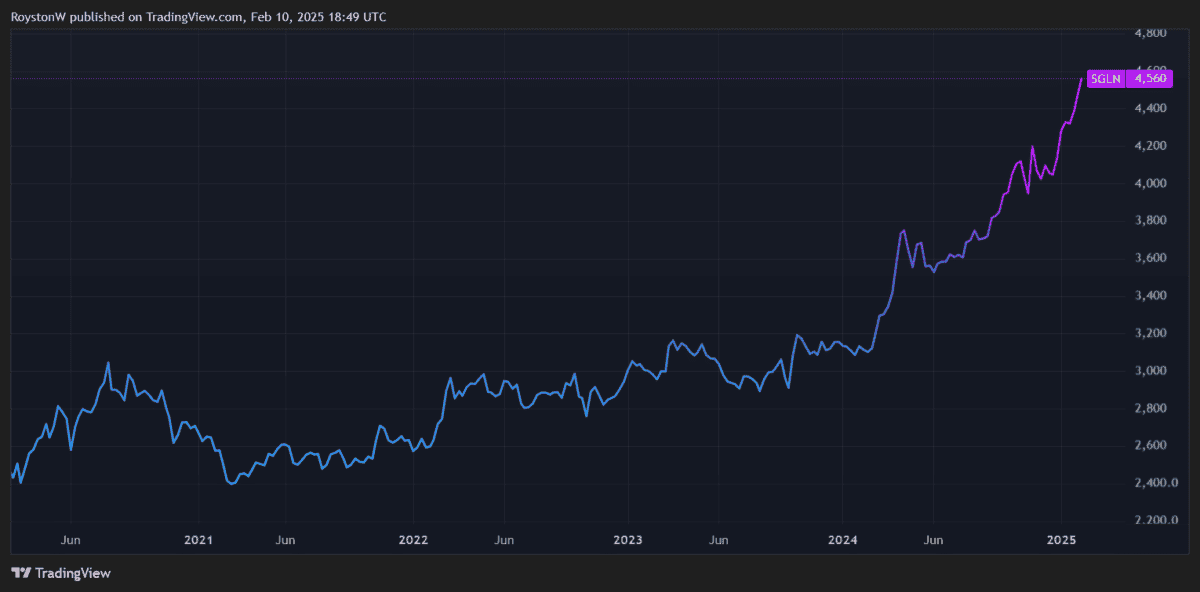
Source: TradingView

The iShares Physical Gold (LSE:SGLN) fund is one I think is worth a look because of its low charge structure. At 0.12%, its ongoing charge is one of the lowest in the business.

Funds like this allow investors to own gold without the hassle and cost of storage and delivery, nor worries of whether the metal they own is of acceptable quality. iShares says that 100% of the bars it holds meet criteria laid down by the London Bullion Market Association (LBMA).

This fund has another feature that makes it popular with certain investors. Unlike many ETFs, it tracks the metal price itself instead of a basket of companies with gold-mining operations. Therefore it protects individuals from the hazards attributed to minerals exploration, mine development and metal excavation.

Returns can be lower as a result. But it may be the preferred route to consider for risk-averse investors.

Another precious ETF

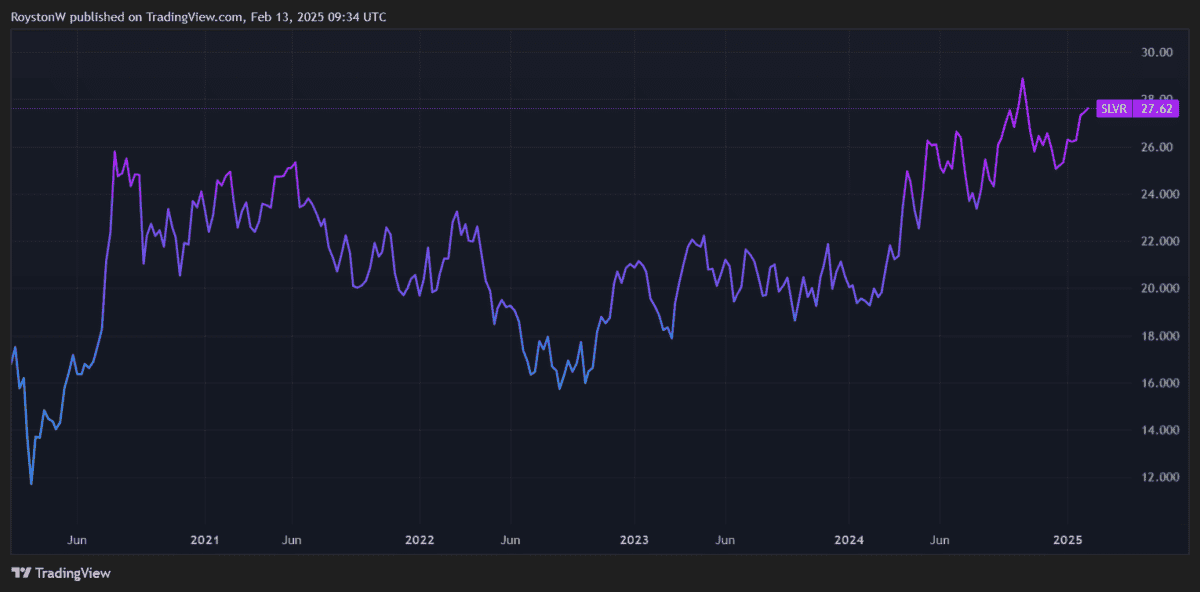
Source: TradingView

My view is that safe-haven demand for gold will continue to climb. There’s no guarantee of this, of course, and improving economic conditions that jolt market confidence could send it sharply lower.

One way investors can ‘hedge their bets’ and mitigate the risks of this scenario is by considering a silver-backed ETF instead. One I feel that’s worth considering today is the WisdomTree Silver (LSE:SLVR) fund.

This financial instrument — which also tracks physical metal prices instead of mining stocks — has leapt in 2025 as worries over the global economy and geopolitical turbulence have grown, supercharging investment demand for silver.

While safe-haven buying could continue, silver prices may conversely rise if the global economy improves and industrial demand for the metal picks up. Sectors like the car industry and electronics segments account for around 55% of silver demand.

Despite its dual role as investment and industrial metal, there are risks to silver prices and by extension related funds. Like gold, values may fall if the US dollar strengthens, making it more expensive to buy the greenback-denominated asset.

On balance though, I think both these ETFs could continue taking off in 2025 and potentially beyond.

1 red-hot stock I love in my Stocks and Shares ISA!

Today (14 February) is Saint Valentine’s Day. So in the spirit of Foolish fun, I’ve penned a soppy love letter to a beloved holding in my Stocks and Shares ISA. Namely Ferrari (NYSE:RACE).

You make my heart beat faster, Ferrari

Dear Ferrari shares,

From the moment we met in 2022 and I welcomed you into my portfolio, I knew this was no ordinary investment. 

At first though, I hesitated. You traded at a price-to-earnings multiple of 36, and some called such a valuation too racy. But I saw it differently. Extreme quality demands a premium and you, oh Prancing Horse, are the very definition of ultra-luxury. 

You have more than doubled in value since we entered into our relationship — so we have had the last laugh!

When I glance around at the so-called competition – ahem, Aston Martin – I feel no urge to stray. Those ravishing red supercars from Italy still turn heads everywhere they go. And I see them holding pole position for decades to come.

Some shares I’ve been with have proven to be a flash in the pan with no staying power. But you are in a class of your own. Year after year, you deliver truly exceptional margins, steady revenue growth, and a brand so powerful that demand never falters — recession or not.

While others chase mass production – selling to every Tom, Dick, or Harry – Ferrari keeps output tight. This maintains desirability and an insatiable demand, underpinning extreme pricing power and profits. The net margin was a stunning 23% in 2024!

What was it founding father Enzo once said? Ah yes: “Ferrari will always deliver one less car than the market demands”. Sometimes less truly is more.

What about our future?

Naturally, even the best thoroughbreds can eventually grow old and lose their edge. Perhaps pricing power and profit margins are pushed to the absolute limit, hurting the brand in the process. Perhaps the premium value is too high and you end up stalling in my portfolio. In that case, it might be time for us to… sob… part ways.

As things stand though, I can’t imagine us splitting up. The Daytona SP3 hypercar starts at $2.2m before personalisation options, while the F80 costs around $4m. And the first all-electric supercar is due to go on sale in 2026 at a rumoured $500,000.

Between 2023 and 2026, 15 new vehicle models will have roared out of the iconic factory gates in Maranello. This fresh line-up is expected to help annual earnings grow at low double digits over the next few years.

Meanwhile, the order book is at record levels, with a significant backlog. They say money can’t buy you happiness, but it can buy you a Ferrari. And have you ever seen a sad-faced owner experiencing the spine-tingling V12 at full throttle? Me neither.

Indeed, are you even a billionaire these days if you don’t own a collection of Ferraris?!

Looking back on our time together, I’m very happy with how things turned out. As for the future, I’m sure there will be speedbumps along the way, and I don’t expect another doubling of the share price anytime soon. But I think we will get through any challenges to even more prosperous times down the road.

All my love,

Ben

Defense stocks drop after Trump says Pentagon spending could be halved

  • Defense stocks dropped sharply Thursday afternoon after President Donald Trump suggested the U.S. could massively cut defense spending.
  • Trump has sent mixed messages on military spending throughout his 2024 campaign and in the early days of his presidency.
U.S. President Donald Trump sits in the Oval Office of the White House in Washington on Feb. 13, 2025.
Kevin Lamarque | Reuters

Defense stocks dropped sharply Thursday afternoon after President Donald Trump suggested the U.S. could massively cut defense spending.

Trump said Thursday at the White House the U.S. could cut defense spending in half at some point in the future. The comments came in the context of Trump discussing a potential conference on defense spending with China and Russia.

“At some point, when things settle down, I’m going to meet with China and I’m going to meet with Russia, in particular those two, and I’m going to say there’s no reason for us to be spending almost $1 trillion on the military … and I’m going to say we can spend this on other things,” Trump said.

“When we straighten it all out, then one of the first meetings I want to have is with President Xi of China and President Putin of Russia, and I want to say let’s cut our military budget in half. And we can do that, and I think we’ll be able to do that,” he added.

Defense stocks that had been higher earlier in the day quickly fell. Shares of Lockheed Martin were down 1.3%, Northrop Grumman sank 2.6% and General Dynamics lost 2.1%.

Trump has sent mixed messages on military spending throughout his 2024 campaign and in the early days of his presidency.

On one hand, Trump has enlisted Elon Musk and the so-called Department of Government Efficiency to find places to cut costs throughout the government. Trump has also pushed for a quick resolution of the war in Ukraine, which has involved the purchase of a lot of American weapons.

On the other hand, he has touted the importance of having a strong military and signed an executive order to explore building an “Iron Dome of America” missile defense system. Trump also said Thursday that the U.S. has the “greatest military equipment in the world.”

“Right now, people are confused by a number of different crosscurrents” on defense spending, TD Cowen policy analyst Roman Schweizer told CNBC last week.

Don’t miss these insights from CNBC PRO

Financial News

Daily News on Investing, Personal Finance, Markets, and more!

Financial News

Policy(Required)