Here’s the growth forecast for JD Sports Fashion shares to 2027!

Owning JD Sports Fashion (LSE:JD.) shares has been a painful experience of late. At 87.5p per share, the FTSE 100 retailer’s fallen 28.4% in value since mid-August.

JD’s slump is due to a series of profit warnings resulting from weak consumer demand. For the last financial year (ended January), City analysts expect annual earnings to have risen just 1%.

In better news, the number crunchers think profits growth will heat up over the next couple of years. This is shown in the table below:

But given recent downgrades, how robust can these forecasts be considered? And should I think about adding JD, a former hero for growth share investors, to my portfolio?

Hard times

To recap, JD’s been battered due to weak conditions in its markets, and particularly so in the US. In January’s most recent profit downgrade, it said: “Market headwinds were higher than we anticipated” during the key Christmas period. It added: “With these trading conditions expected to continue, we are taking a cautious view of the new financial year”.

Like-for-like sales were down 1.5% across November and December, with declines in North America and the UK offsetting rises in Europe and Asia Pacific.

Combined, its North American and British operations account for 65% of group turnover.

Ongoing uncertainty

So what can we expect going forwards? Well judging from most recent newsflow, JD may have to wait a little longer for any sales recovery.

On a seasonally-adjusted basis, clothing and accessories sales in the US fell 2.96% month-on-month in January, according to the CNBC/NRF Retail Monitor. Weak Stateside demand has been the chief problem for JD in recent times.

Sticky inflation and its impact on interest rates continues to impact consumer spending across the firm’s markets. It’s hoped that these pressures could ease as 2025 progresses, boosting retailers’ takings.

But this is far from certain. In fact, the situation has arguably become a little more gloomy following latest Consumer Price Inflation (CPI) data from the US this week.

A figure of 3% was higher than market expectations and has cast doubt on the pace and scale of future Federal Reserve rate cuts. The possibility of new price-inflating trade tariffs coming into effect adds another layer of unpredictability.

A top value buy for me?

Yet despite these hazards, I’m still considering adding JD Sports Fashion shares to my portfolio. This is because I’m someone who buys stocks to hold for the long term. And while it may take a little longer than the market hopes, impacting current earnings forecasts, I’m optimistic JD’s sales will roar back into life, supercharging its share price from current levels.

For one thing, the global athleisure sector still has room for considerable growth. Analysts at Fortune Business Insights think sales will rise at an annualised rate of 9.82% between 2024 and 2032, driven by growing demand for comfortable, functional clothing and product innovation.

Through steady expansion, JD — which added 1,159 stores in the first half of last year — could be well placed to capitalise on this upturn too.

I’m also attracted by the company’s low P/E ratio of below 7 times. This gives the JD share price plenty of scope to rise if (as I expect) sales recover.


Looking for last-minute ISA buys? Here are 2 cheap UK shares to consider

It’s human nature to leave certain things to the last minute. The same applies to investing, with many Stocks and Shares ISA investors waiting until the 11th hour to add to their portfolios.

Here are two cheap UK shares I think are worth considering before the £20k annual ISA allowance resets on 6 April. I think it’s a matter of time before the market drives their share prices higher.

Silver surfer

Some disappointing operational news has hammered Hochschild Mining‘s (LSE:HOC) share price in early 2025.

Rising costs are an issue for Argentina’s miners as inflation rockets again. In January, Hochschild predicted a rise of 5-10% in all-in sustaining costs for 2024, above forecast, and suggested further cost pressures ahead.

However, I believe the scale of the sell-off could be unjustified (it’s down 14% since 1 January). At 109.6p, the precious metals miner trades on a bargain-basement price-to-earnings (P/E) ratio of just 5.9 times for 2025.

Its forward price-to-earnings growth (PEG) ratio, at 0.1, is also below the value watermark of 1. This cheapness is especially surprising given the overall robustness of Hochschild’s earnings picture.

Production remains strong at the FTSE 250 firm, with forecast-beating output at its Immaculada asset and maiden output at its Mara Rosa mine resulting in a robust final quarter in 2024.

On top of this, gold and silver prices are buoyant, and are widely tipped continue soaring as worries over trade tariffs and broader geopolitical turbulence grow.

Safe-haven gold hit new peaks around $2,945 per ounce this week, and is up 11% since New Year’s Day.

Fears over its cost base remain high. So signs of further pressure — for instance, if Argentina’s inflation rate worsens — could pull Hochschild’s share price lower again.

But, on balance, I think the silver giant is a top bargain to think about at today’s prices.

Dividend darling

While Hochschild has suffered in early 2025, Warehouse REIT (LSE:SHED) has had no such problems. Its shares have risen 4.3% in value since January 1.

Ye, on paper, the property giant still looks dirt cheap to me. At 82p per share, the real estate investment trust (REIT) trades at a 37.9% discount to its estimated net asset value (NAV) per share.

Its forward PEG ratio is 0.7. It also offers great value from an income perspective with its prospective dividend yield sitting at an impressive 7.8%.

This, in part, reflects rules that state REITs must pay at least 90% of annual rental earnings out in the form of dividends.

Please note that tax treatment depends on the individual circumstances of each client and may be subject to change in future. The content in this article is provided for information purposes only. It is not intended to be, neither does it constitute, any form of tax advice.

Warehouse REIT’s one of many property stocks that have jumped in 2025. They’ve risen on signs from the Bank of England that interest rates could fall steadily, boosting firms’ NAVs and reducing their borrowing costs.

Yet what goes up sharply can also fall if market sentiment changes. Prices here could dip if the interest rate outlook changes (for instance, if inflationary markers tick up again).

I believe though, that this scenario’s already baked into Warehouse REIT’s rock-bottom valuation. For ISA investors, I think it’s a great last-minute buy to consider alongside Hochschild.

Here’s the dividend forecast for GSK shares through to 2026!

GSK (LSE:GSK) has re-emerged as one of the FTSE 100‘s more attractive dividend-paying shares.

Annual payouts were kept locked at 80p per share for years before toppling to 44p in 2022. But dividends have grown strongly since then, including a 5% hike to 61p last year.

City analysts are expecting cash rewards to keep rising through to 2026 too. Here are the forecasts:

Year Dividend per share Dividend growth Dividend yield
2025 64.6p 6% 4.5%
2026 69.7p 8% 4.9%

Expectations of further dividend growth mean the yields on GSK’s shares soar above the FTSE 100 average of 3.5%. Yet dividends are never guaranteed. And as a dividend investor, I need to consider how realistic these estimates are before splashing the cash on its shares.

So what’s the verdict? And should I consider adding GSK to my portfolio?

Strong foundations

The first thing I’ll consider is how well predicted dividends are covered by expected earnings.

A figure of two times or more is desirable, as it provides a wide margin of safety in case of profits shocks. It also gives breathing room for the company to keep investing in its operations while paying a dividend.

On this front GSK scores very highly, with dividend cover standing at 2.6 times and 2.7 times for 2025 and 2026 respectively.

The next stage is to consider the firm’s balance sheet. A sturdy financial foundation’s particularly important for pharma companies, given the huge costs associated with product development.

Once again GSK looks good, with its net debt falling to £13.1bn at the end of 2024 from £15bn a year earlier. This results in a pretty manageable net-debt-to-core EBITDA ratio of around 1.2 times.

The firm’s decision to launch a £2bn share buyback programme also underlines the company’s robust financial health.

Bright outlook

On balance then, the dividend forecasts at GSK look rock solid. But predicted payouts for the next couple of years aren’t the only things on my mind as a possible investor. I also need to consider the company’s growth prospects, which will impact its share price performance (along with dividends) over the long term.

Owning pharma shares can sometimes be a tough pill to swallow, so to speak. Drug development costs can spike, and regulators can scotch planned product launches. Companies can also be hit with expensive litigation (GSK last year paid £1.8bn to settle legal cases over its Zantac heartburn treatment).

But on balance, things are looking sunny for GSK right now. This month it upgraded its 2031 sales target, saying it now expects revenues of £40bn versus a previous forecast of £38bn.

These forecasts are underpinned by strong recent late-stage testing results. In fact, with a strong track record of execution — and a packed pipeline of 71 drugs in the Specialty Medicines and Vaccines segments — things are looking good for the FTSE company for the next decade.

Supported by growing global healthcare demand, I think GSK shares are worth serious attention for both growth and income.

3 S&P 500 stocks for the quantum revolution

Investing in quantum stocks comes with considerable risk due to the highly technical nature of the field. Here, we asked five Fool.co.uk contract writers to suggest a stock listed on the S&P 500 that they think investors should consider buying to potentially benefit from this emerging theme…

Alphabet

What it does: Alphabet is the parent company of Google and a diversified technology giant with quantum ambitions.

By Dr James Fox. Alphabet (NASDAQ:GOOG) (NASDAQ:GOOGL) and Google’s quantum ambitions have taken a leap forward with the unveiling of the Willow quantum chip in late 2024. This breakthrough device can perform complex calculations exponentially faster than classical supercomputers, completing tasks in minutes that would take traditional systems septillions of years. 

Google aims to demonstrate the first “useful, beyond-classical” computation and ultimately build a large-scale quantum computer capable of tackling real-world applications. Based on publicly shared progress reports, Google seems to have a lead in the area. 

Looking at the company’s valuation, the price appears reasonable with a forward price-to-earnings ratio of 24.1 times, slightly below its five-year average. Key risks include regulatory issues, particularly the Department of Justice’s demand to split off Chrome, which could impact Android revenues. Additionally, AI competition and shifts in search behavior pose threats to Google’s core business. 

Nonetheless, Google’s strong balance sheet supports continued investments in cloud, AI and quantum technologies. And the company’s quantum computing breakthroughs, if successfully commercialized, could provide a significant competitive advantage in the long term.

Dr James Fox does not own shares in Alphabet.

Alphabet 

What it does: The owner of Google and YouTube, Alphabet is one of the largest technology companies in the world. 

By Edward Sheldon, CFA. There are a number of S&P 500 companies that offer exposure to quantum computing. Personally, I like Alphabet for exposure to the theme as it has been working on the technology for over a decade now.  

Late in 2024, Alphabet announced the arrival of ‘Willow’ – the company’s latest quantum chip. And this looks very exciting. 

With this chip, it only takes five minutes to perform a calculation that would take one of today’s fastest supercomputers 10 septillion years (10,000,000,000,000,000,000,000,000 years) to compute. So, it’s incredibly powerful. 

Meanwhile, the chip can reduce errors exponentially as ‘qubits’ are scaled up. This cracks a key challenge in quantum computing that has plagued the field for decades. 

Of course, there are no guarantees that Alphabet will go on to be a winner in the quantum computing industry. There are also no guarantees that quantum computing itself will go mainstream. 

Alphabet offers exposure to many other areas of technology though. So, I see it as a relatively safe play on the theme. 

Edward Sheldon owns shares in Alphabet. 

Alphabet

What it does: Alphabet is an innovative technology company driving AI, search, cloud and quantum advancements.

By Paul Summers: It will take quite a while before quantum computing becomes commercially viable. For this reason, picking out the likely ‘winners’ in 2025 is difficult. But I think Google-owner Alphabet stands a good chance of being among them.

The incredibly cash-rich tech titan had another great year in 2024, significantly outperforming the S&P 500 index. Quite a lot of this extra uplift came in December, following the unveiling of its Willow chip and its ability to handle seriously complex computations that classical computers can’t manage. In time, this could support areas as disparate as drug discovery, financial modelling and logistics.

Of course, investors may experience a rollercoaster ride before then as technology stocks drop in and out of fashion. Alphabet can also expect to face increasing competition as other firms vie for a piece of the quantum pie.

But I’d be surprised if Alphabet’s best days were behind it.

Paul Summers has no position in Alphabet

Honeywell

What it does: Honeywell is a multinational conglomerate working in aerospace, automation, security and sustainable energy.

By Mark Hartley. Honeywell (NASDAQ: HON) is a $142bn corporation with revenue of $36.6bn and income of $7.15bn (2023). It produces everything from aircraft engines and flight tools to safety sensors and smart building automation.

It’s enthusiastic about quantum computing, believing it to have significant applications in improving safety, increasing efficiency and accelerating research and development. In particular, the ability to optimise predictive analytics, run simulations and build quantum encryption is attractive.

In partnership with Cambridge Quantum Computing, it formed the company Quantinuum to build quantum systems using trapped-ion technology, known for its high accuracy and scalability.

However, quantum is nascent technology the benefits of which are yet to be proven. If the projects fail to bear fruit, it could lead to significant losses. What’s more, it’s reliant on the success of its partnership. Recent news suggests it may split its business between aerospace and automation although nothing is confirmed.

Mark Hartley does not own shares in Honeywell.

Microsoft

What it does: Microsoft is one of the S&P’s ‘Magnificent Seven’ stocks and a powerhouse in information technology.

It is a leading light in a multitude of tech segments including artificial intelligence (AI), productivity software and gaming. And through its Azure Quantum platform, Microsoft (NASDAQ:MSFT) is hoping to pioneer the new generation of ultra-fast and powerful computing.

Pleasingly, it’s been making huge strides here in recent times.

It made headlines back in September when — alongside quantum specialist Quantinuum — it created and entangled 12 highly reliable logical qubits. According to Microsoft, this was “the largest number of entangled logical qubits, with the highest fidelity, on record.”

In simple terms, logical qubits are essential for error reduction and better stability in quantum systems.

Microsoft’s since broken that record, and in November announced it would launch a quantum machine with Atom Computing that features 24 logical qubits. It’s taking orders for these systems, with delivery scheduled for later this year.

These are early days, and development setbacks later on could hamper Microsoft’s ambitious plans. But recent progress is highly encouraging.

Royston Wild does not own shares in Microsoft.

Would Warren Buffett buy BP shares, as oil excitement grows?

Billionaire investor and head of Berkshire Hathaway Warren Buffett recently piled into oil shares, just as BP (LSE: BP.) has been hitting the headlines.

News emerged that Elliott Management has built up a stake in BP worth close to £3.8bn. The hedge fund is urging the company to offload some of its green energy goals and return its focus to high-profit oil and gas. Did somebody say “Drill, baby, drill“?

Warren Buffett might not be such an open activist. But he’s just put another $409m of Berkshire money into Occidental Petroleum. Berkshire now owns a whopping 28% of the $45bn oil giant. If he invested in the UK stock market, I can’t help thinking he might be eyeing up BP’s valuation today.

Falling profits

The BP share price has jumped 6.5% since the Elliott Management news broke. But a 61% fall in fourth-quarter profits reported on 11 February might not exactly make it look like a screaming oil buy.

For the 2024 full year, rival Shell posted revenue of $284bn while BP hit $189bn. That puts Shell 50% ahead on the revenue front, yet its market capitalisation is more than double BP’s. And Shell’s adjusted EBITDA for 2024 came in 73% ahead of BP’s.

That’s based on a single snapshot in a volatile market at a time of economic change. But on this, admittedly simplistic, basis it doesn’t look like BP has done as well for its shareholders as Shell.

A person claiming to be familiar with Elliott has said that analysts believe BP is currently destroying value.

Cheap oil

We’re looking at a forecast price-to-earnings (P/E) ratio for BP of 10 for 2025, with analysts expecting it to dip to around 8.4 in 2026. Shell is on similar forward valuations, of nine dropping to around 8.1. With decent dividend yields, those could be tempting valuations. I think the outlook might favour Shell right now, but a bit of fresh activism could change that.

One observer, MarketScreener, even thinks Elliott might have a merger between BP and Shell in mind. It’s a sector with no competitive advantages between product offerings — oil is oil, gas is gas. It’s possibly the industry in which consolidation makes the most sense.

If we’re talking of potentially cheap oil stocks, we can’t ignore the stuff itself. And that’s a possible downside, as President Trump’s hopes of getting the oil taps gushing could send the price of a barrel down. It’s currently a bit over $70, and has been falling so far in 2025.

Investor considerations

The Elliott interest could get BP on a more profitable footing in the short term. And though it can be a politics-driven industry, a single presidency might not mean much in the decades ahead. Whatever we might think about the current US administration’s take on unfettering the oil business, it’s Trump’s final turn at the wheel.

The Warren Buffett approach has to be all about the long-term future of oil, and he’s bullish. I’m less certain and a lot less knowledgable, so I’ll sit it out and just enjoy watching.

Here’s how long-term loyalty to UK shares can lead to dazzling returns!

It can be tempting to buy and sell shares based on short-term market movements. However, history shows us that taking a patient approach to investing in UK shares can be a better way to building wealth over the long term.

Share investing can be a bumpy ride. As we saw most recently in 2020 with the pandemic, markets can sink rapidly, leading investors’ portfolios into a sea of red.

But staying the course and holding onto quality stocks can lead to superior returns over time. Fresh data from trading platform eToro perfectly illustrates the value of this strategy.

A timely release

According to eToro, “loyalty is just as crucial in investing as it is in romantic relationships.” And in a report perfectly timed for Valentine’s Day, it has the numbers to back up its view.

Studying data from Bloomberg and the Federal Reserve Bank of St. Louis, it concludes that the likelihood of making a positive return from FTSE 100 shares is:

  • 66% over one year
  • 73% over five years
  • 85% over 10 years
  • 83% over 20 years

The same trend can be seen with US shares, as the chance of generating profits with S&P 500 stocks stands at:

  • 72% over one year
  • 81% over five years
  • 83% over 10 years
  • 95% over 20 years

According to eToro’s global markets analyst Lale Akoner, “time in the market beats timing the market. There are ups and downs in investing just as in relationships, so it’s important not to always panic-sell at the first sight of a red flag“.

Thinking like Buffett

This is not to say that investors should always cling onto their shares if circumstances change. Indeed, eToro says that the likelihood of enjoying a positive return from STOXX 600 shares has declined over time, at:

  • 66% over one year
  • 66% over five years
  • 61% over 10 years
  • 47% over 20 years

But as in other aspects of life, investing throws up some anomalies from time to time. The weight of evidence shows that buying shares with the intent of holding them for a prolonged period — say five years or more — gives investors the best chance of making a solid return.

Billionaire investor Warren Buffett is a perfect example of how a patient approach can pay off. The lion’s share of his wealth has been made decades after he first began buying shares.

Staying the course

I take a long-term approach to my own portfolio. Let me give you the example of Legal & General (LSE: LGEN) — the share price plunged 14% within four months of my opening a position last April.

Instead of panic selling, I stayed the course, and the share has recovered significant ground. My holding is still down, but only 3%.

I’m confident that — despite intense competition — Legal & General shares will rise over the long term as interest rates are likely to decline, boosting sales and returns from its asset management arm.

I’m also confident its shares will rise as demographic changes drive demand for retirement and savings products. In the meantime, I expect the business to keep paying large dividends (its yield for 2025 is 9%).

Since 2005, Legal & General shares have provided an average annual return of 7.2% through price gains and dividend income. I’m convinced it will remain a solid long-term bet.

NatWest has just smashed brokers’ dividend forecasts!

It’s not easy coming up with accurate dividend forecasts. As dividends are a distribution of earnings to shareholders, for forecasts to be worth the paper they’re written on it’s necessary to correctly model how a business is likely to perform.

Fortunately, there are analysts that are paid to crunch the numbers. And before NatWest Group (LSE:NWG) released its 2024 results this morning (14 February), the consensus of 16 of them was for a full-year dividend of 19.4p.

However, as a result of a “strong financial performance” against an “uncertain external backdrop”, the bank was able to do better than this. After declaring a final payment of 15.5p, the total payout for 2024, will be 21.5p.

That’s 10.8% higher than analysts were expecting.

And it implies a current yield of 5%, comfortably ahead of the FTSE 100 average of 3.6%.

NatWest’s directors also confirmed that, with effect from 2025, they intend to increase the proportion of earnings paid in dividends, from 40% to around 50%. This is something the ‘experts’ weren’t expecting. Prior to the news, they were forecasting a payout ratio of 39.7% (2025), 41.1% (2026), and 44.5% (2027).

Even the most optimistic dividend forecast for 2025 (24p) now looks to be on the low side. Next year, earnings per share are expected to be 54.1p. Returning half of this to shareholders would result in a payout of 27p.

Reasons to be cautious

But it’s important to remember that it’s impossible to guarantee dividends. Should earnings fall, one of the first things to be cut is the payout. Indeed, during the pandemic, the bank slashed its dividend dramatically.

And NatWest’s financial performance is heavily dependent on the fortunes of the wider UK economy. Like all banks, it’s vulnerable to bad loans. Any worsening of economic conditions could lead to an increase in the number of customers unable to repay their borrowings.

However, despite these concerns, the bank’s share price has doubled over the past year.

This is a strong performance, especially given that the government’s been selling its stake that it took during the financial crisis.

At 31 December 2023, it held 37.97% of the bank’s shares. A year later, this had fallen to 9.9%. And yet despite this selling pressure, NatWest’s shares have been the second-best performer on the FTSE 100, over the past 12 months.

A great result

In my opinion, I think this morning’s results show the bank to be in good shape.

During 2024, its return on tangible equity was an impressive 17.5%. For comparison, Barclays reported a figure of 10.5%.

And its balance sheet remains strong, which should help underpin the anticipated growth in earnings and support the healthy dividend.

Therefore, on balance, I feel income investors should consider adding NatWest to their portfolios.

The NatWest share price slips in early trading despite positive FY 2024 results. What’s the deal?

NatWest Group (LSE: NWG) released its final results this morning (14 February) for the year ending 31 December 2024. It reported an attributable profit of £4.5bn, up 12% since last year, but still a slowdown in growth. 

By comparison, the bank’s third-quarter results showed a 26% increase in profit, supported by strong lending growth and customer deposits. The group’s return on tangible equity (RoTE) is now up to 17.5%, higher than guidance forecasts. Despite headwinds from lower interest rates, the bank’s earnings continue to rise, now at 53.5p per share.

Speaking on the results, recently-appointed CEO Paul Thwaite said: “We are fully focused on delivery as we shape the future of NatWest Group as a vital and trusted partner to our customers and to the UK, and in doing so, create further value for our shareholders.”

A final dividend of 15.5p was proposed, resulting in total dividends of 21.5p for the year — 26% higher than 2023.

Growth and dividends

Up over 110% in the past year, analysts have been cautious about predicting further growth for the bank. The average 12-month price target is 480p, less than a 10% rise from today’s price.

The UK government has further reduced its stake in NatWest to 6.98% and it should become fully privatised later this year after it sells its remaining stake. That would be the first time it was fully private since 2008. Once that happens, it’s expected to change its dividend policy, increasing shareholder returns from 40% to 50%. 

That may be one reason it’s been tipped as one of the safest dividend stocks in the UK. Since restarting dividends in 2019, they’ve grown at a rate of 26% a year, from 2p per share to 21.5p. The yield now stands at 4%, a high percentage considering the rapid price growth.

An investment of £1,000 in 2020 could have quadrupled to £4,000 today (with dividends reinvested). Few UK stocks have provided such returns. But can it keep performing so well?

Looking ahead

NatWest is the fourth-largest bank in the UK and a key player in the nation’s banking sector, serving millions of customers with retail and commercial banking services. The past year saw notable leadership changes following the controversy over the closure of Nigel Farage’s bank account at Coutts. Dame Alison Rose resigned as CEO, marking a significant shift in the bank’s leadership.

It has since explored several potential ways to drive growth. Examples include acquiring a prime residential mortgage portfolio from Metro Bank and completing a deal to purchase parts of Sainsbury’s Bank’s operations. Reports suggest Santander is considering selling its UK retail division to NatWest, hinting at potential expansion opportunities.

Yet despite the positive performance, risks remain. The bank recently announced plans to shut 53 branches this year as part of its digital transformation strategy. The move could dent the bank’s reputation as a key high-street establishment. A lower interest rate environment is another factor to account for, as this could limit the bank’s loan-based income.

Overall, the bank has gone from strength to strength under its new CEO and looks likely to continue. While the rapid growth of 2024 may taper off somewhat, I still think it’s a promising stock to consider in 2025.

My Legal & General shares have climbed just 7% — so how come I’m sitting on a 20% gain?

Legal & General (LSE: LGEN) shares have only given me a modest capital return since I started buying them in 2023. So why do I like them so much?

According to my online trading account, I’m up just 7.1%. Hardly spectacular. But when I factor in dividends, my total return jumps to 19.9%. That’s a far more satisfying number. And I think it’s only the start.

I started building my position in the FTSE 100 insurer and asset manager in April 2023, adding to it in July and August that year. My average entry price was 226p. At today’s 242p, my capital gain is fine, but it’s not exactly Rolls-Royce. In fairness, I never expected it to be.

This FTSE 100 stock offers more income than growth

However, I’ve also received three dividend payments, in September 2023, and June and September 2024. All of which I reinvested to buy more Legal & General shares.

That income has helped turned my initial £4,000 into £4,796, after charges. Not a bad return, given I’ve only been fully invested for 18 months. It’s not brilliant either, but this is just the beginning.

Another juicy dividend will hit my account on 5 June, and another should follow in early September. Given Legal & General’s current trailing yield of 8.8%, I estimate they’ll total around £352. That will lift my holding up to £5,148, even if the share price doesn’t rise at all. If it does, my stake will be worth even more.

Of course, the shares might fall. My capital’s at risk, and while dividends are attractive, they’re never guaranteed. The Legal & General share price is up 5% in the last year. Over five years it’s down 25%.

It’s showing signs of life at the moment, up almost 10% in the last month. Shares tend to be cyclical, and a combination of falling interest rates and declining bond yields could drive fresh demand for UK dividend-paying stocks

Especially with US growth shares looking expensive. As a services company, Legal & General may also escape the worst of Donald Trump’s trade wars. We’ll see. Defensive stocks like this could be coming back into fashion.

Today, the stock currently trades at 32 times earnings, more than double the FTSE 100 average price-to-earnings ratio of 15. That reflects some bumpiness in earnings, and it’s something to keep an eye on.

Some analysts think we could get a market crash, as Trumpian volatility kills Wall Street’s bull run. Legal & General has £1.2trn of assets under management, and they’ll plunge if that happens. That won’t help the share price. If sustained, it could imperil the dividend. Time will tell. Short-term market volatility is always a threat, but it’s the long run that matters.

Even when capital growth is unexciting, dividend stocks like Legal & General can generate serious wealth. The real rewards come after five, 10, or 20 years. That’s why I’m happy to sit back, collect my income, and let compounding do the work while making sure I understand my total return – including income – and not just share price growth.

Prediction: the BP share price could rise in 2025 (or it might fall!)

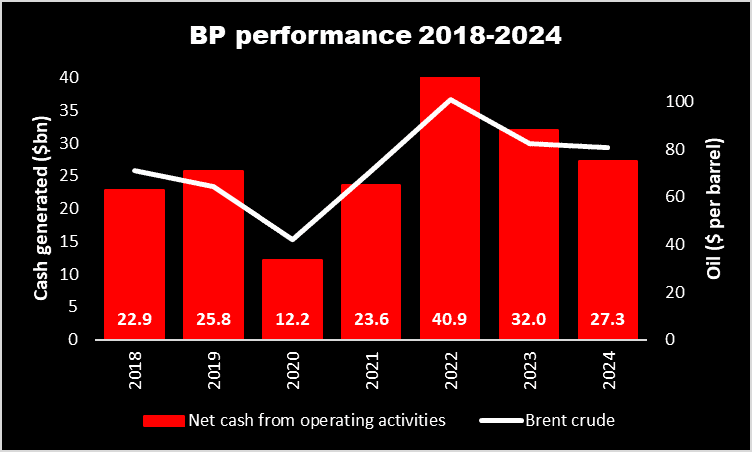
Making predictions about the BP (LSE:BP.) share price isn’t easy. That’s because the group’s financial performance is closely linked to the price of oil. Although it’s not obvious how much of its revenue comes from the sale of the black stuff, its oil production and customer & products divisions contributed 84% of revenue in 2024.

Therefore, it stands to reason, that it does better when energy prices are high. This can be seen in the chart below, which shows the cash generated from its operations from 2019-2024, alongside the average price of a barrel of Brent crude.

Source: US Energy Information Administration / company accounts

From a statistical point of view, the two variables are 96% correlated. This means they have a near-perfect relationship.

A crystal ball

However, it’s impossible to accurately predict oil prices. They’re influenced by numerous factors, including production decisions by OPEC+ members, regional conflicts and global demand.

Over the past decade, I’ve seen headlines suggesting Brent crude could reach anything from $100 to $1,000 a barrel. It’s currently (14 February) around $75.

The United States Energy Information Administration’s predicting an average price of $74 (2025) and $66 (2026). A survey of economists by The Wall Street Journal is forecasting $73 this year.

If any of these estimates prove to be correct, BP will — in 2025 — probably have its most disappointing year since 2021. As for 2026, it could be worse than its 2019 performance. And this could put pressure on its share price.

But then again, if a barrel of Brent crude hits $1,000 …

However, the prediction of a four-figure oil price was a little tongue-in-cheek. The article appeared in Fortune magazine, in 2008, with the author writing: “I say this with absolutely as much information at hand as the pundits who are now making headlines for themselves by their soggy $200 predictions. Nobody knows what’s going to happen. So I’m going to not know what’s happening at an even more dramatic level.”

With so much uncertainty surrounding commodity prices, I think it’s fair to say that predicting the BP share price is a mug’s game.

A healthy income stream

However, the energy giant pays a generous dividend. For the past three quarters it’s paid $0.08 a share. If this is repeated one more time, its annual payout of $0.32 (25.7p at current exchange rates) implies a yield of 5.6%.

This is comfortably above the FTSE 100 average of 3.6%.

But it’s important to remember that dividends are never guaranteed, particularly in the energy sector where earnings can be volatile. BP cut its payout in 2020 and even though it’s steadily been increased since, in cash terms it remains 23% lower.

But the yield’s not high enough to make me want to invest, although others appear to disagree.

Shareholders got excited on 10 February when reports emerged that Elliott Investment Management had taken a position in the company. Its share price jumped 8% on hopes that the ‘activist investor’ will force changes to the business that’ll see it valued more highly. With the demand for hydrocarbons continuing to climb, now could be a good time to consider investing.

However, I’m not going to take a stake. Its reliance on the price of oil — which is so unpredictable — makes it too risky for me.

Financial News

Daily News on Investing, Personal Finance, Markets, and more!

Financial News

Policy(Required)