Don’t look now, but the FTSE 100’s beating the S&P 500 in 2025…

It’s early days, but the FTSE 100 has made a very strong start to 2025. The index is up 6.2% so far this year, which is comfortably better than the 3.4% the S&P 500 has achieved. 

Despite this, UK stocks still trade at lower price-to-earnings (P/E) multiples than their US counterparts. So is this the time for investors to look at buying FTSE 100 shares?

Interest rates

A big reason the UK’s been the place to be for investors in 2025 has been interest rates. The Bank of England (BoE) has been bringing down interest rates, while the Federal Reserve hasn’t.

Furthermore, this looks set to continue. At the last Monetary Policy Committee meeting, two of the seven members voted to reduce rates by 0.5%, rather than the 0.25% cut that materialised.

Across the Atlantic, the Federal Reserve’s indicated that investors shouldn’t expect rate cuts in the near future. So the outlook for the S&P 500 might be less promising.

This however, is only one part of the equation. The reason the BoE’s cutting rates is the economy isn’t growing – the latest data indicates that GDP is stagnant.

The US doesn’t have this problem – its latest GDP growth figure is 2.3%. But inflation across the Atlantic is currently at 3%, which is higher than the 2.5% the UK is dealing with.

In both cases, there’s scope for the situation to get worse. So the question is what investors should do to get themselves in the best position.

Buying stocks

When it comes to investing in stocks, I think the most important thing over the long term is the quality of the underlying business. That’s true regardless of which side of the Atlantic I’m looking.

The future might involve inflation, a recession, neither, or both. But I can’t think of a situation where I’d prefer to own shares in a low-quality business over a high-quality one. 

A good example is Howden Joinery Group (LSE:HWDN). I’m not saying the business is immune to the threat of a recession – it isn’t – and that’s a risk investors shouldn’t ignore.

The company can’t do much about GDP growth, but it does a good job of managing the things it can control. And I think the result is a business that has a very strong competitive position.

The main thing that stands out to me about the firm is its cost structure. Selling exclusively to trade means it can operate out of warehouses, which cost less to rent than retail showrooms.

That puts Howden in a position to charge customers less than its competitors while still maintaining wider margins. As I see it, that’s a powerful combination that means the stock’s worth considering.

Long-term investing

I think a key reason why the FTSE 100 has been outperforming the S&P 500 (so far) in 2025 is the outlook for interest rates is much more positive. But things are more complicated than this. 

In my view, the best way to bypass these complications is to focus on buying shares in quality companies. And these exist in the UK as well as in the US.


How much would someone need in UK shares to earn £5,000 in passive income each month?

Wouldn’t it be nice to have a passive income of £5,000 per month, without having to lift a finger?

FTSE 100 stocks made an average annual return of 6.9% over the past 20 years. So we’d need a Stocks and Shares ISA pot of close to £870,000 to earn that amount at that rate (which is not guaranteed, mind). The trouble is, if we take out the whole return, then the pot’s value would dwindle with inflation.

To be able to take out £5,000 a month and leave enough behind to grow in line with inflation? We’d need to reach a bit over £1.22m.

That’s a lot, and it might be hard to believe it’s an achievable target. But according to the most recent figures, over 4,800 ISA investors in the UK have built up more than a million. That’s 20% up on the previous year. And the biggest has reached over £11m.

Time conquers all

The key thing here is time. Time in the market beats timing the market, as the old saying goes. Some of those ISA millionaires might have been a bit lucky with their timing on occasions. But it’s really not the way they achieved their success.

No, various surveys show that these are not investors who are good at spotting the next big thing. And they don’t get in and out at the right time. Instead, they spread their investment cash between funds (including index trackers), investment trusts, and solid blue-chip stocks like Shell, Lloyds Banking Group, GSK

They also put a greater proportion of their money in investment trusts than the average ISA investor. Over at AJ Bell, City of London Investment Trust (LSE: CTY) is a popular choice. So I’ll go with that as an example. Well, also because it’s one of my favourites, having raised its dividend for 58 years in a row.

City of London is currently on a forecast dividend yield of 4.8%. I’ve no idea what will happen to its share price. But if that can keep pace with inflation at a long-term 2%, then we’re looking at the kind of return I spoke of above.

Compound it!

An ISA allowance invested with these returns could see us build a £1.27m pot in 25 years. An invested total of £500,000 would have generated a tax-free profit of £770,000. But taking out and spending the dividends would have cut the total pot by more than half, and slashed the gains.

Please note that tax treatment depends on the individual circumstances of each client and may be subject to change in future. The content in this article is provided for information purposes only. It is not intended to be, neither does it constitute, any form of tax advice. Readers are responsible for carrying out their own due diligence and for obtaining professional advice before making any investment decisions.

I wouldn’t put all my cash in one investment. Not even City of London Investment Trust with its holdings in HSBC Holdings, Shell, Unilever, BAE Systems, and many more FTSE 100 companies I consider safe. It’s still an investment fund managed by one company. And if it failed to raise the dividend one year, the share price could suffer.

But I think this does help show the most common route to ISA millions. Invest as much as we can in top quality stocks, reinvest all dividends, and keep going as long as possible.

£10,000 invested in Tesla stock 1 month ago is now worth…

A £10,000 investment in Tesla (NASDAQ:TSLA) one month ago would now be worth a little more than £9,190. This reflects an 8.1% decline as shares hover near two-month lows, but also a small appreciation of the pound.

Though still 43% above its November 2024 levels, Tesla has shed 30% from its December peak of $488.54, pulled down by leadership distractions, policy headwinds, and doubts over its sky-high valuation. For a company of its size, such volatility is unusual.

The slide explained

Tesla’s recent slump stems from a cocktail of self-inflicted and external pressures. CEO Elon Musk’s $97.4bn bid for OpenAI and his role leading the Trump administration’s Department of Government Efficiency (DOGE) have raised concerns about divided focus. Consumer favourability for Musk has cratered to 3% in January 2025, down from 33% in 2018, according to Morning Consult data.

Moreover, political risks also is a real concern. The Trump administration canceled a $5bn electric vehicle (EV) charging infrastructure programme, while new steel/aluminum tariffs threaten Tesla’s China-dependent supply chain.

Additionally, competition is intensifying, too, as BYD’s new $9,600 EV with self-driving tech undercuts Tesla’s pricing power. Tesla’s Q4 2024 earnings missed profit and revenue targets. Analysts have since trimmed 2025 revenue forecasts by 5% to $116.8bn. Insider selling — including a $20m stock dump by Musk’s brother Kimbal — has further rattled confidence.

Despite its size, Tesla trades more like a speculative growth stock. Shares plummeted 21% since Trump’s Inauguration Day (20 January 2025) and 6.3% on 11 February alone, events typically shrugged off by giants like Apple or Microsoft. With a beta of 2.1, Tesla remains twice as volatile as the S&P 500. This is likely a reflection of its dependence on Musk’s reputation and binary bets on futuristic tech.

Valuation vertigo versus tech superpower promise

Tesla’s financial metrics simply don’t comply to traditional norms for a company that makes cars. Its trailing price-to-earnings (P/E) ratio stands at 139.1 times, a staggering 820% premium to the sector median of 15.1 times. Even more eye-popping is its forward price-to-earnings-to-growth (PEG) ratio of 7.98, implying investors pay nearly $8 for every $1 of expected earnings growth — 409% above peers. By comparison, traditional sector leaders like Toyota trade with PEG ratios below 1.5.

Tesla’s huge valuation hinges on two unproven technologies: robotaxis and humanoid robots. A limited robotaxi pilot launches in Austin this June, but BYD’s DiPilot (God’s Eye) system — which is already deployed in China’s $9,600 EVs — threatens to gain an advantage on self-driving tech before Tesla scales. Meanwhile, Musk’s Optimus robots remain somewhat elusive with no clear commercialisation timeline.

As such, Tesla is a Rorschach test for investors. Bulls see a buying opportunity in the panic, while bears point to unsustainable valuations, Musk’s divided attention, and rising competition. Personally, I hope the Tesla succeeds, but I can’t back the stock with the current valuation. There is far too much execution risk with the stock at current levels, and detached from sector norms.

This under-the-radar software company could be one of the UK’s finest growth stocks

When investors think of growth stocks, they typically think of the S&P 500. More specifically, the likes of Amazon, Meta, and Palantir are the first names that come to mind.

That’s perfectly reasonable. But for those who know where to look, I think the UK has some tech stocks with extremely interesting growth prospects.

Celebrus Technologies

Celebrus Technologies (LSE:CLBS) is a good example. It’s a software company with a product that allows businesses to monitor what customers are doing on their websites and apps in real time. 

This is extremely valuable. It can tell online retailers when people abandon their orders, or let insurance firms know which parts of their policies customers spend the most time reading.

It’s also valuable in regulated industries, like banking. And unlike other products, it provides detailed data in real time – rather than hours later – allowing instant fraud detection and response.

Importantly, the technology that sets Celebrus apart is patented until 2034. This gives it time to sign up customers and the high cost of switching should bring long-term recurring revenues.

Growth

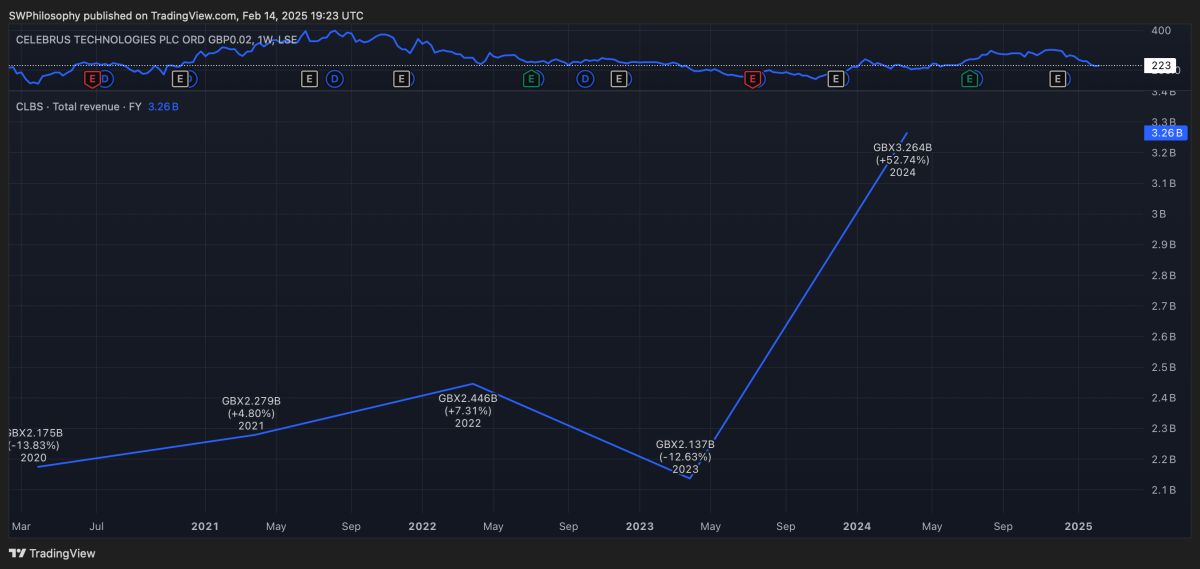
Celebrus has a lot of the features I look for in a growing business. Over the last 10 years, sales have gone from around £10m to just over £32m – an average growth rate of 12% a year. 

Celebrus revenues 2020-24

Created at TradingView

Investors might note that the growth hasn’t been smooth. This however, is the result of the company switching from selling perpetual licenses to a subscription-based model.

Instead of paying big up-front costs, customers pay a smaller fee on a recurring basis. This is bad for sales in the short term but, over time, it results in more predictable revenue streams. 

Importantly, the firm operates in an expanding market. The Customer Data Platform market’s set to grow at around 28% a year until 2033, giving Celebrus a lot of scope for future growth.

Risks

Anyone who thinks the UK doesn’t have any good tech stocks should take a look at Celebrus. But growth stocks are always risky and this one’s no exception. 

The most significant risk is competition. The market’s competitive and the UK company’s up against some big businesses, including Salesforce, Adobe, and even Microsoft.

Celebrus has a product that offers more granular real-time data, but it’s overmatched when it comes to resources and spending power. That’s something investors need to keep in mind.

This might be a disadvantage when it comes to providing generic solutions. But for businesses looking for more detailed data they can use in real time, I think the company has a real edge.

Under-the-radar

I’ve got this far without mentioning artificial intelligence (AI) and it seems a shame to spoil it now. But yes — Celebrus is using AI to turn its data into valuable solutions for customers.

With a market-cap of £87m, Celebrus goes unnoticed by a lot of investors and the share price has gone from £2.12 to £2.22 over the last five years. It’s far too small for the FTSE 100 or the FTSE 250 and not many analysts pay attention to it.

I think they should. With no debt on its balance sheet and 30% of its market-cap in cash, I think the company’s growth prospects mean the stock’s well worth considering.

£20k across these exchange-traded funds (ETFs) would have almost doubled an investor’s money in just 5 years!

Today, the London Stock Exchange hosts more than 1,700 exchange-traded funds (ETFs). The popularity of these products has rocketed among investors seeking a cheap and simple way to diversify their portfolios.

But viewing such funds as merely risk-reduction tools would be doing them a grave injustice. Many ETFs have delivered long-term returns that leave countless FTSE 100 and FTSE 250 shares in the dust.

Take the following two ETFs I’m about to discuss. Combined, they’ve delivered an average annual return of 13.5% over the past five years.

Based on this, £20,000 invested equally across these funds in early 2020 would have almost doubled an investor’s money, generating a total return of £39,133.

Past performance is no guarantee of future returns, but here’s why I think they’re worth considering right now.

Security guard

Artificial intelligence (AI) isn’t the only hot tech trend in town. Companies involved in the field of cybersecurity also have terrific growth potential.

Data’s very much a 21st century currency, and modern societies are becoming increasingly reliant on technology to function and evolve. This makes protection against the growing number of online threats critical.

Analysts at Gartner think the global cybersecurity market will soar from $162bn in 2023 to more than $435bn by 2030. The trouble is that tipping specific winners in this field is tough, given the breakneck pace at which tech markets evolve.

The Global X Cybersecurity ETF (LSE:BUGG) — which has delivered an average annual return of 15.7% in the last five years — helps to reduce this threat. In total, it has holdings in 22 different software, services and hardware providers.

These range from big hitters such as CrowdStrike and Palo Alto to smaller ones with (arguably) greater growth potential like Telos.

There are drawbacks to purchasing focused ETFs like this. They often command higher management fees that can eat into shareholder returns. In this case, the total expense ratio is 0.5%, which is greater than that typically found on basic index trackers.

But on balance, I think that fee could be a small price to gain exposure to this high-growth tech sector.

Let’s be Frank

Targeting particular geographies can be an effective wealth-building strategy too. Franklin FTSE India ETF’s (LSE:FLXI) one country-specific fund whose recent performance has grabbed my attention.

This Franklin Templeton product — which invests in large- and mid-cap stocks in India — has delivered an 11.3% average annual return since early 2020.

The fund’s soared in value as India’s booming economy has supercharged corporate earnings. Such strong returns aren’t guaranteed in future, but a vibrant economic outlook bodes well for today’s investors.

Analysts at S&P expect India to become the world’s third biggest economy by 2030, with nominal GDP tipped to nearly double to around $7trn in that time.

While it provides excellent growth potential, this regional fund also provides higher risk than more global-based ETFs. However, its diversification across multiple cyclical and non-cyclical sectors can still help investors to effectively spread the risk.

Among the fund’s 246 holdings are HDFC Bank, IT specialist Infosys and telecoms provider Bharti Airtel.

How much would an investor need in an ISA to earn a £10,000 monthly passive income?

Assuming a 5% withdrawal rate, which could be achieved by investing in dividend stocks, an investor would need around £2.4m invested in a Stocks and Shares ISA to earn £120,000 of annual passive income. This equates to around £10,000 monthly.

These might sound like really big numbers. And they are. However, because most of these strategies for passive income take decades, it’s important to remember that £10,000 in 30 years will be worth a lot less than it is today.

In fact, assuming inflation does average 2% over the next 30 years — which may be an underestimate given broader challenges around scarcity of supply — £10,000 will feel like the equivalent of £5,520 in today’s money.

So in other words, this is a strategy to build a passive income stream for 30 years’ time that will feel like receiving £5,520 in today’s money, or a little less if inflation averages above 2%. Given that income from a Stocks and Shares ISA is totally tax free, that’s actually the equivalent a £97,000 salary after tax.

Please note that tax treatment depends on the individual circumstances of each client and may be subject to change in future. The content in this article is provided for information purposes only. It is not intended to be, neither does it constitute, any form of tax advice. Readers are responsible for carrying out their own due diligence and for obtaining professional advice before making any investment decisions.

The formula for success

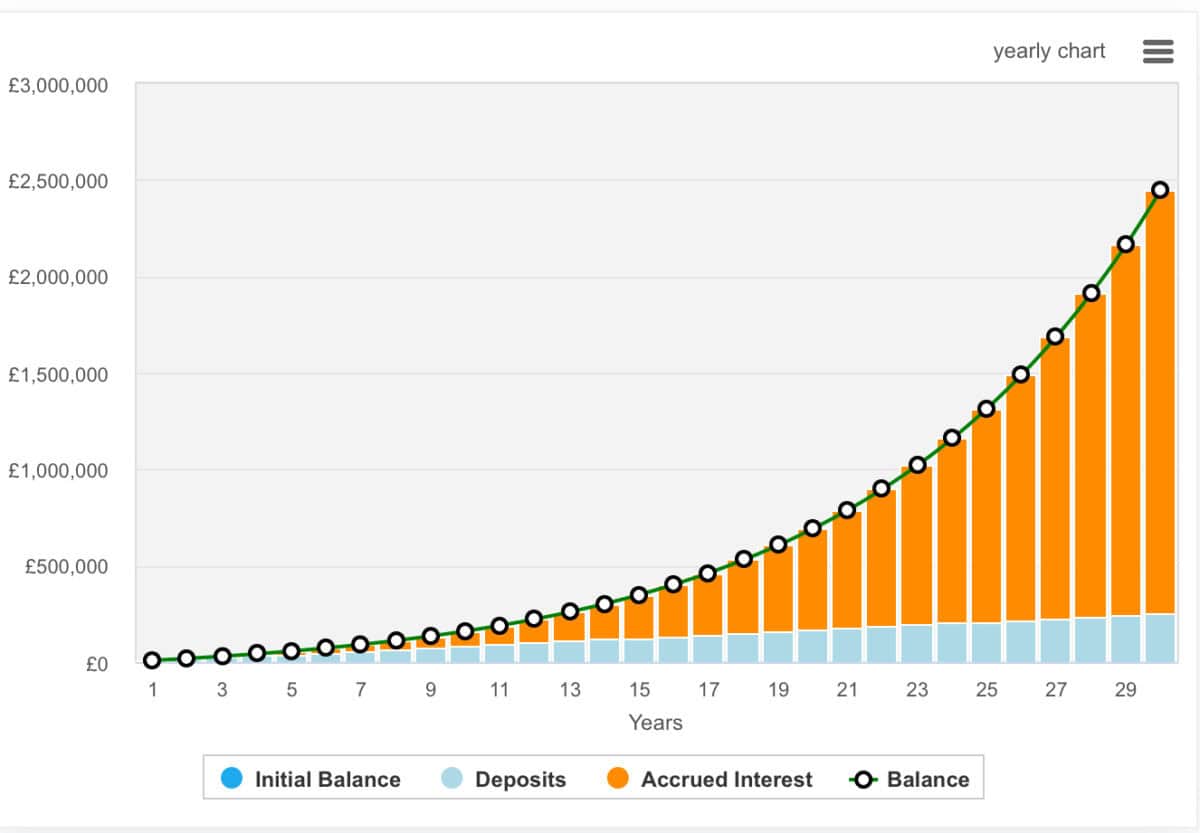
Ok, so how can a novice investor start with nothing and reach £2.4m. Well, it requires regular contributions, a sensible investing strategy, and time. Here’s one way to achieve it:

  1. A regular contribute of £700 a month. This would result in an annual contribution of £8,400, well below the cap of £20,000.
  2. A growth-oriented investment strategy that yields at least a 12% annual return. This may sound easier said than done, but many growth-focused funds have achieved this over the long run.
  3. A 30-year investment timeline, providing ample opportunity for the investments to compound.
Create at thecalculatorsite.com

This visualisation shows how the returns compound over time. Just look at the growth towards the end of the period compared to the beginning. It’s a stark contrast, and highlights the importance of time in the market.

One to consider

For long-term growth prospects with instant diversification, investors may want to consider Scottish Mortgage Investment Trust (LSE:SMT). This isn’t an uncommon choice, and I’ve previously highlighted sister trusts, Edinburgh Worldwide Investment Trust and The Monks Investment Trust.

However, it’s hard to look beyond Scottish Mortgage sometimes. The trust’s stock is up 74% over five years and continues to trade at an 8% discount to its net asset value. In turn, this suggests that I’m buying the companies that Scottish Mortgage invest in at a discount.

I appreciate that some investors will be put off by the unlisted holdings. For example, SpaceX, which represents 7.5% of the portfolio, doesn’t publish its financial information because it doesn’t have to. Moreover, its massive valuation‘s established by the stock market.

However, I’d point to the company’s excellent track record of picking the next big winner. It invested in Moderna before the pandemic — if only it sold more stock earlier — and owned Nvidia stock before the artificial intelligence (AI) revolution began.

Personally, I keep topping up on the trust when I can. It nicely complements the rest of my growth-focused portfolio.

Here’s how someone could invest £200 each month in cheap shares to target a £7,108 passive income

Putting under £50 a week into cheap dividend shares and reinvesting the proceeds over time is one way to build a passive income.  Potentially, a big passive income.

Here, I explain how someone could aim to do just that.

Here’s how the money adds up

Imagine the money’s invested at an average dividend yield of 7% (I’ll get into that below). Putting £200 a month into shares and compounding them annually at 7%, after 20 years (in 2045) the portfolio would be worth around £101,545.

At a yield of 7%, that would be enough to throw off £7,108 of passive income the following year. In fact, it could potentially do that every year afterwards. The amount may actually go up, although it could also go down, depending on whether dividends are maintained, raised, or cut.

Buying cheap shares can be an income booster

That explains why the smart investor would diversify across a range of shares rather than put all their eggs in one basket.

Another part of this plan is buying cheap shares. When it comes to dividend income, cheap shares can be a bargain.

Here is why. At the moment, the average yield for blue-chip FTSE 100 shares is 3.6%. So the target 7% yield I am discussing here is fairly aggressive.

But buying dividend shares when they sell for a cheap price means the yield is higher than buying the shame shares more expensively.

Hunting for bargain shares to buy

For example, Lloyds (LSE: LLOY) shares yield 4.5% at the moment. Not bad at all.

The Lloyds share price has risen 54% over the past year. So not only would someone who invested in the Black Horse Bank back then now be sitting on a very tidy paper profit, they would also be earning a yield of around 6.8% compared to the lower 4.5% yield available to investors buying today.

Is there a way to spot a cheap share versus a value trap? Not one that is guaranteed to work, or else the smart money would all be used the same way in the market.

But Lloyds obviously has a lot going for it. It has a massive mortgage book, large customer base and multiple well-known brands in the UK market.

One reason for that 54% share price rise over the past year seems to be that investors are now less concerned than before about the risk an economic slowdown could push up loan default rates and eat into Lloyds’ profits.

That risk still concerns me though. I am unsure that Lloyds is indeed a cheap share and not one that will ultimately turn out to be a value trap. So I have not bought its shares.

Getting the ball rolling on the income machine

Still, I do think there are plenty of cheap shares in today’s market even among blue-chips.

Indeed, shares I own, including Legal & General and M&G, yield even more than 7% at their current share prices.

The passive income plan I outlined above is not complicated, but it will not happen by itself.

To get going immediately, I think a new investor could look at some of the share-dealing accounts and Stocks and Shares ISAs available to see what looks most attractive.

Here’s 1 FTSE share I think will soar in 2025

Demand for travel is stronger than ever. It remains a priority for many according to recent consumer outlook surveys. With more people flocking abroad to spend time on the beach, I’m looking at travel-related FTSE shares to add to my Stocks and Shares ISA.

One FTSE share that I think could soar to new heights in 2025 is online travel agency On The Beach (LSE:OTB). The company had a record-breaking year in 2024. Pre-tax profits rose 25% to £31m, and total sales reached £1.2bn.

Why this is my favourite FTSE share

But what stands out is the company’s ambition for the coming years. It has a medium-term goal to double sales to £2.5bn. And management have a strategy that looks promising.           

When looking for small but mighty growth shares, I like to find companies that offer something new. For instance, it could be a new product, service, or technology. This FTSE small-cap share has three new developments.

For instance, On The Beach expanded its business to offer city break holidays. This should allow it to capture a larger share of customers’ holiday wallet.

It also started selling holidays from Ireland. This makes sense as it has similar trends and taste for holidays as the UK.

In addition, On The Beach managed to secure a partnership arrangement with low-cost airline Ryanair. This means that it’s now easier for customers to search for Ryanair flights as part of their holidays.

The partnership also resulted in lower admin costs for On The Beach, boosting its profit margin.

Fundamentally solid

Its potential is underpinned by strong financials. Despite sales and profits that are expected to rise by double-digits over the coming years, it remains remarkably cheap. This share offers a price-to-earnings ratio of just 14.

I’d class this as a high-quality business given its 25% profit margin and 19% return on capital employed.

I also like that it has a market capitalisation of just £410m. Small companies of this size can multiply much faster than the large FTSE 100 shares.

Some points to note

Bear in mind that smaller companies can carry more risk. This share in particular is focused on the travel sector. In recent years, the pandemic was detrimental to so many travel-related businesses. And any future crisis that prevents travel would likely hurt these shares.

In addition, if there was an economic downturn, it could also reduce demand for holidays.

Note that between 2021 and 2023 On The Beach shares fell by a whopping 58%. That said, since then, travel has bounced back.

Just recently, the world’s second-largest online travel agency Expedia reported “better-than-expected travel demand”. And several airlines recently reported renewed consumer confidence. That bodes well for On The Beach, in my opinion.

I happen to think this is one of the best opportunities for a FTSE growth share this year. As such, as soon as I can free up some cash, I’ll be popping it into my ISA.

Could this 15%-yielding dividend stock double an investor’s money in 5 years?

It’s a mathematical certainty that a dividend stock offering a yield of 15% will — all other things being equal — double an investment in five years.  

This assumes a constant payout and that all dividends received are reinvested. It also requires the share price to remain unchanged during the period.

Although these assumptions are unlikely to hold, it does illustrate the potential of high-yielding income shares. And the power of compounding, which has been described as the eighth wonder of the world.

Year At start of year (£) Dividends received (£) At end of year (£)
1 1,000 150 1,150
2 1,150 172 1,322
3 1,322 198 1,520
4 1,520 228 1,748
5 1,748 262 2,010
Source: author’s calculations based on an initial investment of £1,000 and a yield of 15%

A rare thing

By my calculations, there are presently (14 February) five stocks that offer a yield in excess of 15%.

One of these is Serica Energy (LSE:SQZ). It extracts hydrocarbons from the North Sea. Although relatively unknown, it currently supplies around 5% of the UK’s gas requirements.

Unusually for an energy company, it was in a net cash position at 30 June 2024. The industry is capital-intensive, meaning significant borrowings are common. However, despite acquiring a number of other companies and assets in recent years, Serica Energy has managed to keep its level of debt under control.

This has been helped by a sustained period of high energy prices. And whether we like it or not, despite the move towards net zero, the demand for oil and gas continues to rise.

But the thing that sets it apart from most other stocks is its generous payout.

Over the past 12 months, the company has paid a dividend of 23p, implying a yield of just over 15%.

Too good to last?

But a look at the company’s cash flows makes me question whether the dividend at its current level can be maintained. During the 18 months ended 30 June 2024, it spent $179.5m more than it earned.

Item Cash inflow/(outflow) ($m)
Cash inflows from operations 771.2
Taxation (420.0)
Capital expenditure (222.6)
Repayment of loans (net) (112.5)
Acquisition of subsidiary (54.2)
Interest (net) (13.4)
Sub-total (51.5)
Dividends and share buybacks (128.0)
Cash outflow (179.5)
Source: company accounts / 18 months ended 30 June 2024

There’s little the company can do to reduce its tax bill or loan repayments. And cutting back on capital expenditure is likely to harm the business in the long term. Should things start to go wrong, its options for preserving cash are, therefore, limited.

Also, part of the impressive yield can be attributable to the decline in its share price. Compared to February 2024, it’s down 23%. Since achieving its 52-week high in April 2024, it’s fallen 30%. Then it was yielding a more modest — albeit still impressive — 11%.

This loss of investor confidence is probably explained by a recent softening in energy prices.

And concerns about the impact of the energy profits levy (EPL). The EPL — or ‘windfall tax’ as it’s more commonly known — means the company faces an effective tax rate of 78%.

Looking to the future

With oil prices easing, and the government confirming that the EPL is here to stay, I think Serica Energy’s earnings (and cash flows) are going to come under more pressure. In these circumstances, the easiest way of saving cash is to cut the dividend, even if it means upsetting shareholders.

Having said that, even with a 50% cut in its payout, it would still be one of the highest-yielding shares around.

With a 75% reduction, the stock would yield more than the average of those on the FTSE 100.

Despite the risks associated with the energy sector, this could make it attractive to income investors on the lookout for passive income opportunities.

£10,000 invested in Lloyds shares 5 years ago is now worth…

Lloyds’ (LSE:LLOY) shares have skyrocketed over the past 12 months, but the longer-term story’s less positive. The banking stock’s up just 10% over five years. That takes us back to February 2020, the month before the first Covid lockdown in the UK.

As such, £10,000 invested in Lloyds shares would be worth £11,000 today. However, this figure does include around £1,500 that would have been received in the form of dividends during the period.

This isn’t a great return, but it’s still stronger than the returns that Britons would have received if they left their money in a savings account. However, it certainly would have required some conviction to remain invested as the stock tanked during the pandemic and a various other points over the last five years.

What’s been going on?

Lloyds shares have experienced a tumultuous journey over the past half-decade. The pandemic in 2020 caused a significant downturn, with the bank’s profits plummeting and dividends suspended. As the economy recovered, Lloyds’ share price began to rebound, benefiting from rising interest rates which boosted its net interest margins.

However, these higher rates proved to be a double-edged sword, potentially dampening demand for mortgages and increasing the risk of loan defaults. 

By early 2025, Lloyds shares had shown remarkable recovery, with a 53% increase over the previous year. Despite this growth, concerns about economic uncertainty, potential interest rate cuts, and the impact of motor finance litigation have created volatility in the share price.

The bank’s performance remains closely tied to the UK’s economic health, with investors closely watching for signs of stagflation and changes in monetary policy.

Things are certainly looking up

Lloyds is well-positioned to benefit from the current macroeconomic situation. With a soft landing scenario unfolding, the bank can expect reduced pressure on loan defaults, improving its credit risk profile. As interest rates begin to fall, Lloyds stands to gain from a resurgence in loan demand, particularly in mortgages where it holds a dominant market position.

The bank’s strategic hedging approach is likely to provide a windfall, potentially offsetting any contraction in net interest margins. Furthermore, lower rates could stimulate business lending, diversifying Lloyds’ loan portfolio. The combination of these factors suggests a positive outlook for Lloyds, with potential for improved profitability and growth in the coming years.

However, there are some risks to the thesis. Lloyds is facing increased competition in the mortgage market where it has traditionally been dominant and the UK economy certainly isn’t growing that quickly. For context, the Goldilocks scenario would probably see interest rates sit between 2.5% and 3.5% and UK economic growth — under the best realistic scenario — around 2-2.5%. These growth figures, for now at least, look farfetched.

Personally, I’d consider buying more Lloyds shares for the long run, largely because its valuation metrics, including the forward price-to-earnings ratios, are below sector averages. However, the motor finance case may deliver near-term volatility, and this stock’s already well-represented within my portfolio.

Financial News

Daily News on Investing, Personal Finance, Markets, and more!

Financial News

Policy(Required)