Up 33% in 2025, this top Warren Buffett growth stock could head even higher! 

It’s not often that hyper-growth stocks are mentioned in the same breath as Warren Buffett. The investment portfolio of his holding company, Berkshire Hathaway, tends to mainly buy mature blue-chips.

So it’s safe to say that Nu Holdings (NYSE: NU) is a bit of an outlier in Berkshire’s portfolio. The firm is a fast-growing digital disruptor shaking up the traditional banking system across Latin America.

Admittedly, this is a small holding and we can’t be sure that Buffett bought it himself. More likely, it was one of his two investing lieutenants, Todd Combs and Ted Weschler, who took a stake in the Brazilian neobank back in 2021.

Nevertheless, the stock has been on fire, rising 33% in 2025 and over 200% since the start of 2023. Yet I think it has a lot more growth in the tank and is therefore worth considering. Here’s why.

The rise of digital banking across Latin America

Nubank, as it’s known, is the largest digital bank in Latin America and one of the fastest-growing online platforms in the world. Its purple credit cards are ubiquitous in its native Brazil, where it has over 100m customers (more than half of the adult population).

Why are so many customers flocking to the firm? Well, the region’s traditional banks are notorious for their outrageous fees and terrible customer service. Even today, they often charge fees for nearly every transaction, including ATM withdrawals, online transfers, and even account inquiries.

This has created opportunities for fintech companies like Nubank, which offer easy-to-use online banking solutions with far lower fees and vastly superior customer service. 

Indeed, founder and CEO David Vélez has said that the company chose to make its debit and credit cards purple because it wanted to be “the most anti-bank possible.” 

While the firm’s offering services to lower-income populations in Brazil, Mexico and Colombia, it’s increasingly attracting higher-income customers from legacy banks.

Growth machine

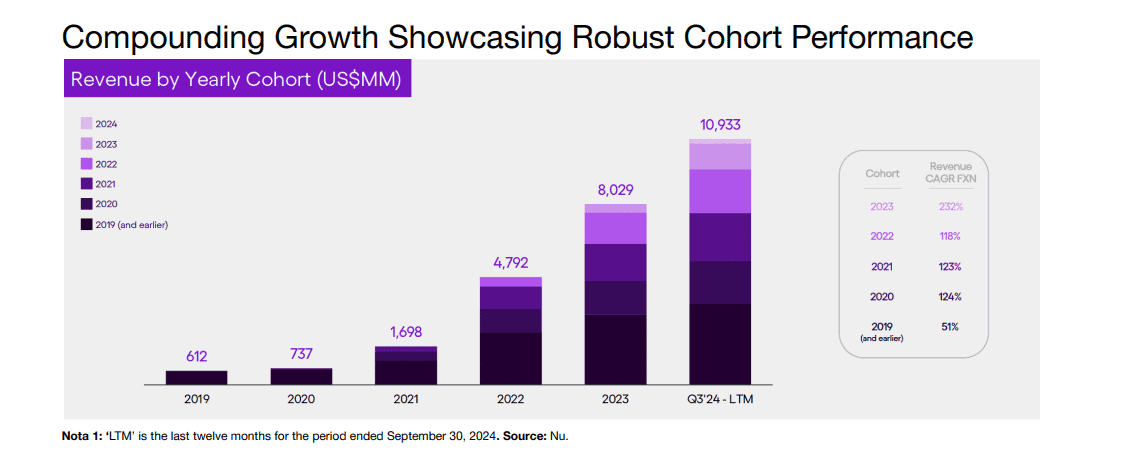
Revenue growth’s been nothing short of mind-blowing, rising from $612m in 2019 to an expected $11.8bn last year.

Source: Nu Holdings Q3 2024.

But this is no cash-incinerating start-up. Nu’s average revenue per active customer has grown from $3.50 at the beginning of 2021 to $11 by the end of September last year. And net income is expected to have surged 84% to $2.2bn in 2024.

Looking ahead, revenue is forecast to motor past $20bn by 2027, with earnings rising by an average of 48% in that time.

Attractive valuation

But how much to pay to invest in this high-growth stock? Not as much as might be suspected, with the stock sporting a price/earnings-to-growth (PEG) ratio of 0.7.

For context, a PEG ratio below one suggests that a stock might be undervalued relative to its earnings growth potential. I strongly believe that to be the case here, which is why I’m looking to buy more shares.

That said, I’ll be keeping an eye on Nu’s rising non-performing loans. In Q3, 90+ day delinquencies rose to 7.2% from 6.1% the year before, a trend that may lead to more loan loss provisions and lower earnings.

Longer term though, I’m very bullish here. Nu’s rapidly expanding digital ecosystem should result in lucrative cross-selling opportunities, while further expansion across Latin America and beyond looks very likely. 

These 5 UK stocks are stinking out my portfolio – should I bin them?

I’ve bought some brilliant UK stocks over the last couple of years and thank heavens for that. Because I’ve also picked up five stinkers.

They’ve stuck to the bottom of my portfolio, giving off a nasty odour. So why did I buy them?

With James Bond car maker Aston Martin, the answer is easy. Because I’m an idiot. After the shares dropped 95%, I thought they couldn’t do worse. But they did! They’re down another 34% over the last 12 months. I’m down 30%.

In my defence, this was a flutter with a tiny corner of my portfolio. I’m only holding because selling isn’t worth the trading charges, and to remind myself never to be this cavalier again.

Pretty much the same applies to grocery retailer and robot tech hope Ocado Group. Its shares are down 40% in a year. I’m only down 24%. Perhaps that counts as success. The share price does occasionally spark into life. It’s jumped 17% in the last month. I know the moment I sell it will fly to the stars. So I’m stuck with it.

Five big FTSE 350 fallers

My filthy five includes spirits giant Diageo. It’s down 23% over the last year and 35% over two. Falling profits, inventory troubles, Ozempic, Donald Trump’s trade wars – everything is against it.

I keep meaning to sell but it’s like being in one of those nightmares where you try to run but your legs are made of glue. Maybe it will recover. Maybe…

Mining giant Glencore is down 12% over one year and 33% over three. China is mostly to blame, as its slowing economy hits demand for commodities.

Natural resources stocks are cyclical, and I’d be daft to sell at the bottom. I’m due a juicy dividend in June. I’ve earned it.

My final FTSE flop is sportswear JD Sports Fashion (LSE: JD). Its shares are down 20% over the last year, and so am I. They’re down a thumping 50% over two.

I have hopes for JD Sports shares

JD Sports spent most of last year threatening to recover, but it’s on the back foot once more, after a second underwhelming Christmas. With consumers struggling, inflation sticky, and Trump’s tariffs threatening non-US trainer brands such as Adidas, I don’t expect the stock to suddenly race ahead.

But at some point, I think it will. JD Sports is building a international presence, particularly in the US, after buying retailer Hibbett for $1.1bn. It also has strong partnerships with leading brands, although that’s backfired with Nike struggling. When shoppers have money in their pockets again, trainers could fly off the shelves.

There’s a pattern here. I bought four of these companies after a profit warning. I don’t remember Glencore issuing a profit warning, but it might as well have done. In every case, things got worse rather than better. Turning companies around takes time.

Am I only hanging on because I hate banking a loss? Probably. On the other hand, Burberry was my biggest flop but it’s now flying. Maybe the others will too. Investing is a long-term game and for now I’m keeping the faith. But I’ll tread carefully around profit warnings in future.

Down 23% with a 6.5% yield, this FTSE 250 dividend gem looks undervalued to me!

There are lots of shares on the FTSE 250 with high yields and rock-bottom prices. Unfortunately, each of these two factors is a result of the other — as the price drops, the yield rises.

Of course, everyone likes a high yield especially if it’s at a bargain — but that’s not always a good thing. The price could just keep dropping until the company goes bankrupt. When looking for dirt cheap shares with dividend potential, it’s critical to assess the long-term viability of the company.

Shares in the price-comparison media platform MONY Group (LSE: MONY) are down 23% in the past year. I recently bought some of the shares when the price fell to a two-year low a few months ago. However, it’s been slow to recover so it still looks like a good bargain.

The key driving factors behind my decision remain in place, a 6.5% dividend yield, decent earnings growth potential and future return on equity (ROE) expected to be around 40%.

The current price level of around 180p has proven to be an attractive buying point for investors in both 2014 and 2022. However, past performance isn’t indicative of future results. So I must also evaluate the company’s market position, demand for its services, and managerial performance.

Economic challenges

Previously known as Moneysupermarket.com, the business rebranded as MONY Group last May. It now operates as a specialist in technology-led money-saving platforms, including several price comparison websites.

The company enables consumers to compare prices on a range of products, including energy, car, home and travel insurance, mortgages, credit cards and loans. Its subsidiaries include MoneySuperMarket, TravelSupermarket, IceLolly, Decision Tech, Quidco, and MoneySavingExpert.

Although it’s considered a market leader, it still operates in a highly competitive industry. The rise of multiple other outfits competing for market share is an ongoing risk pressuring the company. Regulatory changes in the UK financial services sector are another concern that could impact MONY’s operations and profitability.

However, the most likely culprit behind its recent losses is inflation. Consumer spending declined significantly through 2022 and 2023 as the economy suffered a downturn. Many companies using price comparison services have suffered losses and, subsequently, so have the sites themselves.

Long-term potential

Despite the risks mentioned above, I see good long-term growth potential in MONY Group.

We’ve already experienced the first interest rate cut this year and more are expected, with the aim to help reduce inflation. The benefits of a revitalised economy and increased consumer spending would be a boon for the price comparison industry.

If so, MONY’s in good stead to enjoy renewed growth. The share price is currently trading at only 13 times earnings, well below the UK market average.

With earnings forecast to grow 8.6% a year, that figure could come down even further. It’s already 51% below fair value, based on anticipated cash flows, and is forecast to rise an average of 42% in the coming 12 months.

It appears to be a well-established business operating in a high-growth industry and trading below value due to external factors.

I’m as optimistic as ever about its long-term potential and believe it’s worth considering as part of an income-focused portfolio. 

Is Tesla stock running out of road?

Over the past decade, some investors have made a lot of money owning shares in Tesla (NASDAQ: TSLA). In the past five years alone, Tesla stock has moved up by 567%, meaning it now has a market capitalisation of $1.1trn.

However, Tesla stock has slumped by a quarter since the middle of December. Could this be a sign the investment case is becoming less attractive – or a potential contrarian buying opportunity for my portfolio?

Business performance and prospects drive share prices

Shares often move around and that is typically down to one of two things – momentum and fundamentals.

Momentum is when a share moves because lots of people are buying or selling it, even if the business performance has not changed in a way that merits a new valuation.

That can have a big effect on share prices, sometimes for years. Tesla stock has certainly seen a lot of momentum in recent years, with some speculators piling in just because they expect it to keep going up, rather than because they saw the share as good value for what they paid.

Momentum can work both ways of course, and I think we have seen some of that lately. In any case, I am an investor not a speculator, and momentum does not strike me as a sound basis for long-term investment.

Rather, I prefer to buy (or sell) based on what are called fundamentals — how well a business is expected to do in financial terms.

Tesla’s a great, proven business

Given the recent share price tumble, it can be hard to forget that Tesla is a genuinely great, successful business.

It has been a mass market pioneer in electric vehicles (EVs) and has a strong market share. It has developed a vertically integrated manufacturing and sales operation that has helped it scale up sales quickly. The company now sells thousands of vehicles each day globally.

The expertise Tesla has developed in batteries is helping it ramp up its already sizeable power generation business. Meanwhile, a large customer base, strong brand and proprietary technology could all help it keep doing well in the EV business.

Unlike many sector makers, Tesla is already solidly profitable. However, its vehicle sales did fall slightly last year.

Combined with growing rivalry in that space, I see a risk that revenues could decline and profit margins may also be eroded due to more price competition.

Nonetheless, if I could buy Tesla stock at the right price, I would.

So are Tesla sharers overvalued after the fall? There’s the rub… despite the recent share price crash, the share still sells on a price-to-earnings ratio of 175.

That looks far too expensive to me, even if ignoring the prospect that price competition and reduced tax rebates could lead to Tesla’s earnings falling in years to come.

As an investor not a speculator, I will not be touching Tesla stock at its current price.

£20,000 in savings? Here’s how it could be used to target a £278 monthly second income

Earning a second income can be done in different ways. One is to invest in a diversified portfolio of proven blue-chip shares that pay dividends.

Doing that in the way I illustrate below, an investor starting with £20k today could realistically hope to have a second income of £278 a month after 15 years – and a sizeable share portfolio to boot.

Here’s where the money comes from

To start, I will explain the maths. That £278 a month is presuming a 6.5% average dividend yield. Compounding £20K at 6.5% annually would mean that after 15 years, the portfolio would be worth around £51,436. At a yield of 6.5% that ought to generate £278 per month.

Now, 6.5% is above the FTSE 100 average yield, which stands at around 3.6%. My compound annual growth rate could include some capital growth, though of course shares can fall in value as well as rise. It pays to choose carefully.

However, in this example I am presuming 6.5% compound annual growth from dividends alone. It is well above the current FTSE 100 average but attainable in today’s market from quite a few proven blue-chip dividend shares.

The sorts of shares to buy – and where to find them

As an example, one share I think investors hunting for a second income should consider is Phoenix (LSE: PHNX).

The FTSE 100 insurer blows past my 6.5% average yield target, currently offering 10.3%. In fact, that makes it the highest-yielding of any FTSE 100 share.

Yield alone is not the thing to focus on first however. After all, dividends are never guaranteed to last.

Phoenix does face risks, like any company. For example, it has a mortgage book. So if the property market plunges and valuations in reality do not reflect Phoenix’s assumption, it could suffer a loss as it writes down loan values.

But on balance, I see a lot to like about Phoenix. It is not a household name but it owns some, such as Standard Life. Phoenix aims to be the UK’s leading retirement savings and income business — and already has around 12m clients.

The business has a proven model for cash generation and in the first half of last year generated £954m in cash. That has helped fund a healthy and growing dividend.

How to get the ball rolling

Of course, dreaming of a second income and thinking about what shares could provide it is one thing. But not a single penny of dividends will roll in unless an investor actually buys some shares!

For that, setting up a share-dealing account or Stocks and Shares ISA would provide a home where the £20k could be parked now, ready to be invested when the right shares are found.

I asked ChatGPT to name the FTSE 250 share it would buy in a heartbeat – and it went mad!

I’m keen to add a few FTSE 250 shares to my portfolio of mostly FTSE 100 stocks, but I’m wondering where to start. So I decided to ask ChatGPT.

Artificial intelligence (AI) is going to be running our lives soon enough, I’m told. So why not let it run my portfolio today?

Actually, there are reasons. ChatGPT’s first pick was Warhammer-maker Games Workshop. It exited the FTSE 250 on 5 December, and now resides in the FTSE 100. Oh well. Even robots aren’t perfect.

So I asked ChatGPT to give it another shot. I must have annoyed my AI chum because it plumped for online fashion retailer ASOS (LSE: ASC). Now that was a brave call!

By brave I mean mad. ASOS? Really? Of all the stocks on the FTSE 250, I didn’t expect that.

If AI does own the future, it’s going to be volatile.

ASOS is a high-risk play

ASOS could be the ultimate falling knife. Online fashion retail hope turned fashion victim. And AI would buy it in a heartbeat? Just be grateful it doesn’t have a heart. Yet.

The ASOS share price is down 88% over the last five years. Trading at 385p, it’s back down to 2009 levels. 

This is a perfect storm of a stock, hammered by everything from the cost-of-living crisis to tough competition from Chinese-owned fast fashion rival Shein, which forced it to offload piles of unsold stock at a discount.

In full-year 2023, losses hit £296.7m. That increased to £379.3m in 2024, while group revenues slumped 16% to £2.9bn. CEO José Antonio Ramos Calamonte still claimed to have hit his key priorities by reducing inventories and “generating positive adjusted EBITDA and free cash flow”.

Sales were up too and ASOS still boasts 20m customers, he added. But forget Calamonte. He’s only the boss. What does AI think?

ChatGPT admires the group’s “strong online presence” while praising its “robust e-commerce platform that appeals to a global customer base”. That line could have been written by a computer. Oh, it was.

As was the bit about how ASOS’s international expansion plans could “diversify revenue streams beyond the UK”. Where is it nicking this stuff from? And why didn’t it mention the mothballed £110m fulfilment centre in Lichfield?

The worst may be over

In its defence, ASOS shares have stopped falling. In fact, they’re actually up 2.62% in the last year. Is this the long-awaited recovery?

The shares got a small boost on 2 February when two credit insurers reinstated cover for its clothing suppliers, withdrawn in 2023 due to concerns over profits. This suggests ASOS has greater financial stability.

ASOS has also made some progress in addressing its inventory challenges. It’s halved unsold stock and transitioned to a more agile ‘Test and React’ model. This should help it respond swiftly to new trends, driving full-price sales and boosting margins.

Selling its 75% stake in the Topshop and Topman brands for £135m will boost liquidity and allow management to focus on the core business. So maybe ChatGPT hasn’t gone haywire.

After its terrible run, ASOS is back on my radar. But with consumers still strapped for cash and inflation sticky, there’s no way I’m going to buy it today.

I’m mad enough to request stock tips from a computer. Not mad enough to act on them.

Is the BP share price primed for lift off?

There is a lot of doom and gloom priced into the BP (LSE: BP.) share price these days. On one level that’s understandable. After all, the business just posted its worst results in four years. However, with an activist investment fund recently taking a substantial holding, and a major strategy refresh due at the end of February, interesting times are ahead.

Increasing investment

Over the past year, the company has announced significant investment in 10 major projects, spanning its three reporting segments.

In gas and low carbon energy, one of its biggest approved projects is the $7bn Tangguh Ubadari carbon capture, utilisation, and storage (CCUS). Expected to begin operation and production from 2028, it will unlock 3trn cubic feet of additional gas in Indonesia.

In oil production and operations, its investment in Iraq’s Kirkuk oil and gas fields will total $25bn over the lifetime of the project. The fields were first discovered by a consortium, which included BP, 100 years ago. This fact will be key in unlocking the area’s estimated 9bn barrels of oil.

Profitability of renewables

There is little doubt that the market remains deeply sceptical of the company’s continued investment in renewables.

One of the main issues I have is that the renewables portfolio is not reported separately. Lumped into the gas and low carbon energy segment, assessing profitability of individual projects is therefore impossible.

But all is clearly not well. Back in December it divested itself of its offshore wind assets by entering into an equal joint venture with a Japanese company, JERA. Before that, it had already announced it was freezing new investment in wind.

Then there is Lightsource bp and Bunge Bionergia, its solar battery storage and biofuels businesses, respectively. These acquisitions helped push up net debt by $3bn. It has already acknowledged that it will need to bring in a partner for Lightsource. That tells me the path to profitability is going to be challenging, as with its wind assets.

BP future

Murray Auchincloss, the CEO, is coming under increasing pressure to close the valuation gap with US peers. It has already dismissed talk of moving its primary listing to the US. But what about a breakup of its assets?

The fear among the Board must be that this is what Elliott Management will be looking to do. Although the exact amount of its stake is unknown, Bloomberg has reported that its substantial.

During its full-year results presentation on 11 February, the company announced a major reset of its strategy at the end of the month. I quote: “It will be a new direction for bp, and NOT business as usual.

Despite the negative headlines surrounding the company, I still remain very bullish on the outlook for the stock.

One issue I believe that is being completely overlooked by the market today, is an uncontrollable spike in oil prices. On a scale, I would put geopolitical risks at 10 today. It’s not just wars, but the slow unwinding of globalisation, and countries becoming increasing insular.

BP remains a well-run company with a huge portfolio of high-grade assets. Its share price weakness over the past year has presented a gift to value investors such as myself, which is why I continue to buy when finances allow.

No savings? I’m using the 5-step Warren Buffett method as I aim to get rich

Warren Buffett has made many billions of pounds in the stock market. But he started as a schoolboy, with no shares at all until he spent some money from a paper round to dip his toe in the market.

I am applying some lessons from Buffett as I aim to build wealth in the stock market. An investor could use the same approach starting with nothing. Here are those five steps.

1. Getting some capital to invest

Buffett began with nothing but he saved up to buy shares.

Whether from savings, regular contributions or a combination of the two, it does take money to invest in the stock market.

Like Buffett, another additional source of funds I use to build up my investment capital is dividends I earn from shares. Rather than frittering that cash away, I use it to fund more share purchases – a simple but powerful technique known as compounding.

2. Finding brilliant companies that excite me

Buffett only invests in companies he understands. But he also sticks to just a few such companies.

They are ones that have a business model that excites him. As an example, consider Buffett’s biggest holding (even after selling down a lot of his stake last year): Apple (NASDAQ: AAPL).

The company is targeting a user market that is massive and likely to stay that way. It has built loyalty with an existing customer base due to proprietary technology, a product and service ecosystem and iconic brand. That gives it pricing power that underpins the firm’s large earnings.

3. Buying at the right price

Still, lately Buffett has been a seller, not a buyer, of Apple shares.

The exact reasons are unclear although Buffett has mentioned taxation as a consideration. But the reason I am not buying Apple shares at their current price is I think they are too expensive.

Yes, it is an excellent business. But revenues have been falling and Apple faces risks from tariffs adding costs to its supply chain and increased competition from Chinese rivals.

Buffett does not just aim to buy great companies. He also aims to buy such shares at an attractive price.

Just buying into a great company is not necessarily a way to build wealth. In fact, if the price paid is too high, it can end up destroying wealth.

4. Taking the long-term approach

Typically though, Buffett takes a long-term approach to investing. He aims to buy and hold.

That makes sense to me. Owning a share that keeps raising its dividend (as Buffett’s long-term holding Coca-Cola has done) can mean a shareholding just sitting in the portfolio ends up generating more money each year.

5. Taking risks seriously

While it is easy to focus on what Buffett gets right, he also takes care to try and avoid costly mistakes.

Some are inevitable over time. But he takes weighing risks seriously, paying as much attention to what might go wrong with an investment as to what might go right.

With a spare £3,000, here’s how a new investor could start buying shares

Putting off getting into the stock market can mean that someone who only dreams of making money in it never actually starts buying shares.

That might be because they feel they lack experience. However, everyone has to start somewhere. So if a stock market novice had £3,000 and wanted to start investing, here is how they could go about it.

Understand what you’re getting into

It is possible to begin investing with no stock market experience and build wealth. But it is not guaranteed by any means.

So I think it makes sense for a would-be investor to begin by getting to grips with how the stock market works. When people sell you a share at a certain price, how can you try and judge whether it is a good share to own – and a good price to pay?

Such an approach would also involve taking time to get to understand important risk management concepts like diversifying across a number of shares. And £3k is ample to do that.

Set up a way to buy and own shares

Another simple initial step would be to put that money into an account that can be used to start buying shares. For example, that might be a simple share-dealing account or a Stocks and Shares ISA.

With lots of choices available it makes sense to take time for a new investor to decide what seems to suit their own situation and objectives best.

Finding shares to buy

Along the way, the investor may have their eye on some shares as potential purchases. In any case, now would be a good time for them to start looking.

When it comes to that search, I think a few simple principles can help. One is to stick to what you know and understand. Another is to focus on finding businesses that seem to have a strong investment case – and then consider whether their share price is attractive, even after allowing for a margin of safety. After all, all shares carry risks.

As an example in practice, one share I think new investors should consider is Legal & General (LSE: LGEN).

The FTSE 100 financial services company is focused on the retirement-linked market. That is huge, long-term and fairly resilient in my view. Legal & General has a strong brand, large customer base and business model it has proven can throw off a lot of excess cash.

That surplus cash helps fund a beefy dividend. Currently, the yield is 8.5%, meaning that for every £100 invested, an investor would hopefully earn £8.50 in dividends annually.

Payouts are never guaranteed though. Legal & General cut its dividend per share during the last financial crisis and I see a risk that the next sharp market downturn leads policyholders to pull out money, hurting profits for the firm.

Such risks underline the reason why when someone starts buying shares, it makes sense to diversify – and keep that good practice in decades to come as they try to build more wealth!

£10,000 invested in Greggs shares in 2020 has made this much passive income…

Greggs‘ (LSE: GRG) shares have tumbled 22% in the past year. Over five years, they’re down 9%, which is disappointing for a stock that used to have a habit of outperforming the FTSE 250 index (to which it belongs).

However, the beloved bakery chain has also been dishing out dividends as well as sausage rolls over most of that time. Would these cash payouts have erased the 9% loss and put a £10,000 investment into positive territory? Let’s find out.

Dividends

Back in 2020, we were in the middle of the pandemic. High streets were empty and people were stuck at home. Greggs’ revenue fell sharply and it paid no dividend that year (proof that cash dividends are never guaranteed).

However, the company made up for it in 2021 when it paid out 57p per share. Then 59p and 62p in the two years after. There have been a couple of 40p special dividends too.

Adding them all up, Greggs has paid out £2.77 per share since 2021. Therefore, an investor would have received around £1,205 in dividends over this time from the 435 shares that £10k would have bought the start of 2020.

It means that the investment would be a couple of hundred quid up over this time. Not great.

That said, Greggs is forecast to pay another 49p per share in May, then 70p for this financial year. That would add another £517 to the total return.

If the share price gets moving in the right direction again, this hypothetical investment could still turn out to be a good one. But what are the chances of a strong Greggs share price recovery this year?

Risks

Unfortunately, not great, I’d say. Investors have soured on the stock because the company’s facing extra costs from April following the Budget. This has forced it to raise prices on food, which might put some consumers off. After all, Greggs is meant to offer value.

More broadly, the UK economy’s plagued by weak consumer spending, high taxes, and low growth. So there’s quite a bit of uncertainty around at the moment.

Looking beyond the doom and gloom

Given all this, it wouldn’t be too shocking if the company was closing loads of stores and suffering double-digit sales declines. Yet that’s not the case.

In 2024, total sales topped £2bn for the first time ever, growing 11.3% year on year. Like-for-like sales in company-managed shops edged 5.5% higher.

Meanwhile, it plans to open a further 140-150 shops this year, bringing the total closer to its target of at least 3,000.

Looking ahead, analysts expect revenue growth of about 8-9% this year. Then the same in 2026. Admittedly, that’s not mind-blowing, but it does demonstrate to me how resilient Greggs is. If it can survive this truly dreadful period for retailers, then I think it will do just fine whenever things improve.

Last month, HSBC analysts upgraded the stock to Buy from Hold, pointing out that concerns about the maturity of Greggs’ business might be “overly pessimistic“. As a shareholder, I agree with that.

The stock trades at just 15 times this year’s forecast earnings and offers a 3.2% dividend yield. I still think it’s worth considering for long-term investors.

Financial News

Daily News on Investing, Personal Finance, Markets, and more!

Financial News

Policy(Required)