The world is full of get-rich-quick schemes. Buying FTSE 100 shares is not one of them, as far as I am concerned. Still, it could be a path to riches albeit at a more leisurely speed.
The foundations of wealth creation
In theory at least, getting rich is not that complicated. Buying assets for less (ideally much less) now than they will be worth in future is one way to do it.
FTSE 100 shares are a form of asset. But the key point, as far as I am concerned, is that they represent a stake in a much bigger asset: a company like Shell or AstraZeneca.
So by putting money into such shares when they are attractively valued, piling up (or reinvesting) any gains along the way and holding for the long term, I think it is possible to create wealth.
That depends, of course, on adding some money in the first place. Owning the right shares can be one way to build wealth – but it takes at least some money to purchase them to start with.
Here’s what can set FTSE 100 shares apart
Shares in far smaller, less known and potentially flashier companies can often seem more interesting to at least some investors.
Many people dream of putting a few pounds in some unknown penny stock and striking it rich.
It is true that some small companies go on to make massive returns for early stage shareholders. But loads do not. They simply sell more and more shares to raise cash, burn that cash and go bankrupt.
A great business idea or product innovation is not necessarily the basis of a great investment for a small, private investor.
By contrast, FTSE 100 shares can seem boring and stodgy. Some are mature businesses in areas that seem to offer little or no future growth opportunities.
But they are big. In most (not all) cases, they have grown big by honing a successful business over decades. The market can lose sight of that and send a share crashing in price from time to time.
I think that offers an opportunity for an investor to build a diversified portfolio of great companies at attractive prices – and hopefully build wealth.
Want to know what I think a great company looks like?
As an example, JD Sports (LSE: JD) is worth considering. To start with, have a look at the share price chart over the past few years.
See how much the price has moved around? Even over the past year alone, the cheapest price has been less than half the most expensive one.
Has the actual value of JD Sports’ business seesawed as much as that in just 12 months? I do not think so (though I could be wrong).
Rather, I think investors have struggled to value the business. Its stream of profit warnings suggests consumer demand may be weakening and JD’s store opening programme risks eating into profits.
Still, the retailer does expect full-year profit before tax and adjusting items of £915m–£935m. Against that, its market capitalisation of £4.5bn looks cheap to me given JD’s strong brand, proven business model, resilient profits and growing international footprint.
There are different ways to prepare financially for retirement no matter how far away it may seem. While an obvious one may be a SIPP, an ISA can be useful too.
Using the decades before retirement to good advantage, an investor can reap the rewards of taking a long-term approach to investing.
Here, as an example, is how someone could turn a £10k ISA into one worth £132,676 over the course of 30 years.
So someone 36 or under starting today could do that before the standard retirement age of 66.
The retirement age could rise again, so it may be that even someone in their late 30s now could take a 30-year timeframe when considering this approach. (Even after 27 years though, today’s 39 year-old could still hope to have a £102,450 ISA by 66).
Doing the maths is the easy bit!
To start with, let me explain the key assumption that underpins the numbers above. They presume a compound annual growth rate of 9%.
That is net of any fees or charges imposed by the ISA provider. Those may seem small on an annual basis, but can add up dramatically over time. It definitely makes sense to shop around for the best Stocks and Shares ISA available.
That key assumption also means compounded growth of 9% a year. That can come from share price growth as well as dividends. (I presume here that dividends are compounded by reinvesting them).
But the key point in my opinion is that this growth is compounded over 30 years, potentially including some bad market periods as well as better times.
So a 9% target is harder to achieve than it may sound. I do think it is possible though.
Choosing the right shares to buy and hold is the hard bit!
Clearly then, making the right choices about how to invest is critical to success.
Diversifying across a range of blue-chip shares would be an important part of reducing the risk of one share performing poorly. £10k is ample to do that, for example, by spreading it over five to 10 different shares.
In a sense, finding the right shares could be difficult. But in fact I think the principles are simple. Basically, an investor will likely be looking for great businesses that are set to stay that way but with a share price lower than the likely long-term value.
One FTSE 100 income share to consider
As an example, one share to consider is M&G (LSE: MNG). The FTSE 100 asset manager operates in a market that has two key advantages in my view, it is huge and it is likely to be around for decades to come.
That attracts competition. Indeed, low-cost rivals like fintechs eating into the market share of long-established firms including M&G is one risk I see.
But M&G has some strengths that hopefully can help it stay competitive. It has a well-known brand. It also has an existing customer base in the millions, spread across over two dozen markets.
A mixture of institutional and retail business also provides some measure of diversification to M&G’s business. The company has proven its cash generation potential and has a generous dividend. Currently, the yield is above 9%.
Rolls-Royce (LSE:RR) shares are up 158% over five years. That doesn’t tell the whole story because the stock slumped during the pandemic and has since risen 1,500% from its lows. It’s an incredible story and quite frankly, an investor would need ultra strong conviction to remain invested throughout. Nonetheless, a £10,000 investment five years ago would now be worth £25,800. However, at one point, that £10,000 investment would have been worth just £1,300. It’s the type of volatility most of us aren’t used to seeing on the FTSE 100.
A fresh start
Rolls-Royce has dramatically transformed since the pre-pandemic era through strategic restructuring. The company executed a comprehensive financial overhaul, raising £2bn through asset sales and workforce reductions. Digital transformation accelerated, with initiatives like the Digital Academy enhancing technological capabilities.
Supply chain improvements and operational efficiency became critical focus areas. The company strategically repositioned itself, emphasizing financial resilience and sustainable performance. Leadership changes drove a more agile approach to market challenges.
While core aerospace and power systems businesses remain unchanged, Rolls-Royce emerged leaner and more adaptable. By 2024, the company returned to positive free cash flow and reintroduced dividends, signalling a successful post-pandemic recovery strategy. The fundamental engineering DNA remains, but with a more modern, flexible execution model.
Catalysts galore
Rolls-Royce’s aviation recovery has been a defining catalyst in its post-pandemic transformation. Civil aerospace flying hours have rebounded and engine deliveries are rising, particularly in long-haul jet production for Airbus, driving significant profit growth. Strategic investments in engine research and development have focused on improving durability and efficiency across challenging global conditions.
Most recently, Rolls-Royce secured a landmark £9bn nuclear contract with the UK Ministry of Defence, further diversifying its strategic portfolio and reinforcing its technological leadership. This builds on a host of recent announcements, several around its high potential small modular reactor business.
There must be some risks
However, like any investment there are risks. The cyclical aerospace industry leaves it vulnerable to economic downturns and travel demand fluctuations. Geopolitical tensions, supply chain disruptions, and emerging technologies like electric aircraft pose threats. High R&D costs, lengthy development cycles, and stringent regulations in aviation and nuclear sectors present ongoing challenges. Meanwhile, currency fluctuations add further complexity to its global operations.
Valuation still favourable
Rolls-Royce’s valuation may appear high for a FTSE 100 company, but its price tag is potentially justified. With a forward price-to-earnings (P/E) of 33.2 times, it’s 66.3% above the global industrials sector median. However, this is 21.2% lower than its five-year average, indicating improved value. Crucially, Rolls-Royce’s forward price-to-earnings-to-growth (PEG) ratio of 1.15 is 37.4% below the sector median, suggesting better value relative to growth prospects.
Rolls-Royce appears cheaper than its peer GE Aerospace, which trades at 37 times forward earnings with a PEG of 2.1. The sector has exceptionally high barriers to entry, requiring substantial upfront capital and advanced technological capabilities. This competitive moat, combined with Rolls-Royce’s strong market position in widebody aircraft engines and sole-source contracts, supports its valuation premium. The company’s improving profitability and growth prospects further justify its current price levels.
If my holding wasn’t already large compared to the size of my portfolio, I’d buy more. It’s worth consideration by other investors.
Value stocks can go nowhere for years. But when they take off, it’s action stations. That’s certainly the case with two FTSE 100 recovery plays that have been falling for years, despite looking incredibly cheap for most of that time.
Investors in Prudential (LSE: PRU) and Schroders (LSE: SDR) have had a miserable time of it. Until now. Any investor lucky enough to take the plunge just one month ago will have seen remarkable gains. Both are up just over 20% in that time.
If they’d split a £20,000 Stocks and Shares ISA evenly between these two struggling blue-chips in mid-January, they’d now be sitting on around £24,000. When value stocks go, they go.
Prudential’s shares are fighting back
Given that they’re both in the financials sector, it may not be a coincidence that they’re behaving in a very similar way.
But what went wrong for these two in the first place, and is this recovery sustainable?
Both have faced long-term structural and macroeconomic challenges. Prudential, a heavyweight in insurance and financial services, was supposed to fly after making the pivot to booming Asia.
While there’s a brilliant opportunity in the emerging middle class, this also exposed the company to Chinese economic volatility. Investor confidence wavered as China’s property crisis and sluggish growth hit earnings hopes.
Half-year adjusted operating profits still climbed 9% to $1.5bn, but investors had hoped for more.
Schroders meanwhile, has been hit by volatile stock markets and the shift towards passive investing. This has hit demand for active fund managers and squeezed fees too. Q3 outflows hit £2.3bn.
So why the sudden change? Prudential was lifted by improving sentiment towards China, although the recovery still looks fragile to me, and trade wars loom.
News that Prudential is evaluating a potential listing of ICICI Prudential Asset Management, its joint venture with Indian financial services group ICICI Bank, gave the shares another helpful kick.
Schroders has benefitted from the rally in UK and global markets. With interest rates potentially peaking and the outlook for assets that have some risk improving, investors have rotated back into shares. This could lift inflows and assets under management.
Broker RBC Capital Markets upgraded Schroders to Outperform, which gave it another lift. With the price-to-earnings ratio near a 10-year low of just 10 times, there’s an opportunity to consider here. Prudential looks pricier at 15.5 times earnings.
Schroders has a stellar yield
Companies that have underperformed for years can seem like they’re going nowhere – until the market suddenly re-evaluates them. When that happens, share prices can climb rapidly as investors rush to reprice the business in line with improved expectations.
But can it continue?
If China’s rebound is sustained, Prudential could have further to run. If financial markets continue to stabilise and fund inflows return, so could Schroders.
I’m wary of buying any stock straight after a spike. But I think both stocks are worth considering for investors who want wider exposure to FTSE 100 financials. Schroders’ bumper 5.8% yield tempts more than Prudential’s 2.3%.
For investors willing to ride out volatility, there may still be value to unlock. But as ever when considering value stocks, patience is required
Gold is traditionally seen in some quarters as a safe haven in times of geopolitical volatility. I think the reality is a bit more complicated than that but with the gold price recently hitting all-time highs, clearing the yellow metal has been attracting a lot of buyers.
Before digging into specifics, let me discuss how the gold business works. As a precious metal with finite availability, the gold market is cyclical.
When demand is high, for example because nervous investors seek a store of value, money piles in. As demand increasingly outstrips supply, the price rises.
At some point the market tops and sellers outnumber buyers. The price then starts falling and eventually (maybe many years later) reaches a bottom, when the process starts all over again.
Crucially though, it is not obvious that the market is at a bottom or a top at the time – that only becomes clear in retrospect.
Mining is initially highly speculative and capital intensive. Miners spend lots of money prospecting and sometimes building mines. That can be money down the drain. But a viable mine can produce great rewards.
The marginal production cost can be low, so surging sale prices can feed almost directly to the bottom line. In other words, profits can soar when prices are high.
Investing in miners is not for the faint-hearted
In investment terms, prospecting can be high-risk, high-reward. That is the case with many prospecting penny shares. They want to raise money to fund a single prospective project. The potential rewards could be high — but there is a big concentration of risk.
The industry economics still apply to giant diversified miners like BHP. Fixed costs can be high, prospecting is costly and metals are a cyclical market, meaning potentially big swings in sale prices over time.
Crucially though, they have far less concentration risk than the typical mining penny share.
Two that have soared!
That explains why I have no plans to invest in gold-focused shares that sell for pennies, including Serabi Gold (LSE: SRB) and Metals Exploration.
A year ago, both were penny shares with market capitalisations of under £100m. While they still trade for pennies, those two shares have soared 164% and 116% respectively in 12 months, giving each a nine-figure market-cap. That shows what a soaring gold price can do.
Serabi’s profits have jumped accordingly. Full-year figures are not yet available, but its gold output last year was up 13%. Add to that higher production a very strong gold price and the profit uplift should be substantial.
If gold prices stay high, this year could be even better, as Serabi expects to ramp up production significantly again.
But whereas Metals Exploration has at least some geographic diversification, Serabi is all-in on one market (Brazil). Both companies focus on one metal: gold.
Even aside from the risk of the gold market turning into a downward phase of its cycle, that level of concentration is still far too risky for me.
Inflation worries, tariffs under the Trump administration and earnings season could continue to keep the stock market volatile and rattle investor sentiment.
Investors looking for attractive stock picks should focus on the ability of a company to navigate ongoing uncertainties and deliver strong returns over the long term. To this end, recommendations of top Wall Street analysts can help people make the right investment decisions, as they are based on in-depth analysis and thorough research.
With that in mind, here are three stocks favored by the Street’s top pros, according to TipRanks, a platform that ranks analysts based on their past performance.
Pinterest
This week’s first stock pick is image sharing and social media platform Pinterest (PINS). The company impressed investors with its solid fourth-quarter results and highlighted that it marked its first billion-dollar revenue quarter. Moreover, Pinterest’s global monthly active users grew 11% year over year to 553 million.
Following the Q4 print, Evercore analyst Mark Mahaney reiterated a buy rating on PINS stock and raised the price target to $50 from $43, noting the spike in the stock following better-than-feared results.
Mahaney observed that the sentiment heading into Q4 results was very low for Pinterest, especially around the Q1 2025 revenue outlook, given that the company faced significantly tougher comparisons. However, Pinterest not only surpassed the Street’s Q4 revenue and EBITDA estimates by 1% and 6%, respectively, but issued a top-line growth outlook that indicated an only one percentage point deceleration (excluding forex) on a 10 percentage point tougher comparison, noted the analyst.
Additionally, Mahaney highlighted that after Q1 2025, Pinterest will see structurally easier comparisons for the balance of the year. The analyst also pointed out that unlike other ad companies he covers, Pinterest doesn’t have significant political exposure. Consequently, this implies that there is a possibility of PINS delivering consistent revenue growth acceleration through FY25, which Mahaney believes would be a key catalyst for the stock.
“Longer term, it appears PINS is seeing a snowballing impact of multiple product cycles that should power mid to-high teens % Revenue growth (ex-FX) for the foreseeable future,” said Mahaney.
Mahaney ranks No. 24 among more than 9,300 analysts tracked by TipRanks. His ratings have been profitable 64% of the time, delivering an average return of 29.1%. See Pinterest Hedge Fund Activity on TipRanks.
Monday.com
We move to workplace management software provider Monday.com (MNDY). The company recently reported better-than-expected fourth-quarter results. Monday.com attributed its performance to product innovation and its focus on go-to-market execution. Management is optimistic about driving further demand by leveraging artificial intelligence (AI).
In reaction to the Q4 results, JPMorgan analyst Pinjalim Bora reaffirmed a buy rating on MNDY stock and increased the price target to $400 from $350. The analyst noted the company’s solid performance, saying that it surpassed the consensus estimates for key metrics in Q4 2024, following a muted performance in the previous quarter.
The analyst noted that the company’s 2025 revenue outlook of over 26% growth at the mid-point in constant currency surpassed the firm’s expectations and perhaps all buy-side expectations. Bora thinks that demand in the U.S. remains healthy and bounced back from a decline in September, while the demand in Europe continues to be uneven, though it has stabilized relative to November.
Bora thinks that MNDY offers a unique opportunity over the medium term, as it transitions from a collaborative work management platform into a multi-product story. The analyst noted that MNDY has “a solid opportunity to play a central role around Agentic AI workflow around its customers over time.”
Overall, Bora thinks that Monday.com stands out compared to its rivals, thanks to strong execution in a choppy macro environment. The analyst views MNDY as a multi-year compounder, offering a lot of value to long-term investors.
Bora ranks No. 541 among more than 9,300 analysts tracked by TipRanks. The analyst’s ratings have been successful 64% of the time, delivering an average return of 15.2%. See Monday.com Stock Charts on TipRanks.
Amazon
E-commerce and cloud computing giant Amazon (AMZN) is this week’s third pick. The company delivered better-than-anticipated results for the fourth quarter of 2024. However, it issued disappointing guidance for the first quarter of 2025, citing forex headwinds.
In reaction to the Q4 earnings report, Mizuho analyst James Lee reiterated a buy rating on AMZN stock with a price target of $285. The analyst contended that while Amazon issued a subdued outlook and announced a huge increase in capital expenditure, its margins surpassed expectations and the cloud business AWS (Amazon Web Services) fared better than its peers.
Commenting on the elevated capex, Lee stated that management seems very comfortable with the significant rise in investments. This is because they see signs of robust demand and expect a rapid decline in computing costs due to a shift to custom ASICs (Application-Specific Integrated Circuit) and AI model training innovations, which should fuel an acceleration in AI adoption.
Meanwhile, Lee expects Amazon’s retail business to benefit from its redesigned inbound network, expanding local delivery centers and robotic automation.
“Despite a soft start to 2025, we believe AMZN’s structural story remains unchanged,” said Lee. AMZN stock remains a top pick for Mizuho.
Lee ranks No. 191 among more than 9,300 analysts tracked by TipRanks. His ratings have been profitable 63% of the time, delivering an average return of 15.5%. See Amazon Ownership Structure on TipRanks.
Trump has launched a broadside against the wind industry, pausing new leases for offshore projects and halting new permits pending a review.
The order has had an immediate impact and puts at risk a pipeline of projects on the East Coast that could power millions of U.S. households.
Some Northeast states don’t have viable alternatives to offshore wind right now, and the order could create grid reliability issues in the future, analysts say.
A view of the turbines at Orsted’s offshore wind farm near Nysted, Denmark, September 4, 2023.
Tom Little | Reuters
President Donald Trump promised to unleash U.S. energy dominance, but his sweeping executive order targeting wind power puts a pipeline of projects at risk that would generate enough electricity for millions of American homes.
The order Trump issued on his first day in office indefinitely paused new offshore wind leases in U.S. coastal waters and halted new permits pending the completion of a review. The order jeopardizes proposed projects on the East Coast that have not yet secured permits totaling 32 gigawatts of power, according to data from the consulting firm Aurora Energy Research.
“At the moment, it’s really hard to see how any of these projects will be able to move forward,” said Artem Abramov, head of new energies research at the consultancy Rystad. Like Aurora, Rystad estimates that around 30 gigawatts of projects on the U.S. East Coast are at risk.
Those projects, if realized, would provide enough combined power for more than 12 million homes in the U.S., according a CNBC analysis of data from the Energy Information Administration. The order is not expected to impact projects under construction totaling about 5 gigawatts, according to Aurora.
Trump has abandoned commitments made during the Biden administration to fight climate change, withdrawing the U.S. for a second time from the Paris agreement. He has focused on boosting fossil fuel production, opening U.S. coastal waters to oil and gas leasing on the same day he withdrew those waters for wind.
Trump’s order will jeopardize the efforts of states in the Mid-Atlantic and Northeast to transition away from fossil fuels and decarbonize their electric grid, Abramov said. New York, New Jersey and Virginia, for example, have ambitious clean energy goals adopted at the state level. But they are too far north to rely on solar with battery for power, Abramov said.
“If you want to achieve the future where the power generation in New York or New Jersey or Virginia is completely fossil free, if that’s the ultimate goal, there are not so many alternatives to offshore wind,” Abramov said.
The order could ultimately force states to rely more on carbon-emitting natural gas, according to Rystad and Aurora. But it is virtually impossible for a state like New York to meet its climate goals and ensure an adequate energy supply, particularly downstate in the New York City metro area, without offshore wind, said Julia Hoos, who heads Aurora’s U.S. East division.
Power projects waiting in line to connect to the electric grid in downstate New York through 2027 are almost entirely wind and transmission, Hoos said.
“There is virtually no possibility to bring online new gas in the next 18 to 24 months, unless there’s a significant reform or there’s some sort of fast track to bring online that gas, so you really can run into reliability issues,” Hoos said.
But more natural gas generation will likely be built later in the decade on the back of Trump’s policies, Hoos said. Investor sentiment was already shifting toward gas before the election results due in part to the need for reliable power to meet demand from artificial intelligence data centers, Abramov said.
Immediate impact
Two weeks after Trump’s order, New Jersey decided against moving forward for now with the Atlantic Shores project, which stood to become the first offshore wind development in the state. The state utilities board cited “uncertainty driven by federal actions and permitting” and European oil major Shell pulling out of the project.
“The offshore wind industry is currently facing significant challenges, and now is the time for patience and prudence,” Gov. Phil Murphy said in a statement backing the board’s decision.
Murphy, who has set a goal to achieve 100% clean energy in New Jersey by 2035, said he hoped “the Trump Administration will partner with New Jersey to lower costs for consumers, promote energy security, and create good-paying construction and manufacturing jobs.”
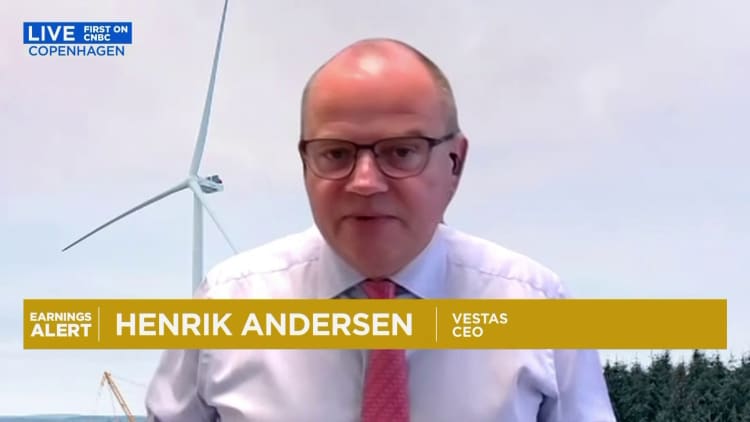
Offshore wind in the U.S. “has come to a stop, more or less with immediate effect” in the wake of Trump’s order, Vestas Wind Energy Systems CEO Henrik Andersen told investors on the company’s Feb. 5 earnings call. Denmark’s Vestas is one of the world’s leaders in manufacturing and servicing wind turbines.
Industry headwinds
Trump’s order deepens the challenges of an industry that was already facing an uncertain outlook after years growth.
Wind has surged as power source in the U.S. over the past 25 years from 2.4 gigawatts of installed generating capacity to 150 gigawatts by April 2024, according to data from the Energy Information Administration. Generation from wind hit a record that month, surpassing coal-fired power. Wind currently represents about 11% of total U.S. power generation.
But the industry has struggled against supply chain bottlenecks and high interest rates. Offshore wind was already the the most expensive form of renewable energy, Abramov said. Developers in the U.S. have faced a lot of cost certainty due to the challenges of building on water as opposed to land, Hoos said.
“The industry was hoping that the cost would come down,” Abramov said. “We haven’t seen any projects in the United States which was able to achieve lower levelized cost of energy.”
The world’s largest offshore wind developer, Denmark’s Orsted, decided on Feb. 5 to ditch its goal to install up to 38 gigawatts of renewable energy capacity by 2030. Orsted also slashed its investment program through the end of the decade by about 25% to range of 210 to 230 billion Danish crowns (about $29 billion to $32 billion), down from 270 billion crowns previously.
Orsted’s Sunrise Wind and Revolution wind projects that are under construction offshore New York and New England respectively should not be impacted by Trump’s order, CEO Rasmus Errboe told investors the company’s company’s Feb. 6 earnings call. Future developments, however, may be at risk.
“We are fully committed to moving them forward and deliver on our commitments,” Errboe said. “We do not expect that the executive order will have any implications on assets under construction, but of course for assets under development, it’s potentially a different situation.”
The order also should not impact Coastal Virginia Offshore Wind, the largest such project under construction in the U.S. at 2.6 gigawatts of power, Dominion Energy CEO Robert Blue told investors on the utility’s Feb. 12 earning call.
“Stopping it would be the most inflationary action that could be taken with respect to energy in Virginia,” Blue said. “It’s needed to power that growing data center market we’ve been talking about, critical to continuing U.S. superiority in AI and technology.”
Looking for clarity
The wind industry lobby group American Clean Power in a Jan. 20 statement described Trump’s order as a blanket measure that will jeopardize domestic energy development and harm American businesses and workers. The president’s order contradicts the administration’s goal to reduce bureaucracy and unleash energy production, ACP CEO Jason Grumet said in the statement.
The ACP is now trying to get clarity from the Trump administration on how the executive order will be implemented, said Frank Macchiarola, the group’s chief advocacy officer. It’s unclear, for example, when the review of permit and lease practices will be complete, Macchiarola said.
A spokesperson for the Interior Department simply said the department is implementing Trump’s executive order when asked for comment on a detailed list of questions. When asked when the review of permit and lease practices will be complete, the spokesperson said any estimate would be hypothetical.
The wind industry is committed to working with the Trump administration, supports the president’s push for energy dominance agenda and is making the case that renewables have a key role to play in that agenda as the largest new source of electricity in the U.S., Macchiarola said.
“When past administrations have chosen to stifle American energy development that has been almost universally viewed as a mistake,” Macchiarola said.
Onshore wind permitting has also been halted pending the review, but the part of the industry is unlikely to face a substantial impact, Rystad’s Abramov said. Wind farms onshore are almost entirely built on private rather than federal land, he said. The market is also already saturated and adding capacity is largely dependent on building out more energy storage first, the analyst said.
Offshore wind, however, is a much less mature market in the U.S. and was viewed as major growth opportunity for the industry, Abramov said. But that appears to changing rapidly.
“They don’t see the U.S. as a market for continuous offshore wind expansion as long as this order is in place,” the analyst said.
— CNBC’s Gabriel Cortes contributed to this report.
An investor with £20k and a long-term approach can turn a Stocks and Shares ISA into a serious passive income stream.
In fact, in the example below, that £20k ISA could grow in value while also throwing off over £600 each month in dividends – while being invested in proven blue-chip FTSE 100 shares.
Investing long term is an income force multiplier
I mentioned a long-term approach and in my example here, I am using a 25-year timeframe.
The same approach could still turn an ISA into a passive income generator on a much shorter timeframe, just at a lower amount each month.
Time helps here. As shares pay dividends, instead of being withdrawn from the Stocks and Shares ISA, they are reinvested. That process is known as compounding.
Thanks to compounding, more and more shares can be bought that, in turn, also pay dividends – without the investor needing to put in a single penny more beyond the original £20k.
That depends, of course, on dividends being maintained by the companies in which the investor has bought shares.
That is not guaranteed. No dividends ever are. But it could be that those dividends grow, boosting the passive income streams yet further.
So a couple of key lessons emerge for investors: choose shares carefully and do not put all of the £20k into any one share no matter how good it may seem. Diversification is the name of the game.
Doing that and compounding at an annual rate of 7%, the £20k ISA should grow over 25 years into over £108,000. At a 7% yield, that should throw off £633 a year in passive income (although this is not guaranteed).
Focusing on income, but being realistic
I reckon a 7% yield is realistic in today’s market even when sticking to FTSE 100 shares. But it is a bit more than double the FTSE 100 average, of 3.4%.
So achieving it requires careful share selection, recognising that while some shares offer yields far above the average, that might be a sign that the City perceives an elevated risk of a cut in the payout.
One option to consider for a Stocks and Shares ISA is insurer Aviva (LSE: AV). It has been on a tear over the past year, rising 22% (though, in fairness, the FTSE 100 has risen an impressive 17% during that period). Despite that increase, the share still yields 6.7%.
Insurance is a large, resilient market. That attracts competition – but it is also a complex market. Making the wrong decisions can be costly, as shown by Direct Line in recent years.
Aviva has a strong brand, large customer base and proven model.
Its planned acquisition of Direct Line is a double-edged sword. It may distract management and hurt business performance. But it could also be an opportunity to add economies of scale and improve profitability.
After a dividend cut in 2020, Aviva has been growing its shareholder payout handily.
Investing in dividend stocks remains a popular way to earn passive income in the UK, particularly due to the high yields commonly found on the FTSE 100 and FTSE 250. Consistent monthly contributions to a portfolio of these dividend stocks can lead to exponential growth through compounding returns.
For example, putting £5,000 per year into the stock market could snowball over time to become a dividend-paying powerhouse. Especially if investors adopt a dividend reinvestment plan (DRIP); that is, putting dividends back into the pot to maximise growth.
After 10 years, it won’t just add up to £50,000 in savings — it could be much more!
In this article, we will explore potential passive income outcomes and strategies for maximising returns to achieve financial freedom through long-term investing.
Dividends explained
Dividend-paying companies distribute a portion of their profits back to shareholders each year. Some of the most common UK dividend stocks include companies like British American Tobacco, Unilever,and Legal & General (LSE: LGEN).
Their popularity stems not just from high yields but consistent and reliable payments. The yield defines the percentage of overall profits that are returned to shareholders. In some ways, it’s similar to the interest one might earn on cash in a savings account. However, it can change daily because it is not fixed but rather inversely correlated to the share price.
Moreover, companies can increase or decrease dividends regularly. Consequently, when calculating potential dividend income, we estimate using the average yield of a portfolio.
Initially, the returns look small. But with consistent reinvestment each year, the compound growth can add up significantly.
Consider the high-yield example. Over 10 years, the total amount in the portfolio would grow to £81,550 with dividends reinvested (assuming the 7% average yield held). That’s not even accounting for any potential share price growth – even slow growth of 3% per year would add an extra £10,000 on top of that.
Achieving a stable average yield
To achieve an average yield of 7%, an investor must choose several stocks with yields between 5% and 9%. Diversifying is helpful as lower-yield stocks can be more stable. It might appear logical to only pick high-yield stocks but it is risky.
Consider Legal & General, a long-favoured British dividend payer. The 189-year-old insurance stalwart has been increasing dividends consistently for decades, often by as much as 20% per year. Its yield typically stays within a range between 6% and 10%.
But it’s far from perfect (is anything?) and lately has been underperforming. The company’s net margin for 2023 fell to 1.69% as earnings missed expectations by 34%. Despite a solid track record, there’s always a risk this could lead to a dividend cut, particularly as the current payout ratio of 360% is unsustainable.
But things are looking up!
Shares have clambered up 6.5% in the past six months, igniting hope that this year’s final results will be better. If so, there’s more chance it could achieve the average 12-month price target of 8.5% that analysts expect. Even if the price is slow to recover, its long-term prospects make it a stock worth considering.
Year after year, people dream of getting into the stock market without actually doing anything about it. It does not take much money to start investing – but it does take some action!
Here is how a new investor could start investing with less than £300.
Step 1: getting a dealing account ready to use
As a first step, I think it would make sense to have a way to buy shares. That may seem like putting the cart before the horse… why set up an account before even finding shares to buy?
The answer is it can take time to find the right account from the many available and then to set it up. So I think doing this first is logical, as hopefully an investor will then be ready to invest as soon as they do find shares to buy.
So they could begin by comparing share-dealing account and Stocks and Shares ISA options. Having found a suitable one, they could then put the money in it, ready to invest.
Even with, say, £200 or £250, that is possible (though the dealing costs of lots of transactions could soon add up, underlining again the benefit of carefully choosing the right share-dealing account or Stocks and Shares ISA).
Figuring out how to start investing properly involves getting to grips with what investing is all about.
Simply finding a brilliant business is not necessarily enough. It is also important to ask questions like whether that brilliance can continue, what the balance sheet looks like (highly profitable businesses can and sometimes do go bankrupt if they have too much debt) and what its valuation is.
Step 2: building a portfolio to try and create wealth
With the right approach and having found great companies at attractive share prices, a stock market novice would be ready to start investing.
One share to consider is Smith & Nephew (LSE: SN). The medical devices manufacturer has had a tough five years, with its share price falling 43%.
That makes it a ‘recovery play’ and may not seem like an encouraging start. Clearly the company faces challenges, with risks including tough conditions facing the company’s surgical business in China.
We will find out this month how things are shaping up, when Smith & Nephew publishes its full-year results for 2024.
Stepping back to look at the longer term picture though, Smith & Nephew operates in a market with high demand. Quality matters, giving manufacturers pricing power.
Smith & Nephew has a wide product portfolio including innovative tools, a global sales operation, longstanding reputation and well-regarded brand. I see those as assets that can hopefully help its business in coming years – and its share price.
Financial News
Daily News on Investing, Personal Finance, Markets, and more!