I asked DeepSeek AI for the best UK stocks to buy! Here’s what it said

DeepSeek is a real force in artificial intelligence (AI). Its advancements took the stock market by surprise in January and, as it is one of the most advanced AI platforms available, I asked it to pick me the best UK stocks to buy.

Here’s what it said

DeepSeek AI identified several stocks it deems undervalued in the current market. Among the top picks was Associated British Foods, a diversified consumer staples company with a market capitalisation of £13.9bn. The platform noted that ABF’s relatively low price-to-earnings (P/E) ratio of 9.5 times and significant potential for 34.8% price appreciation make it an attractive option for value investors. The company’s stable earnings from its Primark retail division and food businesses provide a solid foundation for growth, while its 2.2% dividend yield offers an appealing income stream.

Another standout recommendation is 3i Group (LSE:III), a private equity firm with a market cap of £40bn. The large language model noted that with a P/E ratio of 9.5 and 30.5% of possible appreciation, 3i Group presents a compelling investment case. The company’s diverse portfolio spanning healthcare, consumer goods, and business services positions it well for strong capital appreciation. Recent reports indicate robust performance, with 3i Group’s main asset, Action, maintaining impressive sales growth and earnings margins exceeding expectations.

For investors interested in the technology and communications sectors, DeepSeek suggests considering Herald Investment Trust. While specific financial reasoning was limited, DeepSeek liked the trust’s focus on smaller tech companies.

Rounding up, DeepSeek said that the combination of low P/E ratios and significant growth potential in companies like ABF and 3i Group suggests that the market may be undervaluing their future earnings potential.

Some food for thought

The P/E ratio and the average share price targets, which DeepSeek referenced, are great places to start when investigating whether a stock is a good buy. However, when assessing P/E ratios, it’s essential to compare them within the same industry, as what constitutes a good P/E for one sector may be poor for another. Likewise, growth is key. A P/E ratio of five, for example, could be attractive but misleading especially if earnings are heading in reverse — that’s not uncommon on the FTSE 100 and FTSE 250.

Having said this, I do believe 3i Group is an interesting opportunity. The company reported a 20% total return for the nine months to December 2024, with NAV per share increasing to 2,457p. Action, 3i’s major investment, continues to deliver exceptional results, with net sales and operating adjusted earnings up 22% and 29% in 2024. 

The company’s diverse portfolio and strategic focus on growth investments have contributed to solid earnings momentum. With a well-funded balance sheet, successful recent disposals, and new investments, 3i Group demonstrates resilience in challenging market conditions. The company’s consistent dividend growth and strong liquidity position further enhance its appeal to investors.

However, no investment comes without its risks. The company acknowledges an uncertain geopolitical environment and weak growth across much of Europe, which could impact portfolio performance. Nonetheless, I may consider this stock after further research. I must confess, I haven’t given it my full attention in recent years.

2 cheap UK stocks I think could thrive during a tough 2025

Navigating the stock market can be extra challenging during tough, uncertain times like this. Yet the London Stock Exchange‘s diverse range of UK stocks still provides investors a chance to achieve strong returns.

Here are two top companies I think share pickers should consider today.

Begbies Traynor

Begbies Traynor (LSE:BEG) provides a range of services for companies in distress, and is an expert in the field of corporate insolvency.

Its services are in high demand as the UK economy struggles, with latest financials showing revenues up 16% (or 11% on an organic basis) in the six months to October.

A stream of industry surveys since then suggest takings have likely remained strong. On Monday (18 February), the Insolvency Service reported 1,971 registered company insolvencies in England and Wales for January.

This was up 11% year on year, and 6% from December. With businesses facing higher national insurance contributions and National Wage hikes, and spending by consumers remaining weak, insolvency numbers look set to (unfortunately) keep chugging higher.

A strong balance sheet mean Begbies Traynor has headroom to continue investing in its operations and on additional acquisitions to give earnings an extra boost. Its net-debt-to-adjusted EBITDA (earnings before interest, taxation, depreciation, and amortisation) ratio was just 0.2 as of October.

I don’t think this picture is reflected in the company’s low share price. At 93.4p per share, it trades on a forward price-to-earnings (P/E) ratio of 8.9 times.

This provides scope for fresh share price gains, in my opinion. Though be aware that signs of economic recovery could blunt any price appreciation.

Serabi Gold

Tension over the global economy and political landscape is creeping higher, and as a result demand for gold is taking off.

The yellow metal hit new peaks around $2,943 per ounce in recent days, pulling the prices of gold stocks with it. A move through the $3,000 marker looks inevitable to many, a scenario that in itself could fuel further substantial gains.

Investing in gold mining shares can be a bumpy ride at times. Commodity prices are notoriously volatile. On top of this, exploration and production issues can be common, damaging profits even when metal prices surge.

Yet this threat is baked into the share prices of many of London’s mining stocks. Gold miner Serabi Gold (LSE:SRB), for instance, trades on a forward P/E ratio of just 3.2 times.

It’s a rock-bottom reading I think leaves scope for more upwards price action. Serabi’s shares have leapt almost 30% in value since the start of 2025 alone.

I’m also encouraged by Serabi’s efforts to supercharge production from its South American assets.

Group output hit 10,022 ounces in the final quarter of 2024, the highest level for five years. And with 2025’s production tipped at 44,000 to 47,000 ounces, the miner’s targeting annual growth of at least 17.3%.

All in all, I think conditions are ripe for Serabi to enjoy blistering profits growth.

Forget Lloyds’ cheap share price! I’d rather consider this FTSE 100 bargain share

Lloyds‘ (LSE:LLOY) share price has surged by an impressive 47.2% over the past year. And yet, at 63.1p per share, the FTSE 100 bank still looks dirt cheap across various value metrics.

With a price-to-earnings (P/E) ratio of 9.3 times and 5.4% dividend yield for 2025, Lloyds shares look cheap based on expected profits and predicted cash rewards.

Finally, with a price-to-book (P/B) multiple just below one, the bank also trades at a slight discount to the value of its assets.

Risky business

But are Lloyds shares really the bargain they first appear? I’m not convinced.

On the plus side, revenues may improve and bad loans drop as interest rates fall. But the risks to profits (and consequently shareholder returns) remain considerable, including:

  • Sinking margins as interest rates drop.
  • Prolonged poor sales growth as the UK economy struggles to grow.
  • Additional revenues and margin pressure as competition intensifies across sectors.
  • High claims costs, if found guilty of mis-selling car loans by the regulator.

Against this backcloth, I believe Lloyds shares will continue delivering poor returns (its annual average is a paltry 1.1% since early 2015).

So while they’re cheap, I think they could end up costing me as an investor a packet in the long run.

I’m looking East

I’d rather invest my hard-earned cash in HSBC (LSE:HSBA) shares instead.

It faces the same industry pressures as Lloyds, like increasing competition and interest rate pressures. Its large operations in China also leaves it vulnerable to the country’s creaking property market.

Yet its significant emerging markets exposure provides long-term opportunities too. I’m expecting profits to lift off as rising wealth and population growth supercharge financial services demand.

The bank’s said that “over the medium to long term, we continue to expect mid-single digit year-on-year percentage growth in customer lending“.

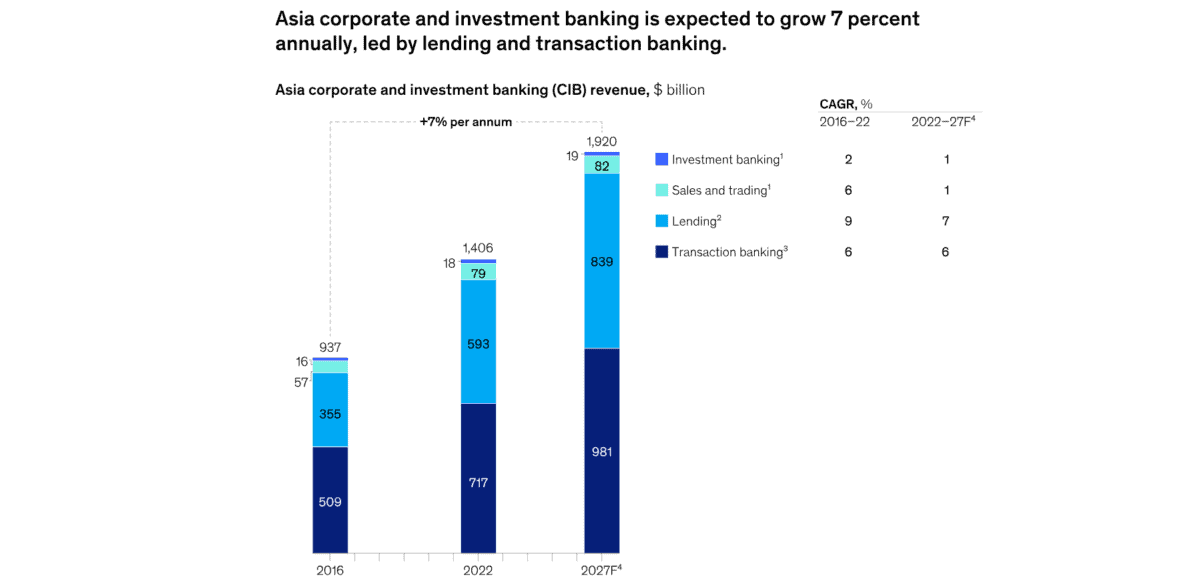
Analysts at McKinsey & Company expect Asia’s corporate and investment banking sector to grow 7% per annum between 2022 and 2027 alone, continuing the rapid expansion of recent years.

Source: McKinsey & Company

HSBC is trimming its non-Asian operations to better focus attention and resources on these hot growth markets, too. Last month, it announced plans to slim its investment banking operations in the US, UK, and Europe as it rejigs its global footprint.

An 8% annual return

I’m confident this will lead to exceptional shareholder returns in the years ahead.

Past performance is not a guarantee of future profits. But the 8% average annual return on HSBC shares over the past decade illustrate the potential gains investors could make.

That’s better than the 1.1% return on Lloyds shares over the same period. It’s also better than the 6.5% return delivered by the broader FTSE 100.

I don’t think HSBC’s blistering potential is reflected in its low share price. It trades on a forward P/E ratio of 8.6 times, which is even lower than that of Lloyds.

The bank’s 5.8% dividend yield also gives value investors something to shout about.

While it’s also not without risks, I think HSBC shares are worth a close look at today’s price of 897.2p.

Down 6% today, is the BT share price gearing up for a larger fall?

The worst-performing stock in the FTSE 100 so far today (18 February) is BT Group (LSE:BT.A). At 142.7p, it’s down almost 6%, mostly due to a downgrade from a leading Wall Street bank. With some of the reasonings provided by the research team, it could spell trouble looking forward for the BT share price.

Flipping the view

The research team at Citi downgraded BT Group from a previous Buy recommendation to a Sell. They revised the target price for the coming year down from 200p to 112p. That’s basically halving the expectations, with the view that the stock will fall, not rally, from the current level.

In terms of reasoning, they make a rather big assertion that they feel Openreach will have a decline in revenue for the coming year and remain that way for the rest of the decade. As a result, this could put pressure on free cash flow. Citi also cites concerns around the sustainability of the Consumer division pricing structure in the long term.

Given that the bank is very reputable in terms of research and content, the stark outlook and slashing of the price target has been the main trigger for the share price fall today. Clearly, the implications that Citi cite aren’t just concerns for today. If true, it could trigger a large move lower in coming months.

The other side of the coin

Some investors might feel that the claims around Openreach won’t turn out to be correct. The division, which manages the UK’s broadband infrastructure, has made significant progress in expanding its full-fibre (FTTP) rollout. As this continues, BT becomes an even more dominant fibre provider in the UK.

FTTP broadband plans generate higher average revenue per user, so as more users migrate to full fibre, Openreach will benefit from premium pricing. In theory this should increase the revenue from this division, not decrease it.

Further, one of the key reasons behind the new rollout is that companies increasingly rely on cloud computing, AI, and data-heavy applications. The fibre expansion with Openreach caters to this. So in the years to come, there’s a good chance of higher corporate subscriptions for BT.

Implications from here

The BT share price is still up 37% over the past year, even with the move today. This highlights that investors are happy with the direction of the company.

Even with this move, the price-to-earnings ratio is 8.17. This is still below the fair value benchmark of 10 that I use when trying to value companies.

Based on the current financials and the valuation of the company, I struggle to see how the stock will fall to 112p as Citi suggests. I don’t have cash free to buy BT right now, but I do feel this represents a dip that other investors might want to consider buying.

This FTSE 100 stock is down 25% from its 52-week high. Should I buy?

I’ve been keen on Segro (LSE: SGRO) before, but it’s one of those FTSE 100 stocks that’s largely flown under my radar this past year.

Seeing how the Segro share price has fallen 25% since the 52-week high it set in July 2024, I’ve been looking closely again. And I like what I see.

What it does

It’s a name that might not trip off the tongue, so what is Segro? It’s a real estate investment trust (REIT), and describes itself as “a leading owner, asset manager and developer of modern warehousing and industrial property“.

I think that answers another question too. Why has the share price had such a tough time? Inflation and interest rates, retail sump, shaky economic outlook, real estate weakness… just about every company in related businesses has felt the pressure.

It’s big across Europe, which helps offset UK market risk. But the eurozone hasn’t exactly been brilliant for business in the past few years either.

Please note that tax treatment depends on the individual circumstances of each client and may be subject to change in future. The content in this article is provided for information purposes only. It is not intended to be, neither does it constitute, any form of tax advice.

Turnaround

Segro slipped to a couple of years of earnings per share (EPS) losses, at least on a reported basis. But it swung back to both positive reported and adjusted earnings in 2024. CEO David Sleath spoke of “£91 million of new headline rent, our third best year on record, including a 43% uplift from UK rent reviews and renewals.”

The value of assets under management slipped in the year. But the company still reported an adjusted net asset value (NAV) per share of 907p. It’s hard to be precise on that, but it’s nicely in excess of the share price. At the time of writing, we’re looking at a discount to NAV of 20%.

We have a trailing price-to-earnings (P/E) ratio of 20, based on adjusted 2024 figures. And that might look a bit high. But forecasts suggest it could drop below nine in the next couple of years. The earnings predictions perhaps look a bit ambititous, but Segro says it’s expecting good things.

The CEO said that positive trends suggest leasing and pre-letting activity will increase. And that “would support attractive, compounding earnings and dividend growth in the medium-term“.

What next?

Construction in the commercial sector is still weak. And there has to be a good chance it could stay like that for a while yet. We see supply-side shortage coupled with intense competition from many others in the same space. And that could make growth quite a challenge in the next few years.

At FY results time, the company told us that “two-thirds of [its portfolio] is located in Europe’s largest cities, with the remaining one-third strategically located near logistics hubs and along key transportation corridors“. That sounds like a competitive advantage, though some others can no doubt say something similar.

Will I buy Segro? I’d like to buy a REIT, but I’m undecided. That’s mainly because others are also attractive. And it’s partly because I can see further weakness in the sector. But at the moment, it’s ticking most of the right boxes.

£10,000 invested in Nvidia stock just two weeks ago is already worth…

On 3 February, Nvidia (NASDAQ:NVDA) stock closed at $116.66. At the time of writing (after the market closed on 17 February) it’s at $138.85. That’s up 19%, enough to turn £10,000 into £11,900 in just two weeks

It might seem like chickenfeed compared to the 88% gain of the past 12 months. Or 1,816% over five years. But there’s another way to think about it that might cause an intake of breath. In this short period, Nvidia’s market capitalisation has risen by around half a trillion dollars.

Am I saying we should get in quick and bag the next fortnight’s profit? No. In fact, these recent gains haven’t quite made up for the dip that followed the release of China’s DeepSeek artificial intelligence (AI) model.

What does it mean?

What do these price movements really mean for investors thinking of buying Nvidia? For one thing, I think it all means we need to check the tensile strength of our nerves.

I sure wouldn’t rate it a ‘widows and orphans’ investment. And I wouldn’t consider buying unless I knew I could handle the volatility. Even then it would only be a level of money where the size of the risk wouldn’t keep me awake at night.

There’s big short-term risk here, and I think £10k invested today could be worth a fair bit less in another fortnight. Or more. It’s anybody’s guess.

I really am considering buying Nvidia shares however. And if I do, it’ll be because I think they’re underpriced compared to their long-term potential.

AI on the cheap?

DeepSeek shocked us with its cheap price. It works on older-generation Nvidia chips, because US export restrictions prevent Chinese developers getting newer ones. And it allegedly cost less than $6m to train, though many doubt that’s accurate and cheating allegations have emerged.

All those billions that the Magnificent 7 AI stocks were going to pump into AI development? Including the huge sums likely to be headed Nvidia’s way? Maybe it won’t be needed after all, and maybe AI’s going to be as cheap as old chips.

But as earnings reports roll in, we see the opposite. Amazon said it plans to plough $100bn into capital expenditure in 2025, up from $83m last year. Microsoft has $80bn earmarked for AI investment, and Meta‘s not far behind on $65bn.

Thanks DeepSeek!

I’m starting to think DeepSeek might have done Nvidia a favour. It looks like Chinese competition is increasing the urgency of AI research and development in the US. And it all needs even more chips.

Even though Nvidia stock has skyrocketed, I still don’t see it as overpriced. Forecasts put the price-to-earnings (P/E) ratio at about 50 for 2025, which maybe does look a bit spicy. But they expect earnings growth to drive it down to a very palatable 26 by 2027.

Think long-term thoughts

This business is changing rapidly, with news seeming to come almost daily. But whatever happens, I’d urge investors to remember that a fortnight in the market rarely means much. I’ve not made up my mind yet so for me, Nvidia will either be a long-term Buy, or I won’t buy at all!

Here’s why Lloyds shares have dipped sharply

Lloyds Banking Group (LSE: LLOY) shares dipped sharply on Monday afternoon (17 February). They lost 4.3% in the space of just 15 minutes, but pulled back a bit to end the day down 2%. What’s happening?

It’s all about the car loan mis-selling thing, and Chancellor Rachel Reeves’ attempt to intervene. She previously wrote to the Supreme Court with a caution that any harsh outcome could damage the availability of loans. And she urged that “any remedy should be proportionate to the loss actually suffered by the consumer and avoid conferring a windfall.”

Court rejection

The news broke Monday that the court has rejected the government’s approach.

But what does this all mean for Lloyds and other banks? Lloyds isn’t the only one to fall in response to the news, as Close Brothers Group ended the day with an 8% slump. Close Brothers, a much smaller lender, could face serious problems if it’s hit with a big penalty.

The FTSE 250 company posted a modest £100m profit after tax for its last full year. And in a November trading update, Finance Director Mike Morgan spoke of “the significant uncertainty resulting from the FCA’s review of historical motor finance commission arrangements.”

Lloyds, with a profit after tax of £5.5bn last year, seems far more able to shrug off any fines without too much long-term harm. But it could still be painful, and could give long-suffering shareholders yet another kick.

What it means

What might come down on the heads of Lloyds and the others is still far from clear. Some, however, are suggesting total penalties across the sector of up to £30bn.

The Lloyds board has said precious little about the whole thing. With each quarterly update, the bank just keeps saying things like “no further charges in respect of the FCA review of historical motor finance commission arrangements.” That’s no change from the £450m provision announced with 2023 full-year results a year ago.

Management must surely share their current thoughts on the affair in FY24 results due Thursday (20 February). Mustn’t they? I won’t be alone in checking what they say the moment it’s released.

What should we do?

The choices facing shareholders and would-be investors remain the same. For me, it’s got nothing to do with any Treasury talk. Or any day-to-day speculations on the probe’s outcomes, or short-term ups and downs in share prices. No, it’s all about the actual outcome of the court process, with the case set for April. And I’m not sure even that will make much difference for me.

We’re looking at a projected price-to-earnings (P/E) ratio of 9.7 for the year just ended. We can confirm or not on Thursday. Forecasters expect earnings to dip in 2025 though, pushing the P/E to 11 before earnings growth gets it down to 7.5 by 2026. There’s an expected dividend yield of 4.6%.

Lloyds clearly faces retail banking risk in the next couple of years, and I see that as the real long-term key. At today’s valuation I think I’ll continue to hold my Lloyds shares, whatever the Supreme Court might decide.

I’ll wait for the results and for the court case to conclude before I decide whether to buy more.

A £10,000 investment in BAE Systems shares 5 years ago is now worth…

BAE Systems‘ (LSE:BA.) shares have been on a bumpy ride since last summer. But the defence contractor’s share price is still significantly higher than it was before Russia invaded Ukraine in early 2022.

In the last five years, the price has doubled, to £13.38. With dividends included, someone who invested £10,000 in the FTSE 100 firm back then would have made £21,972.

That’s a spectacular return, especially compared with the broader Footsie wich has risen ‘just’ 18% in that time. But past performance isn’t always a reliable guide to the future. So what can we expect from BAE Systems’ shares looking ahead?

Spending calls

As I say, the defence giant’s shares have been more volatile in recent months. This is perhaps no surprise, with many investors booking profits following those earlier gains, and fears that defence spending may begin cooling.

But BAE Systems shares have burst back into life in recent days. On Monday (17 February) they soared 9% on the day as European leaders met to discuss the war in Eastern Europe.

A planned summit between the US and Russia on the Ukraine war today hasn’t fuelled hopes of a peaceful resolution. It’s instead fuelled speculation that European arms spending will surge as the US takes a reduced role in safeguarding the continent’s security.

UK Prime Minister Keir Starmer on Monday (17 February) called for European nations to “step up” and “increase our defence spending and take on a greater role in NATO“. This follows similar comments from other key politicians, including European Union President Ursula von der Leyen who’s called for “hundreds of billions of more investment every year“.

Good and bad

As one of the world’s major defence suppliers, BAE Systems is well placed to capitalise on any spending boom. While it makes around a quarter of sales from the UK, it also ships a lot of hardware to Mainland Europe. In 2023, around 11% of sales came from its continental partners.

The business makes roughly another 5% from other NATO members Canada and Australia. These relationships leave it in one of the box seats to enjoy a spending boom across the defence bloc.

That said, there’s no guarantee that sales to the US will ignite under President Trump. In fact, BAE Systems could be a victim of defence cuts as Elon Musk’s Department of Government Efficiency gets into gear. This could be a huge problem, given that more than 40% of group sales come from the US.

The verdict

So should investors consider it today? I believe BAE Systems is hugely attractive. Regardless of US intentions, the defence industry could enjoy a massive cash injection that might lift earnings through the roof.

City analysts think BAE’s earnings will continue rising strongly over the next couple of years at least. Bottom-line growth of 13% and 10% is forecast for 2025 and 2026 respectively.

Medium-term forecasts are supported by its robust order backlog, which was a record £74.1bn as of last June.

Today, BAE Systems trades on a price-to-earnings (P/E) ratio of 17.8 times. This is well below the global defence average of around 29 times, and could leave scope for big gains as arms spending ramps up.

On balance, I think investors could enjoy spectacular returns over the next five years if they consider this stock.

£8,000 invested in high-yield dividend stocks could make this amount of passive income

There’s a clear balance to be had when weighing up the risks versus the rewards of a potential investment. With dividend shares, this is precisely the same.

A high-yield option likely carries more risk around the sustainability of the passive income, but at the same time, the cash payments could be very juicy. If an investor did decide on a higher-risk approach with a sum of £8,000, here’s what could be achieved.

How to think about it

The FTSE 100 average dividend yield at the moment is 3.46%. Technically, anything above this average could be considered a high-yielding option. Yet in reality, I’d only classify a stock as being high-yield if it’s above 7%. Currently, there are six shares in the FTSE 100 that fit this profile. If I extend it to the FTSE 250, there are another 25 companies.

So even though, at a company-specific level, these stocks might be riskier to buy, an investor could still look to diversify some of this by holding a portfolio of dividend shares. There’s plenty here to allow an investor to buy a dozen stocks and still achieve an average yield that’s generous. That way, if one of the companies cuts the dividend, the overall impact’s more limited.

Even with this, investors do need to be aware that firms with a very high yield could cause problems over time. Sometimes, the yield’s been pushed higher because the share price has been falling rapidly. This could mean there’s trouble brewing, which could cause management to cut the dividend.

Renewable energy as a theme

One example an investor could consider if they were building this portfolio is Greencoat UK Wind (LSE:UKW). Greencoat’s a renewable energy investment company that generates revenue through owning and operating wind farms across the UK. Over the past year, the stock’s down by 14%, with a current dividend yield of 8.83%.

Greencoat’s an investment trust, with one of the key aims being to provide steady returns in the form of dividends. It has long-term power purchase agreements (PPAs), which means that cash flow for years to come can be forecasted fairly easily. In turn, this helps to provide stability when it comes to paying out income.

One reason why the yield’s increased in the past year is the dip in the share price. This is partly due to lower power prices, alongside the risk from the UK government, with it hinting at potential changes to renewable energy subsidies. Naturally, this would impact future revenue.

Even with these risks, renewable energy’s a key long-term theme, with the generous yield being an added perk.

Looking at the numbers

If an investor put £1,000 in eight dividend stocks that had an average yield of 8.5%, they could stand to make £680 in the following year. If this money was put back into the stock market, further income payments could compound faster. For example, in year six it could pay £1,080.

Granted, this isn’t guaranteed, but it shows what can be achieved with a slightly higher risk tolerance.

£5,000 invested in Tesco shares 2 years ago is now worth…

Investors often think that in order to generate big returns from the stock market, they need to invest in exciting growth stocks such as Nvidia and Amazon. This couldn’t be further from the truth. Just look at Tesco (LSE: TSCO) shares. Over the last two years, they’ve generated phenomenal returns for investors.

A jump in the share price

Two years ago, Tesco shares closed the day at 251p. Let’s say that an investor snapped up £5k worth of stock at that price.

Today, the share price is 397p. So, the investor’s £5k investment would have grown to about £7,910 (I’m ignoring trading and platform fees here).

That’s a brilliant return in two years. It works out at about 26% per year.

Dividend income too

It gets better though, because Tesco has also paid dividends to its shareholders.

I calculate that had an investor bought some shares two years ago, they would have been entitled to 23.4p per share in dividends. This would have meant another £466 or so for the investor above who bought £5k worth of stock (assuming the dividends weren’t reinvested).

So overall, the investor would now have about £8,376. In other words, they would have made a profit of £3,376 from their initial £5k investment.

Not bad from a sleepy stock like Tesco!

I was bullish

Now, Tesco shares haven’t always delivered strong returns like this of course. In fact, there have been times when the shares have tanked and investors have experienced big losses.

However, I’ve been relatively bullish on the shares for most of the last two years. And I’ve highlighted the stock as one to consider buying numerous times here at The Motley Fool.

I’ve been encouraged by the company’s rising level of profitability. Over the last two years, the company has raised its profit guidance on several occasions.

I’ve also liked the rising dividend payments and reasonable valuation. Since early 2023, the price-to-earnings (P/E) ratio has often been relatively low at around 10 to 12.

Worth a look today?

Looking ahead, I think the shares could have further to run. For the financial year ending 28 February 2026 (next financial year), City analysts expect earnings growth of nearly 10%, which is decent.

As for the valuation, the forward-looking P/E ratio using next year’s earnings forecast is 13.6. That seems quite reasonable to me.

One factor that could potentially help the shares is the 3.7% dividend yield. If UK interest rates continue to fall, and the rates offered on savings accounts decline, this yield could come into focus.

However, there are also factors that could potentially hurt the shares. One is the UK government’s new National Insurance (NI) rules – these are likely to hit Tesco’s profits.

Overall though, I’m cautiously optimistic about Tesco shares. I believe they’re still worth considering for a portfolio today.

Financial News

Daily News on Investing, Personal Finance, Markets, and more!

Financial News

Policy(Required)