2 key reasons Nvidia stock could still soar from here

Chipmaker Nvidia (NASDAQ: NVDA) is now worth $3.4trn. Nvidia stock is up 1,797% over the past five years.

Yes, you read that correctly. 1,797%.

So someone putting £20k into the (already well-established) tech firm in February 2020 would now be sitting on a holding worth just shy of £380k.

Given such a run, it could seem that Nvidia is headed for a fall – and maybe it is.

But, in fact, there are also reasons to be bullish about where it might go from here.

Here are a couple of reasons I think Nvidia stock could soar in price from today’s level over the next few years.

Unique position in high-growth market

The key reason behind the recent massive price growth has been investor excitement about artificial intelligence. Companies are already spending billions of pounds buying chips to help them optimise AI opportunities.

Warren Buffett likes companies to have a ‘moat’ or competitive advantage. Nvidia has a lot of proprietary technology that helps set its chips apart from rivals.

It may be that, after a burst of initial AI-related spending, the chip market cools down and Nvidia’s sales fall. Then again, recent activity could just be the start of something much bigger.

So I think Nvidia could benefit from having a unique position in a large, fast-growing market.

In its most recent quarterly sales update, the company’s chief executive said, “the age of AI is in full steam, propelling a global shift to NVIDIA computing”.

That makes it sound as if sales could potentially keep surging.

Profits could grow even faster thanks to economies of scale and the company’s pricing power. The third quarter, for example, saw year-on-year revenue growth of 94% but net income grew 109%.

If such heady growth continues – sales almost doubled in just 12 months — the investment case will grow and Nvidia stock could rise.

Nvidia arguably still has an attractive valuation

Despite its meteoric rise over the past five years, I think there is an argument to be made that Nvidia stock is attractively priced.

Its price-to-earnings (P/E) ratio at the moment is 55. That is high and indeed the valuation is the reason I currently have no plans to invest in the company, as I think it offers me insufficient margin of safety as an investor.

That said, although the P/E ratio is notably higher than some leading tech stocks, it is cheaper than some.

Tesla’s P/E ratio of 174 is over three times Nvidia’s, despite weaker business growth prospects based on last year’s performance. Meanwhile, some companies using AI substantially are far costlier. Palantir has a P/E ratio of 661.

If Nvidia can grow its earnings strongly – and as I explained above, I believe it can – the prospective P/E ratio is much lower than today’s 55. So if the market keeps the valuation roughly close to where it is now, higher earnings could mean a jump in the share price.


Here’s how £10k could set a stock market beginner on the path to riches in 2025!

Doing well in the stock market does not necessarily require great skill or vast sums of money.

Clearly, they would help. But fortunately, it is possible to build wealth through a mixture of careful share selection, sensible risk management, patience, and whatever capital is at hand.

For example, if someone had £10k but had never invested before, here is how they could go about it.

Learning is vital to improve the chance of success

It is possible to plunge into the market knowing little and strike it lucky. But that is speculation and, while it can work occasionally, it can also be like setting fire to hard-earned money.

So it definitely makes sense, before investing a single penny (as opposed to speculating), to learn about how the market works. For example, how are shares valued?

Another key thing to understand is the role of risk management.

Spreading £10k evenly over 10 different shares means £1k is the maximum loss an investor could suffer if one share loses all value. Putting the whole £10k into a single share, by contrast, risks it all.

Why a long-term approach helps build wealth

I mentioned patience above. Why does it matter?

Imagine a portfolio that grows at 10% compounded annually. After one year, 10% grows to £1,000. But the following year, 10% (now of £11,000) will grow to £1,100. The following year, 10% (now of £12,100) will be £1,210. And so on.

In short, the growth creates more capital that in turn can lead to further growth. This simple but important concept is known as compounding.

Compound £10k at 10% annually and after 20 years it will be worth £67,275. That is excellent.

But compound it for the same time again and it will be worth not double £67,275, but well over six times as much: £452,593.

Time and patience are the smart investor’s friends.

Finding shares to buy

Some might think that 10% doesn’t sound like much for a compound annual growth rate.

Indeed, FTSE 100 firm Phoenix has a dividend yield of 10.7%.

But no dividend is ever guaranteed. Over five years, Phoenix’s share price has fallen 37%, meaning its compound annual growth rate has not been 10% despite that double-digit dividend.

While 10% is not an easy target over the long run, I think it is possible. Dividends could play a role (maybe a big one) but probably some capital gains would be important too.

One share I think long-term investors could consider with both those things in mind is Guinness brewer Diageo (LSE: DGE).

It has strong brands, a large distribution network, and pricing power thanks to owning unique assets like iconic distilleries. That has helped it fund annual dividend increases for decades. Currently, the share yields 3.8%.

What is less appealing is the five-year stock market record: a share price fall of 32%.

From a positive perspective, that could be seen as potentially offering better value.

But the fall could be seen as reflecting risks including declining alcohol consumption among younger consumers and struggles to maintain sales in a weak economy. This month’s interim results showed lower sales volumes and net sales than in the prior year period.

Still, building wealth is a long-term project.

A short-term first step could be putting the £10k into a share-dealing account or Stocks and Shares ISA.

The BAE share price struggles despite strong earnings and a 10% dividend increase. Is it still a buy to consider?

The share price of the UK’s largest defence contractor, BAE Systems (LSE: BA.), suffered minor losses this morning (19 February) after posting its full-year 2024 results.

It had started the year with exceptional growth, up 16% year-to-date when markets opened on Monday this week. Then this morning it announced its full-year 2024 results. Despite strong sales and revenue, some figures missed analyst expectations.

Even though the news was positive overall with an increase in cash flow guidance, the shares slipped 3% in early morning trading.

The numbers

Today’s earnings report covered the 12-month period ending 31 December 2024. The company reported strong performance with both sales and revenue up 14% to £28.3bn and £26.3bn, respectively.

Underlying earnings per share (EPS) increased 10% to 68.5p (from 63.2p) and operating profit grew 4%. Underlying earnings before interest and tax (EBIT) also increased 14% to £3.2bn. 

The final dividend announced for the year was increased by 11% from 18.5p to 20.6p, bringing the total annual dividend up to 33p, a 10% gain from 30p in 2023. With a history of reliable dividend payments, the yield of 2.4% makes it an attractive option for income-focused investors like me.

Analysts expect continued sales growth of between 7% to 9% and underlying EBIT growth of 8% to 10%. This is based on an expectation of increasing demand for defence systems.

Business developments

BAE recently secured a $251m contract to support the US Navy’s AEGIS Combat System, another gold star for its impressive portfolio of global defence projects. With defence budgets on the rise worldwide, such contracts help ensure the company is well-positioned for long-term growth.

The new deal with the US Navy is just the latest in a series of wins. The deal grants BAE rights to provide critical engineering and technical services for the AEGIS system, a key component of US naval operations. Along with other significant contracts secured in late 2024, it reinforces an already comprehensive order backlog, promising revenue for years to come.

Factors that could hinder growth

No investment is without risk, and BAE is no exception. A change in government defence budgets, supply chain disruptions or a rise in geopolitical tensions could impact its performance. It’s also at risk of losing contracts to US-based competitors like Lockheed Martin or Northrop Grumman.

Unlike BAE, these companies have suffered stock declines since the US election following an expectation of lower defence spending. This could lead to them competing more aggressively for EU-based contracts, threatening BAE’s future revenue.

While its valuation still looks good, it could be moving toward overbought territory. The share price has been soaring in recent months, so its price-to-earnings (P/E) ratio, at 21.8, is slightly above the UK market average. This could limit the potential for further capital appreciation, despite forecasts predicting earnings growth of 8.2% per year going forward.

However, its diversified portfolio and global presence provide some cushion against these risks.

With a strong start to 2025, high-profile contracts and positive analyst sentiment, I believe BAE remains a stock worth considering this year. Its defensive nature adds stability to my portfolio and after today’s positive results, I plan to continue adding to my holdings in 2025.

Could this Nvidia-backed growth stock be a millionaire-maker at $10?

Disruptive growth stocks trading for a few dollars have the potential to generate life-changing returns. One that’s been getting a lot of attention from investors is Recursion Pharmaceuticals (NASDAQ: RXRX). Recently, the stock soared almost 24% in a single day (14 February).

The company is backed by Nvidia, as well as Scottish Mortgage Investment Trust, and Softbank. So there’s a lot of smart institutional backing here.

Let’s take a closer look at this under-the-radar $10 stock.

The company at a glance

Recursion is a clinical-stage biotech firm that’s attempting to industrialise drug discovery by using artificial intelligence (AI) and machine learning to decode biology.

In July 2023, Nvidia announced a $50m investment in the firm, initiating a partnership aimed at enhancing Recursion’s AI-powered drug discovery capabilities. With Nvidia’s powerful chips, Recursion has built BioHive-2, the largest supercomputer in the biopharmaceutical industry (and 35th in the world). 

It’s developing a few therapies for cancer and rare diseases, but also aims to generate substantial service fees by allowing other biopharma firms to use its drug development platform. Notably, it has signed deals with industry heavyweights like Bayer, Roche, and Sanofi.

Another encouraging thing here is that Nvidia hasn’t sold any of the Recursion shares it bought even though the AI juggernaut did offload a few of its positions in Q4, including Soundhound AI. This apparent vote of confidence in the firm is what sent the stock up nearly 24% last week.

Recently, the company merged with Oxford-based Exscientia, another leader in the AI drug discovery space. The combined entity now has a portfolio of more than 10 clinical and preclinical programmes, and over 10 partnerships.

Recursion is automating the age-old practice of looking into a microscope and is replacing human interpretation with AI. This is exciting because it provides the opportunity to profitably pursue more minor diseases that may not have been commercially viable using traditional drug development processes.

Scottish Mortgage Investment Trust.

Still early days

As revolutionary as this sounds, the company’s pipeline is still at an early stage. That means it will be at least three-to-five years, at best, before any of these therapies start generating sales.

Source: Recursion Pharmaceuticals

In the meantime, the company could sign more deals and receive milestone payments for drug development collaborations. However, this is a very speculative stock because consistent sales, let alone profits, aren’t expected for many years.

Following the merger, the firm has over $700m in cash and equivalents. That’s enough to pursue its pipeline for now, but a further fundraise can’t be ruled out at some point. Therefore, the possibility of shareholder dilution is a risk here.

Millionaire-maker?

Nvidia CEO Jensen Huang thinks the next big AI revolution will be in healthcare, which explains the partnership with Recursion. So the stock is definitely worth keeping on the radar.

However, it’s far too early for me to get bullish because the company’s platform isn’t yet churning out AI-discovered treatments.

To turn £10k into £1m, the stock would need to rise 100-fold, assuming constant exchange rates. Currently, Recursion has a $4.1bn market cap, which means it would be valued at around $410bn if it achieved that feat – larger than AstraZeneca today! So highly unlikely then.

As things stand, I’m not going to invest in this risky stock.

£10,000 invested in the S&P 500 the day before the presidential election is now worth…

Arguably the largest event for the S&P 500 last year was the US presidential election, held in early November. We’re now over three months past that date, with Donald Trump implementing early policy actions. Investors have already experienced high volatility in the market during this period, with tariff talk and other actions in focus. Yet if someone had invested £10k the day before the election, here’s how things would be looking now.

Details of the performance

On the day before the election, the S&P 500 was trading at 5,712 points. It’s now at 6,129 points. This marks a 7.3% increase over the three-and-a-half-month period in question. So the £10,000 would currently be worth £10,730.

Clearly, the initial takeaway is that stocks have taken the election results well. Some people might think that a 7.3% return isn’t exactly outstanding. Yet it’s important to note that this is the profit after only a few months. Using some nifty maths, the annualised performance would be 27.45%, if the stock market kept rising at the same pace as it has done since the election. Of course, there’s no guarantee of this, but it helps to put in perspective the size of the move we’ve seen since November.

It might interest investors to know that over the same time period, the FTSE 100 is up by 7.12%. Part of this can be explained by the general positive sentiment felt by stock investors around the world. Yet it also goes to show that the performance of the S&P 500 isn’t significantly better than index performances from other countries.

Election winners

Within the index, there have been some clear early-stage winners from the election. For example, Tesla (NASDAQ:TSLA). If an investor had bought the US stock the day before the election, they would be up a whopping 45.8%. Over a broader one-year time period, the stock is up 82%.

Part of the jump can be explained due to the close ties that Elon Musk has forged with President Trump. Some feel that the affiliation could ultimately be beneficial for Tesla as a company, with Trump maybe offering preferential terms or trade agreements for the electric vehicle (EV) maker.

The business has performed well over this period. Since the election, there has been more news around robotaxi approvals, with Musk committing to releasing a prototype of the Optimus humanoid robot this year.

One concern is that higher competition in the EV space could cause the traditional source of revenue to fall. In fact, 2024 saw the firm post the first annual decline in EV sales in more than a decade.

I think the stock is worth considering for investors. I’ve held it for a while already and won’t be selling any time soon as I feel the rally could continue for some time. If anything, I’d look to buy more if the stock did see a dip.

The bottom line

The S&P 500 has done well in the months that have followed the November election. Given the outperformance of select election winners, I feel investors can look to active stock picking to try and beat the index this year.

Should I consider buying Glencore as its share price slumps to multi-year lows?

A weak period for commodity markets has proved catastrophic for Glencore (LSE:GLEN) and its share price.

At 329.6p per share, the FTSE 100 company is down 16.3% over the past year. It’s nearly 7% lower today (19 February) after announcing a second straight year of sinking earnings.

Due predominantly to falling coal prices, Glencore said that adjusted EBITDA dropped 16% over the course of 2024, to $14.4bn. The miner also crashed to a loss before tax of $998m from a profit of $5.4bn the year before.

2024 was another year of operational robustness, with production across its mines and smelters, matching forecasts. But that couldn’t stop the bottom line slumping again.

Should I avoid Glencore shares like the plague right now? Or should I capitalise on recent weakness and add them to my portfolio?

Danger ahead

Aside from gold, the last 12 months has been pretty dire for the metals and minerals business. Since January 2024, the Westpac Export Price Index has fallen more than 7%, driven by thumping drops in metallurgical coal and iron ore prices (down 43% and 23%, respectively).

Could business be about to turn higher? As things stand today, I wouldn’t bet the house on it.

As Westpac succinctly commented: “We doubt we will get much more clarity in 2025 with risks of trade wars, shifting priorities around the transition to a low-carbon economy, while geopolitical uncertainties all at play.”

Take copper, for instance, a key commodity for Glencore on the mining and trading side. Crippling trade tariffs and changing green policy in the US could decimate demand from key sectors like electric vehicles (EVs), renewable energy and electronics.

On Tuesday, US President Trump shook markets by threatening 25% tariffs on imports of foreign vehicles and semiconductor chips.

Taking a long-term view

Does all this make Glencore shares extremely unattractive? I’m not so sure.

First, it depends on an investor’s preferred timeframe. The near-term outlook for metal prices is pretty murky, while its coal business could also continue to struggle. But over a longer horizon — say a decade or more — the picture is far more encouraging.

The green economy and digital sector still look poised to expand significantly over the next 10-20 years, boosting industrial metal demand. Other factors, like increased urbanisation, the booming global population, and rising emerging market wealth will also drive consumption.

Glencore’s extensive operations put it in great shape to exploit this opportunity. The firm has more than 60 metal-producing assets spanning the globe and a large marketing division.

A strong balance sheet gives it scope for growth-boosting acquisitions as well. Its net-debt-to-adjusted EBITDA ratio stands at just 0.8.

Too cheap to miss?

It’s also worth considering the cheapness of Glencore shares, and whether current threats are reflected in today’s low share price.

Analysts think annual earnings will rebound 25% in 2025. So the miner trades on an undemanding price-to-earnings (P/E) ratio of 10.9 times.

Meanwhile, its price-to-earnings growth (PEG) ratio sits at 0.4, well within bargain basement territory below 1.

At today’s price, I think the FTSE 100 miner is worth serious consideration. A tasty 5.5% forward dividend yield adds an extra sweetener for investors.

If I didn’t already have significant commodities market exposure through my Rio Tinto holdings, I’d be look to ad Glencore shares to my own portfolio today.

£5,000 invested in Lloyds shares 3 months ago is now worth…

Since 18 November 2024, the value of Lloyds Banking Group (LSE:LLOY) shares has risen 12%. This means a £5,000 investment made three months ago would now be worth £5,600.

Although this is a better performance than the FTSE 100 as a whole (up 7.9%), it still lags behind the other four banks in the index, with HSBC leading the way (up 36%). However, with the possible exception of NatWest Group, they have a more global reach.

Lloyds earns nearly all of its revenue in the UK. And with the economy struggling to grow at the moment — and disposable incomes coming under pressure — it faces a difficult environment in which to try and increase its revenue and earnings.

A simple business model

Like all banks, Lloyds charges interest on the amounts it lends, and pays interest on customer deposits. The gap between the two is known as the net interest margin.

Although both rates tend to move in line with decisions made by the Bank of England, banks are generally able to charge more for loans. Higher interest rates are, therefore, better for income.

After reaching a post-pandemic high — in August 2023 — of 5.25%, the base rate’s been cut three times since, to 4.5%. It’s now at the same level as it was in October 2008, just before the global financial crisis.

But although good for income, higher rates also mean an increased risk of customers defaulting on their loans. Banks are required to make a quarterly assessment as to the likelihood (and value) of any bad debts. If the position’s getting worse, an impairment charge (cost) is booked in the accounts. Otherwise, a credit (income) is recorded.

However, Lloyds appears to have its loan book under control. For the seven quarters ended 30 September 2024, it’s recorded a £581m increase in its impairment charge. This might sound like a lot but, over the same period, its net income has been £30.67bn.

A dark cloud looms overhead

But the investigation by the Financial Conduct Authority (FCA) into the alleged misselling of car finance remains a potential problem. And it makes me wonder whether the recent increase in the bank’s share price is justified.

Tomorrow (20 February), the bank releases its 2024 results. It’ll be interesting to see whether it increases the amount it’s set aside to cover the potential costs. Presently, it’s forecasting that the ‘scandal’ could cost £450m. I’ve seen one ‘conservative’ estimate suggesting the final bill could be as high as £4.2bn.

Looking at the firm’s balance sheet at 30 September 2024, this doesn’t seem particularly significant. At this date, it had total assets of £901bn, including £59bn of cash. However, based on its current market cap, the £4.2bn cost estimate is equivalent to 6.9p (11%) a share. Ouch!

And the saga could drag on for the rest of the year. The FCA has given motor finance providers until December to issue a final response to complaints.

Until the situation becomes clearer, I’m expecting the share price to be volatile, which is why I don’t want to buy the stock. It’s already close to its 52-week high, which could be a sign that investors may not be anticipating a £4bn+ cost arising from the FCA investigation. And they might be overly optimistic about the prospects for the UK economy.

Should I buy gold stocks for my ISA or SIPP as bullion prices surge?

Gold’s on fire at the moment and charging towards the $3,000 per ounce mark. As a result, many gold mining stocks are doing well. Is it worth buying a few of these stocks for my Stocks and Shares ISA or Self-Invested Personal Pension (SIPP)? Let’s discuss.

The advantage of investing in gold stocks

When the price of gold is rising, as it is now, gold mining companies can be great investments. That’s because they’re essentially a leveraged play on the precious metal. Often, rising gold prices can lead to a sharp increase in profitability for these companies. This is the result of revenues rising at a faster pace than costs.

A good example here is Pan African Resources (LSE: PAF) – a small gold miner that’s listed on the London Stock Exchange. For the 12-month period to the end of June 2024, its revenue climbed 16.8% year on year. However, its profit for the period jumped 30.2%. In other words, profits rose at a much faster pace than revenues.

When gold prices are high, miners can also generate substantial profits. Because often the cost to produce gold is far lower than the price it can be sold at. Going back to Pan African Resources, its ‘all-in sustaining costs’ for that financial year were $1,354/oz. So with gold in the high $2,000s, it was making a lot of money ($79m profit for the year on revenue of $374m).

Another thing worth mentioning is dividends. When gold miners see a big increase in profitability, they often reward shareholders with bigger dividends. We can see this with Pan African Resources. Last financial year, it raised its payout from ZA18 cents to ZA22 cents – an increase of 22% (the yield’s currently around 3%).

Gold miners can be risky

Gold miners can also be quite risky investments however. I learnt this the hard way around 15 years ago when many of these stocks tanked during the 2008/2009 Global Financial Crisis.

If the price of gold falls, these stocks are likely to fall too (as investors pencil in lower profits). It’s worth noting here that gold has had a huge run over the last year, so there’s a chance of a pullback in the near term.

Source: Trading Economics

Another risk to be aware of is operational setbacks. With these companies, there are a lot of things that can go wrong here. Adverse weather, equipment failures, and staff strikes are some examples. These can all lead to share price weakness.

Given that lots of things can go wrong, gold mining stocks don’t always do well when the price of the commodity is rising. If we look at Pan African Resources, its share price is actually down about 10% over the last month, while gold is up about 9%.

Not for me

Given the risks, I don’t plan to buy gold mining stocks such as Pan African Resources for my portfolio any time soon. If I decide to allocate some capital to gold, I’ll most likely buy a gold ETF that gives me direct exposure to the spot price of the commodity.

The HSBC share price doesn’t know what to do after the bank releases its 2024 results

A bit like the Grand Old Duke of York in the nursery rhyme, the HSBC (LSE:HSBA) share price was up and down in early trading today (19 February).

At first, it was up nearly 1%. But then it fell 1.5%, before recovering again. It’s almost as though investors were unsure what to make of the bank’s 2024 results.

But the headline figures look good to me.

Beating expectations

For the year ended 31 December 2024, it reported a profit after tax of $25bn, an increase of $440m (1.8%) on 2023. This includes some notable one-off items, such as a profit on disposal of its operations in Canada ($4.8bn) and a loss arising from its decision to exit Argentina ($6.1bn). Exclude these and the picture looks even better. Indeed, the reported result was marginally ahead of the consensus forecast of analysts ($24.8bn).

And the bank used its considerable assets more efficiently than brokers were expecting. Excluding exceptional items, the return on average tangible equity (ROTE) was 14.6% (forecast: 14.4%). For comparison, this is comfortably ahead of Barclays (10.5%), the other FTSE 100 bank with a global reach.

And although the bank’s net interest margin fell to 1.56% (2023: 1.66%), this exceeded forecasts as well (1.52%). The fall was blamed on “increased deployment of our commercial surplus to the trading book”. This sounds like a deliberate decision to cut interest rates to me, and shows how competitive the banking sector can be.

But not all of its divisions are performing well. Profits from its commercial banking arm were down nearly 10%.

Looking further ahead

The group’s chief executive described the results as “strong” and said they provided a “firm financial foundation” on which to build.

Indeed, the bank’s expecting to achieve a ROTE in the “mid-teens” from 2025-2027. Some of the anticipated improvement will be driven by a huge efficiency drive that’s forecast to yield savings of $300m in 2025, and $1.5bn in 2026.

The Chinese real estate market is also showing signs of picking up with prices starting to rise. HSBC is heavily exposed to the sector but recent statistics suggest the market’s now recovering.

And income investors will be happy that the group increased its payout. Its total dividend for 2024 will be $0.87. Excluding the one-off payment of $0.21 following the sale of its Canadian business, shareholders will receive $0.66 (52.1p at current exchange rates) a share. The stock’s therefore offering a healthy yield of 5.9%. Fans of share buybacks will also be pleased to learn that the bank intends to spend $2bn buying its own shares in 2025.

A muted response

But the reaction of investors during the first hour of trading suggests there are marginally more sellers than buyers.  

Perhaps some of them have decided to ‘cash in’ after the share price has increased 39%, since February 2024. Or maybe it’s going to take time for the contents of the mammoth 460-page annual report to be digested.

Okay, I don’t think the results were particularly exciting. But there’s lots to be positive about and the outlook looks good to me. For those looking for a stock that ‘s likely to deliver few surprises — and one that offers an above-average yield — I think HSBC is one that investors could consider.

Looking for defence stocks to buy? Consider this brilliant ETF

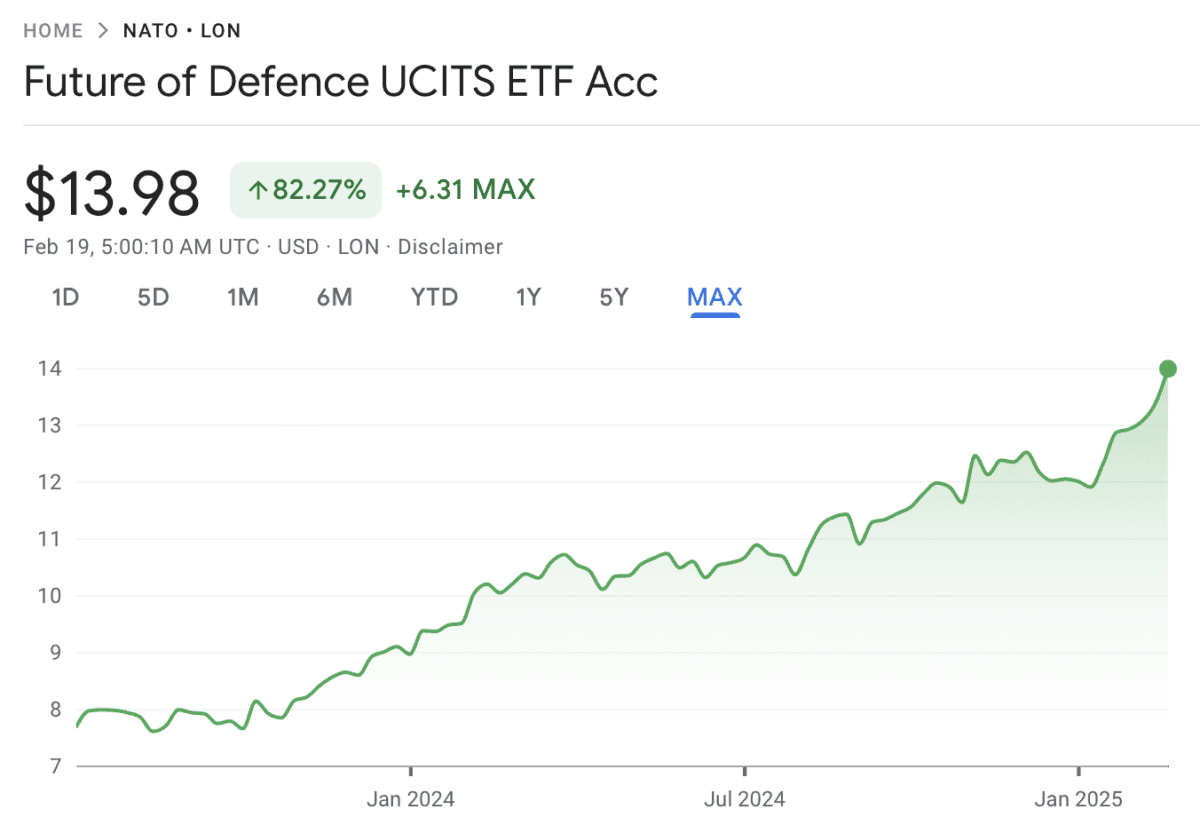
Defence stocks are hot right now. It’s easy to see why – currently geopolitical uncertainty is sky-high. Looking for stocks to buy in this area of the market? I think it’s worth considering the HANetf Future of Defence ETF (LSE: NATO) – which provides exposure to a range of different companies.

Outperforming BAE Systems shares

I bought this ETF for my own portfolio back in November, shortly after Donald Trump won the US election. And I’m not regretting it. Already, I’m sitting on a gain of 16.5% (after trading fees). That’s a great return in a little over two months. For reference, shares in UK defence contractor BAE Systems have only risen about 1% over the same timeframe. So, I’ve outperformed them by a wide margin.

Diversified exposure to the sector

This performance gap is exactly why I chose to go with a defence ETF instead of buying shares in BAE Systems or another individual company. Back in November, I was pretty confident that the defence sector, as a whole, would — sadly from a human suffering perspective — do well in the months and years ahead. However, when you invest in an individual company, there’s always the risk that it won’t fully participate in an industry rally. With this ETF, I was able to get exposure to nearly 60 different stocks – including the likes of Safran, Rheinmetall, and L3 Harris – and that has worked out well as many defence stocks have risen in recent months.

A modern take on an old industry

One reason I chose to invest in this particular ETF, instead of other similar products, was that it takes a futuristic view of defence, providing exposure to cybersecurity and artificial intelligence (AI) companies alongside traditional defence companies. Some examples here include CrowdStrike, Palantir, and Palo Alto Networks (which are all doing really well this year). Today, the nature of defence is rapidly evolving. And these kinds of companies give me exposure to cutting-edge technologies that are shaping the future of the industry.

Low fees

I was also attracted to the fee structure. Ongoing fees for this ETF are just 0.49% per year, which to my mind are reasonable (although I also need to pay trading commissions to buy and sell).

Favourable outlook

Looking ahead, there are no guarantees that this ETF will continue to do well. If geopolitical uncertainty eases (as we hope it will) and there’s a sentiment shift away from defence and cybersecurity stocks, the product could underperform.

Another risk is US defence budgets. With the Department of Government Efficiency (DOGE) – led by Elon Musk – looking to cut US government costs, there’s a chance that US defence contractors could see lower revenues in the years ahead.

However, with European leaders having just met to discuss the ramp up of defence spending across Europe, I think the outlook for the defence sector, as a whole, looks favourable. So, I believe this ETF is worth considering for a diversified portfolio today.

Financial News

Daily News on Investing, Personal Finance, Markets, and more!

Financial News

Policy(Required)