2 UK dividend shares that aren’t what they seem

There are some UK shares with interesting dividend yields on offer at the moment. But when it comes to investing, things aren’t always what they seem.

I’m firmly of the view that dividend stocks can be great passive income investments. Finding the right ones however, can be a tricky business.

High yields

There are a number of stocks that have dividend yields that seem too good to be true. And in some cases, that’s because they are. Regional REIT (LSE:RGL) is one example. According to some sources, the real estate investment trust (REIT) is set to return over 16% of its share price to investors in the next 12 months. 

This however, is a mistake. The firm’s actually looking to distribute around 7.8p per share and with a current share price of £1.16, that implies a 6.7% dividend yield.

A 6.7% return isn’t bad, especially with Regional REIT having strengthened its balance sheet recently. But it’s far from the yield advertised in some places, so what’s going on here? 

I think the answer has to do with the company going through a reverse stock split last year. In doing so, it replaced 10 (old) shares with one (new) one. 

My suspicion is that this is causing some of the calculations in certain places to go wrong. But this is exactly the kind of things investors need to know about. 

Please note that tax treatment depends on the individual circumstances of each client and may be subject to change in future. The content in this article is provided for information purposes only. It is not intended to be, neither does it constitute, any form of tax advice.

Special dividends

In other cases, returns can be much higher than they seem – B&M European Value Retail‘s (LSE:BME) a good example. A quick look suggests the stock comes with a 5% dividend yield.

That isn’t bad by any means. And in 2024, B&M returned 14.9p per share in ordinary dividends, which is indeed 5% of the current stock price of £2.94.

This however, isn’t the full story. The firm also distributed a special dividend of 15p per share, which takes the total cash distribution to 29.9p – 10% yield at today’s prices.

No dividends are guaranteed, especially special ones. Investors should also note that declining like-for-like sales meant B&M’s big February distribution was lower than in previous years.

The company however, does have a good track record when it comes to its special dividend. And leaving this out of the yield calculation significantly understates the overall return. This is why investors aiming for passive income need to look closely at stocks. Sometimes a dividend can actually be more impressive than it looks. 

Appearances can be deceptive 

Income investors generally know that there’s more to a stock than its dividend. Over the long term, the most important thing is the underlying business.

Sometimes though, even the dividend yield isn’t what it seems. A closer look can show investors they’re set to receive much less than they might have thought – or much more.

A 16% dividend yield would be a pretty compelling reason for investors to think seriously about buying shares in Regional REIT. But I’m not convinced this is the case at 6.7%.

With B&M, however, the situation is the opposite way around. The fact the stock looks set to distribute 10% of its market-cap each year, rather than 5%, means I think it’s worth considering.


This S&P 500 giant just fell 16% after hitting an all-time high. Time for me to sell?

The share price of one of my top-performing S&P 500 stocks took a shocking dive yesterday (19 February).

Axon Enterprise (NASDAQ: AXON), a leading developer of security products in the US, lost over 16% of its stock value in a matter of hours.

Just one day prior, on Tuesday, the shares had hit a new all-time high of around $715. But when markets opened the following morning, the price began a rapid descent to $580.

So what happened – and is this a sign to sell?

Rating downgrade

The devastating collapse seems to have been prompted by a downgrade by a key analyst at Northcoast Research. After Axon dissolved its partnership with Flock Safety, Keith Housum downgraded the stock from Buy to Neutral. 

Reportedly, there are concerns that Flock may be transitioning from a partner to a competitor. This follows suggestions from Axon that Flock was imposing untenable barriers on data access. 

“As Flock has increasingly imposed artificial barriers on integrations and access to agency-owned data, we have made the unfortunate decision to terminate our existing partnership with Flock,” said an Axon spokesperson.

In response, Flock Safety CEO Garrett Langley said: “Axon decided that being open and collaborative is no longer in its best interests, and no additional reason was given to us.”

While the immediate financial impact is bad enough, the potential long-term effects could be even worse. The failed partnership could boil over into Axon’s recent acquisition of Fusus, a company that potentially relies on Flock for certain data capabilities.

Recovery potential

Prior to the fall, Axon was favoured by tech enthusiasts for its impressive AI integrations and drone developments. It’s been less than a month since Goldman Sachs reiterated a Buy rating on the stock with a price target of $700. It already hit that target this week.

Even with this week’s losses, the price remains up by over 120% in the past 12 months.

In Q3 2024, revenue came in at $544m, a 32% increase year-over-year. Consequently, the security firm raised its full-year revenue guidance to approximately $2.07bn, representing over 32% annual growth. 

There are now fears those targets may not be met, possibly eroding shareholder confidence.

It’s difficult to gauge the true impact of the Flock fallout. I wouldn’t imagine the dissolution of a single partnership would prompt a full-blown price trend reversal. However, if this is just the tip of a much bigger iceberg of problems, things could go south.

Sell or hold?

Considering Axon’s price-to-earnings (P/E) ratio recently crossed above 180, a correction isn’t all that surprising. A high P/E isn’t unusual for the stock (it’s been above 100 for most of the past two years) but 180 is still a lot.

When Nvidia crossed above a P/E of 200 back in 2023, the share price declined nearly 20% in the following month. The losses didn’t last long though — it reached new highs in the following months while its P/E ratio dropped.

But Axon isn’t Nvidia and it can’t rely solely on AI to save it. If Flock emerges as a serious competitor, it could threaten Axon’s profits and market dominance.

For now, I tentatively plan to hold my shares but I’d consider selling some if the situation deteriorates further.

Is this a FTSE 100 stock to consider? Major US brokers think so!

When looking for FTSE 100 stocks to invest in, there are many factors to consider. From recent results and financial ratios to management, developments, and market position, the range is daunting.

One place I like to start is by checking recent broker ratings. Since major brokers can’t afford to make too many mistakes, they hire the best and brightest minds to guide their decisions.

So when two top US brokers put in positive ratings for Barclays (LSE: BARC), I had to see what the fuss was about.

Strong results

On 18 February 2025, Bank of America issued a Buy rating for Barclays and JP Morgan reiterated its Overweight rating. Together, they reflect growing confidence in the bank’s future prospects and a favourable outlook for the stock. 

The ratings follow a positive set of FY2024 results released last week Thursday (13 February 2024).

Many of the results outpaced analysts’ expectations, with pre-tax profit climbing to £8.1bn — a 24% increase. The growth was driven by strong income from its investment banking division and steady interest rates supporting domestic lending. The return on tangible equity (RoTE) stood at 10.5%, meeting the bank’s targets.

The bank also announced a £1bn share buyback programme, adding to £3bn worth of capital contributions achieved in 2024. 

Up 100% in a year

The share price has climbed 5% since the report, bringing its 12-month gains to over 100%. Now at around £3 per share, it’s the highest it’s been in over 10 years.

Despite the growth, the bank’s valuation remains low, with a forward price-to-earnings (P/E) ratio of 7.27. This is a slight increase from the figure of 5.72 reported at the end of 2024. The price-to-sales (P/S) ratio has also increased slightly, from 1.24 to 1.29.

Both suggest the share price represents good value and could have further room to grow. However, if it keeps rising and earnings lag behind, it could soon wander into overbought territory.

Looking at the wider UK banking sector, Barclays is ahead of its competitors. The second-closest in terms of price performance is NatWest, up 96.7% in the past year.

Lloyds and HSBC lag behind, up 46% and 40% respectively. Notably, all four banks have similar P/E ratios.

Risks and rates

The recent growth, while impressive, has not come without certain challenges and concerns. 

In early February 2025, the bank experienced a significant IT outage that disrupted online and mobile banking services for several days. The problem eroded customer trust and satisfaction and may incur additional costs for the bank.

These add to the £90m the bank has set aside to address potential compensation claims related to the now infamous motor financing scandal. This follows a Court of Appeal ruling that expanded the issue’s scope. 

Barclays’ future performance is dependent on how interest rates evolve over the next year or so. Like most banks, it benefits from higher rates that boost net interest margins (NIM) while keeping deposit rates relatively low. However, if rates start to fall in 2025 as expected, it could squeeze margins and reduce profitability.

Like the brokers above, I think it’s a stock worth considering. However, I’d keep a close eye on UK interest rate changes.

As Lloyds launches a £1.7bn buyback, is the share price too cheap to ignore?

The Lloyds Banking Group (LSE: LLOY) share price has been driven largely by the car loan mis-selling probe in recent weeks. It rose after chancellor Rachel Reeves urged leniency from the Supreme Court in its forthcoming case. And it fell again when the court rejected the government’s overtures.

And now Lloyds’ shares have moved up a few percent on full-year results morning (20 February) despite a 20% plunge in profits. News of a new £1.7bn share buyback was something of a sweetener. But what did the bank say about the mis-selling?

Mis-selling provisions

Previously, Lloyds had set aside a provision of £450m “for the potential impact of the FCA review into historical motor finance commission arrangements and sales“. In the fourth quarter, it’s added a further £700m to that for a total of £1.15bn.

Against a background of claims that the total cost to lenders could be as high a £30bn, will that be enough? I have no idea, and it seems Lloyds hasn’t either.

This latest statement adds: “Given that there is a significant level of uncertainty in terms of the eventual outcome, the ultimate financial impact could materially differ from the amount provided”.

Lloyds recorded a return on tangible equity (RoTE) of 12.3%, which is reasonable. But without the car loan provisions, it would have been up at 14%.

Cash cow

Statutory profit before tax, down 20%, fell short of the analyst consensus. Forecasts had £6.39bn on the cards, while Lloyds delivered short at £5.97bn.

Despite this stumble, Lloyds still has surplus capital to return to shareholders. It comes partly as a 15% hike in the full-year dividend to 3.17p per share, for a 5% yield on the previous day’s closing price. The board also announced a new share buyback of up to £1.7bn. Total capital returns for 2024 add up to £3.6bn, worth approximately 9% of the company’s market capitalisation.

These things, coupled with Lloyds’ outlook, are key for me. And that outlook suggests a RoTE of about 13.5% in 2025, and greater than 15% by 2026. That is, unless some new alleged misbehaviour should emerge and rack up sizeable provisions. I’d thought the banks might have learned to be squeaky clean after the PPI mis-selling scandal, but it seems not.

What does it mean?

Despite my misgivings, I think we’re seeing a pretty decent underlying performance here. Especially as Lloyds told us that “income grew in the second half of the year“. If it continues, that should support the latest guidance.

Would I buy more shares right now? I’m not so sure, though I see no pressing reason for me to sell. Forecasts indicate a 2025 price-to-earnings (P/E) ratio of 11, which I don’t see as screamingly cheap. But they also show a fall to only around 7.5 by 2026, and that does look like a bargain valuation.

A lot can happen between now and then, including the mis-selling conclusion. My personal stance remains to hold, with a side order of short-term nervousness. I’ll wait and see what the Supreme Court says.

Here’s how investors could target £4,973 in passive income from a £10,000 holding in this FTSE 250 media gem

FTSE 250 broadcaster ITV (LSE: ITV) has fallen 15% from its 22 July one-year traded high of 88p.

As a share’s yield moves in the opposite direction to its share price, this has pushed up its annual return to 6.7%. By contrast, the average FTSE 250 yield is just 3.3% and the FTSE 100’s is 3.5%.

It is also very close to the 7% minimum I look for in shares selected for my passive income portfolio.

This is designed to generate a high yearly passive income so I can keep reducing my working commitments. Passive income is money made with minimal effort, most notably, in my view, from dividends paid by holding shares.

How much passive income might it generate?

Investors taking a £10,000 stake in ITV should make £670 in first-year dividends. On the same 6.7% average yield this would increase to £6,700 over 10 years and after 30 years to £20,100.

However, these payouts could be even greater if the standard investment process of dividend compounding were used. This involves buying more of a stock with the dividends it pays.

By doing this on the same 6.7% average yield (which is not guaranteed, of course), the dividends would be £9,506, not £6,700. And on the same basis, it would rise to £64,217 after 30 years, rather than £20,100.

Including the initial £10,000 investment, the total value of the ITV holding would be £74,217. This would be paying £4,973 every year in passive income by that point!

An additional share price bonus?

I only ever buy stocks that look undervalued to me. These are less likely to lose significant value over time than overvalued shares, in my experience. Conversely, such a stock is more likely to gain in price over the long term.

The first part of my assessment process for any share is to compared its key valuations with its competitors.

ITV currently trades at a price-to-earnings ratio of 6.6 against a peer average of 9.5, so it looks undervalued here. These competitors comprise Atresmedia Corporación de Medios de Comunicación at 5.8, Métropole Télévision at 9.2, MFE-Mediaforeurope at 10.8, and RTL Group at 12.1.

ITV also looks undervalued on its price-to-sales ratio of 0.8 compared to its competitors’ average of 1.

The second part of my stock price evaluation is to look at what a fair value is based on future cash flow forecasts. Using other analysts’ figures and my own, the resultant discounted cash flow analysis shows ITV is 66% undervalued at 75p.

So the fair value for the shares is technically £2.21, although market vagaries might push them lower or higher.

Will I buy the stock?

A risk to the share is the intense competition in the sector that may squeeze its earnings. It is these that ultimately power a firm’s share price and dividend.

This is even more relevant for stocks priced under £1, as each penny represents a disproportionately large amount of its total value.

This is too much pricing volatility risk for me to take at my point in the investment cycle, aged over 50 as I am.

If I were younger, I would probably buy the stock for its high yield and share price potential and I do think it is worth investors with a longer timeframe considering.

Down 21% from May despite excellent Q4 2024 results, is GSK’s share price an irresistible bargain to me now?

GSK’s (LSE: GSK) share price is down 21% from its 15 May 12-month traded high of £18.19. This is despite the 5 February release of very strong 2024 results that pushed the stock up 7% on the day.

Such a price slide in recent months could indicate that the firm is fundamentally worth less than it was before. Or it may be that a major gap between the stock’s price and its fair value has opened. This could provide me with a terrific opportunity to lock in substantial value at a bargain-basement price.

To ascertain which it is, I ran the key numbers and looked more closely at what has been going on.

Why is the share price down?

I think ongoing legal action over GSK’s Zantac drug’s link to cancer is the key reason for the price drop.

It agreed last October to pay $2.2bn to resolve 93% of the relevant cases in the US. But further lawsuits are pending and remain a key risk for the firm.

Shortly after this, the negative tone for the share price was compounded by a cut in GSK’s 2024 vaccine sales forecasts.

And in December, the US Food and Drug Administration de-authorised its Sotrovimab Covid antibody-based drug for emergency use.

How were the 2024 results?

Total sales in 2024 increased 7% year on year to £31.376bn. Over Q4 they rose 4% to £8.117bn, easily surpassing analysts’ consensus forecasts of £7.75bn.

Full-year operating profit jumped 11% to £9.148bn, while earnings per share (EPS) leapt 10% to 159.3p. Over Q4, EPS was 23.2p, again outpacing consensus analysts’ forecasts of 19.01p.

Overall, the loss in vaccine sales flagged by the firm was more than offset by major rises elsewhere. Specifically, vaccine sales fell 4%, while respiratory/immunology jumped 13%, its specialty medicines unit increased 19%, and oncology soared 98%.

In my view, Q4’s $1.15bn acquisition of US biotech firm IDRx was positive as well. This is part of GSK’s strategic shift towards gastrointestinal cancers to further compensate for a declining vaccine business.

The 2024 results also saw the firm increase its 2025 sales growth target to 5% against analysts’ previous expectations of 3.5%.

It also lifted its 2031 sales target to £40bn+ from £38bn+.

Analysts forecast GSK’s earnings will increase by 18.26% each year to end-2027. And it is earnings growth that ultimately powers a company’s share price (and dividend) higher.

So, are the shares undervalued right now?

On each of the three relative pricing measures I most trust, GSK is extremely undervalued against its competitors.

It trades at a price-to-earnings ratio of 22.9 compared to a peer average of 29.7. On the price-to-book ratio, it trades at 4.3 against its peer average of 6.7. And on the price-sales ratio, it is at 1.9 compared to a 5.9 average for its competitors.

To find out what all these mean in share price terms, I ran a discounted cash flow analysis using other analysts’ figures and my own.

This shows GSK shares are 65% undervalued at their present price of £14.38. So their fair value is technically £41.09, although they may go lower or higher due to market unpredictability.

Given these and the supporting factors, the shares look an irresistible bargain to me now and I will buy more very soon.

Which would I buy today, the FTSE 100 or the S&P 500?

As a value investor. I scour stock markets for undervalued companies for my family portfolio. In particular, I regard the FTSE 100 as my happy hunting ground.

Home or away?

Alas, value investing has ridden a rocky road since the global financial crisis of 2007-09. Over 15 years, growth stocks have delivered vastly superior returns to value shares. And today’s biggest game in town is owning mega-cap US tech stocks, notably the ‘Magnificent Seven’.

Despite favouring value over growth, I heed the advice of my hero, billionaire philanthropist Warren Buffett. In 2021, he warned investors to “Never bet against America” — and I live by this mantra.

Hence, while our individual shareholdings are mostly lowly rated UK shares, my family has huge exposure to US stocks. Indeed, I guess that maybe four-fifths of our liquid wealth is tied to corporate America.

The FTSE 100 looks cheap

Then again, I worry that US stocks look overpriced. Today, the S&P 500 index trades on 25.7 trailing earnings, delivering an earnings yield of 3.9%. Meanwhile, its dividend yield is just 1.2% a year, due to American corporations’ dislike of returning cash to shareholders.

Over here, the FTSE 100 is more modestly priced, trading on 14.7 times earnings and producing an earnings yield of 6.8%. Furthermore, its dividend yield of 3.6% a year is roughly three times the S&P 500’s.

However, history shows that US stocks have produced superior returns to UK shares. Over one year, the S&P 500 is up 23.1%, versus 12.7% for the Footsie. Over five years, the gap widens to 83.6% versus 17.6%.

So, which do I bet my future on, the mighty US or the weaker UK?

The best of both worlds?

One lesson I’ve learnt from my many investing mistakes is to spread my risk widely. Indeed, this diversification has been described as ‘the only free lunch in finance’. Hence, rather than choosing one market over another, I prefer to back both. Thus, future investment contributions are heading for widely diversified, global stock funds. By going global, I get major exposure to the US, but also to cheaper stocks elsewhere.

For example, one exchange-traded fund we own is Vanguard’s FTSE All-World UCITS ETF (LSE: VWRP). This passive ETF acts like a mutual fund, but trades like other listed shares — and can be bought in a few clicks.

This ETF invests in 3,655 large-company stocks worldwide in developed and emerging markets. It aims to track the performance of the FTSE All-World Index and has closely tracked this benchmark since inception.

Since its start in July 2019, VWRP has grown to have $34.5bn in assets. VWRP shares are up 19.3% over one year and 71.8% over five years. The yearly charge is 0.22%, which seems a fair price to own companies on almost every continent.

While two-thirds (67%) of this ETF is invested in North America, the remaining third is spread widely. This helps me to sleep easier, so we have invested a large sum in this fund.

Finally, if global stock markets undergo another crash, as happened in 2000-03, 2007-09, and spring 2020, I suspect this fund will not fare well. But many other assets would also suffer, so I’m happy to hold this ETF for the long run!

I’m in 2 minds about the Vodafone share price. What should I do?

The Vodafone (LSE:VOD) share price is now only 4.5% above its 52-week low. It’s a sad decline for the telecoms giant that was once Britain’s most valuable listed company. Today, it’s ranked 31st in the FTSE 100 league table of market-caps.

And no matter what the company’s directors do — or how well it performs — it doesn’t appear to reverse the decline.

Ringing the changes

In February 2020, the group’s shares were changing hands for around 150p. They are now 57% lower, at around 66p. But from an operational perspective, the company hasn’t been standing still over the past five years.

It’s sold five under-performing divisions (Malta, Hungary, Ghana, Spain and Italy), floated Vantage Towers — its German infrastructure company — on the Frankfurt Stock Exchange, announced an alliance with e& and changed its chief executive and chief financial officers.

Further, it’s entered into a strategic partnership with Microsoft to help improve the experience of customers, formed a joint venture with Altice to provide fibre to 7m homes in Germany, received regulatory approval for a merger of its UK operations with Three, and announced five share buyback programmes.

The result is that company was more profitable during the year ended 31 March 2024 (FY24), than it was in FY20. It’s also improved its balance sheet over this period. Using the sales proceeds from its disposals, the company’s managed to reduce its net debt from €42.1bn to €33.2bn.

In addition, the disposal of some of its less efficient divisions has helped improved its pre-tax return on capital employed, from 6.1% to 7.5%.  

This all sounds good to me. And yet its share price appears to be in perpetual decline.

On the other hand…

However, I have to remind myself that, in terms of revenue, the group’s 22% smaller than it was.

Its largest division — Germany — is loss-making and is expected to remain so for the foreseeable future. This is important because the country contributes 30% of the group’s revenue. And its dividend was cut by 50% in 2024.

Also, despite the reduction in borrowings, relative to EBITDAaL (earnings before interest, tax, depreciation, and amortisation, after leases), its net debt’s higher than it was in FY20.  

Cheap as chips?

But the principal reason why I hang on to my shares is that I believe the group’s undervalued.

Its five most recent disposals have realised sales proceeds of between 5.3 (Spain) and 8.4 (Hungary) times EBITDAaL. Applying the lowest of these to the company’s FY24 earnings (€11.1m), and reducing it by the company’s net debt (€31.8bn at 30 September), gives a possible valuation of €27bn (£22.4bn at current exchange rates).

This is a 35% premium to today’s share price. In theory, this is what someone would have to pay if they wanted to buy Vodafone.

Decision time

On reflection, I’ve decided to retain my shares. Although I can’t force other investors to value the group as I do, I reckon rational investors will look more favourably on the company over the coming months.

But my patience is wearing thin. If the share price doesn’t start to recover significantly by the end of 2025, I’m going to revisit my decision.

£10,000 invested in Greggs shares 10 years ago is now worth…

A £10,000 investment in Greggs (LSE:GRG) shares a decade ago would now be worth around £25,773, based on the stock’s rise from 821p in February 2015 to 2,116p today. This translates to a 157% capital gain over 10 years, excluding dividends, which would add roughly £1,500–£2,000 to the total return.

While this long-term growth appears impressive, recent performance tells a more nuanced story.

The Greggs recipe for success

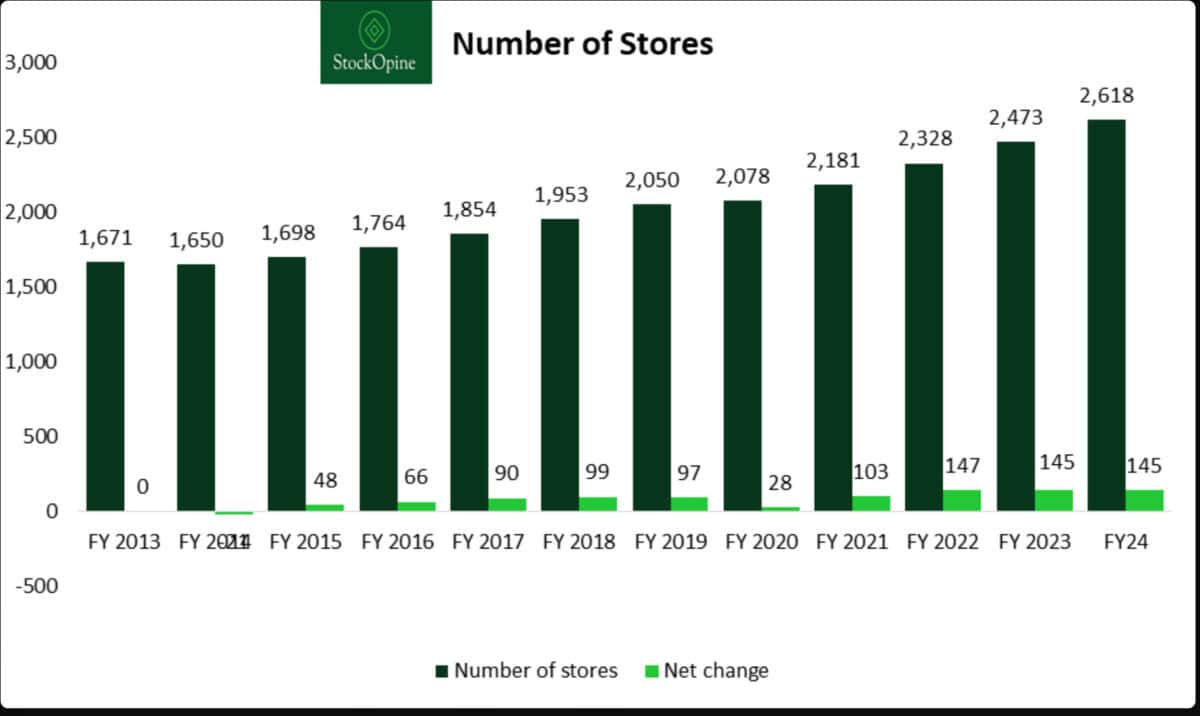
Greggs’ 10-year rally was fueled by strategic expansion and product diversification. The bakery chain added nearly 1,000 stores to over 2,500 locations, capitalising on demand for affordable, on-the-go food.

Innovations like vegan sausage rolls, extended evening hours, and partnerships with delivery platforms broadened its appeal beyond traditional lunchtime trade.

By 2024, Greggs achieved £2bn in annual sales, supported by operational efficiencies such as its new national distribution centre in Kettering.

Source: stockopine

Financial metrics underscore this growth. Annualised revenue increased by nearly 150% over the decade, while net profit margins improved over the period excluding a pandemic-era dip. Return on equity surged to 28.2%, reflecting stronger capital allocation.

Cracks in the pastry

However, momentum’s stalled recently. Shares have fallen 32% since August 2024 after the company warned of slowing sales growth, settling at a five-year return of -13%. CEO Roisin Currie attributed this to subdued consumer confidence, with Q4 2024 like-for-like sales growth decelerating to 2.5%.

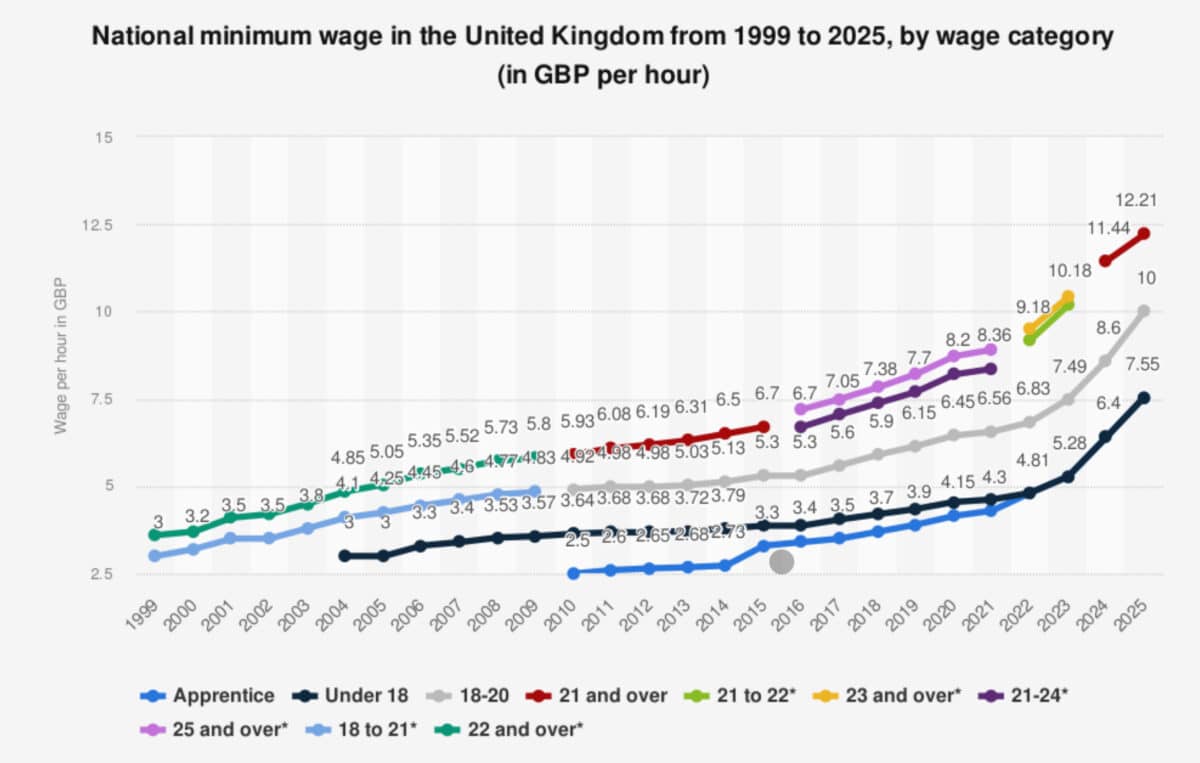
Rising costs — particularly the National Living Wage increase to £12.50 per hour — are like to add pressure to margins, despite Greggs’ efforts to maintain “value leadership” through price stability. Coupled with rising National Insurance contributions and high energy costs, management has its work cut out to maintain the level of growth that investors expect.

Source: UK Govt. Pace of National Minimum Wage Growth

Moreover, while the company excelled during austerity and pandemic-era trading down, it now faces saturation risks in its UK-focused model and intensifying competition from supermarkets’ meal deals. What’s more, in the long run consumers should be trading up to healthier alternatives.

Institutional analysts remain divided: 10 rate the stock a Buy, citing its resilient brand and expansion potential, while two recommend selling due to valuation concerns.

Personally, I’m in the second camp. At 15.9 times forward earnings, the stock trades at a premium to the FTSE 250 average. With medium-term earnings growth projected at 7%, the price-to-earnings-to-growth (PEG) ratio stands around 2.2 — that’s well above the threshold of ‘1’ typically associated with undervalued stocks. Dividend-adjusted metrics suggest shares could be overvalued by up to 55%.

The bottom line

Greggs’ decade-long returns demonstrate the power of consistent execution in defensive sectors. Yet the stock’s current valuation appears to bake in overly optimistic assumptions about growth reaccelerating.

Is it one to consider? Maybe, but I believe the stock’s overvalued and I don’t have much faith for this part of the market. I believe investors might find better exposure to British consumer discretionary stocks elsewhere.

With a 9.5% yield, could this FTSE 250 share be a dividend gold mine?

The country’s biggest dividend payers, by dint of their size, are FTSE 100 firms. But that does not mean that FTSE 250 firms do not spend a fair bit of cash on paying dividends to shareholders.

Some FTSE 250 shares have attractive dividend yields. For example, one that has a well-known and well-established business currently yields 9.5%.

Investing £1,000 today and compounding it at 9.5% annually for a decade, it would already have grown to £2,478.

That sort of (potential) dividend gold mine is tempting for me – but is this the right share for me to buy to try and achieve it?

Large, proven business

The FTSE 250 company is financial service firm abrdn (LSE: ABDN).

Its brand may have a daft spelling, but it is well-established and well known. The firm also owns digital platform ii (abrdn does not like mixing vowels and consonants, it seems). So this is a big business with a large customer base and deep financial markets experience.

How big?

It ended last year with over half a trillion pounds of assets under management and administration.

That was higher than the level at the end of September. I see that as encouraging, as investors pulling more money out than they put in has sometimes been a challenge for abrdn in recent years. I think it continues to be a risk.

Still, while its commercial performance has long been inconsistent, abrdn is what I would regard as a proven business. It made a profit of £171m in the first half of last year.

Dividend is tempting, but will it last?

But abrdn faces a range of challenges, from strong competition to the potential that its cost-cutting programme will sap staff morale.

The dividend is attractive. But it has been held steady since 2020, when it was cut by a third. Past performance is not necessarily a guide to what will happen in future. In any case, even if the dividend remains at the same level, the current yield would be attractive to me.

My concern is the risk for another cut at some point. The firm made just £12m in its most recent full-year results. That follows a loss of over half a billion pound the prior year.

To sustain its dividend, abrdn needs to throw off enough spare cash to pay for it. Its earnings performance over the past several years does not fill me with confidence it will do that with enough regularity for me to sleep comfortably as an investor.

Clearly, the company is trying to reshape itself.

It has been cutting costs, while using its digital platforms to try and appeal to a wider range of potential clients than its traditional customer base. That strategy could work, in which case profits may grow.

But the business has long been an unpredictable performer. Some of the reasons for that lie outside its control. For example, a weak economy could lead to investors putting less money into the markets, hurting investment managers’ profits.

The risks here do not sit comfortably with me, so for now I will not be buying abrdn shares.

Financial News

Daily News on Investing, Personal Finance, Markets, and more!

Financial News

Policy(Required)