How much money would investors need to target a £10,000 monthly passive income?

Different analysts will have their own opinions, but I’d suggest that £2.4m is just enough money to generate £10,000 a month. or £120,000 a year.

That’s based on having £2.4m invested in stocks, debt, bonds or active savings that collectively pay an average of 5% annually. What’s more, when this money is invested within a Stocks and Shares ISA, that income would be entirely tax free. That’s the equivalent of earnings £205,000 annually in a salaried job, given the current tax bands.

Please note that tax treatment depends on the individual circumstances of each client and may be subject to change in future. The content in this article is provided for information purposes only. It is not intended to be, neither does it constitute, any form of tax advice. Readers are responsible for carrying out their own due diligence and for obtaining professional advice before making any investment decisions.

Wait! It may be easier than you think

Now, I’m sure many Britons will have zoned out when they saw the figure £2.4m. However, it’s much more achievable than many people think. The answer lies in the economics of a pension, which admittedly many people won’t be familiar with as they don’t actively manage it throughout their working career.

Nonetheless, there’s a critical component and it’s called ‘compounding’. When we invest over a long period of time, our gains compound as each year builds on the next. It may not sound like a winning strategy, but it really is.

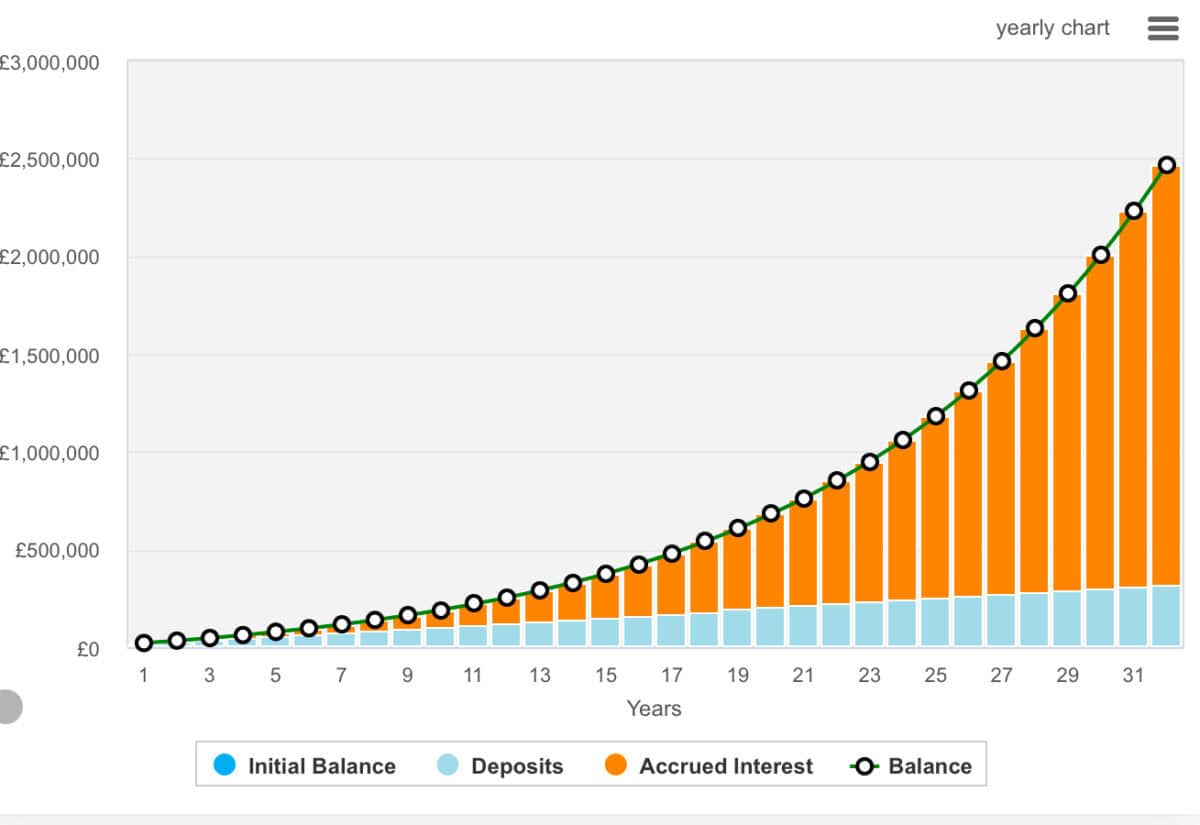
Here’s just one example of how an investor might be able to build a £2.4m portfolio:

  • Initial investment of £10,000
  • Monthly contributions of £800
  • 32 years of consistent contributions and reinvestment
  • An average annualised return of 10%
Created at thecalculatorsite.com

Investing well is key

The above formula is great. However, it doesn’t tell us how to invest. And if we invest poorly, we can lose money. Sadly, this is what happens to lots of novice investors looking to replicate get-rich-quick stories.

Many financial planners or analysts will start by recommending index funds — these attempt to track the performance of an index like the FTSE 100. This is a great approach to achieve diversification quickly.

However, the more adventurous may want to consider investing in individual stocks, more focused funds, or trusts. The Monks Investment Trust (LSE:MNKS) is one with interesting prospects, aiming for long-term capital growth — instead of income. This is because the fund’s managers are attracted to “businesses addressing a particular ‘crisis’ in a novel manner which can help to reduce costs and/or produce a radically improved quality of service”.

Over the past 10 years, the shares have seen 246% growth, driven by investments in companies such as Meta, Amazon, Microsoft, TSMC, and Nvidia, which also represent the five largest holdings.

However, it’s very diversified with the largest holdings all representing less than 5%. The trust’s portfolio consists of about 100 holdings across various growth profiles. As of February, it has total assets of £3,056m and a low ongoing charge of 0.44%. The trust’s dividend yield is just 0.16%. 

Risks? Well, its top holdings are big tech names and some of those valuations are getting a little frothy, and some analysts will suggest that a downturn’s coming. However, over the long run, these big tech names look set to dominate.

Another risk of investing in Monks is the use of gearing (borrowing to invest). The trust can borrow money to make further investments, which can amplify both gains and losses.

In short, it’s an investment I like a lot, and it’s one I’ve added to my daughter’s Self-Invested Personal Pension (SIPP) so I feel it’s worth considering.


With 7%+ dividend yields, are these among the FTSE 250’s best passive income stocks?

As interest rates look set to fall further in the coming year, trying to earn passive income from cash savings seems less attractive. Stocks and Shares ISAs are looking ever better to me. And quite a few FTSE 250 stocks are catching my attention for their attractive dividends.

Assura (LSE:AGR) is one, with a 7.9% forecast dividend yield. It’s a real estate investment trust (REIT) with a portfolio of leased-out heathcare properties.

Please note that tax treatment depends on the individual circumstances of each client and may be subject to change in future. The content in this article is provided for information purposes only. It is not intended to be, neither does it constitute, any form of tax advice.

Price fall halted?

The Assura share price slide of the past five years is painful. But on Monday (17 February), the stock gained 9% in a single day on news of a takeover approach.

US private equity firm Kohlberg Kravis Roberts made overtures regarding a possible cash offer at 48p per share. That’s 23% above the closing price on 14 February.

The board says the offer would “materially undervalue” the company and has rejected it.

Long-term value

Buying a dividend-paying stock only to have it bought out underneath us for cash means we’d be looking for something else to buy pretty quick. But at least we might have more cash to invest if we make a quick profit.

I wouldn’t consider it for that though, as these things have a habit of disappointing. If no deal comes off, I’d expect the share price to fall back. And we could be back to worrying about that long-term price fall again. Any kind of commercial real estate surely still faces uncertainties too.

But this tells me I’m not the only one who thinks a lot of our FTSE 250 REITs like Assura are worth considering now. At least one big US investor appears to agree.

Time for change

Zigup (LSE: ZIG) might not be a name that gets investors’ heads nodding in recognition. But it’s really just the old Redde Northgate which changed its name last year.

The new name for the vehicle rental and fleet management firm is apparently “allied to a refreshed strategic framework under the new pillars of Enable, Deliver and Grow“. I don’t really know what that means. But I do like Zigup’s 8.3% forecast dividend yield.

I’m less impressed by the 16% fall in underlying first-half earnings per share (EPS) the company posted in December. But it did say at the time that its “outlook is unchanged and remains in line with market expectations“.

Covered dividends

Those expectations include a full-year EPS fall, but a return to earnings growth in 2026. We’d be looking at a price-to-earnings ratio of eight for the 2025 year, dropping to seven on 2027 forecasts. And there’s a solid Buy consensus.

Analysts expect further dividend rises, well covered by earnings. The dividend has been growing over the long term, with just a few minor dips. Together, they make me think Zigup has to be worth considering for those wanting to build up a passive income pot.

We’re still in a tough market here with plenty of competition. And a shaky economy could put pressure on business rentals. But I think the signs look good.

1 penny stock down nearly 50% in my Stocks and Shares ISA!

Creo Medical (LSE: CREO) has been a big disappointment in my Stocks and Shares ISA. Since I first invested in early 2023 (then again last year, at a higher price), the penny stock is down almost 50%. It’s now just under 16p.

On 17 February, shareholders got a trading update from the £65m medical device firm. Was it any good? Let’s take a look.

Mixed update

AIM-listed Creo Medical makes minimally invasive electrosurgical devices. Its flagship Speedboat product can do multiple things — cut, coagulate, dissect, and inject — in a single instrument, eliminating the need for multiple tools.

The company is transitioning from the development phase to full commercialisation, and its devices are being used in a growing number of hospitals. In the full-year trading update, though, we saw mixed results.

Revenue for 2024 is expected to be roughly £30.4m, down slightly from 2023’s £30.8m. Within this, Creo Core Technology revenue grew 74% to £4m, with the second half achieving a 50% growth in sales. This covers sales from all core products, including its latest Speedboat UltraSlim device. Management said there had been “significant new customer additions during the period“.

Elsewhere, its innovative MicroBlate Flex device is making progress in robotic-guided lung cancer procedures. It’s now in use with Intuitive Surgical’s Ion robot system at two UK hospitals. More sites are to launch soon, with the expectation that these will becoming revenue-generating after initial cases. Unfortunately though, no revenue was recorded here during the period.

Regarding 2025, the company said it had made a “positive” start to the year, with trading in line with expectations.

Decent cash position

Earlier this month, Creo completed the sale of 51% of its Creo Europe consumables business to Micro-Tech, a Chinese firm. Creo Europe markets both its own and third-party consumables and systems.

Following this, the group’s cash position was £31.2m. It said this strategic sale “strengthens Creo’s commercial platform and enables Creo to continue to fund the ongoing strategic development of its core technology business“.

Meanwhile, the company says it has reduced operating costs by £5m, with the full benefit to be seen this year. We won’t know exactly how much the firm has been losing till the full earnings results in April.

According to analysts at Edison, cash-flow breakeven is now likely to be achieved in 2028 versus 2025 previously. Therefore, Creo is expected to be loss-making for some time, which obviously adds risk.

My thoughts

The deal with Intuitive still looks promising to me, with sites now performing combined lung diagnosis and procedures with the robotic system and Creo’s MicroBlate Flex device. This could eventually be a high-margin revenue stream.

The company also has dry powder to invest in its core business, and I expect a significant ramp-up in revenue from just £4m. If that doesn’t happen, the stock could fall even further.

I’m optimistic it can recover, however, if I’m patient. Indeed, broker Cavendish has reiterated its 70p share price target — over 330% higher than the current level (no guarantees it will end up there, of course). It said it now expects Creo to reach “profitability utilising its internal resources“.

At 15p, Creo might be worth a look for risk-tolerant investors. As for me, I’m going to keep the shares I already hold, but I won’t buy any more.

Here’s what Stocks and Shares ISA investors are buying in 2025 to build a second income

Investors in January 2025 were buying into the kind of investments that can build up to a healthy long-term second income. But what they’ve actually been stashing in their ISAs might come as a bit of a surprise.

I do hope they’re all ploughing whatever dividend income they earn back into more shares. Failing to do that can really undermine the possible benefits of a Stocks and Shares ISA. Over decades, the portion of the final value of an ISA from reinvested dividends can eclipse the value of the cash we initially put down.

I’ll use Taylor Wimpey (LSE: TW.) as an example to show what I mean. It was one of the most-bought stocks at Hargreaves Lansdown in January, despite US growth stocks like Nvidia and Tesla being big on investors’ buy lists.

Compound it

Taylor Wimpey is on a forecast dividend yield of 8.4%. That’s high by FTSE 100 standards. And it’s largely due to Taylor Wimpey shares falling 50% in the past five years. The same dividend money means a bigger percentage yield.

In the coming years, I’d hope to see the Taylor Wimpey share price regain some ground. And over the long term, I’d also expect the dividend to grow in money terms. On balance, I’d expect the two to even out to a dividend yield closer to the FTSE 100 long-term average of around 4%.

But there are no guarantees with dividends. And I still see possible rough times times ahead for house builders before things really get better.

For illustration, £10,000 invested in Taylor Wimpey shares with an annual 8.4% dividend could generate total cash of £16,800 over 20 years. But buying new shares with the money each year would mean next year there would also be 8.4% of this year’s 8.4%, and so on. After 20 years it could compound up to a profit of more than £40,100, well over twice as much.

Growth works too

While dividend shares might seem obvious for building up a bigger and bigger second income, they’re not necessary. If we don’t want to draw down the income yet, buying growth shares can make good sense.

In January, those HL customers were also buying Broadcom, Alphabet, and others related to artificial intelligence (AI). They also liked GSK, with a 4.5% forecast dividend, so there’s still a fair balance.

Investment trusts are high in popularity. At Barclays, Scottish Mortgage Investment Trust has been February’s most popular. So tech stocks do seem to be the flavour of the year so far. But City of London Investment Trust is also in the top 10 with a 4.8% dividend, having raised it for 58 years in a row.

Total returns

Achieving the biggest possible second income from shares comes down to one key thing. Total returns matter, whether from dividends or growth. As we get closer to needing the cash, we can start to sell our growth stocks and move into dividends.

That’s what a lot of the UK’s Stocks and Shares ISA millionaires do. And it can help reduce the risk a bit too.

Oh dear! Warren Buffett says people should only invest in companies they understand

When I was looking at the Barclays (LSE:BARC) results last week, I was reminded of the words of Warren Buffett, who once said: “Never invest in a business you cannot understand.”

As a shareholder in the bank, I was taking an interest in its 2024 results, which were released on 12 February. In particular, I was reviewing the company’s extensive 536-page annual report.

What’s inside?

It’s an impressive document. It contains 226,195 words – yes, I checked! Based on an average reading speed of 238 words per minute, it’d take me nearly 16 hours to read it all. But this leaves no time for breaks. And it’d take me far longer to understand it all.

I’m an accountant so it’s the numbers that interest me most. However, the financial statements don’t start until page 423. Before that, it’s necessary to wade through all sorts of other information, including a business review, climate and sustainability report, and a section on corporate governance.

Risk is clearly a big issue for the bank. The word – and its derivatives – appears 3,846 times. Indeed, the risk review runs to an astonishing 134 pages. Reading the potential challenges, I’m surprised the bank’s directors want to get out of bed in the morning.

And then there’s the bit on the climate. Don’t get me wrong, we all need to play our part in saving the planet. But over the course of 78 pages, Barclays goes into a huge amount of detail. Do I really need to know that £42bn has been lent to properties with an Energy Performance Certificate rating of D?

Stepping back

Warren Buffett claims that investors don’t have to be particularly bright to make money. He reckons an IQ of 130 will do. Unfortunately, mine isn’t high enough to cope with this information overload.

But there’s a danger of over-complicating things.

I’ll admit I don’t understand “franchise-viability risk” or Basel 3.1 standards. 

But I do know Barclays makes its money by incentivising customers to deposit their savings, and then lends this cash to others at a much higher interest rate. Simple. I don’t need to read all 536 pages of the bank’s annual report to understand this.

And impressively, despite interest rates starting to fall, it managed to increase its net interest margin, in 2024, to 3.29% (2023: 3.13%).

I know the earnings of banks can be volatile. And there are no guarantees that Barclays will meet its targets.

But I own the bank’s shares because, when I first invested, I thought they offered good value. Also, its growth prospects looked promising. Today, my view hasn’t changed. Based on its 2024 earnings per share of 36p, the stock trades on a historical price-to-earnings ratio of 8.3. This is below the FTSE 100 average.

Encouragingly, its 2024 results beat expectations and the bank plans to increase its return on tangible equity significantly over the next couple of years.

For these reasons, I think it’s a stock that investors could consider.

But I reckon the time’s come for a re-think. The oldest annual report I can find for the bank is from 1990 — it runs to just 68 pages. If the Chancellor is serious about getting the UK economy growing again, maybe she should let companies focus on growing their earnings, rather than their annual reports?

How much would an investor need in an ISA to earn a £700 monthly passive income?

Generating passive income doesn’t have to be complicated. It can be as simple as investing in UK company shares in a Stocks and Shares ISA, then sitting back as the tax-free dividends accumulate over time. 

To give an example, let’s assume an investor wants to aim for an average of £700 each month in passive income. How would they get there? Let’s take a look.

Please note that tax treatment depends on the individual circumstances of each client and may be subject to change in future. The content in this article is provided for information purposes only. It is not intended to be, neither does it constitute, any form of tax advice. Readers are responsible for carrying out their own due diligence and for obtaining professional advice before making any investment decisions.

The yield

When an investor puts money into a company for dividends, they will obviously want to know the expected income return. That can be worked out by looking at the stock’s dividend yield.

Take blue-chip bank HSBC (LSE: HSBA), for instance. It currently sports a 6% yield, which means investors would be looking to receive £60 in annual dividends from every £1,000 they invest.

However, dividends are paid at the discretion of the company, meaning the sum could end up lower or higher. In an extreme case (such as another pandemic or financial meltdown), there might be no shareholder distribution at all.

£700 a month

Let’s stick with that 6% figure and use it for the example here. An ISA portfolio yielding 6% would need to be worth £140,000 to throw off £8,400 a year (the equivalent of £700 a month).

Unfortunately, that’s not the sort of cash most people have down the back of the sofa. Moreover, it far exceeds the annual contribution limit of £20,000 for a Stocks and Shares ISA.

Therefore, an investor would need to build up to that amount over time. How long that takes, of course, would be down to how much they invested and the rate of return.

If they invested £550 a month, it would take them just under 14 years to reach £140,000. This assumes a 6% return and the initial reinvesting of dividends to build up the portfolio’s value.

For someone able to max out the full annual ISA limit (£1,666 a month), it would take less than six years.

Banking goliath

Returning to HSBC, I think it’s a FTSE 100 dividend share worth considering. Even after a strong recent performance that has put the share price close to its highest level since the turn of the Millennium.

Last year, the bank reported that pre-tax profit rose 6.6% to $32.3bn, ahead of analysts’ expectations for $31.7bn. It also announced a new $2bn share buyback, which it plans to complete by April.

In recent years, HSBC’s been retreating from mature Western markets to focus more on a growing Asia. While I think that strategy will pay off long term, it does present risks, especially as China’s economy can be unpredictable. This can translate into volatility in both earnings and the share price.

In terms of income though, I think this is a solid stock. The proposed payout’s covered almost twice over by forecast earnings, which provides a nice margin of safety. As a shareholder myself, I’m also hoping for further share price gains in future.

Again though, no dividend is assured. So it’s important to build a diversified portfolio of quality dividend stocks to target passive income.

Now that’s a surprise! The Lloyds share price went up despite disappointing results

Well, I wasn’t expecting that. The Lloyds Banking Group (LSE:LLOY) share price closed 4.9% higher 20 February, after the bank released its 2024 results.

At one point, its stock was up 7.6%, having set a new 52-week high of 67.6p.

And yet the bank failed to meet analysts’ expectations on a number of key measures. In these circumstances, I’d normally expect the group’s value to go down. Instead, investors collectively decided that its market-cap should be over £1.15bn higher.

Lower-than-expected profits

For example, the consensus of analysts was for post-tax earnings of £4.64bn. The bank missed this by £161m (3.5%). Also, at 12.3%, its return on capital employed was 0.3 percentage points lower than forecast.

However, my biggest surprise is that investors appeared to ignore the increase in the amount set aside to cover fines and compensation arising from the Financial Conduct Authority’s (FCA) investigation into the alleged misselling of car finance.

Previously, the bank had estimated that it might have to pay £450m. This has now been increased by a further £700m, to £1.5bn. However, it’s still lower than the £4.2bn (or 6.9p a share) that one analyst reckons it’ll cost.

As events have unfolded, we’ve seen how sensitive the bank’s share price has been to various court judgements, FCA announcements and media reports. With disappointing profits and an increase in the motor finance provision, I was expecting a significant correction in the share price, especially since it’s performed so strongly in recent months.

Egg on my face

But I was wrong. However, on closer inspection, it’s easy to see why investors reacted so positively. Despite the base rate being cut, it managed to record a net interest margin of 2.95%, which was in line with ‘expert’ predictions.

Also, the bank’s increased its dividend. The payout for 2024 will now be 3.17p. This beat market expectations by 2.6%. Even with the post-results jump in the share price, the stock’s yielding 4.8%. Also, it’s announced another £1.7bn of buybacks.

However, I believe future dividends and share buybacks could come under threat if the motor finance provision has to be increased further. When there’s a need to preserve cash, these are easy targets.

But I think the Lloyds share price isn’t the bargain it once was. It has a price-to-book (PTB) ratio of 0.88. On paper, this suggests the stock’s cheap. However, according to McKinsey & Company, the average PTB ratio of 1,500 listed banks is 0.9, the lowest of all sectors.

And its shares now trade on a multiple of 10.5 times its 2024 earnings. With all of the FTSE 100’s banks now reporting their 2024 results, it’s possible to compile a league table of price-to-earnings (P/E) ratios, and Lloyds is at the bottom.

Bank P/E ratio
NatWest Group 8.37
Barclays 8.44
Standard Chartered 8.97
HSBC 9.00
Lloyds Banking Group 10.53
Source: company annual reports 2024

I believe this reflects the recent share price rally rather than investors rating the bank more highly than the others. Lloyds is almost totally reliant on the domestic economy, and with the UK struggling to grow, I fear the bank’s future earnings may disappoint investors. Also, I’ve no idea what the final bill might be once the FCA completes its investigation.

For these reasons, I’m not going to invest.

Could this FTSE 250 trust outperform Rolls-Royce over the next 5 years? I think so — and then some!

Rolls-Royce has been one of the best UK investments over the past five years but I think the stock’s future is questionable. Risk-averse investors with a long-term vision may prefer a reliable FTSE 250 investment trust with stable growth potential.

There’s no denying Rolls’ shares have been on an absolute tear. They’re up almost 500% in the past two years, far outperforming any other stock on the FTSE 100. But growth like that is seldom rational or sustainable.

As it continues to skyrocket, the chance of a correction becomes more and more likely.

Upcoming results

Next Thursday (27 February), Rolls will announce its full-year results for 2024. It’s expected to achieve underlying operation profit ranging £2.1bn-£2.3bn, with free cash flow of £2.1bn-£2.2bn. It also plans to reinstate dividends, starting with a payout ratio of 30% of profit after tax.

All that is great and if it comes to pass, the stock could climb even further.

The risk is that if it fails to meet those expectations, investors could be spooked and the stock could take a dive. With limited new buyers left to prop up the price, the losses could be significant. That’s maybe why analysts are increasingly bearish, with an average 12-month price target of 632p — 1.4% down from today’s price. 

A more reliable, low-risk option?

Don’t get me wrong, Rolls is a great company that’s in a great position to keep performing well. But historically, its price has been volatile and is currently in a precarious position.

When thinking long-term, I find consistent and sustainable growth more attractive. For that, investors may want to consider JPMorgan American Investment Trust (LSE: JAM), a US-focused trust that’s delivered consistent returns for decades.

Since 2005, the share price has grown at an annualised rate of 12% a year. At the same time, Rolls has grown at an annualised rate of 10% a year. And since the JPMorgan trust is highly diversified and less prone to volatility, I’m more confident it could maintain that growth.

Stability through diversity

The fund’s top holdings are unsurprisingly dominated by US tech stocks. In fact, 25% of the fund is made up of just five stocks: Amazon, Microsoft, Meta, Nvidia and Apple.

Further down are some finance stocks like Capital One, Berkshire and Loews. All told, the portfolio’s made up of 283 holdings from around the world, spanning 11 different sectors. The level of diversification helps to ensure stable growth with low volatility.

Over the past three, five and 10 years, the fund’s annualised share price growth has consistently outperformed its net asset value (NAV).

Risks to consider

When looking at any stock, it’s important to consider the risks. While this trust has generally favourable reviews, that alone doesn’t mean it’s a good buy. When it comes to investment trusts, the risks tend to be related to how the portfolio’s balanced and managed.

Since JPMorgan American’s heavily weighted towards US stocks, an economic downturn in the States would affect it. In the same vein, any currency fluctuations between the US and the UK could have an impact on returns.

Despite these risks, I would be surprised if it underperformed Rolls-Royce over the next five years.

Here’s why the Standard Chartered share price jumped 5% on FY results

The Standard Chartered (LSE: STAN) share price spiked up 5% in early trading Friday morning (21 February), as 2024 full-year results beat expectations. It was already up 90% over the past 12 months in the long-awaited FTSE 100 bank sector recovery.

Standard Chartered mainly offers offers international corporate banking, wealth management and financial services. And that helped isolate it from the UK’s retail banking pressures of the past few years. It shows.

Capital returns

The year brought net interest income of $10.4bn, ahead of the bank’s $10.25bn target. That helped boost underlying operating income for the year by 13%, leading to a 20% boost to underlying profit before tax (up 18% on statutory reporting). It’s been a year of rising profits at a time when the UK’s retail banks are reporting falls.

Standard Chartered’s return on tangible equity (RoTE) is a bit behind some high street names, at 11.7%. That’s a key measure for valuing bank shares, though it’s expected to be “approaching 13% in 2026 and to progress thereafter.” Liquidity looks strong with a CET1 ratio expected to remain “dynamically within the full 13-14% target range” in the coming years.

If that makes it sound like there’s cash to hand out, there is. The bank lifted its full-year dividend by 37% to 37 cents per share (29.2p at current rates). That’s a 2.6% yield on the previous close, and ahead of analysts’ expectations.

And not missing out on the trend for banks to repurchase their own shares, the board has launched at $1.5bn share buyback. It’s part of a “plan to return at least $8bn to shareholders cumulative 2024 to 2026,” along with continuing dividend increases.

Global focus

Standard Chartered’s focus on Asia, Africa and the Middle East is paying off, as its wealth management business is booming. CEO Bill Winters told us: “Growth in our footprint markets across Asia, Africa and the Middle East, is set to outpace global growth.” With the outlook for Western economies still looking cloudy, that bodes well for the bank’s aims in the next few years.

It does, however, bring emerging-markets risk. It exposes investors to political uncertainty and potential for major economic challenges. I know the West isn’t exactly painting a picture of stability on those scores right now. But over the long term, developing world risk has been greater. Stocks dependent on emerging markets, including a fair few investment trusts, have had volatile histories.

Temptation

Saying that, I’ve always liked the potential from this kind of investment. We have to balance the risk with the reward.

The relatively low dividend yield does count against it for me. That 2.6% doesn’t come close to the 4.9% at NatWest Group or 4.6% from Lloyds Banking Group. But the range of bank yields is narrowing.

I already have enough exposure to banks and financial sector stocks. Otherwise I could easily be tempted to buy even after the price rise. I think investors who want to balance domestic with global finance risks could do well to consider Standard Chartered.

3 little-known UK shares for investors to consider buying

In the stock market, the best opportunities are often where other investors aren’t looking. And I think this is definitely true when it comes to UK shares. The FTSE 100 and the FTSE 250 get a lot of attention – and rightly so. But beyond this, there are some quality companies I think investors should have on their radars.

Cohort

One example is Cohort (LSE:CHRT). The company is a collection of six smaller businesses focused on defence technology, specifically communications and sensors. 

With this type of business, demand is highly sensitive to political (in)stability. Obviously, this isn’t under the company’s control and this creates a risk that can’t be ignored.

The firm’s growth strategy however, has been very successful. It looks to acquire businesses that can complement its existing operations and leave current management teams in place.

This is the kind of model that the likes of Diploma and Halma have applied very effectively. And I think investors should keep an eye on Cohort as a business with a lot of potential.

Porvair

I also think filtration equipment manufacturer Porvair (LSE:PRV) is worth paying attention to. Its products help keep aircraft fuel clean and lab samples free from contaminants. 

These industries can be cyclical and this is a risk. With aerospace, for example, investors should pay close attention to the ongoing issues at Boeing and (to a lesser extent) Airbus.

Importantly though, these industries also have high barriers to entry. Both aircraft equipment and laboratory filters need to meet strict quality standards and specifications. 

This means customers have limited (or no) choice when it comes to suppliers and this translates into a lot of pricing power for Porvair. In this regard, it reminds me of Rolls-Royce.

Forterra

Forterra (LSE:FORT) is a straightforward business – it makes bricks. And a combination of efficient manufacturing and UK-based production helps it maintain lower costs than its rivals.

The business is naturally vulnerable to downturns in UK construction output. Furthermore, the debt on its balance sheet has been increasing over the last few years, which creates risk.

On the plus side, the government is aiming to boost housebuilding. And this should mean that demand for bricks is set to pick up before too long.

Lower costs than competitors is a big advantage for any business. It’s the advantage Howden Joinery Group has and I think there’s something similar here.

Off-the-grid

With high-quality shares, it’s often hard to find opportunities in stocks that other investors are looking at. These usually present themselves when the market overreacts to some news.

A bit further off the beaten track, however, there are companies that don’t necessarily get the attention they deserve. And that can mean buying opportunities come around more often. I think Cohort, Porvair, and Forterra are stocks investors should think seriously about buying.

At the very least, they should take a closer look and keep an eye on them going forward.

Financial News

Daily News on Investing, Personal Finance, Markets, and more!

Financial News

Policy(Required)