Down 61%, is the Tullow Oil share price a potential bargain for contrarian investors?

The Tullow Oil (LSE:TLW) share price has fallen to just 14p as I write. That’s down from over £10 in the early part of the 2010s, and around £2 before the pandemic. Buy-and-hold investors over the past 15 years would have seen their investments reduced to almost nothing.

A different business model

Tullow Oil’s business model is distinct due to its focus on frontier hydrocarbon economies, largely in Africa. The company looked to leverage local skills and invest in their development, with hundreds of Ghanaian workers going on rotation to its Chiswick offices to gain more experience. The logic was that using local employees and suppliers was cheaper and gave back to the economy. I actually wrote my PhD on the topic and studied the company’s operations in Uganda.

Tullow had hoped to position itself as a nimble operator with a unique growth strategy tailored to emerging markets. However, things haven’t exactly gone to plan. Operating in frontier economies can be challenging, and taking Uganda as an example, progress toward first oil simply took too long. Uganda is expecting first oil this year, some 20 years after the discovery of commercial quantities of crude oil in the Albertine Graben basin. Tullow has since exited the market.

What’s happening now?

Tullow Oil made progress in 2024. The company returned to profitability with a $55m profit after tax, reversing a $110m loss in 2023. This turnaround was driven by strategic delivery, production optimisation, and debt reduction efforts. Revenue slightly declined to $1.54bn from $1.63bn, but adjusted EBITDAX remained stable at $1.15bn. Net debt was reduced to $1.45bn, lowering gearing to 1.3 times EBITDAX, while free cash flow reached $156m.

Operationally, Tullow optimised production at its Jubilee and TEN fields in Ghana, achieving 97% FPSO uptime — the time the FPSO was operational — and bringing five new wells onstream ahead of schedule and under budget. This represented a saving $88m. The company also resolved a $320m tax arbitration in Ghana and extended its revolving credit facility to mid-2025.

Clearly, lots of positives as the firm looks to bring its balance sheet under control and rationalise its operations. Looking ahead, Tullow plans to sell its Gabon assets for $300m and expects 2025 production to average 50,000–55,000 barrels per day.

A slave to global markets

I’m not perfectly sure what Tullow’s breakeven point is in 2025. However, estimates I’ve found online put it around $45 per barrel. Regardless of the exact figure, we can’t ignore the general weakness in oil prices at the moment. President Trump’s trade policies have put downward pressure on oil, and this, if sustained, will likely feed through to earnings later in the year. This is makes me a little concerned when we consider Tullow’s huge net debt position.

Personally, I think there’s too much risk here. Trump has vowed to keep oil prices low throughout his presidency. This could hurt indebted producers like Tullow more than others. That’s why I’m not buying.


Up 4% in a week, is this the end of the slump for Tesla stock?

After hitting its lowest level since the US Presidential election, Tesla (NASDAQ:TSLA) got a much-needed pop higher last week. So far in 2025, the stock is still down 34%, but over a broader one-year period, it’s up 56%. The volatility in the share price might put off some investors, but given the potential for a sharp move higher from here, it’s worth considering whether the worst of the rout is now behind us.

The case for staying away

Some might feel this is a short-term relief rally that will fade in the coming weeks. One reason for this is that the uncertainty that exists with the US tariff situation hasn’t gone away. Almost every day, there seem to be headlines about a change of direction. This is driving the higher and lower swings and movements in Tesla stock. So, although the past few days have brought relief with a 90-day tariff pause and hopes of trade deals, this could quickly revert to fears around trade wars with other nations like China.

Tesla is exposed to the overall tariff uncertainty because China is the largest EV market globally. Higher import levies will make the company less competitive. The other problem is that Tesla relies on importing some car parts from abroad, from countries that could face higher tariffs. This could increase the cost of production, even for cars sold within the US. Again, this could hurt earnings further down the line.

Finally, some investors might be worried about the distraction for CEO Elon Musk given his close ties and roles within the US government. If his focus is diverted from Tesla, it could be bad for the US stock.

The case for buying

On the other hand, this could be considered a great purchase right now. The business has already taken steps to counter potential tariff impacts. For example, it has removed some models for sale from the Chinese website. To try and stimulate demand back in the US, a new cyber truck variant has been released, which is $10k cheaper than the existing base model.

Further, Tesla is pushing rapidly ahead with other projects that reduce its reliance on selling conventional EVs. This includes the increased adoption of robotaxis, along with the development of Optimus, the humanoid robot. These, and other, initiatives should diversify investor risk by offering other sources of revenue in the coming years. It creates a larger target market size, which in turn increases the potential earnings and therefore company valuation.

Making a call

Right now, there’s too much uncertainty regarding tariffs to safely say that Tesla will not be negatively impacted going forward. It may not be the end of the stock’s slump. Therefore, it’s too risky for me to buy. However, some investors who have a high risk tolerance or who are very convinced that tariff concerns will fade away might want to consider it.

2 high-growth tech stocks to consider buying and holding for the next 5-10 years

For those seeking big gains from stocks, the Technology sector’s a good place to look for opportunities. In this sector, there are a lot of companies rolling out innovative new products and experiencing strong growth in the process.

Looking for tech stocks to buy for the long term today? Here are two under-the-radar ideas to consider.

Technology that’s in demand today

First up is Workiva (NYSE: WK). It’s a $3bn market-cap (relatively small) software company that specialises in solutions that simplify financial, compliance, and ESG reporting for businesses.

I think this company has bags of potential. Speak to any financial company today and they’ll tell you their biggest headache is compliance reporting. This is where Workiva comes in. Using its software (which integrates with other platforms and offers artificial intelligence (AI) functionality) employees can navigate datasets and create important reports seamlessly.

It’s worth noting that the company’s having a lot of success today. In the fourth quarter of 2024, revenue was up 20% year on year to $200m. Meanwhile, customers with annual contract value over $500,000 grew 32% year-over-year. “Our platform continues to resonate resulting in broad-based global demand for our solutions,” said president and CEO Julie Iskow.

We enter 2025 confident about our market opportunity and ability to execute on our large and untapped total addressable market.

Workiva President and CEO Julie Iskow

Now recently, this stock’s been hit by two factors. One is concern that deregulation under the Trump administration will result in less demand for its products. Another is concern that a slowdown in the economy will result in less software spending.

These are both valid risks. However, with the stock down 40% in less than three months and now trading on a price-to-sales ratio of five, I think a lot of risk is baked into the share price.

Taking a five-year view, I think Workiva stock will do well. I bought some shares recently, and I’m most likely going to add to my position in the next few weeks.

Software that companies can’t afford to ignore

The second stock in focus is Fortinet (NASDAQ: FTNT). It’s one of the world’s leading cybersecurity companies.

Cybersecurity’s an area of technology that no company can afford to ignore. Ultimately, the risks associated with cybercrime (eg going out of business) are too high. So I see a long growth runway ahead for Fortinet. With the cybersecurity industry forecast to grow by around 13% a year over the next five years, this company could get significantly bigger.

What I like about this cybersecurity stock in particular is that it has a lot of quality. Top-line growth has been strong in recent years, with revenue climbing from $2.2bn to $6bn between 2019 and 2024 (173% growth). Meanwhile, return on capital employed is very high (an average of 26% over those five years). There are not many companies in this industry with that level of profitability.

It’s worth pointing out that cybercrime’s extremely dynamic. So there’s no guarantee that Fortinet will continue to have success. This company has a great long-term track record when it comes to navigating industry changes (look at the long-term share price chart). So I’m optimistic it’ll continue to do well.

Here’s why the B&M share price just jumped 5%

The B&M European Value (LSE: BME) share price is down 39% in the past 12 months. But on Tuesday (15 April), the shares jumped sharply when the market opened, putting on a quick 7%.

The price has faded a bit, but as I write it’s still 5% ahead. It’s due to a trading update for the year ended 29 March.

Revenue growth

The owner of B&M stores in the UK and France, and the UK Heron Foods chain, saw full-year revenue rise by 3.7% to £5.6bn.

Like-for-like revenue fell a little in the two UK operations. That doesn’t surprise me, as cut-price competition has been fierce. Even Tesco expects lower profit this year, seeing a potential for supermarket price wars.

Still, positive like-for-like revenue in France offset that. And the overall revenue growth looks good to me in the current high-inflation economy. Perhaps as a sign of better to come, the fourth quarter showed upticks all round on a year-on-year basis.

New store openings in the UK and France have progressed as expected. I see that as another good sign, going against the battering the retail sector has been enduring.

FY Outlook

B&M expects adjusted EBITDA for the year to come in “above the midpoint of our £605m-£625m guidance range.” That’s a bit down on 2024’s figure of £629m, but not by much. And again I’d rate it as a solid result considering the retail pressure of the past 12 months.

Whether to consider buying BME shares now is the big question. And for me, it all pivots on whether I think there’s sufficient safety room in today’s share valuation to cover the risks.

Generally, I’ll avoid buying shares in a company that competes on price alone. It’s why I don’t invest in airlines. Food and other consumables are a bit more essential than flights though, so I dislike the idea less in the retail business.

The next few years

Forecasts show earnings per share (EPS) dipping about 9% this year. That’s a bit more than the forecast drop in EBITDA. But this latest update makes me think it’s probably not far off the money, if perhaps a tiny bit pessimistic.

The forecasts don’t show EPS getting back above 2024 levels until 2027. And that could mean a couple of years of more uncertainty for the B&M share price.

The company is also on a search for a new CEO, as Alex Russo will retire from the role from 30 April. That’s another unknown. But at least we should expect “an announcement in the coming weeks.

Valuation, valuation

At interim time, the company reported a net debt to adjusted EBITDA ratio of 1.2 times. That’s fine in my books, and I don’t see any liquidity concerns.

We’re looking at a low forward price-to-earnings (P/E) ratio of nine. And it would drop to eight on 2027 forecasts. With a forecast 5% dividend yield on the cards, I think that provides the safety I need and more. In my books, B&M is one to consider at this valuation level.

Making these moves in an ISA now could pay off in 5 years

Over the last month, the stock market’s experienced a major pullback. Due to uncertainty over the impact of tariffs, the FTSE 100 index has fallen about 8% from its highs while America’s S&P 500 has dropped about 12%.

Now, for those with a long-term mindset, this weakness could be a major opportunity. By making a few moves in an ISA now, while shares prices are low, investors could potentially set themselves up for solid gains in the long run.

The opportunity to buy low

It’s never easy to invest during periods of uncertainty. Share price volatility can be uncomfortable and it can feel very risky putting new money into the market.

History shows however, that putting money to work in the markets during periods of weakness can be financially rewarding in the long run. Often, stock prices go on to rise significantly in the following years. For example, during the Global Financial Crisis of 2008/2009, the FTSE 100 index was trading below 4,000 at one point. Five years later, it was near 6,500 – more than 60% higher.

More recently, the S&P 500 was trading near 2,500 in early 2020 during the coronavirus pandemic. Less than five years later, the index was above 6,000 – 140% higher.

Now, there’s no guarantee that stocks will perform well over the next five years, of course. We live in an uncertain world and stock market movements are unpredictable. But if an investor has a long-term horizon, I think allocating some capital to stocks now is smart. Taking a five-year view, I think there’s a decent chance that it will pay off.

The right risk level

It’s worth noting that investments can be tailored to individual risk tolerance. For those looking for a lower-risk option, they may want to consider an investment fund such as the Legal & General Global 100 Index. This provides exposure to 100 well-established businesses.

For those willing to take on a bit more risk however, investors may want to consider a few individual stocks. This is riskier than a fund but it could lead to higher gains in the long run.

A beaten-down stock

One stock I think is worth considering (one I’ve been buying recently) is Shopify (NASDAQ: SHOP). It operates one of the world’s largest online shopping platforms. Back in February, this stock was trading near $130. Today however, it can be snapped up for $83 and I think that’s an attractive entry point.

Over the next five years, the online shopping industry is likely to get much bigger. Forecasts vary, but experts say it could grow by anywhere from 8% to 20% a year between now and 2030.

As a platform company, Shopify’s well placed to benefit from this industry growth. Using its platform, new retailers can set up an online store and start selling their products in next to no time.

Of course, Donald Trump’s tariffs and a potential recession are risks here in the short term. These cloud the near-term outlook for revenue and earnings. Another risk is the valuation. As a growth stock, Shopify has a high price-to-earnings (P/E) ratio.

Taking a five-year view however, I’m optimistic about the company’s prospects. I wouldn’t be surprised if Shopify’s trading at significantly higher levels by 2030.

As tariffs create uncertainty, this legendary FTSE 100 stock is rising

Tariff uncertainty has led to significant market volatility. As a result, a lot of major indexes are in negative territory year to date. Not all stocks have taken a hit though. While the FTSE 100 index is down in 2025, this Footsie stock is up about 14%.

The stock in focus is property search company Rightmove (LSE: RMV). It’s one of the FTSE 100’s smaller companies, with a market-cap of just £5.7bn.

A few weeks ago, I said that this was one of the safest UK dividend stocks to consider buying in the current environment. That call is now looking pretty good – while a lot of Footsie stocks have experienced weakness since then, this stock has hit new 52-week highs.

Immune to tariffs

It’s not hard to see why this stock is outperforming the market right now. For starters, Rightmove is a British digital company that operates in the UK. So Donald Trump’s tariffs shouldn’t really have any direct impact on the business.

Secondly, it’s relatively immune to the property cycle due to the fact that it’s a search company and not a construction business. So if there was a downturn in the UK property market, it would most likely hold up reasonably well (while housebuilders like Taylor Wimpey and Persimmon could take a big hit).

Third, it has a rock-solid balance sheet with minimal debt. So if interest rates remain high, it’s unlikely to be vulnerable (unlike a lot of other FTSE companies). Finally, it pays dividends. The yield‘s not high (around 1.5% at present) but there’s plenty of scope for dividend growth in the years ahead as earnings per share comfortably cover dividends per share.

Worth buying today?

Are Rightmove shares worth considering for a portfolio today? I think so. In my view, the valuation still looks quite reasonable, despite the fact that the shares are near 52-week highs. Currently, the stock’s price-to-earnings (P/E) ratio is around 25, which isn’t high for a profitable online company (Rightmove is one of the most profitable companies in the entire FTSE 100) with a strong brand and a huge market share.

It’s worth noting that last year Australian property search company REA Group tried to buy Rightmove when the UK company’s shares were trading at slightly lower levels. So it clearly saw some value in the company.

Of course, there are risks to consider with this stock. I think the biggest one is competition from other players in the industry. Recently, US company CoStar Group has been making moves to try and capture market share in the UK (it bought OnTheMarket). CoStar’s a much bigger company and has a lot of financial firepower so this risk can’t be ignored.

Overall though, I see plenty of appeal in Rightmove shares at current levels and feel they’re worth considering. I hold the shares and I have no plans to sell them any time soon.

Is this the end of the FTSE 100 market rout? 3 things I’m watching like a hawk

On Monday morning (April 14), stock markets around the world opened higher. The constant selling pressure from early last week seems to have evaporated, even though it’s unclear if the world’s out of the woods yet regarding US tariffs.

When trying to weigh up where the FTSE 100 goes from here, I’m focused on three points.

The US dollar

The index that tracks the US dollar is currently at its lowest level since early 2022, and is still falling. This is very telling, as the value of the currency provides an alternative way for investors to express how confident they feel about the economy at a given point in time. The fact that the dollar’s still weakening isn’t a great sign for other financial markets.

It could indicate that people are worried the situation around US tariffs still isn’t adequately resolved and could have further twists to come. Until the dollar stabilises in value, I’m cautious about investing too much in stock markets.

Gold prices

Gold’s seen as one of the best safe-haven assets to own. Given recent events, it’s no surprise that gold has been rocketing to all-time highs. The precious metal is up 21% already this year!

I’d like to see gold prices fall as a sign that investors feel more confident about the stock market. This would likely show that people are happy to reallocate money away from gold and into riskier assets such as stocks. This should cause stocks to rise and gold to fall. Yet until gold stops rallying, it’s a very telling sign about how people feel.

Growth shares

Typically, growth names are the hardest-hit stocks during a market rout. This is because they’re often the most sensitive to a slowdown in economic activity. The potential hit to future earnings also causes investors to rethink the valuation that the company deserves right now. So when FTSE 100 growth shares start to rally, it’s a good sign that sentiment’s improving for the market overall.

For example, I’m watching Rolls-Royce (LSE:RR). The stock’s still up 70% over the past year but has fallen by 7% in the last month. I think most of the recent fall is based on souring sentiment in general rather than anything too company-specific.

After all, the firm has a diversified global footprint, with significant operations in Europe and Asia to offset exposure to the US. From the data I saw online, only about 8% of widebody aircraft engine deliveries go to the US, so the tariff impact’s limited. It has manufacturing facilities in the US, so it could increase production here for any domestic needs.

The share price has already started to recover in recent days, albeit modestly relative to the recent fall. If this continues over the next week, it would be a good sign to me that we’re over the worst. If that proves to be the case, I’ll consider buying Rolls-Royce shares along with other growth ideas.

The Shell share price is down 16% in April and looks a bargain to me

Oil stocks have been one of the biggest casualties of the tariff-induced sell-off over the past couple of weeks. But with a recent pivot away from renewables, the Shell (LSE: SHEL) share price could be set to push higher in the years ahead.

Oil price slump

This month’s collapse in the price of Brent Crude to four-year lows has clobbered Shell. It also starkly highlights how the company’s fortunes are tied to the price of an asset over which it has no control. This may be so, but is this really a valid reason against making an investment?

If I took this argument to its logical conclusion I’d end up investing in nothing. The point is that no company or industry is in complete control of various macro external forces. A bank can no more prevent a recession than an insurance company can prevent devastating floods or wildfires.

What I’m much keener to understand is what the long-term demand trajectory for oil and gas looking like. Here I’m on much more solid ground.

Scenario planning

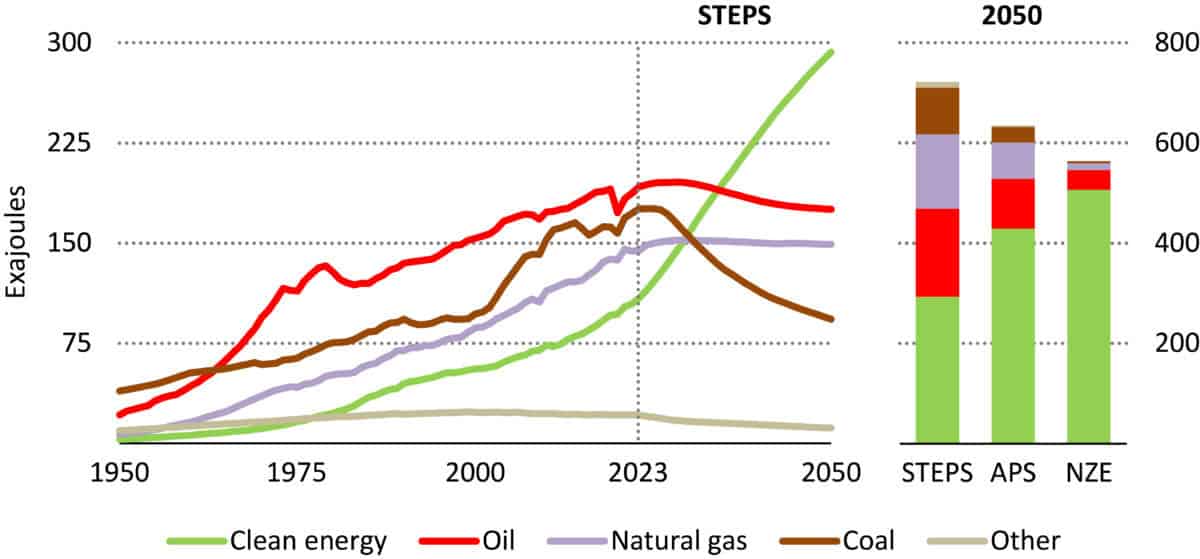
In its World Energy Outlook 2024, the International Energy Agency, updated its energy mix projections out to 2050. For its default Stated Policies (STEPS) scenario, both oil and gas demand peaks in 2030. But unlike oil, which thereafter slowly declines, natural gas demand remains flat.

Source: International Energy Agency

Its Net Zero (NZE) scenario sees huge declines in fossil fuel demand. However, its energy trajectory assumptions seem completely unrealistic to me, particularly based on the present state of technology and adoption rates.

At its Capital Markets Day in March, Shell released its own updated scenarios. Some argue that scenarios are just guesses, but that fundamentally misses their utility. They’re not used as expressions of a strategy or a business plan. But they do help stretch minds, broaden horizons and explore assumptions.

Demand for energy

I believe we can learn a lot about future energy demand from cues happening now. Not since the end of the Cold War have we seen political and societal tensions of this size. Plus countries are grappling with a new era of economic growth from AI, energy security and climate change.

The slow unwinding of globalisation and unfolding trade wars has the potential to re-draw the world’s manufacturing base away from China. Developments in China will likely accelerate higher-income lifestyles there, thereby boosting energy demand. At the same time, as the US builds more manufacturing capability, that can only be a boost for demand too.

Ultimately, I see hydrocarbons remaining an important part of the energy mix for decades to come. But the pace of adoption to net zero is the big unknown and remains Shell’s greatest risk.

We’re already seeing increasing regulatory pressure in the UK, which is preventing any further exploration licences. Should investors turn against the industry en masse the consequences for it could be disastrous.

Like its peer BP, Shell recently slashed its spend on low-carbon technologies. I remain convinced this is the right approach to take. As it prioritises shareholder returns in the coming years, I think its share price at clearance sale levels means investors should consider adding it to their portfolios.

Down 15%! Should I snap up Tesco shares for a second income?

Like million of others, I shop regularly at Tesco (LSE: TSCO). I’m kept loyal by its Clubcard programme and all-round value for money (relatively speaking for the UK). But I’ve never owned any of the supermarket’s dividend-paying shares that might help me generate a second income.

I see the Tesco share price has dropped 15% since mid-February. So, is this my chance to snap up the FTSE 100 dividend stock while it’s in the discount aisle? Let’s take a look.

What’s going on?

Over the past few years, Tesco has done a great job of navigating the challenges of high inflation. Its Finest range combined with the Aldi price-matching initiative has resulted in a strong product mix, luring in a diverse set of customers despite relentless competitive pressures.

Indeed, at the start of this year, the company had increased its market share to a commanding 28.3%. Meanwhile, Aldi and Lidl have continued to take market share, meaning supermarkets other than Tesco have been losing out.

Recently though, one of those (Asda) has vowed to fight back. It has initiated a price-cutting strategy to regain market share, backed by what it says is a “pretty significant war chest“.

The risk here then is that a price war could be brewing across the UK supermarket sector.

Profit pressure

In anticipation of this, Tesco dropped a profit warning on 10 April when it released its preliminary results for the full year ending February. It said adjusted operating profit for the current financial year would be £2.7bn to £3bn, down from £3.3bn last year.

In the last few months, we have seen a further increase in the competitive intensity of the UK market. We are committed to ensuring that customers get the best value in the market by shopping at Tesco and we see further opportunities to protect and strengthen our competitiveness.

Tesco, April 2025.

This isn’t disastrous, of course, and it committed to a £1.45bn share buyback over the next year. This will be funded by £750m in free cash flow and £700m from the sale of its banking operations. Meanwhile, free cash flow is expected to remain within medium-term guidance of £1.4bn to £1.8bn.

Nevertheless, the prospect of a price war between grocers doesn’t get me too excited about investing. Growth could be subdued for a while, even if Asda doesn’t make a dent in Tesco’s market-leading position.

Also, higher National Insurance contributions will cost £235m this year, forcing the group to cut costs to offset this.

Dividend yield

I fear all this might result in a drifting — or even lower — share price. To compensate for this risk then, I want a big juicy dividend yield.

But do I get that here? Well, the full-year dividend was 13.7p per share, which translates into a yield of about 4.1%, based on the current share price.

Unfortunately, that’s not too much higher than the FTSE 100 average of 3.6%.

My decision

I don’t think Tesco’s position is under threat, and I won’t be surprised if its operating profit comes in towards the higher end of the cautious guidance. It has massive scale, a powerful Clubcard scheme and growing Finest range, and a well-oiled delivery service.

However, the yield isn’t high enough to tempt me, given the weak growth outlook.

Hunting for an enticing entry point? 3 US stocks to key an eye on

As financial markets remain turbulent, savvy investors are hunting for opportunities in the chaos. I have quite an extensive watchlist entitled ‘Trump Sell-off’, but today I’m focusing on three US stocks that are trading near their 52-week lows.

The three stocks are Nu Holdings (NYSE:NU), RH (NYSE:RH), and Carnival (LSE:CCL) (yes, Carnival is a UK stock but it has a primary listing in the US). Anyway, they’ve all been heavily impacted by global economic uncertainty and policies under US President Donald Trump. Despite these challenges, they boast strong fundamentals.

However, the market is choppy. A lot depends on the whim of the US administration and I’m yet to buy any shares since ‘Liberation Day’.

A fintech powerhouse with room to run

Nu Holdings is a leading fintech company in Latin America. The stock is flat over the year, but has traded more than 50% higher than it does today. The downturn has been exacerbated by Trump’s trade policies that have strained international markets, particularly emerging economies.

However, Nu Holdings remains a compelling business. The company reported impressive revenue growth of 49% year on year in its latest quarter, reaching $2.99bn. That was well above analyst expectations. Its customer base has surged by 22% to 114.2m, capitalising on demand for banking services especially among underserved populations. 

Despite challenges such as foreign exchange volatility and narrowing net interest margins, Nu Holdings achieved a huge annualised return on equity of 29% and a net income increase of 85% year on year. It’s pricey at 20 times forward earnings, but this is expected to fall to 6 times by 2027.

Luxury furniture, made in Vietnam

RH (formerly Restoration Hardware) is another stock near its 52-week low that deserves attention. Known for its upmarket furniture and home décor offerings, RH has established itself as a global leader in luxury retail. However, the company mostly manufacturers in Vietnam and is exposed to any tariffs there. As such, management experienced a whirlwind of emotions in recent weeks — the CEO was shocked when he saw what was happening to the share price during the 3 April earnings call.

I’m just keeping a close eye on this one. Tariffs could really impact margins. Current forecasts suggest it’s trading at 15 times forward earnings, falling to five times in just three years. These forecasts will need altering if the tariffs on Vietnam are hard to absorb.

Choppy waters

Carnival is one of the world’s largest cruise operators and its stock price drifted near its 52-week low since the tariff announcements and a threat from the administration to make cruise operators pay more tax. A tariff-induced recession and more taxes aren’t good for business.

Nonetheless, it’s important to note the cruise sector has been performing extremely well since the pandemic. Consumers have increasingly focused on experience-based holidays, providing a real boost for cruise companies. This is evidenced by the fact that Carnival has approximately 80% of capacity booked for 2025 already, providing some shelter from Trump’s tariffs.

Moreover, it has implemented cost-saving measures and fleet upgrades to enhance operational efficiency. And at 9.4 times forward earnings, the stock doesn’t look expensive. I’ve owned this one for some time, but I may double down in the current market.

Financial News

Daily News on Investing, Personal Finance, Markets, and more!

Financial News

Policy(Required)