Is this Warren Buffett favourite a share for me to buy in 2025?

Sometimes, we can learn from great investors – but what works for them may not necessarily work for us. Take Warren Buffett for example. Some of the shares he owns I understand as businesses. But others I do not. So I would not invest in them even if they have performed brilliantly for the ‘Sage of Omaha’.

That is because I like to stick to what Buffett calls my ‘circle of competence’. After all, putting money into businesses I do not understand is not investing at all, but simply speculation.

Here’s a simple, proven and compelling business model

Some of Buffett’s investments sit well inside my own circle of competence. For example, take his holding in Coca-Cola (NYSE: KO).

I think the investment case here is strong. The market for soft drinks, including water, is vast and likely to stay that way for the foreseeable future.

Lots of companies compete in that space. So what sets Coca-Cola apart? It has unique competitive advantages, including iconic brands and proprietary formulas. The company enjoys economies of scale, thanks to its large global footprint.

Coca-Cola has also devised an interesting division of labour. Local bottlers (in which it may own a stake) are responsible for much of the sharp-end production, sales and distribution. (London-listed Coca-Cola HBC and Coca-Cola Europacific Partners are examples).

So Coca-Cola itself can focus on brand building and selling syrups to those bottlers. That is a leaner model than trying to do everything and lets it focus on where its biggest strengths lie.

It’s been an incredible investment for Buffett

No wonder Buffett likes the business. Since finishing building his stake in 1994, it has soared in value – and he now gets over half of his original investment back every year in the form of dividends alone.

When it comes to dividends, Coca-Cola also has an excellent track record. The business model throws off a lot of spare cash and that can support strong dividends. Last week, the company announced it would increase its dividend per share for the 63rd year in a row!

Should I buy the shares?

However, although Coca-Cola has been a roaring success for Buffett, he has not bought any shares in the company since the last century.

I do not know why. Maybe he wants to keep his portfolio sufficiently diversified. One risk I see is that changing consumer attitudes to healthy drinking could see long-term demand decline for many types of soft drinks, hurting sales and profits at Coca-Cola.

But what puts me off buying Coca-Cola shares for my portfolio is its share price. Currently, the company trades on a price-to-earnings ratio of 28. That is higher than I would like to pay, even for a brilliant business like this one.

Every investor is different and needs to make their own decision. What works for Buffett may not be the right choice for me.

When it comes to his holding in Coca-Cola, I think me buying the share could make sense – but only at the right price.

Buffett says he likes to buy stakes in great companies at attractive prices. Me too!

But for now, Coca-Cola is on my watchlist and I will not be investing this year, unless the valuation becomes significantly more attractive.


Here’s how an investor could aim for an annual second income of £50k with just £10 a day

There are many ways to skin a cat, as the saying goes, and even more ways to secure a second income. Working nights is less fun than it sounds and starting a side hustle’s a pain in the neck. Trust me. 

One tried and tested way that requires minimal effort is by leveraging the tax benefits of investing in a Stocks and Shares ISA. Yes, there are risks involved but they’re arguably more manageable than the previous two options.

The key ingredient is capital – but even as little as £10 a day’s sufficient to get started. A basic plan an investor may consider is compounding returns to build a portfolio before transitioning to dividends for meaningful passive income.

Please note that tax treatment depends on the individual circumstances of each client and may be subject to change in future. The content in this article is provided for information purposes only. It is not intended to be, neither does it constitute, any form of tax advice. Readers are responsible for carrying out their own due diligence and for obtaining professional advice before making any investment decisions.

Realistic expectations

Consider a portfolio that delivers a consistent yearly return of around 10%. When looking at the recent returns of some major US tech stocks, that might sound low. But remember, this is a long-term strategy —  Nvidia and the like won’t keep pumping out those huge returns forever.

Consistency is key and it’s best to be realistic when estimating income decades ahead. A well-balanced portfolio sacrifices high returns in exchange for reduced risk. Losing everything on one or two stocks isn’t a good look. It is however, a good way to learn the importance of diversification.

With just £10 a day to contribute, an investor may consider the following. With a portfolio that averages 10% returns, £3,650 a year invested in an ISA could balloon to over £650,000 in 30 years. 

It could then be transferred to a dividend-focused portfolio that yields an average of 7% a year — equivalent to almost £50,000 of annual passive income.

Shares to consider

The portfolio would initially require reliable growth stocks to aim for an average 10% return. Think 3i Group, Unilever or Compass Group. These consistent, slow-growth stocks exhibit defensive qualities against market volatility. Index-tracking funds like the iShares Core S&P 500 ETF are also popular choices for similar returns.

When transitioning to a dividend portfolio, consider stocks with yields between 5% and 9%. However, it’s critical to consider the company’s longevity beyond just the yield. Some popular UK dividend-paying companies include Vodafone, Legal & General and British American Tobacco.

One I recently added to my portfolio is well-known insurance firm Aviva (LSE:AV.). It’s maintained a yield of around 7% for the past two years and increased its dividends at a rate of 8.4% for the past decade.

The share price is up 24% in the past five years, outperforming competitors like Legal & General and Phoenix Group. Recent results have also been impressive, with revenue up 10.9% year on year and earnings per share (EPS) up 57%.

In December, Aviva agreed to buy rival insurer Direct Line for £3.7bn, taking out a £1.85bn loan for the purchase. The acquisition could help expand its customer base and market share, but also runs the risk of significant losses if it’s not profitable. Legal fees alone are reportedly in the area of £23m. 

When considering stocks, it’s important to check recent developments and asses any related risks.

However, analysts remain positive about the stock, with 12 out of 14 putting in a Buy rating with an average 12-month growth target of 15.8%.

How much would someone need to invest in Greggs shares to target a £1,000 monthly passive income?

When it comes to earning passive income in the stock market, I think there’s one thing that gives some investors a big advantage over others. It’s having time on their side.

Being able to be patient can increase returns dramatically. And shares in FTSE 250 bakery and food retailer Greggs (LSE:GRG) are a good illustration of this.

Dividend growth

Over the last 12 months, Greggs has distributed 59p in dividends per share. So to earn £12,000 a year – or £1,000 a month – before dividend taxes, an investor would need 20,339 shares.

At today’s prices, that costs £424,271 (leaving aside stamp duty). That’s a lot – and I suspect few of us have that amount knocking around right now.

Greggs however, has grown its (regular) dividend by 161% over the last decade. And if it does this again, 7,643 shares will be enough to generate £1,000 a month by 2035.

The current share price means that costs £159,127. That’s still a lot, but much less than the £424,271 it costs to start earning that amount of passive income straight away. 

Outlook

The big question is whether Greggs will keep growing its distributions at the same rate over the next 10 years. Dividends are never guaranteed, but I think this one’s especially uncertain.

Over the last 10 years, the company’s increased its store count by just over 54%. If it does that again, it’ll be operating around 4,031 outlets. 

The trouble is, even Greggs isn’t anticipating that level of expansion. Its manufacturing base is currently set up for around 3,500 stores, which is quite a bit lower.

If the business stops expanding, it might find itself with more free cash. But while this might boost the dividend in the short-term I don’t see it as conducive to long-term growth.

Other opportunities

I think UK investors looking for passive income should consider opportunities beyond Greggs. Croda International‘s (LSE:CRDA) one that looks attractive to me.

The company makes chemicals that help pesticides stick to plants, make moisturisers smooth, and help drugs get to where they’re needed. And its products are very well-protected.

The risk is that sales volumes can be highly volatile. With agriculture, for example, the price of wheat can have a big influence on demand and Croda has no control over this.

Despite this, the company has a very strong track record of increasing its dividend consistently. And I think it has a competitive position that will allow it to keep doing this over the long term.

Long-term investing

Not all investors are able to take a long-term approach to passive income. But I think those who are have a big advantage. 

With the right businesses, all shareholders have to do is wait as the returns grow. And that can mean they eventually get a lot more in dividends with less invested at the start.

7.6% dividend yield! I’m eyeing up this FTSE 250 stock to aim for big passive income

Take a look at the share price chart for this FTSE 250 stock…

Does that look like an exciting stock to buy today with the aim of generating big piles of passive income?

At first sight, a 42% five-year fall doesn’t inspire confidence, does it? I think the market has this one wrong. And for a while I’ve been thinking it might just be a great long-term income buy.

Oh, I nearly forgot, what is it? It’s Primary Health Properties (LSE: PHP), a real estate investment trust (REIT). The fall surely has to be all about real estate, and that’s not suprising. But it’s the nature of the real estate and the security I think it brings that makes me see this as a potential buy.

Please note that tax treatment depends on the individual circumstances of each client and may be subject to change in future. The content in this article is provided for information purposes only. It is not intended to be, neither does it constitute, any form of tax advice.

Healthy income

Just like fellow FTSE 250 REIT Assura, this trust invests in healthcare properties. They’re in the same kind of business and offer very similar dividend yields. I’m considering both of them as candidates for my next investment.

Primary Health gets “90% of rental income directly or indirectly backed by the government, via the NHS in the UK or HSE in Ireland“, it told us at Q3 time in October. In that update, ahead of full-year results due on 28 February, CEO Mark Davies spoke of “the significant opportunity ahead in primary care and PHP’s continued dedication to dividend growth.”

He added: “We welcome the new Government’s commitment to reforming the NHS and specifically the need for increased investment in primary care which will add further resilience to the business model.

In the first nine months of the year, the company generated £2.7m in extra rental income. That was the equivalent of a 3% annualised rise. And full-year guidance suggests in excess of £3m in extra income over the full year.

Big borrowings

This kind of business relies a lot on funding by debt, which can be scary. At 30 September, net debt stood at £1.32bn, which represented a pro-forma loan-to-value ratio ratio of 48.1%. It’s within the target range, and I’m happy enough with that. There’s still £301m in undrawn loan facilities available.

I particularly like the fact that 95% of debt was fixed or hedged at a weighted average cost of 3.3%, even at a time of high interest rates. Overall liquidity looks good to me. And if that’s how things look in today’s tough lending environment, I’m optimistic about the future when rates should fall further.

Risk/reward balance

I’d say the main risk does come from being so heavily dependent on debt. Also, Primary Health has issued new equity over the years to help fund its expansion. So investors need to keep their eyes open for any possible earnings or dividend dilution.

I expect commercial property weakness to put pressure on the share price for a while yet too. The market, it seems, is judging these stock valuations largely on asset values. But if the price does stay low for a bit longer, I’ll probably buy some.

If I don’t decide that Assura looks even better, that is.

2 popular S&P 500 shares I’m avoiding like the plague in today’s stock market

Just because a share is popular in the stock market doesn’t mean I should buy it. Equally, I wouldn’t rule out an investment just because it’s beloved by many other investors — each case has to be taken individually.

With that in mind, here are two popular stocks that I’m keen to avoid right now.

Growing pains

The first share is Tesla (NASDAQ: TSLA). Of course, the electric vehicle (EV) pioneer has long made mincemeat out of people betting against it — the stock is up 2,350% over 10 years!

However, that was largely in a period when the company was growing like gangbusters. Today, Tesla faces mounting global competition, especially from cheaper Chinese models.

On a weekly basis, I’m seeing a rising number of BYD EVs on the road. And that’s likely to increase, as the Chinese firm is reportedly considering a second factory in the EU (it has nearly finished building one in Hungary).

At the same time, Tesla is losing market share in Sweden, Norway, and elsewhere. It has been suggested that Elon Musk’s outspoken campaign against ‘wokeness’ is putting off some potential Tesla buyers. In theory, this makes sense, as EV buyers tend to prioritise greener and left-leaning causes more than conservative voters.

Last year, the company reported flat revenue, with earnings dropping by double digits. Yet the stock is trading at a bewildering 173 times earnings. That valuation reflects bold optimism that Tesla will soon be generating tens of billions from a global robotaxi fleet. Perhaps it will, but that potentially golden road remains full of regulatory and technological hurdles.

At the current price, I see little point in taking a risk on the stock.

Extreme overvaluation

The second S&P 500 share I currently have no desire to buy is Palantir Technologies (NASDAQ: PLTR). Having said that, I sure wish I’d bought shares of the data-mining specialist two years ago — they’re up a mind-boggling 1,200% in that time!

Palantir’s Artificial Intelligence Platform (AIP) enables organisations and businesses to integrate AI into their operations and automate decision-making. And AIP is fuelling massive growth, with Q4 revenue surging 36% year on year to $828m.

In his letter to shareholders, CEO Alex Carp said: “The business we have built has now developed its own internal momentum and strength, its own interior life and forms of untamed organic growth, with the output that we are seeing far surpassing what we are investing. A software juggernaut has indeed emerged.”

Obviously, the idea of “untamed organic growth” is an exciting one. And its customer count grew 43% in the quarter, indicating years of recurring revenue and upselling opportunities.

Also, the Trump administration’s America-first policy is creating a favourable environment for Palantir, as AIP is well-positioned to secure more federal contracts in the coming years. So there’s much to be bullish about.

However, the stock is trading at an astronomical price-to-sales (P/S) multiple of 96. Even if the firm grows revenue at the forecast compound annual growth rate of 31% over the next three years, the P/S ratio would end up at about 43. That’s still sky-high.

Palantir is a stock I wish I had bought in the past, might own in the future, but won’t be buying right now.

If a 45-year-old puts £700 a month into a Stocks and Shares ISA, here’s what they could have by retirement

Investing within a Stocks and Shares ISA is one of the most effective ways to build wealth in the UK. With a regular savings plan and a sound investment strategy, an investor can potentially build a lot of capital over the long run with these accounts.

Here, I’m going to look at how much money a 45-year-old could potentially build up by retirement if they were to put £700 a month into this type of ISA. Let’s dive in.

Attractive returns

There’s no guaranteed return on offer with the Stocks and Shares ISA. This is due to the fact that it’s an ‘investment vehicle’ and not an investment.

With a proper investment strategy however, it’s not unreasonable to expect a return of 8% a year (after fees) over the long term. And with that kind of return, money can grow quickly due to the power of compounding (earning a return on past returns).

Invest £700 a month starting at age 45 and earn an 8% average annual return on the money, and you’d have around £385,000 by age 65, or £515,000 by age 68. That could be a nice little retirement bonus to sit alongside a work pension or Self-Invested Personal Pension (SIPP).

It’s worth pointing out that all gains generated inside a Stocks and Shares ISA are tax-free. So the investor wouldn’t have to pay a penny of tax on this money – a great result.

Please note that tax treatment depends on the individual circumstances of each client and may be subject to change in future. The content in this article is provided for information purposes only. It is not intended to be, neither does it constitute, any form of tax advice. Readers are responsible for carrying out their own due diligence and for obtaining professional advice before making any investment decisions.

Investing properly

Now, I mentioned an investment strategy above and this is crucial if one wants to achieve attractive returns within a Stocks and Shares ISA. Invest without a plan and/or in the wrong assets, and long-term returns could be well be below 8% year (they could even be negative).

The key to achieve strong long-term returns is to build a diversified investment portfolio that has exposure to many different businesses. By doing this, you can mitigate the risk of any single company’s failure significantly impacting your returns while simultaneously increasing the likelihood of capturing gains from the market.

The good news is that building a diversified portfolio is super easy today. With index funds, you can literally do it in minutes. These funds typically offer exposure to thousands of stocks. So they offer instant portfolio diversification.

A good example of an index fund is the iShares Core MSCI World UCITS ETF (LSE: SWDA). This is a global investment fund that offers exposure to around 1,400 stocks.

With this product, an investor gets exposure to all the big names in the stock market such as Apple, Amazon, and Nvidia. However, they also get exposure to smaller companies such as CrowdStrike, London Stock Exchange Group, and Sage.

I’ll point out that in recent years this ETF has returned far more than 8% a year. Over the 10-year period to the end of January, for example, it returned 174% (in US dollar terms) which is about 10.6% a year.

That said, past performance is no indicator of future returns. And if the world was to experience an economic slowdown, or the Technology sector (which has a large weighting in the ETF) experienced some weakness, this fund could underperform.

I believe it’s a good product to consider though. In my view, this ETF could be an excellent foundational investment for a Stocks and Shares ISA.

£10,000 invested in Rolls-Royce shares at the start of 2025 would already be worth…

After nearly doubling in 2024, Rolls-Royce Holdings’ (LSE: RR.) shares were surely due a less exciting 2025, right? Well, they gained another 8% with still a week of February to go.

So 8% every two months, and by the end of the year that £10,000 could be worth… No, that’s not how it works, even if it might have seemed that way last year. But with a £10k investment on the last day of 2024 now worth £10,800, what might happen by the end of this year?

Growth share dilemma

The Rolls share price is climbing ever closer to £6.50, which seemed unthinkable a couple of years ago. Something scares me about that.

I’ve seen growth shares perform a lot like this in the past, but a good few of them were bubbles waiting to burst. So buy if we think there’s further to go, and sell when it starts to look too high? That’s another thing that doesn’t work the way we might want. Bubbles don’t conveniently wait to burst until after we decide to sell.

Something else contributes to my concerns. I reckon a lot of people buying in the past 12 months have been momentum investors. They buy something because they see it going up, reasoning that they’ll be able to sell later before there’s a crash.

But then, in what might seem like a stopped-clock thing, momentum investors do often get it right. And judging by the amount of insightful analysis I’ve seen covering Rolls-Royce, many investors are surely also in it based on rational, fundamental valuation.

More than just aviation

Broker forecasts can’t tell us anything for sure. But treated with caution they can give us a feel for market sentiment. We’re looking at a forecast price-to-earnings (P/E) ratio of 32 for the year just ended, with results due on 27 February. But that doesn’t reflect the optimism over future earnings, predicted to drop the P/E to 25 by 2026. I don’t see that as too high.

Aero engine demand looks strong, though in November’s trading update CEO Tufan Erginbilgic spoke of “a supply chain environment which remains challenging.”

Last month, Rolls announced a £9bn deal for nuclear submarine reactors, its biggest ever contract with the Ministry of Defence. And the government is making noises about loosening regulations restricting the installation and use of nuclear reactors.

Rolls-Royce’s small modular reactors (SMRs) could get a boost from that, especialy with artificial intelligence (AI) server farm demand rising. A local SMR might be just the job.

Still a growth buy?

Perhaps the main risk I see is the supply side the CEO mentioned. Demand’s rising, but competition for resources is fierce. And if Rolls can’t keep pumping out the deliveries fast enough, I think those growth projections might suffer. And even a slight miss in results could trigger a sell-off.

But I do think growth investors could still do well to consider Rolls-Royce shares at today’s valuation. I’d just try not to attach too much importance to the share price chart.

£100,000 invested in Tesla shares 10 years ago is now worth…

On paper, a £100,000 investment in Tesla (NASDAQ: TSLA) made a decade ago would now be worth approximately £2.4m, reflecting share price growth of 2,340%.

This growth trajectory masks significant turbulence, notably earlier this year as shares plunged 30% from their December peak of $488.54. Nonetheless, this growth’s huge.

However, it gets better. That’s because the pound has depreciated around 20% over the last decade. Essentially, £100,000 back then would have bought be $150,000 of Tesla stock. Today, that $150,000 of stock would be worth $3.5m, or £2.7m.

Should investors cash in?

Tesla’s decade-long ascent transformed early investors into millionaires, fuelled by its electric vehicle (EV) market dominance and cult-like shareholder loyalty. However, the company and its stock is at something of a crossroads.

So after such a bull run, why would investors consider selling? Well, Tesla’s financial metrics defy automotive sector norms, trading at 147 times trailing earnings – an 860% premium to the industrials sector median.

This premium is also present in forward metrics — those based on analysts’ forecasts — with the forward price-to-earnings-to-growth (PEG) ratio of 8.5 representing a 450% premium to the industrials sector average.

On paper, this looks like an opportunity to sell. The stock’s surged and the valuation metrics certainly aren’t attractive. In fact, the stock’s value appears entirely disconnected with its fundamentals.

Of course, the value proposition lies in Elon Musk’s plans for Tesla. The boss sees the company dominating in self-driving and robotics. In short, it has a lot of cash, and grand plans, but so far it appears to be falling some way behind its peers.

Overreach and unpopularity

What’s more, Musk’s simultaneous roles as Tesla CEO, head of SpaceX, and Trump administration’s Department of Government Efficiency (DOGE) chief have diluted focus, and this appears to be impacting shareholder conviction.

After all, he can’t realistically run all these companies at once. And that’s an issue given Musk has been so central to Tesla’s rise.

Concerningly, this role in the Trump administration doesn’t appear to be bearing any fruit for Tesla shareholders either. In fact, the administration’s cancellation of a $5bn EV charging initiative and new 25% steel/aluminium tariffs have disrupted Tesla’s China-dependent supply chain.

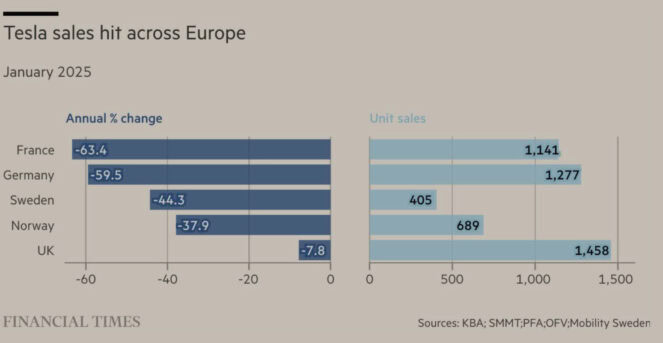
In addition, Morning Consult data shows Musk’s consumer favourability plummeting to 3% in early 2025 from 33% in 2018, eroding the brand’s cultural capital. This is particularly apparent when we look at recent sales data in Europe.

As the Financial Times data below highlights, Tesla sales fell 63.4% in France in January. Musk’s own image may have something to do with this. Sales in Germany also plummeted where he’s shown support for the more radical AFD party.

Of course, none of this will really matter if Tesla delivers a dominant product in self-driving and humanoid robots. However, that’s a big ‘if’ given the lack of publicised progress.

I’d love to be bullish on this Western technology leader, but I simply can’t get behind the valuation and the speculative nature of investing in unproven technology. I won’t consider buying.

2 surging FTSE 250 shares to consider in March!

Looking for the best FTSE 250 shares to buy next month? Here are two momentum heroes to consider that I think could keep on flying.

The miner

Rocketing prices for precious metals have driven Hochschild Mining (LSE:HOC) shares 119% higher over the past year. I think there could be further to go.

Bullion prices are soaring to new highs near $3,000 per ounce, as inflationary risks and geopolitical tensions increase. These threats could linger as tension over US protectionism and defence policy in Europe worsen.

Investing in mining shares like Hochschild is still a risky endeavour despite this encouraging picture. Commodities markets are famously volatile, and a sudden change in market sentiment could instead pull precious metals sharply lower.

The business of metals extraction can also be highly unpredictable. Earnings-sapping problems at the exploration, mine development and production stages can be commonplace.

Just last month, Hochschild warned of higher-than-forecast costs due to inflationary pressures. News of this pulled its share price sharply lower in January, and it’s down around 12% in the year to date.

I’d argue that, on balance, the outlook remains pretty bright for Hochschild and its share price. And I don’t believe this is baked into the current share price of 195.2p.

Today, the gold and silver miner trades on a forward price-to-earnings (P/E) ratio of 6 times. It also deals on a price-to-earnings growth (PEG) ratio of 0.1. Any reading below 1 implies that a share is undervalued.

Hochschild’s shares are recovering following last month’s shock. They’re up 3% in the past month, and I think they could continue rising strongly, helped by the company’s rock-bottom valuation.

The defence contractor

Babcock International (LSE:BAB) shares have experienced no such turbulence at the start of 2025. They’re up 30% in the year to date in fact, meaning the defence share’s up more than a third over the past 12 months.

Could it have further to run? I think so, fuelled by ongoing conflict in Ukraine and signs of wavering from the US for its NATO colleagues. It’s a mix analysts think will boost European arms spending by hundreds of billions of pounds.

Babcock’s strong relationships with NATO members France, Canada, Australia and the UK mean it’s likely to see strong and sustained demand for its services.

Sales here were up 11% year on year in the six months to September. And last month the firm said strong demand had continued during the third quarter and into January, leading it to upgrade profits forecasts for the full year.

Babcock’s valuation has risen sharply in 2025. Yet with a forward P/E ratio of 14.4 times, it still trades at a healthy discount to the broader UK defence sector. BAE Systems‘ shares, for instance, now command a P/E ratio of just below 18 times. On top of this, the firm’s PEG ratio sits at a bargain basement 0.3.

Soaring sector demand leaves Babcock vulnerable to potential supply chain issues. But on balance, I still believe the FTSE 250 firm’s a top stock to consider right now.

£20,000 invested in the S&P 500 at the start of 2020 is now worth this much…

The S&P 500 has been on an absolute tear in recent years. So much so that the US index’s total return has been logging in at 13.1% a year on average, significantly above its historic 11%.

Based solely on share price growth, it means that an investor who put £20k into an S&P 500 tracker fund at the start of 2020 would now have around £38k. Throw in the dividends and the impact of a stronger US dollar, and the investment would have doubled!

Animal spirits on Wall Street

Stepping back, I find this remarkable given what’s happened in this time. We’ve had the pandemic, wars in the Middle East and Eastern Europe, a bear market in 2022, rampant inflation, high interest rates, and deteriorating relations between the world’s two superpowers.

Offsetting all that, of course, has been the artificial intelligence (AI) revolution. Chipmaker Nvidia has added a staggering $3trn to its market capitalisation in this period, while the already-established tech giants have all reached new heights.

A more recent factor has been the election of the Trump administration. It is promising to boost economic growth, cut taxes, and deregulate industries of the future. In other words, unleash animal spirits (not that Wall Street needs any more).

Low-cost ETF

This showing from the S&P 500 has proven Warren Buffett right. In early 2020, he said: “In my view, for most people, the best thing to do is to own the S&P 500 index fund“.

One of the most popular ways of doing this in the UK is through Vanguard S&P 500 UCITS ETF (LSE: VUSA). This has been the most popular exchange-traded fund (ETF) on AJ Bell‘s platform in the past month.

It’s easy to see why, given the strong performance and no-hassle exposure it gives to all the biggest AI players. That includes Microsoft, Nvidia, Amazon, Alphabet, Meta, Palantir, and so on.

This Vanguard ETF is also very low cost, which is attractive for investors.

What about the next five years?

Looking ahead to the next five years though, I find it hard to see an investment in the S&P 500 doubling.

That’s due to the starting valuation. The S&P 500’s Shiller P/E ratio, which measures the price-to-earnings ratio based on inflation-adjusted average earnings over the past 10 years, is now above 38. There aren’t many times in history it has been so high. 

Therefore, it wouldn’t take too much to trigger a sharp sell-off. That could be a global trade war, rising inflation, or a black swan event that few see coming.

Meanwhile, China making a move on Taiwan would plausibly lead to a stock market crash. Or at least a crash among big tech names that rely on Taiwan for semiconductors, which is most of them.

Over the past decade, the vast majority of active fund managers have failed to outperform the US stock market. This is due to the rise and extraordinary concentration of a handful of tech stocks. The downside to this is that the index today offers far less diversification.

My preference is to selectively invest in individual shares that I think can beat the S&P 500 average over the next few years. With the index now at an historically high valuation, I’m sticking to this strategy.

Financial News

Daily News on Investing, Personal Finance, Markets, and more!

Financial News

Policy(Required)