Is the Vodafone share price a bargain in plain sight?

Looking at how Vodafone (LSE: VOD) has performed in recent years on the stock market, it can be difficult to get too excited. The Vodafone share price is up just 3% over the past year. Across five years, it has lost 49% of its value.

That does not tell the full story when it comes to total return though.

While the share has performed poorly, the telecoms giant has been a generous dividend payer. Even after halving its dividend per share this year, Vodafone still offers a prospective yield of 5.5% at its current price.

The compelling growth story is long gone

That dividend cut is a bit of a red flag to me. It was a savage cut, after the dividend had been held flat for a number of years, following another big cut.

In other words, the share’s financial performance has been going in the wrong direction compared to what I look for as an investor.

Meanwhile, Vodafone has been selling off bits of the business. While that can be positive in the short term as it boosts cash and can help pay down debt, it also makes it harder to sustain profit levels in future.

Both revenue and post-tax profit at the company fell last year.

I still see telecoms as an area of growth. But Vodafone has been moving in the opposite direction, by slimming down.

In itself though, that does not necessarily make the company less attractive to me. Debt reduction has helped its balance sheet and focusing in markets where it has a strong position could turn out to be a smart strategic choice over the long term.

I see some possible value here

Indeed, Vodafone’s business performance lately has been solid in my view.

This year it expects to generate at least €2.4bn of free cash flow. So the current share price means Vodafone’s market capitalisation is less than 9 times its anticipated free cash flow for the year.

Asset sales helped the firm cut net debt to €31.8bn at the halfway point of its current financial year. That is still substantially higher than I would like to see, but it is a move in the right direction.

The dividend cut also takes some of the pressure off the company’s finances. It has also been using some spare cash to buy back its own shares.

Meanwhile, the company has a huge customer base and a strong brand in many European and African markets. Demand for mobile telephony and data services will likely remain high and mobile money is a growth driver, notably in some African markets.

Still, Vodafone has disappointed shareholders in recent years (including me before I sold my holding). While the business does seem to be putting itself on a firmer long-term footing, the balance sheet still strikes me as a risk given the debt level.

Although the current Vodafone share price could turn out to be a bargain, I also do not see any obvious drivers to push it upwards at the moment. For now, I have no plans to invest.


Tesla stock is 30% off its highs. Time to consider buying?

Tesla (NASDAQ: TSLA) stock has experienced a sharp pullback recently. Currently, it’s trading about 30% below its all-time highs (set late last year).

Is now the time to consider buying the growth stock? Let’s discuss.

Two sides of the business

When I look at Tesla from an investment perspective, I always see two distinct parts of the business. First, there’s the electric vehicle (EV) side of the company, which is generating revenues and profits now. Then, there’s all the future stuff – full self-driving vehicles, robotaxis, artificial intelligence (AI), humanoid robots, etc.

Now, I’m really not that excited about the EV side of the business. Because ultimately, it’s struggling at the moment.

For example, in January, Tesla’s year-on-year EV sales fell 63% in France, 60% in Germany, 44% in Sweden, and 8% in the UK. This weakness can be attributed to several factors including lower consumer demand, more competition from rivals (nearly all major auto manufacturers have slick new EVs now), a lack of new models, problems with vehicles (Tesla has recently made product recalls), and dislike for CEO Elon Musk.

However, I am quite excited about all the future technology. When I think about Tesla’s robotaxis and humanoid robots, there appears to be a lot of potential (even if a lot of it is a long way away).

For example, if the company can crack full self-driving technology (FSD) and is able to roll out fleets of robotaxis, it could enjoy a whole new growth trajectory. It’s the same with humanoid robots (Tesla has already developed the Optimus robot but this is still years away from a commercial rollout).

What’s it worth?

The question is, how much should investors pay for all this future potential?

Currently, Tesla trades on a forward-looking price-to-earnings (P/E) ratio of about 122 using the 2025 earnings per share forecast. That’s a really high valuation.

To put that earnings multiple in perspective, Nvidia – which is spearheading the AI revolution with its high-powered chips – currently trades on a forward-looking P/E ratio of about 30. So, Tesla is about four times as expensive as Nvidia (which many investors think is pricey).

Now, I could probably justify a P/E ratio of 50 (maybe 60) for Tesla given its significant growth potential. But a ratio of 122 doesn’t make a lot of sense to me.

Because there are quite a few risks to consider here. For example, what if robotaxis don’t actually come to fruition anytime soon? Or what if Elon Musk is really distracted by his work with the Department of Government Efficiency (DOGE). Alternatively, what if Musk leaves Tesla to focus on xAI or SpaceX?

Given the sky-high valuation, I don’t see Tesla as a great investment for me or other investors today. To my mind, it’s just too risky at current levels.

Of course, if the stock continues to fall there could be an opportunity to consider. But it would have to be trading at a much lower valuation for me to be bullish.

Has the Smith & Nephew share price finally turned the corner?

It has been an unrewarding few years for shareholders in medical devices manufacturer Smith & Nephew (LSE: SN). But in early trading this morning (25 February), the market reacted to the company’s full-year results by pushing the Smith & Nephew share price up 9%.

Could this be the start of a turnaround for the shares – and ought I to buy now?

Solid company with real potential

Smith & Nephew has long been on my radar as a potential buy for my portfolio because I see a lot to like in the FTSE 100 company.

Demand for medical devices is high and resilient. A global footprint and presence in multiple different areas of medicine gives Smith & Nephew economies of scale. It owns some powerful brands and technologies in its space and has in recent years been focussed on a growth plan.

The results contained a fair bit of good news. Full-year revenues rose 5%, while earnings per share were up 56%. Free cash flow more than tripled, to over half a billion dollars.

Not only did revenue grow, but so did profit margins at the trading level, something the company put down to its growth plan.

Management reckons there could be more to come. This year it is targeting “another year of strong revenue growth and a significant step-up in trading profit margin”.

Valuation is looking more attractive – but not enough

If that happens, I think it could boost investor confidence and possibly support a higher share price.

The market capitalisation after today’s results is around £9.9bn. Profits after tax last year came in at roughly £327m. So, the share continues to trade on a price-to-earnings ratio of 30.

Not only do I not see that as a bargain, I do not even see it as reasonably attractive for this business.

Smith & Nephew has had a mixed performance record for a fair few years now. While today’s results increase my confidence that the business is finally getting back on its feet and proving some of its growth potential, I reckon there is a lot of work still to be done.

On top of that, there are some risks that continue to threaten performance.

One is ongoing weakness in the China market (and that may also be an early warning sign of weaker demand in other markets over the next year or two). Another is inflation, threatening profit margins.

My take on the business

So, I still see this as a company with a lot of the right elements for long-term success. The results demonstrate that it is making strong progress and hopefully that will continue this year and beyond.

At the right price, I would be happy to add it to my portfolio. For now, though, I reckon the share price offers me insufficient margin of safety.

I will keep it on my watchlist, without investing at the moment.

£11k in savings? Here’s how investors could target £17,864 in annual passive income from this 9.5%-yielding gem

FTSE 100 investment manager M&G (LSE: MNG) remains one of my top-performing passive income shares.

These are stocks chosen for their ability to generate very high annual dividends without much effort on my part.

If these returns are invested back into the stock that paid them — ‘dividend compounding’ – the yearly income can be extremely high.

I aim to increasingly live off this income whilst reducing my weekly working commitments.

Key qualities in my passive income stocks

The starting point in my initial passive income share screening process is an annual yield above 7%.

This figure compensates me for the extra risk involved with investing in stocks rather than the ‘risk-free rate’ of UK 10-year government bonds. The current yield on these bonds is 4.5%.

The second element I want is an undervalued share price. I rarely sell my passive income stocks, but I do not want to take a loss if I do.

An undervalued share price reduces the chance of this happening, in my experience. Conversely, it increases the chance of my making a share price profit in this event.

Underlying both is the third quality I look for in my passive income holdings – earnings growth potential. It is ultimately this that drives a firm’s share price and dividend higher over time.

How does this stock rate on these criteria?

M&G has one of the highest yields of any stock in any FTSE index – currently, 9.5%. This is way more than double the average FTSE 100 yield of 3.5% and nearly triple the FTSE 250’s 3.3%

Moreover, analysts forecast that the firm’s dividend will increase from 19.7p to 20.7p in 2025, 21.3p in 2026, and 22.9p in 2027. These would generate respective yields of 9.5%, 10% and 11%.

The firm also looks extremely undervalued to me. More specifically, using other analysts’ numbers and my own, a discounted cash flow analysis shows the shares are 54% undervalued right now.

This means their fair value is theoretically £4.52. A risk to this is a resurgence in the cost of living that may cause customers to cancel their policies.

However – and my final investment criterion satisfied – analysts forecast its earnings will grow 26.7% every year to end-2027.

How much passive income can it generate?

Investors considering a stake of £11,000 (the average UK savings) in M&G would make £1,045 in first-year dividends.

On the same average yield, this would rise to £10,450 after 10 years and £31,350 after 30 years.

However, using the aforementioned dividend compounding process would greatly boost these numbers.

Doing this on the same 9.5% average yield would generate £17,337 in dividends after 10 years, not £10,450. And after 30 years on the same basis, this would increase to £177,043 rather than £31,350.

With the initial £11,000 included, the M&G holding would be worth £188,043. This would be paying £17,864 in yearly passive income by then.

Given the share price undervaluation in my view, the huge yield, and the high earnings forecasts I will be buying more M&G shares very soon.

My favourite FTSE 250 stock doubled my money in 15 months and still looks cheap to me!

Investing in the FTSE 250 can unearth some hidden gems. One of them is shining in my portfolio right now.

I bought insurer Just Group in November 2023 and added to my holdings last May. And last week, my trading account showed share price growth had hit the magical 100% mark.

Just has kindly doubled my money in less than 15 months. So what should I do now? Let my money run, or cash in and look for the next FTSE 250 recovery play?

One thing’s certain. I don’t expect my shares to double in value again over the next year, as growth trajectory has slowed. While the Just Group share price is up 104% over the last 12 months, it’s only climbed 12% in the last six. No stock keeps smashing the market forever.

The shares have smashed it

It still looks incredibly cheap though, with a trailing price-to-earnings (P/E) ratio of 5.8. That’s well below the index average of 10.7 times.

Recent performance has been impressive too. Its update for the year to 31 December, published on 15 January, showed a 36% jump in retirement income sales to £5.3bn.

It’s making hay in the bulk annuity market, where insurers assume the risk of managing company-defined benefit pension schemes. It recently completed its largest transaction to date, a £1.8bn full buy-in with the trustee of the G4S pension.

New business strain, which reflects the initial loss incurred by a life company in the first year of a policy, is expected to remain low at 2%.

The disappointing news is that Just anticipates full-year 2024 new business margins will be lower than the first half of the year. It said this is principally down to business mix, as it maintains pricing discipline and limits risk.

For income-focused investors, Just might not be the most attractive option. Its trailing dividend yield’s a modest 1.27%. That pales in comparison to FTSE 100 insurers Aviva and Legal & General, which yield 6.7% and 8.6% respectively.

High growth, low income

Analysts’ sentiment is positive but not ravingly optimistic. The seven brokers offering one-year share price forecasts have produced a median target of around 186p. If correct, that’s an increase of 14% from today. 

Five out of seven analysts rate it as a Strong Buy, and two as a Buy.

There are risks. While the bulk annuity market offers a huge growth opportunity, it’s very competitive. Also, sales of individual lifetime annuities may fall once interest rates start dropping from today’s relative highs. If that happens, profit growth will slow.

I won’t add to my stake in Just. It’s reasonably large after its blistering run. Also, I already have more than enough exposure to the UK financials sector. It’s proving to be a happy hunting ground for both dividend income and share price growth

I’m expecting solid returns ahead, but won’t push my luck. There are other FTSE 250 stocks I’d like to buy. Maybe they’ll double my money too. No guarantees though.

At a 52-week low, is this under-the-radar UK stock now an unmissable opportunity to consider?

It’s unusual to find a UK stock that has outstanding potential for both growth and dividend investors. And it’s almost impossible to find it trading at a bargain price. 

Tristel (LSE:TSTL) however, might be such a stock. It’s at a 52-week low, but the business is growing well and the company just increased its dividend by 8% – with more to come.

What is Tristel?

Tristel’s a stock that investors probably aren’t paying much attention to. But I think they could be missing out if they don’t at least take a closer look.

The company makes disinfectant products for medical equipment. And what sets it apart is its use of chlorine dioxide – rather than chlorine – in its products.

Source: Tristel Investor Presentation February 2025

Chlorine dioxide (CIO2) has a few advantages over chlorine (CI2). Microorganisms can’t build resistance to CIO2, it’s more efficient than CI2, and it doesn’t produce harmful by-products.

In short, Tristel’s products are both effective and require a lot of technical knowledge. And I think this could be a powerful combination going forward.

Outlook

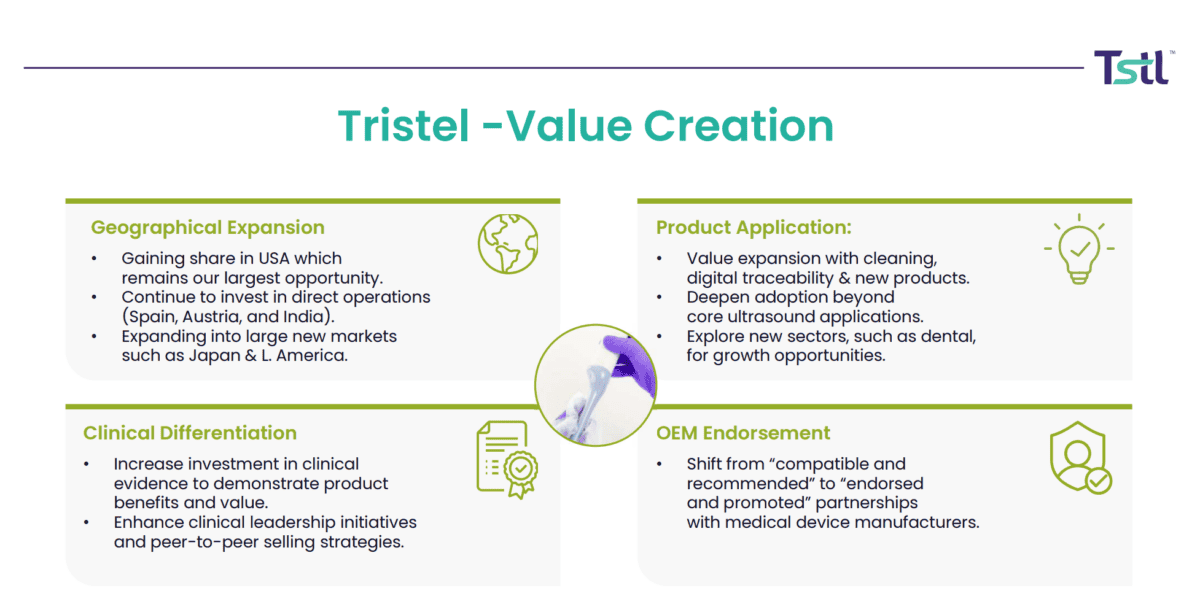
Tristel’s been successful in the UK disinfection market. But the big opportunity is it’s trying to make progress with is the US, which could be huge for a business currently valued at £165m. This however, isn’t straightforward.

The company’s solutions are expensive and convincing hospitals to change from trusted suppliers offering cheaper products might be difficult. Despite this, Tristel’s made progress. Its disinfectant for ultrasound probes has been given regulatory approval and the firm has issued a filing for its ophthalmic devices treatment.

It’s worth noting that, while the US is a huge potential market, it’s not the only growth avenue. The company has also identified Spain, India, and Austria as potential opportunities for 2025.

Dividends

With several international expansion possibilities in progress, it’s natural to think Tristel isn’t likely to be returning cash to shareholders any time soon. But that would be a big mistake. The company currently distributes just under 14p per share in dividends – a yield of 4% at today’s prices. And it’s committed to increasing this by 5% a year going forward. 

Given the uncertainty around its international expansion, that might seem somewhat cavalier. If its plans go as hoped, Tristel will have to invest cash to support its growth. 

The company however, has no debt and the cash on its balance sheet‘s growing. And its latest 8% increase in its interim dividend is in line with the growth from the underlying business.

Risks and rewards

Over the last five years, Tristel’s share price has been all over the place as pandemic-driven demand gave way to unusually high inventory levels. But that volatility should be in the past.

With the stock at a 52-week low, I think investors should consider it. Expansion into the US brings a lot of uncertainty, but the share price offers good value for the risks involved.

If things go well, a £10,000 investment in Tristel today might be generating significant passive income 10 years from now. And the stock could be worth a lot more as well.

Up 85% from its one-year low to around £3 now, can Barclays’ share price still be significantly undervalued?

Barclays’ (LSE: BARC) share price has risen 85% from its 26 February 12-month low of £1.62. I think this underlines that the 5% drop following the 13 February release of its 2024 results was driven by profit-taking.

Indeed, the strong numbers highlight to me that a lot of value may still be left in the stock.

A closer look at the latest results

Barclays’ total income in 2024 rose 6% year on year to £26.788bn, ahead of analysts’ forecasts of £26.3bn. And its pre-tax profit jumped 24% to £8.108bn, again outpacing forecasts (of £8.07bn).

A risk for Barclays was – and remains – a drop in its net interest income (NII) as UK interest rates decline. NII is the difference in money made from loans given out and deposits taken in.

However, the UK banking giant continues to shift its focus away from interest-based to fee-based business.

Income from its fee-based investment banking operations was up 7% over the year, to £11.805bn. And in Q4 it rose 28% over Q4 last year to £2.607bn.

Its similarly fee-based private bank and wealth management business saw income jump 8% in the year to £1.309bn. And Q4 saw a rise on the same period last year of 12% to £351m.

Barclays’ return on tangible equity (ROTE) target of 10%+ was achieved, with a final reading of 10.5%. Like return on equity, ROTE is calculated by dividing the company’s net income by average shareholders’ equity. However, ROTE excludes intangible elements such as goodwill.

Where does it go from here?

The bank’s guidance for 2025 includes a ROTE of around 11%. This is targeted to rise to over 12% in 2026.

Additionally positive is its plan to return £10bn+ of capital to shareholders in the next two years. This will be in the form of dividends and further buybacks (which tend to support share price gains).

Consensus analysts’ forecasts are that Barclays’ earnings will rise 8.7% every year to the end of 2027.

And it is this growth that ultimately drives a firm’s share price and dividend higher over time.

Are the shares currently undervalued?

Barclays presently trades at a price-to-earnings ratio of 8.2. This is undervalued compared to the 8.4 average of its key competitors. These are NatWest at 8, Standard Chartered at 8.5, Lloyds at 8.6, and HSBC at 8.7. 

It also looks undervalued on its price-to-book ratio of 0.6 against its peers’ average of 0.9.

And the same is true of its 1.8 price-to-sales ratio compared to its competitors’ 2.4 average.

I ran a discounted cash flow analysis to put these into a share price context. This shows where a stock’s price should be, based on future cash flow forecasts for a firm.

In Barclays’ case, it shows the shares are 58% undervalued at their current £2.99. Therefore, the fair price for the stock is technically £7.12, although market forces could move them lower or higher.

Will I buy the stock?

I already have holdings in HSBC and NatWest, and another bank stock would unbalance my portfolio.

If I did not have these, I would buy Barclays’ shares today based on their earnings growth potential. This should push their share price and dividend much higher over time in my view and I feel the stock is worth considering.

This FTSE investment trust offers exposure to Nvidia, Apple, Alphabet, and other tech stocks (at a discount)

I’m a big fan of US-listed tech stocks such as Apple, Alphabet (Google), and Nvidia. The world today is in the middle of a tech revolution (that could last for decades) and it’s these kinds of companies that are benefitting. If one is looking for exposure to these kinds of stocks, the Polar Capital Technology Trust (LSE: PCT) could be worth considering. A FTSE 100 investment trust, this is invested in over 100 different tech businesses.

One for growth investors

The business is a technology-focused investment trust that’s managed by British investment firm Polar Capital. Launched in 1996, it has been around for nearly 30 years now.

Over the last few decades, the trust has established a strong long-term performance track record. For example, over the 10-year period to the end of 2024, its net asset value (NAV) increased 586%.

Exposure to high-growth industries

Today, the trust is invested in some brilliant companies. At the end of January, for example, the top 10 holdings included the likes of Nvidia, Microsoft, Apple, Amazon, and Alphabet.

With names like this in the portfolio, the trust offers investors exposure to a range of growth industries including artificial intelligence (AI), cloud computing, data centres, semiconductors, online shopping, and self-driving cars. So, it could be a good way to play the digital revolution.

Trading at a discount

One thing that stands out to me today is that the trust trades at a substantial discount to its NAV. Currently, the discount is about 7%. What this means is that investors are essentially buying a range of world-class tech stocks for a 7% discount. That’s an attractive deal, in my view.

Be aware of the fees

It isn’t perfect though. And one drawback is the fees, which are higher than some other similar products. One worth highlighting in particular is the performance fee. If the trust beats its benchmark, the managers can charge an extra amount (10% over the benchmark).

The risks

It’s also worth pointing out that this trust can be volatile at times. That’s because technology stocks themselves tend to be volatile.

These stocks often trade at higher valuations because the underlying companies are expected to generate strong growth in the future. And if there are doubts about future growth, they can swing around wildly.

We saw this recently with Nvidia. When Chinese AI app DeepSeek emerged and investors became concerned that demand for Nvidia’s AI chips may decline, the stock fell more than 20% in the blink of an eye (it has since recovered most of the decline).

Given the trust’s niche focus, and its level of volatility, I wouldn’t go ‘all in’ on it. But I think it’s worth considering for a diversified investment portfolio today as the world is only going to become more digital.

Could these former penny stocks continue soaring in March?

Investing in cheap, small-cap shares like penny stocks can be a wild ride, at times. They can also be more likely to fail than larger-cap businesses, while price volatility can often be extreme.

But on the plus side, they can also deliver juicy long-term capital gains as earnings take off and share prices increase.

These two former penny stocks have enjoyed impressive share price gains more recently. I’m optimistic too, that they could continue rising in 2025 and potentially beyond.

The gold miner

Gold prices continue to rise sharply and are now within a whisker of the critical $3,000 per ounce marker. With worries over the broader political landscape mounting, analysts are continuing to hike their short-term price forecasts.

UBS, for instance, now predicts bullion to hit $3,200 in the next year.

Propelled by the recent price surge, gold digger Metals Exploration‘s (LSE:MTL) more than doubled in value over the last year, to 5.9p per share.

The business owns the Runruro gold mine in The Philippines, from where it produced 83,897 ounces of the yellow metal in 2024 (beating upper guidance forecast of 82,500 ounces). It also owns exploration assets in the country, as well as in Nicaragua following its takeover of Condor Gold last month.

The Condor deal saw it snap up the La India gold project, from where it’s targeted annual production is 145,000 ounces.

This is all pretty exciting. But it’s important to remember that investing here also involves a high degree of risk. Mining operations don’t always go to plan, and cost and production issues can tear up earnings forecasts. There’s also no guarantee that gold prices will continue their impressive ascent.

Yet the cheapness of Metals Exploration shares suggest it’s worth serious consideration. For 2025, they trade on a forward price-to-earnings (P/E) ratio of 3.7 times.

This — along with the small-cap’s strong operational momentum and the bright outlook for gold prices — could facilitate more impressive share price gains.

The brick maker

Improving housing market conditions have helped Michelmersh Brick (LSE:MBH) burst back out of penny stock territory in recent weeks. It’s up 11% in the year to date, at 110p per share.

As the name implies, this small-cap provides a staple product for the construction of new homes. It manufactures more than 122m clay bricks and pavers a year, and things are looking up as housebuilders (including Barratt Redrow, the UK’s biggest builder) start discussing production increases again.

Confidence is improving following recent Bank of England interest rate cuts. Encouragingly in September, Michelmersh’s order book was at its highest since 2022.

Given this backdrop, could Michelmersh shares continue rising in the near term? I’m on the fence, to be honest.

A meaty forward P/E ratio of 13.4 times may limit further upside. There’s also the danger that rising inflation, and its impact in interest rates, could draw the momentum out of the housing sector.

Yet despite this, I still think the penny stock’s still worth serious consideration. Over the long term, I believe earnings could shoot higher as the government executes its plan to build 300,000 new homes each year.

Michelmersh’s also has financial scope for more acquisitions (like that of FabSpeed in 2022) to supercharge profits.

Down 50% in a year, could this be the FTSE 250’s best recovery stock?

Holders of B&M European Value Retail (LSE:BME) shares have endured a tough time in the past year. Having fallen 50.6% in value, the discount retailer now sits in the FTSE 250 having been relegated from the FTSE 100 blue-chip index in December.

And things seem to be going from bad to worse for B&M. On Monday (24 February), its shares slumped again as it cut profits guidance and announced the departure of chief executive Alex Russo.

Investors should be braced for more bumps along the way. But a part of me thinks now could be a good time to consider piling into B&M shares. Could it prove to be the best recovery stock on the FTSE 250?

Steady slide

B&M’s suffered its first investor exodus when it released full-year financials in June.

On the plus side, the firm announced adjusted EBITDA of £629m for the 12 months to March 2024, at the top end of forecasts. But it spooked the market by failing to publish forward guidance for fiscal 2025, leaving investors fearing a sales slowdown.

The firm finally guided in November that corresponding earnings this year would range £620m-£660m. However, news has been grim since then, trimming the top end of this estimate by £10m in January. And this week, B&M absolutely took the scythe to its forecasts. Adjusted earnings are now tipped to range £605m-£625m.

B&M said the downgrade “reflects the current trading performance of the business, an uncertain economic outlook and the potential impact of exchange rate volatility on the valuation of our stock and creditor balances which is a non-cash item“.

Cheap as chips

The rapid sales growth of recent years has also slowed to a crawl. At constant currencies, group revenues were up 2.8% in the nine months to December. That’s down markedly from growth of 8.1% in the corresponding 2023 period.

The retirement of Russo — who had been in charge since September 2022 — is a telling signal that all’s not well at B&M. His departure may also add to the near-term turbulence.

But for patient investors, I think B&M’s crashing share price could represent an attractive dip-buying opportunity. Today, its shares trade on a forward price-to-earnings (P/E) ratio of just 7.5 times. This represents great value, in my opinion.

Market opportunity

I’m surprised that B&M’s sales have cooled so sharply in this tough period for consumers. Demand for lower-priced items tends to thrive when inflation’s stubborn and the economy’s weak.

I feel intense competition is impacting revenues, while B&M’s lack of an online channel isn’t doing it any favours. These could remain big problems going forward.

But there are also reasons to be optimistic. The discount retail segment is expected to continue growing strongly, by around 4% per annum in the next few years.

B&M’s rapid expansion positions it well to capitalise on this trend. It plans to have 1,200 B&M-branded stores in the UK, up from 772 today. Further expansion is also likely in France and across its Heron Foods division. Naturally, this scaling up will also provide B&M with profits-boosting economies of scale.

While it’s not without risk, I think it could — at current prices — be one of the FTSE 250’s best recovery stocks to consider.

Financial News

Daily News on Investing, Personal Finance, Markets, and more!

Financial News

Policy(Required)