Will the Ocado share price ever amount to more than a hill of beans?

The Ocado (LSE: OCDO) share price has jumped 4.1% today and as an investor I should be pleased. It’s nibbled away at a small proportion of my losses.

Now I’m just down just 22%, but I shouldn’t grumble. Investors who bought the FTSE 250 group at its peak in February 2021, when the shares hit 2,808p, will be down a thumping 88% at today’s 323p.

Ocado was once hailed as the UK’s big tech hope, selling its cutting-edge grocery warehouse technology to the world. It hasn’t happened yet.

Could this be a FTSE 250 winner one day?

Ocado shares continue to slide having plummeted 40% over the last year. I can’t be the only investor asking whether they’ll ever amount to more than a hill of beans. 

It’s yet to turn a regular profit and is at least five years away from doing so. While we wait, the board continues to pour money into developing its technology, but the number of overseas grocers adopting its robotic tech warehouses seems to have stalled.

There are glimmers of hope. In its recent Q4 update, published on 14 January, Ocado Retail, the grocery joint venture between Ocado Group and M&S, reported a 17.5% increase in retail revenue to £716m. Weekly orders hit 500,000 for the first time at the end of November.

The shares jumped on the day but as is so often the case with Ocado, couldn’t hold onto their gains. It’s the same every time some good news sneaks out. The shares will probably give up today’s loss tomorrow.

Whenever interest rates fall, investor interest is briefly revived, as lower rates reduce borrowing costs. The launch of a new grocery fulfilment warehouse or success in Ocado’s retail operations can provide a temporary boost. It never lasts though.

Hope springs eternal and I continue to hold onto my shares. Maybe that’s simply reluctance to admit I got it wrong.

Am I being too down on this stock?

Yet there are some positives. Here are three:

Innovative technology. Ocado’s cutting-edge robotic warehouses and fulfilment solutions give it a real technological edge. With luck, this could attract more partnerships and clients in the future. The potential market is huge.

Recent revenue growth: A record Christmas indicates that Ocado Retail’s strategies may be gaining traction.

Market expansion opportunities: As online grocery shopping expands globally, Ocado could tap into new markets and expand its customer base.

There are plenty of negatives too. Here’s three of those:

Profitability. Continued investments in technology development may push the break-even point even further down the line.

Stagnant overseas partnerships. The anticipated growth in international clients adopting Ocado’s technology has not materialised, raising questions about the scalability of its business model and likely return on its tech investment.

Share price volatility. Its reputation as a FTSE falling knife may deter potential new investors.

As I’ve discovered to my cost, just because a stock has fallen sharply, doesn’t mean it can’t fall again, and again. I wouldn’t recommend investors consider Ocado shares today.

One day, they could add up a mountain beans. But we’re likely to be served a lake of thin gruel while we wait.

The Next share price is up 36% in a decade. Should I buy now for the next decade?

Over the past 10 years, shares in Next (LSE: NXT) have moved up 36%. So the Next share price has outperformed the wider FTSE 100 index during that period.

In contrast, the retailer’s dividend yield of 2.2% is well below the FTSE 100 average, which is currently 3.5%.

So, did I miss out by not buying Next shares a decade ago? Might it make sense for me to add the stock to my portfolio today?

Strong long-term business performance

The fact is that Next has actually done far better than many rivals in the past decade.

My own forays into rag trade shares have been disastrous. My boohoo shareholding is badly under water (meaning it is worth less than I paid for it – and unlike Next it does not pay a dividend).

Owning shares in Superdry just left me super high and dry when the company was delisted after enormous value destruction.

I fared better with Burberry (a luxury pick), although its shares have also seesawed in the past several years.

I actually reckon Next is one of the better players in its space. It has a strong brand that it has managed to keep relevant even amid relentlessly shifting consumer tastes and style trends.

It has managed the move to digital very well while maintaining a high street presence.

The company is well-run and has a proven business model. It expects to report profit before tax for last year just north of £1bn.

Smart investors choose a winning company in a winning industry

But while Next strikes me as one of the better looking listed companies in British clothing retail, I have no plans to buy its shares.

I think it makes sense as an investor to try and go for great companies – but ideally in great industries. Next is one of the better British clothing retailers, but that is a business area that seems to face one hurdle after another.

Tastes change, supply chain costs have soared, pricing is increasingly undercut by fast fashion rivals, high street rents and business rates have increased, the budget added on substantial new employee and taxation costs… the list is almost endless.

I reckon a number of those disadvantages are not only here to stay but could get worse.

Just as the UK grocery market has seen profit margins shrink over the past couple of decades due to intense competition, I see ongoing margin pressure for mass market fashion retailers like Next.

I missed out, but won’t be buying now

If I had bought Next shares a decade ago, I would now be quids in, thanks both to share price growth and a steady flow of dividends.

Looking forward, though, while I still like the company’s prospects, I think sectors other than clothes retailing could be more rewarding.

I have not abandoned the rag trade altogether: I still hold my boohoo shares and have been actively building my stake in JD Sports.

If the Next share price dropped to what I thought was a bargain level, I would reconsider buying into it. For now, though, I will leave it on the shelf.

How an investor could target a passive income of £2,747 a year from just £2k of savings!

Passive income is a rare and precious thing: money that comes in without demanding constant effort and labour. 

It can flow in month after month, year after year, without the recipient having to actively work for it. In an ideal world, it will steadily increase over time, to combat inflation.

All that might sound too good to be true, but it’s possible to generate this by investing in FTSE 100 stocks that distribute regular dividends. 

The average yield on UK blue-chip stocks is currently around 3.6% annually, with some offering returns as high as 7%, 8%, or in a handful of cases, even more.

Even better, as businesses grow their profits, they tend to boost their dividend payouts, meaning that income stream could expand over time.

Investing in dividend stocks

There’s another advantage. By reinvesting every dividend, investors can steadily accumulate more shares. These shares generate more dividends, compounding returns in an ongoing cycle.

And if the company’s share price rises too the investor’s capital will appreciate, increasing their overall wealth.

Stock market investments carry risks, and there’s no guarantee of profits. However, by spreading my investments across 15 to 20 different firms, my relative winners should outweigh any laggards, with luck.

Wealth manager M&G (LSE: MNG) offers one of the highest trailing yields on the entire index at 9.4%. That’s way more than any savings account pays. Plus there’s prospective share price growth on top.

Naturally, investing in shares differs from holding cash. Dividends aren’t guaranteed. Capital is at risk. The M&G share price has dropped 7% over the past year and 10% over five years. That will have eaten into the dividends. 

A potential downside for M&G is that market volatility could hit the value of the assets it manages, while lower investor confidence could reduce fund inflows.

Another risk is that M&G funds are mostly actively managed, while in recent years investors have favoured trackers. This trend could continue, hitting demand.

Share price growth too

M&G shares could benefit if interest rates continue to slide, but there’s no certainty. I hold M&G myself. I think it’s well worth considering, especially for investors who favour income over growth.

I would suggest mixing it with lower-yielding stocks that have stronger growth potential. By adopting this balanced approach, it’s possible to target an average dividend yield of around 6% per year.

If an investor generated average annual capital growth of 5% on top, this would lift their overall total return to 11%.

If someone invested £2,000 today and left it to grow for 30 years, an 11% average annual return could increase their capital to roughly £45,785.

With a 6% yield, that would generate a passive income of £2,747 a year, which hopefully rises over time. Not bad from an initial £2k.

These numbers are estimates, but they illustrate how stock investments can provide a sustainable second income. 

With £2k an investor could consider buying these cheap shares in March

Investors seeking cheap shares to buy in March will find plenty of choice on today’s FTSE 100. They don’t need to be super wealthy either. It’s possible to start with £2,000, £1,000 or less. So which stocks might investors consider?

The UK’s blue-chip index has retreated in recent days, although it’s still up more than 5% this year, and around 13% over 12 months. Plus dividends on top.

The recent dip excites rather than alarms me. It means many top FTSE shares are cheaper than just a few days ago. So what’s out there?

Some FTSE 100 bargains to consider

Some shares are cheap because they have fallen sharply lately. Trainer specialist JD Sports Fashion has a lowly price-to-earnings ratio of just 6.7, less than half the FTSE 100 average of around 15.

That’s unsurprising given that its shares are down 30% over the last year. British Airways owner IAG is also cheap with a P/E of 7.8 times. By contrast, its shares are up 113% over the last year.

I think investors should approach with caution. JD Sports is struggling to kick on, as consumer demand remains weak. The IAG share price may have burned itself out, following its stellar run.

Barclays (LSE: BARC) seems well worth considering though. Its shares are up 83% over the last 12 months, but may have a bit more fuel in the tank.

Again, they’re pretty good value, with a P/E of 8.3. The price-to-book (P/B) ratio, a measure I always check with banking stocks, is low at 0.6. That makes it cheaper than rivals Lloyds Banking Group and NatWest, which both have P/Bs of 0.9.

Barclays also has a thriving investment banking arm, having resisted pressure to dump it after the financial crisis. That should benefit from stock market volatility, which I expect we’ll see a lot more of under US President Donald Trump.

The shares look decent value

On 13 February, Barclays reported a 24% surge in pre-tax profit to £8.1bn in 2024, slightly above broker forecasts. It also hiked its dividend by 5% and announced a new £1bn share buyback.

There are risks to buying Barclays, as with every stock. As interest rates slide, it could squeeze net interest margins, the difference between what it pays savers and charges borrowers. Its Wall Street operations leave the bank at the mercy of aggressive US regulatory scrutiny, where it could face lawsuits or hefty misconduct fines.

Like IAG, the Barclays share price may struggle to extend its stellar run. Yet I still think it’s good value and worth considering.

Specialist insurer Beazley is a dark horse. It looks really cheap with a P/E of just 5.2, despite a 27% jump in its share price over the last 12 months. Beazley is exposed to climate risk. Last November it revealed an estimated a hit of up to $175m from Hurricanes Helene and Milton.

Telecoms giant BT Group also looks cheap with a P/E of 8.3 times and a generous 5% yield. Investors should research the risks here, as there are loads. British American Tobacco is another cheapie. Its P/E is also 8.3 with a bumper 7.8% yield. An investor with £2k could think about splitting it between Barclays and one of these three. Those with larger sums should consider spreading their money around.

Down 30%, this FTSE 250 stock has an 11% dividend yield! I’m tempted

The FTSE 250 can be a treasure trove for investors looking for income potential. However, not every stock with a high dividend yield is worth buying. So when I spotted a share with a double-digit percentage yield but a falling share price, I knew I had to do some more digging. Here’s what I found out.

Falling revenue, rising yield

I’m referring to Ashmore Group (LSE:ASHM). The specialist investment management firm currently has a dividend yield of 11%, making it one of the highest-yielding options in the entire index.

Before I can figure out if the stock is a bargain, I need to understand why it has dropped by 30% over the past year. Part of the problem has been declining assets under management (AuM). For financial service providers, this metric is really important. It refers to how much in client funds it manages at any point in time. As it makes money from charging fees and commissions from managing the money, it’s directly correlated to overall profitability.

For Ashmore, the latest half-year results out in February showed AuM falling from £39.44bn from June 2024 to £39.04bn now. This factor pulled revenue down from £94.5m to £81m.

Another factor has been the disappointing investment performance over the past year. Only 43% of invested client funds have outperformed the benchmark in the last year. It’s not a great advert for the business when trying to attract new money.

Attractively priced

The main reason why I’m tempted to buy is that the share price recently hit the lowest level in a decade. Based on the current figures, the price-to-earnings ratio is 11. This ratio is close to what I would call a fair value. So although the stock could keep falling, it’s now in a position where it would fall into undervalued territory. Therefore, I feel that any further losses should be relatively small, as value buyers would likely step in and snap up some Ashmore shares.

Further, the management team decided to hold the dividend per share at 4.8p following the recent results. If they were genuinely worried about the outlook for the business, they would have cut the dividend to help cash flow. This provides me with some hope that things aren’t as bad as the share price move suggests.

A high-risk play

Even though I mulled it over for a while, I’ll hold off purchasing the stock right now. The dividend cover is 0.57, which is below the figure of 1 that I use to consider it sustainable. I feel I need to see some good news out first before taking the plunge. Investors who have a higher risk tolerance than me might be happy to get involved right now. But I just want to see some signs of the stock stabilising first before committing.

Has the IAG share price peaked already for 2025?

In 2024, the International Consolidated Airlines Group (LSE:IAG) stock went on a tear higher. It almost doubled in value over the calendar year, with the rally continuing in January.

However, the IAG share price has lost 11% in value over the past two weeks. Some investors might be concerned that the stock has peaked, with a more significant move lower pending.

The case for a further drop

Human investment psychology has been studied at length. One point that always comes out is the herd mentality of retail investors. What this means is that when a stock’s rising, everybody jumps on board, fuelling a more extensive move higher. Yet as soon as the stock starts to drop, investors all rush for the exit, causing a sharper fall than is really justified.

This could happen with IAG shares if enough of the retail crowd gets concerned that the stock could keep falling in the coming months. I’m not saying that investors should sell, but it’s hard to cut emotions out when the stock has surged in value over the past year and now is starting to fall.

When looking at company-specific factors, the release of annual results on 28 February could be part of the recent share price wobble. Some investors might be banking some profit ahead of the earnings, just in case some bad news gets released. For example, in the latest quarterly report, the business spoke of higher costs, higher wage bills, and supplier inflation. Should this continue, it could hamper profitability.

Why further gains could happen this year

It’s natural for a short-term correction in a stock to occur after such a sharp rally. Yet the IAG share price could keep progressing in 2025 based on a few factors.

From a valuation standpoint, it’s not overpriced. The price-to-earnings ratio (P/E) is 7.87. This is below the fair value benchmark of 10 that I use for comparison. So if anything, the stock is undervalued and therefore could keep rising as value buyers see the longer-term vision.

Improved financial results could fuel the stock to jump. This is especially true given the momentum that the company has at the moment. The Q3 results flagged that management “expect our strong financial performance to continue for the rest of the year”. The CEO commented that “demand remains strong across our airlines”.

Based on higher revenue and higher profitability, the share price should rise as investors continue to be optimistic about the outlook for 2025 and beyond.

What I’m doing

I bought IAG shares last month. I’m not looking to sell any time soon, even with the risk of the annual results upcoming. When I consider the valuation at present versus what I think it could be in another couple of years, I can afford to look past this short-term drop.

The Lloyds share price is already up 24% in 2025! Can it hit £1?

It has been an excellent couple of months for investors in Lloyds (LSE: LLOY). The Lloyds share price has surged 24% since the turn of the year and twice that much over the past 12 months.

An investor who put £1,000 into the black horse bank at its September 2020 nadir would now be sitting on a holding worth £2,763.

Short-term dividend growth, but still 88% below 2007 levels

They would also be earning a dividend yield of 12.8%. For buyers today the yield would be 4.7%.

The prospective yield is even higher as Lloyds has been growing its dividend handily.

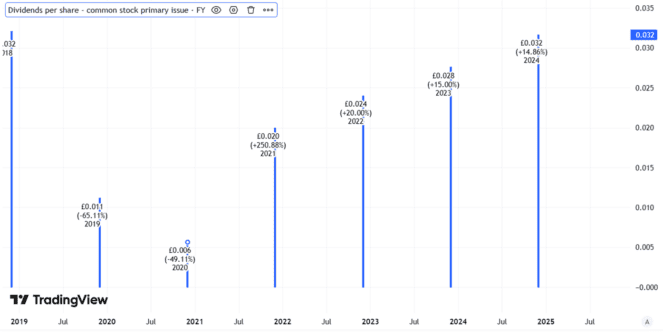
Last week it announced a full-year dividend per share increase of 15%. What is known as a progressive dividend policy means that the FTSE 100 bank aims to keep growing its dividend, although in practice no dividend is ever guaranteed to last.

Created using TradingView

Long-term Lloyds shareholders know that only too well.

Even after last week’s increase, the dividend per share is not yet back to where it stood in 2018. It is 88% below where it stood in 2007, before Lloyds ran into trouble in the financial crisis.

The shares could still move up from here

When it comes to the Lloyds share price, I see room for it to keep moving upwards from here.

At the moment, the bank’s shares trade on a price-to-earnings (P/E) ratio of 11.

Moving up to a £1 share price would imply a prospective P/E ratio of 16. That is high compared to its peer group of major UK banks, although smaller lenders like Metro Bank have a much higher P/E ratio (64 in its case).

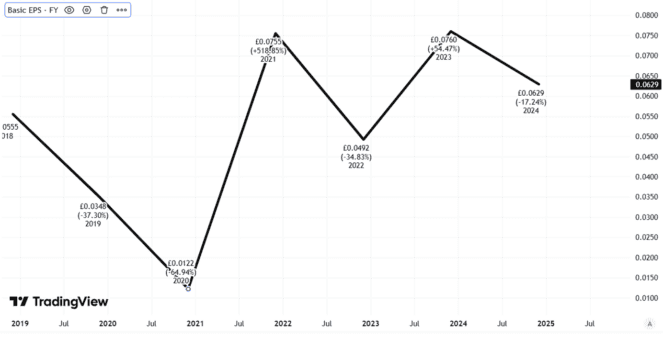
But if Lloyds’ earnings grow, the share price could hit £1 even if the P/E ratio remains broadly unchanged. They would have to grow by close to 50%. Is that likely given that last year, earnings per share fell 17%?

Created using TradingView

With its strong brands, £312bn mortgage book and massive customer base, Lloyds has the potential to perform well. However, I do not see any reason to expect earnings per share to jump dramatically. The recent trend has been downwards.

The bank faces ongoing pressures, such as mounting costs for historical car finance practices (it set aside a £700m provision for that in its most recent earnings).

Meanwhile, a medium-term risk that concerns me is higher loan defaults eating into profits. The bank said in its results that asset quality remains strong and last year saw lower default rates though, which helps partly explain why the Lloyds share price has been moving up.

Given the reassurance on asset quality and relatively cheap-looking valuation, I think that momentum could continue. However, I do not think the prospective business performance is strong enough to justify a move up to £1.

I’m steering clear

The last time the Lloyds share price was that high was back in 2008.

For now, business remains strong. The bank’s upbeat note about default rates in its results was music to my ears as an investor.

But it is not enough for me to want to invest.

Lloyds has been a long-term disaster over the past 20 years. I am not confident enough in the economic outlook to want to buy bank shares right now – including this one.

This is the worst FTSE 100 stock of 2025 so far. Should I buy it?

Up 6.4% already, the FTSE 100 is having a decent start to the year. Yet, as always, not all Footsie stocks are doing so well.

According to my data provider, the worst-performing share in 2025 is JD Sports Fashion (LSE: JD). It’s down 16.5% and is trading for 80p (it was above 200p at the start of 2022).

Unfortunately, I already hold this one, having invested in November at 97p. I hoped I was getting in somewhere near the bottom, but I was wrong. The knife kept falling.

Should I double down at 80p? Let’s dig in.

Tough market backdrop

For many years, JD Sports grew strongly as it expanded internationally and cemented its reputation as the ‘King of Trainers’. Even today, it’s still known for its wide selection of brands and the latest fashionable trends and styles in sportswear.

However, soaring inflation and a cost-of-living crisis has hit JD hard in recent years. Many people just don’t feel as flush as they once did, forcing retailers to engage in price wars to lure spend-shy shoppers.

JD has chosen to maintain its premium sportwear image by not engaging in discounting. While that pricing discipline is good for the gross margin, it has impacted top-line growth and resulted in two weak Christmas trading periods on the trot.

Moreover, its once-enviable close relationship with Nike has become a bit of an Achilles heel. The US athleisure giant took its eye off the ball in recent years and lost market share to more nimble brands like Hoka and Roger Federer-backed On.

Clearly, interest rate cuts would help matters here, but it’s unclear when things will improve. Consumer and business confidence is at rock-bottom in the UK, with no sign of the dark clouds parting yet. So there is a risk that JD’s UK sales could weaken even further this year.

International operations

So, why on earth did I choose to invest in the first place? Well, one reason is that I like JD’s international growth prospects over the next few years. It has a growing presence in Asia and parts of Europe like Spain and Poland (both economies have been growing strongly lately). Only around a third of sales come from the UK and Ireland.

Also, JD has beefed up its store count in the US with the recent $1.1bn acquisition of Hibbett, an Alabama-based sportswear retailer. This acquisition added over 1,000 stores across 36 states, particularly strengthening JD’s presence in the US.

Finally, there is new management at Nike, which is reducing investment in its own direct-to-consumer channel. This renewed focus on selling more through wholesale partners like JD should ultimately benefit the FTSE 100 firm (Nike trainers are higher-margin). I think demand for Nike products will eventually recover.

My decision

On paper, the stock looks dirt cheap. It’s trading at just 6.4 times earnings for the current financial year. Even if earnings come under pressure, that looks like a decent margin of safety to me.

I have to think most of the bad news is being priced in here. Therefore, I think JD shares are worth considering at 80p.

The company’s Q4 2025 trading update is due in March. If there is no alarming guidance given for this year, I may buy more shares.

Are Diageo shares the ultimate recovery play?

It never rains but it pours. That seems to have been the story for brewer and distiller Diageo (LSE: DGE) in recent years. Tough markets in Latin America, increasing numbers of consumers spurning alcohol, supply challenges with Guinness in England: the list goes on. Little wonder that Diageo shares have lost over a quarter of their value in the past year.

Taking a step back though, there are a few things to remember about what increasingly looks like a company in trouble.

This FTSE 100 firm is massively profitable and has a market capitalisation of £49bn.

It has increased its dividend per share annually for decades. It owns many of the world’s leading alcoholic drinks brands, from Johnnie Walker to Smirnoff.

So, while Diageo shares have been poor performers lately, could this be the ideal recovery play for a long-term investor like me?

It’s all about future demand

Diageo may do better or worse at different moments.

But in the long term, I think that if demand for premium alcohol is resilient, it has the right assets to prosper. Those include strong brands, unique production facilities and an excellent global distribution network.

So I reckon the key question when it comes to how good a recovery play Diageo may be is what will happen to the global alcohol market in coming decades.

After all, weak demand and declining interest among younger consumers is not a problem specific to Diageo. US-listed Corona brewer Constellation Brands has fallen 27% in a year. Anheuser-Busch InBev is down 13%. In Europe, Remy Cointreau shares have tumbled 48% over the past 12 months.

Multiple risks face the drinks industry

There are usually good reasons for that sort of rout.

Investors have real concerns about short-term demand for premium tipples and the longer-term question of whether alcohol sales will enter the sort of decline we have seen with cigarettes. They might.

Diageo’s interim results this month provided cold comfort, with both volumes and sales revenues in the first half of its financial year showing slight declines year on year.

With the global economy still looking uncertain and many consumer budgets stretched, I do not expect to see any strong turnaround soon either in business performance or Diageo shares.

Here’s why I’m feeling confident

Longer term though, I am doubtful that the spirits market will show significant, sustained decline. As more people enter the middle class as the global population grows, I expect spirit demand to remain high.

Beer I think may see more obvious volume declines, although in recent years Guinness has been successfully bucking that trend. The first half was the eighth in a row in which the black stuff has delivered double-digit growth.

So while I see no immediate reason for Diageo shares to bounce back in a big way any time soon, as a long-term investor I am feeling pretty good about its recovery prospects.

It may not be the ultimate recovery play: some beaten down far smaller companies have more space for their battered share prices to soar.

But I like Diageo’s size. Unlike many recovery plays, even while it is struggling, it remains massively profitable. I plan to hang on to my Diageo shares.

£10,000 invested in IAG shares a year ago is now worth…

Shares in International Airlines Group (LSE: IAG) are up 110% in the past year. That makes the group, which is parent to major airlines such as British Airways, Iberia, and Vueling, one of the best performing UK stocks.

An investment of £10,000 would be worth £21,168, with dividends included. That’s great news for investors who bought the shares a year ago but what does that mean for newcomers? Is there still value in the stock?

To evaluate where the stock might be headed, it’s worth looking into its recent earnings and checking valuation metrics.

Recent blue-sky earnings

IAG’s set to release its final results later this week with a significant impact on its share price going forward. In its Q3 results, revenue came in at €9.33bn, a 7.9% increase year on year, and operating profit hit €2.02bn, up 15.4% from the previous year.

The operating margin also improved to 21.6%, a 1.4% increase. The company also announced a €350m share buyback, reflecting strong performance and a commitment to shareholders.

Valuation metrics

When evaluating IAG as a potential investment, it’s worth considering the following key metrics. IAG’s current price-to-earnings (P/E) ratio is approximately 4.1, below the peer average of 12, so there could be more growth potential in the stock.

Its price-to-sales (P/S) ratio and price-to-book (P/B) ratios are similarly low at only 0.6 and 0.8 respectively, suggesting the current share price is significantly undervalued.

However, in the past two weeks, the price has declined by over 10%. This could be a minor pullback but could also be the start of a major price correction. It could also be evidence of weakening investor confidence if shareholders expect underwhelming Q4 results.

Analysts expect a 15% increase in annual profits when the results come out but the potential impact from fuel costs remain a critical concern. Which brings us to the risks the company faces.

Debt and disruption

To meet the challenge of rising fuel costs, IAG’s been investing in fuel efficient aircraft and optimising routes. This has shown some early signs of profitability but many other risks remain.

As the pandemic proved, the airline industry is highly susceptible to travel disruptions. These occur in many forms, such as strikes, unexpected maintenance costs and the impact of geopolitical issues on travel demand.

In addition, it faces tough competition from budget airlines like easyJet and Ryanair, both of which have become increasingly popular in recent years.

Managing these risks while reducing Covid-era debt is critical. In H1 of 2024, the company’s net debt stood at £13.66bn, down from £17bn in 2022. That’s almost double its cash and cash equivalents.

Long-term thinking

I’m annoyed I didn’t purchase IAG shares last year as they would have been quite profitable. I mulled it over but eventually chose to pursue other options.

Yet the hesitations that held me back then remain. The risks related to fuel costs and travel disruption are significant enough that I feel they outweigh the potential long-term benefits.

Combined with the now higher price, it’s not a stock I’ll consider unless results this Friday beat expectations considerably.

Financial News

Daily News on Investing, Personal Finance, Markets, and more!

Financial News

Policy(Required)