£10,000 invested in IAG shares 12 months ago is now worth…

Shares in International Consolidated Airlines Group (LSE:IAG) have climbed 113% over the last 12 months. That’s enough to turn £10,000 into something with a market value of £21,301 today. 

Despite this, the average analyst price target‘s 17% above the current level. So should this be a stock investors have on their radars as a potential buying opportunity?

Returns

A 113% gain is outstanding by itself, but it’s even more impressive in the context of the wider stock market. Nvidia – at the forefront of artificial intelligence (AI) – is up 71% in the same time.

I’m not saying the two companies are equal. They aren’t, it’s clear which one has better prospects, and a look at what the stocks have done in the last five years reflects this.

Equally though, they aren’t priced like comparable businesses. While Nvidia shares trade at a price-to-earnings (P/E) ratio of 54, IAG stock trades at around 8 times earnings. 

A low earnings multiple can be a sign of investors being pessimistic about the stock. But analyst forecasts are strong, with earnings set to reach pre-pandemic levels in 2027.

Earnings

Analysts are expecting IAG’s earnings per share to climb steadily and reach 62p by 2027. With the stock trading at £3.26, that could make the current share price extremely good value.

Investors however, should be wary. Whether it’s pandemics, ash clouds, or economic downturns, the airline industry’s prone to downturns – and the effects can be significant. This is because the likes of IAG have a lot of fixed costs. These are expenses that don’t go away even when demand subsides for some reason.

As a result, airline earnings generally don’t just go lower in a downturn – they go negative. So investors should be wary of thinking a P/E ratio of 8 provides any sort of margin of safety. 

Flag-waving

IAG’s a flagship carrier for both the UK (British Airways) and Spain (Iberia). That differentiates it from the likes of easyJet and Wizz. There are some positives to this. Theoretically, it can mean the company is a candidate for support when – as is so frequently the case – things get difficult for the industry.

That protection however, can come at a cost. In general, a flag carrier can find it has to balance its interests with those of a national government.

From an investment perspective, I find this unattractive. I think generating returns is hard enough for airlines without the potential for additional complexity in their decision-making.

Long-term investing

Right now, the outlook for IAG shares is very good. Since the end of the pandemic, the company has been growing its earnings impressively and this looks set to continue.

But in the airline industry, things look good until they don’t. And when things change, the effects are often substantial on earnings and balance sheets. 

As a flag carrier, IAG might have better protection than some other airlines. But over the long term, this makes the company too complicated for me to consider buying.


Up 10% in 2025, can this FTSE 100 recovery share keep soaring?

Healthcare giant Smith & Nephew‘s (LSE:SN) shares continue to rise sharply from last autumn’s lows. At £11, the FTSE 100 share has risen 9.9% since the start of 2025.

The company — which builds artificial joints and limbs, surgical robotics, and sports medicine and woundcare products — has been troubled in recent years by soaring costs and sales weakness in China.

But fresh financials on Tuesday (25 February) have boosted hopes that Smith & Nephew’s turnaround is gaining momentum. News of soaring sales, margins, and profits in 2024 have given the share price an extra dose of jet fuel.

So what’s going on? And should investors consider buying the Footsie share today?

Sales accelerate

Tuesday’s update underlines the impressive progress of Smith & Nephew’s ’12-Point Plan,’ introduced in 2022 to slash costs, reduce waste, and boost commercial execution.

Sales rose 5.3% in 2024, to $5.8bn, with revenue growth accelerating to 8.3% in the final quarter. Trading profit improved 8.2% over the year to a shade over $1bn, helped by a strong improvement in trading profit margin.

This increased to 18.1% from 17.5% in 2023.

Pricing pressures and regulatory changes in China remained a familiar problem for Smith & Nephew. The firm said it experienced “reduced end-customer demand in the second half of the year, resulting in orders from our distribution partners significantly slowing as they reduced stock-levels“.

But this was more than offset by strong demand in established markets, particularly in the US. Full-year turnover in there increased 4.8%, to $3.1bn.

Restructuring on point

Tuesday’s release has reinforced hopes that Smith & Nephew (and its share price) have turned the corner following years of turbulence.

With the 12-Point Plan rolling on, annual revenues are on course to rise another 4.8% in 2025, the business says. It also expects the trading profit margin to increase further, to between 19% and 20%.

Strong progress on R&D leaves the business looking in good shape further out, too. It’s launched 16 new products in 2024, taking the total number during the last three years to 50. Planned new rollouts in 2025 include further extensions to its CORI and AETOS robotics-assisted surgical systems.

Its new innovations create considerable long-term potential for the company. As Smith & Nephew noted: “many of these new platforms are driving growth today and have multi-year runways still ahead of them as we expand indication and applications and launch in new markets.”

The verdict

Supported by new products, continued restructuring, and rising global healthcare spending, things are looking good for Smith & Nephew’s turnaround story.

City analysts agree. They think annual profits will rise 23% in 2025, and by a further 13% next year.

Yet, despite the company’s strong progress, significant earnings risks still remain. Sales challenges in China are persisting, meaning distributor inventories are still unusually high. The business is also vulnerable to further exchange rate volatility (currency movements dented sales by 0.5% in 2024).

So what should investors do today?

On balance, I think Smith & Nephew shares are worth a close look today given its current momentum. With a sub-1 price-to-earnings growth (PEG) ratio of 0.6, I think it offers good value for money, even following recent price strength.

2 FTSE 100 shares for investors to consider buying for a technical recession

Earlier in February, data came out that showed the UK economy grew by 0.1% in the final quarter of last year. This follows the preceding quarter of 0% growth. It goes to show that the economy isn’t performing that well.

Should we get two quarters of negative GDP growth, we’d be in a technical recession later this year. For investors concerned about this potential, here are two FTSE 100 shares to consider.

Recession-resistant goods

First up is Unilever (LSE:ULVR). The company owns a portfolio of strong global brands, including Dove, Hellmann, and Magnum. The stock’s up 10% over the past year, reflecting the solid financial performance over this period.

In the 2024 results released earlier this month, turnover grew by 1.9% versus the previous year. The Beauty and Wellbeing division saw revenue jump 5.5%, with Ice Cream up 4.5%. The CEO spoke of the year as being one of “significant activity” as they focused on “transforming Unilever into a consistently higher performing business”.

This is great, but it’s when times get tough that I feel Unilever could outperform. It’s recession-resistant due to its focus on essential goods, particularly in the house care division. Things like cleaning products will be bought by consumers even during a recession. This should help to keep revenue high regardless of the economic performance.

As a risk, a recession could be triggered by inflation rising even further. This is a trend we’ve started to see, and if it continues, it could cause Unilever to face cost pressures. This could squeeze the profit margins, negatively impacting earnings.

Constant utility demand

Another option is National Grid (LSE:NG). The share price is down 6% over the past year, with an above-average dividend yield of 5.88%.

In my view, the utility provider ticks the box of being a defensive share due to the essential nature of electricity and gas transmission. It has a diversified client base, serving both businesses and individuals.

Even though some might try to cut usage during a recession, people do need to heat their homes and use electricity as a basic need. So the stable cash flow and reliable income this provides to National Grid can be seen as an advantage over other consumer discretionary stocks.

National Grid’s ramping up investment, with a recent £7bn rights issue being a part of a five-year, £60bn investment plan. This should help to future-proof operations and ensure that the business can stay ahead of the competition.

One concern is the recent £1.4bn sale of the US onshore renewables business to a Canadian investment firm. I know this allows National Grid to focus on priorities closer to home. But at the same time, I feel US operations helped to diversify things away from the UK. Renewable energy’s the future, so selling this asset might not be the smartest move.

I think both stocks are worthy of consideration by investors who are concerned that the UK economic outlook could be rather gloomy.

If I’d invested £10k in Diageo shares 1 month ago, here’s what I’d have now

Diageo (LSE: DGE) shares continue to suffer the mother of all hangovers. The FTSE 100 spirits giant has given investors a major headache, and I know, because I’m one of them.

Diageo promised me a real party. It nibbled away at my inhibitions, until I couldn’t resist adding it to my portfolio.

Every seasoned investor knows the feeling. And averaging down on the stock – the investment equivalent of a hair of the dog – didn’t help.

Over the past year, the Diageo share price has dropped 25%. Over two years, it’s fallen 40%. And the bad news keeps coming.

In the past month, Diageo shares tumbled more than 12%. That drop alone would have turned a £10,000 investment into just £8,800. A painful paper loss of £1,200. On the FTSE 100, only Glencore has fared worse over the past month.

This FTSE 100 stock needs a pick-me-up

What’s behind the latest slip? The prime factor seems to be the company’s decision on 4 February to withdraw its medium-term guidance. Management blamed Donald Trump’s tariffs on Mexican and Canadian imports, which could seriously impact Diageo’s tequila and Canadian whisky brands. Cynics suggested Trump was a handy excuse.

In its latest results, Diageo reported that net sales had slipped 0.6% to $10.9bn, while operating profit slipped 4.9% to $3.16bn. 

Foreign exchange movements didn’t help. Nor did a 132-basis point decline in operating margins to 30.3%.

With all this uncertainty, it’s no surprise the stock recently slumped to a fresh 52-week low. While this may have tempted bargain seekers before, for many it’s now a case of once bitten, twice shy.

Diageo now trades on a price-to-earnings ratio of exactly 16. That’s the lowest valuation I can remember. That doesn’t mean it can’t fall lower though.

On top of that, the dividend yield now stands at 3.7%. That’s also as high as I can remember.

I’ll hold but I’m not happy

There are some silver linings. Operating margins are forecast to rise from 21.5% to 28.1%. And with a return on capital employed (ROCE) of 30.7%, this is still a fundamentally strong business. The real question is whether the worst is over or if there’s more pain to come. So what do the experts say?

The 21 analysts offering one-year share price forecasts have produced a median target of 2,579.5p. If correct, that’s an increase of around 18.5% from today. 

Combined with the dividend yield, that would give me a total return of more than 22%. I’d raise a glass to that.

However, within that target figure, there’s a broad range of expectations, from a high of 3,062p to a low of 1,980p. Which confirms my view that this stock could go either way.

Honestly, I never expected Diageo to take such a beating. I thought alcohol was forever. That may not be the case, as younger generations find their kicks in other ways. Like being healthy.

At least Guinness is giving Diageo strength. I’ll need some of that as I wait for this hangover to clear. While quietly groaning to myself “Never again…”

Is Warren Buffett selling before a stock-market crash?

My hero is Warren Buffett, the 94-year-old chair of American conglomerate Berkshire Hathaway. In an investing career beginning in the 1940s, the Oracle of Omaha has generated massive wealth for investors. He’s also donated $60bn to good causes and will do the same with 99% of his current fortune of $149.5bn.

Buffett’s amazing success has created hundreds of millionaires and billionaires in his home town of Omaha, Nebraska. Disclosure: my family portfolio owns Berkshire Hathaway stock. But ‘Uncle Warren’ sold stocks heavily in late 2024, building the largest cash pile in corporate history, which has got me thinking.

A crash course?

As well as owning operating companies and insurers, Berkshire manages a portfolio of stocks and US Treasurys (government bonds). And Buffett has been selling stocks and reinvesting proceeds into Treasurys.

Obviously, I can’t hope to know the mind of such a genius. Still, one of Buffett’s popular sayings comes to mind: “Be fearful when others are greedy and be greedy when others are fearful.”

The investment guru wrote this back in mid-October 2008. Back then, in the depths of the global financial crisis of 2007-09, Buffett revealed that his non-Berkshire wealth was almost 100% invested in US stocks. Since then, returns from American equities have been astonishing.

Clearly, Warren loves buying with blood in the streets. Now that he is selling stocks, is it because he expects a crash? Who knows, but if he is preparing for a collapse, then he’s going the right way about it.

Buffett sells stocks

Notably, Berkshire has halved its holding in US mega-cap Apple — another stock in my family portfolio. Likewise, he has slashed the group’s stakes in big American lenders Bank of America and Citigroup. But maybe Buffett is just top-slicing, taking profits after the US banking index leapt by 40% last year?

Following these and other sales, Berkshire had a record cash pile of $334.2bn at end-2024. That’s almost doubled in a year and this sum is larger than all but a handful of listed European companies. It still leaves the firm with a stock portfolio worth $272bn.

What investors think

To discover what other investors believe, here is a [heavily edited] selection of online comments I found:

* “He seems very reluctant to buy, through lack of opportunity. He probably smells trouble ahead.”

* “Buffett sees the bubble and wants cash to buy post-crash.”

* “He sees a peak and is just selling at toppy valuations.”

* “He’s building a war chest to buy bargains in the next downturn.”

* “He’s worried about Trump, trade, rising inflation, and interest rates.”

* “He believes market valuations are well above true value and can’t find a better bet than Treasurys.”

* “Buffett says never bet against America, but he’s looking bearish [negative].”

* “He thinks the risk/reward equation for US stocks is not compelling.”

* “He is cleaning house to provide liquidity and reduce volatility for his successors.”

* “He’s cashing out to pay for share buybacks, philanthropy, or care-home costs!”

However, in his latest yearly letter to shareholders, Buffett said he would “never prefer [cash] over the ownership of good businesses”. And though Berkshire sold stocks worth $143bn in 2024, it has almost 200 subsidiaries generating cash for shareholders. He also added, “Often, nothing looks compelling; very infrequently we find ourselves knee-deep in opportunities”.

I agree, but will keep our Berkshire shares for now!

Here’s how to target a £20k+ passive income in retirement with UK stocks!

UK stocks have performed pretty disappointingly over the past decade. But they’re back in high demand as bargain hunters — encouraged by the more stable political environment — have sought out quality, undervalued shares.

If an investor was starting from scratch today, here’s a strategy they could use to build a £20k+ passive income from shares.

Eliminating tax

The first thing to do is open a tax-efficient Individual Savings Account (ISA) or Self-Invested Personal Pension (SIPP).

Within the first category, we’re able to buy shares, funds and trusts in either a Stocks and Shares ISA or Lifetime ISA. We can do the same with a SIPP, a product which also provides us with tax relief (the level of which depends on one’s personal income tax bracket). The Lifetime ISA also comes with a handy government top-up.

The amount we can invest differs enormously among these producys. For the SIPP, we can invest the equivalent of my annual earnings (up to a limit of £60,000). The amounts on the Lifetime ISA and Stocks and Shares ISA are £4k and £20k respectively, though these may change following March’s Spring Statement.

Big changes to the broader ISA regime are expected as the government seeks to boost investment in UK shares.

Over time, the ISA and SIPP often save investors tens of thousands of pounds in tax. It’s important though to carefully consider conditions on withdrawals and potential penalties before using one of these products.

Please note that tax treatment depends on the individual circumstances of each client and may be subject to change in future. The content in this article is provided for information purposes only. It is not intended to be, neither does it constitute, any form of tax advice. Readers are responsible for carrying out their own due diligence and for obtaining professional advice before making any investment decisions.

Choosing an ETF

With an ISA or SIPP set-up, we can look to build a diversified portfolio of assets. This can take time to achieve, but it’s an important step for wealth-building and capital preservation.

Investors today don’t have to spend a fortune or wait years to achieve a well-rounded portfolio though. This is thanks to rapid growth in the exchange-traded fund (ETF) market.

Like investment trusts, these products invest in a wide range of financial securities, giving investors excellent diversification from the get-go. Currently there are more than 1,700 listed on the London Stock Exchange, providing access to a broad spectum of asset classes, industries and regions.

What’s more, investors don’t have to pay stamp duty at 0.5% when purchasing an ETF. This tax is applicable on all stocks not listed on the Alternative Investment Market (AIM).

The SPDR FTSE UK All-Share ETF (LSE:FTAL) could be a great fund for investors for investors to consider today. With positions in 531 separate UK shares, it provides exposure to stable, blue-chip companies along with smaller businesses with high growth potential.

Some of the largest holdings here are FTSE 100 shares AstraZeneca, Shell, HSBC and Unilever.

Since its inception in 2012, the fund has delivered an average annual return of 7.2%. If this continues, a £400 monthly investment via a tax-efficient ISA or SIPP would, after 30 years, create a retirement fund of £507,690.

This could then provide an annual passive income of £20,308, based on an annual drawdown rate of 4%.

Returns could be bumpier during economic downturns when share prices tend to underperform. But I’d still expect it to deliver strong returns over the long haul.

In fact, with UK shares coming back into vogue, now could be a great time to consider investing in a fund like this.

UK stock investors are piling into this under-the-radar share up 270%! Should I join them?

Out of curiosity, I like to check in on the top buys over at AJ Bell and Hargreaves Lansdown. Often their lists are made up of the usual UK stock suspects like Rolls-Royce, or Big Tech names such as Nvidia, Tesla, and Palantir.

However, you do get the odd exception. One that stood out recently was Hims & Hers Health (NYSE: HIMS). On 24 February, this was the sixth most-bought share among AJ Bell customers.

Now, I feel for some of these invested because Hims and Hers stock plummeted 26% yesterday (25 February)! Yet despite this drop, it’s still up 270% in the past year.

Here, I want to dig into this this under-the-radar US stock to see if it’s worth me buying.

Digital healthcare

Hims and Hers is an online healthcare company. It offers prescription medications, over-the-counter wellness products, and virtual consultations for conditions such as hair loss, mental health, and skincare.

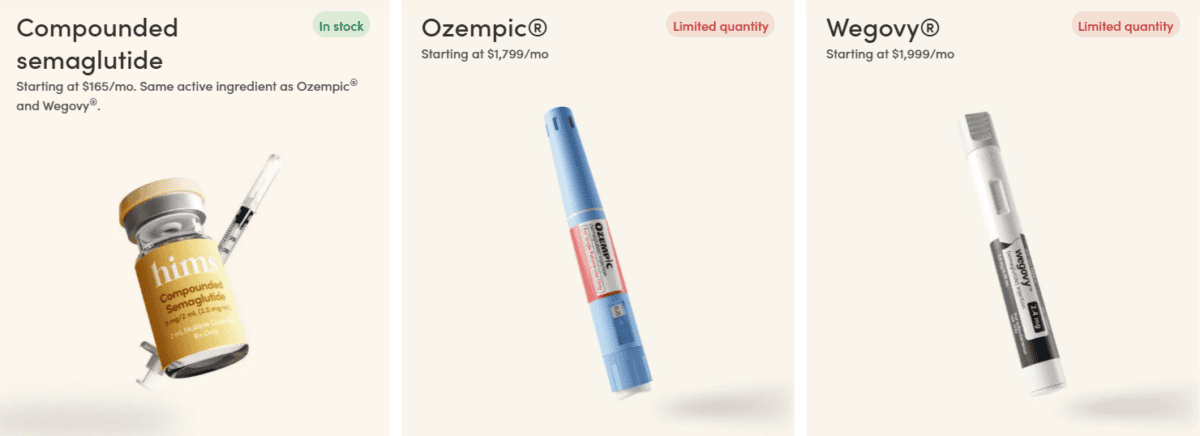
However, it has been compounded semaglutide products that have put rocket boosters under the share price. Semaglutide’s the active ingredient in Novo Nordisk’s blockbuster GLP-1 medications Ozempic and Wegovy. Compounded drugs are custom-made alternatives to branded versions.

In May, the company was allowed to start prescribing these copycat weight-loss products because there was a GLP-1 drug shortage due to massive demand. It’s been offering compounded versions of semaglutide at prices starting around $165 a month. By contrast, the list prices for Ozempic and Wegovy without insurance are way higher. 

Source: Hims website

Unsurprisingly, this has driven huge growth at the digital health firm. However, regulators announced last week that the shortage in semaglutide injection products is over. As a result, compounding pharmacies like Hims and Hers will have to stop selling them in the next few weeks.

Still strong growth

On 24 February, the company posted its Q4 results. Revenue surged 95% year on year to $481m, while earnings per share skyrocketed to 11 cents from 1 cent. However, gross margin fell from 83% to 77% due to the higher costs and GLP-1 products that were “strategically priced to attract new customers“.

Co-founder and CEO Andrew Dudum said: “We continue to build a platform that leverages personalisation and technology unlike any traditional healthcare system. Over 2 million subscribers now entrust Hims & Hers to aid them in their journey to better health.”

The underlying platform’s growing nicely. Excluding GLP-1 drugs, full-year revenue increased 43% to over $1.2bn. This saw the firm reach its previous 2025 revenue target a year early!

Meanwhile, the company’s pursuing vertical integration. To this end, it recently acquired a peptide facility in California and blood-testing business Trybe Labs. This latter acquisition allows it to offer at-home blood testing services, providing customers with insights into various health markers.

Worth watching

For 2025, management expects revenue of $2.3bn-$2.4bn (roughly 60% year-on-year growth) and adjusted EBITDA of $270m-$320m. That puts the stock on a reasonable price-to-sales (P/S) multiple of about 3.5.

Nevertheless, the concern here is that earnings growth will drop sharply once compounded semaglutide products disappear. There’s also a lot of competition in the digital healthcare space.

I think it might be too risky to try and catch this falling knife right now. But this is a very interesting $8bn growth company. So I’ve put the stock on my watchlist.

£10,000 invested in Lloyds shares 20 years ago is now worth…

It’s great to see Lloyds Banking Group (LSE: LLOY) shares up 25% so far in 2025. That would already have turned £10,000 invested at the start of the year into £12,500 today.

We’re seeing a 31% gain over five years, which would take £10,000 up to £13,100. Oh, plus five years of dividends. But even five years is still a short time for long-term Foolish investors. What does the long term say?

Two decades

Let’s take ourselves back 20 years to 2005. Before Covid, Brexit, PPI mis-selling… and even before the 2008 banking crisis.

At the end of February 2005, Lloyds shares were selling at 318p. At the time of writing, we’re looking at a price of 68p. That’s a 79% fall, which would have reduced £10,000 to just £2,100. Ouch! What can we learn? I think quite a lot, and it’s by no means all bad.

Thanks to dividends, our actual losses wouldn’t have been that high. No, Lloyds paid out a total of 141p per share over that period. So we could be sitting on a total value per share today of 209p.

That’s still a loss of 34%, which would leave our £10,000 worth £6,600. It’s still not great. But it’s not the wipeout we might expect from the second-biggest FTSE sector crash I can remember. The dot com crash was the biggest.

Diversification wins

It also shows the importance of diversification. Over that same two-decade period, the FTSE 100 is up 75%. Add around the same again in dividends, and it’s enough to take an intital £10,000 up to £25,000. That includes Lloyds and the other banks. And it also covers a period from Ocotber 2007 to February 2021 when the Footsie posted a zero overall rise.

Stock market investors have been through a high-risk 20 years. But look how well we could still have come out of it had we been well diversified.

Diversification can be tricky when we’re getting started. I bought some Barclays shares in 2007 just before the big crash. If it hadn’t been part of a diversified ISA, I could have quickly lost three-quarters of my money.

One way to reduce the risk would be to go for something like the iShares Core FTSE 100 UCITS ETF. That’s an exchange-traded fund that tracks the FTSE 100. Over 20 years something like that can closely match the index, less a small annual charge. We get maximum FTSE 100 diversification from just one buy.

Investment trusts

I like investment trusts too, and I have a couple, including City of London Investment Trust. It doesn’t try to track the market, but instead goes for a range of dividend-paying UK stocks. Again, it offers a package of diversification. And it’s raised its dividend for 58 years in a row.

I have one core takeaway from this look back on the past 20 years of Lloyds shares. Even someone buying Lloyds at such an apparently disastrous time could still have done well had it been part of a diversified strategy.

How much would we need in a Stocks and Shares ISA for £1,000-a-month passive income?

Albert Einstein is claimed to have called compound interest the eighth wonder of the world. In my world, a tax-free Stocks and Shares ISA might be number nine.

Combine them, and I reckon we have a great route for private investors to build up a passive income for when we retire.

More than 12 million UK adults subscribed to an ISA in 2022-23. That’s great. But almost eight million of those were Cash ISAs. And I think that could mean a lot of wasted opportunities.

Please note that tax treatment depends on the individual circumstances of each client and may be subject to change in future. The content in this article is provided for information purposes only. It is not intended to be, neither does it constitute, any form of tax advice. Readers are responsible for carrying out their own due diligence and for obtaining professional advice before making any investment decisions.

Different strokes for different folks

A Cash ISA can be a great way to set aside cash we might need for a rainy day. Or save for a planned spend in the not-too-distant future. Some offer 4-5% now, so I can see the attraction.

Some people don’t want any stock risk at all. So a guaranteed Cash ISA rate might be best for them, even if rates have been low over the long term.

And I’ll always remember a couple I once met who’d sold their business and retired. They’d invested in shares in the past, but now they had everything in cash… because they had enough to not need to take any risk at all.

It shows there’s no one-size-fits-all savings and investment plan. Everyone needs to weigh up their own needs and make up their own mind.

Back to the question

This doesn’t answer my question of how much we’d need to earn £1,000 a month. Part of it is straightforward. It depends on the return we achieve. If we can get 8% annually, we’d need a pot of £150,000. With only 2%, it would take £600,000.

The harder questions are how can we get there, and how long might it take?

I chose the 2% figure as it’s the UK’s inflation target. When we achieve that, interest rates should come way down. I think 2% might still be optimistic for a Cash ISA, but I can go with optimism.

The 8% is close to the forecast dividend yield for Legal & General (LSE: LGEN) shares.

What compounding can do

What about investing half an ISA allowance a year of £10,000, split monthly? That much into cash savings paying 2% a year could take 40 years to get over the £600,000 threshold for generating £1,000 a month.

But in a stock like Legal & General paying dividends of 8%? With all dividend cash reinvested, we could hit the required £150,000 in just 14 years. Sounds like an easy choice, right?

Well, Legal & General’s dividends aren’t guaranteed. It can be a cyclical business, and there’ll be bad years among the good, for sure. Will there be times when no dividend at all is paid? I’d say there’s a good chance. Financial stocks suffered in the 2020 stock market crash, and we can see the sharp Legal & General dive in the chart above.

Stock market diversification

I’d never put all my cash in Legal & General, or in any one stock. But with the FTSE 100 returning an average 6.9% annually over the past 20 years, I’d say the odds favour investors going for a diversified Stocks and Shares ISA.

Prediction: this newly-promoted FTSE 100 firm will outperform Rolls-Royce shares

Rolls-Royce shares have done really well in my portfolio since I bought them two years ago. Yet while I think the FTSE 100 engine maker is set up for further future gains, especially as defence budgets rise, I envisage a handful of stocks doing even better.

One of them is a newcomer to the UK’s blue-chip index: Polar Capital Technology Trust (LSE: PCT). Shares of this investment trust have surged 132% over the past five years.

However, the stock might just be getting started, making it one for growth investors to consider, in my opinion.

What it does

As the name suggests, this trust invests in the technology sector. It was launched in 1996 and has been managed by Polar Capital since 2001. It has been run by lead manager Ben Rogoff since 2006, which signals a stable investment philosophy.

What I like here is that the trust is invested in a number of high-growth technology themes. These long-term trends include:

  • online advertising
  • e-commerce
  • software as a service
  • cloud infrastructure
  • cybersecurity
  • artificial intelligence (AI)
  • connectivity/5G

The portfolio contains 105 stocks, but the top 10 holdings at the end of January accounted for nearly half (49%). I do like to see a concentrated portfolio, as one spread too thinly among many hundreds of shares operates in a (pointlessly) similar way to a global index fund.

The top five positions are Nvidia (7.5%), Meta Platforms (7.3%), Microsoft (6.8%), Apple (6.1%), and Alphabet (5.9%). It also has a large holding in Taiwan Semiconductor Manufacturing (TSMC), which makes the high-end chips for Apple and Nvidia.

Furter down the portfolio, there are interesting stocks like edge computing firm Cloudflare and streaming app Spotify.

Over the 10-year period to the end of January, the trust’s net asset value (NAV) rose 602%. This strong performance has pushed its market value above £4bn and into the FTSE 100 for the first time.

Today, rapid innovation is propelling AI towards superhuman capability. While market fluctuations are inevitable, Polar Capital Technology Trust is well positioned for the AI era which we expect to be one of the most exciting and transformative investment opportunities of our lifetimes.

Ben Rogoff

Volatility is a given

One risk worth noting here is the heavy concentration in semiconductor and related equipment firms, which make up approximately 28% of the portfolio. While I expect this sector to only grow in importance — nearly everything has a chip in it nowadays — it can also be highly cyclical. This means the earnings of semiconductor companies can be volatile.

Also, Nvidia is a large and important holding. If the AI chipmaker’s rate of growth slows faster than expected over the next year, the trust’s position in it could become less valuable.

A final thing worth highlighting is that there was a 10% performance fee if the managers significantly outperformed. Thankfully, that is getting scrapped in May. The ongoing charge on Hargreaves Lansdown is 0.85%, which is competitive within the sector.

Foolish takeaway

As the AI/digital revolution intensifies over the coming decade, I expect Polar Capital Technology Trust to grow alongside it. I see it easily outperforming the wider FTSE 100, including Rolls-Royce.

Finally, the shares are trading at a 7% discount to the trust’s NAV. I think they’re worth considering for inclusion in a diversified portfolio.

Financial News

Daily News on Investing, Personal Finance, Markets, and more!

Financial News

Policy(Required)