Here’s the latest dividend forecast for Aviva shares through to 2026

Aviva (LSE: AV.) shares are beating the FTSE 100 in 2025. As I write, the insurer’s up 10% versus a near-7% gain for the Footsie.

However, Aviva easily triumphs with its juicy dividend yield. Right now, that stands at around 6.8%, roughly double the FTSE 100’s 3.4%.

Indeed, things look even better when we consider the latest dividend forecast. They show some attractive income potential.

High-yield stock

For 2025, the market currently expects the company to dish out a dividend of 37.7p per share. That translates into a forward yield of 7.3%.

For 2026, the payout’s forecast to rise to 40.3p per share, which gives an eye-catching prospective yield of 7.8%.

Of course, no dividends are guaranteed, as Aviva proved during the pandemic when it slashed its payout. But as one of its shareholders, I’m optimistic on the income growth prospects here.

Management is sounding an optimistic tone too. In the Q3 trading update, CEO Amanda Blanc said: “Aviva is financially strong, trading well each quarter and has significant opportunities for further growth. We are confident about the outlook for the rest of 2024 and beyond, growing the dividend and achieving the Group’s financial targets.”

Year Dividend per share Dividend growth Dividend yield
2024 35.3p 5.7% 6.8%
2025 37.7p 6.7% 7.3%
2026 40.3p 6.9% 7.8%

Now, it should be noted that the company’s £3.7bn takeover of Direct Line is expected to close by the middle of 2025. This combined group will command more than 20% of the UK motor insurance market.

This deal will increase the total number of Aviva shares outstanding. However, the firm anticipates that the acquisition will enhance its earnings capacity, leading to a projected mid-single-digit percentage increase in the dividend per share following completion.

However, it doesn’t expect to launch any share buybacks in 2025.

Source: Aviva presentation on the Direct Line acquisition.

Solid business

In recent years, Aviva’s disposed of low-growth or non-core international operations. This has seen it focus on markets in Ireland, the UK, and Canada. Consequently, the business is much leaner and has been progressing nicely.

In Q3, general insurance premiums rose 15% to £9.1bn, with 18% growth in the UK and Ireland and 11% growth in Canada. Meanwhile, wealth net flows of £7.7bn were 21% higher.

Over the last four years, Aviva’s increased its customer numbers by 1.2m to 19.6m. It now has 5m customers in the UK with more than one policy. The ambition is to grow that to more than 21m customers by 2026, including 5.7m UK customers with two or more policies.   

A dividend stock worth considering

One risk with this stock comes if the UK dips into a recession. And with the UK economy stagnating right now and inflation ticking up, that can’t be ruled out. In this scenario, consumers could choose not to renew certain insurance policies.

Nevertheless, I think Aviva’s worth considering for investors looking for a solid dividend stock. A forward yield in excess of 7% combined with a cheap valuation signals good value to me.

The share price has also broken through the £5 barrier for the first time in years. So it has good momentum on its side, and I’m hoping for further price gains this year.

Here’s how much £500 put into Nvidia stock a year ago is worth today

One of the big stock market stories of recent years is the stunning performance of chipmaker Nvidia (NASDAQ: NVDA). Over the past five years, Nvidia stock has soared 1,776%. Wow!

On top of that there is a dividend, although with a current yield south of 0.1%, the main driver for shareholder returns has been share price growth.

But I did not invest in Nvidia stock five years ago. How have investors done on a shorter timeframe?

Why I invest for the long term

Over the past year, the share price has gone up 60%. So £500 invested 12 months back would now be worth £800 (ignoring exchange rate movements).

That is still an excellent return as far as I am concerned. It significantly beats the 17% increase in the US S&P 500 index over the same period, or the 13% growth in the value of the FTSE 100.

But, while I would have been very happy with such a result, it falls far below what Nvidia stock has managed to do over five years. In that sense, I see this as a useful reminder of why I invest for the long term.

A great investment case like Nvidia’s (massive market, surging demand, unique product technology and largely price-insensitive customers) can produce results in a relatively short timeframe. But it tends to be by taking a longer-term approach that the really impressive growth can start to add up.

Tiny dividends are still dividends

I mentioned above that Nvidia stock has a miniscule dividend yield of 0.03%. On a £500 investment, that would be around 15p a year of dividends.

Bear in mind that that is the current yield. For an investor who bought a year ago, the yield would be higher because the share price was lower. That is even truer for someone who bought five years ago. They would be earning around £2.80 per year of dividends on a £500 investment.

That is still fairly small beer, but In a Stocks and Shares ISA, for example, those dividends could be piling up free of tax, ready to be reinvested in other shares.

But, again, the current dividend only tells one part of the story. While the yield is paltry, the dividend per share has been growing fast. Last May, for example (allowing for the impact of Nvidia stock splitting), the quarterly dividend per share grew 150%.

With a large market, massive profits (net income was $19.3bn in the most recent quarter) and proven cash generation ability, I think there is plenty of scope for Nvidia to keep raising its shareholder payout significantly.

Please note that tax treatment depends on the individual circumstances of each client and may be subject to change in future. The content in this article is provided for information purposes only. It is not intended to be, neither does it constitute, any form of tax advice. Readers are responsible for carrying out their own due diligence and for obtaining professional advice before making any investment decisions.

Should I bite the bullet and invest now?

Although I did not buy Nvidia stock a year ago, I do believe in the growth story here. So will I invest £500 today?

I am sorely tempted, but I do not plan to. With a price-to-earnings ratio of 50, the valuation simply looks too rich for my tastes.

After all, as the Deepseek launch suggested, AI technology that requires less processing power could lead to a sudden plunge in demand for high-end chips. If buying Nvidia stock I would want a price with a margin of safety that makes me feel comfortable.

Up 47%, does the BT share price have more room to grow?

One of the star performers in the FTSE 100 index over the past year has been BT (LSE: BT.A). In just 12 months, the BT share price has soared 47%.

Sure, it has been a good year for the FTSE 100. The flagship blue-chip index has moved up 14% during that time. But with a performance over three times as strong, the BT share price has left it in the dust.

What has been going on – and might it make sense for me to buy some BT shares for my ISA even at this point in the game?

Long-term, revenues are in decline

At the operational level, it has largely been business as usual for the telecoms giant.

In the first nine months of last year, adjusted revenue fell 3% year-on-year. I do not mind investing in businesses with limited growth prospects, but it is always something of a red flag to me when a firm has falling sales revenues.

That can make it harder to swallow fixed costs – and a telecoms operator has plenty of those. BT revenue has been in long-term decline for years with the odd exception (such as 2024).

Shaking the value tree

The first nine months of last year saw adjusted earnings before interest, tax, deprecation and amortisation (EBITDA) grow 2%. All of that came from the firm’s Openreach division. Its consumer and business arms both showed year-on-year EBITDA declines.

I generally treat EBITDA with caution as a performance metric. Expenditures like interest and tax can be real cash costs. But in the first half, BT’s adjusted EBITDA grew 6% and reported profit was even stronger, up an impressive 29% year-on-year. So while we await the full-year numbers, it looks as if it was potentially a year of revenue contraction but real profit growth. That is consistent with a mature business milking its cash cow.

That helps explain why the BT share price has performed so strongly over the past year.

Investors have been running the slide rule over the business and weighing up some of its strengths, such as a still-powerful brand, large installed user base, significant pricing power and an Openreach business that is both valuable and has long-term growth prospects.

Add in the profits and BT may have looked like a bargain. Even now, after the share price rise, its total market capitalisation is only £15bn.

I don’t like the risk profile here

But the full picture is more complicated than that. For one thing, the business may only have a market capitalisation of £15bn, but that does not mean it is valued at £15bn. BT also has net debt approaching £20bn.

In the first half of last year, that grew rather than shrinking. Over the long term, a key risk I see (and that has put me off buying BT shares in the past) is that its legacy pension scheme could suddenly need more money put into it, eating into profits.

Indeed, the business said the net debt growth in the first half was “mainly due to pension scheme contributions”. Add to that uncertain long-term financial obligation a business in structural decline and I do not see the BT share price as a bargain.

At a price-to-earnings ratio of 20, I see it as pricey. I will not be investing.

After its strong 2024 results, HSBC’s near-£9 share price looks a steal to me!

Some investors might think HSBC’s (LSE: HSBA) share price has increased so much this year it cannot keep rising.

Others may believe the bullish momentum developed from its 11 March one-year traded low of £5.72 cannot be derailed.

As a former senior investment bank trader and longtime private investor I know neither view helps in optimising investment returns.

I am only interested in whether there is any value left in the stock. If there is, I will add to my existing stake in the bank. Otherwise, I will keep my position as is.

How does the stock’s price look in value terms?

Price and value are not the same thing. And the difference between the two is where the big profit opportunities lie, in my experience.

The key tool I use to determine the fair value of any stock is the discounted cash flow (DCF) method. This shows where any share should be priced, based on future cash flows for a firm.

Using other analysts’ figures and my own, the DCF for HSBC shows its shares are 45% undervalued right now. This is despite their big rise since March.

Therefore, the fair value for the shares is technically £16.31.

Market vagaries might push them lower or higher at different points, of course. But the DCF underlines to me that HSBC looks a steal to me at the current price.

How does the core business look?

The bank’s 2024 results released on 19 February saw profit before tax rise 6.5% year on year to $32.309bn (£25.66bn). This was higher than consensus analysts’ forecasts of $31.67bn.

Earnings per share increased 8.7% to $1.25, and the dividend per share rose 43% to 87 cents. These strong numbers enabled the bank to announce a $2bn share buyback expected to be completed by the end of Q1. These tend to support share price gains.

A risk to these numbers is a continued decrease in the bank’s net interest margin (NIM). This is the difference between the loan and deposit interest rates. It has fallen since the Bank of England resumed rate cuts last year.

HSBC’s NIM dropped from 1.66% in 2023 to 1.56% in 2024.

That said, the bank is shifting its strategy away from interest-based and towards fee-based business. Wealth and personal banking delivered over a third of its 2024 profits with this share expected to increase in 2025.

Overall, HSBC targets a return on tangible equity (ROTE) in the mid-teens in each of the three years from 2025 to 2027. Unlike return on equity, ROTE excludes intangible elements such as goodwill.

The high-yield bonus

The increase in 2024’s dividend has pushed HSBC’s yield up to 7.7%. By comparison, the average FTSE 100 yield is 3.5% and the FTSE 250’s is 3.3%.

So, investors considering an £11,000 (the average UK savings) holding in HSBC would make £12,699 in dividends after 10 years. After 30 years, this would increase to £99,004.

These numbers are based on an average 7.7% yield and the dividends being reinvested back into the stock.

With the initial £11,000 stake added in, the HSBC holding would be worth £110,004 by then. This would be paying £8,470 in yearly dividend income at that point.

Consequently, I will be buying more of the stock very soon.

£10,000 invested in Lloyds shares at the start of this year is now worth…

If an investor had put £10,000 into Lloyds (LSE: LLOY) shares at the start of this year, they’d be justified in breaking out the bubbly.

The FTSE 100 bank has bounced back nicely after being outgunned by rivals Barclays and NatWest last year.

A key factor in its underperformance was the motor finance mis-selling scandal. Lloyds is far more exposed than Barclays and NatWest via its Black Horse car loans division. The board set aside £450m for potential impairments. Some analysts reckon it could be on the hook for billions.

In its full-year 2024 results, published on 20 February, the board set aside an extra £700m to cover potential claims. That lifted the total to £1.15bn, which Lloyds called its “best estimate”.

This FTSE 100 bank is bouncing

Investors now await a Court of Appeal hearing in April about the scope of a review into the scandal. This could drag on for months or years. Yet investors decided not to panic. Why?

They were too busy celebrating the board’s bumper £1.7bn share buyback. If that was designed to show investors that Lloyds could afford to lose a billion or two in compensation, it worked. The dividend was hiked by 15%.

This also put a positive gloss on a 20% drop in pre-tax profits from £7.5bn to £5.97bn. In another disappointment, net interest margins, the difference between what Lloyds pays savers and charges borrowers, fell 16 basis points to 2.95%.

Sometimes I really don’t understand the stock market. On another day, Lloyds could’ve taken a beating. Instead, the shares are flying. Over the last 12 months, Lloyds shares have surged 46%. That’s good, but over the same time scale Barclays has rocketed 87% with NatWest up a staggering 93%.

Still, £10k invested in Lloyds at the start of the year would now be worth £12,100. The investor won’t have received any dividends yet, but they’ll get a payout on 20 May.

Dividends are on the way

Even after this rally, Lloyds shares still don’t look too expensive. They trade at a price-to-earnings (P/E) of 10.7, comfortably below the blue-chip average of around 15 times.

I’m a little concerned by the price-to-book ratio. When I bought the shares a couple of years ago, it was down to 0.4. Last year, it was around 0.6, then 0.8. Today, it’s up to 0.9. The shares are starting to look fully valued.

When I look at the income, I stop worrying. The trailing dividend yield stands at 4.75%, but analysts expect this to rise to 5.01% in 2025 and 5.73% in 2026.

If interest rates fall later this year, that could boost consumer lending (but may squeeze margins further). The motor finance scandal could drag on, as could the general downturn and cost-of-living crisis.

The 18 analysts offering one-year share price forecasts have produced a median target of just under 69p. If correct, that’s an increase of just 2.8% from today. The easy gains may have been made.

I still think the shares are well worth considering for an investor who wants long-term exposure to a FTSE 100 bank. I’m holding mine, with luck, for decades. But in the shorter run, I expect them to slow from here.

What returns can an investor expect with £5 a day in a Stocks and Shares ISA?

UK stock market investors love to make the best of their Stocks and Shares ISA allowance. This is because the rules provide for up to £20,000 a year invested with no tax levied on the capital gains.

That can amount to some serious savings later in life. For instance, with 10% average returns on a portfolio, an ISA could save £2,000 a year!

Please note that tax treatment depends on the individual circumstances of each client and may be subject to change in future. The content in this article is provided for information purposes only. It is not intended to be, neither does it constitute, any form of tax advice. Readers are responsible for carrying out their own due diligence and for obtaining professional advice before making any investment decisions.

But before we get ahead of ourselves, let’s start small.

A fiver a day

Stashing five quid away each day may seem like a small amount but it all adds up. Within a year, that’s £1,825 saved! When invested in a well-diversified portfolio inside an ISA, that money can be put to work.

Consider a portfolio that returns the historical average of 10% (which isn’t guaranteed and returns can be much lower). By investing just £1,825 per year and compounding the returns, the pot could grow to £38,324 in 10 years. 

That’s almost double the amount invested!

But it’s not a life-changing amount just yet. With a meagre £1,000 drawn down per month, it would barely last three years. Serious returns may require more time.

After 20 years, the compounding returns really kick in. At that point, it could have grown to £137,000 — assuming the average returns held. Just two years later and it would be over £170k.

At that point it would be almost large enough to convert to a dividend-based income portfolio. With an average yield of 7%, a £172,000 portfolio could bring in £12,000 a year in passive income.

So what UK stocks are worth considering when aiming for stable dividend income?

Here’s one I like.

HSBC

HSBC (LSE: HSBA) is the largest bank in the UK and one that investors have long-trusted for growth and dividends.

The stock’s yield fluctuates between 6% and 7%, often delivering some of the highest dividends in the UK banking sector. It’s hit some snags in the past — a reduction in 2008 and 2019 — but generally the dividend grows each year.

A recent restructuring under new CEO Georges Elhedery could help save £1.2bn by streamlining operations and enhancing efficiency.

But as always, risks are ever present. The restructuring could cost £1.42bn in severance costs alone, potentially impacting short-term profits. Plus the current geopolitical situation doesn’t help, leading HSBC to consider splitting operations east to west. 

That could invite a whole host of new risks into the fray.

Results-wise, it’s been doing well lately. In 2024, its pre-tax profits reached a record £25.5bn with net profit of £18.1bn, a 2.2% increase from the previous year. It also announced a £1.5bn share buyback programme, reflecting loyal commitment to its shareholders.

Asset allocation

HSBC is just one great dividend stock to consider. Others include Legal & General, British American Tobacco and BT Group. It’s also good practice to include some defensive shares like AstraZeneca or Unilever

A well-diversified portfolio ideally has a mix of assets, including ETFs, commodities and investment trusts. This helps protect against a single point of failure, keeping the portfolio steady during uncertain economic periods.

The FTSE 100 is in a strong bull market. Here are 2 shares to consider buying now

The FTSE 100 is in a powerful bull market right now. Currently, nearly 70% of the stocks in the index are above their 50-day moving averages (meaning that they’re trending up).

Looking for shares to buy in this market? Here are two Footsie names to consider now.

A bank stock with a big dividend

First up, we have banking powerhouse HSBC (LSE: HSBA). It has had a good run recently (it’s up about 45% over the last year) but it still looks quite cheap today on a price-to-earnings (P/E) ratio of 8.7.

I’m bullish on this bank stock for a few reasons. One is that I like the company’s strategy. Today, HSBC’s management is focused on creating a simple, more agile, focused bank built on its core strengths. This involves targeting high-growth areas such as Asia and wealth management. It also involves cutting costs. Recently, management said that it’s committed to an annualised reduction of $1.5bn in its cost base by the end of 2026.

Another is that the company is returning plenty of capital to investors. Earlier this month, HSBC advised that it’s initiating a buyback of up to $2bn. It also declared total dividends of 87 cents per share for 2024. That translates to a yield of 7.7% at today’s share price (note that analysts expect a lower payout of about 66 cents per share for 2025).

Of course, as a global bank, HSBC does face plenty of risks. These include economic weakness in China, falling interest rates (higher rates are generally better for banks), and regulatory fines.

Given the relatively low valuation and attractive dividend payments, however, I like the risk/reward proposition.

Growth and income at a reasonable price

Another Footsie stock that I believe is worth a look today is Coke bottler Coca-Cola HBC (LSE: CCH). It also has strong share price momentum at present but doesn’t look particularly expensive (the P/E ratio is about 15.7).

One reason I’m bullish on this stock right now is that the company is growing at a really healthy rate. Earlier this month, it advised that for 2025 it expects organic revenue growth of 6%-8% along with earnings per share growth of 7%-11%.

It’s worth noting that since the company provided these forecasts, a number of brokers have raised their price targets for the stock. These include Bernstein and JP Morgan, who have gone to 3,625p and 3,650p respectively.

I also like the company’s dividend growth track record. The yield here isn’t super high (about 3% currently) but the payout has been increased every year since 2014.

Of course, changing consumer tastes and preferences are a risk here. While Coke has been around for decades, there are no guarantees that it will continue to be popular in the years ahead.

The good news, however, is that Coca-Cola HBC has a whole portfolio of beverages (including sports drinks, coffee, energy drinks, and spirits). This diversified portfolio should reduce brand specific risk for investors.

The US stock market extends its losses! Can Nvidia results save the day?

The US stock market has been hit with a triple-whammy of trade tariffs, AI threats and inflation fears, leading to prices dropping across the board.

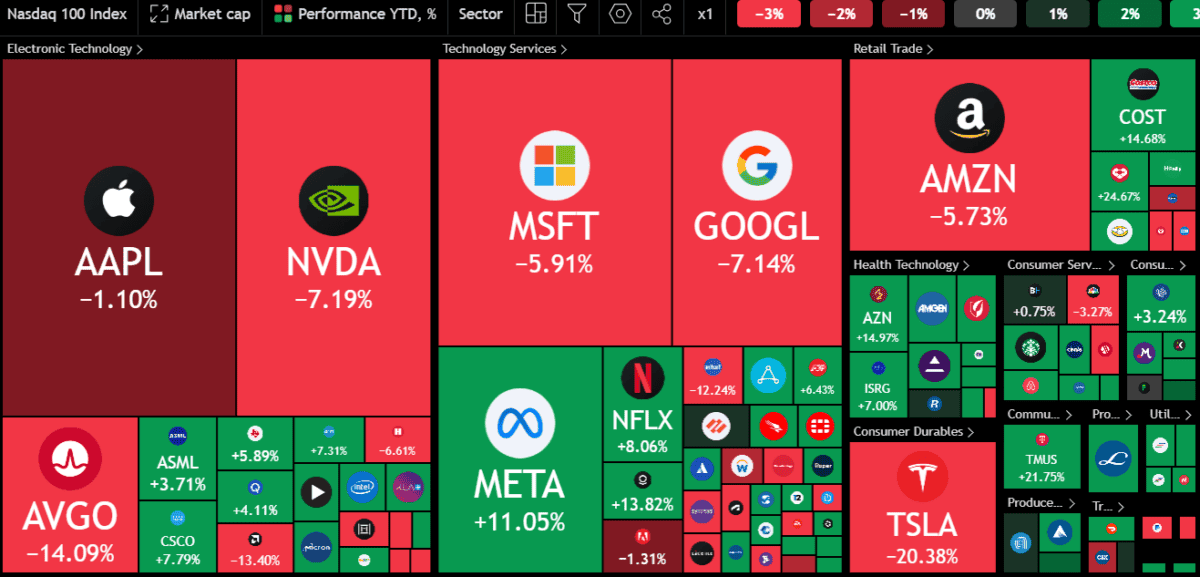
Popular indices like the S&P 500 and Nasdaq 100 are down 3% to 4% since last week. While there’s been some growth in healthcare and retail, major tech and finance stocks have suffered the most.

So far this year, Microsoft and Amazon are down by around 5.7%. Meanwhile, Google and Nvidia (NASDAQ: NVDA) have seen losses closer to 7% each.

Some of the worst hit include Tesla and Axon, both down by around 20%. Overall, approximately 40% of Nasdaq 100 stocks are suffering losses this year. This is despite the vast majority of stocks finishing last year up.

Created on TradingView.com

With Nvidia set to report Q4 earnings today (26 February), all eyes are on the semiconductor manufacturer. Can it deliver market-beating results and save the day?

High expectations

Analysts have high expectations for Nvidia, with revenue forecast to grow 72% and earnings per share (EPS) 63% year on year. 

Despite recent losses attributed to the launch of AI competitor DeepSeek, the price is up over 60% in the past year. The past two months, however, have been a marked difference from the gains it made in 2023 and 2024.

The loss of momentum has many questioning where Nvidia stock may be headed in 2025. The $3.17trn company has been losing ground to Apple this year after briefly securing the top spot as the largest global company by market cap.

Other major tech stocks with AI links have followed suit while Apple has bucked the trend. Meta briefly tracked its growth only to suffer a sharp correction in the past week. 

Maybe Apple alone keep the AI dream alive in the US?

US market outlook in 2025

A failure to impress in today’s earnings could extend Nvidia’s losses and further compound the US stock market’s rout.

Already there are signals from leading investors that troubles are brewing. Warren Buffett, for instance, seems to be leaning toward substantial cash reserves, possibly anticipating a market downturn. Similarly, Howard Marks of Oaktree Capital has raised concerns about potential market corrections following recent strong performances.

Economist Julia Coronado has highlighted risks such as slowing economic growth, stubborn inflation and geopolitical uncertainties. All these factors could impact market stability in 2025 and beyond.

But it’s not all doom and gloom. 

BlackRock’s Fundamental Equities CIO Tony DeSpirito remains optimistic about market gains this year, albeit at a more subdued pace than in 2024.

Goldman Sachs recently raised its GDP growth forecast for 2025, citing strong consumer spending, a resilient job market and improving corporate earnings. Morgan Stanley analysts expect the S&P 500 to grow although at a more moderate pace than last year, driven by AI-driven productivity gains and strong performance from the tech sector.

For now, the US market stands at a sensitive juncture, one that could be tipped by today’s results. If Nvidia fails to impress, the knock-on effects could drag the rest of the market down. Alternatively, a solid set of results could reassure investors that DeepSeek isn’t a serious threat.

Will that alone be enough to turn US markets around? I doubt it — but it might just be enough stop the current slide.

Down 30% to just around £12, Persimmon’s share price looks a bargain to me now!

Persimmon’s (LSE: PSN) share price is down 30% from its 16 October 12-month traded high of £17.21.

A big drop like this could mean a firm is fundamentally worth less than it was before. Or it could signal a major bargain to be had.

I ran key valuation numbers and looked more closely at the core business to find out which is true here.

How does the operational background look?

The advent of Covid in 2019/20 hit the UK housing market hard. The subsequent rise in interest rates that pushed mortgages to 16-year highs made matters worse. And the resultant cost-of-living crisis added to housebuilders’ woes.

However, last year’s first cuts in benchmark UK interest rates since March 2020 flagged a possible turnaround in their fortunes. And another reduction was made earlier this month.

Moreover, the government remains committed to its pre-2024 election promise to build 1.5m new homes over five years.

A risk for Persimmon is the tax-raising October budget exacerbates the current cost-of-living crisis.

Is the core business healthy?

In its 14 January 2024 trading update, Persimmon delivered 10,664 homes, up 7% year on year, ahead of market expectations.

The average selling price of the properties was up 5% compared to 2023. And its order book increased 8% to £1.146bn.

Over the same period, the firm opened 100 new sales outlets, bringing up the total to 270.

Given these numbers, it expects full-year 2024 underlying profit before tax to be at the upper end of its previous £349m-£390m guidance.

It also predicts a 14% underlying operating margin, in line with previous guidance.

Consensus analysts’ forecasts are that Persimmon’s earnings will increase 16.9% a year to the end of 2027.

And it is this growth that ultimately drives a firm’s share price and dividend higher over time.

What’s the current dividend and projections?

In 2023, Persimmon paid a total dividend of 60p. On the current share price of £12.02, it gives a yield of 5%. This compares very favourably to the FTSE 100 average of 3.5%.

However, analysts forecast the dividend will rise to 65.2p in 2025, 71.5p in 2026, and 80.2p in 2027.

These would give respective yields on the present share price of 5.4%, 5.9% and 6.7%.

Are the shares undervalued?

Persimmon trades at a price-to-earnings ratio of 15.3 against a peer average of 24.6. So it is a bargain on this measure.

However, it looks overvalued on its 1.2 price-to-book ratio compared to the 0.8 average of its competitors. This also applies to its 1.4 price-to-sales ratio against its peer average of 1.2.

A discounted cash flow analysis using other analysts’ figures and my own shows Persimmon shares are 45% undervalued at their current £12.02 price. So, their fair value is technically £21.85, although market vagaries could push them lower or higher.

Will I buy the stock?

Aged over 50, I am in the later part of my investment cycle. So, I do not want to wait for stocks to recover from any price shocks.

I think Persimmon’s earnings growth will power its share price and dividend much higher over time.

However, I do not rule out a short-term dip if the government continues to raise taxes and then fails to meet its housebuilding targets.

Therefore, this share is not for me right now.

£10,000 invested in BAE Systems shares 1 year ago is now worth…

BAE Systems (LSE: BA) shares should be soaring right now, if you ask me. The FTSE 100 company is Europe’s largest defence contractor and the continent is feeling jumpier than it has done in years. 

Europe had grown accustomed to US military protection, but under President Donald Trump it can no longer take that for granted. 

NATO members are going to have to step up their spending as the US pulls back, which should be good news for BAE.

Can this FTSE 100 stock fight back?

Yet, over the past year, BAE’s share price has climbed just 1.13%. Throw in the trailing dividend yield of 2.53% and the total return stands at a modest 3.66%. 

A £10,000 investment a year ago would be worth just £10,366 now. By contrast, a simple FTSE 100 tracker would have lifted the same amount to £11,700, including dividends.

However, the long-term picture is stronger. Over five years, BAE Systems is up 88%, more than doubling an investor’s money with dividends reinvested. 

One issue may be valuation. As the shares climbed, so did the price-to-earnings ratio, which topped 22 times last year.

There’s also uncertainty surrounding US defence policy. While Trump has expressed strong support for military spending, he’s also focused on reducing the national deficit. Some worry that could impact US weapons procurement. Trade war tariffs pose another threat.

Yet BAE’s recent results suggest demand remains robust.  Full-year 2024 figures, published on 19 February, showed the company secured £33.7bn in orders, pushing its backlog to a record £77.8bn. 

Revenues surged 14% to £28.3bn, while underlying earnings before interest and taxes rose 14% to more than £3bn. Free cash flow of £2.5bn funded a 10% dividend hike.

Despite these solid numbers, the share price dropped 11%. That reaction puzzled me. Profit-taking might explain it, but given the lacklustre short-term gains, it’s hard to see why.

One silver lining: that P/E now looks more reasonable. BAE shares trade at 18.3 times earnings, only slightly above the FTSE 100 average of around 15. Given the security of its vast order book, I expected a higher premium.

Long-term buy and hold

Some ESG-focused investors remain wary of defence stocks, but that sentiment has softened as Russia menaces.

I bought BAE shares last year and have been disappointed by their short-term performance. But I’m not worried. I view this as a long-term play. I plan to hold for at least five, 10, or even 20 years. Unless the world suddenly embraces love, peace, and understanding (it won’t), BAE should continue to thrive.

Analysts predict a one-year median target price of just over 1,512p, suggesting a potential 16% rise from here. With the dividend, that could deliver a total return of nearly 20%. No guarantees though

Achieving this depends on factors like sustained defence spending, effective order execution, and overall market conditions.

For those with a long-term view, BAE shares look well worth considering. I’m certainly not selling. At some point, BAE Systems will take off again. I want to be holding them when they do.

Financial News

Daily News on Investing, Personal Finance, Markets, and more!

Financial News

Policy(Required)