Looking to target £100 a week in passive income? Consider these UK shares

Earning £100 a week in passive income from UK shares is a realistic goal for beginner investors. It just takes a bit of time and dedication.

By building a portfolio of reliable shares and reinvesting the dividends, the compounding returns can speed up the process. 

Here’s how I’d think investors should go about it.

Setting the target

To generate £100 per week – or £5,200 per year – from dividends, the size of the investment depends on the average dividend yield. 

For example:

  • A 5% average yield requires an investment of £104,000.
  • A 6% average yield requires £86,667.
  • A 7% average yield requires £74,285.

While these figures might seem high, remember that regular contributions and reinvesting dividends can help accelerate growth.

By investing £200 a month into a 7% portfolio and reinvesting the dividends, it would take less than 17 years to reach £74,285.

When factoring in any additional price appreciation, that time could be reduced even further.

Picking the right dividend stocks

When researching dividend stocks for an income portfolio, it pays to carefully evaluate the following metrics.

Yield

First, the dividend yield. It’s critical to find a balance between a high yield and sustainability. A yield above 5% is attractive but note that this can make sustainability less reliable.

Growth

It’s also important to ensure the company has a long track record of dividend growth. Increasing dividends not only affirms a dedication to shareholders but also provides inflation protection.

Health

Check the financial health of the company and make sure its balance sheet is solid. It should have consistent earnings with sufficient cash flow and manageable debt levels.

Cover

The dividend cover ratio is calculated by dividing earnings per share by dividends per share. It should ideally be above 1.5, meaning the company can easily afford to cover its payouts.

UK shares to consider

When looking at stocks for a dividend-focused portfolio, there are many good options in retail, utilities and financial services.

National Grid, for example, is the UK’s largest regulated utility company. It has a 5.3% yield and a 20+ year track record of increasing payments.

Global consumer goods giant Unilever performs well even through economic downturns. It only has a yield of 3.3% but is a consistent and reliable payer.

Lloyds Banking Group is another popular choice, with a yield usually around 5%. Its payment track record has been a bit sketchy since 2008 but improved lately.

The highest-yielding stock on the FTSE 100 is Phoenix Group (LSE: PHNX), a specialist life insurance and pension provider. Recently, its yield has risen above 10% but historically, it averages 7%.

It has a long history of stable payouts and dividend growth, climbing from 31.8p per share in 2011 to 52.6p in 2023.

Although I like the stock, its financials could be better. In 2023, it reported a £138m loss after revenue declined by 50%. This was impacted by £6.14bn in policy claims in 2022.

If it misses expectations in next month’s earnings call, the share price could take a further hit. It’s already down 25% in five years so the company needs a win.

Overall, I think its worth considering as the UK’s ageing population is ramping up demand for retirement and pension products. Analysts remain optimistic, forecasting growth of 11.5% on average in the coming 12 months.


As the WPP share price slumps on FY results, is this a big buying opportunity for me?

Media group WPP (LSE: WPP) reported a fall in 2024 revenue, and the share price slid 20% in morning trading Thursday (27 February). The day’s low so far, of 616.6p, is the cheapest it’s been in the past 52 weeks.

From a peak in early 2022, the share price has lost more than 45%. But I don’t think the results are as bad as the day’s big sell-off suggests.

Disappointing quarter

Revenue less pass-through costs fell 2.3% in the fourth quarter. That dragged full-year revenue on the same basis down 4.2%. But on a like-for-like (LFL) basis, WPP reported a full-year gain, up 2.3%.

The company has been through a restructuring phase, and CEO Mark Read spoke of “significant progress against our strategy in 2024“. But he added: “The top line was lower, however, with Q4 impacted by weaker client discretionary spend.”

In a business dedicated to advertising, PR and commercial communications services, that’s key. But does anyone really expect discretionary spend to be booming right now when inflation and interest rates are high, and individuals and businesses alike have less of the disposable stuff in their pockets?

I don’t. And in the current economic environment, this set of results looks decent to me. If anyone thinks the market has overreacted and unfairly marked a stock down, it’s a good time to consider buying, right? That’s what’s in my mind.

Changing strategy

WPP’s refocus of recent years looks to be bearing fruit. With its simplified client structure, around 92% of its business is now represented by just six agency networks.

As with many companies in public-facing industries, artificial intelligence (AI) is growing in importance. The company described AI, data and technology as “increasingly central to the way we serve our clients; critical to new business wins“.

Wins include Amazon, Johnson & Johnson, Kimberly-Clark and Unilever. These few alone make for a nicely diversified global selection, and to me they show WPP’s wide appeal.

WPP expects 2025 full-year LFL revenue less pass-through costs to be somewhere between flat and a 2% drop. That’s a bit disappointing. And I suspect it could keep the share price under pressure for much of the year.

AI future

The focus will be on AI development in the coming year. But I worry AI could erode its competitive advantage. Imagine a time when all we’d need to do is ask an AI model to design an advertising and marketing campaign.

Could it eliminate the need for media agencies like WPP altogether? I don’t see it happening any time soon. And I reckon expertise, experience and business contacts should still have lasting value. But it’s a scary thought at the back of my mind.

Ultimately it has to be down to valuation. Prior to these results, analysts had the price-to-earnings (P/E) ratio dropping to 9.5 by 2026. The 39.4p dividend just announced represents a 6% yield on the 650p share price at the time of writing.

WPP has long been bubbling under my list of potential buys for my ISA.These results might just move it up a bit.

£5,000 invested in stocks with a high dividend yield could make this amount of passive income

It’s always a careful balancing act when assessing the best UK income stocks with high dividend yields. As with anything in life, a higher reward usually equates to higher risk.

Dividend stock yields are no exception — the higher they are, the riskier they tend to be. If profits fall or expenses rise, a company paying a lucrative dividend may need to cut it to save money.

This is why I typically look for the sweet spot when it comes to dividend sustainability. That would be a percentage that most companies can maintain for an extended period of time without cuts.

Looking at historical trends, it’s rare to see a company maintain a yield above 8% for very long. Those that do are often suffering share price losses, which simply negate any dividend gains.

So I’m looking for companies with a steady stock price and a yield that’s consistently between 7% and 8%. 

Not an easy task!

One stock to consider

Take OSB Group (LSE: OSB), for example. Its share price has been relatively steady for the past five years. In rare moments it’s dropped to 200p or surged to 600p, but overall it’s been around 400p. 

The share price is up 95% in the past 10 years, representing annualised growth of 6.93% per year.

Since reaching a yield of 7% in 2022, it’s mostly fluctuated between 7% and 9%. Since 2014, it’s increased its annual dividend almost tenfold, from 3.9p to 32p per share.

That’s the kind of reliable dividend stock I’m looking for! 

But there’s no guarantee it’ll keep that up. What if the business is on the brink of collapse, or operating in a dying industry?

OSB Group doesn’t show any imminent signs of that happening but still, it faces risks. As a UK challenger bank, it operates in a highly regulated industry and is up against major competitors like Barclays and Lloyds. It must be creative if it hopes to appeal to customers who feel more comfortable with high-street banks.

Through various subsidiaries, the group offers a range of services like savings, mortgages, and financing, which helps expand its customer base. But it operates solely in the UK, so if the local banking sector suffers, it could hurt the share price.

That’s why diversification is key. Other similarly reliable dividend stocks to consider are British American Tobacco, BT Group, and Aviva. All three have stable share prices and yields that remain between 6% and 8%. 

Calculating returns

So how much passive income could an investor earn with £5,000 in a portfolio of stocks with yields between 7% and 8%? After one year, such a portfolio would only return between £350 and £400. That’s assuming moderate share price growth of 3%.

After 10 years of earning and reinvesting the dividends, the pot could reach almost £12,800. Still, it would pay only around £730 a year.

Clearly, it will require some additional contributions to achieve a meaningful return. 

An extra £100 each month would make a big difference. Then the investment would reach £32,300 after 10 years, paying dividends of £1,764. 

And after 20 years? The pot could balloon to over £88,000, paying a decent £3,600 per year. 

The longer held the better, as the miracle of compounding returns will make the pot grow exponentially!

Rolls-Royce shares are already up 24% in 2025. Is another bumper year on the way?

In 2023, Rolls-Royce (LSE: RR) was the best performing share in the FTSE 100 index. Last year, despite having already risen sharply, the company was again among the index’s top performers. In under two months this year, the share price has moved up 24% by early trading today (27 February) following the release of Rolls-Royce’s annual results.

So, should I add some Rolls-Royce shares to my portfolio now hoping for another blockbuster performance from the engineering company?

Solid business helped by a favourable environment

The past is not necessarily an indication of what to expect in future, of course.

Despite the Rolls-Royce share price soaring 688% since the end of 2022, it still trades on a price-to-earnings (P/E) ratio of 27.

That is not cheap, but it does not sound wildly overpriced to me either. After all, Rolls-Royce is a fast-growing yet proven business, with a large installed base of engines, unique technology and trusted brand.

Meanwhile, the business areas in which it operates are very favourable ones right now.

British and European defence spending is set to surge in coming years. Civil aviation has had a very strong couple of years and many airlines have been expanding their fleets. This means that the demand not only for new engine sales but also engine servicing has boomed.

Rolls has been making hay while the sun shines

That has helped propel Rolls’ commercial performance.

In its results, the company reported revenue growth of 15% year on- year. Net cash flow from operating activities surged 94%.

The company firmly put its heavy indebtedness of the pandemic era in the historical dustbin, reporting a net cash position of £0.5bn. Compared to net debt of £2.0bn a year beforehand, that is excellent.

And it declared a dividend of 6p per share.

What about profits?

Here, things get a bit more complicated. What the company calls (and has long called) its underlying pre-tax profit rose from £1.3bn to £2.3bn. However, the statutory profit before tax (which is the one I prefer to use, for consistency of comparisons) fell from £2.4bn to £2.2bn. That was slightly disappointing in my view.

Rolls-Royce has now set even higher targets

So, why did the Rolls-Royce share price soar following the release of the results?

The surging share performance in the past few years has been a combination of business results coming in strongly and the company setting aggressive growth targets.

There was more of that today. The company said that this year it expects to deliver £2.7bn-£2.9bn of underlying operating profit and £2.7bn-£2.9bn in free cash flow. That is two years earlier than previously expected.

It also boosted its medium-term (2028) targets to £3.6bn-£3.9bn of underlying operating profit, 15%-17% operating profit margin, £4.2bn-£4.5bn free cash flow and 18%-21% return on capital.

The share price might keep going

Today has already seen the Rolls-Royce share price hit an all-time high.

I think it might rise even from here. The business performance is strong, demand is strong and the company’s aggressive goals should focus employee minds.

However, demand largely sits outside Rolls’ control. The risk of a sudden plummet in civil aviation demand due to a pandemic, natural disaster or terrorism puts me off buying. At its current P/E ratio, I do not see sufficient margin in the share price so will not be buying Rolls-Royce for my ISA.

The Aviva dividend grew 7% last year – can it keep getting bigger?

There was good news for passive income fans in the annual results published today (27 February) by insurer Aviva (LSE: AV). The FTSE 100 firm announced a 7% increase in its annual dividend. That means the Aviva dividend now stands at 35.7p per share.

That is lucrative. Indeed, at the current share price it equates to a prospective dividend yield of 6.7%. The ex-dividend date for the 2024 final dividend (23.8p per share) is not until 10 April, so buyers of the share in coming weeks could still qualify.

But while that sort of yield and growth grabs my attention, is it sustainable? After all, no dividend is ever guaranteed to last and Aviva did slash its payout in 2020.

Evidence that Aviva’s strategy is working

Aviva is now a fairly different business in some ways to five years ago though. The essence may have remained largely unchanged, but there has been a strategic refocus on the core UK market. That has involved disposing of multiple overseas assets, returning some of the cash to shareholders along the way.

Such an approach can offer economies as scale, but might be seen as increasing concentration risk. Aviva’s fortunes are now more closely tied to the UK than before. Aviva is the country’s leading diversified insurer and has over 20m customers globally.

Its proposed takeover of Direct Line will help it build further scale, while unlocking an estimated £125m per year of cost savings due to getting rid of duplicated activities in the two companies.

Last year, Aviva grew its adjusted operating profit by a fifth to £1.8bn. It is targeting £2bn by 2026.

Why insurance shares can be high-yield

Insurers tend not be very exciting businesses. When they have growth prospects – and Aviva does, thanks to moves like the Direct Line takeover – they do not always get full credit from investors.

So when it comes to the investment case, dividends matter. Boards know that. It is no surprise that, alongside Aviva, some other big FTSE 100 dividend payers are in the insurance business, such as Phoenix with its 10.3% yield and 8.4%-yielding Legal & General.

That means that, while cuts sometimes happen – weak markets can hurt investment returns, eating into profits – insurers realise that dividend growth can make them more attractive to investors. Of course, that depends on the business performance being strong enough to fund it.

I reckon the dividend can keep on getting bigger

Aviva’s stated aim is “mid-single digit (percentage) growth in the cash cost of the dividend”. In other words, it expects to spend somewhere around 5% more each year on paying dividends than it did the prior year.

Note that this growth is in the “cash cost” not dividend per share. Why? By buying back its own shares, Aviva has been reducing its share count. That means fewer shares in circulation. That allows it to grow its dividend per share by, say, 7% without the overall cost of doing so growing by quite as much.

Aviva does face challenges. Integrating Direct Line could distract management from running what is already a vast, complex business. But if the business keeps performing well, I see room for the Aviva dividend to keep growing from here.

That could make it a share to consider for passive income.

As the Rolls-Royce share price hits a record high, I missed out badly

I keep waiting for Rolls-Royce Holdings (LSE: RR.) to miss forecasts and for the share price to tumble so I can buy cheap. But once again it hasn’t happened, as 2024 results smashed through expectations.

In early trading Thursday (27 February), Rolls-Royce shares spiked 16% to reach a new all-time high of 735p.

Key points

Rolls announced a share buyback of up to £1bn. This is the company that, in the 2020 stock market crash, had to take on billions in debt just to survive. What a turnaround!

We also have the first dividend since their suspension during the pandemic, of 6p per share. On the previous day’s close that’s a 1% yield, and a bit ahead of broker forecasts.

CEO Tufan Erginbilgiç told us: “Based on our 2025 guidance, we now expect to deliver underlying operating profit and free cash flow within the target ranges set at our Capital Markets Day, two years earlier than planned.”

The guidance includes underlying operating profit of £2.7bn-£2.9bn, with free cash flow at the same level. And that includes impacts from supply chain availability, which are expected to persist for another 12-18 months.

What next?

The CEO went on to say: “Our upgraded mid-term targets include underlying operating profit of £3.6bn-£3.9bn and free cash flow of £4.2bn-£4.5bn. These mid-term targets are a milestone, not a destination, and we see strong growth prospects beyond the mid-term.”

Company bosses do like to paint an optimistic picture. And Erginbilgiç has been among the most vocally upbeat of them. I generally prefer managers who under-promise and over-deliver… But wait, that’s actually what he’s been doing, as Rolls keeps beating expectations.

Stock market history suggests every company fails to hit targets from time to time. But for Rolls, I’ve given up holding my breath.

Underwater

Growth prospects for the aero engine market, while likely strong in the next few years, are probably fairly limited. The bigger drivers for growth that I see are defence and nuclear power.

Rolls reported a £13.3bn order intake in the year. Of that, an eight-year submarine contract with the UK Ministry of Defence is a clear highlight. The order “combines several current and upcoming contracts and underscores our unique nuclear capability“.

The Czech government picked the Rolls-Royce small modular reactor (SMR) business as a preferred supplier in September. Sweden has shortlisted it for a project too, as part of that country’s plan to be free of fossil fuels by 2045.

The SMR business is still in its early days as “first power is still planned in the early 2030s, which will be dependent on securing orders from the UK Government’s SMR procurement process“. So it’s promising, but risky.

Valuation

I still think the main risk for Rolls-Royce shareholders is in the stock’s high valuation (relative to the FTSE 100). And the likelihood of what might happen when this expectations-busting growth phase starts to slow.

It’s too rich for me. But will I be ruing more missed chances a year from now? It’s a distinct possibility.

Down 90%! Is the Ocado share price a rare tech bargain?

The London market contains far fewer tech investment opportunities than its Stateside equivalent. Is Ocado (LSE: OCDO) one of them? Unpromisingly, the Ocado share price has plummeted 90% in four years. But the business does have a decent client roster, has grown substantially and a unique offering in a growing business sector.

Final results were published today (27 February) and so give a good opportunity to assess the current state of the business.

Two businesses in one

Imagine a tradesman who does work himself, but also rents his tools out to other people in the same line of business.

The tool rental business takes off and looks like it could be a huge success (just look at Ashtead). But to grow it requires lots of investment in everything from buying tools to warehousing them and administering rental payments.

So the tradesman continues to earn a living doing his own plastering and decorating. Meanwhile, although the tool rental business is growing, for now at least it actually sucks money up rather than spewing it out.

That, in essence, is how I see the Ocado business model.

It has set up and runs a joint venture for UK grocery home delivery (currently with Marks and Spencer but previously with Waitrose). We know that can make money because it does. Indeed, in the past Ocado overall even had a couple of profitable years on the back of this business.

But the bigger prize for the FTSE 250 firm is licensing its technology to other retailers. They do not just want the tech part, though. They want the whole caboodle, so Ocado has spent years building warehouses and logistics facilities to offer it to them alongside software.

That could set up long-term profitable relationships. But, just as in my example of the tradesman, it eats up capital upfront – a lot of capital.

Is it turning the corner?

Ocado ended last year with net debt of £1.2bn. I see a risk of further shareholder dilution in future if the loss-making business needs to raise more funds.

Revenue in the retail division grew 13% last year. Its adjusted EBITDA (earnings before interest, tax, deprecation and amortisation) were £45m, a strong improvement on the prior year.

The company does not provide a statutory profit breakdown for its divisions and I do not think EBITDA Is very useful – things like interest and tax can be real expenses. Still, I see clear value in the retail division.

As for the technology division, revenue grew 18% last year to £497m. Here too, adjusted EBITDA was up strongly, to £81m. This year, existing customers are expected to order more capacity and Ocado sees new customers signing on.

But while the company overall reported adjusted EBITDA of £153m, its pre-tax loss was £375m. Finance costs, depreciation and amortisation are real after all.

The latter two may not be current cash costs, though, but instead involve writing down payments made before. So Ocado’s cash flow position is improving. It expects to turn cash flow positive next year. If that happens, I think it could help the share price substantially.

At the current share price, Ocado could turn out to be a long-term bargain. But I think it is too early to tell, so will not be investing yet.

This British oil giant just dropped to third place on the FTSE 100

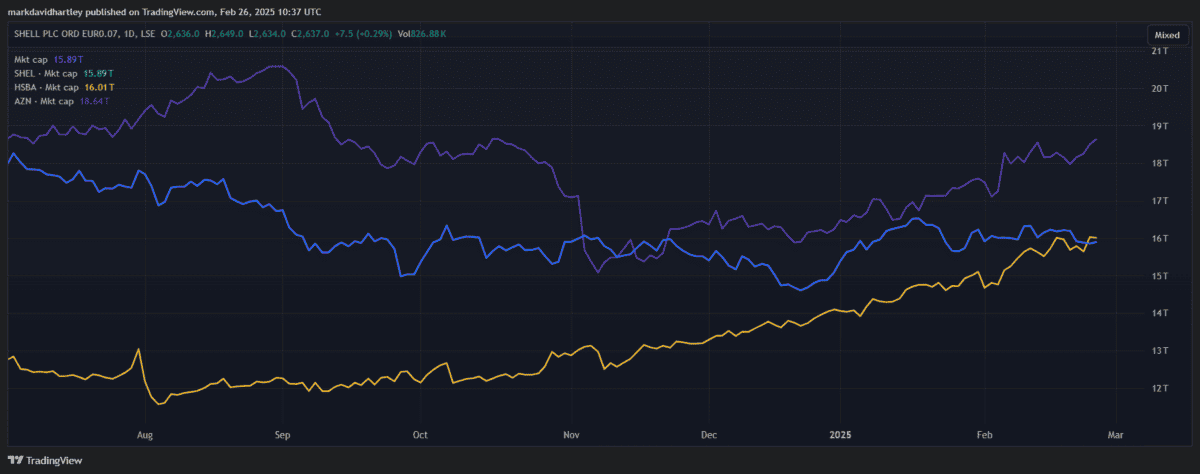
For years, Shell (LSE: SHEL) has been one of the largest and most influential energy stocks on the FTSE 100. But in a surprising turn, the leading UK oil stock has slipped to third place in the index, overtaken by HSBC in terms of market capitalisation.

Since August last year, it’s doubled from £80bn to £160bn, while Shell’s market cap has dropped from £175bn to below £160bn.

Created on TradingView.com

So, what’s behind this shift and should investors be concerned about Shell’s future? 

Let’s take a closer look at the key factors driving its share price, from global oil prices to the company’s latest strategic moves.

Why did Shell drop?

Shell’s fall in the rankings has far more to do with HSBC’s growth than its own weaknesses. But why hasn’t Shell’s market cap grown in a rising Footsie too? Could there be underlying issues worth examining?

For example, falling crude oil prices could be affecting revenue and earnings expectations. Shell’s profitability is directly tied to crude oil prices. When oil prices are high, the company enjoys soaring revenues, but when they fall, profits can take a hit.

Recently, Brent crude has hovered between $75 to $85 a barrel, down from highs above $100 in 2022.

OPEC+ production cuts have attempted to stabilise prices while demand concerns in China have weighed on market sentiment.

There are many reasons why Shell remains a good stock to consider but first, let’s look at the risks.

An industry in flux

Unlike some sectors, energy stocks are highly cyclical and susceptible to global market swings. This adds a degree of volatility to stocks that are dependent on oil prices. If the world economy weakens, energy consumption could decline, further pressuring Shell’s revenue and profit margins.

In recent years, this problem has been compounded by a growing desire to shift away from fossil fuel consumption. Governments worldwide are tightening climate policies, leading to higher costs and reduced demand for fossil fuels. 

A full transition to renewable energy, while necessary, is proving to be costly and drawn out. This has become a key risk affecting its bottom line.

Prioritising profits

Shell may be suffering short-term losses but it remains a solid stock with a history of strong shareholder returns. With a dividend yield of around 4% and a dedicated share buyback programme, it offers good value for investors.

Despite oil price fluctuations, its diverse operations in refining, chemicals and renewables help maintain a steady cash flow. 

But to continue turning a profit, it may need to rebalance its priorities.

While some renewable energy and carbon capture efforts remain, there’s been a notable weakening of emission reduction targets.

The high costs of these efforts threaten shareholder returns, pressuring it to prioritise fossil fuel profits over climate needs. While this could help revitalise short-term growth, it comes at a high cost for the environment.

Hopefully, a more beneficial long-term solution can be achieved. 

For those bullish on oil prices rebounding, Shell may be a stock to consider. But for investors worried about long-term energy transition risks, it may be worth considering more diversified FTSE 100 stocks.

Tesla stock is down 26% in a month. What on earth is going on?

The Tesla (NASDAQ:TSLA) share price is volatile. Most investors who have been monitoring the stock market for a period of time will know this. Yet the 26% fall over the past month is a large drawdown by anyone’s expectations. Understanding the reasons behind the move can help people to make informed decisions and avoid overreacting when it comes to Tesla stock.

Key factors to note

I put the move over the past month down to three main reasons. To begin with, underwhelming financial performance. The Q4 (and 2024 annual) results that came out at the end of January missed market expectations. Total automotive revenue fell by 8% in 2024 versus the previous year. Net income dropped by 53%, with free cash flow decreasing by 18%.

A second factor is the concern about Elon Musk’s political involvement. Some investors are getting a bit concerned about the extent of his support for Germany’s far-right AfD party, as well as the time being taken up with his role in President Trump’s administration. It’s true that any political affiliation will impact the brand image, and it appears that actions over the past month haven’t helped.

Finally, chatter about slower EV demand in Europe has hampered the share price. In January, Tesla’s vehicle registrations in Europe fell by 45% compared to the same period in 2024. This is a chunky fall, and comes at a time where not only is EV demand stalling but competition is increasing. It’s a tricky cocktail to navigate for the business.

Looking ahead

The past can’t be changed. What’s important is assessing whether these factors could continue for the rest of the year or not. Musk’s affiliations and support will always be a risk for the stock, but I don’t see it as something that will seriously spook investors further.

The financial performance and outlook for Europe is concerning. However, the results did show some positives. For example, Q4 was a record quarter for both vehicle deliveries and energy storage deployments. Once all the data is in, Tesla expects the Model Y to “once again be the best-selling vehicle, of any kind, globally for the full year 2024”.

Let’s not forget about key initiatives that are expected to go live this year, including the robotaxis in the US. As the business continues to expand into other areas beyond traditional vehicles, new revenue streams open up. This could provide shareholders with more optimism as the year goes on, causing the stock slump to ease.

The bigger picture

Over the past year, the stock is up 49%. So although the move lower in the past month isn’t excellent, it’s not the end of the world. I don’t think investors should panic right now. Those who don’t own the stock might even consider this a dip to buy.

Down 9% from August but with 18% annual projected earnings growth, should I buy this FTSE 250 defence gem?

FTSE 250 defence firm Chemring Group (LSE: CHG) is down 9% from its 20 August one-year traded high of £4.24.

This could indicate that the company is fundamentally worth less than it was before.

Or it could be that the market has not factored its full value into the share price. In this event, the stock could be a huge bargain buying opportunity for investors whose portfolios it suits.

How does the global security backdrop look?

I think that irrespective of any ceasefire deal struck in the Russia-Ukraine War, NATO’s defence spending will increase dramatically.

This is likely to focus on preventing further Russian military actions against its member states.

Indeed, NATO Secretary-General Mark Rutte said in December that the security organisation needs to: “Shift to a wartime mindset.”

He added in February that average spending will have to increase to “considerably more than 3%” of members’ gross domestic product (GDP). Only 23 out of the 32 NATO members managed to reach the previous target of 2% this year.

In my view, it may well have to go even higher than 3%. US President Donald Trump made clear recently that he wants NATO members to spend 5% of their GDP on defence.

The stock’s earnings growth potential

Earnings growth ultimately drives a company’s share price and dividend over time. A risk to Chemring is any major fault in its key products. This could prove costly to fix and might damage its reputation.

However, analysts forecast the firm’s earnings will increase 18.2% each year to the end of 2027.

Its full-year 2024 results saw revenue rise 8% year on year to £510.4m, and operating profit jumped 28% to £58.1m. Profit after tax soared more than sevenfold to £39.5m.

Over the same period, its order book jumped 13% to an all-time high of £1.038bn. Since Russia invaded Ukraine in 2022, it has risen 59%.

In the results, Chemring also reiterated its previous target of achieving revenue of around £1bn by 2030.

In this context, the maker of sensors, countermeasures and information products counts big civilian firms among its customers and military ones. These include NASA and SpaceX.

In January, its Roke operation signed a £26m contract with a major US prime contractor to supply high-speed Miniature Radar Altimeters. Expanding in the US through such firms that work alongside the US government is key to Chemring’s growth strategy.

Are the shares undervalued?

My key method to determine whether a stock has value in it is the discounted cash flow (DCF) model. This shows where a firm’s stock price should be, based on future cash flow forecasts for it.

Using other analysts’ figures and my own, the DCF for Chemring shows its shares are 63% undervalued at their current £3.85.

Therefore, the fair value for the stock is technically £10.40.

It may be pushed lower or higher than this due to the unpredictability of the market. However, it underlines to me what a bargain the shares look right now.

Will I buy the shares?

I would buy it but I already have shares in defence stock BAE Systems. To add another share in the same sector would unbalance the risk-reward balance of my portfolio.

That said, I believe Chemring shares are worth considering today for their high earnings growth potential.

Financial News

Daily News on Investing, Personal Finance, Markets, and more!

Financial News

Policy(Required)