Are Reckitt shares a buy to consider ahead of next week’s results?

Reckitt Benckiser (LSE: RKT) shares struggled last year, suffering losses after an infant death in the US was blamed on its product Enfamil. The financial and reputational damage of the subsequent lawsuit wiped 28% off the share price.

I’ve held shares in the company since before the lawsuit (which was in March 2024). Finally, after almost a year, it’s close to recovering all those losses.

I’m still down around 7%, although the dividends have helped reduce those losses somewhat. Investors who bought the dip six months ago will be happy with their 20% gains.

But there’s still a long road ahead to a full recovery.

Next Thursday (6 March), the company is set to release its full-year 2024 results. With a history of earnings misses and muted growth expectations, investors may be wondering whether the shares are worth considering ahead of the announcement.

Let’s take a closer look at the key figures and what they could mean for the stock.

Earnings expectations: another miss?

Reckitt has failed to meet earnings expectations for the past three years, and 2024 could potentially be another disappointment. Analysts predict earnings per share (EPS) of £3.16, which would be lower than last year’s figure. 

While revenue is expected to rise slightly to £14.2bn, the overall earnings picture remains weak. This suggests that cost pressures or weaker margins may still be a concern.

One positive sign is Reckitt’s financial discipline. Since 2021, the company has steadily reduced its debt while increasing free cash flow. 

This trend indicates strong capital management and could provide stability in the long run. However, with earnings stagnating, investors may need to be patient before seeing significant returns.

Barclays downgrade and growth concerns

Recently, Barclays downgraded Reckitt shares from Overweight to Equalweight, reflecting concerns about the company’s near-term prospects. Analysts forecast flat earnings until at least 2027 as Reckitt reorganises its product portfolio. 

This restructuring may lead to long-term benefits, but it could also mean subdued returns in the short term.

The average 12-month price target for the shares is £57, representing a modest 8.3% growth from current levels. While this suggests some potential for capital appreciation, it’s not particularly exciting compared to other opportunities in the market.

On the dividend front, it offers a reliable 3.78% yield, which is slightly above average. The company has a strong track record of increasing dividends at a compound rate of 5.2% annually for the past 15 years. 

This consistency may appeal to income-focused investors. However, if the share price remains stagnant, dividends alone may not be enough to justify an investment.

Should investors consider acting before results?

With earnings pressure, a recent downgrade, and limited growth expectations, I don’t see Reckitt shares as a compelling pick ahead of next week’s results. While its financial discipline and steady dividends provide some stability, the lack of earnings growth and potential for another earnings miss could keep the stock under pressure.

Still, I remain confident in the company’s long-term potential. For those looking for a defensive play, I think Reckitt remains a potential choice. But for investors seeking growth or strong capital appreciation, there may be better opportunities to consider elsewhere in the current market.


£10,000 invested in Taylor Wimpey shares 6 months ago is now worth…

Last autumn, I was thrilled with the progress of my super-soaraway Taylor Wimpey (LSE: TW) shares. I wrote an article on the topic, headlined: The Taylor Wimpey share price is up 50% in a year but still gives me a 5.9% yield!

What’s that old saying? If you want to make God laugh, tell him your plans. Or in my version, boast about your investment wins.

The Taylor Wimpey share price has fallen a hefty 30% in the last six months, from 160p to around 111p. That’s wiped my gains and no, I didn’t see that coming. Go ahead God, laugh.

Can this FTSE 100 stock fight back?

An investor who put £10,000 into the FTSE 100 housebuilder six months ago would have bought 6,250 shares. Today, they’d be worth £6,938. They’re down more than £3k.

However, they would also have received a dividend of 4.8p per share on 10 October. That would have lopped £300 off their losses. The next dividend of 4.66p lands on 9 May, we should hand them another £291. That’ll further help ease their pain. With luck, the shares will pick up at one point too.

I can laugh at myself because, deep down, I’m not worried. First, I only invested about 3% of my Self-Invested Personal Pension (SIPP) into Taylor Wimpey. My portfolio contains around 20 stocks for diversification purposes and, happily, the winners far outnumber the losers.

Second, I only buy shares for the long-term. Since I’ve no plan to sell, I haven’t lost any actual money yet. In fact, I might ultimately gain some. If the shares are still down when I reinvest my next dividend in May, I’ll pick up more shares than if they were flying high.

So what went wrong? One reason is that interest rates – and therefore mortgage rates – look set to stay higher for longer than markets expected last year, squeezing buyer demand. Another is that today’s sticky inflation is driving up build costs. The Budget won’t help, as National Insurance and Minimum Wage hikes will push up labour costs too.

What does the future hold?

On Wednesday (27 February) Taylor Wimpey said it completed 10,593 homes in 2024, down on the previous year’s 10,848. Average selling price fell from £370,000 to £356,000. Pre-tax profits fell 32.4% to £320.3m. It’s hardly surprising the shares are down too.

CEO Jennie Daly reported some positive moves, including improved affordability, a rising order book and a “robust” start to the spring selling season. Completions will only edge up slowly though, with a forecast ranging 10,400-10,800.

So will the Taylor Wimpey share price rebound? I’m making no predictions. Happily, others are. Some 16 analysts have set one-year share price forecasts. Together, they’ve produced a median target of just over 148p. If correct, that’s an increase of almost 33% from today. 

The stock has a bumper trading yield of 8.6%. Add that and I’d be looking at a total return north of 40%. Will it happen? Only God knows. And he’s too busy laughing to tell me. But, over time, I expect to be laughing too. I hope others are too as I feel this stock is worth considering.

Up 189% so far in 2025! What’s going on with the EUA share price?

We are not yet three months into the year and already Eurasia Mining (LSE: EUA) — usually known as EUA — has performed spectacularly. Specifically, the EUA share price is up 189%. Yes, that is close to tripling in just two months!

What on earth is going on – and could I still aim to make some money if I buy the shares today?

The difference between investing and speculating

Let me answer the second question first. I have no plans to put money into Eurasia Mining shares.

That is because I like to invest in what I see as great businesses that are trading at an attractive share price. By contrast, buying Eurasia Mining shares seems to me more like speculation than investment in the current geopolitical environment.

It is what is sometimes known in the City as a “special situation”. Special situations can be very lucrative (as the soaring EUA share price has lately shown), but also risky.

Right assets, wrong place, wrong time

So, what is Eurasia’s situation?

It owns some potentially valuable mining assets. They are not currently generating meaningful revenue.

That puts me off to a large extent, but it is not uncommon. A lot of small mining companies with a share price in pennies (as EUA has) own mines that are not in full production, or simply the rights to mine an area.

The challenge with Eurasia’s mining assets is that they are in Russia. For some time it was trying to find a buyer for them, in what looked more like a buyer’s than a seller’s market.

The share price has jumped on hope more than facts

So, does the 189% jump in the EUA share price reflect a deal being struck? That would be an obvious conclusion to draw as to why a company that last year was facing liquidity challenges now has a market capitalisation of £180m.

In fact though, Eurasia’a situation has not changed. It has not issued any news to the stock exchange this year about any possible sale of its assets.

But then what is going on with the share price leap?

I think the most likely answer is that investors (or speculators) think the recent shift in US policy towards Russia could presage a more constructive business environment there again for western companies.

Maybe they will. Maybe Eurasia will find a buyer more easily. Or maybe it will end up being able to work its own mines in Russia.

To me though, that all seems highly speculative for now – and certainly does not adequately justify 189% share price growth in two short months.

I would rather invest on the basis of a proven business model and what look like healthy commercial prospects, at an attractive share price. Eurasia’s long-term stock market history does not speak to a proven business model.

As for its commercial prospects, for now little is certain and the geopolitical risks remain very high even before getting into the specifics of the company’s business. I have no plans to buy.

The IAG share price flies higher as the company reports strong growth in 2024

The International Consolidated Airlines Group (LSE:IAG) share price was 3.5% higher in the first few minutes of trading today (28 February) after the airline announced its annual results.

Comparing 2024 with 2023, the group reported a 9% increase in revenue. And a 26.7% rise in operating profit before exceptional items to €4.44bn. This was significantly ahead of the consensus forecast of analysts of €4.08bn.  

Also, as a result of “structural improvements” its operating margin improved by 1.9 percentage points to 13.8%.

As further evidence of an improving balance sheet, debt relative to earnings fell during the year. At 31 December 2024, net debt was 1.1 times EBITDA (earnings before interest, tax, depreciation and amortisation). A year earlier, it was 1.7.

This measure is important because the directors have said that further distributions to shareholders will be made “when net leverage is below 1.2x to 1.5x, with consideration to the outlook and depending on future capital requirements and commitments”.

Indeed, over the next 12 months, €1bn is expected to be returned by way of dividends and share buybacks. The 2024 dividend has been increased to 9 euro cents (7.43p at current exchange rates).

Overall, I think the results demonstrate that the group’s strong post-pandemic recovery is continuing. Since February 2022, its share price has been the fourth-best performer on the FTSE 100.

Potential challenges and opportunities

But operating an airline isn’t easy. There are all sorts of financial, operational and technical risks that need to be overcome.

In particular, rising oil price can play havoc with earnings. Although buying in advance can give some certainty over costs, there’s little an airline can do in a rising energy market. However, the recent softening in prices has helped the group. In 2024, fuel costs and emissions accounted for 27.3% of its total expenditure on operations. During 2023, it was 29.1%.

Despite the increase in revenue and earnings, income investors are likely to prefer other stocks. Even after today’s boost to the dividend, IAG’s yield is 2.1%. The average for the FTSE 100 is 3.6%.

However, I think there are many reasons to be positive.

I like the fact that the group’s portfolio of airlines covers all sectors of the market. Its two flag carriers — British Airways and Iberia — are well placed to benefit from the anticipated growth in long-haul air traffic. It also owns low-costs airlines, Vueling, Aer Lingus and LEVEL. These fly across Europe, North Africa and — crucially in my view — the United States.

In its latest report, the International Air Transport Association is predicting — by 2043 — an additional 4.1bn passengers each year. This is equivalent to an annual growth rate of 3.8%.

This could help explain why the group appears to have the majority support of the 17 brokers covering the stock. Prior to today’s announcement, 12 of them rated it a Buy and five said Neutral.

Final thought

After today’s reaction of investors, IAG trades on a historical (2024) price-to-earnings ratio of 7.6. This compares favourably to the average of 71 listed airlines (9.05).

Continued growth, a solid (if unspectacular) dividend and a below-average valuation multiple are reasons why investors could consider adding the airline group to their long term portfolios.

Rolls-Royce shares are on a tear and could climb even further!

Yesterday (27 February), Rolls-Royce (LSE: RR.) unveiled its full-year earnings for 2024, and the results were nothing short of spectacular. The British aerospace titan not only soared past profit expectations but also announced a lucrative plan for rewarding shareholders.

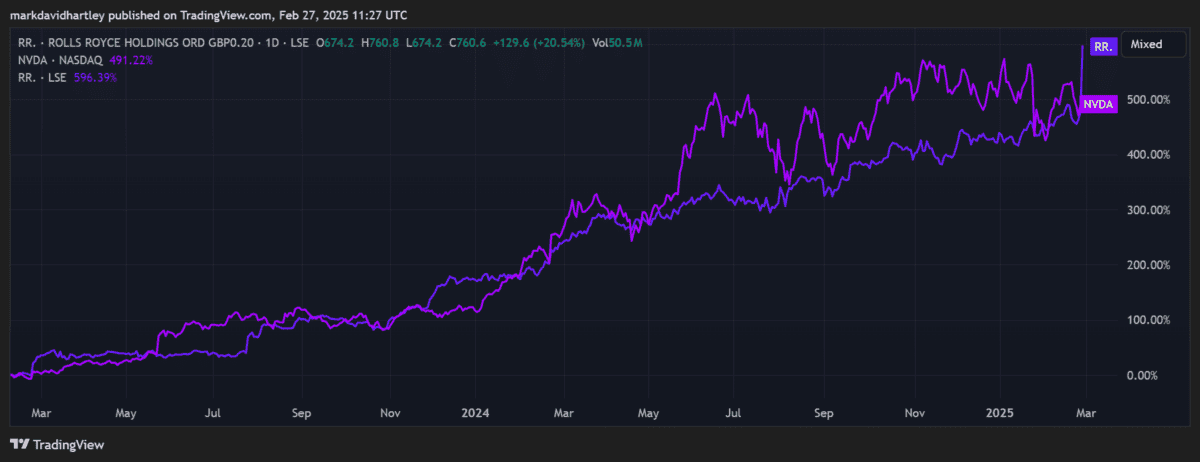
The stock surged 18% on the news, bringing its year-to-date (YTD) gains up to 28%. It’s now even outperformed Nvidia over the past two years.

The earnings report has sent ripples through the UK market, bolstering the aerospace sector and contributing to a 0.1% uptick in the FTSE 100 index. 

Created on TradingView.com

Full-year 2024 results

In 2024, Rolls’ underlying operating profits rose a remarkable 55%, reaching £2.5bn, and sales soared by 15% to £17.8bn. The growth was fueled by a resurgence in air travel and heightened defense spending amid global geopolitical shifts.

But the news that seriously sent investors into a fervour was the reinstating of dividends. Initially, it plans £500m in payments supported by the launch of a £1bn share buyback programme. Dividends will be paid at 6p per share initially, equating to a 1% yield.

This marks the first dividend distribution since the pandemic, solidifying an undeniable financial recovery. CEO Tufan Erginbilgiç once again emphasised the importance of rewarding shareholders to attract future investments.

More growth coming?

Under the influence of Erginbilgiç, who took the helm in 2023, Rolls has sharpened its focus on financial performance, implementing cost-saving measures and renegotiating contracts to boost profitability. 

The company now anticipates achieving its mid-term profit targets two years ahead of schedule, with projections of operating profits between £3.6bn and £3.9bn by 2028.

However, the rapid gains could severely limit further growth. The average 12-month price target is now 13.7% lower than the current price. These may be updated slightly in the coming days, but I wouldn’t expect much change. The price-to-earnings (P/E) ratio is now higher than average at 27, adding risk that a pullback could be imminent.

With the price overvalued and at high risk of a correction, I wouldn’t consider buying the stock now.

There’s also the ever-present risk of more travel disruptions, which could hurt the price again as Covid did. Additionally, any significant dip in defence spending could reverse the shares’ upward trajectory.

Yet, despite these risks, Rolls has another trick up its sleeve that could still help the company continue to grow in 2025.

Nuclear expansion

Rolls is particularly well-positioned to benefit from the UK’s plans for nuclear power. Thanks to its expertise in the development of small modular reactors (SMRs), it’s a key contender to support the nuclear strategy.

Unlike traditional large-scale nuclear plants, SMRs are smaller and faster to build, reducing construction risks. They’re also more cost-efficient at around £2bn per unit compared to the tens of billions needed for full-scale plants. Since much of the construction is done in factory conditions before assembly on-site, it’s much easier to deploy them.

The UK government has already backed Rolls-Royce’s SMR project with a £210m grant, and the company has raised additional private funding. If nuclear expansion accelerates, further government contracts or subsidies could flow to Rolls-Royce, helping to fund development and production.

How do Nvidia shares measure up as a GARP investment?

Breakneck earnings growth has driven Nvidia (NASDAQ:NVDA) shares spectacularly higher in recent times. At $125.73 per share, the semiconductor maker has soared 432% in value during the past two years.

Nvidia has its fingers in many pies, from artificial intelligence (AI) and gaming to robotics and cloud computing. And City analysts are expecting profits to continue soaring over the near term as the digital revolution rolls on.

Having said that, those stratospheric price gains lead me to question whether Nvidia shares could still be an attractive GARP (growth at a reasonable price) investment.

Here’s what I’ve found.

Test #1

Growth shares — and particularly those in the technology arena — tend to command sky-high price-to-earnings (P/E) ratios. These high valuations reflect the premium that investors are willing to pay for companies with electrifying profits potential.

The GARP strategy, on the other hand, seeks to balance growth and value by applying the the P/E-to-growth (PEG) ratio. It’s a method that helps investors avoids the danger of buying overhyped, overpriced stocks.

As a GARP investor, I’m seeking a reading of one or below. Here’s how Nvidia shares stack up:

2026 2027
Earnings per share (EPS) growth 49% 24%
P/E ratio 29.9 24
PEG ratio 0.6 1

Brokers expect EPS growth to slow considerably from the 147% rise recorded in the last financial year (ending January 2025). But the company’s expected growth trajectory still leaves it trading on attractive PEG ratios of 1 or below for the period.

Test #2

Things look good so far, then, but I’m not finished yet. I also think it’s worth comparing how Nvidia’s share price compares with those of other semiconductor stocks.

Here’s what I found, based on expected earnings for their current financial years:

Company P/E ratio PEG ratio
Advanced Micro Devices (AMD) 22.6 0.1
Intel 44.8 N/A
Broadcom 34 0.1
Taiwan Semiconductor
Manufacturing Company (TSMC)
17.2 0.5
Qualcomm 13.8 0.5

As you can see, four out of the five carry lower PEGs than Nvidia. Intel is the only exception: it recorded losses per share last year, resulting in an invalid multiple.

The verdict

So there we are. On paper, Nvidia shares look like a good investment from a GARP viewpoint, although its PEG isn’t quite as attractive as its major industry rivals.

But could the business be worthy of this premium? I think it might.

Nvidia’s high-power graphics processing units (GPU) make the firm the go-to chip supplier for AI applications. With the market growing at stunning speed, the company is in the box seat to capitalise.

Full-year financials released Wednesday (26 February) underline the progress it continues to make. Revenues soared 114% in financial 2025, to $130.5bn. This was driven by a 142% sales rise at its Data Center, whose products power AI and cloud computing.

This reflected in large part huge demand for its Blackwell AI chips.

Past performance is not always a reliable guide to the future, however. And Nvidia faces several large challenges looking ahead.

Its rivals are investing heavily in their own AI capabilities to grab market share. The emergence of DeepSeek’s efficient AI model poses another danger, as it could potentially reduce demand for high-power GPUs.

But encouraged by Nvidia’s strong record of innovation, I’m optimistic earnings will continue to rip higher. I think the chipmaker’s a top GARP investment to consider.

£10,000 invested in BP shares 5 years ago is now worth…

BP (LSE: BP.) shares can be found in many UK investor portfolios today. It seems that investors are drawn to the oil giant’s ‘blue-chip’ status (it’s one of the largest companies in the Footsie) as well as the dividends on offer.

But have the shares delivered for investors recently? Let’s see how much £10,000 invested in the shares five years ago would be worth today.

Average returns

On 28 February 2020, BP shares ended the day at 396p. Today however, they’re trading at 438p – roughly 10.6% higher.

That means that the original £10,000 investment would now be worth about £11,060 (ignoring trading commissions and platform fees, etc.). That’s not a lot of capital appreciation over half a decade – it translates to a gain of just 2% per year.

Of course, we also need to factor in the dividends here. Crunching the numbers, I calculate that an investor who bought BP shares five years ago would have received a total of 96.51p per share in dividends. Assuming these weren’t reinvested, this income would have resulted in another £2,440 or so.

So, in total, they’d now have approximately £13,500. That equates to a total return of 35% or about 6.2% per year.

That’s not a terrible return. It’s higher than the returns from cash savings and roughly in line with the returns from the FTSE 100 index.

However, it’s worth pointing out that many stocks have produced much higher returns over the last half decade. Amazon shares, for example, are up about 120% in US dollar terms over the same period (that translates to almost 17% per year).

Long-term challenges

I’ll point out that I don’t think it’s a coincidence that Amazon shares have outperformed BP shares by a wide margin over the last half decade. Today, the world is rapidly becoming more digital and Amazon is at the heart of this evolution thanks to its booming online shopping and cloud computing divisions.

At the same time, the world is slowly moving away from oil. So, BP is facing long-term structural challenges and this is reflected in its share price.

Of course, the pandemic didn’t help the performance of BP shares. This resulted in a major drop in demand for fuel for a few years.

At the same time, the pandemic boosted demand for Amazon’s services significantly. With people stuck at home, online shopping and cloud computing saw huge growth.

Dividend income on offer

Now, BP shares could still play a role in a portfolio today so they could still be worth considering. Especially if one is seeking income – currently the dividend yield on offer is about 5.8%, which is attractive.

However, given the risks associated with the global shift to renewable energy (BP has recently backed away from its pledge to become a clean energy company), I think there are better shares to consider buying today. Over the next five years, I reckon a lot of other stocks will generate higher total returns.

Amazon is one stock that I believe is worth considering for the long term. Over the next five years, I think this tech company will get much bigger.

1 FTSE 250 stock I’ve sold in February

Earlier this month, I sold my shares in FTSE 250 real estate investment trust (REIT) Primary Health Properties (LSE:PHP). And my timing arguably couldn’t have been worse.

My view on the company hasn’t changed, but the share price jumped 5% shortly after I sold the stock. So have I made a potentially costly mistake? 

Please note that tax treatment depends on the individual circumstances of each client and may be subject to change in future. The content in this article is provided for information purposes only. It is not intended to be, neither does it constitute, any form of tax advice.

Lots to like

Primary Health Properties owns and leases buildings like GP surgeries and healthcare centres. The majority of its rent comes from the NHS. 

As a REIT, the firm distributes 90% of its income as dividends to shareholders and this makes it attractive from a passive income perspective. And there’s more to like about the business.

Depending on a single source for much of its rent is a risk. But the company has consistently maintained high occupancy rates and the threat of the NHS defaulting on its rent seems low.

Another potential concern is the balance sheet. Primary Health Properties has just over £1.3bn in total debt, which is a lot in the context of a company with a market value of £1.2bn.

Again though, I think it’s easy to overestimate this. The debt might have to be repaid at some point, but even if the firm doubles its share count to do it, things don’t look too bad to me.

Increasing the share count would halve the dividend per share, bringing the yield to around 3.75%. For a stock with a growing dividend, I don’t think that’s a terrible outcome.

So why sell?

Why have I been selling? The short answer is I found something else I wanted to own – but that only changes the question to why this stock, rather than a different one?

Like a lot of REITs, Primary Health Properties has limited capacity to reinvest for growth. So the investment return’s largely driven by the dividend – which has a current yield of 7.5%.

Compounding an investment at that rate of return’s quite attractive, but things aren’t quite so straightforward. Since 2019, the share count has increased by an average of 6% a year. 

This means two things. The first is that shareholders need to reinvest 6% of their stake in the company each year in order to continue owning the same amount of the underlying business.

The second is that Primary Health Properties needs to increase the amount it distributes by 6% each year to keep the dividend per share the same. And this could be a challenge. 

This is why I’ve decided there are better opportunities elsewhere at the moment. A 7.5% dividend yield’s attractive, but the equation looks less exciting when it’s offset by a 6% shareholder dilution.

Timing

It’s fair to say my timing could have been better. Just after I sold, Assura – a similar operation – reported news of a takeover bid sending shares in Primary Health Properties higher.

An extra 5% from the sale would have been nice, but I don’t think there was any obvious way for me to see this coming. So I’m happy enough with the decision. 

I still view Primary Health Properties more favourably than other REITs and I think it’s worth considering for income investors. But the rising share count means it’s important to look past the high dividend yield.

Is right now a once-in-a-generation chance to buy UK shares?

Investment expert Nick Train thinks there’s a huge opportunity in UK growth shares right now. And he’s putting his money where his mouth is.

The manager of the Finsbury Growth & Income Trust has sold out of international stocks and is focusing on the UK. But there’s more to the story than this.

Selection

Not all UK stocks are the same. And Train’s portfolio isn’t a broad-based bet on FTSE 100 and FTSE 250 companies – it’s actually quite heavily concentrated in a few key names. 

According to the most recent update, almost half the fund is made up of Experian (LSE:EXPN), RELX, London Stock Exchange Group, and Sage Group. And they have one thing in common. 

When it comes to tech, these companies represent the biggest and best the UK stock market has to offer. And Train thinks they’re being overlooked at the moment.

The FTSE 100 isn’t the first place most investors go when it comes to growth stocks. But Train thinks that’s an advantage – it leads to more attractive valuations for strong businesses.

Valuations

I’m not convinced. For example, Experian’s a similar business to Equifax and TransUnion – both listed in the US – but the UK stock doesn’t trade at an obvious discount.

On a price-to-earnings (P/E) basis, Experian looks much cheaper. It trades at a multiple of 37, which is lower than Equifax (50) or TransUnioni (66). But there’s a catch.

Both Equifax and TransUnion report adjusted profits to try and remove distorting effects on earnings per share. On this basis, they trade at P/E multiples of 33 and 24 respectively.

Adjusted metrics are always a bit tricky, but all three trade at similar price-to-sales (P/S) ratios. On this basis, Experian (6.1) isn’t cheaper than Equifax (5.4) or TransUnion (4.5).

UK discount?

Experian’s a quality company. Its database is incredibly difficult to replicate and it has an attractive position in emerging markets that could generate strong growth over time. 

There are, of course, risks. A combination of high interest rates and weak construction output might weigh on demand for mortgages and this could challenge the company’s growth.

The point though, is the stock isn’t really trading at a significant discount to its US rivals. And while Experian isn’t Train’s only example, I think there’s better value elsewhere. 

When it comes to undervalued UK stocks, I think the most obvious examples are outside the FTSE 100 – and even the FTSE 250. There are a few exceptions, but this is where I’m looking. 

Bargain hunting

Train thinks UK growth stocks are a “generational opportunity” and he’s prepared to back up this statement with his cash. I agree, although I have different companies in mind. 

Looking where other investors aren’t paying attention is a strategy that appeals to me quite a lot. But I’m not convinced the FTSE 100 is as overlooked as Train thinks.

As the companies get smaller, the number of analysts following decreases. This is where I think the really outstanding opportunities for investors to consider right now are.

I’ve lost my faith in National Grid shares!

I feel a bit bad rocking up on The Motley Fool UK website to diss National Grid (LSE: NG) shares.

My fellow Fools have a deep pool of affection for National Grid, a natural monopoly with regulated earnings, ensuring solid cash flows and a reliable dividend income stream. Historically, it has also delivered steady share price appreciation. Just not recently.

Last year, I woke up to the dangers. In May, the board announced an unexpected £7bn equity raise to fund an ambitious £60bn infrastructure investment plan over five years to March 2029. That’s nearly double the previous five-year investment level. It also cut the dividend for the first time in 20 years. By a hefty 20%.

Is this FTSE 100 stock that safe?

CEO John Pettigrew insisted the plan will “deliver long-term value and returns for our shareholders, support over 60,000 more jobs, and accelerate the decarbonisation of the energy system”.

It’s a massive, necessary and ambitious initiative, but as an investor, I’m uneasy. UK infrastructure projects typically take twice as long and cost twice as much as planned, with plenty of political wrangling along the way. More shocks could follow.

The National Grid share price initially plunged but quickly recovered thanks to a discounted share offer for existing investors. Yet this sudden capital raise also unsettled me. It poses questions about the board’s financial planning and foresight.

In December, Pettigrew outlined “unprecedented” plans to invest £35bn in its electricity transmission business over five years. The aim is to double energy transportation capacity and accelerate electrification.

The green transition is crucial, but increasingly politicised. Things could get messy. I’m not sure I want my portfolio caught up in the crossfire.

The dividend yield’s falling

Then there’s the dividend. National Grid currently offers a trailing yield of 5.82%, well above the FTSE 100 average of around 3.5%. However, that’s forecast to slip to 4.73% in 2025, due to the aforementioned cut.

To be fair, the dividend should edge up to 4.84% in 2026. And it’s still pretty competitive. It’s just not as reliable as I would have liked.

Funding the biggest electricity network overhaul in a generation is a huge undertaking. As of September, National Grid had £46.4bn in debt, falling to £39.2bn after deducting its £7.27bn cash reserve. It recently sold its US renewables business for $1.7bn to streamline operations and raise funds, but that’s a drop in the ocean. Also, isn’t it odd to sell renewable assets to finance a green transition?

For years, National Grid shares traded at a price-to-earnings (P/E) ratio of around 15 times, a fair valuation. Today, the trailing P/E is just 11.7. That’s highly tempting. I can’t remember the stock being this cheap and I do love a bargain.

The shares are up just 3% over the last year and a similar amount over five years. So many see this as a buying opportunity. I fear it raises doubts about the group’s growth prospects.

I may be very wrong and I can’t ignore the fact that the company has been a very reliable investment for many years. But I won’t buy and don’t think it’s one to consider at this moment. I just don’t think it’s the rock-solid investment many still believe it to be. I’ve lost my faith. Sorry.

Financial News

Daily News on Investing, Personal Finance, Markets, and more!

Financial News

Policy(Required)