If a 40-year-old puts £500 a month into a SIPP, here’s what they could have by retirement

Many Britons today invest within Stocks and Shares ISAs as these are powerful, tax-efficient investment vehicles. But for those investing for retirement, a Self-Invested Personal Pension (SIPP) could potentially be a great option. That’s because these accounts can be even more powerful from a wealth-building perspective.

An attractive deal from the government

One major benefit of a SIPP is that contributions come with tax relief. Think of this as a reward from the government for saving for retirement. The amount of tax relief depends on the tax band a investor’s in. However, for basic-rate taxpayers, it’s 20% (40% and 45% for higher-rate and additional-rate taxpayers, respectively).

So if a basic-rate taxpayer was to contribute £800 to their SIPP, the government would add another £200. That total contribution of £1,000 means, essentially, a 25% risk-free return.

Please note that tax treatment depends on the individual circumstances of each client and may be subject to change in future. The content in this article is provided for information purposes only. It is not intended to be, neither does it constitute, any form of tax advice. Readers are responsible for carrying out their own due diligence and for obtaining professional advice before making any investment decisions.

This generous arrangement can lead to substantial wealth over the long term. Especially when returns from investments are factored in.

I calculate that if a 40-year-old basic-rate taxpayer puts £500 into their SIPP every month (£7,500 a year after 20% tax relief) and achieved an average return of 8% on their money from their investments, they’d have around £345k by 65 and £460k by 68. Not bad for someone starting at 40 and only investing £500 a month.

Note that I’ve assumed here that the current tax relief arrangement continues in the future. And this isn’t guaranteed.

Achieving 8% a year

In terms of achieving a return of 8% a year over the long run, an investor could aim to do this in several ways. They could simply consider investing in index funds.

With a simple global index fund such as the iShares Core MSCI World UCITS ETF, there’s a decent chance of achieving a return of 8% or more over the long run. Over the last decade, this fund (which could be worth considering today) has actually returned about 12% a year. However, this figure’s been boosted by weakness in the pound.

Alternatively, they could build their own portfolio of stocks. This is riskier but could mean higher returns if an investor picks the right stocks. Just look at the returns generated by Amazon (NASDAQ: AMZN) over the last 20 years.

Over the last two decades, it’s made investors around 120 times their money (in US dollar terms). In other words, had someone put $10,000 into the company 20 years ago, it would now be worth about $1.2m.

You’re never going to get that kind of life-changing return from an index fund. That said, this stock’s been far more volatile than most funds over the last 20 years – investors have had to live through some wild (30%+) falls.

I’ll point out that I think Amazon shares are still worth considering as a long-term investment today. I believe they have the potential to generate strong returns for investors in the long run, given the company’s exposure to cloud computing and artificial intelligence (AI).

However, we could see short-term share price pullbacks if there’s a downturn in technology spending or economic weakness. General market weakness is another risk.

The best of both worlds

It’s worth noting that these approaches aren’t mutually exclusive. There’s nothing to stop doing both. I actually think this is a great idea and it’s what I do.


At 52-week lows, I still wouldn’t touch these FTSE 250 growth stocks with a bargepole!

In contrast to the FTSE 100, our more UK-focused FTSE 250 hasn’t been in scintillating form. As I type, the mid-cap index is now in negative territory for the year to date. At least some of this lacklustre performance has been down to a number of its constituents hitting 52-week lows.

While such a situation normally gets my contrarian instincts firing, there are at least two growth stocks I’m definitely steering clear of.

Lovely cars, awful investment?

The vehicles made by the luxury car company Aston Martin Lagonda (LSE: AML) are beautiful to look at. I’m sure they’re just as beautiful to drive. Having helped James Bond save the world countless times, the firm is a household name (at least in very affluent households).

As an investment however, it remains an absolute dog. In fact, that’s an insult to dogs. Ridiculously overpriced when it came to market back in October 2018, it’s been a textbook example of value destruction.

Yet another loss

On Wednesday (26 February), management revealed another poor set of full-year numbers to the market. An adjusted pre-tax loss of £255.5m was recorded for 2024, far worse than the already-awful £171.8m loss for 2023.

There’s a chance that things could get even worse. The threat of US tariffs by Donald Trump, supply chain disruptions and falling sales in China could all conspire to drive the shares even lower. As things stand, the market is already sniffy about a lower-than-expected guidance on production in 2025 and the firm’s decision to delay the launch of its first electric car.

With debt levels only going in one direction (and not the one investors would like), I’m more concerned than ever that Aston Martin Lagonda is slowly, painfully running out of road. Bankrupt seven times in its 112-year history — what price eight?

For now, job cuts will help to ease the financial burden. The ongoing presence in F1 will also maintain brand awareness.

But the road back to health looks long and painful.

Once loved, now hated

Another FTSE 250 firm I’m avoiding is Ocado (LSE: OCDO). It shares are already down 16% in 2025, making the e-commerce, fulfilment, and logistics player another one of the index’s big losers.

To be fair, anyone owning a stake when the Covid-19 pandemic first began would have been handsomely rewarded up to around February 2021. Back then, the explosion in ordering groceries online played right into management’s hands. The stakes of early investors duly multi-bagged in value.

Even so, I remember writing at the time that this sort of performance wasn’t sustainable. Ocado simply wasn’t making any profit. And that situation has changed in the years since.

All that glitters…

I’ve never doubted that Ocado’s tech is impressive. But a great product does not necessarily make for a great investment, especially if expectations overtake reality.

It’s positive that the firm has already inked quite a few contracts with prominent retailers for its automated warehouses. If these sites can be rolled out at a faster rate, there’s hope. In the meantime, the debt pile is steadily growing.

Yet with interest from short sellers remaining high (indicating that at least some believe the shares have further to fall), there’s no way I’m getting involved.

Here’s why the Aviva share price just jumped 4%, and why there could be more to come

Aviva (LSE: AV.) released full-year results on Thursday (27 February), and the share price rose 4.2% on the day in response. Aviva is now up 15% in 2025 and we’re only two months in.

The latest results were impressive, but I think we might only be at the start of what the new-look Aviva could achieve for passive income investors.

Dividend up

Aviva just announced a 35.7p dividend per share for 2024, up 7%. On the pre-results close that’s a 6.8% yield. On the price at the time of writing, it’s still a very respectable 6.6%. And investors have until 10 April before the stock goes ex-dividend.

Insurance shares often pay big dividends. Legal & General, for example, is on a forecast yield of 8.5%. And leading the sector, the Phoenix Group Holdings yield is up at a huge 10.3%.

Yields of 7%-10% or so really can’t keep going at that rate year after year after year. But they can come down by a good route, or a bad one. The bad way is for a company to have a bad year and have to cut its payout — as Aviva did in 2020.

So let’s hope for the good way, that the percentage yield comes down because the share price rises.

Dividend vs earnings

Insurance dividends are periodically covered thinly by earnings, if at all. And that can be a cause for concern for anyone considering investing in this sector.

This time, we have basic earnings per share (EPS) of only 23.6p. But operating EPS of 48p is up 19% from last year, and forecasts show strong earnings growth in the next few years. The dividend prospects look strong enough to me.

But I’ve invested in insurance sector shares on and off for decades. And one thing I always expect is that I’ll have bad years, earnings hit, dividends cut… and so far I’ve never been wrong. It can be a risky cyclical sector.

New company

In the words of CEO Amanda Blanc: “Over the last four-and-a-half years we have completely transformed Aviva, built a track record of consistently strong results, and returned £10bn to shareholders.

That ‘transformed’ thing means we’re looking at a very different company now, very much focused on the UK. So there’s no point comparing to the Aviva of five years ago (even if the share price has risen since then).

We’re still very much in the early days, and we haven’t seen how the new Aviva might cope with a sector downturn. But those shareholder retuns bode well.

Direct Line

The proposed takeover of Direct Line could result in synergy cost savings of around £125m per year. And Aviva reckons it could add an annual 10% to EPS. That should boost future dividend prospects, though there’s always some risk with merging companies.

Based on this latest update, Aviva remains a hold for me. I reckon investors looking for long-term passive income could do well to consider it. But given the cyclical nature of the insurance business, I really do think it’s best with a long-term horizon.

I’m fed up with the Unilever share price

Every time I think the Unilever (LSE: ULVR) share price is about to spring to life, down it goes again. Sometimes I wonder what’s the point.

I’m probably being unfair. Maybe even a little antsy. It’s nowhere near the worst performer in my self-invested personal pension.

By rights, I should be venting at Diageo, Glencore and GSK. They’ve done far worse. Instead, I’ve chosen to ignore them. Unilever bugs me though.

Why am I so grumpy about this FTSE 100 stock?

It’s one of the UK’s biggest and best companies, but it’s lost its way for years. Since peaking at just over 5,000p in August 2019, the shares have gone nowhere fast, sliding 10% to today’s 4,466p.

CEO Hein Schumacher looked like he might be getting a grip. The shares are up 15% over the last 12 months but now he’s gone after just 19 months and the shares are sliding again.

Schumacher will be replaced by Fernando Fernandez, chief financial officer since January 2024. Fernandez has impressed the board with “his decisive and results-oriented approach and his ability to drive change at speed”. Let’s hope that shines through in the share price. It needs a lift. So do I.

Happily, others are somewhat less glum. Broker Berenberg was pleased the group’s full-year results, published on 13 February, which saw underlying sales growth hit analyst expectations by rising 4%.

Underlying operating margins climbed 18.4%, up 170 basis points. Underlying earnings per share also beat forecasts, rising 14.7% to €2.98.

Berenberg hailed Unilever’s “best-in-class” growth which it expectes to outpace industry peers Nestlé and Procter & Gamble.

The 21 analysts offering one-year share price forecasts have produced a median target of exactly 4,998p. If correct, that’s an increase of almost 12% from today. Throw in the forecast yield of 3.7% (nicely covered 1.7 times), and this would give me a total return of more than 15% if true.

Growth, dividends and meh

That’s pleasant but hardly riveting. It will only recover half the recent slide. Certainly not enough to shake me out of my malaise.

There are reasons to believe in Unilever, including its strong global brand portfolio, huge emerging markets opportunity and defensive nature in troubled times.

Plans to cut jobs, boost productivity, hive of the ice cream division and double down on its largest brands could inject some much-needed life.

However, sticky inflation will continue to force up input costs and squeeze margins, while emerging markets aren’t exactly flying. Unilever is confident it can manage Trump tariffs. We’ll see.

If I didn’t own Unilever shares, I wouldn’t be in a rush to buy them. They’re not exactly cheap, with a price-to-earnings ratio of almost 23 times.

But investing is a long game. I’d lose self-respect if I bowed out of a stock just because I got a bit bored with it. Patience is required. I’ll try ignoring it for a while, like Diageo, Glencore and GSK. Who knows, I might be in for a pleasant surprise on my return.

Aim for a million with just a few shares? Here’s my approach!

The idea of becoming a stock market millionaire may seem a fantastical one without having lots of money in the first place. But in fact it is possible for someone to aim for a million even from a starting place of zero, if they take the right approach.

Being realistic about how much to invest

To do that, they could get into the habit of drip-feeding money into a portfolio of carefully selected blue-chip shares.

How much an investor puts in depends on their individual circumstances. Everyone is different. In this example, I use a sum of £800 per month.

To use the money to buy shares, our investor will need a way to do so! There are lots of share-dealing accounts and Stocks and Shares ISAs available.

I think it makes sense to take some time and choose the most suitable one. Even small-seeming fees and charges can add up over the long term, making it harder to aim for a million!

Aiming for outstanding stock market performers

How long might such an approach take before the champagne corks start popping?

Putting aside £800 per month and achieving compound annual growth of 5%, the answer is 38 years.

But wait. What if that compound annual growth rate was 10%?

Then, still investing the same £800 per month, the answer would be 26%.

At a 15% compound annual growth rate? Just two decades.

It is not easy to beat the market, let alone achieve a compound annual growth rate of 15%. But, as some investors demonstrate, it is possible.

Buying just a few great shares

Some FTSE 100 shares have achieved compound annual growth rates of 15% (or more).

Rather than buying the whole FTSE 100 index, instead an investor could aim simply to buy the five to 10 best-performing shares as they target a 15% compound annual growth rate.

Easy in theory – but what about in practice? After all, nobody ever know in advance how a share will perform.

That is true, but I also think success leaves clues. Consider, for example, equipment hire group Ashtead (LSE: AHT). Its share price has more than doubled in the past decade (and it has a 2% dividend yield to boot).

The company operates in an area of high demand. Not only that, but it has pricing power. When a building site needs a specific, critical piece of heavy plant, it needs it and will pay even a high price.

Thanks to its network of depots and proprietary stock of equipment, Ashtead is able to offer a solution in such situations sometimes with limited or no competition. Such rentals can go on for months or even years.

So, this is a simple business to understand. But it is one that benefits from high demand and has high barriers to entry in terms of the cost and complexity of building a network of depots and kitting them out with the right equipment to rent out.

There are risks, of course. A clear one is the danger of a big downturn in construction activity due to economic weakness. That could eat badly into revenues.

Still, even now Ashtead’s price-to-earnings ratio of 17 means it is a share I think an investor could consider as they aim for a million.

Are February’s 3 fastest falling blue-chips the best shares to buy in March?

When looking for the best shares to buy, I paradoxically find myself looking at the worst performers.

Picking stocks that have fallen out of favour can sometimes yield bargains. Sometimes not. Three FTSE 100 stocks have taken a beating in February. Are they worth considering next month?

Annoyingly, I own two of them. The first is spirits giant Diageo (LSE: DGE), which fell another 14.5% in February, the worst showing on the blue-chip index. Having averaged down before, I’m wary.

Diageo shares are falling again

The spirits giant has been struggling for a while. Its shares are down 30% over one year and 40% over two.

They’re now the cheapest I’ve seen, with a price-to-earnings (P/E) ratio of 15.5. The usually low yield is now nudging 3.7%. Yet investors have been reluctant to take advantage, as Diageo battles falling demand in key markets, stock inventory issues and Trump tariffs, which menace its tequila and Canadian whisky portfolios.

If I hadn’t thrown so much at the stock already, I’d be tempted. It does own Guinness after all. And maybe Gen Z will start drinking again, if the economy puts more money in their pockets. I’ll hold, but won’t buy.

The WPP share price has also taken a hit

Advertising giant WPP (LSE: WPP) has been struggling for years but matters got worse on 27 February when disappointing Q4 results hammered the stock. The WPP share price fell 13% over February and is down 10% over one year.

The global downturn has hammered client spending. UK revenues fell 5.1% in Q4, while North American revenues slipped 1.4% and Chinese revenues crashed more than 20%.

Headline operating profit did rise 2% to £1.71bn while free cash flow improved to £738m, but a downbeat 2025 outlook confirmed the gloom.

Last time I looked at WPP, it had a hefty P/E of around 70. That’s suddenly below 13 times. The yield now stands at more than 6%. The board is also battling to streamline operations, and is investing heavily in AI to boost productivity.

I’m tempted but won’t buy in March. I think the WPP recovery is still some way off.

Glencore shares have inflicted more pain

I don’t own WPP but do hold mining firm Glencore (LSE: GLEN). Which means I’m smarting from the 12% drop in its share price in February. It’s down almost 15% over 12 months.

That’s mostly due to falling demand for commodities from struggling China. Yet China is picking up this year, and it hasn’t helped. Nor did reports that Glencore may shift its listing to New York.

On 19 February, Glencore posted a 16% drop in adjusted 2024 earnings to $14.36bn. Revenue did rise 6% to $231bn, but adjusted operating profits still tumbled 33% to $7bn.

I’ve heavily down on Glencore but won’t be bailing out. Natural resources is a cyclical sector and it should recover at some time. Plus the board planning $1.2bn in dividends and a further $1bn share buyback before 6 August.

Net debt is a concern. That’s up from $4.9bn to $11.2bn, following significant capital spend and acquisitions. If I’m brave enough, I’ll buy more in March. I expect a bumpy ride.

Here’s how I find blue-chip shares to buy and hold for a decade!

As a long-term investor, I look for shares to buy and hold. That does not always happen, of course. Sometimes what seems like a great investment can turn sour for some reason and I decide to sell it.

But ideally, I would be happy to take the Warren Buffett approach to  investing and buy shares in outstanding companies at attractive prices, then hold them for years, or even decades.

Defining the search area

To begin, it helps to know what you are looking for – and be likely to spot it when you see it! So again like Buffett, I stick to my “circle of competence” when investing. In other words, when looking for shares to buy, I search for businesses I can understand and assess.

Why a competitive advantage is important

Within those areas, I focus on businesses I think have a competitive advantage (what Buffett calls a ‘moat‘). That is important because such an advantage can help set a company apart from its rivals, giving it pricing power. When a company has some power to set its own prices not just follow the market pressure, that can be good for profits.

As an example, I own shares in Diageo (LSE: DGE). The FTSE 100 company owns brands such as Guinness and Smirnoff. That helps give it pricing power.

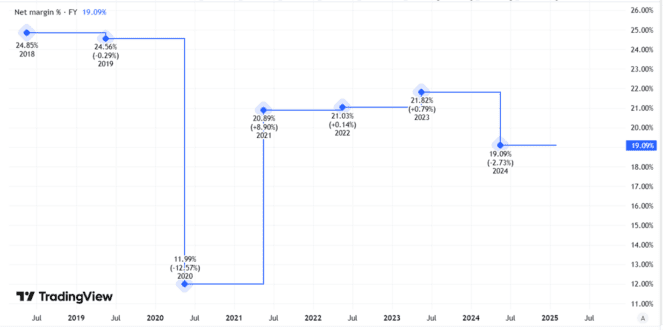
So Diageo has a net margin of around 20%, meaning that even after it pays all its costs and taxes, it still makes around 20p for each £1 of products it sells.

Created using TradingView

For a company whose revenues topped £20bn last year, that adds up to a lot of profit!

Figuring out how I can profit

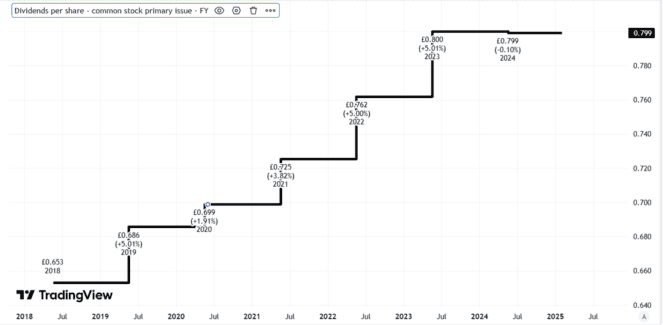
So what does Diageo do with all those profits? It uses some of them to pay a dividend. Indeed, Diageo is a rarity among FTSE 100 firms because it has raised its dividend per share annually for decades.

Created using TradingView

Hopefully, that will last. But it may not as dividends are never guaranteed. Diageo faces a number of risks that could eat into profits, from weak demand in Latin America to rising levels of teetotalism among younger generations.

Dividends are only one way I might make money from owning a share though. I could also benefit from share price growth (though only when I come to sell the shares).

Like dividends though, such growth is not guaranteed. Indeed, a share could fall so I end up losing money when I sell it.

Indeed, if an investor bought Diageo shares five years ago and sold them today, they would get back 22% less than they paid for them. Even taking five years’ worth of dividends into account, they would still have lost money overall.

So when looking for shares to buy, I always ask myself how I might make money from them. If I pay more than I think they are worth, it hardly seems like I am setting myself up for probable success.

Instead, I try to find shares I can buy for less than I think their long-term value will be – and any dividends along the way could be a welcome bonus.

That is why I bought Diageo shares for my portfolio last year.

Should I buy Palantir stock for my ISA after its 32% crash?

Palantir Technologies (NASDAQ: PLTR) stock has been one of the biggest winners of the artificial intelligence (AI) revolution so far. Anyone who added it to their Stocks and Shares ISA when ChatGPT was released in late 2022 is up around 1,000%!

However, the Palantir share price has fallen from $125 to $84 in just over a week. That’s a 32% drop! Is this my chance to buy the stock for my ISA? Let’s dive in.

What does Palantir do?

Palantir is a data-mining company that operates a number of software platforms. One called Gotham enables data-driven decision-making for national security and is used by agencies like the CIA and FBI. It helps analyse counterterrorism and cyber threats, providing real-time intelligence. It’s widely believed that Gotham played a role in tracking down Osama bin Laden.

Meanwhile, Foundry is a data analytics platform for commercial organisations. For example, BP‘s using it for energy insights, Scuderia Ferrari for data-driven decisions around F1 car performance, and the NHS to reduce waiting lists.  

Finally, Artificial Intelligence Platform (AIP) enables customers to deploy large language models and AI automation while maintaining strict data security. Many Fortune 500 firms have been flocking to AIP.

Rapid growth

Last year, revenue jumped 29% year on year to $2.9bn, while adjusted free cash flow topped $1.25bn, representing a 44% margin.

In the fourth quarter, Palantir’s customer count grew by an astonishing 43%. This is great news for shareholders, as many customers sign multi-year contracts. Plus, once onboard, clients typically expand their usage over time, driving even more growth.

Speaking about AI, co-founder and CEO Alex Karp recently said: “We are still in the earliest stages, the beginning of the first act, of a revolution that will play out over years and decades… And the momentum we are seeing across sectors, both commercial and government, is unlike anything that has come before.”

Why the sell-off?

This is very exciting stuff. So why has the stock lost a third of its value in a few days? There seems to be a few reasons.

First, proposals have been put forward for an 8% reduction in the US defence budget, amounting to around $50bn annually over the next five years. The concern here is that Palantir may struggle to win new defence contracts due to these budget constraints.

Next, Karp has disclosed plans to sell nearly 10m worth of shares in the next six months. While that’s nowhere near his full stake in the firm, it’s caused a few jitters.

Finally, the stock was extremely overpriced. Even following the sell-off, the price-to-sales multiple is around 68, while the forward-looking price-to-earnings ratio is over 100. Those are very high multiples that leave little room for error (slowing growth, for example).

My decision

This is definitely a stock I want in my portfolio though. The company is founder-led, extremely innovative, and growing very strongly.

Moreover, a bit like Nvidia with AI chips, Palantir’s quickly becoming the go-to software partner for companies looking to integrate AI into their operations. The list of blue-chip clients speaks for itself.

The stock’s still very pricey. But if it continues to fall over the coming days, I may buy a few shares, then look to build up my position over time.

Here’s how DeepSeek could be great news for the Nvidia stock price

The release of the Chinese DeepSeek artificial intelligence (AI) model hit Nvidia (NASDAQ:NVDA) stock hard, knocking $600m off the market capitalisation.

And even expectations-busting fourth-quarter results on Wednesday (26 February) didn’t reverse the decline. At close the following day, Nvidia was down 22% from its all-time high.

Cracking quarter

Q4 revenue rose 78% to $39.3bn, with earnings per share (EPS) up 82%. Data centre revenue nearly doubled to $35.6bn.

Early shipments of Blackwell chips alone contributed $11bn, driven mainly by demand from major cloud service providers. The next-gen Blackwell Ultra is expected to be released in March.

Nvidia predicted first-quarter sales for 2025 of $43bn, plus or minus 2%.

In the company’s earnings call, CEO Jensen Huang said: “We’ve really only tapped consumer AI and search and some amount of consumer generative AI, advertising, recommenders … the next wave is coming.

Agentic AI for enterprise, physical AI for robotics, and sovereign AI … We can see great activity happening in all these different places,” he added.

DeepSeek threat

DeepSeek hit the headlines by using older and cheaper Nvidia technology as the new-generation Blackwell chips are restricted for sale to China. And it was, it’s claimed, trained up for just $6m.

Who needs to spend multiple billions on this stuff if Chinese developers can do it for so much less? Well, some are already casting doubt on those cost claims. And there’s a lot more to it than just cheap pre-training.

Missing the point

Huang suggests the market reaction to DeepSeek is wrong and investors are missing the point. The pre-training that comes before the release of an AI large-language model (LLM) is just the start, he says.

Maybe an AI Model can be pre-trained using cheaper chips. But continuing competition is going to be based on how well these things can learn and develop in time. And those using better chips will surely have a competitive advantaage.

Huang said: “Reasoning models that apply inference time scalingcan consume 100x more compute.

Exports

Nvidia might see overseas sales restrained further by tightening chip exports to China. And that might help keep overseas competition from boosting Nvidia’s profits the way shareholders might like.

Competitor Alibaba has just revealed what’s described as its first reasoning AI model, QwQ-Max. And that, depending on the scale of US export limits, could further drive demand for top-end processors. These are clearly risks.

Chip competition

There’s one key threat a lot of investors fear. And it’s all about what the competition is doing. In particular, the rise of application-specific integrated circuits (ASICs) is causing ripples. Google‘s Gemini AI platform was trained using its own ASIC, for example.

And surely we can’t write off companies like Intel, Advanced Micro Devices, and the rest.

Would I buy Nvidia stock now? ‘Father of Value Investing’ Benjamin Graham pointed out that markets follow sentiment in the short term. But in the long term, they weigh up the fundamentals. Right now, I’d say we’re in the grip of sentiment. I’ll keep watching, with my eye on the fundamentals.

Down 98%, will the Aston Martin share price ever bounce back?

If someone offered to give you a pound coin and asked for a £20 note in return, that would sound like a terrible deal. Yet it would still be a better return than buying shares in Aston Martin (LSE: AML) when the luxury carmaker listed in 2018 and holding them until now.

During that time, the Aston Martin share price has fallen by 98%. Yet this is an iconic brand with a well-heeled customer base, desirable vehicles and strong pricing power. So might the share price bounce back – and should I invest in the hope it does?

A great business is not necessarily a great investment

While Aston Martin has a lot going for it, I think its predicament contains some powerful lessons for investors.

The first lesson is that having great assets does not necessarily equate to having a great business. Last year, for example, even though it generated revenue of £1.6bn, Aston Martin still recorded an operating loss of well over £1m a week.

Aston Martin cars are not cheap so it may seem odd that the business is losing money making and selling them. But the economics of a business matter. Selling just a few thousands cars a year can make it harder to swallow fixed costs than with much bigger volumes.

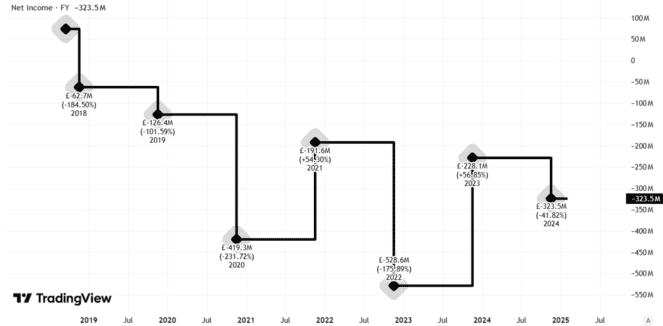
The second lesson is that a business’s balance sheet always needs to be considered alongside its operational performance. Aston Martin’s operating loss last year was £83m, but its overall loss for the year was £290m.

Created using TradingView

Where did that extra £200m+ of red ink come from? Non-operating costs.

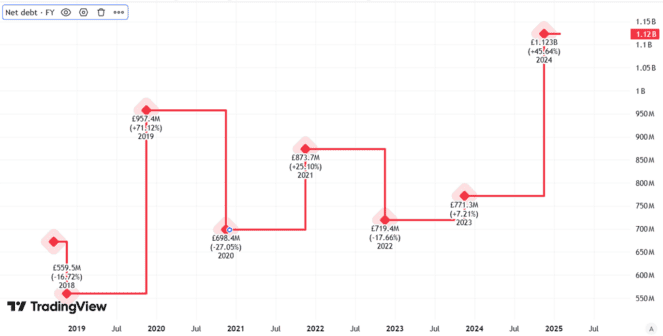
Specifically, the company had £180m of financing costs. That is what comes of having net debt of £1.2bn, as Aston Martin did at year end, especially when much of it is at a high interest rate. Aston Martin is paying 10% or more interest on some of its borrowings.

Created using TradingView

Much needs to go right for a share price revival

So could the Aston Martin share price ever bounce back? To do so, I think the business would first need to stop spilling red ink at the operating level and secondly sort out its finances by getting rid of most debt. That could involve issuing more shares, diluting existing shareholders.

While that is possible, for now I do not think the signs are encouraging. Revenues fell last year by 3% and wholesale sales volumes were down 9%. The fact that sales volumes fell more than revenues demonstrates positively that the company has pricing power, but neither trend is a positive one, in my view.

As the chief executive said this week as part of the annual results announcement: “We have all the vital ingredients for success”.

That is true, but it has long been true. Meanwhile, the Aston Martin share price has lurched from one disappointment to another. I have no plans to invest.

Financial News

Daily News on Investing, Personal Finance, Markets, and more!

Financial News

Policy(Required)