This top growth stock’s down 33% since February! Here’s why I bought more shares

The market’s been punishing any growth stock that fails to live up to high expectations. One new stock in my portfolio — Duolingo (NASDAQ: DUOL) — fell victim to this, slumping 33% since mid-February.

Here’s why I’ve used this dip to buy more shares.

Market leader

Duolingo ended 2024 with 116m monthly active users, making it the world’s leading language learning app. It offers courses in more than 40 languages, ranging from English and Spanish to fictional ones like High Valyrian from Game of Thrones.

On St David’s Day (1 March), Prince William delivered his first full message in Welsh. Turns out even the Prince of Wales has been using Duolingo to improve his language skills!

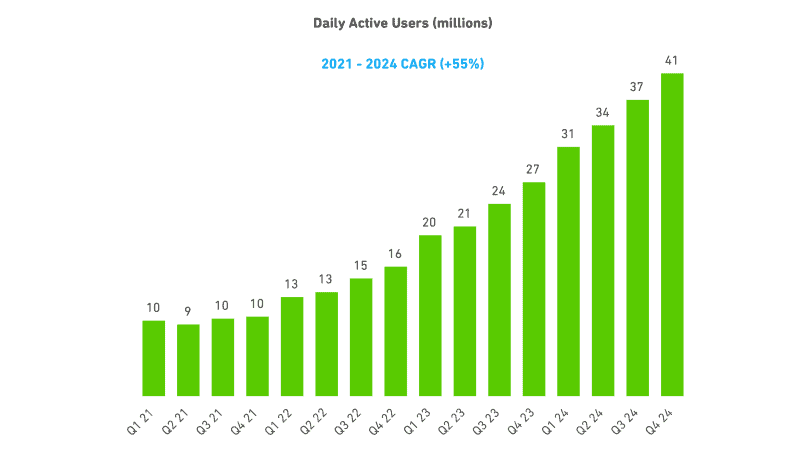
Last year, the firm’s revenue surged 41% to $748m, with the adjusted EBITDA margin reaching a record 25.7% ($192m). In Q4, daily active users rocketed 51% to 40.5m, while paid subscribers jumped 43% to 9.5m.

Source: Duolingo Q4 2024 shareholder letter.

Prioritising AI over profitability

These are healthy numbers. So why has the stock bombed? Well, the company beat Wall Street’s estimates for revenue, but Q4 earnings per share (EPS) came up short ($0.28 rather than $0.50).

Another issue can be found in the quote below:

While we expect to continue growing margins this year, we will do so at a more measured pace due to the investments we are making into AI and the variable costs associated with Video Call. We see a tremendous growth opportunity ahead.

CEO Luis von Ahn

Basically, management’s warning that strategic investments in artificial intelligence (AI) will weigh on profitability in 2025. The video call feature enables users to have real-time, AI-powered conversations in their chosen language with Lily, one of the app’s characters. This interactive tool is exclusive to Duolingo Max, the premium subscription tier.

My view

To be frank, I don’t really care about profit optimisation this year. As a shareholder, I want management to invest in cutting-edge AI features that boost user acquisition, engagement and improve subscriber conversion. This should ultimately strengthen the platform’s competitive positioning and long-term monetisation potential.

AI and automation tools have driven at least a tenfold increase in the company’s content generation capacity over the past two years. Once courses are developed, adding new users incurs minimal additional costs. In other words, Duolingo’s platform is highly scalable, with real cash machine potential.

I recently upgraded to Duolingo Max. The video call feature preserves context from prior conversations in Spanish. If I mention a hobby, say, Lily may bring it up later, making interactions more personalised and engaging.

It’s one of the most powerful consumer applications of generative AI I’ve experienced. Yet just 5% of Duolingo’s learners use it so far.

$1bn in bookings

Now, this investment isn’t without risk. A spike in inflation could cause consumers to downgrade their paid subscriptions to Duolingo’s free offering. And inflation might negatively impact international travel, and therefore the motivation to learn a new language.

Also, based on 2025 forecasts, the stock’s trading at an enterprise value-to-sales multiple of 12.7. That’s not cheap.

However, Duolingo’s on track to surpass $1bn in bookings this year. Revenue is projected to hit $1.8bn in 2028 — roughly 140% higher than last year. I think the stock’s worth considering.


A 3.4% dividend yield may not be much, but investors should take a closer look at Associated British Foods shares

Right now, shares in Associated British Foods (LSE:ABF) — or ABF for short — come with a 3.4% dividend yield. That doesn’t look like much, but that’s the highest it’s been in the last 10 years. 

There’s also an ongoing share buyback programme worth £500m (or 3.7% of the current market value). So with a potential return of just over 7%, should investors pay attention?

Why’s the stock down?

The share price has fallen almost 10%. In a volatile stock market, that doesn’t sound like a lot, but the FTSE 100 is up 6% in that time.

Latest results at the company haven’t been good. Sales at Primark – which accounts for around half of overall revenues – climbed just 1.9% (after adjusting for exchange rates). 

With inflation above 2%, this means revenues in arguably the most attractive part of the business were down in real terms. And the other divisions mostly fared even worse. 

I therefore don’t think there’s much mystery as to why the stock’s been falling. But the question is has it reached a level where it’s a bargain?

Valuation

ABF isn’t just a value fashion/lifestyle retailer – there are also grocery, ingredient, sugar, and agriculture divisions. But none of these fill me with much enthusiasm.

As a result, I view the stock as a bargain when Primark by itself is enough to justify the share price. In other words, when the other parts of the company are essentially free.

Right now, Primark generates £9.5bn in revenues and operating margins are expected to be around 10%. That means investors should probably expect around £950m in operating income. 

On this basis, the current £13.5bn market-cap implies a potential return of around 7%. I don’t think that’s bad and the combination of dividends and buybacks create scope for growth.

Dividend growth

With ABF, its revenues depend on a lot of factors beyond its control. The weather – for example – can affect sales and this is a significant risk for investors to consider.

When it comes to issues like this, there isn’t much investors can do. The best strategy, in my view, is to make sure they’re well-compensated for the inherent risks.

On the face of it, a 3.4% dividend isn’t a great incentive. But this overlooks the effect of the ongoing share buybacks, which create significant growth potential.

The current repurchases could lower the share count, so the same overall distribution might result in a higher dividend per share in 2025. And 3.7% is enough to outperform inflation.

A stock to consider

I think now’s a very good time to take a closer look at the stock. It’s down due to weak results, but the time to think about being greedy is when others are fearful.

The dividend yield is the highest it’s been in years and share buybacks create the potential for further increases. Over the long term, I think that could be a good passive income opportunity.

In my view, the stock’s also close to the point where Primark by itself might justify the entire investment. So while there are risks, there could be decent compensation for considering them.

As the Admiral share price jumps after profit nearly doubles, should I buy?

As we approach another year’s ISA deadline, I’ve been watching the Admiral (LSE: ADM) share price with one eye on the dividend yield. Full-year results delivered Thursday (6 March) didn’t disappoint, with the shares up 5.5% in early trading.

Dividend boost

For the 2024 year, Admiral announced a final ordinary dividend of 91.4p per share, taking the full-year ordinary payment to 162.4p including the interim 71p. That’s a 5.5% yield on the previous day’s closing price.

And it gets better, with a 29.6p special dividend taking the total to 192p for a total 6.6% yield.

I’m a bit surprised the company doesn’t follow recent trends and return extra capital through share buybacks. Earnings per share (EPS) climbing 95% to 216.6p gives us a trailing price-to-earnings (P/E) ratio of 13.4, so it doesn’t look like the stock is too highly valued.

Cracking results

I really don’t see much for shareholders to complain about in this set of results as profit before tax climbed 90% to £839.2m, based on a 28% rise in turnover to £6.15bn.

CEO Milena Mondini de Focatiis was understandably enthused: “2024 was a remarkable year … as we welcomed an additional 1.4m customers to the group.”

She added: “The main driver of our exceptional performance was our UK Motor business. However, it is great to see UK Household, Admiral Money, and our French and US Motor businesses all report a double-digit profit.

But she also warned: “As we enter into 2025, the market is softening, and the outlook is uncertain.

Competitive market

Uncertainty is very much at the forefront for the insurance business, especially retail insurance of the Admiral kind. It’s a hugely competitive market. And I really think we should be careful over one year’s results, excellent though they might be.

Admiral’s liquidity position looks strong, with a solvency ratio of 203%, even after the dividend. That’s up from an already high 200% a year previously.

Gross loan balances at Admiral Money rose 23% to £1.17bn over the year too. And to me, that adds to the insurance gains in suggesting high customer confidence in the company.

Missed chance?

The share price rise so far on the day is, I think, still fairly modest considering this profit spike. I suspect it reflects the uncertainty of the industry, and the freqent year-by-year lumpiness of profits. With forecast rises in earnings dropping the forward P/E over the next two years, I just can’t see Admiral as overpriced.

I currently own Aviva shares, and I have Legal & General on my list of candidate buys. But those are heavily into savings, investments and commercial insurance. And I like the idea of going for a retail-focused insurer like Admiral.

But dividends aren’t guaranteed. And a big one-off special can sow the seeds for future disappointment if it’s not repeated. It’s in a cyclical sector, and I can see volatility in the share price in the short and medium term. And dividend volatility too. But I definitely think it’s one to consider.

2 strategies for trying to make money in a volatile stock market

The introduction of tariffs in the US has created a volatile stock market. In general, share prices took a hit on Tuesday (4 March) before staging a recovery the next day. 

In this type of environment, it can be difficult to know what to do. But there are a couple of things investors can do – and avoid doing – to give themselves the best chance of achieving success.

What not to do

Let’s start with bad ideas. I think trying to work out when shares are going to reach their lowest point – and hold off buying until then – is a bad idea.

One reason is that it’s very difficult to figure out when the lowest point for a stock will be. Barclays (LSE:BARC) has been a great illustration of this. 

The stock fell 6% on Tuesday and the downward momentum looked set to continue. But it recovered 4.5% on Wedneday, meaning investors who held off buying might have missed out.

Where the stock goes next is anyone’s guess. So I don’t think trying to wait for the declines to end and then buy is a particularly good strategy.  

Strategy 1: looking for value

Instead of looking for when stocks are at their cheapest, one strategy involves working out when they’re cheap enough. And I think this is a good approach for a certain type of investor.

With Barclays, this involves estimating how much the bank’s going to make through its various operations. The question is then how much that future income’s worth.

Undervalued stocks can keep falling. But sooner or later, stocks tend to reflect the value of the underlying businesses and the share buybacks at Barclays should help this process along.

A volatile stock market can make shares trade below what they’re worth. But this strategy relies on being able to assess a company’s future cash flows accurately – and this isn’t easy.

Strategy 2: cost averaging

An alternative strategy involves identifying businesses with strong long-term prospects and buying shares consistently at different times. This can help smooth out volatility.

Again, Barclays might be a good example. It combines a strong retail presence with one of the largest investment banking divisions in the world, making it more diversified than other UK banks.

In order to assess this accurately though, investors need to weigh this strength against risks, such as the potential for a change in bank regulation. And this is far from straightforward.

With the right businesses though, this strategy can work. Investing regularly gives the best chance of buying at the lows and as long as the stock goes higher, investors can do well.

The most important thing

The two strategies have something important in common. Rather than attempting to predict what the share price might do in the near future, they focus on the underlying business.

With Barclays, its diversified model has resulted in a less efficient business than other UK banks. But at the right price, I think investors would be wise to take a closer look.

In a volatile market, an opportunity could well present itself. So investors would be wise to keep a close eye on share prices for potential opportunities.

I’m following Warren Buffett’s lead and safeguarding against Trump’s trade tariffs

In a recent interview with CBS News, Warren Buffett expressed dire concerns regarding US President Donald Trump’s trade tariffs.

The CEO of Berkshire Hathaway (NYSE: BRK.B) likened trade tariffs to an “act of war“. 

Over time, they are a tax on goods”, he explained, and could send inflation soaring.

The tariffs include a 25% levy on imports from Canada and Mexico and a 20% levy on imports from China. They came into effect at midnight on Tuesday, 4 March, 2025. 

Experts fear the economic effects of the tariffs could seriously hurt the US stock market, particularly in the automotive sector.

This week, the Nasdaq 100 and S&P 500 fell to their lowest levels since Trump won the election in November 2024. Meanwhile, the Dow Jones is down 5.5% in the past month.

Retaliatory action

In response to the tariffs, Canada and China have announced retaliatory measures. Canadian Prime Minister Justin Trudeau criticised the move as unnecessary and harmful. China has increased tariffs on US agricultural products and filed a complaint with the World Trade Organisation. 

The issue has caused an international outcry, as businesses face the devastating effects of a trade war. Economists have warned that such disputes could disrupt supply chains, drive up inflation, and negatively impact both importers and exporters. 

Buffett’s game plan?

Seemingly in preparation for the fallout, Berkshire Hathaway has recently been selling large swathes of equity and stockpiling cash. Such defensive action could be interpreted as safeguarding against market volatility. 

But not all funds are following suit, leaving many to question Buffett’s motives. Some believe it could be part of a broader plan to reduce large positions as he prepares for his succession.

Either way, market volatility is quickly becoming the status quo in 2025, so planning accordingly may be the best bet.

Berkshire’s defensive characteristics

Preparing for a market downturn is all about risk management and staying disciplined. With markets at risk of further turmoil, investors should consider the wisdom of Buffett and the benefits of investing in Berkshire Hathaway stock.

Here are some best practices to follow:

To reduce risk, diversify investments across different asset classes like stocks, bonds, and commodities. Berkshire is moderately diversified, with a focus on high-quality companies like Mastercard, Coca-Cola, and Apple. With strong balance sheets, low debt, and consistent cash flows, these companies tend to weather downturns better. Unfortunately, this singular focus on US stocks puts Berkshire at higher risk from localised economic issues. UK stocks for investors to consider include AstraZeneca and BAE Systems.

Think about shifting towards stocks with stable earnings and strong dividends, such as utilities, healthcare, and consumer staples. Examples of defensive stocks in Berkshire’s portfolio include the consumer staples giant Kraft Heinz and credit rating agency Moody’s. In the UK, Unilever is a good example.

Focus on long-term growth rather than short-term fluctuations. While Berkshire is undoubtedly one of the most successful funds of our time, its sustainability is in question. Recently, concerns have arisen regarding the imminent departure of Buffett. There’s a risk the fund’s success will falter without his guidance.

Stockpile cash or short-term bonds to take advantage of buying opportunities when prices drop. This strategy has helped Berkshire in the past to secure cheap stocks, like Goldman Sachs and General Electric during the 2008 financial crisis.

This high-yield FTSE 250 dividend stock is up 25% this year! But is it worthy of the hype?

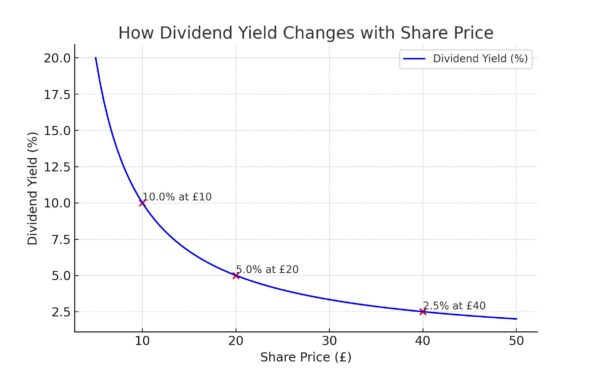
When looking at dividend stocks, it’s common to see two things: a high yield and a falling price (or vice versa). This is because the yield is the dividend’s percentage of the price, so it drops as the price rises.

Imagine a company that pays a dividend of £1. The below graph shows how the yield reduces as the price increases.

Therefore, it’s rare to find a soaring stock that still has a high yield. If so, it was either very high before, or the company recently raised dividends.

The latter is the case for investment firm aberdeen group (LSE: ABDN), formerly abrdn, before which it was Standard Life Aberdeen!

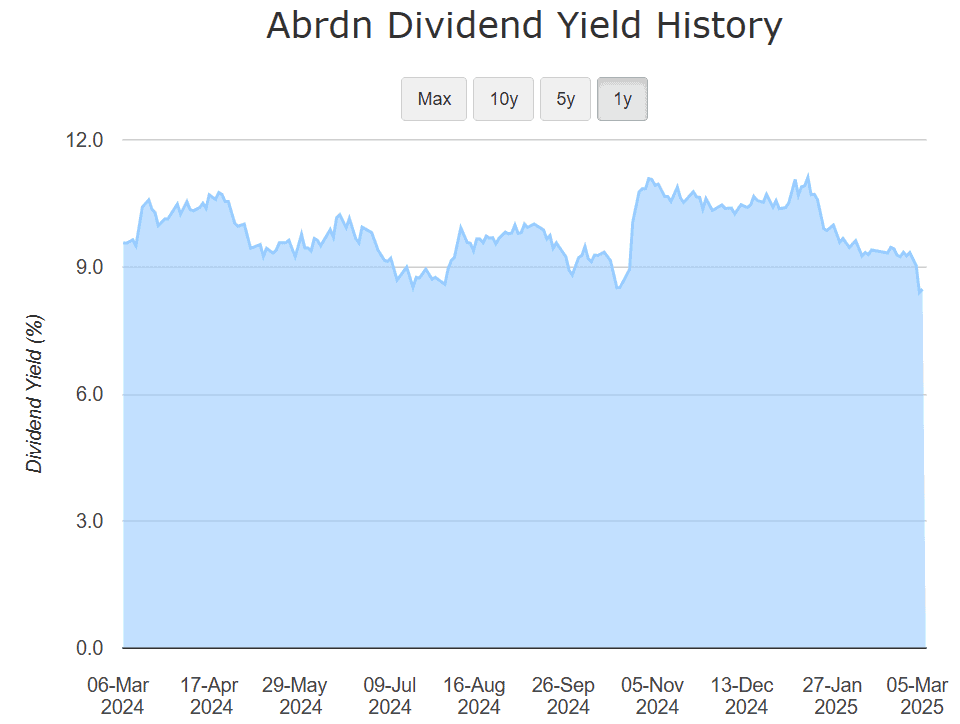
When the year began, its yield was sky-high at over 11%. But with the stock gaining 25% since the New Year, it’s dropped to 8.5%.

abrdn dividend yield
Screenshot from dividenddata.co.uk

Still, that’s more than double the industry average, so I can’t help being tempted.

But what kicked off this recent rally – and does the investment have legs? 

Let’s have a look.

A rose by any other name

The company released its 2024 results this week on Tuesday (4 March) with big news: vowels are back on the table!

That’s right, the much-maligned ‘abrdn’ moniker will be reverted to ‘aberdeen group’ (capital letters remain elusive).

The result was a resounding sigh of relief from investors and a subsequent 12% price jump. But the name was not the only good news.

Despite a 6% decline in adjusted operating income, it reported a 2% increase in operating profits to £255m. Assets under management (AUM) increased 3% and net capital generation was up 34%. Most notably, adjusted earnings per share (EPS) grew 8% and the final year dividend remained the same, at 14.6p per share.

The company has set ambitious targets to reach £300m in operating profits by 2026, but achieving these goals in a competitive market presents a significant challenge.

Following the impressive results, Deutsche Bank put in a Buy rating on the stock with a target of 200p.

Challenges remain

Despite the positive results, abrdn — sorry, aberdeen — remains one of the most shorted stocks on the FTSE 250.

The rebranding to aberdeen group has been positively received but still raises questions about the company’s strategic consistency. Yes, the previous rebrand was widely criticised but is reversal the answer? Could it not bring into doubt the board’s decision-making capabilities? 

Frequent shifts like these suggest instability in leadership and strategy, which may affect investor confidence.

For a company that operates in a highly competitive and strictly regulated industry, it’s playing with fire. Whether this turnaround is enough to reignite long-term growth remains to be seen.

Looking ahead

With a dividend yield of 8.5% and a forward price-to-earnings (P/E) ratio of 10, the stock may offer a compelling opportunity for income investors to consider. Its customer base and AUM grew in 2024 despite the difficulties around the rebranding. That speaks volumes about its operations and business model.

However, the success of its turnaround strategy remains uncertain. If the company can sustain profitability and rebuild investor confidence, the shares could have further to run. Until then, I’ll keep an eye on it but won’t consider buying it just yet.

If a 40-year-old puts £500 a month into a SIPP, here’s what they could have to retire on

The Self-Invested Personal Pension (SIPP) has, since its inception in the late 1980s, helped millions of Britons to target a comfortable retirement.

With a SIPP, individuals don’t pay income, capital gains or dividend tax on the gains while they’re growing their wealth . And they benefit from tax relief (at 20% to 45%, depending on a person’s income tax bracket) that can be invested for further compound gains.

The return someone makes from a SIPP naturally depends on what they invest in. But here’s what a 40-year-old might expect to retire on if they invested £500 each month.

A £900k+ nestegg

As I say, one of the benefits is the payment of tax relief. For a basic rate taxpayer who invests £80 themselves, the tax relief tops it up to £100, with the extra £20 paid directly into the account by the government several weeks later.

This means that our 40-year-old, if they fell into the basic rate tax band, would have an extra £125 each month on top of their own £500 investment. Higher- and additional-rate taxpayers could claim back even more through self assessment.

With a SIPP, individuals can choose to buy stocks, investment trusts, funds, bonds, commodities, and certain types of property and land. On the other hand, holders can decide simply to keep their contributions in cash savings.

With these categories, investors can expect to see very different levels of risk and returns. But for the sake of this example, let’s say our investor chooses to buy equities, trusts and funds with their £625 monthly investment.

With this method, they could realistically target a 9% average annual return over the long term. If they did this up to the State Pension age of 68, they could make around £942,690 to retire on. Not that 9% is guaranteed, of course.

Lower return

This investing approach can involve more risk than holding cash in a SIPP. But the difference in eventual returns can be considerable.

Let’s say our 40-year old decided to save instead of invest, and chose a pension with a reasonable 3% savings rate. Over the same 28-year-timeframe, they’d have made £328,485, far below the £900k described above.

On the plus side, this is guaranteed, while returns from share investing can wildly miss the target. It’s why I believe holding a proportion of one’s capital (whether in a SIPP or elsewhere) in cash is a great idea for managing risk.

But the potential to make truly life-changing returns mean that, in my opinion at least, investing in shares, funds and trusts merits serious consideration.

Top trust

A lower-risk way of doing this could be to consider buying an investment trust like the Allianz Technology Trust (LSE:ATT).

By investing in a basket of stocks, vehicles like this help individuals to effectively spread risk. In total, this particular trust holds shares in 45 high-growth companies including Nvidia, Meta, Apple and Microsoft.

Investors pay a 0.7% management charge to hold the trust. And returns could be bumpier going forward given the threats of US trade tariffs and competition from Chinese companies.

But I think Allianz’s tech trust could still deliver exceptional long-term shareholder profits as sectors like artificial intelligence (AI) and quantum computing take off. Since March 2020, it’s delivered an average annual return of 20%.

Are these 2 of the best dividend stocks to consider buying in these uncertain times?

Confidence among stock traders and investors is plummeting. With fears over the macroeconomic and geopolitical landscape growing, so are concerns over the capital gains and dividend income that global stocks might deliver in 2025 and potentially beyond.

I’m not saying that fresh trade tariffs, signs of resurgent inflation, and a weakening US economy are nothing to worry about. However, with some shrewd stock picks, UK share investors can limit the impact these hazards may have on their portfolios.

Here are two I think are worth considering today. I’m expecting them to deliver solid dividends regardless of these external factors.

The PRS REIT

We need to keep the rain off our heads regardless of the economic backdrop. This can make residential property stocks like The PRS REIT (LSE:PRSR) lifeboats for investors in tough times.

Rent collection at this FTSE 250 share has ranged between 98% and 100% in the last three years, even despite the twin problems of higher-than-normal inflation and a struggling domestic economy.

It’s worth noting that private rental growth in the UK is cooling sharply at the moment. Latest Zoopla data showed annual growth of 3% for new lets, down from 7.4% a year ago.

Further cooling is possible, although Britain’s rapidly growing population could put a floor under future declines. PRS REIT’s focus on the family homes sector, where accommodation shortages are especially sharp, might also support rental growth.

I’m certainly confident that the business will remain profitable enough to continue paying a large and growing dividend. Under real estate investment trust (REIT) rules, the company has to pay at least 90% of yearly rental earnings out to shareholders.

For this financial year (to June 2025), PRS REIT’s dividend yield is a market-beating 3.8%.

Please note that tax treatment depends on the individual circumstances of each client and may be subject to change in future. The content in this article is provided for information purposes only. It is not intended to be, neither does it constitute, any form of tax advice.

BAE Systems

The stable nature of arms spending makes defence stocks classic safe havens during tough times. With Europe proposing hikes to regional defence budgets, now could be an especially good time to consider buying shares like BAE Systems (LSE:BA.)

I like this particular firm because of its considerable financial resources and strong balance sheet, which add extra strength to dividend forecasts. This has underpinned steady payout growth dating back to the early 2010s.

Free cash flow remains considerable, and in 2024 remained stable at around £2.5bn. In my opinion, this gives BAE enough wiggle room to continue paying a growing dividend while also servicing its rising debt pile (net debt increased to £4.9bn last year following the acquisition of Ball Aerospace).

I think its terrific record of dividend growth makes it a great passive income stock to consider, even though recent share price strength has reduced its forward dividend yield to a modest 2.3%. This is some way below its 10-year average of around 4%.

On the downside, BAE Systems may face the prospect of cooling US sales as President Trump seeks to boost government efficiency. But on balance, I think the FTSE 100 stock still merits a close look from savvy dividend investors.

Up 55% in a year, this FTSE 100 stock is on fire! 

Games Workshop (LSE: GAW) stock rose 6% today (5 March) in the FTSE 100, taking its one-year gains to around 55%. Over five years, the return is above 150%, including dividends.

This multi-year surge saw the Warhammer creator finally enter the blue-chip index in December. The way things are going, it might be there to stay!

Short and sweet

The reason Games Workshop stock surged to a new all-time high of 14,900p today was a brief trading update. It simply said that “trading in January and February has been ahead of expectations, with strong trading across both the core business and licensing. As a result, the Group’s profit before tax for the 12 months to 1 June 2025 is estimated to be ahead of expectations“.

Shareholders like myself are used to such no-frills updates. Games Workshop prefers to let the financial numbers do the talking in its interim and annual reports.

This distinctive corporate culture was one thing that attracted me to Games Workshop a few years ago. Unlike most publicly traded companies, it doesn’t hold traditional earnings calls with analysts. And it doesn’t engage in rah-rah investor updates or high-profile acquisitions.

Instead, the firm has clear ambitions. This is “to make the best fantasy miniatures in the world, to engage and inspire our customers, and to sell our products globally at a profit. We intend to do this forever. Our decisions are focused on long-term success, not short-term gains“.

Underexploited IP

For context, the market was expecting revenue of £571m for FY25 (ending 1 June). Meanwhile, the consensus forecast for pre-tax profit currently sits at around £226m. This shows how exceptionally high the company’s profit margins are.

I find the update’s mention of licencing very encouraging. This is highly lucrative revenue based on the company’s treasure trove of intellectual property (IP).

For example, the company earns royalties from video game sales. In the first half of the year, the Warhammer 40,000: Space Marine 2 title helped licensing operating profit more than double to £28m.

Games Workshop says it owns “some of the best underexploited intellectual property globally“. However, in line with its long-term focus, management is very selective in how it monetises this IP.

As Russ Mould, Investment Director at AJ Bell, points out: “This quality control might mean it misses out on some potential income, but Games Workshop wants to uphold its brand values and ensure that its reputation isn’t tarnished by going down the Disney route of milking assets until they are bone dry.”

International expansion

Now, this pickiness means licencing revenue can be lumpy one year to the next. This is one risk I see here, as a sell-off might happen at some point if royalty income disappoints.

Also, the stock trades at a premium. Based on the current FY26 forecasts, the price-to-earnings (P/E) ratio is around 29. That means ongoing growth will have to be met or the valuation could pull back sharply.

As things stand though, the company is delivering the goods. The Amazon deal to adapt the Warhammer 40,000 universe into films and television series is exciting. And the first Games Workshop store in South Korea is opening, while expansion in Japan and Thailand continues.

I still think the stock is worth considering for long-term investors.

Is today’s 15% jump in the Aston Martin share price the start of a stunning recovery?

The Aston Martin (LSE: AML) share price is racing ahead today, up almost 15% this morning.

That’s good news for me, as I was daft enough to buy the James Bond car maker last year. I bought it to take advantage of a 90%+ drop in the value of its shares. Surely they couldn’t drop any further, could they? I should have known better.

Despite today’s impressive rebound, Aston Martin shares are still down 54% over one year and 97% over five.

So is today’s rebound the start of a brilliant return to form? I’m not convinced. To me, it looks like Aston Martin shares have just been swept up in current stock market volatility. They fell 9% yesterday. They tend to plunge faster than the market when investors are feeling nervous, and soar faster when they’re feeling bullish.

How risky is this FTSE 250 stock?

When the company publishes results, the outcome is easier to predict. More pain for people like me. The FTSE 250 group’s latest market update was released on 26 February, and it wasn’t good.

Aston Martin reported a widening of pre-tax losses to £289.1m, up from £239.8m the year before. Revenue dipped 3% to £1.58bn, while wholesale volumes fell 9% to 6,030. These don’t indicate recovery mode to me.

Management is cutting around 5% of its global workforce, shedding 170 jobs. This should save around £25m but cost-cutting can only go so far. Aston Martin still needs to drive revenues, and that remains a challenge.

Once again, it’s delayed the launch of its first electric vehicle — that luxury car customers probably don’t want anyway. It’s now scheduled for “the latter part of the decade“. Never say never. I suspect this is the board’s favoured timescale.

New-ish CEO Adrian Hallmark remains upbeat as he shifts the group’s focus to “operational execution and delivering financial sustainability”. The company is pinning hopes on its upcoming Valhalla hybrid supercar, expected in the second half of 2025. We’ll see.

Meanwhile, external risks loom. The second Trump presidency could potentially see the US slap 25% tariffs on UK-made vehicles. That would hit Aston Martin hard. Struggles in China, another key market, aren’t helping.

It’s a hugely volatile recovery play

The 10 analysts offering one-year share price forecasts have produced a median target of 135p. If correct, that’s a staggering increase of more than 60% from today’s 84p.

Those forecasts were produced before the latest slump. They won’t reflect last month’s results or the last few turbulent days.

I wouldn’t suggest any sign investor considers buying Aston Martin shares. I’m only holding on because selling my greatly reduced stake would barely cover the trading costs. I jest, but only just.

And who knows? Maybe, just maybe, this could be the start of something. Perhaps Amazon’s Jeff Bezos will buy Aston Martin to match his purchase of the James Bond franchise.

He could certainly afford it. The group’s market cap of just £782m would be small change to him. For the record, nobody has suggested Amazon will buy Aston Martin but hope springs eternal!

Hope can also be expensive, especially the blind type. Blind hope is possibly the only reason to buy Aston Martin shares today. It didn’t work out for me.

Financial News

Daily News on Investing, Personal Finance, Markets, and more!

Financial News

Policy(Required)