The Greggs share price is too tasty for me to ignore!

I have been eyeing shares in baker Greggs (LSE: GRG) for a while. After a big fall in the Greggs share price this week following the company’s results, I decided to make a move and buy.

Why I like the investment case

To start with, let me explain what attracts me to the company.

It operates in an area with high, resilient consumer demand. People always need to eat and Greggs is an affordable, convenient option for many. 

As the business has grown, it has built economies of scale. For example, centralised production plants mean that much of the food prepping can be done in bulk at more efficient, lower-cost locations than the chain’s high street sites.

The business has been quite innovative when it comes to product launches. It now has an offering that includes some unique items. I see that as giving it a competitive advantage over rivals.

The results were good – or were they?

Looking at the double-digit percentage fall in the Greggs share price following the release of annual results, it would seem that they were poor. Many commentators seemed unimpressed with the performance.

Personally, though, I saw lots to like.

Sales revenues grew 11%, pre-tax profit was up 8%, and diluted earnings per share were 8% higher than a year before. The annual ordinary dividend per share was increased by 11%, meaning that the FTSE 250 share now offers a dividend yield of 3.9%.

Sales in company-managed stores grew more slowly than sales overall (some of the sales growth came from opening new shops) and this year has started with only modest sales growth.

On balance, though, I did not think that the results undermined the investment case.

Waiting for value, then pouncing

The current Greggs share price-to-earnings ratio is 12.  

That is lower than it has been for a while and in my view looks like good value.

Sure, there are risks that help explain why the Greggs share price has been falling. Its cash pile fell last year. Costly capital expenditure requirements could continue to eat into it, as the chain keeps expanding its operations.

But when I look at the company I see a solidly profitably, cash generative business with a proven model and ongoing growth prospects.

I have been waiting a while for the share price to get to a level that I think offers an attractive buying opportunity. Now it has.

Like billionaire investor Warren Buffett, my stock market approach is to buy stakes in what I think are great businesses at attractive prices, with a view to holding them for the long term.

A tumbling Greggs share price has given me an opportunity to do just that – and I have seized it.


How high can the Rolls-Royce share price go in 2025? Here’s what the experts say

I’ve been watching broker forecasts for the Rolls-Royce Holdings (LSE: RR.) share price for a long time. And I’ve often had half a suspicion that all the analysts do every time it breaks new highs is just up their targets a bit.

And if that’s what they’ve been doing? Well, they’ve been right, haven’t they? So what do the experts say now?

Cracking results

Just look at that spike in the share price chart above. That was the result of Rolls-Royce smashing through 2024 expectations. On results day on 27 February, investors saw their dividends reinstated along with a new $1bn share buyback.

CEO Tufan Erginbilgiç told us: “We now expect to deliver underlying operating profit and free cash flow within the target ranges set at our Capital Markets Day, two years earlier than planned.”

City analysts have no doubt been working hard on their spreadsheets to work out their new price targets. And some of them were quick enough to get them out on results day itself. Is that the result of super efficient modelling software calculations, or fingers in the air? However they do it, I expect shareholders will be happy with the overall outcome.

Rapid price upgrades

Most of the new ratings that have come out since the results are strongly positive.

As an example, we saw a renewed buy rating from JPMorgan. The previous target price of 655p has already been well beaten, and it’s now been lifted to 900p. Rolls shares have already peaked as high as 812p, and at the time of writing they’ve backed off a bit to a few pennies below the 800p level.

Deutsche Bank is also sticking with a Buy, putting a new price target on the stock of a 860p to replace the previous 630p. I wonder how long it might be before that needs to be adjusted again?

But, in a move that shows they’re not all just sheep following each other, Berenberg still reckons we should sell and expects the price to plunge to a measly 240p. That would be a 70% crash, and could drop the forecast price-to-earnings (P/E) as low as 10. Ouch!

What does it mean?

So, we see a wide range of opinions between analysts, just as there is among private investors. What does it mean and what should we do about it?

For one thing, I think just going with the broker consensus can be a mistake. They have different priorities and shorter-term goals than private investors. On the other hand, I’ve heard people say we should just ignore the experts’ opinions and work it all out for ourselves. And while I can appreciate the thought, I don’t think that’s the best approach either.

No, I think we can maximise our chances by listening to all opinions, then doing our own research on top and making up our minds that way. Every bit of information and opinion we can absorb can make us increasingly better investors, little by little.

The 2025 Stocks and Shares ISA countdown is on! It’s time to plan

We have less than a month left to make the most of our 2024-25 Stocks and Shares ISA! 5 April marks the final day to use up our £20,000 contribution limit. And even for the majority who don’t have as much as that to invest, every £1 we don’t put in is a £1 missed tax-free opportunity.

Please note that tax treatment depends on the individual circumstances of each client and may be subject to change in future. The content in this article is provided for information purposes only. It is not intended to be, neither does it constitute, any form of tax advice. Readers are responsible for carrying out their own due diligence and for obtaining professional advice before making any investment decisions.

Here’s a few possible approaches:

Option 1: Cash ISA

It can be tempting to go for a Cash ISA, with some rates still close to 5%. It’s a choice made by many who don’t want, or just don’t need, to take any stock market risk at all. And I reckon it could make sense as a shorter-term holding while rates are high, with a transfer of the cash to a Stocks and Shares ISA when the risk-to-reward balance shifts.

But as a long-term investment, I feel it’s not ideal. I’d be surprised if Cash ISA rates can stay above 2% for long when Bank of England interest rates fall.

What might £20,000 per year, spread monthly, at 2% annually achieve in 10 years? My calculations put the result at £221,350.

That’s a modest return on savings, but…

Option 2: biggest dividend

What about a Stocks and Shares ISA and putting all the money every year into the FTSE 100 stock with the biggest dividend yield? In reality I see it as madness to put all the eggs in one basket like that, and I won’t consider it for a moment myself.

But I just want to see what consistently hitting the highest in the Footsie might do. And right now, that’s from Phoenix Group Holdings (LSE: PHNX) with a forecast 10.3% dividend yield.

We can see straight away from that chart that the Phoenix share price has had a poor five years. And that’ll take a chunk off any investment returns. As well as owning a single stock being horribly risky, the insurance and investment business is possibly one of the most volatile on the stock market.

And the Phoenix price might have performed poorly because investors don’t expect the dividend to be maintained. Saying that, I think Phoenix Group is worth considering as part of a diversified ISA. Even if the dividend can’t keep up at this yield, I’m convinced it could still provide decent long-term income.

But if a consistent 10.3% can be attained, the same annual £20,000 invested every year for 10 years could grow to £341,140.

But considering how risky it might be…

Option 3: FTSE 100 average

Over the past 20 years, total FTSE 100 returns have averaged 6.9% per year.

If that keeps up, it could be enough to turn a £20,000 per year investment into £285,200 in 10 years. Over 20 years? £841,000.

That’s below the return from the top dividend yield, but it beats the pants off a Cash ISA. And spreading Stocks and Shares ISA investments across a wide range of FTSE 100 stocks should be a lot safer.

With some careful stock selection, I think starting with the FTSE 100 average and then aming to beat it with some carefully selected dividend stocks is a strategy worth considering.

Here’s the 12-month price forecast for ITV shares!

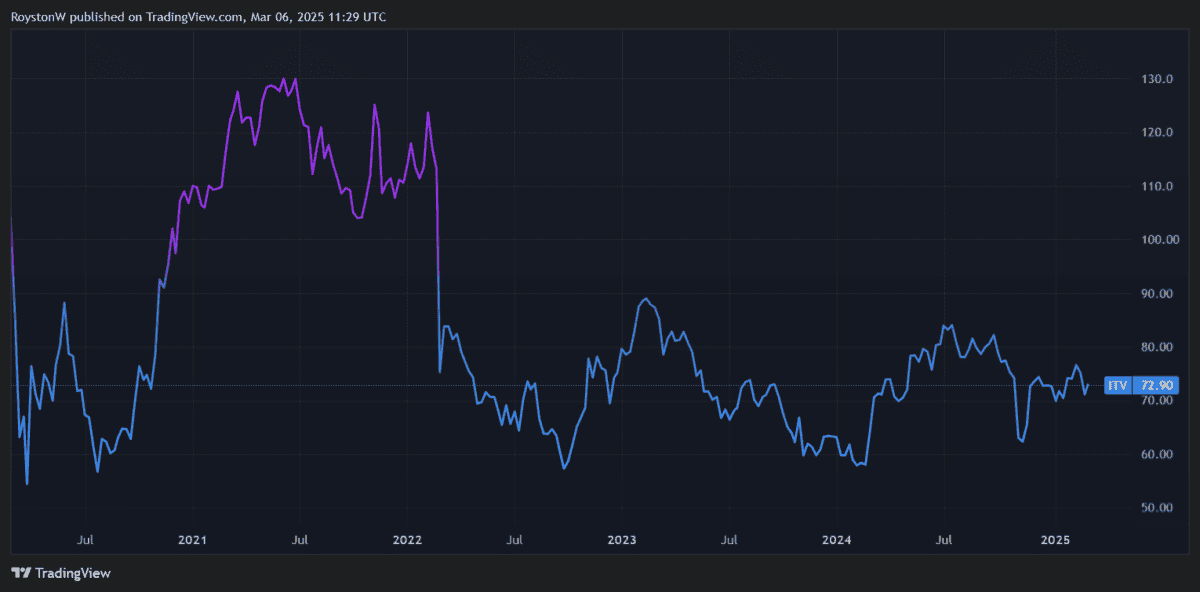
ITV (LSE:ITV) shares are rising strongly again following a bumpy few months. Problems at the broadcaster’s production division, mixed with concerns over the health of the UK economy and direction of interest rates, weighed on investor sentiment late last year.

But it’s on the front foot again Thursday (6 March) after a solid set of trading numbers for 2024. These showed adjusted pre-tax profits up 19%, at £472m.

Source: TradingView

At 72.90p per share, ITV’s share price was last around 5% higher on the day. And if broker forecasts prove correct, it will continue to rise during the next 12 months. But how realistic are the City’s estimates?

Another 17% rise?

As with any share, a wide range of opinions exist where ITV’s share price is heading. One particularly bleak forecast has the commercial broadcaster slumping 18% from current levels, to 60p per share. At the other end of the scale, the most bullish estimate has the FTSE 250 company leaping 58% to 115p.

Overall, City analysts are overwhelmingly positive on ITV shares for the next year. The average price target among eight brokers with ratings on the stock is 85.57p per share, marking a 17% premium to today’s price.

Still cheap

What suggests significant price rise potential from current levels? When combined with predicted dividends, a lump sum investment today could yield a significant total investor return. City analysts are expecting a 5.1p per share cash reward in 2025, resulting in a huge 6.9% dividend yield.

Encouragingly, ITV shares continue to trade at a decent discount to their long-term average. This theoretically provides added scope for the broadcaster to rise in value.

City analysts think annual earnings will increase 4% in 2025, to 8.99p per share. This leaves the firm with a price-to-earnings (P/E) ratio of 8.1 times, some way below the 10-year average of 9.9 times.

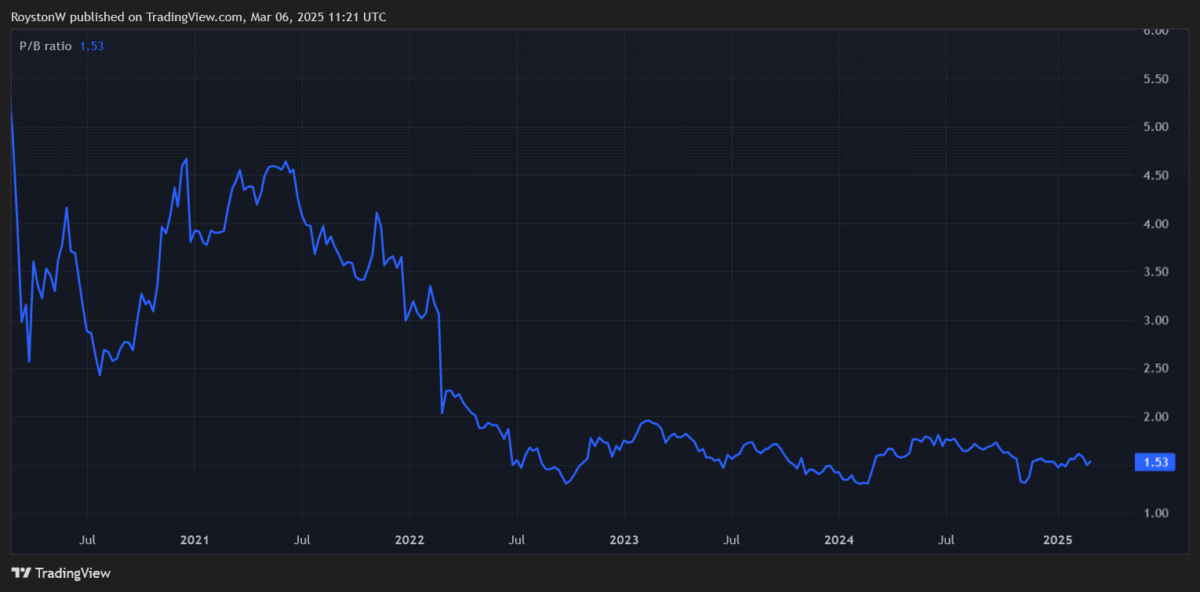
ITV’s price-to-book (P/B) ratio of 1.5 meanwhile, is also well below the long-term average (as the chart shows).

ITV's P/B ratio
Source: TradingView

With its forward dividend yield also above the 5.5% average for the past decade, I think the business could continue attracting interest from value hunters.

Quietly confident?

Yet a further rise in ITV shares is by no means a done deal. Advertising revenues could crumble again if economic conditions worsen. Tighter marketing restrictions on unhealthier foods from October may also hit ad sales hard.

Intense competition from other broadcasters, not to mention US streaming giants like Netflix and Amazon‘s Prime service, could also weigh on performance.

But on the whole, I’m optimistic that ITV’s share price could continue rising. With demand for content steadily rising, and creative strikes in the US over, I believe ITV Studios can keep shining (profits here reached record highs in 2024).

I’m also encouraged by the breakneck momentum of ITVX. It’s been Britain’s fastest growing streaming platform during the past two years and drove ITV’s digital ad revenues 15% higher last year.

Finally, the firm’s cost-cutting programme also continues to surpass expectations. It delivered £60m of savings in 2024, beating estimates by a cool £10m. I think ITV shares are worth serious consideration today.

Why the FTSE 250 isn’t matching the all-time highs of the FTSE 100

The FTSE 100 has been getting a lot of publicity in the past couple of weeks as it pushes to fresh all-time highs. Some believe it could even reach 9,000 points later this year. However, the FTSE 250‘s currently a way off the record highs made back in September 2021. Here’s why I think that is, along with one index member I think is undervalued.

Type of businesses included

The main reason for the underperformance relates to the constituents in the FTSE 250. The businesses are typically more domestic in nature, catering to the UK market. In the FTSE 100, the index is dominated by multinational corporations that generate most of their revenues overseas.

Over the past couple of years, UK economic growth’s been sluggish. This has been the result of a multitude of factors, with concerns over high interest rates, consumer spending pressure, and a weak property market. As a result, companies that mostly trade in the UK haven’t been able to outperform their international peers.

That’s not to say the FTSE 250’s fallen in value over the past year. It’s up 5% over this period, compared to the FTSE 100’s 15% rise. So although an investor would have made money in buying a tracker fund in the past year, it’s underwhelming versus the main index.

Value to be found

Looking forward, I feel there’s scope for some FTSE 250 stocks to outperform going forward due to attractive valuations. For example, aberdeen group (LSE:ABDN), with the business transforming at a rapid pace, beyond the decision to revert to a more ‘regular’ name from the widely criticised abrdn!

The latest annual report showed a flip from an IFRS loss before tax of £6m in 2023 to a profit of £251m in 2024. The business also improved performance with the percentage of funds beating a benchmark. Over a one-year period, 77% of investments being managed performed versus the benchmark, up from 55% a year back. Naturally, if people see their money is being managed well, it bodes well for giving the company more cash going forward.

The share price is up 14% over the past year, but the bulk of this has come over just the past two weeks. In fact, it was only in January that the share price hit its lowest level in a decade. So in terms of valuation, I believe the progress being made on the transformation makes it an undervalued share to research further.

One risk is that the wealth management space is becoming increasingly competitive, with companies noticing the large fees and commissions that can be made here. Aberdeen needs to be careful when trying to win market share.

So even though the FTSE 250 has somewhat missed out on the party, I believe there are good value picks for investors to consider buying.

FTSE shares: digging out undervalued gems with growth potential

FTSE shares often attract value investors due to the UK stock market’s relative underperformance and appealingly low valuations. Compared to the US, many British companies trade at a price significantly below their fair value.

For investors targeting undervalued companies with strong growth potential, the UK market is rife with opportunities.

Seeking value

On average, UK shares tend to have low prices compared to their reported earnings. There may be a few reasons for this but the main one is the lure of American stocks. The rapid gains of big tech companies have proved irresistible to British investors for many years now.

But before we get ahead of ourselves, there are certainly some highly valued shares on the Footsie. Since Brexit – and even more so, Covid – several top-quality companies have enjoyed spectacular price growth. Rolls-Royce being a prime example, but let’s not forget Games Workshop and 3i Group.

So, when searching for value, we need to consider a few factors.

The dividend angle

One of the best ways to extract value from low-priced shares is through dividends. As prices fall, yields rise and many FTSE shares are now over 10%. Investing in an undervalued stock with a high yield can be a great way to secure lucrative passive income for a small price.

But if the price keeps falling, it’s all for nothing. Especially if that money could have been directed to a growth stock offering better returns in the long term.

So how can I uncover a high-yield dividend stock that isn’t going to tank?

Why is it cheap?

Asky why a share is cheap is the most important question to ask. It may seem illogical, but many FTSE shares are cheap for no good reason. This is where value lies.

Consider the popular UK pub and hospitality chain, JD Wetherspoon (LSE: JDW). During Covid, it was hit hard, reporting its first loss in 36 years in 2020. It’s had a tough time since, with the stock down 55% in five years.

But it’s not doing badly, financially.

Its price-to-sales (P/S) ratio of 0.36 suggests it’s bringing in more revenue than its share price reflects. Equally, its price-to-earnings (P/E) ratio of 14.8 is far below the UK Hospitality average of 33.7.

What’s more, it recently reintroduced dividends at 12p per share.

So why is the stock undervalued?

There are some risks that could be giving investors reasons for caution.

Alcohol consumption is trending down among younger generations, bringing the future of pubs into question. Wetherspoons must adapt to these changing habits if it hopes to remain relevant.

On top of that, increases in the national living wage and national insurance contributions could ramp up operational expenses. If it passes these costs to consumers, it risks losing its main selling point: low prices.

Does that negate its value proposition?

Created on TradingView.com

I don’t think so. At least, not yet.

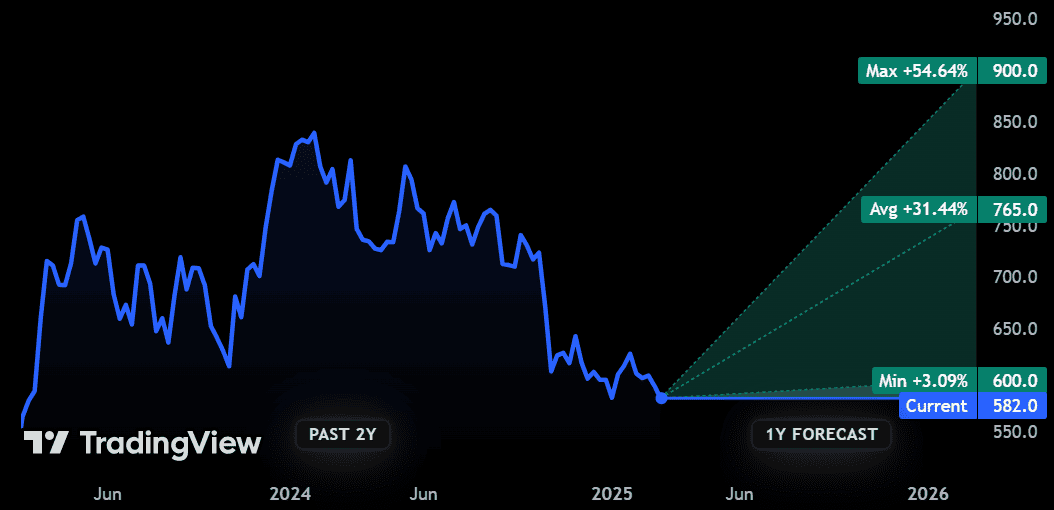
Wetherspoon not only has a thriving food and beverage business but also a growing portfolio of hotels. While many pubs may suffer in the coming years, I think ‘Spoons is well positioned to remain profitable. And so do analysts – the average 12-month target of 765p is 31.44% higher than the current price.

That sounds like a stock worth considering if you ask me.

10% yield! Is this a once-in-a-decade chance to consider buying FTSE income stocks like this one?

Events may finally be moving in favour of FTSE 100 income stocks. As volatility hammers US growth stocks, UK blue-chips are standing firm while offering incredible yields of 8%, 9%, even 10%.

The downside? They haven’t delivered much in the way of share price growth over the last decade. This may be about to change.

US tech mega-caps have left old-school FTSE 100 blue-chips in the shade. The UK’s once-dominant financial sector has struggled, with banks, insurers and asset managers finding the going tough. While banks are now on the up, insurers and asset managers remain in the doldrums. They could be next to stage a recovery.

Is it time to buy dividend shares?

Donald Trump’s presidency has hit Wall Street. US equities already looked expensive. This could boost the attraction of more stable, higher-yielding options like FTSE financials. I’ve been loading up on them in recent years. So far, I’ve picked up lots of dividends but not much growth.

UK insurers offer stability and, crucially, incredible income. One standout for me is Phoenix Group Holdings (LSE: PHNX).

Phoenix specialises in buying up closed life and pension funds and running them efficiently. I hold the stock, and while it’s been a solid source of income, its share price has been underwhelming. Over the past year, it’s up a modest 4%, but over five years, it’s actually down 25%. Phoenix shares have held firm over the last turbulent month. Which is something.

Stubbornly high interest rates aren’t helping. When investors can get 4% or 5% on cash or government bonds with little risk, they’ve less incentive to expose their capital to stocks like Phoenix. When rates fall, that could change. But inflation is sticky, so central banks may keep rates higher for longer.

Maybe one day I’ll get growth too

Right now, Phoenix has a jaw-dropping yield of 10.2%, the highest in the FTSE 100. Yields this high are often unsustainable, but as far as I can see, Phoenix is good for it. No guarantees though. The board must keep finding new business to maintain cash flows and sustain payouts.

That won’t be easy though. This is a competitive market. Phoenix has spotted a new opportunity in bulk annuities, but so has every other major insurer. If trade tariff uncertainty triggers a stock market slump, that will hit the value of the whopping £280bn of assets it has under administration. The board cut even use the uncertainty to slip through a dividend cut.

The yield is forecast to hit 10.8% this year. I’m reinvesting every penny to pick up more stock at today’s low price. But will the share price ever rise?

The 14 analysts offering one-year share price forecasts have produced a median target of 574.5p. If correct, that’s an increase of just over 11% from today. That would give me a total return of almost 22% if true. We’ll see.

I think now’s a good time to consider income stocks like Phoenix. It’s decent value with a price-to-earnings ratio of around 15. That said, I also thought it was a good time to buy 18 months ago. But when I look at the dividends I’ve received so far, I don’t regret it. The next lands on 21 May. It’s in the calendar.

£10,000 invested in Scottish Mortgage shares 1 month ago is now worth…

It’s not hard to imagine why an investor would have put a big lump sum into Scottish Mortgage (LSE: SMT) shares one month ago. They were flying.

The FTSE 100-listed investment trust, which is heavily focused on disruptive US tech, both quoted and unquoted, was up 42% in a year, trading at 1,108p.

It was a big beneficiary of the so-called ‘Trump bump’ in November, when investors anticipated that Donald Trump’s ‘America First’ policy and planned corporate tax cuts would drive Wall Street to fresh highs.

Unfortunately for our Scottish Mortgage investor, the mood has shifted over the last month, as investors fret over the impact of Trump’s trade tariffs instead. The Scottish Mortgage share price has slumped almost 10% in a month to around 1,100p.

Can this FTSE 100 stock fight back?

If our momentum-chasing investor had put £10,000 into the stock, they’d have just £9,000 today. So it goes.

The Scottish Mortgage share price is notoriously volatile. It crashed by half in 2022, during that year’s tech sell-off. But despite the recent dip it’s still up 75% over five years and 25% over the last 12 months.

Here’s a thought. Does anybody actually remember the 2022 tech slump? In retrospect, it was a brilliant time to buy. A crash usually is, for investors who take a long-term view.

So is the current Scottish Mortgage dip also a buying opportunity? Not for me. But that’s because I already have a big stake in the stock. My strategy now is simple. Hold. Forget. Believe.

Investors who also believe in Scottish Mortgage, but don’t hold it, should consider taking advantage of today’s reduced price.

An exciting but risky growth stock

I was concerned whether performance could survive the departure of inspirational manager James Anderson in April 2022. He ran the fund for more than two decades, turning it into the giant we know today. Lead manager Tom Slater seems to be making a good fist of the succession.

Yet there are risks. The trust is US tech heavy, with Amazon, Meta Platforms and Nvidia all in the top 10 holdings. So was Tesla, until the recent sell-off.

There’s a danger Trump triggers a backlash against big tech. Elon Musk’s MAGA associations risk hurting Tesla’s Image among those who don’t share his views.

Investor should also consider their view on Musk’s privately-held Space Exploration Technologies. It’s now Scottish Mortgage’s biggest holding, making up 7.1% of the fund. This is a brilliant way of getting access to a huge unlisted opportunity. Again, it’s risky. The Musk trade – like the Trump trade – could go either way.

So where will Scottish Mortgage shares go over the next month? The only honest answer is – anywhere. All I know is that it’s 10% cheaper than a month ago. Which is a nice discount.

Investor should only consider buying with a very long-term view. Like the 2022 crash, today’s troubles will eventually be forgotten. Investors will be worrying about other stuff instead. I aim to hold throughout.

Prediction: this FTSE 100 dividend stock can keep paying passive income for years

Don’t you love it when you’ve been fearing a possible dividend cut from a high-yield FTSE 100 stock, and then the company bounces back and proves you wrong? That, at least, is what I think just happened with the newly-renamed aberdeen group (LSE: ABDN).

The company posted 2024 results Tuesday (4 March), leading to a 7.7% share price spike on the day. We’re still looking at a 48% fall since 2021’s high point. But it’s not a bad start to a recovery, if that’s we’re seeing.

Danger signs

A consistent dividend of 14.6p probably helped avoid a worse share-price performance. Several troubling signs, however, led me to think the forecast 9% yield might not be sustainable.

One is a lack of cover by earnings over the past few years. Especially as the company even slumped to a loss per share in 2022, while still paying out the cash. Forecasts weren’t much better, with City analysts seeing the lack of cover continuing until at least 2027.

The latest results haven’t fully alleviated that fear. And the forecasts have yet to be updated. But the company did report adjusted earnings per share (EPS) of 15p, marginally ahead of the dividend.

It sounds like we might be back to profit growth sufficient to back the dividend too, as CEO Jason Windsor told us: “The group grew profit in 2024 for the first time in three years.” After a 5% fall in operating profit in 2023, that could mark a happy turnaround.

Assets and flows

In 2023, assets under management declined by 1% to $495bn, which isn’t a big drop but it marked a continuing decline. For 2024, we saw a 3% rise to £511bn.

Net outflows continued in 2024, at £1.1bn. And excluding liquidity movements, the outflow rises to £6.1bn. Clearly, investors will want to see net inflows. But this was a much better result that the previous year, which saw net outflows of £17.6bn (£13.9bn excluding liquidity).

Again, this boosts my confidence in the likelihood of the dividend being maintained in 2025 and hopefully beyond. The longer term is obviously open to risk. And with the economic outlook still pretty ropey, it’s far from being a negligible risk.

Things to watch

There are two things in aberdeen’s targets which I think could determine the sustainability of the dividend.

Firstly, the company is targeting an adjusted operating profit of at least £300m by 2026. It would be supported by a predicted “significant uplift in contribution” from the firm’s interactive investor division. And it would mark a rise of at least 18% from 2024’s result. As a target, it might not be a huge one. But I think it could be sufficiently stretching, and achieving it could be key.

The other is net capital generation, expected to rise to about £300m in 2026, approximately 26% above the 2024 figure.

There can be no guarantee of dividends. But I think investors seeking long-term passive income could do well to consider aberdeen.

£10,000 invested in IAG shares 1 month ago is now worth…

A month ago, I was gung-ho for International Consolidated Airlines Group (LSE: IAG) shares. On 7 February, I noted they’d climbed a stunning 145% in a year, making them the best performer on the entire FTSE 100.

I swept aside my usual worry that I was coming too late to the party. I decided the British Airways owner still looked terrific value, with a price-to-earnings (P/E) ratio of just 8.6.

Admittedly, its P/E was below four times at the start of its stellar run, but I decided the airline still had more fuel in the tank.

So what stopped me? The simple fact that my trading account was empty of cash. I had to sell something to buy, and couldn’t decide what.

Can this FTSE 100 stock gain altitude again?

In retrospect, I got lucky. The share price has slumped 10% in the last month, from 363p to 327p. Its P/E’s down to around seven. The shares are still up 130% over 12 months, but have I just been handed a brilliant buying opportunity?

The first thing to say is that one month’s movement is neither here nor there. In the short term, shares can go anywhere. It’s worth paying attention if bad news or bad results have destroyed the investment case, but that isn’t the case here. 

The IAG dip’s mostly down to wider stock market volatility as the world adjusts to the Donald Trump presidency.

After the initial ‘Trump bump’ following his November election victory, investors decided that British Airways’ transatlantic travel operations left IAG nicely placed to benefit from the anticipated US boom. Now they’re having a rethink.

Threatened tariffs pose a threat to international trade and travel demand, as well as wider economic and geopolitical stability. Even if Trump’s tariffs don’t directly target the airline industry, they could still hit business travel and consumer confidence. Airlines can be cyclical, booming in good times, struggling in bad.

The uncertainty has cast a shadow over a positive set of 2024 results, published on Friday (28 February). These showed full-year operating profit 49% higher than analyst predictions, at €961m. CEO Luis Gallego felt confident enough to claim during an earnings call that “this is not the peak, but the start of a more sustained level of profits”.

Share buybacks and dividends

IAG also announced a €1bn share buyback while the trailing dividend yield of 2.47% is forecast to hit 2.81% this year. With luck, it will continue to climb.

Let’s not get carried away. The post-Covid rapid recovery stage is over. Operating margins are forecast to creep up very slowly, from 13.3% to 13.5%. Net debt is still around the €6bn mark.

The 26 analysts offering one-year share price forecasts have produced a median target of 387.9p. If correct, that’s an increase of 18.5% from today. So while they’re optimistic, nobody expects the shares to double again. Investors considering this stock need to temper their expectations.

I’m keen to buy but I’m butting my head against the same problem. My trading account is empty. That’s still the only thing stopping me from buying IAG today. Better get saving.

Financial News

Daily News on Investing, Personal Finance, Markets, and more!

Financial News

Policy(Required)