3 UK shares ChatGPT thinks could lead the next big stock market rally

It’s been a bumper year so far for global markets, but with conflicts and trade tariffs threatening volatility. Since artificial intelligence is a hot topic, I thought I’d asked ChatGPT which UK shares it thinks could benefit in the coming years.

It said investors looking for high-growth opportunities should look at global defence spending, the renewable energy transition and rising demand for critical metals. It then provided three British companies as examples.

I decided to see if they’re worth considering ahead of the next stock market rally. My verdict on ChatGPT? Not bad, but not good enough!

Riding the defence boom

BAE Systems (LSE: BA.) stands out among European aerospace and defence contractors as a critical player within the current geopolitical landscape. It’s the largest of its kind in Europe and with the Ukraine conflict boosting defence budgets, demand for its equipment is surging.

The company has built up a large order backlog exceeding £65bn, promising strong revenue for years. This comes as several European governments increase defence spending, reinforcing its long-term prospects.

But it’s a high-risk business, at constant threat from cyberattacks, supply chain disruptions and political changes. Its profits rely heavily on overcoming these issues and retaining lucrative defence deals. In 2023, it reported healthy earnings growth and continued to raise its dividend but many factors out of its control could reverse that performance in future.

Still, with strong government contracts and steady cash flow, I think BAE is a good stock to consider.

The green energy powerhouse

As governments accelerate their push for green energy and net-zero targets, SSE (LSE: SSE) stands out as a major beneficiary. The company is one of the UK’s largest renewable energy producers, focusing on wind and hydro-power.

It invests heavily in offshore wind farms and benefits from stable, regulated income, supported by UK and EU climate policies. With energy transition efforts gaining momentum, its long-term growth prospects remain strong.

At the same time, this reliance on government support is a risk. Policy changes such as reduced subsidies could impact profitability. Equally, lower power prices or increased competition in the renewables sector could squeeze margins.

A key attraction is the 4.2% dividend yield, making it attractive for passive income. However, I think National Grid is a better pick as it also stands to benefit from green energy transition, with a higher dividend yield and better growth potential.

Rio Tinto (LSE: RIO) is well-positioned to benefit from a rising demand for critical minerals as global supply chain disruptions and China’s economic slowdown threaten mining stocks.

The company is a leading supplier of copper, lithium and aluminium — key materials for electric vehicles, renewables and defence technologies. As Western nations seek alternative metal sources, a reduced reliance on China could boost its revenues.

However, this is also a key risk, as China is one of its largest customers for iron ore. US trade tariffs compound this issue, along with supply chain disruptions, which could increase costs and hurt profits.

In addition to growth potential, it also offers a high dividend yield of 6.3%, making it a good one to consider for an income-focused portfolio, ChatGPT says.

Unfortunately, I think it’s ignoring the potential risks from Rio’s history of sometimes controversial mining practices that could mean losses from fines and penalties.

Why did this high-flying FTSE 250 stock just fall 15%?

Shares in Just Group (LSE: JUST) led the FTSE 250 fallers on Friday morning (7 March) with an early 15% dip, despite strong headline results for the year to December.

CEO David Richardson said: “We made a pledge three years ago to double profits over five years. We have significantly exceeded that target in just three years and created substantial shareholder value as a result.

What’s not to like about that? Maybe it’s because the good news was hinted at in a 15 January update, boosting the share price. Perhaps investors are going on ‘buy the rumour, sell the news?’

“Shaping a brighter future”

The CEO added: “Our markets remain buoyant and we are confident in our ability to grow earnings at an attractive rate from this significantly higher level.”

The pensions insurance group saw a 34% rise in underlying operating profit to £504m. That includes a contribution from new business growth. But recurring profits, which can be a key sustainer of long-term income, played a part.

Adjusted profit before tax actually fell, to £482m from the previous year’s £520m. The bulk of that is deferred, which leaves IFRS profit before tax of just £113m (£172m a year ago). Am I seeing some reason behind the morning’s share sell-off?

A 15.3% return on equity (up from 13.5%) and tangible net asset value (NAV) per share of 254p (from 224p) both look impressive. On the previous day’s close, that implies a discount to NAV of 36%.

Five-year winner

Just lifted its 2024 dividend by 20% to 2.5p per share for a 1.5% yield. It’s not among the FTSE 250’s biggest, but it beat forecasts. Seeing the share price more than double over the past five years more than makes up for a low dividend in my books.

After such a steller performance, the stock must be highly valued, right? Well, that’s where Just Group adds another to the list of puzzle-building, in my mind.

Underlying earnings per share (EPS) of 36.3p indicate a trailing price-to-earnings (P/E) ratio of just 4.5. But on a reported basis, EPS came in at only 6.5p per share for a P/E of 25. That’s a huge difference, and it’s down to IFRS profit before tax being so low.

Forecasts had put EPS at 8.1p. So on a reported basis, this was a miss. For 2025, the analysts predict 7.7p per share, which is a fall from the 2024 expectations but a rise on Just’s actual reported 6.5p. How do these figures relate to adjusted earnings? My head hurts.

What should investors do?

I think results like these offer us a helpful lesson. Anyone considering buying should take care to understand all the adjustments. It doesn’t imply anything wrong, and IFRS sometimes doesn’t apply well to specific businesses. But varying accounting standards can mean it’s much harder to make like-for-like comparisons between stocks based on the same headline criteria.

My take on Just as an investment? Until I do some further research to clarify these confusions, I simply don’t know.

With a new strategy, could BP shares become fashionable again?

In April 2010, just before the Deepwater Horizon oil spill, BP shares were changing hands for around 630p. Today, nearly 15 years later, an investor could buy one for 410p. The disaster is a reminder how dangerous the industry can be. Eleven workers lost their lives and the environmental damage was enormous. As a result, the group continues to incur legal fees.

More recently, over the past five years, the BP share price has underperformed that of Shell, its closest rival. If an investor had put £10,000 into each company in March 2020, the stake would now be worth £26,283. However, £5,911 (94%) of this increase would have been due to the performance of Shell’s share price.

Against this backdrop, on 26 February, BP organised a Capital Markets Day and announced a new strategy to help increase shareholder value.

A new era of hydrocarbons

Central to the group’s revised approach, is a planned $10bn investment in oil and gas between now and 2027. This is 20% more than previously advised and significantly slows the group’s transition to a less carbon-intensive business model.

Those worried about the environmental impact of BP’s new strategy will be concerned that during the Q&A session with analysts, there was no mention of ‘net zero’ or ‘global warming’. And only one reference to ‘carbon footprint’.

In another move intended to reassure shareholders, over the next three years, the group wants to raise $20bn from the sale of non-core assets. Some of these funds will be used to reduce debt to $14bn-$18bn by the end of 2027. For comparison, at 31 December 2024, it stood at $23bn.

Of course, it’s easy to come up with an impressive plan but far harder to successfully implement one.

Responding to market conditions

In my opinion, the renewed emphasis on oil and gas reflects the fact that — whether we like it or not — demand continues to rise.

There’s a document on the company’s website that considers when peak demand for oil will come. It notes that there are all sorts of predictions, from now through to 2040. However, BP’s chief economist argues that the debate is misguided for two reasons. Firstly, nobody can be certain when it will happen. And more importantly from the company’s point of view, it’s largely irrelevant because oil consumption is unlikely to fall dramatically thereafter.

However, I believe the biggest impact on the company’s future financial performance will be energy prices. And these are impossible to predict with any accuracy. Also, it’s unclear how President Trump’s ‘drill, baby, drill’ message will impact prices. In theory, increasing supply will bring them down although OPEC+ members will try and stop this happening.

But despite these challenges, the stock continues to be good for income. Based on the four previous quarters, the group’s shares are presently yielding 5.9%. It plans to raise the dividend by 4% a year. And continue with share buybacks.

On balance, I think this is a buying opportunity for less risk-averse investors to consider. But I suspect those following ethical principles will be horrified at BP’s new strategy and want to steer well clear.

The Harbour Energy share price sinks 11.5% in a day. Can it recover?

Since March 2020, the Harbour Energy (LSE:HBR) share price has fallen 86%. Of all the FTSE 250 stocks, this makes it the third-worst performer. It also fell heavily yesterday (6 March) when the oil and gas producer announced its 2024 results.

The group’s performance includes around four months’ contribution from the Wintershall Dea portfolio of assets. These were acquired on 3 September, for consideration of $11.2bn (£8.7bn at current exchange rates). The deal has been described as “transformational” because it means the enlarged group will be producing more than twice as much as Harbour Energy’s previous output.

Investors appear unimpressed

But just prior to the purchase, the group’s stock market valuation was £2.2bn. It’s now – despite the significant uplift in production — only £3.1bn. It looks as though investors are sceptical about the deal.

However in 2024, Harbour Energy achieved production of 258,000 barrels of oil equivalent a day (boepd). This was 40% more than in 2023. And revenue was 65% higher at $6.2bn. For 2025, when the full benefit of the acquisition is realised, output is expected to be 450,000-475,000 boepd.

However, despite this revenue growth, the company’s bottom line has been severely impacted by the government’s energy profits levy, or windfall tax as it’s more commonly known.

The group made a post-tax loss of $93m versus a profit of $45m in 2023. However, the 2024 results do include $1.1bn of exceptional costs, including impairments and write-offs.

Amazingly, the company was subject to an effective tax rate of 108%. Fortunately, much of the Wintershall Dea portfolio falls outside the scope of the windfall tax. But the group’s still likely to face an eye-watering tax bill for the foreseeable future.

Cash is king

However, it’s cash that really matters. And in 2025, the company’s forecasting free cash flow (after tax and before shareholder distributions) of $1bn. This is based on a Brent crude price of $80 a barrel and a European gas price of $13/mscf (thousand standard cubic feet).

By comparison, oil’s currently trading at $70 and gas is just over $15. A $5 movement (up or down) in Brent crude is equivalent to $115m of cash a year. A $1 change in the gas price will have the same impact.

Based on current market prices, it therefore appears as though the group remains on target to deliver the $1bn of cash that’s been forecast. And with the dividend currently costing $455m a year, assuming all goes to plan, it will be covered more than twice by free cash.

But commodity prices can be volatile, so there are no guarantees that the $1bn will be achieved. And any sign of a shortfall could impact the dividend and investor confidence.  

However, ignoring the disappointing market reaction to the results, I intend to remain a shareholder. Despite the enormous tax rate, the group’s cash generative. And there’s a bit of headroom, which should ensure the dividend’s maintained even if energy prices soften a little.

Also, the group’s price-to-book ratio is only 0.63 which, in my opinion, suggests the recent sell-off has gone too far. On this basis, investors looking to add an undervalued stock to their portfolios — and one offering a generous dividend — could consider buying Harbour Energy shares.

As tariffs shake the stock market, here are 2 discounted shares to consider buying

The time to buy shares is when they trade at discount prices. And with US tariffs shaking stocks on both sides of the Atlantic, I think there are some nice-looking opportunities for investors at the moment.

I’ve got an eye on two stocks in particular. The underlying businesses are very different but they have one important thing in common – the shares look like good value to me.

WH Smith

I thought I’d missed my chance on WH Smith (LSE:SMWH). I was looking at the stock with interest at the start of the year, but the share price jumped 14% at the end of January.

Since then though, the shares have fallen back and I’ve seized the opportunity to add the stock to my portfolio at what I think is a bargain price.

The thing with WH Smith is it’s actually two businesses – a high street division and a travel division. The first isn’t particularly attractive, but the second is.

WH Smith has announced plans to focus on its travel business. This is risky, as it’s much more vulnerable to a recession weighing on discretionary spending – like holidays.

But I think the decision is the right one. The travel ops generated £189m in profits last year and could alone be worth the current £1.4bn market cap.

If I’m right, investors might well have a margin of safety built into the current share price. And anything the company can get for its high street stores is a nice bonus. 

Celebrus

Celebrus Technologies (LSE:CLBS) is much less of a household name. And it’s a very different type of investment – this one is about consistent growth going forward. 

The stock is actually higher than it was at the start of February. But zoom out a bit and the share price is down 18% since the start of the year, so it’s trading at a discount to that level. 

Celebrus is a software firm with a product that allows businesses to see what customers are doing on their website or app in real-time. And it has been growing very impressively.

Source: Celebrus

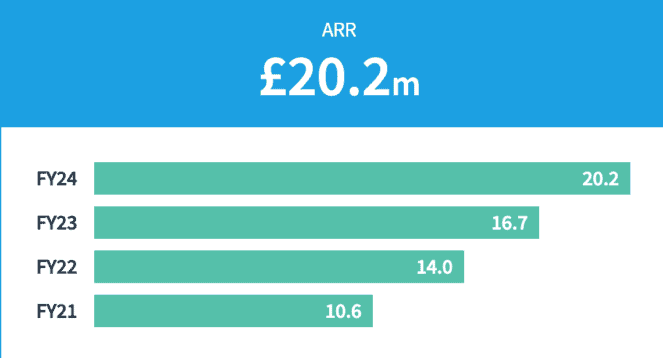
The company operates on a subscription model and since 2021, annualised recurring revenues have been increasing by at least 20% per year. I think that’s impressive, but there are risks.

Celebrus has some significant competition and it gives away a lot in terms of size against some of its rivals. That’s something investors should keep in mind.

I think, however, this is reflected in a price-to-sales (P/S) ratio of below 3. Compared to CoStar Group (11), Guidewire Software (16), or Tyler Technologies (13), the multiple is incredibly low.

Same… but different

Both WH Smith and Celebrus shares trade at a price-to-earnings (P/E) ratio of 23. But that’s where the similarities end, from my perspective.

WH Smith is a well-known business, but I think there’s more to the stock than meets the eye. And Celebrus doesn’t get much attention, but I’ve been buying it for my portfolio.

Noise from the US and its tariff threats have created uncertainty in the stock market. As a result, I think this is a great time to be looking for potential opportunities.

My investment in this FTSE 250 stock is down 20%. What should I do?

I’ve been buying shares in FTSE 250 pub chain JD Wetherspoon (LSE:JDW) for some time. And the falling share price means I’m down around 20% on my investment. 

That obviously hasn’t gone according to plan, but the question is what should I do next? Is the stock now better value than it was before, or should I write this one off and look elsewhere?

Why’s the stock been falling?

On the face of it, things have actually been going pretty well for JD Wetherspoon. In 2024, sales grew 5.7%, but some big cost reductions meant earnings per share were up 77%. This is the result of the firm figuring out how to do more with less. Closing some of its pubs and buying freeholds to reduce lease obligations has made the business a lot more profitable.

All of this is what I expected when I first bought the stock. But there have been some less positive developments and some of these are more obvious than others. Investors have (rightly) been focusing on rising Employers’ National Insurance Contributions and an increase in the Living Wage. These are a threat to JD Wetherspoon’s profit margins.

There is however, also a less obvious issue. The company’s like-for-like sales growth has slowed from 12.7% in 2023 to 7.6% in 2024, to 5.1% in the first half of 2025. That’s been a broader theme across UK consumer businesses and I think it’s something investors considering the stock should pay attention to. 

Should I be worried?

Weak like-for-like sales growth has been a common theme of late. Associated British Foods, B&M European Value Retail, Greggs and several others have all reported something similar.

I see this as a sign things are tough across the sector at the moment. And I don’t expect to find JD Wetherspoon exempt from this when it reports its half-year earnings later this month. 

I do however, think the company is an unusually strong one. Businesses that sell things to customers for less than their competitors are generally ones that I like to look at. The attraction of low prices is something that I think is a durable one for consumers. But there’s a catch – this strategy only really works for firms that can keep their own costs down. 

With JD Wetherspoon, I think the company has some clear strengths in this regard. The scale of its operations allows it to negotiate better prices from suppliers, which it can pass on. On top of this, its strategy of owning – rather than leasing – its pubs helps reduce rental costs. With both of these advantages still intact, I still have a positive long-term view of the stock.

My plan

The risks of a tough economic environment weighing on sales and higher staff costs weighing on margins are real. But JD Wetherspoon’s long-term strengths still seem to be firmly in place.

As a result, I’ve been buying the stock earlier this week. And my intention is to continue doing so unless something about the underlying business changes in the near future.

3 cheap FTSE shares I’m considering before next month’s ISA deadline!

With 5 April’s Stocks and Shares ISA deadline approaching, I’m building a list of the best cheap UK shares to buy.

I don’t need to actually purchase any shares, trusts or funds before next month’s cut-off point. I merely need to park money in my ISA to make use of this tax year’s £20,000 contribution limit.

But with so many bargain stocks out there, I think waiting to strike could be a mistake. Here are three great shares from the FTSE 100 I think could be great buys for me to consider before they have a chance to re-rate.

1. Standard Chartered

Standard Chartered‘s (LSE:STAN) share price has rocketed over the past six months. Yet at current prices, the bank still looks to me like a brilliant bargain.

At £12.42 per share, it trades on a forward price-to-earnings (P/E) ratio of 8.4 times. This is lower than the corresponding readings of UK-centred FTSE 100 operators Lloyds and NatWest, and fails to reflect (in my opinion) the superior earnings potential that its focus on Asia and Africa provides.

StanChart’s price-to-earnings growth (PEG) ratio of 0.8 meanwhile, is below the widely regarded value watermark of 1.

Economic turbulence in its key Chinese market poses some near-term danger. But I find the bank’s ongoing resilience hugely encouraging (pre-tax profit rose 18% year on year in 2024, to $6bn).

2. Aviva

Aviva (LSE:AV.) meanwhile, offers excellent value based on predicted earnings as well as dividends. It’s why the Footsie company’s a key plank in my own UK shares portfolio.

For 2025, it trades on a PEG ratio of just 0.1. At 541.8p per share, the company also carries a tasty 6.9% dividend yield.

As with Standard Chartered, Aviva’s share price has also enjoyed significant strength in recent months. More specifically, the financial services giant has surged on the back of February’s forecast-topping trading statement for 2024.

Strength across its British, Irish and Canadian divisions pushed operating profit 20% higher, to £1.8bn. With its Solvency II capital ratio at a healthy 203%, the business hiked the annual dividend 7% year on year.

Market competition is severe and poses a constant threat to revenues. But I’m optimistic Aviva will deliver impressive long-term growth as demographic changes drive demand for its retirement and wealth products.

3. WPP

WPP (LSE:WPP) carries much higher risk, in my opinion, than Aviva and StanChart. But at current prices of 610.20p I still feel it deserves serious attention.

The communications agency trades on a forward P/E ratio of 6.9 times, while its corresponding PEG ratio’s just 0.1 times.

Finally, the dividend yield for 2025 is a mighty 6.5%.

This impressive value reflects WPP’s share price collapse following February’s full-year financials. Weakness across North America, the UK and China meant like-for-like sales net revenues dropped 1% in 2024, to £11.4bn. It predicted corresponding sales would fall between 0% and 2% this year too.

The FTSE firm’s under pressure as the tough economic environment causes advertisers to scale back spending. But I think the long-term outlook for WPP remains robust, with its impressive scale and rising investment in digital marketing potentially putting it in the box seat for an eventual market upturn.

I think it’s worth serious consideration following recent price weakness.

£10,000 invested in a FTSE 100 index fund in 2019 is now worth…

The FTSE 100 is a rich hunting ground for elite UK shares. Conceived in Thatcher’s Britain, it quickly became the country’s leading stock market indicator. Today, it’s easy to gain broad FTSE 100 exposure via low-cost index funds.

But how has the Footsie performed compared to the S&P 500 recently? Should investors consider looking for individual stocks with the potential to outpace Britain’s premier benchmark?

Let’s explore.

Index returns

14 May 2019 was a big date for index investors. On this day, asset management giant Vanguard launched exchange-traded funds (ETFs) tracking the FTSE 100 and S&P 500.

Including dividend reinvestments, £10,000 put into Vanguard’s FTSE 100 UCITS ETF (VUKE) at its inception would be worth £15,065.21 today. That 50% gain looks decent at first glance!

However, there’s a fly in the ointment. Vanguard’s S&P 500 UCITS ETF (VUSA) significantly outperformed its UK counterpart, rising 133% over this time period.

Individuals who invested their cash in the US ETF would have £23,336 today. Those juicy compound gains add up over time.

Winds of change?

Despite shining on dividends, the UK index lacks cutting-edge growth shares. Technology stocks represent just 1% of the FTSE 100 ETF. That’s dwarfed by a 32.5% allocation for Vanguard’s US tracker.

Essentially, a tech boom stateside has powered a colossal bull run in US stocks, while homegrown equities have struggled to keep pace. It’s an uncomfortable dynamic for British investors to grapple with.

But fear not, FTSE 100 fans! I have some good news. Vanguard’s forecast for US stocks’ 10-year annualised return is just 3.9%. Regarding UK shares, anticipated gains are almost double at 6.7%.

Attractive valuations for British equities sit at the crux of the fund manager’s logic. The Footsie’s average price-to-earnings (P/E) ratio of 16.4 compares favourably to a 27.5 multiple for the S&P 500. Whether this is enough to stop the UK stock market’s relative decline remains to be seen.

A potential FTSE 100 gem

Index funds warrant a place in most portfolios, especially for those getting started in investing. However, it’s also worthwhile to consider individual FTSE 100 stocks, although this brings greater risks.

One that merits contemplation is 3i Group (LSE:III), a closed-ended investment fund focusing on private equity and infrastructure.

The 3i Group share price has advanced 316% in five years. These mighty gains can primarily be attributed to a single position accounting for 70% of the company’s portfolio, Dutch discount retailer Action.

This unlisted firm operates 2,750 stores across 12 European countries, selling low-cost household goods. With limited numbers of SKUs and spartan stores, Action aims to undercut supermarket competition by keeping overheads down. What’s more, 80% of products are priced under €5.

Growth has been spectacular, driven by Action’s aggressive expansion beyond Europe’s northern shores and its fast turnover strategy. 3i Group initially invested in the business in 2011 for €279m. That position was worth a whopping €17.1bn in December 2024.

However, I have some concerns. There’s an obvious concentration risk in 3i Group’s portfolio. That’s especially worrying if Action’s growth slows down. A reliance on constant expansion could cause problems if new store openings begin to wane.

That said, even if 3i Group’s a one-trick pony, its huge return on investment thus far must be admired.

The ITV share price is down 27% in 5 years. Can it recover?

Today (6 March) has seen a jump in the ITV (LSE: ITV) share price, after the broadcaster unveiled its full-year numbers.

Over the longer term, though, the City has been tuning out the FTSE 250 company’s investment case. The ITV share price has fallen 27% over the past five years.

The price chart does not show the full picture when it comes to investors’ returns.

After all, ITV has a juicy 6.7% dividend yield. The company held the annual dividend per share flat in today’s results and said it expects the same payout for this year, although it anticipates growing the dividend over the medium term.

So, is this a share investors should consider not only for the attractive passive income potential, but also perhaps some capital gains as it starts to get back to its former price level?

Long-term question mark

To some extent, I think the ITV share price chart contains some clues to the answer.

For years, ITV shares have looked cheap. Yet they have generally failed to rise above a certain level before falling again.

Revenue last year fell 3%. That points to some of the longer-term challenges for ITV. Demand for legacy terrestrial services remains substantial but is in structural decline, posing an ongoing threat to advertising revenues.

Meanwhile, digital services can help provide some growth opportunities and indeed digital revenues last year were a substantial £556m. But the market is crowded.

ITV’s studios business, which helps other broadcasters produce and shoot shows, could help. But demand has been weakening and last year, revenue from ITV’s studios division fell 6%.

The question I think investors have been wrestling with for years – and that remains unanswered – is whether this is a cash generative legacy business in genteel decline, or a bargain media company that is successfully pivoting to new areas of opportunity.

Lots of potential

Although revenues declined, earnings per share doubled.

The company benefits from a strong brand, large viewer and subscriber base, unique studio facilities, and substantial cash flows. Last year, for example, it generated £325m of free cash flow. For a company with a market capitalisation of £2.8bn, that is substantial.

In fact, I think ITV has the potential to keep doing well over the medium to long term.

It has adapted its business model for a shifting media landscape while continuing to make profits and generate free cash flow, supporting a generous dividend.

Despite all that, the ITV share price has continued to languish for the most part.

The investment case now is much as it has been for the past several years or more, so I see no immediate reason for it to start climbing back to its old level.

From a long-term perspective, though, I do see it as undervalued and so think investors ought to consider it.

This S&P 500 darling is down 25% in the past month! Here’s what’s going on

It has been a jittery start to March for the US stock market. Concerns around tariffs and the impact they could have on economic growth and inflation have caused some investors to get worried. Some S&P 500 stocks have seen a significant move lower in a short space of time. Here’s one that has fallen that I think could be worth buying.

Reasons for the fall

I’m referring to Vistra Corp (NYSE:VST). The stock is down 24.6% over the last month, but still up 122% over the past year. Vistra’s a US-based energy company engaged in the production and distribution of electricity and related services. 

One reason why the stock has struggled so far in 2025 is due to the rise of DeepSeek, a Chinese AI-model that was reportedly trained and built for a fraction of the cost of other large language models (LLMs). You might think that this story doesn’t really have anything to do with Vistra, but you’d be wrong.

A key reason for the surge in the stock over the past year has come because the energy infrastructure it owns is seen as the future for powering AI projects. The ability to fuel such energy-hungry processors means that Vistra could see revenue significantly increase in coming years. However, the DeepSeek breakthrough caused the stock to fall. If investors have to dial back optimism about how much electricity is actually going to be needed, then maybe Vistra won’t be as profitable as initially thought.

Another factor has been lower electricity prices. The mild winter in the US has further reduced electricity demand, putting downward pressure on energy company revenues.

The long-term view

Despite the short-term negatives, it doesn’t change the fact that Vistra is still hot property. The 2024 results mentioned that “in these 12 months, we closed on a unique acquisition, adding three nuclear sites, approximately one million additional retail customers in the key PJM market and 2,000 new team members”.

The bottom line is that there’s a lot of progress being made at the company, aside from the AI-hype and speculation. The share price will likely continue to be volatile. But I think that it will move back higher this year. As the dust settles on some of the AI concerns, people should realise that Vistra is a profitable utility company.

Further, it’s pushing ahead with renewable energy. Even though this will be attractive for big tech with AI spending plans, it’s also appealing to other corporate customers. So even if AI slows down, it can still do very well with other clients.

Summing it up

Overall, I think this is a dip opportunity worth considering for investors. In contrast to some other AI-related stocks, Vistra has a strong core utility business, which I think makes it more sustainable going forward.

Financial News

Daily News on Investing, Personal Finance, Markets, and more!

Financial News

Policy(Required)