Passive investing movement gets its Hollywood moment

A new documentary titled “Tune Out The Noise” brings together some of the academic heavyweights whose work reshaped the financial industry and helped lower costs for all investors.

The film, made by Academy Award-winning documentarian Errol Morris, chronicles the rise of academic finance in the middle of the twentieth century and how it led to a boom in passive investing and to the creation of Dimensional Fund Advisors, which now has more than $700 billion in assets under management.

Morris and David Booth, Dimensional chairman and the namesake of the University of Chicago Booth School of Business, spoke to CNBC’s Bob Pisani on Thursday ahead of the film’s New York premier.

“It’s really about how markets work and how different that is from people’s intuition or perception,” Booth told Pisani.

In addition to Booth and some Dimensional executives, the film features interviews with many of the biggest names in financial academia, including Myron Scholes, Robert Merton, Eugene Fama and Kenneth French.

The work of those academics, who have all had roles at Dimensional over the years, helped push the investment world away from traditional stock picking and toward passive, low-cost strategies. That trend extends beyond Dimensional, with firms like Vanguard using those insights to build their own businesses.

“People are getting a much better deal now than when I started in 1971,” Booth said.

Morris’ previous work includes “The Fog of War,” which won the Academy Award for best documentary feature in 2004, as well as “The Thin Blue Line.”

“One of the reasons I became a filmmaker, or a documentary filmmaker, whatever you want to call it, is I like to hear people telling stories. And this is filled with it,” Morris said of his new film.


Here’s the dividend forecast for BAE Systems shares for 2025 and 2026

Defence contractors like BAE Systems (LSE:BA.) often prove to be great dividend shares to hold over the long term. This particular FTSE 100 operator has grown its annual dividend every year since 2012.

It’s long record of payout growth reflects BAE’s market-leading position and the resilient nature of defence spending. Demand for weaponry and related hardware remains broadly stable regardless of broader economic conditions.

In fact, the outlook for defence spending is stronger now than it has been for decades. And so holders of the Footsie company can realistically expect dividends to keep growing as sales (likely) strengthen, at least over the near term.

Further growth expected

My optimistic take is shared by City analysts. As the table below shows, dividends on BAE Systems shares are tipped to keep rising through to the end of 2026:

Year Dividend per share Dividend growth Dividend yield
2025 35.92p 9% 2.2%
2026 39.50p 10% 2.5%

Encouragingly for investors, these dividend projections are well covered by expected earnings over the period, too. So even if profits are blown off course — for instance, by supply chain issues or project delivery problems — the company could still be in good shape to meet broker forecasts.

Dividend cover rings in at 2.1 times for each of the next two years, beating the widely regarded minimum level of 2 times that investors crave. This should give the company the flexibility to meet payout forecasts while also continuing to invest for growth.

Strong foundations

That’s not to say I’m expecting profits to disappoint over the next couple of years. BAE Systems’ sales and operating profit rose 14% and 4%, respectively, in 2024, to £26.3bn and £2.7bn.

With a strong order book — the company’s order backlog rose £8bn last year, to £77.8bn — the business has strong earnings visibility over the period too.

On top of this, the FTSE 100 company has considerable financial resources it can call upon to grow dividends in line with forecasts. Free cash flow remains strong and was an impressive £2.5bn in 2025, helped by strong customer advances and impressive operational cash conversion.

BAE’s £1.5bn share buyback programme (due to complete in 2026) underlines the robustness of its balance sheet.

A top buy?

BAE Systems’ soaring share price has had a negative impact upon the company’s forward dividend yields. For the next two years they sit some way below the FTSE 100 forward average of 3.5%.

Still, I believe the prospect of rapid, inflation-beating payout growth in the years ahead makes the stock worth serious consideration for passive income.

There are hazards the company may face further down the line. Particularly troubling is the prospect that US defence spending will fall under President Trump’s efficiency drive. The US is the company’s largest single market.

But on balance, I think BAE Systems shares are an extremely attractive option for both growth and dividend investors, supported by surging defence spending by non-US NATO countries.

A last-minute buy for Stocks & Shares ISA investors to consider!

A sense of panic is rising on stock markets as the threat of ‘Trump Tariffs’ and reciprocal action from other major economies grows. But I’m not tempted to run for the hills. Instead, I’m searching for great stocks to buy before next month’s Stocks and Shares ISA deadline.

Any of my £20,000 annual allowance that I don’t use before 5 April is lost, as it can’t be rolled over to the 2025/26 tax year. So it makes sense to at least deposit as much money as I can in my ISA before that date. This is even if I don’t actually buy any shares, trusts, or funds with it.

Please note that tax treatment depends on the individual circumstances of each client and may be subject to change in future. The content in this article is provided for information purposes only. It is not intended to be, neither does it constitute, any form of tax advice. Readers are responsible for carrying out their own due diligence and for obtaining professional advice before making any investment decisions.

I’m not planning to stop building by Stocks and Shares ISA despite current uncertainty. This is because I buy stocks for the long term, and as a consequence volatility like we’re currently seeing doesn’t dampen my investing appetite. In fact, recent market sell-offs leave me with a chance to go hunting for bargains.

Finally, with a broad spectrum of assets to choose from, I can invest in assets that may remain resilient — or perhaps even thrive — if the economic and political landscape worsens.

Here’s one such safe haven on my watchlist today.

Rising in the gloom

Demand for gold-related assets like the iShares Physical Gold ETF (LSE:SGLN) is soaring as financial market tension grows.

According to the World Gold Council (WGC), global bullion-backed exchange-traded funds (ETFs) reported inflows of $9.6bn in February, the strongest level for almost three years. Holdings increased across Europe, Asia, and North America (where inflows were at their greatest since July 2020).

Demand for the yellow metal continues to soar despite its increasing expensiveness. Its latest record high around $2,959 per ounce was printed a fortnight ago. It’s currently up $775 over the last year, and is (in my opinion) set to keep appreciating.

Fears over geopolitical realignment — including the developing landscape around the Ukraine war — look set to continue simmering. The US dollar could also keep tumbling as worries over the impact of President Trump’s policies on the US economy grow.

A weaker dollar makes it more cost effective to buy buck-denominated assets like precious metals. The world’s reserve currency recently dropped to multi-month lows against both sterling and the euro.

A top fund

I’m a fan of ETFs like the iShares one because, unlike buying gold stocks (or a fund of mining shares), ISA investors can gain exposure to gold without the risks associated with digging for precious metals.

The market for gold ETFs can also be more liquid than that for many mining shares, making it easier and more cost effective for investors to buy and sell them.

I like iShares Physical Gold specifically because it’s one of the more popular funds out there, too. And its 0.12% ongoing charge is also one of the lowest in the business.

Of course funds like this aren’t immune to risk. Like gold itself, they are in danger of plummeting if market confidence improves and demand for riskier assets grows.

Yet, on balance, I believe the iShares Physical Gold ETF is worth serious consideration before April’s ISA deadline.

A P/E ratio of 4 or 23? I’m not sure what to make of this FTSE 250 stock

Today (7 March), Just Group (LSE:JUST), the FTSE 250 financial services provider, released its 2024 results. And despite reporting a large increase in profit, investors reacted badly.

Comparing 2024 with 2023, the results show a 34% increase in underlying profit to £504m, a 36% rise in retirement sales, and an improvement in the return on capital. As a result, the directors were able to announce a 20% increase in the dividend.

At first glance, the shares appear to be a bargain. Underlying earnings per share was 36p, implying a price-to-earnings (P/E) ratio of only four.

Summarising the performance, the group’s chief executive commented: “We made a pledge three years ago to double profits over five years. We have significantly exceeded that target in just three years and created substantial shareholder value as a result.”

So why did the company’s shares fall so much today? At one point they were down 15% before recovering slightly.

Different standards

I suspect it has something to do with the group’s use of alternative performance measures. These can produce different results to the statutory ones used by accountants, as laid down by financial reporting standards.

A look at the company’s accounts shows that the reported profit after tax was £80m. This was £49m (38%) lower than for 2023. And very different to its underlying profit of £504m.

Basic earnings per share for 2024 were 6.5p. Using this measure, the shares have a P/E ratio of around 23. Again, this is miles away from the headline number.

To help investors understand the variation in these figures, a reconciliation is provided.

The bulk of the difference is explained by the “deferral of profit in CSM” (£369m), which is excluded from underlying earnings. This refers to the Contractual Service Margin reserve, a bucket into which profits are deferred and reported at a later date.

Accounting standards require the profit from new business to be reflected over the lifetime of the contract. In contrast, when reporting its headline numbers, the company prefers to include it all at once.

Of course, there’s nothing wrong with either approach. The directors aren’t hiding anything, they are just choosing a different method to interpret its results.

What does this all mean?

In my opinion, this makes it difficult for investors to understand the numbers.

However, one thing that never lies is cash. It either exists or it doesn’t. During 2024, the group reported a significant increase in the cash generated from its operating activities. Overall, cash balances increased by 54%.

As well as this, in my opinion, there are other reasons to consider investing in the group. It’s growing rapidly and the company describes market conditions as “buoyant”. In addition, with a Solvency II capital coverage ratio of 204%, its balance sheet remains robust.

But there are risks.

Annuity sales may slow if interest rates fall as anticipated. And the group operates in a very competitive market that’s sensitive to wider economic conditions. Also, there are better income stocks around.

On balance, I’m still undecided. Therefore, I’m going to continue monitoring the company’s performance — considering both alternative and statutory measures — over the coming months, with a view to revisiting the investment case later in the year.

The Nasdaq Composite is in correction territory. Is the S&P 500 next?

A stock market crash is fall of 20%+ from a previous market peak. Meanwhile, a market correction happens when share prices slide 10%+ below their former high. Right now, I’m wondering when the US S&P 500 index will enter the latter category?

US markets leap then lose

After Donald Trump won his second presidential election, US stocks soared. On 4 November 2024, the S&P 500 closed at 5,712.69. It then raced upwards, hitting a record high of 6,147.43 on 19 February, up 7.6%.

The tech-heavy Nasdaq Composite index followed suit. After closing at 18,179.98 ‎on 4 November, it surged to an all-time high of 20,204.58 on 16 December, soaring 11.1% in six weeks.

Both indexes have since retreated from their summits. On Thursday, 6 March, the S&P 500 closed at 5,738.52, down 6.7% from the top. The Nasdaq Composite closed at 18,069.26 on Thursday, losing 10.6% from its high.

What next?

Note that the UK’s FTSE 100 index has done much better lately than its US counterparts. As I write, the Footsie stands at 8,643.04 points, down 3% from its fresh peak of 8,908.82, hit on 3 March.

Hence, while the S&P 500 and Nasdaq Composite have lost all gains made since 4 November, the FTSE 100 is up 5.6% over this period. Inadvertently, it seems that President Trump has made British — rather than US — shares great again.

Despite these pullbacks, the S&P 500 still looks expensive to me. It trades on 23.9 times trailing earnings — pricey in both historical and geographical terms. But unless corporate earnings surge in 2025 (or stock prices slump), this index will continue to appear richly priced for a while.

Will the S&P 500 fall 10%+ from its February peak? For this to occur, it would have to fall below 5,532.69 points, which would involve losing another 205.83 points from here. Given that this requires only a 3.6% decline from its current level, I think it increasingly likely this marker could be breached, possibly before mid-March.

Silicon value

Recently, I’ve been hunting for deep value among the mega-cap US tech stocks known as the Magnificent Seven. My wife and I already own four of these firms, having bought at deep discounts during the market lows of November 2022.

For example, the share price of Microsoft Corp (NASDAQ: MSFT) has fallen far from its summer highs. On Thursday, this stock closed at $396.89. This values this tech behemoth at almost $3trn, making it #2 in the table of largest US-listed companies.

On 5 July 2024, this stock hit a record high of $468.35, but has since dived almost 15.3%. Indeed, it is now within 4.2% of its 52-week low of $381, recorded just three days ago on 4 March. However, it is still up a market-beating 145.7% over five years.

Compared to the rest of the ‘Mag 7’, Microsoft stock looks cheap to me. It trades on under 32 times earnings and offers a modest dividend yield of 0.8% a year. These fundamentals don’t look too wild for a company with a long, storied history of growth.

Of course, I could be wrong, as Bill Gates’ baby faces many obstacles, including federal anti-trust probes and losing customers to smaller, nimbler rivals. But my wife and I aim to hold onto this S&P 500 stock for years!

As the FTSE 100 slumps, here are 3 great bargain shares to consider!

The FTSE 100 index of shares is on course for its worst week so far in 2025. Down 1.8%, it’s slumped as fears on potential ‘Trump tariffs’ — and the threat of retaliatory action from the US’ trade partners — steadily grow.

News today (7 March) that Chinese imports collapsed 8.4% in January and February hasn’t helped the mood, potentially reflecting manufacturers’ fears over the impact of new trade wars.

President Trump’s decision to delay some tariffs this week gives reason for hope. But markets hate uncertainty, and more volatility on the Footsie (and other major indexes) can be expected as mixed signals from Washington continue.

But this shouldn’t cause long-term investors to panic. The Footie is up year to date and over 12 months. And I’m scouring the stock market to any find brilliant bargains that have been sold off in the panic.

Here are two I think deserve serious consideration from savvy investors.

Smurfit WestRock

Packaging manufacturer Smurfit WestRock (LSE:SWR) is one that’s grabbed my attention. At £36.26, its price-to-earnings (P/E) ratio has tumbled to 14.2 times for 2025 following recent price weakness.

But what’s really appetising is its rock-bottom price-to-earnings growth (PEG) ratio of 0.2. Any reading below one indicates that a share is undervalued. Smurfit shares clearly fall well below this threshold.

Smurfit sells cardboard boxes and other packaging products across the globe, and is an especially large player across Europe and North America. But it faces significant headwinds if punishing trade tariffs come in to dampen consumer and business spending.

On the plus side, its significant exposure to defensive industries could help limit any turbulence. It sells product across each part of the food and beverages supply chain, and is also a key supplier to fast-moving consumer goods (FMCG) and foodservice customers.

What’s more, its earnings outlook remains robust over the long term. Major structural opportunities (like the growth of e-commerce and emerging markets growth) exist. Furthermore, its steady transition to providing sustainable products puts it more in line with growing customer needs.

With its forward dividend yield also now peaking above the FTSE average (at 3.6%), I think it’s a great dip buy to consider.

Scottish Mortgage Investment Trust

The Scottish Mortgage Investment Trust (LSE:SMT) is another blue-chip faller I think merits serious attention.

Tech trusts like this have fallen sharply due to the cyclical nature of their holdings’ operations. But this is not the whole story. With large holdings in SpaceX and Tesla, investors fear it could be an indirect victim of the ‘Elon Musk trade’ (with those who don’t align to his political views shunning assets and products associated with the billionaire).

These risks deserve serious consideration. But I also believe they may be baked into Scottish Mortgage’s ultra-low valuation.

At 980.2p, it now trades at a 14% discount to its net asset value (NAV) per share. This is the widest it’s been for almost a year.

I also believe that, on balance, the potential benefits of owning Scottish Mortgage shares outweigh the risks. Over a long-term horizon, I expect fast-growing tech sectors like artificial intelligence (AI), cloud computing and robotics to drive earnings through the roof.

As the FTSE 100 slumps, here are 2 great bargain shares to consider!

The FTSE 100 index of shares is on course for its worst week so far in 2025. Down 1.8%, it’s slumped as fears on potential ‘Trump tariffs’ — and the threat of retaliatory action from the US’ trade partners — steadily grow.

News today (7 March) that Chinese imports collapsed 8.4% in January and February hasn’t helped the mood, potentially reflecting manufacturers’ fears over the impact of new trade wars.

President Trump’s decision to delay some tariffs this week gives reason for hope. But markets hate uncertainty, and more volatility on the Footsie (and other major indexes) can be expected as mixed signals from Washington continue.

But this shouldn’t cause long-term investors to panic. The Footie is up year to date and over 12 months. And I’m scouring the stock market to any find brilliant bargains that have been sold off in the panic.

Here are two I think deserve serious consideration from savvy investors.

Smurfit WestRock

Packaging manufacturer Smurfit WestRock (LSE:SWR) is one that’s grabbed my attention. At £36.26, its price-to-earnings (P/E) ratio has tumbled to 14.2 times for 2025 following recent price weakness.

But what’s really appetising is its rock-bottom price-to-earnings growth (PEG) ratio of 0.2. Any reading below one indicates that a share is undervalued. Smurfit shares clearly fall well below this threshold.

Smurfit sells cardboard boxes and other packaging products across the globe, and is an especially large player across Europe and North America. But it faces significant headwinds if punishing trade tariffs come in to dampen consumer and business spending.

On the plus side, its significant exposure to defensive industries could help limit any turbulence. It sells product across each part of the food and beverages supply chain, and is also a key supplier to fast-moving consumer goods (FMCG) and foodservice customers.

What’s more, its earnings outlook remains robust over the long term. Major structural opportunities (like the growth of e-commerce and emerging markets growth) exist. Furthermore, its steady transition to providing sustainable products puts it more in line with growing customer needs.

With its forward dividend yield also now peaking above the FTSE average (at 3.6%), I think it’s a great dip buy to consider.

Scottish Mortgage Investment Trust

The Scottish Mortgage Investment Trust (LSE:SMT) is another blue-chip faller I think merits serious attention.

Tech trusts like this have fallen sharply due to the cyclical nature of their holdings’ operations. But this is not the whole story. With large holdings in SpaceX and Tesla, investors fear it could be an indirect victim of the ‘Elon Musk trade’ (with those who don’t align to his political views shunning assets and products associated with the billionaire).

These risks deserve serious consideration. But I also believe they may be baked into Scottish Mortgage’s ultra-low valuation.

At 980.2p, it now trades at a 14% discount to its net asset value (NAV) per share. This is the widest it’s been for almost a year.

I also believe that, on balance, the potential benefits of owning Scottish Mortgage shares outweigh the risks. Over a long-term horizon, I expect fast-growing tech sectors like artificial intelligence (AI), cloud computing and robotics to drive earnings through the roof.

Up 42%, TP ICAP shares are soaring! So how is its dividend yield still so high?

I love a good income stock, especially one with a high dividend yield. It can be a great way to target long-term passive income.

Of course, the yield itself doesn’t guarantee a golden goose. If the stock price is falling off a cliff, then no amount of dividends can save it.

That’s why I’m amazed by the investment and brokerage firm TP ICAP (LSE: TCAP). Both its price and dividends have been increasing rapidly lately!

Providing financial services to companies in Europe and beyond, it operates across multiple asset classes and geographies. Its broad range of products and services add a level of diversity and defensiveness to the stock.

The shares are up 42% in the past year and since Covid, the total dividend has more than doubled from 6.99p to 14.8p. Based on my calculations, an investment of £10,000 just three years ago would have grown to over £27,000 today (with dividends reinvested).

But past performance is no indication of future results, so I want to know if it can continue that performance.

TP ICAP’s share price surge

Strong financial results are likely the key drivers behind the stock’s recent price gains. Earnings have beat analysts’ expectations for the past four years running and look set to do so again in the FY2024 results next week (11 March).

In 2021, income took a hit, falling to £5m and dragging the net margin below 1%. But a recovery was swift, with the company turning a £91m profit in H1 2024, bringing the net margin up to 8%.

Revenue has also grown steadily since Covid, from £1.8bn to £2.2bn.

Dedicated to dividends

Prior to Covid, TP ICAP’s total dividend had stood steady at 15p per share for eight years. This was slashed in half in 2020 but rapidly recovered, now likely to be 15p per share again in the 2024 final results.

But can it sustain that level?

The payout ratio is already above 100%, meaning it’s paying out more than it’s earning per share. Strong earnings may bring that down after the next results, but for now, it’s a risk to consider.

In addition, its £1bn debt position is no small matter. It has come down 20% since 2022 but still equates to half its market cap. If earnings slip, there’s a risk it may need to cut dividends to prioritise debt repayments.

Looking ahead

When a stock’s share price has been rising consistently for some time, it can become overvalued. But for TP ICAP, this isn’t necessarily the case.

With earnings forecast to rise 63% next year, its forward price-to-earnings (P/E) ratio is 11.9 — in line with the industry average. That tells me the price growth will probably taper off from here and grow only moderately in the coming year.

Analysts expect growth of around 14.8% on average in the coming 12 months, which fits in with my above valuation. That puts the focus on dividends. If they’re increased beyond 15p per share in next weeks results, it could push the yield even further above 6%.

That would make the stock attractive for income investors and one worth considering as part of a dividend portfolio.

2 key things Rolls-Royce shareholders just learned!

Back in September, writers at The Motley Fool were speculating on whether Rolls-Royce (LSE: RR) shares could possibly break through the 500p mark. The rest, as they say, is history. The Rolls-Royce share price is currently at 809p, bringing the three-year return close to 800%!

Next stop £10? I wouldn’t rule it out after reading through the FTSE 100 company’s full-year earnings call on 27 February.

Here are two interesting takeaways from the call for Rolls-Royce investors like myself. 

Upgraded mid-term guidance

In its 2023 annual report, Rolls-Royce set out ambitious mid-term guidance (defined as 2027). This was for operating profit between £2.5bn and £2.8bn, operating margins of 13%-15%, and free cash flow between £2.8bn and £3.1bn.

In its 2024 report, the company significantly upgraded its medium-term guidance (2028). It’s now targeting underlying operating profit of £3.6bn to £3.9bn, a 15%-17% operating margin, and £4.2bn to £4.5bn in free cash flow.

The largest improvement will come from civil aerospace where we target an 18% to 20% margin in the mid-term.

CEO Tufan Erginbilgiç

In the earnings call, the chief executive set out a number of factors that will drive higher operating profit in its key civil aerospace division.

First, Rolls-Royce has been optimising long-term service agreements (LTSAs) by renegotiating contracts. This is boosting aftermarket margins.

Next, it aims to make Trent XWB widebody engine sales break even or even profitable by the mid-term. These engines power the Airbus A350 family. This is a shift from historically selling at a loss to secure LTSAs.

Crucially, Rolls-Royce is significantly extending time on wing — the period engines operate and generate revenue before requiring maintenance — through design improvements and data-driven optimisations. It’s spending £1bn by the end of 2027 to improve time on wing. Ultimately, this will reduce shop visits and boost margins. 

Meanwhile, business aviation is set for double-digit growth, led by Pearl engines, and outpacing the wider market. Finally, more contract renegotiations will conclude by 2026.

In the call, Erginbilgiç also said: “We see the potential for this [civil aerospace] business to deliver a higher than 20% margin beyond the mid-term.”

Mini-nukes

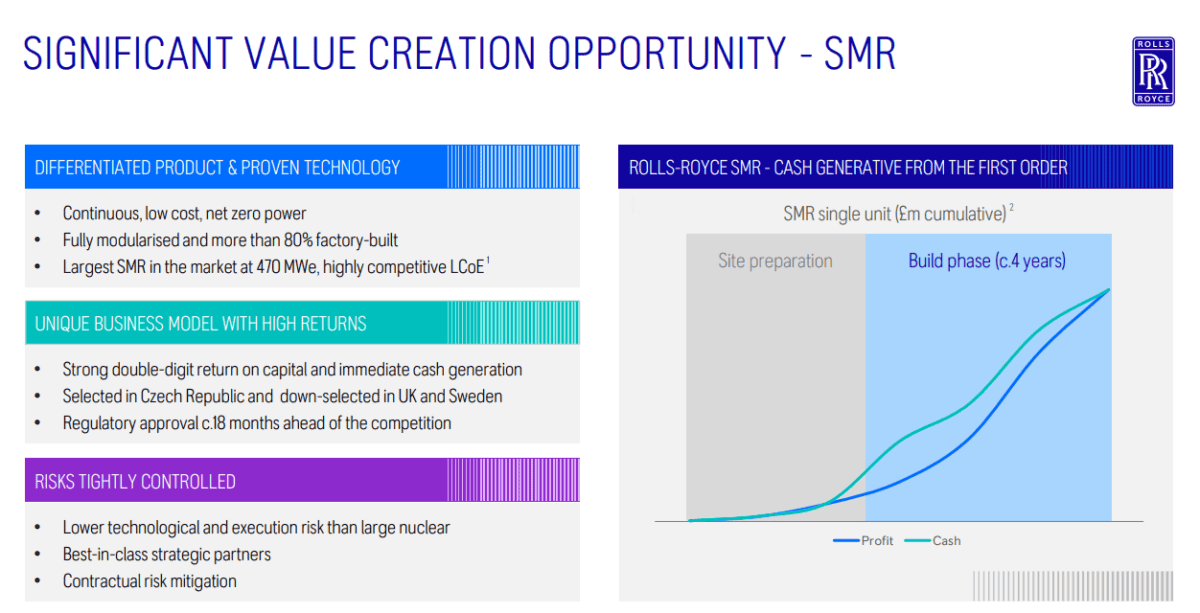
Next, the company gave investors more details on small modular reactors (SMRs), or ‘mini-nukes’.

We are uniquely placed to win in this large and growing [SMR] market and create significant value.

CEO Tufan Erginbilgiç

Rolls-Royce has been selected to deliver up to six SMRs in the Czech Republic and shortlisted for projects in the UK and Sweden. However, there’s a risk that it doesn’t make the cut, which would be a significant setback. Missing out in the UK could undermine its success in securing contracts with overseas governments. 

Importantly though, advanced payments from customers will ensure that SMR contracts are “immediately cash-flow generative”. In other words, margin protection is built into the initial contracts, allowing Rolls to achieve positive margins on the very first SMR.

Consequently, Erginbilgiç confirmed: “We expect to generate a strong double-digit return on capital from SMRs.”

Source: Rolls-Royce

Each unit could cost around £2bn. Based on International Energy Agency forecasts for 2050, management estimates a total addressable market of around 400 of its 470-megawatt SMRs. This highlights the massive long-term opportunity.

Rolls-Royce stock is pricey at 30 times next year’s forecast earnings. But I think it would be worth considering on any significant dip.

3 timeless pieces of Warren Buffett investing wisdom

Billionaire investor Warren Buffett has a stock market record that is nothing short of remarkable. He has often spoken publicly about his approach to investing. That means small private investors like me can learn from his approach. I also use parts of it, although what works for one investor is not necessarily right for another one.

Here are three pieces of Buffett’s wisdom I apply in my own investing.

1. Stick to what you know

Some people get into the stock market because someone tells them about a share that looks set to explode in price. As it moves up, they decide to put some money in (and at risk) – despite knowing nothing about the business. That is not investment, it is speculation.

By contrast, Buffett is a firm believer in sticking to what he calls a “circle of competence”.

How wide or narrow that is does not matter. The key point is only to invest in a business you can understand. That helps explain why Buffett’s portfolio is concentrated in a few areas, such as insurance and consumer goods.

2. Invest with a timeframe of decades

Buffett is the ultimate long-term investor. He invests with a timeframe of years or even decades. Some of his holdings have already been in the portfolio for many decades.

That does not mean he is afraid to sell a dud. When a company turns out to behave in a way that was not part of his original investment idea, Buffett has been willing to sell even at a sizeable loss.

But he thinks for the long term. Rather than buying a share today hoping its price will be higher after it releases its results next week, he buys stakes in what he thinks are great businesses, then lets time do its work.

3. Valuation is critical to successful investing

But Buffett’s approach is not just about buying into great businesses. He also aims to do so at an attractive price. After all, even a brilliant business can ultimately be loss-making if an investor pays too much for it.

Consider his stake in Apple (NASDAQ: AAPL) as an example.

It has a large market of actual and potential users. That market typically also involves users spending big sums of money. Thanks to a strong brand, proprietary technology and large customer base, Apple has a significant competitive edge in that market. That gives it pricing power, in turn fuelling huge profits.

But while profits are big, the company’s current market capitalisation of $3.5trn means it sells on a price-to-earnings ratio of 37. That is too expensive for me to buy Apple shares, as I feel it offers me too little of what Buffett calls a “margin of safety”. He bought when it was much cheaper.

All companies face risks and Apple is no exception. Trade disputes threaten to drive up the price and complexity of its supply chains, while cheaper Chinese rivals are producing increasingly sophisticated phones.

Buffett retains a sizeable Apple stake but he has sold a lot of its shares over the past year. I do not know why, but he realises that successful investment is about price paid, not just the shares purchased.

Financial News

Daily News on Investing, Personal Finance, Markets, and more!

Financial News

Policy(Required)