£20k invested in a Stocks and Shares ISA 10 years ago is now worth…

Few investing vehicles come close to delivering the advantages that Stocks and Shares ISAs provide. By eliminating income, capital gains, and dividend taxes from the equation, British investors have a serious upper hand on their wealth-building journey.

But how much money has this investment vehicle made for long-term investors over the last 10 years? The answer obviously depends on where capital’s allocated. So let’s explore just how much a £20,000 initial investment in 2015 could have grown to today.

Index investing returns

Let’s start with one of the most popular ways to invest – index funds. These types of investments essentially put the wealth-building journey on autopilot. While it becomes impossible to beat the market in terms of performance, that’s not always necessary to build a sizeable ISA.

Index Stocks and Shares ISA Value Total Return
FTSE 100 £36,842 +84.2%
FTSE 250 £31,175 +55.9%
S&P 500 £69,368 +246.8%
Nasdaq 100 £106,687 +433.4%

At a quick glance, it’s clear US technology stocks have been the best-performing investments of the last decade. At least that’s what the performance of the Nasdaq 100 suggests. Of course, such tremendous returns come at a cost. In this case, that cost is high volatility.

The Nasdaq 100 was also one of the worst-performing indices during the 2022 stock market correction, losing more than a third of its value in less than six months. By comparison, the FTSE 100 was actually up during this volatile period, highlighting its impressive resilience to adverse macroeconomic conditions.

What about stock pickers?

Clearly, given enough time, even volatile indices can help build significant wealth. But not everyone likes to rely on index funds. After all, some investors like pursuing market-beating returns. And when executed sucessfully, the rewards can be tremendous.

Take Shopify (NYSE:SHOP) as an example. The e-commerce giant had its IPO roughly 10 years ago and has since delivered a staggering 3,857% return since then. That means a £20k investment in 2015 would now be worth £771.5k today – all of which would be tax-free thanks to using a Stocks and Shares ISA!

With its latest quarterly results delivering 26% growth in gross merchandise value (GMV) to $94.46bn, 31% revenue growth, and higher operating margins, Shopify’s growth story seems far from over. Even more so, given that its international expansion continues to outpace its North American operations.

However, just like the Nasdaq 100, Shopify’s no stranger to volatility, falling by a jaw-dropping 85% between November 2021 and 2022. The stock’s inching closer to a full recovery and I’ve been using the depressed valuation as an opportunity to top up my existing position.

Sadly, not all US growth stocks have enjoyed such a robust bounceback. Another US tech firm from my portfolio is Teladoc Health, which is still down 95% since its 2021 highs as it struggles to respark its growth engine.

This goes to show that stock picking doesn’t always end in success. And depending on the decisions made, a relatively small ISA can end up being worth a fortune, or lose a significant chunk of its value.

I don’t care if the stock market crashes in 2025. I’m still buying bargain shares today

The US stock market has been a bit volatile of late. Here in the UK, FTSE 100 investors have continued to enjoy the stability benefits that our flagship index is known for. But for those investing in US stocks or simply a S&P 500 tracker fund, the past few weeks have seen a bit of a wobble.

There are a lot of factors at play, such as index concentration and the war in Ukraine. However, it seems that most investor concerns are concentrated on the risk of a US trade war with Canada, Mexico, and China.

Given that tariffs are expected to trigger short-term inflation in America, a pause in interest rate cuts by the Federal Reserve is increasingly likely. Even more so given that US inflation has already been on the rise since August 2024, from 2.5% to 3%.

Is a crash coming?

Could all these concerns trigger another stock market crash? Possibly. Although personally, I think a correction is far more likely. On average, the stock market tends to rise two out of every three years. And both 2023 and 2024 both delivered exceptional results. For reference, the S&P 500 jumped 55% while the Nasdaq 100 climbed 90% over this period.

However, whether a crash, correction, or continued upward momentum occurs later this year, my investment strategy hasn’t changed. Regardless of market conditions, I’m still laser-focused on finding top-notch stocks trading at bargain prices.

Where are the bargains?

With all eyes on tech giants like Nvidia and Meta Platforms, finding excellent value among large-cap tech stocks is likely going to be difficult, perhaps impossible. After all, if everyone’s looking for gold in the same place, most will find none.

Instead, my focus is on the smaller businesses that are seemingly flying under the radar. One position I’ve been steadily building up over the last few months is Toast (NYSE:TOST). The restaurant tech firm connects front-of-house to back-of-house operations, handling payments, orders, and payroll while managing staff, inventory and prices from a single platform.

By relieving the administrative headaches that restaurant operators must endure, Toast has already captured close to 15% of the US market, and international expansion’s now underway. Around 134,000 locations already rely on Toast’s ecosystem. And since the firm takes a small fee off each transaction, free cash flow generation is in abundance translating into a debt-free balance sheet.

Over the last five years, revenue growth has averaged just over 40% a year. Pairing that with a recent transition to profitability, the business appears to be firing on all cylinders. As for its valuation, on a price-to-sales basis, Toast’s trading at a ratio of around 4.1. That’s far more reasonable compared to Nvidia’s 23.4!

What could go wrong?

Toast’s revenue stream largely consists of fees from restaurant transactions. This cyclical exposure means that if US economic conditions deteriorate, Toast will likely suffer as fewer people eat out. Consequently, even at today’s seemingly reasonable valuation, the stock could suffer significant volatility in the short term.

It’s why I think drip-feeding capital over time is a more prudent approach in the current stock market environment.

If a 35-year-old puts £700 a month into a Stocks & Shares ISA, here’s what they could have by retirement

Investing inside a Stocks and Shares ISA can be a brilliant way to build tax-free wealth. With money deployed regularly and wisely, someone can potentially build a sizeable portfolio over the long run.

Here, I’ll consider how much a 35-year-old could have by retirement investing £700 a month in an ISA. 

Please note that tax treatment depends on the individual circumstances of each client and may be subject to change in future. The content in this article is provided for information purposes only. It is not intended to be, neither does it constitute, any form of tax advice. Readers are responsible for carrying out their own due diligence and for obtaining professional advice before making any investment decisions.

Ingredients

Boiling things down, I think there are three main ingredients for building wealth in a Stocks and Shares ISA.

Firstly, there are regular contributions. Consistently investing over time allows someone to benefit from compounding while also smoothing out natural market gyrations. While £700 a month might not sound a lot, it is easily enough to build wealth, as we will see.

Next is a solid rate of return. By investing in a diverse set of quality assets (including stocks, investment trusts, and ETFs), I think a 10% annual return after fees is achievable. While not guaranteed, this return would be broadly in line with the global investment fund average, as well as that of the average Stocks and Shares ISA account. 

Of course, this is just an average. In reality, markets fluctuate, which leads me to the final ingredient for success. That is time in the market. Again, this is crucial for a portfolio to compound, while also allowing investors to take advantage of bear markets (investing when stocks are temporarily cheaper).

In my eyes, a great stock to consider as part of a diversified ISA is Scottish Mortgage Investment Trust (LSE: SMT). The aim of this popular FTSE 100 trust is to find and invest in exceptional growth companies.

Now, I should mention straight away that the share price can be very volatile. For example, it has fallen 14% inside the last month due to a tech stock sell-off and uncertainty around President Trump’s tariffs.

There’s a risk these factors could worsen over the coming months. Also, Scottish Mortgage has stakes in private companies, which can be hard to accurately value.

Zooming further out though, the stock is up around 270% in a decade. This shows how it’s suitable for long-term investors who can tolerate stomach-churning periods of volatility.

One reason I like the trust is that it offers diversified exposure to a number of companies that are benefitting from the generative artificial intelligence (AI) revolution. This technology has the potential to make some firms much more profitable by boosting automation.

Our enthusiasm and conviction about the change that generative AI can bring over the next five to ten years has probably never been higher.

Lawrence Burns, portfolio co-manager

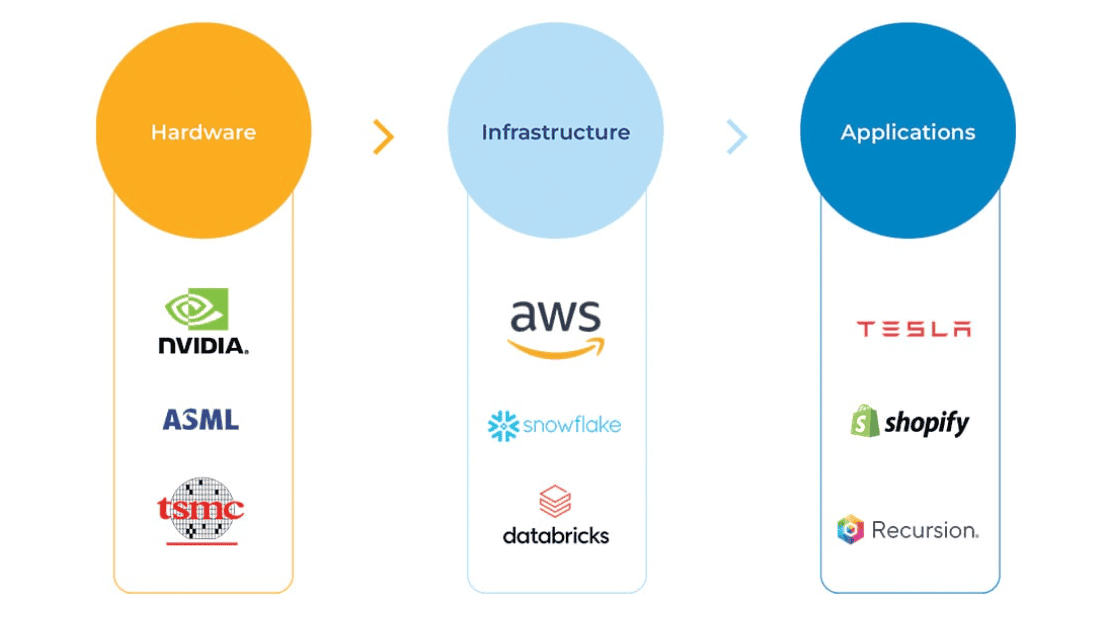
Scottish Mortgage’s portfolio’s has three layers of AI exposure. There is hardware, which includes chip manufacturers. Then there are infrastructure companies helping others use and access AI (cloud platforms like Amazon Web Services). Finally, there is the application side, where businesses are using AI as part of their commercial products.

Below are some of the trust’s main holdings spanning the three AI layers.

Source: Scottish Mortgage.

With the shares currently trading at a 12% discount to the fund’s underlying value, I think they’re definitely worth considering.

Putting all this together then, £700 invested each month by a 35-year-old would result in a £1,952,479 — £1.95m! — portfolio by retirement. This assumes the 10% return and that any dividends received are reinvested.

£15,000 invested in Greggs shares at the start of 2025 is now worth…

Greggs shares (LSE: GRG) have been a major let-down lately. In fact, investing in them has been like ordering a hot steak bake, only to bite in and realise it’s stone cold in the middle. 

In other words, Greggs is not quite the hot growth stock expected, but merely a dividend stock.

So far in 2025, shares of the FTSE 250 bakery chain have dropped 35%. This means anyone who invested £15,000 in them back then would now have £9,750 on paper.

Thankfully, I didn’t have that much in Greggs. Yet I was still down 12% when I sold the stock last week (including dividends).

Here are five reasons I pulled the ripcord to get out.

Easing growth

In 2023, like-for-like (LFL) sales growth in Greggs’ company-managed shops jumped 13.7%. Last year, that eased to 5.5% versus the 6.3% that was expected. It was 2.5% in the Christmas quarter.

Then in the first nine weeks of 2025, LFL sales were up just 1.7%. Management blamed “challenging weather conditions” in January. To be fair, we did have Storm Éowyn, which shut 250 Greggs shops in Scotland and Northern Ireland.

The firm also said there was “improved trading” in February. However, this year is expected to be a slog. CEO Roisin Currie warned: “Looking ahead to 2025, the macroeconomic landscape remains tough. Inflation remains elevated, and many of our customers continue to worry about the cost of living.”

Gloomy economic outlook

This brings me to my second reason for selling: the UK economy.

Greggs has recently flirted with the idea of international expansion, and I think franchised locations would do well in British holiday hotspots like Spain. Of course, it would have to adapt the menu, but Greggs has proven to be a master of that in the past.

For now though, there’s just the UK. And according to Chancellor Rachel Reeves, the global tariff war will hit the UK: “We will be affected by slowing global trade, by a slower GDP growth, and by higher inflation than otherwise would be the case.”

Higher costs

Following the last UK budget, which increased employment costs, Greggs expects 6% cost inflation this year.

To mitigate this, it has implemented price increases and cost efficiencies. But it’s uncertain how much further these can be stretched to maintain profits. If Greggs keeps putting prices up, I fear it could lose its value reputation among consumers. 

High street Armageddon

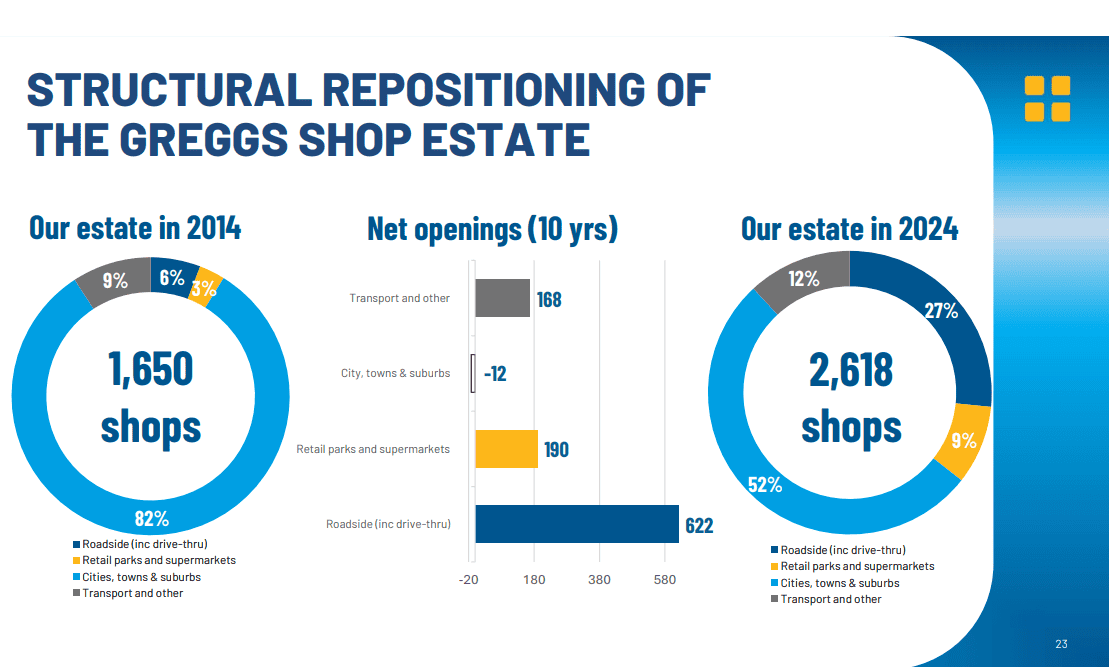
Next, due to high business rates and e-commerce, the UK high street is in terminal decline. And while Greggs is doing a splendid job of diversifying its shop estate and increasing digital channels, it still has over half its locations (52%) in cities, towns, and suburbs.

I fear that falling footfall on high streets could undermine decent growth elsewhere. Of course, this issue and the economic conditions are out of the company’s hands.

Source: Greggs 2004 annual report.

GLP-1 threat

Finally, we have a risk that isn’t yet part of the story but could be in future. That is the unstoppable rise of GLP-1 weight-loss drugs.

These treatments reduce cravings for the sugary and high-carb treats that Greggs is famous for. As of 2022/23, 64% of adults in England were classified as overweight or obese. So the potential market for these treatments is significant. 

How investors can put £500 a month in an ISA to target passive income of £26.5k

One of the surefire ways to achieve financial freedom is to establish a chunky passive income stream. And when leveraging the power of an ISA, it’s possible to earn it without HMRC sticking its fingers into the pot.

While Cash ISAs have certainly been offering more attractive rates in recent years, these returns still pale in comparison to the growth potential of the stock market. The latter can indeed be far more volatile in the short term. But in the long run, investing in quality businesses is a proven technique to unlock substantial wealth-building returns.

The power of consistent investing

Let’s say an investor has a time horizon of 25 years before wanting to start spending the passive income from their portfolio. How much money is needed to earn, say, £2,000 each month? The answer – around £500.

Depending on individual circumstances, £500 might be a hard target. But even with smaller sums, consistently saving and investing new capital each month can make an enormous difference.

Assuming an investor earns close to a 10% average annualised return between now and 2050, they could end up with a portfolio valued at just over £660k! That translates to £26.5k, or £2.2k a month, in passive income when following the 4% withdrawal rule.

Monthly Investment Potential Long-Term Portfolio Value Potential Passive Income
£250 £331,708 £13,268
£500 £663,417 £26,537
£1,000 £1,326,833 £53,073
£1,667 (Maximise ISA Allowance) £2,211,831 £88,473

Going beyond 10%

Earning a 10% return is pretty straightforward, thanks to the invention of index trackers. The US’s flagship index, the S&P 500, has historically provided this level of gains over long periods, outpacing the local FTSE 100. And with London-listed exchange-traded funds (ETFs), British investors can easily hop on the bandwagon.

But some investors may need more. This is where stock picking may have the answer. After all, those who spotted and invested in the GPU chipmaker Nvidia (NASDAQ:NVDA) 25 years ago have earned roughly 30% annualised returns. For reference, investing £500 each month at this rate is enough to accumulate almost £33m of wealth – or £1.3m in passive income!

Risk versus reward

As exciting as the prospect of earning near-30% returns is, such gains are pretty exceptional. Nvidia’s success may seem obvious today, given its technological leadership. But back in March 2000, it was anyone’s best guess who was going to win the chip race. And the same is true today with other bleeding-edge technologies like AI or quantum computing.

It’s unlikely that Nvidia will be capable of delivering 30% annualised returns over the next 25 years. After all, the business already has a market capitalisation of over $3trn. Nevertheless, Nvidia’s future looks bright, in my eyes.

The firm’s latest earnings report delivered a record-breaking performance with near-80% revenue and earnings growth year-on-year. With the upcoming release of its Blackwell Ultra chip architecture later this year and Vera Rubin chips coming shortly after, this momentum could continue.

Of course, these expectations are likely already baked into the stock price, especially with a price-to-earnings ratio of 43. As such, investors should expect significant volatility if the company cannot keep up the pace.

And given chip demand’s cyclical, any slowdown in AI spending could trigger a drastic correction in valuation. Should that happen, Nvidia will be near the top of my personal Buy list.

Here are the dividend forecasts for Aviva shares for 2025 and 2026!

Dividends for Aviva (LSE:AV.) shares have risen strongly after they were battered during the Covid-19 crisis. Last year, the total dividend rose 7%, to 35.7p per share.

Encouragingly, City analysts are expecting cash rewards to keep growing over the next two years, as the table below shows.

Year Dividend per share Dividend growth Dividend yield
2025 37.63p 5% 7%
2026 40.09p 7% 7.4%

These predictions also mean forward dividend yields on Aviva shares sail above the FTSE 100 average of 3.5%.

However, past dividend hikes aren’t necessarily a reliable indicator of future payout movements. It’s also important to remember that broker forecasts — whether on earnings, dividends, share prices and so forth — can often fall short of the mark.

With this in mind, here’s my take on current dividend estimates for the Footsie company.

On a roll

Aviva’s dividend recovery reflects its strong profitability in recent years and its transformed balance sheet. Through share buybacks and dividends, the company’s delivered a total of £10bn in shareholder returns.

Last year, gross written premiums increased at its general insurance division rose 14% year on year. Operating profit meanwhile, rose 20% to £1.8bn, ahead of forecast.

Aviva’s on a roll for multiple reasons. Its broad product offer across the protection, wealth and retirement sectors provides multiple ways for it to exploit soaring older demographics across its markets, as well as the growing importance of financial planning.

In particular, the company’s bulk annuity business (BPA) — which takes on pension liabilities from company schemes — is enjoying rapid growth — is enjoying rapid growth. Its switch to a capital-light operating model is also paying off handsomely, and the upcoming acquisition of Direct Line will mean capital-light businesses will account for 70% of its portfolio.

This underpins Aviva’s plans for operating profit to reach £2bn by 2026.

Dividend danger?

However, there are dangers to the company’s ambitious plans. Worsening economic conditions in its UK, Irish and Canadian markets could smack sales, while high levels of market competition remains a constant danger. It could also encounter execution problems with its acquisition-led growth programme.

Any such issues could theoretically threaten dividends over the next two years. Predicted payouts for 2025 and 2026 are covered just 1.3 times and 1.4 times respectively by anticipated earnings, leaving little wiggle room if profits disappoint. As an investor, I’d want a reading of 2 times or above.

Having said that, I’m optimistic Aviva’s cash-rich balance sheet could provide a shield against any such dividend danger.

The company’s Solvency II capital ratio fell 40 basis points over the course of 2024, to 203%. But this still remains double the regulatory requirement, and gives the company enough room to keep paying large dividends while also investing for growth.

In great shape

Dividends are never guaranteed, and as we saw in the pandemic, payouts can be cut, postponed, or cancelled at extremely short notice.

But assuming a fresh catastrophe doesn’t come Aviva’s way, I think it’s in great shape to meet dividend forecasts through to 2026 and is worth considering.

Could buying this gene-editing penny stock at $1 make me rich?

Gene editing could be a game-changer for humanity. Using this technology, scientists can correct faulty cells and potentially cure diseases like cancer, blood disorders, and even diabetes. Needless to say, if a gene-editing penny stock went on to have commercial success, the rewards for early investors could be life-changing.

Trading for $1.78 and with a small $147m market cap, Editas Medicine (NASDAQ: EDIT) is a penny stock. It’s also an early pioneer in CRISPR-based gene editing, having gone public in 2016, along with rivals Crispr Therapeutics (NASDAQ: CRSP) and Intellia Therapeutics.

Could this biotech stock be my road to riches? Let’s take a look.

Disappointing developments

As the above chart shows, the share price has fallen off a cliff. It’s down 80% over the past year!

What’s gone wrong? Well, in December the firm discontinued its reni-cel programme for sickle cell disease (SCD) and beta-thalassemia after failing to find a commercial partner. 

This means the firm has shifted its focus from ex vivo (outside the body) gene editing to in vivo (inside the body). This led to a 65% workforce reduction — including its chief medical officer! — and cost-cutting measures. 

Restructuring charges were $12.2m in Q4, bringing the overall net loss to $45.4m. This compared to a loss of $18.9m for the same period in 2023. For the full year, the net loss was $237m.

The company ended December with $270m in cash, which it says is enough to fund operations until Q2 2027.

In vivo

Now, in vivo therapies eliminate the need for cell extraction and reinfusion, making treatment less invasive. So perhaps this is the best move long term. 

However, it also means that Editas has become a preclinical company again. In other words, no current active clinical trials.

Reading through the Q4 results, I see plenty of words like “preclinical” and “proof of concept“. But Editas has been a public company for nearly a decade now, so this is obviously very disappointing. And it explains why it has fallen firmly into penny stock territory. 

A red flag

Another thing worth noting here is that Editas just said it is “no longer hosting quarterly earnings conference calls“. It doesn’t explain why, but some investors are speculating that a mergers and acquisitions announcement might be in the works.

If so, perhaps that could salvage some shareholder value. But it’s not guaranteed and merely adds to the uncertainty for me.

Weighing things up, I see no convincing evidence that the stock can create blockbuster returns. So I won’t be taking a punt.

My pick

Returning to Editas’ rivals, Crispr Therapeutics is the only biotech of the three that has a product on the market. Along with partner Vertex Pharmaceuticals, it has won regulatory approval for Casgevy, a revolutionary treatment for SCD and beta-thalassemia. 

Meanwhile, Intellia is partnered with Regeneron Pharmaceuticals on a phase 3 trial for ATTR cardiomyopathy (a heart disease). And it’s independently running another phase 3 trial for hereditary angioedema (a swelling disorder).

The different stages of development are reflected in the gene-editing trio’s market values.

Share price performance since IPO Market cap
Crispr Therapeutics +213% $3.7bn
Intellia Therapeutics -55% $1bn
Editas Medicine -90% $147m

I recently started a position in Crispr Therapeutics stock. It faces the risk of failed clinical trials, but it already has a treatment approved and appears to have far better prospects than Editas. This is my pick in the space.

Don’t panic! Consider buying these dirt cheap UK stocks instead

This week’s been grim for the London stock market. Swathes of quality UK stocks have plunged in value, as worries over ‘Trump tariffs’ and retaliatory action from the US’s major trade partners has gained traction.

The potential impact on the global economy and, by extension, on corporate earnings worldwide, could be considerable. But I don’t think this is cause for investors to ‘sell the farm’ in a state of panic.

Personally speaking, I plan to fill my boots with bargain shares if stock markets correct. To borrow one of Warren Buffett‘s favourite strategies, buying great stocks during a firesale can supercharge the long-term returns I enjoy.

Here are two cheap shares that have already grabbed my attention. I think they’re worth serious consideration following recent price falls.

B&M

Discount retailer B&M European Value Retail‘s (LSE:BME) a share that’s not for the faint of heart.

It slumped last month after slashing its profit guidance for the 12 months to February. This wasn’t the first such cut, with former breakneck sales growth now slowing to a crawl. It’s also prompted the resignation of its chief executive Alex Russo.

B&M shares continue to fall at the start of March. But as a long-term investor, I’m considering whether now could be a good time to open a position.

Its forward price-to-earnings (P/E) ratio is now just 7.5 times. That’s a mile below the company’s five-year average in the early-to-mid teens.

Not even cut-price retailers like this are immune from current weakness in consumer spending. But when conditions eventually recover, I think the former FTSE 100 share could spring back to life. Analysts think the value retail channel has further room for growth, and B&M plans to keep expanding to capitalise on this.

More planned store openings in the UK and France could see the number of B&M-badged stores on these shores rise 55% from current levels, to 1,200.

Topps Tiles

Tile retailer Topps Tiles (LSE:TPT) is also in freefall right now. Like B&M, its chief executive (Rob Parker) plans to head for the exit, causing some considerable uncertainty.

Sales have strengthened more recently (up 4.6% in the December quarter), but dangers remain given how weak consumer sentiment remains. A recent sharp contraction in the construction industry is also hugely alarming.

Yet the cheapness of Topps’ shares has turned my head. Its forward P/E ratio is 7.8 times, while its corresponding price-to-earnings growth (PEG) multiple sits at 0.1.

Any sub-1 reading suggests a share is undervalued. Topps clearly sits well below this threshold.

I think the penny stock could rebound sharply for several reasons. As undisputed market leader, it’s well placed to capitalise on any upcoming housebuilding boom (the government plans to build 300,000 new homes each year to 2029).

I also think Topps’ plans to boost its online channel and expand product ranges could pay off substantially. The company thinks this will improve sales by £100m over the medium term, to £350m, and drive profit margins to 8-10%.

5 UK stocks Fools have been buying!

Investing alongside you, fellow Foolish investors, here’s a selection of stocks that some of our contributors have been buying across the past month!

Airtel Africa

What it does: Airtel Africa provides mobile telecommunication services to 14 countries across the African continent.

By Mark Hartley. I bought Airtel Africa (LSE: AAF) shares a few months ago after the price dipped near a three-year low. This came after underwhelming Q2 2025 results, with earnings per share (EPS) missing expectations by 80%. Despite the drop, I have felt confident in the group’s long-term potential for some time so the low price seemed like a good opportunity. It has since recovered 51%, making it one of the best-performing stocks in my portfolio.

However, it still faces significant risks from currency devaluation in Nigeria, one of its core markets. Rising fuel prices pose another risk as the company uses generators to power its remote cell towers. To mitigate the losses, the company is working to reduce its exposure to foreign exchange, having paid down $809m in forex debt exposure. Despite the rising price, the stock still appears undervalued with a forward price-to-earnings (P/E) ratio of only 7.

Mark David Hartley owns shares in Airtel Africa.

Ashtead Technology

What it does: Ashtead Technology is a leading subsea equipment rental and solutions provider for the global offshore energy industry.

By Ben McPoland. I recently bought more shares of Ashtead Technology (LSE: AT.). The specialist rental firm continues to advance, fueled by its acquisition-driven growth strategy.

For 2024, it expects revenue to reach £168m, a 52% year-on-year increase, with underlying operating profit exceeding the consensus forecast of £46.6m.

In the full-year trading update, CEO Allan Pirie commented: “With one of the largest and most technologically advanced rental fleets in the industry and a continued focus on operational excellence, we remain confident in the Group’s ability to generate substantial long-term value for shareholders.”

I agree with that, though the company’s growth is dependent on offshore oil, gas, and renewables markets. Economic downturns or declining energy prices could reduce exploration and capital expenditure, leading to lower demand for rented equipment.

At present though, Ashtead Technology is in a strong position. Ongoing market demand and record customer backlogs give it confidence that growth will continue through 2025.

A final attraction for me here is the valuation. At 528p (as I write), the stock is trading at just 10 times forecast earnings for 2026.

Ben McPoland owns shares in Ashtead Technology Holdings.

Bakkavor

What it does: Bakkavor is a fresh prepared food group, supplying supermarkets with products such as bread, pizza, ready meals and salad.

By Roland Head. FTSE 250 firm Bakkavor (LSE: BAKK) is not a household name, but its products are found on the shelves of all the UK’s major supermarkets.

I recently added this business to my portfolio. I see it as a steady grower and was encouraged by 2025 forecast earnings growth of 10%. That prices the stock on just 12 times forecast earnings, with a tempting dividend yield of 5.9%.

I’m also reassured by the continued influence of the company’s founders, Agust and Lydur Gudmundsson. They control almost 50% of the shares and sit on the board.

Outside the UK, Bakkavor also operates in the US and China. China looks like the main risk to me, for investors. In addition to geopolitical risks, the China business is currently relatively small and loss making.

However, I don’t see this as a reason to avoid Bakkavor, which looks decent value to me at current levels.

Roland Head owns shares in Bakkavor.

Games Workshop

What it does: Games Workshop manufactures tabletop gaming products including models, paints and manuals.

By Royston Wild. Fantasy wargaming giant Games Workshop (LSE:GAW) enjoyed another barnstorming year in 2024, rising 35% in value since 1 January.

Yet it fell sharply from record closing peaks of £142.70 per share in December, and dropped further following half-year financials last month. I used this as an opportunity to increase my holdings.

There’s been no spooky news coming from the Warhammer maker in recent weeks. Indeed, January’s update showed sales up 14% in the six months to 1 December, helped by licensing revenues soaring 149% in the period.

Games Workshop may endure some near-term turbulence if consumer spending remains weak. Yet this hasn’t proved an obstacle to its breakneck growth story just yet. This reflects in large part its niche product lines and loyal customer base.

I remain supremely confident in the FTSE 100 firm’s long-term outlook. The tabletop gaming segment has scope for further significant growth. And Games Workshop’s film and TV deal with Amazon could supercharge royalty revenues in the years ahead.

Royston Wild owns shares in Games Workshop.

Glencore

What it does: Glencore is one of the world’s largest natural resource companies with operations across 35 countries.

By Andrew Mackie. As a die-hard value investor, I spend a lot of my spare time searching for stocks that I believe are undervalued relative to their long-term prospects. Trading at levels not seen since early 2022, Glencore (LSE: GLEN) is near the top of that list.

In the years ahead, I envisage a mismatch in the supply-demand dynamics for many of its commodities, in particular copper.

It’s no great secret that demand for copper is rising across the globe. Electricity grids are creaking at the seams as demand for electricity from the likes of data centres and EVs continue to grow. And now with a US administration keen to rebuild its country’s manufacturing prowess, I can’t see anything other than demand increasing.

Set this against a global investor community more interested in chasing tech stocks higher, and what has been the result? An industry starved of capital, risk averse and with little incentive for exploration.

Sustained low commodities prices (mainly because of weak Chinese demand) continues to weigh down on its share price. This remains one of the most important short-term risks. But looking a decade out, I remain bullish.

Andrew Mackie owns shares in Glencore.

£10,000 invested in Tesla stock after inauguration day is now worth…

Tesla (NASDAQ:TSLA) stock has been hammered in recent weeks. On 21 January, the day after the US President Trump’s inauguration, Tesla stock was trading for $424. At the time of writing, the stock is at $258. This means the stock is down 39% over the six-week period. As such, a £10,000 investment then would be worth just £6,100 now. In fact, given the appreciation of the pound over the period, the forex-adjusted figure would be closer to £5,700. It goes without saying, but this would be a very disappointing investment outcome.

So, why has it happened?

Tesla boss Elon Musk has a position within the new administration and seemingly the ability to exert influence government policy. This may have buoyed some retail investors following Trump’s election, but the excitement is fading. And there are more factors at play.

Deteriorating fundamentals paint a worrying picture

The latest figures show Tesla’s fundamentals are deteriorating. Analysts have drastically cut 2025’s earnings per share forecast to just $2.85, which is a staggering 66% lower than estimates from two years ago and 12% below mid-January projections. Revenue estimates have been revised down by $4.3bn to $112bn.

Adding to investor concerns, three Tesla insiders — including Elon’s brother Kimbal — have planned significant stock sales for 2025 worth approximately $300m. These planned sales, while scheduled in advance, are bound to harm investor confidence.

Valuation remains stratospheric despite decline

Despite the recent pullback, Tesla’s valuation metrics remain eye-popping. The current price-to-earnings (P/E) ratio stands at 108 times, based on trailing 12-months earnings of $2.23 per share. While this represents a 21% discount to Tesla’s five-year historical average P/E of 138 times, it’s still dramatically higher than competitors and other tech giants.

Meanwhile, Tesla’s P/E-to-growth ratio, which measures price relative to earnings growth, sits at 6.6 —significantly better than it was a couple of months ago, but still vastly elevated compared to traditional automakers and other technology and even AI companies.

Margin compression threatens growth story

Tesla’s operating margin has contracted alarmingly — from a peak of 16.8% in 2022 to just 7.2% in 2024, with Q4’s margin falling to 6.2%. This margin erosion reflects intense pricing pressure and the company’s struggle to maintain profitability while pursuing affordability. The automotive gross profit situation is particularly concerning. In Q4 2024, Tesla generated $3.29bn in automotive gross profit, less than it produced in Q3 2021 ($3.67bn) with half the deliveries. This dramatic efficiency decline explains why Tesla’s earnings power has weakened despite increased deliveries.

The verdict: proceed with extreme caution

Tesla remains a polarising investment. Bulls point to upcoming projects like the Robotaxi pilot in Austin this June, while bears highlight the company’s valuation disconnect, declining margins, and management’s tempering of growth expectations.

Though Musk has called 2025 Tesla’s “most pivotal year,” the realities of slowing growth and intensifying competition suggest investors should approach with extreme caution. What’s more, with Musk distracted by DOGE and SpaceX, among other things, Tesla’s AI future (Robotaxis and robotics) isn’t being sold as well as it has been.

Despite my personal appreciation for Tesla as a brand, at current levels, the stock’s risks simply outweigh the potential rewards. I will not be adding the shares to my portfolio.

Financial News

Daily News on Investing, Personal Finance, Markets, and more!

Financial News

Policy(Required)