My largest dividend stock investment is…

The London Stock Exchange has a wide range of dividend stocks for investors to pick from. And among the roughly 1,700 companies listed in the UK, Somero Enterprises (LSE:SOM) is among one of my favourite and largest dividend-paying investments.

Why Somero?

As a quick crash course, Somero Enterprises is a leading designer and manufacturer of laser-guided concrete laying screed machines. It’s not likely a tool individuals will come across very often.

However, for those working within the construction industry, Somero’s machines play a critical role in ensuring the flooring in non-residential buildings is as flat as possible. That’s crucial for warehouses, retail stores, hospitals, car parks and, most excitingly today, data centres.

As the US ramps up its investments into infrastructure, projects for new data centres and chip foundries are steadily being greenlit. That’s a particularly exciting prospect for Somero, given the US is the firm’s primary target market. And it’s a tailwind that’s already started to bear fruit, with management highlighting a backlog of US projects with activity finally ramping back up after enduring labour shortages and concrete rationing.

What’s up with the dividend?

Somero doesn’t look like a typical choice for dividend investment. Apart from paying dividends in a foreign currency, a quick glance at the group’s dividend history shows a constant fluctuation of hikes and cuts. The share price also seems to have followed a similar pattern of swinging up and down as well.

Year 2019 2020 2021 2022 2023 2024
Dividend Per Share $0.3095 $0.247 $0.3991 $0.5172 $0.3548 $0.2859

This fluctuating pattern perfectly demonstrates the cyclical nature of Somero’s business. Since operations are entirely driven by activity within the construction industry, bad weather, higher interest rates and macroeconomic headwinds can be disruptive.

However, this isn’t anything new. And management’s prudent capital allocation and financial planning skills have kept the balance sheet debt-free despite the constant swings in cash flows.

Leadership’s changing hands

Smart capital allocation is a rare skill to come by. So it’s a sad revelation that CEO Jack Cooney is stepping down at the end of 20 March. After 27 years of growing the company to a £153m enterprise, Cooney is off to enjoy a well-deserved retirement. And chairman Larry Horsch, who joined Somero in 2009, will also be departing at the same time.

It seems the firm is losing a lot of talent due to age. But succession planning has actually been in the works for a while. The first steps were taken last June with the promotion of Jesse Aho to chief operating officer of Global Operations and then president of the entire company six months later.

It’s still unclear who will move into the corner office. Somero’s currently exploring external options with a third-party executive search firm. However, whether any of these candidates will be capable of filling Cooney’s shoes remains to be seen.

It’s a risk investor’s need to consider carefully when exploring Somero as a potential investment today. Yet, personally, I remain optimistic about the firm’s long-term trajectory. Given my already sizable stake in the business, it’s not a stock I’m rushing to buy right now.

However, for investors seeking exposure to the construction industry ahead of artificial intelligence (AI) infrastructure investments, Somero could be worth a closer look.


As the US stock market tumbles, here’s Warren Buffett’s advice

Having kicked off his investment journey at the age of 11, Warren Buffett’s no stranger to stock market volatility. But for newer investors, the last few weeks haven’t been particularly pleasant, especially for those allocating capital across the pond.

The US offers a lot of exciting growth opportunities for British investors, especially within the technology sector. However, compared to UK shares, US stocks can be significantly more volatile. That’s been made perfectly apparent, with some of the most popular stocks to own, like Tesla, Nvidia, and Alphabet, falling by double digits lately.

But as unpleasant as it can be to watch a growth portfolio suffer, volatility creates interesting opportunities for prudent individuals with an appetite for risk. Billionaire Buffett is certainly part of this group with a habit of going on a shopping spree whenever everyone else starts panic selling.

Given his impressive performance track record, heeding his advice could be a critical first step to profiting from the recent chaos. So what does the ‘Oracle of Omaha’ advise investors to do in situations like today?

1. ‘If a business does well, the stock eventually follows’

In the short term, a stock price is driven by the mood and momentum of investors. However, in the long run, their value is derived from the value of the underlying business. That’s why Buffett’s always exclusively focused on the performance of companies rather than that of stocks.

For newer investors, that’s easier said than done. After all, suffering a double-digit decline is hardly fun. And buying more shares when prices are in free-fall can sound idiotic.

Yet this is precisely how Buffett has achieved market-beating returns over the last 60 years. And it’s the same tactic I deployed back in 2022 when Shopify (NYSE:SHOP) saw over 80% of its market capitalisation wiped out.

The e-commerce enterprise undoubtedly encountered some headwinds from rising inflation and interest rates. However, its long-term strategy remained unscathed, with the underlying business continuing to chug along nicely despite what the crashing share price suggested. As such, I started snapping up more shares in April 2022 and have been subsequently rewarded with impressive double- and even triple-digit returns since.

2. ‘Risk comes from not knowing what you’re doing’

Blindly buying more shares in portfolio positions with falling stock prices isn’t a winning strategy. It’s essential to discover what’s driving the valuation in the wrong direction. Is it just short-term investor pessimism and panic? Or is there a fundamental problem with the business that’s recently come to light?

If it’s the latter, then selling, even at a loss, might be far less risky than holding on or buying more. Even Buffett’s learned this lesson the hard way with a company called Dexter Shoes. A failure of competitive analysis resulted in a $433m investment eventually tumbling to zero.

Looking again at Shopify, although I remain bullish, I’m not blind to the risks surrounding this enterprise. The group’s ability to keep costs under control as it scales its operations remains a concern among investors. As is the increasingly intense competitive landscape of both industry titans and international start-ups.

In other words, by staying informed about what could go wrong as well as what could go right, investors can avoid costly mistakes on their journey to building wealth.

3 top-notch dividend stocks to consider for a bigger, better SIPP

Investing with a Self-Invested Personal Pension (SIPP) is a powerful way of building retirement wealth. After all, the elimination of capital gains and dividend taxes paired with tax relief is a huge advantage that regular trading accounts don’t offer.

However, as with all investment portfolios, success depends on finding the right stocks to buy and hold for the long run. With that in mind, here are three dividend-paying positions that are already in my SIPP.

Let’s build an income stream

Unlike my Stocks and Shares ISA, which is focused on growth, my SIPP consists of a far more boring collection of businesses. That’s because the strategy for my retirement portfolio isn’t to generate groundbreaking returns but to establish a substantial passive income stream through continuous dividend-hiking stocks.

As such, some of my earliest investments when I launched this portfolio in 2022 were Greencoat UK Wind (LSE:UKW), Safestore Holdings, and Londonmetric Property. In terms of yield, these businesses didn’t offer the highest payout at the time. However, a critical trait among each is their ability to continue hiking dividends.

Despite operating in different industries and sectors, the recurring and consistent nature of their cash flow generation paved the way for a steadily rising shareholder payout. Safestore currently sits on a 15-year record of uninterrupted hikes, while Londonmetric’s at nine years and, until recently, Greencoat was on track to reach double digits.

Needless to say, if dividends keep increasing, my retirement income stream will continue to grow even without adding any extra capital.

Dividends aren’t risk-free

Today, my conviction for each of these businesses remains strong. However, even with a highly cash-generative business model, there are still risks to consider. All firms are reliant on investing in expensive assets, from wind turbines to warehouses. Generally, demand for these assets is rising – a trend I expect to continue.

Unfortunately, this also means the companies are reliant on debt financing, which introduces sensitivity to interest rates. And while these have started to fall, there’s still significantly more financial pressure compared to three years ago.

Greencoat’s also suffering from the cyclicality of energy prices. Skyrocketing energy bills hit a lot of households hard a few years ago. However, the steep increase in electricity prices was a major boon for Greencoat, bolstering profit margins, thanks to its mostly fixed costs.

This translated into record profits that made their way into the pockets of shareholders through dividends and buybacks. Today, electricity prices have started to tumble, taking Greencoat’s bottom line with it, ultimately ending the firm’s nine-year dividend hiking streak as its latest results saw payouts hold steady at 10p per share.

What to make of all this?

All three firms have had their fair share of headwinds lately. And subsequently, their stock prices haven’t been stellar performers. Yet, when looking past the short-term challenges, their long-term growth and income potential remain intact, in my opinion.

So with the opportunity to buy more shares at a discount and a higher yield, all three are currently on my SIPP Buy list whenever I have more capital to spare.

Here are the dividend forecasts for BT shares for 2025 and 2026!

BT (LSE:BT.A) is beginning to rebuild its reputation as one of the FTSE 100‘s more popular dividend shares.

Dividends were reduced at the turn of the decade, before being cut entirely in the aftermath of the pandemic. But having restored them to 7.7p per share in the 2022 and 2023 financial years, the telecoms giant raised them to 8p last time out as its fibre rollout programme progressed.

BT explained that 2024 was “the year in which we passed the peak of our capital expenditure on this programme, enabling us to see greater normalised free cash flow over the coming years.

City analysts are expecting further dividend growth over the next two years too, as shown below.

Financial Year To March… Dividend per share Dividend growth Dividend yield
2025 8.16p 2% 5.1%
2026 8.33p 2% 5.2%

As you can see, dividend yields for the period also sail past the FTSE 100 forward average of 3.5%.

So are BT shares a slam-dunk buy to consider for passive income? I’m not so sure.

Dividends are never guaranteed, and the telecoms giant still has substantial issues to overcome. So how realistic are these payout forecasts?

Dividend cover

The first thing I’ll look at is how well predicted dividends are covered by expected earnings. As an investor, I’m seeking a reading of 2 times and above.

Generally speaking, dividend cover around this level provides a wide margin of error in the event that profits are blown off course.

BT doesn’t have the worst score on this front, but similarly neither is it particularly impressive. For 2025 and 2026, cover comes in at 1.7 times and 1.8 times, respectively.

This reading is problematic for me given today’s tough economic climate and high levels of competition BT faces. Adjusted revenues slipped 3% in the nine months to December (to £15.3bn), latest financials showed.

On the plus side however, the firm’s cost-cutting programme continues to deliver impressive results. Last year BT completed its £3bn cost and service transformation programme, a full year ahead of schedule.

Further progress between April and December pushed adjusted EBITDA 2% higher, to £6.2bn.

Financial health

On balance though, I’m far from convinced by BT’s earnings outlook. But this isn’t my only fear for what this could mean for dividends.

The company might be past the peak of its fibre-related expenses. Yet I believe it’s financial foundations remain shaky at best. Net debt continues to tick up, and was a whopping £20.3bn as of September.

That was up almost £600m year on year. And as a result, BT’s net-debt-to-EBITDA ratio was an alarming 4.9 times at the half-year point.

BT’s rising debt is thanks largely to its huge pension deficit (related contributions totalled £800m in the first half). With more hefty pension payments planned in the medium term, there’s a good chance debt could remain at sky-high levels.

The verdict

Despite its attractive yields through to 2026, I’m not convinced by BT’s dividend credentials right now. I think the problems it faces could weigh on payout levels over the near-term and potentially beyond.

Personally speaking, there are many other FTSE 100 stocks I’d rather invest in now for passive income.

Prediction: 5 cheap stocks to bounce back amid crazy volatility

US stocks have endured some incredible volatility in recent months. In fact, I’ve become totally accustomed to seeing stocks in my watchlist and portfolio deliver double-digit moves on a daily basis. However, the broader movement has been down as investors attempt to digest President Donald Trump’s trade and economic policies and the potential for a trade war. This has compounded the perception that the economy is slowing and that inflation could return. Now, many of my favourite names are starting to look like cheap stocks.

Five of the best

So, what are the five stocks? Well, there’s a host of companies that I could have chosen, but here’s five that I believe stand out, especially on the price-to-earnings-to-growth ratio.

Stock 1-month performance Forward P/E Forward PEG
Celestica -38% 16.9 0.57
DXP Enterprise -24.7% 14 n.a.
Nu Holdings -21.7% 20 0.6
Powell Industries -36.2% 11 1
SkyWest -25% 9.6 1.1

These five stocks have endured a torrid last 30 days, but their metrics have become incredibly enticing. While it can be dangerous to try and catch a falling knife, these companies offer compelling value propositions.

DXP and Powell Industries are particularly intriguing as these stocks, both of which soared on the artificial intelligence (AI) infrastructure boom, are only covered by a couple of analysts. These analysts don’t appear to have adjusted their expectations, which currently suggest stagnating earnings. Recent results suggest that both companies will continue to grow earnings at an incredible rate.

Meanwhile Celestica is another AI play that has surged 200% over 18 months. Nonetheless, shares in this Canadian company have come under pressure, and unduly in my opinion. And then Nu Holdings is one of the world’s fastest growing banks, with operations in Latin America. While it may be expensive compared to UK banks on a near-term basis, the expected growth is exceptional.

Airlines under pressure

Airlines stocks have come under pressure as US tariffs on Mexico and Canada may reduce trade and, in turn, demand for air travel. SkyWest (NASDAQ:SKYW), which predominantly operates within the US, is exposed to this trend, but perhaps less than the 25% drop in the share price suggests.

Source: SkyWest — includes routes under partnership agreements

The stock is now trading at 9.6 times forward earnings, which represents a 48% discount to the industrials sector, but a modest premium to some of its airline peers. However, this premium becomes a discount when we look at projected earnings for the medium term. It’s broadly expected to grow faster than its peers, as highlighted by the 19.5% revenue increase in Q2.

Its fleet of 624 aircraft, including models like the Embraer E175 and Bombardier CRJ series, supports partnerships with major carriers such as United, Delta, American, and Alaska Airlines. Moreover, while it doesn’t hedge fuel, its long-term contracts with major airlines mitigate this risk. All in all, while Trump’s tariffs represent a concern, the stock appears under-appreciated versus its peers.

Here’s the dividend forecast for Legal & General shares for 2025 and 2026!

I think Legal & General‘s (LSE:LGEN) one of the FTSE 100‘s best dividend shares to consider. It’s why I own the financial services giant in my own portfolio.

Shareholder payouts have risen in 11 of the last 12 years. The firm even kept dividends on hold during Covid-hit 2020, when scores of other UK shares were slashing, postponing or axing cash rewards.

The annual dividend’s tipped by brokers to rise again, to 21.32p, when Legal & General releases full-year financials next week (12 March). And City analysts are expecting it to continue rolling higher over the next two years too, as shown in the table below.

Year Dividend per share Dividend growth Dividend yield
2025 21.81p 2% 8.9%
2026 22.3p 2% 9.1%

Current forecasts leave Legal & General as the fourth-highest-yielder on the Footsie for this year.

However, it’s critical to remember that dividends are never guaranteed. And what’s more, broker forecasts can often overshoot or fall short of the target.

Taking this into account, how realistic are current dividend projections for Legal & General shares?

Dividend cover

The company has lifted dividends by 5% each year since it froze payouts in 2020. But last June it announced plans to reduce the rate of growth, to 2% between 2025 and 2027.

In exchange, Legal & General declared plans to ramp up share buybacks, a move it said would result in more cash being returned to shareholders.

Brokers’ dividend forecasts tally up with the company’s new dividend policy. But this doesn’t mean investors will end up enjoying such juicy payouts.

Dividends could suffer, for instance, if economic conditions worsen and demand for Legal & General’s products slump. With a large asset management division, profits are also vulnerable to a downturn on financial markets.

As an investor, I’m looking for potential dividends to be covered at least two times by expected earnings to provide protection aginst such problems. Any reading below this could theoretically leave payout forecasts in jeopardy.

Unfortunately Legal & General scores badly on this front, with coverage coming in at 1.1 times for both the next two years.

Balance sheet

However, it’s important to note that poor dividend cover is a hallmark of Legal & General shares. The increased 21.34p per share payment in 2023 actually towered above earnings of 7.35p.

The company’s strong cash flows have allowed it to keep paying a large and growing dividend in recent years. And its balance sheet remains rock solid, meaning that even if profits disappoint again, I’m confident it can meet its 2% dividend growth target over the near term.

Its Solvency II capital ratio was a market-leading 223% at the midpoint of 2024. This was more than double the level that regulators require.

Next week’s financial update should underline Legal & General’s robust capital base, one that will benefit from the company’s planned £1.8bn sale of its US protection business.

Looking good

While dividends are never a sure thing, I’m confident Legal & General will meet current dividend forecasts through to 2026. I’m also optimistic it can continue growing cash rewards over the long term as an increasing older population drives demand for retirement and wealth products.

How a Stocks and Shares ISA could help build long-term wealth

According to wealth management company Moneyfarm, over the past 10 years, the average return on a Stocks and Shares ISA has been 9.6%. In comparison, the typical Cash ISA yields just 1.2%. When inflation is taken into account, this means — in real terms — the value of the average Cash ISA has fallen over this period.

But unlike cash savings, when it comes to investing there are no guarantees. Just because a near-10% return has been achieved in the past, doesn’t necessarily mean this will continue.

However, history tells us that by taking a long-term view, the stock market can be an effective way to accumulate wealth.

Those with a bit of money to spare have until 5 April to top-up their ISAs. The maximum amount that can be invested each year is £20,000. The advantage of using this type of investment vehicle is that income and capital gains aren’t taxed.

Please note that tax treatment depends on the individual circumstances of each client and may be subject to change in future. The content in this article is provided for information purposes only. It is not intended to be, neither does it constitute, any form of tax advice. Readers are responsible for carrying out their own due diligence and for obtaining professional advice before making any investment decisions.

Assuming an annual return of 9.6%, a £20,000 lump sum today could grow to £782,442 over a lifetime (say 40 years) of investing.

Food for thought.

Good and bad

The fact that the ‘average’ ISA has yielded a return close to double digits is encouraging. But like any statistic, this disguises the fact that some will have done a lot better. And others will have fared far worse.

As a risk-averse investor, the majority of my ISA comprises FTSE 100 stocks. These are the UK’s biggest listed companies and, in theory, due to their strong balance sheets and global exposure, are less likely to deliver earnings surprises. As a result, their share prices tend to be more stable.

Over the past 12 months, there have been 45 Footsie stocks that have achieved a 10%+ return. Impressively, three of them — International Consolidated Airlines Group, St James’s Place and Rolls-Royce Holdings — have more than doubled in value.

In contrast, 40 have seen their market cap’s fall. This proves that picking winners isn’t easy.

However, in my opinion, successful investing is about owning stocks for several years, not months.

One possible option

With this in mind, one FTSE 100 stock that I think investors could consider for their ISAs is National Grid (LSE:NG.).

Due to its monopoly status, the group — which transmits and distributes gas and electricity — has excellent forward visibility of its revenue and, therefore, earnings. It might not be the most exciting stock on the index but slow and steady sometimes wins the race.  

It plans to grow earnings per share by 6%-8% per annum over the next five years. And due to its contractual arrangements, which include pre-agreed rates of return, the group knows this is achievable.

But energy infrastructure is expensive. In 2024, it surprised investors by announcing a £7bn rights issue to fund its capital investment programme. And it’s regulated, which means it faces fines (or worse) if it fails to keep the lights on.

However, it has an excellent track record in paying dividends and looks set to benefit from the transition to net zero. It plans to spend over £50bn on green projects up until 2029. And with an average return on capital of close to 9%, it could be a good time to think about including National Grid’s stock in an ISA.

At $6, this growth share could be a big stock market winner!

One fascinating share I find in the stock market today is Joby Aviation (NYSE: JOBY). It’s at $6.60 after rising 24% over the past year, but has fallen 35% since hitting $10 in January.

Here’s why I think it has the potential to produce big returns over the next few years.

eVTOLs

Joby Aviation is leading the race to commercialise electric vertical take-off and landing (eVTOL) aircraft. More commonly known as flying electric taxis, they can take off vertically like a helicopter, which means no need for lengthy runways. Unlike helicopters, they fly quietly like a drone.

Joby’s aircraft currently has a 100-mile battery range and carries four passengers and a pilot, reaching speeds of up to 200mph. They offer an emission-free alternative for regional transport.

For example, an eVTOL can fly from JFK Airport to Manhattan in about 7 minutes, compared to 60–90 minutes by car, saving passengers up to 80 minutes of travel time. The company is building vertiports for airport routes first to target this low-hanging fruit.

Last year, the firm signed a six-year exclusive deal to launch air taxi services in Dubai, starting in 2026. A flight from Dubai International Airport to Palm Jumeirah could take just 10 minutes, compared to 45 minutes by car. Its partners have broken ground on the first vertiport in its Dubai network. 

To start with, Joby will offer Uber Black pricing at a per-seat-mile basis. Then it plans to eventually drive prices down to the level of UberX, which is the budget-friendly service. Given the amount of wealth in Dubai, I doubt demand will be a problem!

Blue-chip backing

Speaking of Uber, Joby bought the ride-hailing giant’s eVTOL venture in 2021. As part of the deal, Uber took a stake and agreed to integrate their services, meaning Joby’s air taxis will be accessible via Uber’s app. 

Another partner is Delta Airlines, which plans to integrate the service into its app to ferry passengers between airports and urban centres.

Finally, there is Toyota. The automaker recently made another $500m capital commitment, bringing its total investment in Joby to almost $1bn. It is working closely with the firm on manufacturing and certification.

Another thing to note is that Joby recently delivered its second aircraft to the US military. eVTOLs have defence applications.

Certification

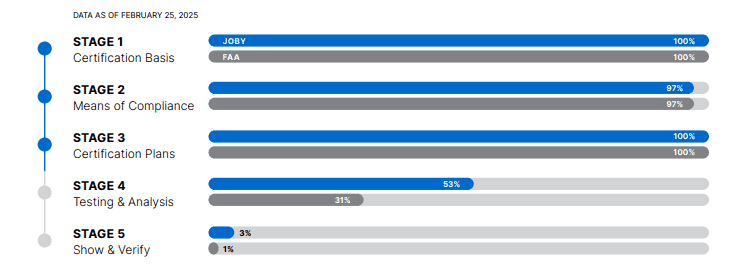
Joby is currently progressing through the fourth of five stages to get the aircraft certified. It expects this to be completed by late 2025 or early 2026. So a delay (or worse) is probably the biggest risk here right now.

Source: Joby Aviation Q4 2024.

Another challenge would be weak consumer demand, though a recent Honeywell survey found that 98% of US airline passengers would consider taking an eVTOL.

A positive here is the balance sheet. At the end of 2024, it had $933m in cash, no debt, plus the additional $500m commitment from Toyota. At the current cash burn rate, this $1.4bn should easily see it through to commercial operations.

More cash will then be needed, though I doubt Toyota will abandon its $900m investment. Funding therefore shouldn’t be an issue, though shareholder dilution could be.

Foolish takeaway

Joby is pioneering flying taxis and they have massive disruptive potential. But it’s pre-revenue, making the stock highly speculative. This means it’s only suitable for risk-tolerant investors with a long-term horizon to consider.

3 simple ways SIPP investors fail to maximise their pensions

Owning a Self-Invested Personal Pension (SIPP) can be a lucrative way to prepare for retirement.

For many of us, retirement may still seem a long way off. But it is getting closer every day – and taking a long-term approach to the necessary financial planning can help reap significant benefits.

Some moves can destroy rather than create value in a SIPP, however. Here are three such pitfalls investors should beware of.

1. Little costs can soon add up

Account management fees, commissions, transfer fees, paper statement fees… the costs and charge of a SIPP can soon add up.

That is even before considering the opportunity costs of some choices. For example, one provider may offer lower interest on cash balances than another.

In isolation, any one of these things may seem minor. But bear in mind that a SIPP can stretch for decades before its owner even retires – and can go on for decades afterwards.

This is very much a long-term investing project. Over time, even small seeming fees and costs can eat heavily into returns.

So choosing the right SIPP provider is a simple but important move for an investor to make.

2. Not paying ongoing attention

Another way people lose money — even when making good investments — is paying insufficient attention to how their portfolio is performing.

As an investor not a speculator, I am not generally a fan of regular trading.

But that does not mean that, having bought a share, one ought simply to tuck it away in the SIPP and forget about it.

An investment case can change for a host of reasons, from geopolitical risks to technological advances.

No matter how good an investment may seem when making it, it makes sense to keep an eye on it from time to time and consider whether anything fundamental has changed that may mean it no longer deserves a place in one’s SIPP (or, conversely, deserves a bigger place than before).

3. Paying too much attention to dividends

Another mistake SIPP investors can make is paying too much attention to dividends.

Dividends are great — but are never guaranteed to last. They also have to be weighed against capital gain or loss.

That helps explain why I do not own shares in gas well operator Diversified Energy (LSE: DEC).

Its 10.3% dividend yield is certainly attention-grabbing. Incredibly (but tellingly), that is actually modest in relation to some of its historic yields!

But guess what?

Over five years, the Diversified Energy share price has collapsed by 64%. So, an investor who had bought it for their SIPP in March 2020 would now be sitting on a large pile of dividends – but also a shareholding worth far less than they paid for it.

Diversified’s business model has risks. Buying up lots of old wells from other companies has bloated the borrowing on its balance sheet. It also brings the risk that large cleanup costs as wells end their productive life could eat into profits.

The business model is innovative and has produced lots of juicy dividends for shareholders, even though we have seen the company reduce its payout.

But dividends are always only one part of the story. A savvy SIPP investor focusses on total return from any shareholding.

Activist Spectrum Entrepreneurial has a stake in Landis+Gyr, and it may be poised to build value

Landis+Gyr Group AG’s residential and commercial FOCUS electric meter installation. 
Landis+Gyr Group AG

Company: Landis+Gyr Group AG (LAND-CH)

Business: Landis+Gyr Group is a Switzerland-based company primarily engaged in the electrical components and equipment manufacturing business. It specializes in metering solutions for electricity, gas, heat/cold and water for energy measurement solutions for utilities. Landis+Gyr product portfolio consists of advanced metering and intelligent energy management products, such as electricity meters, heating and cooling meters, grid management solutions and personal energy management solutions. In addition, the company offers various software services, managed services, cloud services, smart grid services, systems integration, training, as well as consulting and support services.

Stock Market Value: roughly 1.49B Swiss francs (CHF 51.60 per share)

Activist: Spectrum Entrepreneurial Ownership

Ownership: 5.01%

Average Cost: n/a

Activist Commentary: Spectrum Entrepreneurial Ownership (“SEO”) manages a concentrated portfolio of large minority investments, typically six to eight positions, in listed European companies with a focus on the DACH region (Germany, Austria and Switzerland). As a long-term and engaged anchor shareholder, SEO strives to unleash its portfolio companies’ full value potential. The firm targets small and mid-cap companies with multiple catalysts for value creation and prioritizes amicable engagement, typically sitting on the board of most of the companies where they have engagements. The fund’s stable capital base stems from family offices, endowments, pension funds, and other long-term institutional investors. SEO was co-founded in 2022 by Fabian Rauch and Dr. Ilias Läber. The two principals have a combined four decades of board experience in listed companies and each previously worked at Cevian Capital for roughly a decade.

What’s happening

Behind the scenes

Landis+Gyr is a Switzerland-based leading global provider of integrated energy management solutions, specializing in advanced metering infrastructure and smart grid technologies. Utilities and energy providers utilize Landis’ portfolio of smart metering tech, sensors, software and services to modernize and improve the efficiency of their infrastructure. While Landis is a very old company, founded in 1896, it was privately owned and invested in by a series of strategic and financial investors for much of its history. In 2011, Toshiba acquired a 60% stake in the company for U.S. $2.3 billion, but eventually opted to IPO the Swiss unit six years later. It began trading on the SIX Swiss Exchange on July 21, 2017, at 78 Swiss francs (CHF) per share, implying a market cap of CHF 2.3 billion.

Today, Landis is trading well below its IPO price, down over 35%. It is also significantly undervalued, trading around 7.5-times enterprise value/EBITDA, compared to its Nasdaq-listed pure-play peer Itron (roughly 15-times) with which it functionally has a duopoly in the United States, each controlling 35% to 40% of the market. In July 2024, SEO acquired a 5% interest in Landis from Kirkbi, becoming the second largest shareholder. Shortly after, Landis requisitioned an extraordinary general meeting to elect to the board Fabian Rauch, co-founder and managing partner of SEO, in August 2024. Two months later, on Oct. 30, 2024, the company announced a strategic review of its business portfolio which includes the following key elements: (i) increasing focus on its Americas business; (ii) reviewing value creation opportunities for its Europe, Middle East and Africa (EMEA) business; and (iii) evaluating a potential change in listing location to the United States. However, several things have sent the stock price down since then, including Landis reducing its FY24 revenue guidance by 8% and the announcement that it will exit its electric vehicle charging business in EMEA, resulting in expected impairment charges of $35 million to 45 million. Regarding the reduction of guidance, despite Landis continually messaging that post-Covid growth was unsustainable due to pent-up demand, the warnings fell on deaf ears. Shares fell nearly 22% on Feb. 11, 2025, the date of the announcement.

Focusing on the Americas makes a lot of sense. Landis generated $1.963 billion of revenue from three geographic segments: Americas (58%), EMEA (34%), and Asia-Pacific (8%). Despite EMEA contributing a third of revenue, it delivered just 8% of adjusted earnings before interest, taxes, depreciation and amortization, less EBITDA than its significantly smaller Asia-Pacific unit. Exploring additional possibilities for growth in the Americas and winding down its EMEA business through either a sale or spinoff of this business could be highly accretive to shareholder value. A change in listing location, likely to a U.S. exchange, would also make sense considering that this Swiss company is generating most of its profits in the region. This is a strategy which Cevian pushed for at both CRH and Pearson, and it has been a popular activist catalyst in Europe in recent years.

Landis is a story of a failed equity with somewhat of an insular board. Welcoming Fabian Rauch was the first strong signal that the board wanted change. Announcing a value-creating plan shortly thereafter was the second signal. The third happened in November 2024, when the company replaced CEO Werner Lieberherr with Peter Mainz. Finally, the fourth signal happened in January 2025 when the company announced that its chairman Andreas Umbach will not stand for re-election and will be replaced by Audrey Zibelman.

Ken Squire is the founder and president of 13D Monitor, an institutional research service on shareholder activism, and the founder and portfolio manager of the 13D Activist Fund, a mutual fund that invests in a portfolio of activist 13D investments.

Financial News

Daily News on Investing, Personal Finance, Markets, and more!

Financial News

Policy(Required)