How much would an investor need in an ISA for a £999 monthly passive income?

Investors seeking passive income from FTSE 100 shares might wonder how much they need to secure a comfortable retirement. So let’s crunch the numbers.

Generating a second income target of £999 a month would deliver annual income of £11,988 a year. That would almost double the full new State Pension, so it’s well worth having.

The amount of capital required to generate that income would depend on the yield of the investor’s portfolio.

I believe it’s realistic to aim for an average yield of 6% from a diversified mix of FTSE 100 dividend shares. With that assumption, someone would need a total of £199,800 invested to hit their goal.

Building retirement on FTSE 100 shares

That’s a large sum, but it can be built up over time. Someone investing £250 a month could reach this milestone in 25 years, assuming an average total return of 7% per year. That’s roughly in line with the long-term FTSE 100 average total return, which combines both capital growth and dividend reinvestment.

To illustrate the kind of shares that could help build this income stream, let’s look at Aviva (LSE: AV.).

While some FTSE financials have struggled in recent years, as one of the UK’s largest insurers Aviva has delivered solid performance.

The stock has climbed 16% over the last year and is up a hugely impressive 63% over five years.

That’s just the share price growth. Investors have also received bags of dividends over that period, with the trailing yield currently an impressive 6.67%. The total return must be comfortably above 100% in that time.

Avvia shares now look a little expensive, with a price-to-earnings (P/E) ratio of 22.7. However, given the company’s impressive performance and growing profitability, markets believe it’s justified.

The Aviva share price may slow from here

That said, Aviva shares won’t always climb at this pace and dividends aren’t guaranteed. Today’s stock market volatility could potentially hit the value of the assets it holds to offset insurance risks, and hit inflows into its investing division. Once reflected in results, investor enthusiasm may cool.

However, I still think it has a valuable role to play in a well-structured portfolio.

While Aviva is a strong candidate to consider, relying on just one or two stocks is risky. Income seekers should look to hold around 15 to 20 dividend shares in total. Stocks from sectors like utilities, consumer goods and pharmaceuticals can help balance out market fluctuations.

By holding a mix of these types of businesses, investors can build a portfolio that generates reliable passive income while reducing exposure to the risks of individual stocks.

Generating £999 a month in passive income is achievable with a patient, long-term approach. With luck it should rise over time, as companies increase shareholder payouts.

Our investor shouldn’t just stick to tucking away £250 a month though. They should aim to increase that in time to reflect inflation, and throw in lump sums when they have cash to share.

The more they invest, the greater their potentail financial freedom in retirement. That’s the magic of compounding and the joy of passive income.

How much should investors put in an ISA to achieve the UK living wage in passive income?

Generating a small amount of passive income is fairly easy with a well-balanced portfolio of dividend stocks. However, reaching a point where one can live entirely off the income may take a bit more effort.

For those outside of London, the National Living Wage (NLW) is £12.60 per hour. Based on a standard 35-hour work week, that amounts to about £2,000 a month, or £24k annually.

How much would it take to achieve that much passive income?

Let’s take a look.

Reducing outgoings

The first thing to do when formulating an income strategy is to explore cost reduction options. With a Stocks and Shares ISA, UK residents can eliminate one of the biggest costs: tax.

This smart self-directed account allows up to £20k to be invested per year with no tax charged on the capital gains. Brilliant!

Please note that tax treatment depends on the individual circumstances of each client and may be subject to change in future. The content in this article is provided for information purposes only. It is not intended to be, neither does it constitute, any form of tax advice. Readers are responsible for carrying out their own due diligence and for obtaining professional advice before making any investment decisions.

Building the investment

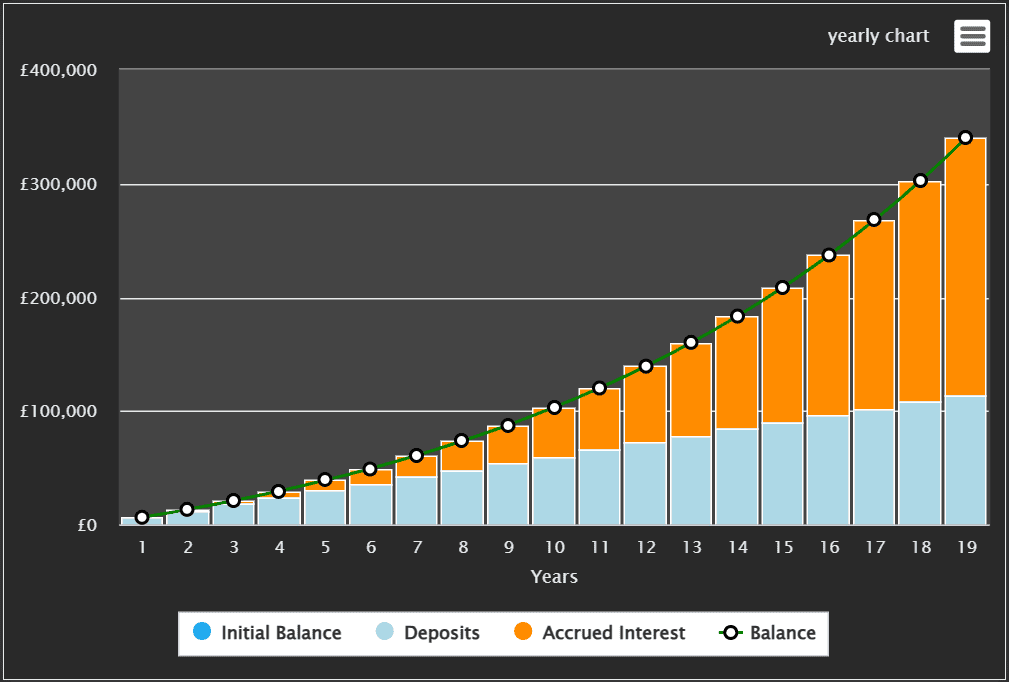
The average dividend yield on the FTSE 100 is 3.5% but income-focused portfolios can achieve as much as 7%. With £343,000 invested, a 7% portfolio would return £24k a year in dividends.

That’s no small chunk of cash. It would take over 56 years of saving £500 a month! Luckily, compounding gains could speed things up. In a portfolio achieving the market average 10% return, it could take only 19 years.

Created on thecalculatorsite.com

Hitting that high yield

In the investment world, passive income almost always comes in the form of dividends. How much in dividends depends on how high a portfolio’s average yield is. Fortunately, the UK stock market is a heavenly treasure trove of high-yield dividend stocks.

Let’s crack open our two main indexes and see what gems they’re hiding.

On top of the FTSE 100, we have Phoenix Group, with a 10.4% yield; M&G, with a 9.3% yield; and Legal & General, with 8.5%.

Over on the smaller-cap FTSE 250 index, the top three are renewable energy-related businesses with yields upwards of 12%. I’m a fan of renewables but when it comes to reliable passive income, I think large established companies are the way to go.

On the Footsie, the largest company paying meaningful dividends is HSBC (LSE: HSBA), with a 5.8% yield. With a £156.8bn market cap, it’s second only to AstraZeneca and recently passed Shell.

AstraZeneca is another great stock but the 2% yield doesn’t make it great for income. Shell’s 4.2% yield is decent but lately its performance has been underwhelming.

A global banking powerhouse

HSBC is a popular option among dividend investors. With a global presence spread across the US, Europe, and Asia, it’s shielded from a slump in any single region. This adds to its reliable income-focused credentials.

Over the years, it has maintained a consistently high yield and strong earnings, giving it more than sufficient coverage for payments.

Despite this, it has made some large dividend cuts in the past during economic downturns. If another pandemic or financial crisis occurs, it might enact more cuts, limiting returns.

Fortunately, it tends to recover quickly and usually enjoys steady price growth. The stock is up 43% in the past year and 90% in the past five years, equating to annualised returns of 13.7% per year.

HSBC is just one example of a great dividend stock to consider for passive income.

I’ve been on the hunt for cheap UK shares to buy – here are 3 I found!

I like a bargain as much as the next investor. The flagship FTSE 100 of leading British shares has recently been riding high. But there are still bargains to be found, both in the FTSE 100 and the wider market. I have been looking for cheap shares to buy – and think I found some!

Here are three I recently bought.

Victrex

I am a longstanding shareholder in polymer manufacturer Victrex (LSE: VCT) – and sometimes that does not seem to be a wise choice.

On paper, the rather dull industrial sounds like a potentially great investment.

It makes polymers for use in safety-critical function in cars, planes, and the like. That gives it pricing power. It has a number of proprietary products, which makes it sound like Victrex has a license to print money.

In practice, though, the share has halved in price over the past five years.

There is a risk from growing competition. The key and high-margin medical segment is still underperforming when it comes to demand, and input cost inflation has made the business more challenging than it once was.

Still, the 6% yield is attractive. While the current valuation looks high relative to earnings, the past several years have seen earnings well below what I believe Victrex is capable of over the long run. As a long-term investor, I see its current price as a bargain.

Greggs

While Victrex may be rather obscure, the same cannot be said of ubiquitous bakery chain Greggs (LSE: GRG).

It has taken a simple, proven retail formula and tweaked the business model to its own advantage.

Unique product lines help build customer loyalty and give Greggs pricing power. A vast estate of branches offers economies of scale, allowing the chain to part-produce some products at centralised factories before shipping them out to shops for onsite finishing.

Consumer confidence is weak, potentially hurting sales. Profits are also threatened, by the additional wage and payroll costs imposed by last autumn’s Budget.

But last week’s share price fall following results publication looked overdone to me.

Greggs was on my list of shares to buy for a long time – so I made a move when it fell to what I saw as an attractive price.

Associated British Foods

If I asked you to name a fancy tea brand, there is a fair chance you would say Twinings. If I asked you to name a high street retailer specialising in cheap clothes, there is a fair chance you would say Primark.

And so on – we could work through the list of well-known brand assets owned by Associated British Foods (LSE: ABF) in such a way for quite a while.

Such a portfolio helps the FTSE 100 firm make solid profits.

But concerns about competition to Primark, weak commodity costs, and uneven demand in the agriculture business have helped push ABF shares down to a point where it now sells for under 10 times earnings.

Like Greggs, this business had long been on my list of shares to buy if the price was right.

The current price looks attractive to me, which is why I recently purchased some ABF shares for my portfolio.

Does it make sense to start investing with £3 a day?

it takes money to make money, as the old saying goes. That is true when it comes to the stock market. To start investing takes some money.

Not everyone who wants to invest has much to spare.

Something I see as an advantage of the stock market compared to some other types of investing is that it has a lower cost of entry. It is possible to start buying shares with just a couple of hundred pounds (or even less).

To illustrate, here is how someone could start investing with £3 a day.

A regular saving habit can build up investment capital

£3 a day might sound like a lot of money.

But think about what it adds up to over time. Within one year, £1,095. Over a decade, it would be more than £10k. Great oaks grow from little acorns, so I think it can be worth starting even on a tight budget.

Given that, it is easy to understand why I think a regular saving habit can be a powerful discipline for someone to get into even if they can only spare a few pounds a day.

To get going on such a habit, I think it would help to choose a share-dealing account or Stocks and Shares ISA into which to deposit the daily £3.

Where and how to start investing

On limited funds, does it make sense to go for the most exciting seeming share? What about one that has already done brilliantly, like Nvidia or Tesla?

A common mistake when people start investing is not understanding how investors actually make money.

Choosing a company that has excellent commercial prospects is only part of it (and past performance is not a reliable indicator of what will happen in future).

Another key part is valuation. What you pay for a share matters because making money typically involves buying a stock for less than it turns out to be worth over the long run, between share price gain and dividends.

Even the best share can come a cropper, so a savvy investor always diversifies. £1,095 a year is ample to spread the risk across multiple shares.

In short, before someone rushes to start investing, they ought to learn about how the stock market works.

Choosing shares to buy

They can then start finding shares to buy.

I like to stick to areas I feel I understand well and businesses I reckon I can judge.

For example, one share I recently bought is Greggs (LSE: GRG). Its 2024 results published last week did not excite much enthusiasm in the City — and the share went tumbling.

But the business looks solid to me. Demand for convenient food like pastries and sandwiches is high and also resilient. There are lots of rivals, but Greggs has a few competitive advantages in my view. One is its large estate of shops. Another is unique product offerings.

The company remains solidly profitable. So, why has the share price fallen to a level that is only 12 times earnings?

Higher staff costs due to last year’s Budget changes are one reason. Another risk is ongoing decline in many high streets, potentially meaning fewer customers.

But I think this is a solid business – and that valuation also looks very reasonable to me.

£100k in savings? Here’s how that could be a starting point for £10k of monthly passive income

Earning passive income through investing is an achievable goal, especially when starting with £100,000 — enough for a large house deposit.

While this amount might not create instant passive income wealth, it serves as a strong foundation to build a steady income stream over time. The key lies in starting smart, staying consistent, and allowing time and compounding to work their magic.

With £100k, a variety of investment options can generate passive income. Dividend-paying stocks provide regular payouts, while bonds offer stable interest payments. Real estate investments, whether through rental properties or REITs, can deliver consistent cash flow. Index funds, with their low fees and steady growth, also present a reliable way to grow wealth.

The secret to success involves reinvesting earnings early on. By investing in growth, redirecting dividends, interest, or rental income back into the portfolio, growth accelerates. Over time, this compounding effect can transform £100k into a much larger sum, significantly increasing passive income potential.

Using an ISA to compound wealth

The Stocks and Shares ISA is an excellent vehicle for building wealth. That’s because income and gains from investments within the ISA are shielded from UK taxes, including income tax and capital gains tax. In other words, if an investors sells a stock that’s surged 100%, they keep all the profits. This allows investments to compound much faster.

Please note that tax treatment depends on the individual circumstances of each client and may be subject to change in future. The content in this article is provided for information purposes only. It is not intended to be, neither does it constitute, any form of tax advice. Readers are responsible for carrying out their own due diligence and for obtaining professional advice before making any investment decisions.

In short, £100,000 could compound into something much larger over the long run when invested wisely. Combined with £200 of monthly contributions and 10% annualised growth, £100,000 could become £2.4m in 30 years. Assuming a withdrawal rate around 5%, this pot could generate around £10,000 a month.

An investments for the job?

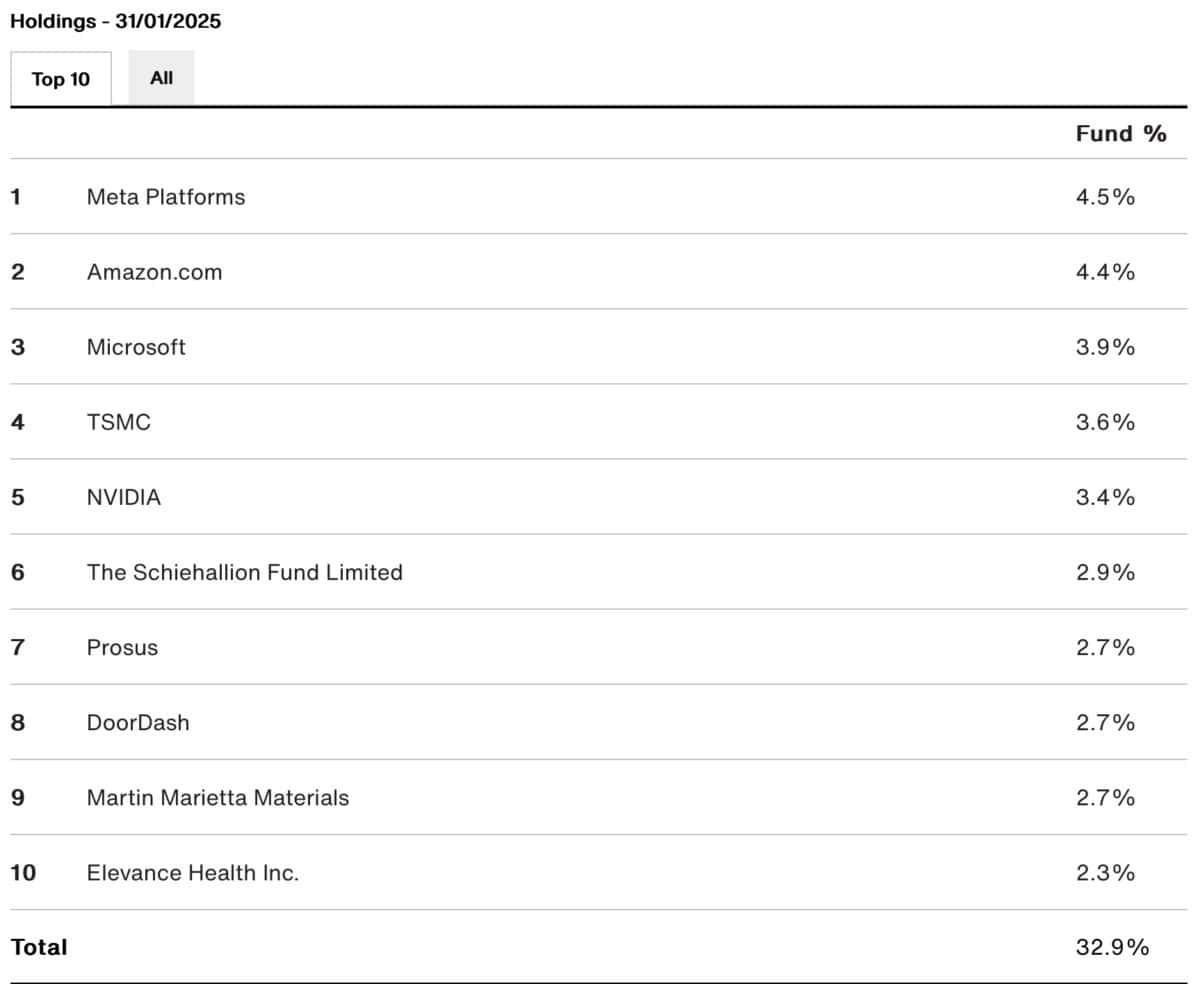
Investors favouring a more hands-off approach may turn to a trust for diversification, and The Monks Investment Trust‘s (LSE:MNKS) certainly an interesting prospect to consider with its focus on global equity investments aimed at delivering above-average long-term returns.

Managed by Baillie Gifford — which also runs the popular Scottish Mortgage Investment Trust — the trust employs a patient, active management strategy, targeting companies that address crises innovatively to reduce costs or improve service quality.

The trust’s portfolio is diversified across regions, including North America (62%), Europe (14.5%), and the UK (3.3%), and sectors such as technology, healthcare, and consumer goods. And with a low ongoing charge of 0.44% and no performance fees, it offers cost efficiency.

Over the past decade, Monks has delivered strong performance, with a 246.2% share price growth, reflecting its ability to weather market volatility while focusing on capital growth. This also reflects the strong performance of tech stocks over the period.

Source: The Monks Investment Trust

Understandably, some investors may be concerned about its weighting towards big tech, which has underperformed over the past month and has plenty of company-specific risk. Yet the trust’s portfolio is balanced, offering a low-maintenance option with a proven track record.

If a 40-year-old put £500 a month in an empty ISA, here’s what second income they might have at 65

Investing in a Stocks and Shares ISA can be a great way to build a second income stream for retirement. 

By regularly investing and letting compound growth work its magic, even relatively modest monthly sums can add up to a sizeable pot.

While it’s never too late to start, it’s definitely better to begin early. That gives more time for compound interest to work its magic.

Let’s say a 40-year-old has only just woken up to the attractions of investing in an ISA, and can afford to put away £500 a month.

Now let’s assume they stick at it for 25 years, and their portfolio grows at an average annual rate of 7%, in line with the long-term FTSE 100 average total return. They could build a nest egg of £406,059 by the time they turn 65.

FTSE 100 dividends can fund a retirement

If they upped their monthly payments as their income increased, and threw in lump sums when they had cash to hand, they could end up with a lot more than that.

Now, let’s say their portfolio generated an annual yield of 6%. That’s above the FTSE 100 average yield of 3.5%, but is doable by targeting stocks that pay above average dividends.

On a £406,059 pot, they’d generate an impressive £24,364 a year, without touching their capital. That’s more than £2,000 a month in passive income.

Crucially, their capital remains intact, meaning they could continue drawing income for decades. Or take lump sums too.

Right now, there are plenty of top dividend stocks to choose from. National Grid (LSE: NG.) is a favourite among income investors.

As a regulated utility, it delivers essential electricity and gas services across the UK and parts of the US. 

This stable business model allows it to generate reliable cash flow, which in turn supports a steady dividend payout. Right now, the stock has a trailing dividend yield of 6.3%.

As with every stock, there are risks. National Grid is investing heavily in the transition to green energy, which requires substantial capital expenditure. We’re looking at £60bn in the next five years.

Even National Grid shares carry risk

Last year, it even asked shareholders for more money through a rights issue. This uncertainty has weighed on the stock, which is down 4% over the last year and flat over five.

Yet it looks unusually good value by its own standards, currently trading at just 10 times earnings. That could make now an interesting entry point to consider for long-term investors looking to lock in a high yield.

Relying on a single stock would be risky. Our hypothetical 40-year-old investor should aim to build a diversified portfolio of around 15 different shares. This would help spread risk, balance income and offer more capital growth potential.

By focusing on high-yield dividend stocks like National Grid and maintaining a well-diversified portfolio, investors could set themselves up for a comfortable and secure retirement.

History suggests the stock market should deliver a far superior return to cash over time, but with volatility along the way. We’re seeing some of that volatility right now. This actually favours investors who pay in regular monthly sums, as their contribution buys more shares when markets are down. The ISA deadline is fast approaching. Time to get stuck in.

After plunging almost 10% in a week do these 2 UK shares now offer unmissable value?

Two UK shares on my watchlist suffered a punishment beating at the hands of disappointed investors last week. So is this a brilliant opportunity for far-sighted investors to consider buying these FTSE 100 stocks?

The first is business intelligence, academic publishing and events specialist Informa Group (LSE: INF), whose shares slumped 9.7% last week. 

This follows a stretch of modest performance, with the stock up just 3.7% over the past 12 months. It has climbed 30% over five years though, so isn’t exactly a basket case.

Have Informa shares been harshly treated?

Historically, Informa has traded at a premium, but the recent downturn has brought its price-to-earnings (P/E) ratio to 15.3, which is tempting.

Full-year 2024 results, published on Thursday (6 March), triggered the recent sell-off. They weren’t all bad news though.

Revenues climbed 11.4% to £3.55bn, while adjusted operating profit jumped 16.5% to £995m. Free cash flow surged 28.6% to £812.1m. What’s not to like?

In this case, it was a disappointing outlook. The board predicts underlying revenue growth will slow to just 5% in 2025. A wider concern is that if global economy struggles, as Donald Trump’s tariffs bite, the events industry could see attendance and sponsorship revenues decline.

On the plus side, a joint venture with the Dubai World Trade Centre should open up new lines of revenue in the Middle East.

The stock only yields 2.6% but the board hiked the dividend by 11.1% last week. It paid £425m share buybacks in 2024 too. The total cash return is to £675m. I think the market was a bit too tough on Informa last week.

Time to consider Bunzl shares?

Distribution group Bunzl (LSE: BNZL) has been on my watchlist for yonks. It’s the FTSE 100’s perennial dark horse and a solid long-term performer, until recently.

The Bunzl share price fell 8.7% last week, and it’s flat over 12 months. Although over five years, it’s up 60%.

That’s similar to Informa and here’s something else they have in common. Bunzl also released a poorly received set of full-year results last week, on Monday 3 March.

Adjusted operating profit rose a healthy 7.2% at constant exchange rates to £976m, but statutory operating profit edged up just 1.3% to £799m.

Revenues rose just 0.2% on a reported basis to £11.8bn. They’ve now idled for the second year in a row, as deflation squeezes prices amid tough competition.

Bunzl’s successful strategy of growth through acquisitions shines undimmed, but it needs to, amid signs of a slowdown in its core operations. The trailing yield is 2.4%. However, the board did lift the full-year dividend by a healthy 8.2%. That’s extended its track record of annual dividend growth to an impressive 32 consecutive years.

I think both Informa and Bunzl are well worth considering with a long-term view. But I think the next year or two could remain sticky, amid global uncertainty. I like both, but wouldn’t go as far as calling them unmissable buys.

7.5% yield! Could this FTSE 100 stock potentially net investors a huge passive income?

For investors targeting passive income, I think real estate investment trusts (REITs) are well worth considering. And there’s one in particular that stands out to me right now. 

Shares in Land Securities Group (LSE:LAND) currently come with a 7.5% dividend yield. While that’s true of a lot of REITs, there’s something that sets this one apart. 

Please note that tax treatment depends on the individual circumstances of each client and may be subject to change in future. The content in this article is provided for information purposes only. It is not intended to be, neither does it constitute, any form of tax advice.

REITs

REITs were first introduced in the 1960’s in the US. The ambition was to allow ordinary people to gain exposure to booming real estate prices. 

With property prices going ever higher, they arguably still serve that function. Instead of buying bricks and mortar, investors wanting exposure to property can buy shares in a REIT.

Different REITs do different things, but they all have a few things in common. Most obviously, they generate income by owning and leasing properties to tenants. 

REITs don’t pay tax on their profits. Instead, they return 90% of their income to shareholders via dividends, providing ordinary people a way of earning passive income from property.

Risks with REITs

Being required to distribute their profits means REITs can’t easily use their cash to buy more properties. And this means that growth opportunities can be limited.

To get around this, they typically do (at least) one of two things. The first is issue debt and the second is raise money via equity. But there are drawbacks to both. 

In the case of debt, it can put the company’s balance sheet in danger. Rising interest rates can make servicing debt more expensive and cut into earnings – and dividends. 

The trouble with issuing equity is it makes the existing shares worth less. If the number of shares outstanding goes up by 10%, the value of each share decreases 10%.

A best-in-class example?

Land Securities Group has done an extremely impressive job of keeping its share count steady, with the number of shares outstanding is roughly where it was 10 years ago. 

Compared with other FTSE 100 REITs, like LondonMetric Property (+80%) and Segro (+58%), this is very impressive. These companies have achieved better growth, but this has come at a cost.

At first sight, Land Securities Group doesn’t have the most attractive portfolio. It contains more offices and fewer warehouses than some of its competitors. And with a big chunk of retail in its portfolio, there’s an undeniably risky sector it has to deal with.

Despite this, the company’s focus on Central London real estate has meant occupancy levels are above 96%. And unlike some REITs, the dividend’s well-covered by earnings. 

Dilution

When it comes to REITs, I think investors have to account for dilution. The effect of getting a 9% dividend yield’s dampened if they have to reinvest half of it to offset a rising share count. 

That’s where Land Securities Group really shines. It doesn’t have the most exciting growth prospects, but – while there are no guarantees – the 7.5% dividend looks reasonably durable.

I think REITs can be a great choice for passive income investors. And Land Securities Group is definitely one that warrants a closer look.

This former penny stock’s up over 1,000%! Can it 10x again?

Despite their popularity, most penny stocks struggle to deliver on explosive promises. Yet when looking at Filtronic (LSE:FTC), the firm seems to have beaten the odds and gone on to deliver ginormous returns for loyal shareholders.

Shares of the electronic aerospace equipment group have skyrocketed by 1,212% over the last five years. That means a £1,000 investment in March 2020’s now worth £12,120. And since 2025 kicked off, the now small-cap firm has surged by a further 45%.

What’s behind this? And can this momentum continue to deliver another 10x return in future?

Partnering with SpaceX is profitable

Filtronic has been making progress over the years. But it wasn’t until last April that growth kicked up a notch. Following a successful partnership with Elon Musk’s SpaceX, Filtronic secured a $19.7m (£15.8m) contract to supply E-band SSPA modules for the Starlink Project. These electronic components enable high-speed communication across 5G and other wireless networks.

The impact of this deal has been made perfectly apparent in the latest interim results released at the start of February. Revenue surged from £8.5m to £25.6m across the six months leading to November 2024. At the same time, operating profits jumped from a loss of £0.4m to a gain of £6.8m. And management’s already been deploying this extra capital to expand production capacity and grow its headcount.

It was only a few days later that Filtronic made another announcement of a contract signed with SpaceX valued at $20.9m (£16.8m) to be delivered before May 2026. It seems its now largest customer is quite happy with the product and is coming back for more.

Another 10-bagger?

Seeing a 200% jump in revenue is undeniably a cause for celebration. So it’s no surprise to see Filtronic’s share price rise out of penny stock territory. However, could it be capable of delivering year another quadruple-digit gain over the next five years?

Providing that the SpaceX contracts are fulfilled on time and to satisfaction, new opportunities will likely emerge. Not just with SpaceX but with other aerospace and satellite businesses that have taken notice of Filtronic’s technological capabilities.

However, whether that will translate into another 1,000% share price return, I’m not so certain. Why? Because at a market-cap of £230m, it seems a lot of this expected growth’s already baked into the stock price. It’s also worth pointing out that part of its deal with SpaceX granted the aerospace business the right to acquire roughly 10% of Filtronic’s equity through share warrants.

SpaceX may just decide to acquire Filtronic for its technology. Of course, this is pure speculation. However, while a takeover bid would likely send the shares flying, a 1,000% buyout premium seems improbable.

What to watch

Right now, I feel Filtronic shares are fully valued in terms of their potential. So this isn’t a business I’m rushing to add to my portfolio today. However, for existing shareholders, a new significant risk has just emerged. Almost all of Filtronic’s newfound revenue growth stems from a single customer – SpaceX.

Should the relationship break down, or Filtronic’s components simply won’t be needed anymore, replacing this lost income will be a serious challenge for management. In the worst-case scenario, Filtronic could tumble back into penny stock territory. I don’t see it as one to consider.

Here’s 1 share I’m avoiding while searching for the top stocks to buy

Finding the best stocks to buy is never an easy task. And while there are plenty of promising growth stories to capitalise on today, most won’t live up to expectations. One company that falls into that category for me right now is Ocado Group (LSE:OCDO).

My views on this enterprise have soured over the years as the true cost of its robotic automated warehouse technology emerged. And while significant revenue growth has finally started to materialise, there are still some notable question marks surrounding this business.

Digging into the details the whole thing

Ocado’s best known as an online grocery retailer. However, for several years now, management has been steadily transitioning the business into a robotics enterprise. Companies can now use its technology to automate the preparation of customer orders within a warehouse, which Ocado calls Customer Fulfilment Centres (CFCs).

As per the latest results, there are currently 25 CFCs operating under Ocado’s ecosystem, with a minimum of seven more expected to be added over the next three years. If everything goes according to plan, the firm’s recent record-breaking £3.2bn of revenue could be just the tip of the iceberg.

Needless to say, that sounds rather promising. However, digging deeper, I’m sceptical management will succeed in meeting its goals on time.

The firm already has a mixed history of delivering on its stated targets. And some of the planned CFC openings are simply existing projects that have been delayed. At the same time, a few of its key customers appear to have a lukewarm reception to the technology.

In the US, Kroger’s already slowed the pace of deploying Ocado’s robots. Meanwhile, in Canada, Sobeys has paused its adoption plans indefinitely. That’s despite both firms reporting strong sales growth. In the meantime, Ocado’s losses remain substantial, landing at £374.3m in 2024 after already burning through £387m in 2023.

As such, despite delivering record top-line growth, Ocado shares tumbled by roughly another 20% on the back of its latest earnings, dragging its 12-month performance to -42%.

Looking on the bright side

Despite the negatives, Ocado’s latest results did have some welcome bright spots. While earnings have a lot of room for improvement, the group’s underlying cash outflow was effectively slashed in half, falling from £472.5m to £223.7m.

Management attributes this success to higher EBITDA margins and improved capital expenditure. And this positive trend is expected to continue over the next two years, entering the black before the end of 2026.

Suppose the firm’s successful in hitting this target? In that case, the improved financial flexibility will give management some much-needed breathing space in terms of managing its debt burden. Not to mention, it paves the way for reaching profitability.

Considering the relatively low price point at which shares are currently trading, today’s valuation may present an exceptional buying opportunity. However, that’s all dependent on management hitting its goals. And as previously stated, Ocado’s poor track record doesn’t exactly fill me with confidence.

That’s why, despite the potential, this business isn’t joining my ‘best stocks to buy’ list. At least, not until I see more progress.

Financial News

Daily News on Investing, Personal Finance, Markets, and more!

Financial News

Policy(Required)