With a historically low P/E ratio of 10.9, is it time to buy this FTSE 250 stock?

Those FTSE 250 stocks with a reliance on the luxury end of their markets have struggled recently. Aston Martin Lagonda and Burberry are two examples that spring to mind. In the wake of post-pandemic inflation and a resulting global slowdown, both have seen their earnings — and share prices — fall.

Watches of Switzerland Group (LSE:WOSG) is no different. Towards the end of 2021, its shares were changing hands for around £15. Today, an investor could buy one for approximately £4.50. The group’s share price is now 25% below its 52-week high.

A large and growing market

Luxury watches are big business. The global market is estimated to be worth close to $50bn. The most expensive timepiece on its website has a price tag of £565,900. In fact, it has 1,155 of them with a retail price in excess of £10,000.

During the year ended 28 April 2024 (FY24), its revenue was over £1.5bn. And its adjusted earnings before interest and tax (EBIT) was £134.7m.

For FY25, analysts are expecting an 8.6% increase in the group’s top line and a 11.3% improvement in EBIT. If their forecast for earnings per share of 41.4p proves to be correct, it means the stock’s currently (10 March) trading on a very reasonable forward price-to-earnings ratio of just under 11.

In December 2021, it was over 35.

Time to look further ahead

The company has ambitious growth plans. It wants to double its revenue and adjusted EBIT by the end of FY28.

It hopes that some of this expansion will come from its decision to move into the pre-owned market, which is forecast to grow by 10% a year up until 2028. Further investment in its network of shops should also help boost sales. In keeping with its status as a premium retailer, Watches of Switzerland prefers to use the term ‘showroom’ and has 217 of them in the UK, United States and Europe.

It’s also selling jewellery, which in FY24, accounted for only 7% of revenue. But I think there’s huge potential here.

However, the Bloomberg X Subdial Index, which tracks the price of the 50 most traded luxury watches, has been falling for some time now. It’s a similar story with the WatchCharts Overall Market Index. It follows the secondhand prices of 300 watches from the top 10 luxury brands. It’s currently a third below its peak, achieved in April 2022.

Although both of these indexes monitor pre-owned prices, they’re a good indicator of the overall health of the luxury watch market. That’s why, in my opinion, the Watches of Switzerland stock price tends to move in tandem.

However, there’s no immediate sign of a recovery, which I think explains why the group’s shares currently attract a relatively low valuation. And inflation in the UK, which has significantly impacted earnings in recent years, hasn’t been tamed yet.

But in my opinion, with a still healthy margin, exposure to a market that should recover if global economic conditions improve as expected — and because of a sensible decision to expand in other luxury products — Watches of Switzerland Group is a stock worth considering.

In a chaotic world, could this be a perfect income stock?

Choosing income stocks has never been easy. And with so much global uncertainty it’s hard to know which sectors or companies are likely to maintain their earnings and dividends.

On paper, companies with an international footprint should do better as they’re less vulnerable to a slowdown in one particular territory. But with President Trump’s erratic approach to tariffs, it’s unclear who the short-term winners and losers will be in the global marketplace.

Then there’s the threat of competition. Due to clever technologies, traditional barriers of entry are now easier to overcome than previously.

And if that’s not enough to contend with, the arrival of artificial intelligence is threatening to disrupt traditional industries. Some companies may be left behind as they fail to embrace what has been described as the fourth industrial revolution.

For these reasons, picking dividend stocks can be a bewildering experience.

However, there’s one company that I recently came across that doesn’t have to cope with any of these problems. And because of its healthy dividend, I wonder whether Jersey Electricity (LSE:JEL) is a perfect income stock.

A finger in many pies

When it comes to electricity, there’s not much the company doesn’t do.

It oversees the import of electricity from France, generates power using its solar arrays, operates the transmission and distribution networks across the island, provides metering services to domestic and commercial customers, sells white goods and provides consultancy services. Because it has no competitors for the supply of electricity, there’s less pressure to innovate.

Approximately 95% of the energy needs of Jersey are met by importing power from France. The interconnector between the two jurisdictions is jointly owned with Guernsey Electricity. The balance of electricity for the island is purchased from local generators, with a tiny proportion produced by the company itself. With no exports, it will never have to worry about Trump’s tariffs.

To my surprise, although having monopoly status, the company isn’t directly regulated. However, its activities are overseen by Jersey’s competition authority and the island’s government is the largest shareholder. But customers enjoy lower prices than their counterparts in mainland Britain.

A closer look

With limited opportunities to expand its customer base, its earnings will be heavily dependent on the amount charged by EDF in France. But Jersey Electricity knows that if its costs are rising, these can be passed on to customers via higher tariffs.

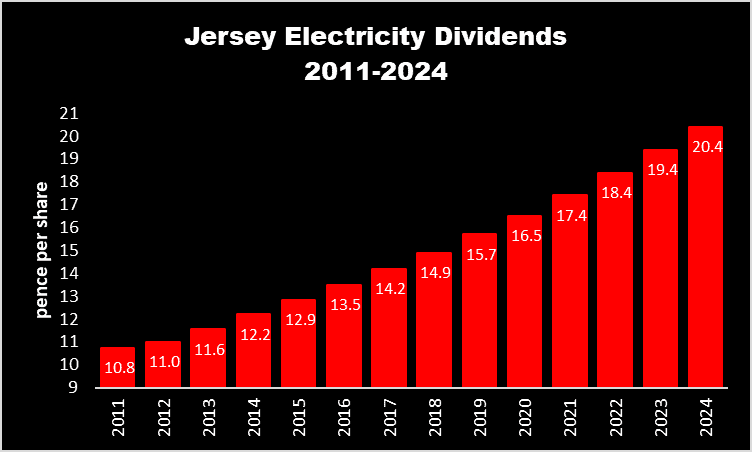
This certainty over earnings means dividend has been reliable. And as the chart below shows, it’s increased its payout for 13 consecutive years. The stock presently yields a very respectable 4.8%.

Source: Investing.com / year-end = 30 September

Based on its 2024 accounts, its price-to-book ratio is only 0.2. In theory, if the Jersey government wanted to buy the 38% of the company that it doesn’t own — assuming it offered a fair price — it would have to pay shareholders more than the current (10 March) value of their shares.

What’s not to like about this stock? Well, with a market cap of just over £50m, it lacks the financial firepower to withstand a major shock. And I can’t see its share price growing significantly.

But principally due to is lack of exposure to the outside world and its healthy dividend, I think it’s a stock that income investors could consider adding to their long term portfolios.

Is it time to listen to the experts and consider buying this FTSE 250 growth stock?

Essentra (LSE:ESNT) is a FTSE 250 stock that, according to research published at the start of 2025 by AJ Bell, was tipped as a Buy by all 17 analysts covering it. When it comes to picking stocks, such unanimity is unusual. Those who regularly read The Motley Fool will know that opinions differ widely.  

But as the Chinese proverb says: “Listen to all, pluck a feather from every passing goose, but follow no one absolutely.” In other words, consider everyone’s opinion but don’t blindly follow.

However, when 17 out of 17 ‘experts’ consider a stock to be a Buy, it’s sometimes difficult to take a different view.

A brief overview

Essentra says that it manufactures “essential components”. It currently makes over 3bn of them a year. These are small but critical parts – locks, washers and castors, to name a few — that are predominantly used in the manufacture of other products. Clearly, there’s significant demand for these things. The group has 14 manufacturing plants and a presence in 28 countries.

When the group’s 2024 results are finalised, they are likely to show revenue of just over £300m. And an adjusted profit before tax of £39.8m-£40.3m. This is in line with analysts’ expectations. The consensus forecast is for earnings per share (EPS) of 8.5p. If they are right, the stock’s trading on a reasonable 13.9 times historic earnings. This compares favourably to that of Diploma, the FTSE 100 company that operates in the same sector. It has a price-to-earnings ratio of nearly 30.

Is it really a growth stock?

It’s difficult to assess the historical performance of the business because it went through a major restructuring in 2022. The group sold its packaging and filters divisions. The proceeds were used to reduce borrowings and helped fund a special dividend.

But curiously, analysts are forecasting revenue in 2025 to be flat. And they are predicting a fall in EPS to 7.5p. This doesn’t feel like a growth stock to me and not one that I’d like to invest in. Of course, successful investing is all about taking a long-term view. But if this expected stagnation proves to be correct, in a year’s time, I suspect the share price will be lower than it is today. If I wanted to buy the stock, I reckon I could get it cheaper this time next year.

My verdict

As well as the anticipated lack of growth, I’m also concerned about the impact of President Trump’s threatened tariffs. In 2023, approximately 30% of the group’s revenue was generated from the United States. But it’s unclear to me whether the company’s manufacturing facilities inside the country can meet this demand. Bringing products into America that have been made overseas could soon attract higher import taxes.

Don’t get me wrong, I have nothing against the company. It looks to be well run and good at what it does. And its borrowings appear to be under control. Also, based on dividends paid over the past 12 months, the stock’s currently (10 March) yielding a reasonable 3.1%.

However, it doesn’t feel like it’s going places to me. Therefore, I don’t want to make an investment, despite what the analysts think.

Investors can aim for a £1,000 monthly second income starting with a £20k ISA

With uncertainty in the British economy still elevated, investors earning a passive second income have a significant advantage over most individuals.

Earning extra cash without having to lift a finger is key to achieving financial freedom. And with the ISA deadline fast approaching, now could be the perfect time to start leveraging the wealth-building power of the stock market.

As with all investments, there are risks to consider. And nothing is ever guaranteed. But given enough time, it’s possible to transform a £20k Stocks and Shares ISA into a £12,000 annual income stream – the equivalent of an extra £1,000 a month.

Earning £12k a year

Following the 4% withdrawal rule, investors aiming to earn an extra grand each month will need an ISA valued at around £300,000. That’s obviously not pocket change. But when starting with £20k already in the bank, it’s a goal that’s far more achievable than most might think.

Even with a passive strategy of investing in a FTSE 100 index tracker, a £20k ISA could reach the £300k threshold within just under 34 years, even without injecting any more capital. This estimate assumes that the UK’s flagship index continues to deliver its historical 8% annual average return moving forward. And while 34 years is a long time to wait, the process can be drastically accelerated by throwing in small regular monthly contributions.

For example, adding an extra £150 each month to the portfolio would slice almost nine years off the waiting time. And for those able to inject £500 every month, the timeline shortens to just 17 years.

Seeking extra returns

Not everyone has the luxury of having spare cash at the end of each month for investments. Fortunately, there’s another way to speed up the wealth-building process – stock picking. This strategy is far more hands-on and requires a higher degree of risk tolerance. However, by picking individual stocks, it’s possible to achieve returns that outpace the FTSE 100’s 8%.

Take BAE Systems (LSE:BA.) as an example to consider. Over the last five years, the aerospace and defence enterprise has seen its valuation fly by over 160% as defence spending ramped up as a result of the Ukraine and Gaza conflicts. On an annualised basis, that’s the equivalent of a 21% return. If this rate of return were to be maintained, the timeline to transform £20k into £300k and unlock a £12k second income would be just 13 years, even without adding any extra capital.

Taking a step back

As exciting as this prospect sounds, earning a 21% annualised return for 13 years straight is far from easy. Even someone as skilled as Warren Buffett has only managed 19.9%.

Meanwhile, BAE’s recent success is currently being primarily driven by short-term tailwinds in defence spending across Europe. However, that could change should the ongoing conflicts come to a peaceful resolution. Don’t forget after the Iraq war ended in 2011, BAE’s growth slowed considerably until geopolitical tensions started to rise again in 2022.

All of this is to say that while BAE appears to have market-beating traits today, that may not always be the case. After all, it’s a cyclical business. And it’s entirely possible for a hand-crafted portfolio to underperform the FTSE 100 if constructed or managed poorly.

Prediction: 12 months from now, £5,000 invested in Nvidia stock could be worth…

When trading at a price-to-earnings (P/E) ratio of 39, the recent volatility surrounding Nvidia (NASDAQ:NVDA) stock should come as little surprise, especially after enjoying such an explosive rise. For reference, the GPU chip maker has seen its market capitalisation rise by over 1,600% over the last five years.

Unfortunately, shares of this tech giant seem to be moving firmly in the wrong direction so far in 2025. Since the year kicked off, the stock’s down almost 20%. And this downward trajectory appears to have accelerated in recent weeks.

So what’s going on? And how much money could investors make if they were to invest £5,000 right now?

Trouble brewing in China

In 2022, the US government introduced a ban on Nvidia from selling its latest version of its AI-powering chips in the Chinese market. However, it seems despite these tight controls, Nvidia’s Blackwell technology has still managed to find its way into this restricted domain.

Authorities in Singapore have launched a fraud investigation into how these chips made it into China, which could land Nvidia in hot water in the weeks and months ahead. At the same time, the introduction of tariffs by the US creates a new headwind for the enterprise, with its operations in Mexico seemingly in the direct line of fire.

Currently, the full impact on the business remains unclear. But there appear to be numerous headwinds starting to creep into Nvidia’s outlook. And when trading at a premium valuation, uncertainty rarely bodes well for a stock price.

Bullish trajectory

Despite these latest developments, analysts remain quite optimistic. The average 12-month price target for Nvidia stock is currently at $175 per share. Compared to today’s trading levels, that’s a potential 53% jump between now and March 2026. If this projection proves accurate, a £5,000 investment today could grow to £7,650 by this time next year.

As exciting as this prospect sounds, there are some caveats to consider. Forecasts are notoriously inaccurate due to the large number of assumptions made by analysts. And right now, one of the biggest is the continued demand for AI accelerator chips as the tech industry expands its AI infrastructure.

Unfortunately, there are already concerns about an incoming spending slowdown in this arena. Even if this doesn’t occur, rival data centre technology firms like Arista Networks are also working on their own Nvidia-alternative solutions that might start undercutting the group’s extensive pricing power.

Time to buy?

Nvidia’s technological capabilities are quite substantial, as is its track record of innovation. This is made perfectly apparent in its latest earnings report, where revenue and profits shot up by 78% and 80% respectively, once again beating expectations for the ninth consecutive quarter.

However, even after the recent slide in valuation, Nvidia’s stock appears priced as if the spending and competitive environment won’t change. That’s despite semiconductors being a notoriously cyclical industry.

As such, I’m still sitting on the sidelines. However, should a better price emerge, Nvidia will likely become a new addition to my growth portfolio.

Prediction: 12 months from now, £5,000 invested in Barclays shares could be worth…

The last 12 months have been a terrific time to be a Barclays (LSE:BARC) shareholder. The UK’s second largest bank has seen its market capitalisation rise by a staggering 75% since March 2024. And following its latest results, it’s not hard to see why.

Total income in 2024 rose a respectable 6% to £26.8bn. But it was the firm’s 23% jump in pre-tax profits, from £6.6bn to £8.1bn, that stole the show. This paved the way for yet another impressive share buyback scheme of £1bn that’s already underway, paired with a 5% bump in dividends, marking the fourth consecutive year of shareholder payout hikes.

Needless to say, this is all rather positive. But as we move further into 2025, investors are wondering whether the bank can keep up this momentum or whether now’s the time to start taking a profit.

Operational progress

The recent acquisition of Tesco Bank offered a welcome boost to earnings. And overall, the bank’s lending activities have steadily become more profitable. At least, that’s what the net interest margin suggests, which reached 4.5% in the fourth quarter of 2024 versus 4.02% at the start of the year.

Operating margins also moved in the right direction as cost-cutting initiatives start paying off. Management successfully delivered £1bn of gross cost efficiencies in 2024, bringing the group’s cost/income ratio to 62%, slightly ahead of the targeted 63%.

Meanwhile, the group’s large investment banking division also delivered a robust performance, with US activity seemingly starting to pick up in the latter half of 2024, post-US election. With that in mind, seeing the Barclays share price rise so aggressively makes a lot of sense, even more so given the stock’s cheap initial valuation.

What’s next?

For the most part, institutional analysts appear to be quite bullish on Barclays shares. Fifteen out of 19 currently rate the stock as a Buy or Outperform with a 12-month average price target of 350p.

Compared to the current share price, that suggests investors can expect to earn a 12.5% return. If this proves accurate, a £5,000 investment today could potentially be worth £5,625 by March next year. And that’s before factoring in the returns from the recently hiked dividends.

However, as encouraging as this sounds, forecasts should be taken with a pinch of salt. It’s not all sunshine and roses at Barclays, as management has announced a £90m provision to cover the cost of any potential claims relating to the ongoing motor financing scandal. That’s significantly less than the £1.15bn Lloyds has put aside, but just as with all banks facing this looming threat, the potential cost could be considerably higher.

Despite this challenge, I remain cautiously optimistic for Barclays’ long-term outlook. And with the bank’s valuation still looking reasonable at a price-to-earnings ratio of 8.9, investors may want to consider taking a closer look. For my portfolio however, I already have sufficient exposure to the financial sector, so I’m not looking to add any shares to it today.

£5,000 invested in BP shares 1 year ago is now worth…

BP (LSE:BP.) shares are on the move as management switches strategy. Despite previously targeting an ambitious transition from oil & gas production to renewables, leadership has now come out to say the company had gone “too far and too fast”. And the impact of this is partially reflected in its lacklustre performance over the last 12 months.

BP shares are down roughly 12% compared to rivals such as Shell, who saw its valuation rise by 4% over the same period. That means those who invested £5,000 in March 2024 now only have a position worth £4,400. And while dividends have helped offset this decline, the company’s by no means keeping ahead of its parent index, the FTSE 100.

But with shares moving downward and management shaking things up, does the current stock price present a potential entry point for opportunistic investors? And if so, how much money could be made by this time next year?

Oil & gas back in focus

Until recently, BP intended on spending $6bn-$8bn on its transition towards renewables. Now, the budget’s been slashed to just $1.5bn-$2bn, with at least $800m dedicated to low-carbon energy sources such as wind and solar.

Meanwhile, over on the oil & gas side of the business, capital spending’s expected to increase as management aims for a production of up to 2.5m barrels of oil equivalents per day (boepd) by 2030. For reference, BP’s output landed at 2.3m boepd in 2024.

Management’s also begun announcing cost-cutting initiatives including a reduction in share buybacks as well as total capital expenditures. This all comes paired with the planned sale of numerous renewable energy assets to raise funds and pay down debt. In fact, the firm’s specifically stated it’s aiming to bring net debt down from $23bn to between $14bn and $18bn.

Considering the current interest rate environment, deleveraging the balance sheet sounds like a prudent move. But regardless, this U-turn in strategy has understandably created some uncertainty among investors.

What’s next for the firm?

Despite the shift in approach, renewables are still a core part of BP’s strategy, with biogas, biofuels, electric vehicle recharging stations, carbon capture, solar, and wind playing a vital role in the firm’s long-term approach. And BP’s still aiming to reduce its carbon emissions by at least 45% by 2030.

The reaction from institutional analysts appears to be relatively positive. While unpopular among environmentalists, the expected reduction in net debt is expected to provide a far more financially sustainable approach to achieving net zero emissions in the long run.

So what can shareholders expect over the next 12 months? The latest analyst forecasts suggest the stock’s likely going to remain stable with a price target of 464.29p. That’s about 7% higher than current levels, so not much growth is expected.

Overall, such expectations seem realistic. After all, due to the incoming asset sales, total production for 2025’s actually expected to fall year-on-year before ramping back up. In the long run, I believe BP will remain a crucial player within the energy sector. But I’m not rushing to buy shares today, given the slow year that appears to lie ahead for this enterprise.

In 1 year, £5,000 invested in Tesla Stock could be worth…

The last couple of months have been quite tumultuous for Tesla (NASDAQ:TSLA) shareholders. The US electric vehicle (EV) manufacturer has seen its valuation tumble by over 40% since its peak in December. This downward trajectory’s seemingly started to accelerate since the start of February, falling by 30% so far.

What’s going on? And is this secretly a buying opportunity for long-term investors?

Falling short of expectations

It’s no secret that Tesla’s stock trades at a premium valuation. Even today, after almost half of its market-cap has been wiped out, the forward price-to-earnings ratio still sits at a whopping 96! As such, seeing such extreme volatility at these levels shouldn’t be surprising. But what triggered this recent sell-off?

There are a lot of influencing factors, making it difficult to pinpoint the main catalyst. However, the general consensus seems to be, as usual, surrounding Elon Musk, who’s become even more controversial.

There was hope that a closer relationship with President Trump could prove advantageous for the company, but that doesn’t appear to have materialised. Furthermore, Musk’s involvement with the newly-formed Department of Government Efficiency (DOGE), as well as meddling in German politics, is seemingly turning off some potential customers.

The latest European car registration data for January was particularly concerning, given it showed a 45% reduction in Tesla registrations for the month. That’s despite a 37% increase in overall EV registrations over the same period. Meanwhile, in its home market, protests have started to break out in front of Tesla showrooms due to Musk’s activities within DOGE.

Where could the stock go from here?

The recent reputational damage surrounding Tesla’s understandably spooking some investors. However, while the short-term appears murky, the long-term trajectory of this business may still hold some promise. Investments in artificial intelligence (AI) and robotaxis pave the way to new market opportunities. And the firm’s industry-leading battery technology continues to give Tesla a significant advantage over its peers both in terms of lower costs and longer vehicle range.

With that in mind, it’s not too shocking to see a large number of institutional analysts shift their recommendations to Buy in light of the recent stock price turbulence. And overall, the average 12-month share price target now sits at $345.76 per share. That’s the equivalent of a 21.5% potential gain, transforming a £5,000 investment into around £6,075 by this time next year.

Of course, share price forecasts aren’t guaranteed. And with new trade wars brewing due to rising US tariffs, Tesla could endure further turbulence ahead. Personally, with so much uncertainty surrounding the brand today, this isn’t a stock I’m tempted to add to my portfolio right now.

However, I may have to reconsider my opinion should the share price fall further.

12 months from now, £5,000 invested in Tesco shares could be worth…

The last 12 months have been a terrific time to be a Tesco (LSE:TSCO) shareholder. The UK’s leading grocery retailer’s seen its valuation fly by almost 40% as it steals back market share from competitors. As of February, the latest data from Kantar shows Tesco now controls 28.3% of the UK’s grocery market, clawing customers from Asda and Morrisons.

But with the busy Christmas period now over, where can the Tesco share price go from here? And how much money could investors be on track to make over the next 12 months?

A tight grip on British shoppers

Despite its huge size, Tesco continues to deliver respectable growth. In fact, its latest quarter marked the 19th consecutive period of expanding its market share. The secret behind the business’s success? Its Clubcard scheme.

There are now around 23m members of Tesco’s Clubcard scheme across Britain versus the estimated 28.4m homes in the country. That’s a market penetration of roughly 81%, while Sainsbury’s is 68%, with its Nectar loyalty card scheme.

With price-matching programmes to fend off discount retailers like Aldi and Lidl and premium quality offers to attract shoppers from Waitrose and Marks & Spencer, Tesco’s having little trouble growing its sales volumes. And the firm remains on track to deliver £2.9bn of adjusted operating profit for its 2025 fiscal year, which ended in February.

Investors will have to wait a couple more weeks before the full-year results are released. But as things stand, Tesco appears to be firing on all cylinders.

Is now the time to buy?

With management’s strategy seemingly paying dividends, the general consensus looks pretty positive. In fact, of the 17 analysts monitoring the stock, 14 have issued a Buy recommendation, with an average 12-month price target of 417.50p.

Assuming this forecast is accurate, that means investing £5,000 today could grow into £5,440 by this time next year. And that’s before factoring in the extra 3.3% gain, or £150, from dividends based on today’s yield. Obviously, this isn’t a jaw-dropping amount of potential growth. But for a mature industry titan, it’s pretty respectable. And given sufficient time, further improvements to its market share and sales volumes could see the stock climb steadily higher.

Of course, none of this is set in stone. Even the largest enterprises in the world have their weak spots. And for Tesco, food inflation‘s a fairly significant threat. As prices rise, shoppers may be forced to venture elsewhere or reduce the quantity of premium-priced goods in their weekly shopping basket.

We’ve already seen the firm’s price-matching scheme helping to mitigate this impact. But with more customers switching to cheaper products, lower volumes of its premium, and higher margin products could cause revenue and earnings growth to stall.

All things considered, I remain cautiously optimistic about the future of Tesco’s share price. The current forecasts may fail to materialise, but the long-term picture looks sound, in my opinion. Having said that, this isn’t a business I’m rushing to buy right now, given there are other more attractive growth opportunities to be found elsewhere.

£5,000 invested in BT shares 1 year ago is now worth…

BT Group (LSE:BT.A) shares are off to a good start in 2025. They’ve climbed by double digits since early January and almost 50% over the last 12 months. That means a £5,000 investment back in March 2024 is now worth around £7,500!

It’s a welcome trend given the lacklustre performance Britain’s telecommunications giant has delivered in recent years. But can the stock continue to climb from here? And if so, how much money could investors make over the next 12 months?

Cost-cutting to profitability

With a pretty massive pile of debt and pension obligations, BT’s CEO Allison Kirkby has been busy finding ways to optimise operations. And to her credit, some significant improvements have already been delivered. That means £3bn of cost savings and a further £3bn on track for 2029. Looking at the latest trading update, shareholders are understandably pleased to see even more progress being made in improving operational efficiency.

Electricity consumption across BT’s network fell by 3%, with a similar drop in labour costs. But more substantially, its Openreach repair volumes fell by 11% as the quality of the firm’s infrastructure improved.

At the same time, the company added yet another million premises to its FTTP (fibre to the premises) portfolio during its most recent quarter. This brought the total to 17m. That marks the fourth consecutive period of at least 1m new additions. And it puts BT firmly on track to hit its 25m total premises target by December 2026. That’s particularly encouraging since most of BT’s competitors are stealing customers where FTTP hasn’t been installed yet.  

There’s still plenty of work ahead, and with most customers still being upgraded from broadband to fibre, revenue growth remains elusive. However, incremental improvements to profit margins have started pushing underlying earnings back in the right direction, albeit by 1%.

Where could the BT share price be in 1 year?

Compared to a year ago, the general consensus from analysts seems to be improving, with 13 now rating the stock as a Buy versus 11 last year. And in terms of share price forecast, the most optimistic outlook puts the BT share price at a whopping 299p by this time next year.

If this projection proves accurate, it would mean that investing £5,000 today could grow to £9,618! Of course, not everyone agrees with some projecting the stock could actually fall to as low as 110p. Under this scenario, a £5,000 investment would actually shrink to £3,540.

The success or failure of this stock over the next 12 months continues to be tied to the restoration of free cash flow and the reduction of the debt burden. For reference, there’s about £23.6bn of outstanding debts & equivalents . This is paired with a £4.3bn pension deficit based on the latest figures, versus only £2.7bn in cash & equivalents on the balance sheet.

If Kirkby’s strategy continues to yield fruit, I think there’s cause to be optimistic about BT’s future. But personally, I’d like to see more progress made in reducing leverage before putting any money into these shares. After all, this isn’t the first time leadership has tried to turn things around.

Financial News

Daily News on Investing, Personal Finance, Markets, and more!

Financial News

Policy(Required)