Here’s what £10,000 invested in Tesla shares yesterday is worth today

Tesla (NASDAQ: TSLA) shares have always been volatile, but investors who couldn’t stomach the swings have generally lost out. The dips have been short-lived, but the peaks spectacular.

Right now, the shares are in a trough. So, is this one of those golden buying opportunities that Elon Musk’s electric vehicle (EV) company occasionally throws up? Or is it the end of the road for what’s arguably the most compelling stock of the last decade?

Has Elon Musk backfired?

The Tesla share price has had a brutal 2025, crashing more than 40% year-to-date. That’s a much sharper drop than the S&P 500, down just 4.33%. 

The stock is back to pre-‘Trump bump’ levels, as investors fret over falling sales, a lack of new models, growing competition and Musk’s latest controversies.

Tesla has always been an unconventional stock. Despite selling far fewer cars than legacy carmakers, on 27 December Newsweek calculated its shares were more valuable than the 35 next biggest carmaking peers.

At the time, Tesla’s market cap stood at $1.46trn. Today, it’s down to $696bn.

That was partly thanks to the cult of Musk and largely the belief that Tesla is more than just a car company. It’s a technology powerhouse that will dominate the future of transport.

But reality is hovering. Tesla’s latest earnings report disappointed investors, with profits missing expectations and vehicle deliveries declining. 

The company has had to slash prices to stay competitive, squeezing margins further. And while Tesla still dominates the US electric market, it’s facing increasingly tough competition from traditional carmakers and cut-price Chinese rivals.

Then there’s Musk himself. His close ties to Donald Trump may have alienated a chunk of Tesla’s possibly more liberal customer base. That could especially be the case in Europe as sales in France of Germany have plummeted around 60%.

Is this a brilliant buying opportunity?

Investors are also asking whether Musk is spreading himself too thinly, running social media platform X, developing AI and shooting for the stars with SpaceX. There’s also the risk that Musk and Trump could fall out at some point.

One thing hasn’t changed. This remains the ultimate high-risk, high-reward stock. The brand still has massive global recognition, its technology remains ahead of many rivals, and the EV market should only grow in the long run.

If an investor had taken the plunge and put £10,000 into Tesla when the market opened yesterday (Monday 10 March) they’d have woken up to an instant paper loss of 15.43% today. 

Their £10k would now be worth just £8,457, minus charges. That’s a brutal short-term hit. Of course, being Tesla, the stock could bounce back just as quickly. But what if this time is different?

Inevitably, Musk still believes. He says Tesla’s profits can go up 1,000% in five years. Plus it’s more than a car company, with a huge opportunity in humanoid robots, robotaxis and other cutting-edge tech advances that old fools like me don’t even get.

Musk has always played for the highest of stakes. Only investors who are willing to do the same should consider Tesla shares today.


Down 25% in a week! Is this beaten-down FTSE growth stock suddenly an unmissable buy to consider?

When a top FTSE 100 growth stock on my watchlist suddenly takes a beating, I perk up. Is this my opportunity to get in at a discount?

Shares in aerospace specialist Melrose Industries (LSE: MRO) have plummeted almost 25% over the past week. They’re down 20% over 12 months.

Their sharp decline is striking given that sector peers BAE Systems and Rolls-Royce climbed 11% and 7% respectively last year, benefiting from renewed interest in defence stocks as Western Europe adjusts to Donald Trump.

Melrose derives 25% of its revenue from defence, with the rest from civil aerospace. Its shares were powering along quite nicely until full-year results landed with a bump on 6 March.

Why are Melrose shares plunging?

Underlying operating profit grew 42% to £540m, driven by a strong performance from its Engines division. Full-year underlying revenue grew 11% to £3.5bn but that fell short of market expectations, while free cash flow more than halved from £113m to £52m.

Net debt rose from £600m to £1.3bn, although that’s largely due to £500m worth of share buybacks. The board hiked the full-year dividend by 20%, which makes me think markets have been a little harsh on Melrose. I often think that. Maybe I’m too soft.

The board gave an optimistic outlook, setting itself a five-year target of more than 20% annual earnings per share growth, while predicting free cash flow would top £600m by 2029. Instead, markets fixated on poor second-half 2024 performance, with group sales 5% short of consensus at £1.73bn.

Ten analysts offer a median one-year share price forecast of just over 705p. If accurate, that suggests a 45% increase from today’s levels. However, these forecasts will have been made before last week’s dip. Brokers may take a less optimistic view today.

There are two ways of looking at a stock: short-term and long-term. At The Motley Fool, we favour the latter. Private investors have one big advantage over the experts – we can afford to be patient.

How bumpy will this FTSE 100 stock be?

That allows us to take advantage of falling share prices to build a long-term position without having to report progress every quarter. We only answer to ourselves. We can bide our time and wait for the investment case to come good. So will it?

I’d say yes, but maybe not yet. Markets hate surprises, and the unexpected sales shortfall hit hard. Further disappointment will bring further punishment.

I like to think of myself as a patient investor, but it isn’t easy. Quite a few of my recent turnaround plays have gone from bad to worse, notably Diageo, Glencore and JD Sports Fashion. I bought them on bad news too. Do I need another potential troublemaker in my portfolio?

Some factors are beyond the board’s control, including production trouble at Airbus and quality issues at Boeing. The aerospace and defence sector has also come under fire from ESG investors, though that may change.

A price-to-earnings ratio of 18.2 is lower than before, but not dirt cheap. With a long-term view, I think Melrose shares are worth considering. But given political and economic uncertainty, they could offer a bumpy ride for a year or two.

£10,000 invested in Scottish Mortgage shares 2 years ago is now worth…

Scottish Mortgage Investment Trust (LSE:SMT) shares are a popular way to gain exposure to fast-moving technology stocks and unlisted companies such as SpaceX. And as a result, the value of Scottish Mortgage shares largely reflects the value of the investments it makes.

Over the past two years, Scottish Mortgage shares have jumped 37.6%. That’s a very strong return regardless of the fact that the Nasdaq index has actually outperformed Scottish Mortgage over the period.

Anyway, this means that £10,000 invested in Scottish Mortgage shares two years ago is now worth £13,760. Most investors would struggle to beat those returns.

What’s behind the growth?

The surge of Scottish Mortgage shares over the past two years can be attributed to its strategic investments in high-growth companies. The trust holds stakes in major players including SpaceX, Amazon, MercadoLibre, Meta Platforms, and Nvidia.

These companies, leading in sectors such as space exploration, e-commerce, social media, and semiconductors, have seen tremendous growth especially from artificial intelligence (AI). The growing adoption of technology and innovation across industries has driven historically significant returns. This has attracted investors looking for exposure to these transformative sectors.

The growth in the value of these holdings has led to an increase in the Net Asset Value (NAV) of Scottish Mortgage. The NAV tells investors roughly how much the stock should be worth. Interestingly, around two years’ ago the share price was roughly 20% discounted versus the NAV. It suggests investors were wary of Scottish Mortgage stock. Now, the discount to the NAV is just 8%, indicating sentiment’s improved.

A winning portfolio

Scottish Mortgage’s portfolio has underperformed the Nasda and other major benchmarks over the past two years. However, it has a diversified portfolio which does provide some shelter from the volatility we’re seeing in areas like technology. This shelter’s provided by the investments in stocks like Ferrari and Kering, although the portfolio is still clearly geared towards tech.

There’s also a preference for founder-run companies, with some of its biggest holdings including Space, Meta, Amazon, Nvidia, Shopify and Spotify.

It’s also the case that Scottish Mortgage’s fund managers have an excellent track record for picking the next big winners. The Baillie Gifford-run trust has invested in companies including Tesla and Amazon before many people had even heard of them. In fact, the first investment in Amazon was made in 2004.

Is there a catch?

While the company’s diverse portfolio reduces risk, its use of leverage can be seen as risky. Scottish Mortgage uses gearing, or borrowing, to enhance returns by investing more than its net assets. This strategy amplifies potential gains, especially in high-growth sectors. However, it also increases risk, as losses can be magnified if investments underperform. This can be especially concerning when stocks go into reverse. In fact, many of its biggest holdings are in reverse right now.

Worthy of consideration?

Scottish Mortgage is a well-managed investment trust, providing exposure to technology stocks and its shares are listed in the UK. The latter’s important because it means the stock’s denominated in pounds. And as I buy Scottish Mortgage shares for the ultra long run, this is important as I don’t want currency fluctuations undermining growth.

In short, I believe this is a stock worthy of consideration for any long-run investor.

As US stocks plummet amid Trumpian uncertainty, these could be standout investment opportunities to consider

US stocks have come under pressure in recent weeks with the Nasdaq now in correction territory. In fact, all of the gains made since the Trump administration started have now been wiped out. And in some parts of the market, especially the high-growth segments that I often target, it’s getting quite ugly.

However, while the current US market’s somewhat hard to navigate, quality companies that have been unduly sold off will come back. So here are some stocks worth considering as the market sell-off continues.

Celestica

Celestica (NYSE:CLS) was my highest conviction pick throughout 2024. But the recent sell-off in Celestica’s stock comes amid growing fears surrounding the US-Canada trade tensions, particularly the impact of tariffs.

However, it’s crucial to note that Celestica sources much of its production from Asia. This will minimise the impact of any Canadian-specific tariffs. While concerns about the trade war persist and absolutely could worsen, I believe these fears are overblown, especially as Celestica’s evolving business model increasingly focuses on high-value services, which are less susceptible to tariff disruptions.

Celestica’s recent Q4 2024 report showed impressive growth, with a 19% increase in revenue and a 46% rise in earnings per share (EPS). This beat expectations. Strong demand from hyperscalers and AI-driven infrastructure investments are expected to sustain growth.

Despite this, the stock remains undervalued, with a forward price-to-earnings (P/E) of 17 times and a price-to-earnings-to-growth ratio of 0.55. This suggests the stock is at least 45% undervalued. Given the strong fundamentals and growth outlook, this correction could represent an excellent opportunity to add to my position.

AppLovin

AppLovin (NASDAQ:APP) was another top pick of mine through 2024. Admittedly I incrementally sold my position as it reached 1,000% above my entry point. However, the recent sell-off has been incredibly sharp — falling more than 50% in one month. And at the current level, the stock looks a lot more attractive.

AppLovin is a mobile advertising and marketing platform that helps developers monetise apps through targeted ads and user acquisition strategies. And while its recent success has been driven by AI, it’s likely that the sell-off also reflects concerns about a recession in the US.

Nonetheless, the forecast remains enticing even if there will be some negative adjustments. The stock is currently trading at 33 times forward earnings, which may sound expensive, but with an expected earnings growth rate above 40%, the price-to-earnings-to-growth (PEG) ratio is just 0.75.

The risk here is that a Trump-engendered recession would see companies pull back on their advertising spend, and that could damage the earnings forecast in the near term. This is especially important as the firm pivots away from its traditional gaming market and into the much more lucrative e-commerce space. It’s worth watching closely.

Personally, with the price at $231 in the pre-market, I believe a lot of these risks are priced in. My daughter still has a reduced position in AppLovin, but I may consider re-adding it to my portfolio. After all, it’s a quality company with impressive margins.

This FTSE 100 stock looks undervalued to me. But by how much?

According to data released by Interactive Investor about its clients’ preferences, the most bought FTSE 100 stock is Taylor Wimpey (LSE:TW.). This is based on trades between 1 January and 25 February, before the housebuilder announced its latest results.

On 27 February, the group reported 2024 completions (excluding joint ventures) of 9,972, compared to 10,356 in 2023. In 2025, it expects to sell 10,400-10,800 homes.

It sounds as though the housing market might be on the turn. But what’s a fair value for the company’s shares? Let’s take a look.

An old favourite

One of the most popular methods for assessing whether a stock offers good value is to use the price-to-earnings (P/E) ratio. A low number could be evidence of an undervalued company.

Based on a current (10 March) share price of 114p – and adjusted earnings per share (EPS) for 2024 of 8.4p — Taylor Wimpey’s presently trading on a multiple of 13.6 times its historic earnings.

Is this cheap? At first glance, it’s hard to tell.

Recent history

The table below shows its EPS for the past five years and its share price at close of trading on the day its annual results were announced. This data’s then used to calculated the P/E ratio at the time.

Year Adjusted EPS (pence) Share price on results day (pence) P/E ratio
2020 6.5 180.5 27.8
2021 18.0 138.6 7.7
2022 19.8 116.8 5.9
2023 9.9 133.9 13.5
2024 8.4 112.0 13.3
Source: company reports / London Stock Exchange Group

The outcome is a range of 5.9-27.8. Apply this to the company’s 2024 earnings and it could be argued that a fair price for its shares is anywhere between 50p and 234p.

Such a large variation isn’t particularly useful, although it’s worth noting that the group’s shares are currently trading 20% below the mid-point.

Future growth

Looking further ahead, the consensus forecast of analysts is for EPS of 8.99p (2025), 10.58p (2026), and 12.07p (2027). This implies an impressive three-year average annual growth rate in earnings of 12.1%.

However, assuming this continued for the foreseeable future, it would be 2032 before EPS exceeded those of 2022. As a result of rising building costs, the industry’s no longer able to command the margins that it did previously. For example, in 2024, Taylor Wimpey’s operating margin was 12.2%, compared to 20.9% in 2022.

Even if completions return to previous levels, I think it will take a lot longer for margins to recover, if ever. Indeed, when announcing the company’s 2024 results, its chief executive warned that costs are still rising.

But assuming the 2027 forecast proves to be accurate, the forward earnings multiple drops below 10. The average for the FTSE 100’s around 15. On this basis, the shares appear attractive.

Another investment appraisal technique

Finally, let’s look at discounted future cash flows. Based on my calculations, this produces a fair value for the company of £6.72bn. This is equivalent to 191p a share, a 66% premium to today’s share price. It was last at this level in April 2021.

Although this technique is popular with many investors, including billionaire investor Warren Buffett, the results are highly sensitive to the assumptions being made. But even allowing for a large margin of error, the outcome does further support the idea that Taylor Wimpey’s shares are undervalued at the moment, even if it’s difficult to determine precisely by how much.

That’s why long-term investors may want to consider adding the stock to their portfolios.

£10,000 invested in BT shares 1 month ago is now worth…

BT (LSE:BT.A) shares have gained 7.5% over the past month, compounding a strong stock performance over the past 12 months. The share price is up 51% over the year. As such, £10,000 invested a month ago is now worth £10,750. This is a decent return for very little work and over a very short period of time.

What’s driven BT higher over 12 months?

Over the past 12 months, BT Group’s stock has surged, driven by a combination of strategic moves and investor confidence. Under CEO Allison Kirkby, BT’s focus on cost-cutting and operational improvements has enhanced its appeal to investors.

Chief among these is the promise to save £3bn in annual costs by the end of 2029. The FTSE 100 company has already achieved some of these savings and is on track to meet its targets. Investors were also relieved to hear that peak capital expense had been passed for the rollout of its fibre to the premise (FTTP).

In addition, a key factor in the stock’s rise was the sale of a 24.5% stake to India’s Bharti Global and the influential involvement of major shareholders like Carlos Slim’s América Móvil. These moves provided strong backing for BT’s future strategy.

Moreover, the consensus among analysts has typically been positive. At one point last year, analysts pointed to an 81% potential appreciation. Some of those share price gains were delivered.

Analysts are still backing BT

BT Group’s stock continues to be the beneficiary of positive analyst sentiment, with a consensus rating of Outperform from 18 analysts. The current share price target of £1.90 is 18.6% higher than the current share price. However, it’s worth noting that analyst’s targets vary, with the highest being £2.99 and the lowest £1.10. It’s not often that you see such a divergence of price targets on a blue-chip stock.

Nonetheless, despite the stock’s positive trajectory over the past month, there have been two notable downgrades. Most recently Barclays downgraded BT to underperform and lowered its price target. This was due to increased competition in the UK broadband market and expectations of market share losses.

The FTTP conundrum

Understanding FTTP is key to understanding BT stock. BT is heavily investing in FTTP technology as part of its strategy to upgrade the UK’s broadband infrastructure. FTTP provides ultrafast broadband by delivering fibre optic connections directly to homes. Given its increased reliability, will allow BT to reduce its maintenance team considerably as old-fashioned copper connections are fazed out. However, it’s a massive cost undertaking, with total debt now £10bn higher than the company’s market cap. And while peak capex has been passed, the business still wants to reach 25m premises by 2026 in an effort to stay competitive in the broadband market.

In short, it’s taking on a lot of debt for a smoother future. However, there’s a risk it might not pay off. Personally, I was bullish at £1, but at the current share price, I’m just not sure.

£10,000 invested in Greatland Gold (GGP) shares at the start of 2025 is now worth…

Greatland Gold (LSE: GGP) shares are shining right now. They’re up 40% in the last 12 months, and 99% over five years. Inevitably, they’re attracting a lot of attention.

Obviously, they’ve been given a great big shove by the gold price. It’s up 33% in the last 12 months to $2,914 an ounce, and 77% over five years. It’s been boosted by economic and geopolitical uncertainty, along with avid buying by the major central banks, notably China.

Established in 2005, Greatland Gold’s a London-listed mining company with gold and copper projects in Australia. In November, it scooped up Newmont’s ageing Telfer gold mine and remaining interest in the Havieron discovery for £380m. Greatland managing director Shaun Day hailed Havieron a “world class… generational” project.

Investors should approach the stock with extreme caution. Smaller mining companies can be highly volatile. Their shares can glister for a while, but don’t always turn into long-term gold.

Yet Greatland continues to power along. An investor who took the plunge at the start of the year will be up a remarkable 48%. That would have turned £10,000 into £14,800.

The sceptic in me says they got lucky. The Greatland Gold price chart’s very choppy, with significant peaks and troughs. Its shares surged 10% in the last week alone.

The four analysts offering one-year share price forecasts are optimistic though. They’ve produced a median target of 15.26p. If correct, that’s an increase of almost 65% from today’s 9.2p. Within those numbers there’s a broad range of views, from 7p to 19p. We’ll see how this pans out.

While gold’s traditionally viewed as a safe-haven asset, it’s not as simple as that. The price can be highly volatile. Plus there’s no yield. Its main role is to provide balance to a portfolio, providing a comfort blanket when stock markets plunge.

A strangely volatile safe haven

Today, investors are nervous, as President Trump embarks on the biggest reset of geopolitical relations I can remember, while threatened trade tariffs spook markets.

Most expect the Trumpian chaos to continue. But what if he does delivers some kind of peace in Ukraine? Or squeezes concessions out of key trading partners, drops tariff threats and declares victory?

The gold price spike might reverse. If it did, the Greatland Gold share price would inexorably follow. Investors could drift away. The shares may idle for years. I’m not saying that’s going to happen. I simply don’t know. But it’s a risk.

On the other hand, if interest rates finally show meaningful falls, that could boost gold, as the opportunity cost of holding this non-yielding asset shrinks.

Basically, it’s binary. I’d say Greatland Gold is worth considering, but only for investors who know exactly what they’re buying and can stand the risk. And only for a small part of their portfolio.

As the Stocks and Shares ISA deadline looms, here are 3 things to consider

It is less than a month until the annual contribution deadline for a Stocks and Shares ISA.

On one hand, that might not be seen as a big deal. After all, when one tax year’s allowance ends, another immediately begins.

Please note that tax treatment depends on the individual circumstances of each client and may be subject to change in future. The content in this article is provided for information purposes only. It is not intended to be, neither does it constitute, any form of tax advice. Readers are responsible for carrying out their own due diligence and for obtaining professional advice before making any investment decisions.

But once gone, the previous year’s allowance is gone forever. So, with just weeks left until this year’s deadline, here are three things I think an investor ought to consider when it comes to their Stocks and Shares ISA.

Maximising the current year’s allowance

Some investors will already have paid as much as they can into their ISA for the current tax year and be itching for a new allowance to start.

For many, though, there will be an unused portion (perhaps all) of their current ISA allowance.

Not everyone has the spare cash to top out the allowance each year. But this does strike me as a good time to consider what one might be able to spare before the current allowance finishes in the first week of April.

Reviewing the mechanics of ISA performance

What companies one owns in a Stocks and Shares ISA are obviously a key driver of whether it grows in value, or not.

But another important, though often overlooked, factor can be the mechanics of how a specific ISA works. For example, what is the annual administration fee? What about dealing charges? What about possible withdrawal charges?

Written down in percentage form, these can seem small. But remember: for many investors, an ISA is a long-term investment project. Over the course of decades, even seemingly minor costs can add up substantially and eat badly into investment returns.

So, I think a looming ISA deadline is as good a time as any not only to look into options for choosing the right Stocks and Shares ISA for the coming year, but also to review the costs of one’s current ISAs.

After all, transferring an existing ISA from one provider to another can be an option.

Checking up on share performance

If spending some time to do that, this also strikes me as a convenient moment for an investor to consider how their current choice of shares is performing.

I am a buy-and-hold investor – but sometimes the investment case of a share I own changes and I decide to sell it.

For example, I bought into retailer boohoo (LSE: BOO) because it had a proven business model, had been highly profitable, and had net cash on its balance sheet.

Now, though, things look very different. The company’s interim results for its most recent year show falling revenues. Its adjusted loss before tax more than tripled year on year and it has net debt of £143m. That is equivalent to almost 40% of the company’s current market capitalisation.

I have hung onto my shares (now trading well below what I paid for them) because I still see some hope for boohoo. It has a large customer base, powerful brands, and has built a sizeable logistics infrastructure that can help it compete against online rivals.

Still, if there is no sign of improvement in financial performance at some point I may need to cut my losses and dump this dog from my Stocks and Shares ISA.

I will be keeping a close eye on boohoo’s performance this year.

If a 45-year-old puts £700 a month into a SIPP, here’s what they could have by retirement

Regularly feeding money into a Self-Invested Personal Pension (SIPP) has the potential to significantly boost an individual’s retirement. That’s true even if the person is only just starting to invest in their middle age. 

To demonstrate, I want to look at how much someone could have by retirement by investing £700 a month in one of these DIY pensions. Let’s get started. 

Tax relief

A SIPP is a type of tax-efficient retirement investment account available to UK residents. The way it works is similar to a Stocks and Shares ISA, but a key difference is that funds cannot be accessed until at least age 55 (rising to 57 in 2028). 

Another difference is that there is tax relief on contributions. In other words, the UK government boosts pension savings by adding 20% tax relief for basic-rate taxpayers. Higher-rate (40%) and additional-rate (45%) taxpayers can claim even more relief through their self-assessment tax return. 

So, for someone investing £700 per month into a SIPP, the tax relief would add an extra £175, bringing the total investment to £875. 

However, it’s worth pointing out that only 25% of the pension pot can eventually be withdrawn tax-free. The remainder is then taxed as income upon withdrawal.

Please note that tax treatment depends on the individual circumstances of each client and may be subject to change in future. The content in this article is provided for information purposes only. It is not intended to be, neither does it constitute, any form of tax advice. Readers are responsible for carrying out their own due diligence and for obtaining professional advice before making any investment decisions.

£663k!

Putting this together then, a 45-year-old basic-rate taxpayer putting £700 into their SIPP every month (£10,500 per year thanks to tax relief) would have around £663,000 by age 68. 

This assumes an 8% return (after fees) over the long run. While not guaranteed, I think this rate of return is achievable for most people willing to carefully research their investments and build a diversified portfolio. 

It’s certainly not a bad result for someone starting at 45 and putting away £700 a month. Undoubtedly, it would be a nice supplementary boost in retirement.

Global index

SIPP accounts offer a wide range of investing options, including stocks, bonds, investment trusts, and exchange-traded funds (ETFs).

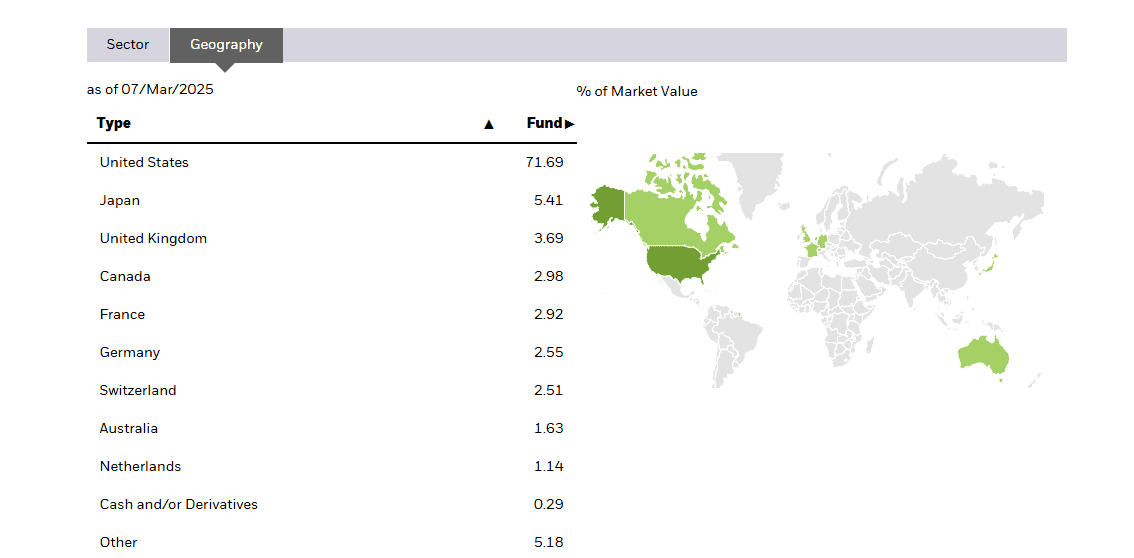
For many investors, a global index fund like the iShares Core MSCI World UCITS ETF (LSE: SWDA) will form a core part of their portfolio. This fund offers broad exposure to a wide range of global companies (1,355 holdings) within 23 developed countries.

Over the past decade, it has delivered an annualised total return of 9.9%. While it’s not assured to deliver that in future, I’m optimistic it can still return at least 8% over the long term.

Now, it’s worth mentioning that the US market has dominated returns and now makes up around 71% of the ETF’s total. So if the American economy enters a recession due to President Trump’s tariffs, the fund’s return could be lower than expected over the next few years. This is a key risk here. 

Source: iShares

Longer term however, I think it’s safe to assume that the tech revolution will only get stronger. Indeed, it could even accelerate dramatically as emerging fields like AI and (potentially) quantum computing take hold.

Such innovation should drive global economic expansion. A global index fund is the simplest way to capture this growth, in my opinion.

Of course, progress is not linear and there will be major volatility along the way. But with £875 to deploy each month, an investor will be picking up bargains during downturns, likely setting them up for strong future returns.

Defence stocks are soaring! Here’s why they could be better shares to buy than the ‘Magnificent Seven’

While the ‘Magnificent Seven’ group of shares slumps, defence stocks continue to boom as the new global arms race heats up.

Since the start of 2025, a basket of seven of Europe’s leading defence shares — BAE Systems, Dassault Aviation, Leonardo, Rheinmetall, Rolls-Royce, Safran, and Thales — have risen 46% in value. That’s according to research from eToro.

By comparison, the Magnificent Seven (Alphabet, Amazon, Apple, Meta, Microsoft, Nvidia, and Tesla) has fallen 8% since 1 January.

But this outperformance is no recent development. In the current political and economic landscape, could now be the time for investors to consider prioritising defence shares?

Sustained outperformance

1 year 3 years 5 years
US Magnificent Seven 21% 66% 227%
European Defence Seven 65% 245% 268%
S&P 500 13% 39% 99%
STOXX 600 11% 31% 50%

Since Russia’s invasion of Ukraine in early 2022, this basket of European defence shares has eclipsed the performance of large-cap US tech stocks.

As the table shows, it’s also provided a return six times larger than the S&P 500 has delivered over that time.

A prolonged ramp up in European defence budgets has fuelled these gains. Spending is tipped to accelerate too as military support from the US recedes.

eToro analyst Lale Akoner notes that “along with persistent geopolitical tensions, these conditions have created a perfect storm for Europe’s defence sector, as the region will now be more reliant on its own contractors”.

A top defence stock

To answer my first question, then, I think buying European defence stocks could be a great strategy to consider.

There are risks here, such as supply chain issues that may be worsened by upcoming trade tariffs. Reduced US defence spending may also substantially impact companies with large exposure to Department of Defense budgets.

But I think the evolving geopolitical landscape means European contractors look in good shape to continue surging.

QinetiQ (LSE:QQ.) is one company that’s recently caught my eye. It sources around 66% of revenues from the UK, and around 10-15% more from non-US countries. This leaves it less exposed to a possible fall in DoD spending than some other London stocks.

The FTSE 250 company provides a wide range of services across land, air, sea, and even cyberspace. It clocked up £1.3bn of orders in the nine months to December, and is predicting £2.4bn of organic revenue and a 12% operating margin by 2027.

That compares with sales of £1.9bn and margin of 11.3% last year.

QinetiQ’s share price has spiked in recent weeks amid the broader surge in defence shares. Yet with a forward price-to-earnings (P/E) ratio of 14.1 times, it’s far cheaper than many other European defence shares today (BAE Systems and Rolls-Royce, for instance, trade on multiples of 20.8 times and 35 times respectively).

This could give QinetiQ further scope to rise than its industry peers.

A sound strategy

I think increasing one’s exposure to the defence sector could be a sound strategy right now. As part of a diversified portfolio these companies could help share pickers to enjoy robust returns.

Remember, though, that past performance is no guarantee of future profits. This is why maintaining a balanced mix of shares across industries and regions remains critical for long-term investors.

Financial News

Daily News on Investing, Personal Finance, Markets, and more!

Financial News

Policy(Required)