£10,000 invested in BAE Systems shares just 1 month ago is already worth…

While the investing world frets about the impact of a tariff war on asset prices, some FTSE 100 shares just keep moving higher. BAE Systems (LSE: BA) is one example.

Incredible gain

Perhaps this isn’t much of a surprise. The UK defence juggernaut was always likely to be in favour after European nations and the UK came together to declare their support for Ukraine following the disastrous meeting between Presidents Trump and Zelenskyy at the White House.

Nevertheless, I think even the most bullish of holders will be delighted by just how well things have panned out. I say this purely from an investment perspective, of course.

As I type, BAE Systems stock has recorded a 31% gain in the last month. Put another way, a £10,000 stake in the company only a few weeks ago is now worth £13,100. That’s the sort of price rise one might see from a blue-sky penny stock!

In case you hadn’t guessed, this return also greatly exceeds that of the major indexes. The FTSE 100 itself has fallen 2% over the same period. The S&P 500, with all its tech titans, has dropped over 7%.

More to come?

There’s an argument that things could get even better for investors.

Regardless of whether a peace deal were struck between Ukraine and Russia, defence spending looks like it’s only going in one direction. European leaders are likely sceptical that President Putin will stick to any terms. There’s also a sense that ties with Trump are now so stretched that our collective reliance on the US for military support has come to an end. As a major player in the space, this could provide another boost to the BAE Systems share price.

That said, there are a few things worth noting.

All priced in?

First, the stock now trades at a forecast price-to-earnings (P/E) ratio of 21. That’s more than the mid-teens average valuation of FTSE 100 firms. It’s also higher than the the company’s average P/E over the last five years (16). I actually remember the very same stock changing hands for less than 10 times earnings a little further back.

So, it seems a lot of good news is already priced in. That could bring out a few profit-takers if expectations are found to have exceeded reality when the company releases news on earnings.

One should also consider the possibility that some of BAE’s biggest customers — such as the aforementioned US — may reduce spending going forward or choose to only deal with home-grown contractors.

Dividend king

Predicting exactly where share prices will go in the next few days or months is a fool’s errand. So, let me leave you with one fact that’s probably been overlooked amid all this focus on the share price: BAE Systems has been and remains a brilliant source of rising dividends.

Sure, any income from the stock market can never be guaranteed. But if it can nab just a portion of the multi-billion pound contracts being mooted by analysts, I’m struggling to see why this form won’t continue. That should provide some compensation to holders if the shares were to (temporarily) give up some of their recent gains.

Consequently, I still think BAE Systems is worthy of consideration as part of a diversified portfolio.
2 FTSE 100 lifeboats to consider as trade tariff fears grow

Tension and confusion over US plans for major new trade tariffs are putting stock markets in a tailspin. The FTSE 100 leading index of shares has dropped 281 points in just over a week to 8,590 points.

This is no surprise. Tariffs often disrupt global supply chains, increase production costs, and put the dampener on consumer and business spending.

Yet the potential impact won’t be the same for all Footsie companies. New import taxes could be a major problem for Rolls-Royce, for instance, given its complex supply chains and dependence on foreign markets. Yet the impact on domestic utilities shares like National Grid could be more negligible, given their focus on the UK and the essential services they provide.

With this in mind, here are two more FTSE 100 shares to consider in the current landcape.

1. Coca-Cola HBC

Coca-Cola Hellenic Bottling Company‘s (LSE:CCH) non-US operations provides great protection from the threat of Washington-led trade tariffs.

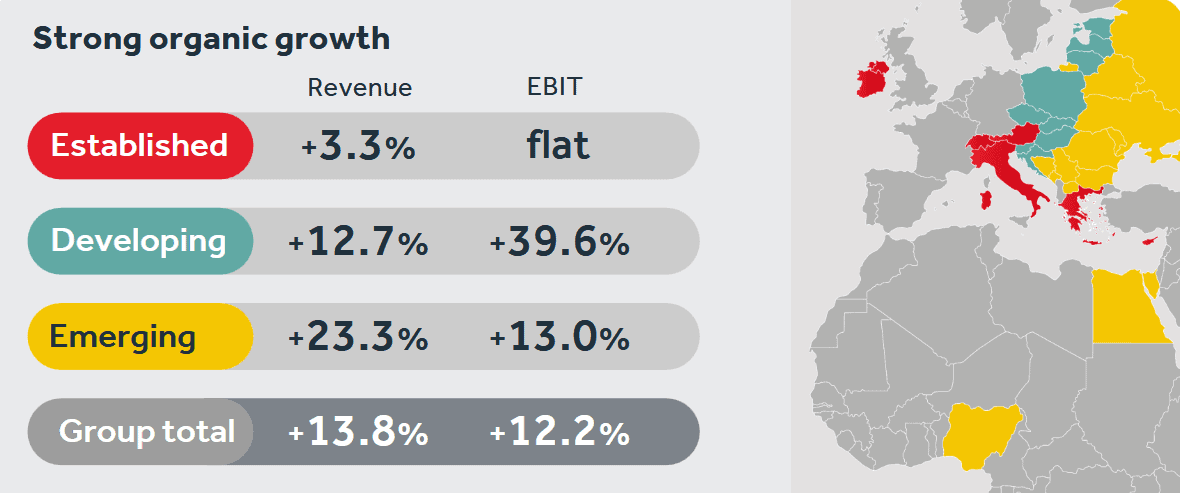
Coca-Cola HBC’s markets and market growth in 2024. Source: Coca-Cola HBC

As you can see, the business focuses its efforts on the developed and fast-growing territories of Africa and Europe. This regional mix provides an added bonus too. As you can see, substantial exposure to emerging and developing markets is supercharging sales and earnings growth.

Trade wars may have wider economic implications for Coca-Cola HBC’s markets. But I’m not expecting this to have a substantial impact on consumer demand, reflecting the star power of drinks brands like Coke, Fanta and Sprite.

I’m more concerned about the highly competitive environment that the company operates in. Pressure from the likes of PepsiCo and Nestle is a constant threat to sales volumes and margins.

That said, I’m confident that Coca-Cola HBC on balance can keep delivering the goods, supported by its packed portfolio of heabyweight labels and strong record of innovation.

2. Fresnillo

Precious metals stocks like Fresnillo (LSE:FRES) could be among the greatest beneficiaries of US-led trade tariffs.

Import taxes could elevate inflation and slow the global economy, both of which are historical price drivers for gold and silver.

The US dollar could also continue to weaken should tariffs hammer the American economy more specifically. This naturally boosts demand for dollar-denominated commodities by making them more cost effective to buy.

Estimates from the National Institute of Economic and Social Research (NIESR) illustrate the scale of the potential damage. They think fres trade wars could boost US inflation by 3.5-5% over the next two years. It also suggests US real GDP could be up to 4% lower than it would be without new tariffs.

Fresnillo isn’t completely without risk though. Silver’s used for a wide array of industrial applications, and so its demand is heavily sensitive to broader economic conditions.

But weakness here could be offset by strong investment demand for silver, reflecting the metal’s safe-haven properties. The Mexican miner’s gold sales would also likely rip even higher if the economy tanks.

Here’s how I’m getting ready for a stock market crash

Looking at the recent performance of the FTSE 100 it may seem that the stock market is in rude health. Just last week, the index of leading British blue-chip shares hit a new all-time high.

Still, stepping back and considering the wider global economic and geopolitical environment, there may seem to be less cause for celebration.

Nobody knows for sure when the stock market will next crash. It could be today or it could be decades from now. But we do know from history that sooner or later, it will happen.

Rather than trying to time a crash, I am instead using my effort to prepare for one, whenever it comes.

Reviewing current holdings

Typically a stock market crash does not happen in isolation. Usually it is part of a wider economic downturn, although in some cases the crash may happen before that downturn is fully evident.

Such a downturn could mean lower profits for many companies, leading to a lower share price.

As a long-term investor, I tend not to react to the everyday shifts and turns of the stock market. But sometimes, the potential of an economic slowdown could hurt the investment case for certain shares.

So, from time to time I review the shares I already own and consider whether any of them look vulnerable to a shift in the economic currents.

As an investor, it can be easy to focus on the potential return from owning a particular company – but assessing risks is a very important part of successful long-term investing.

Making a wishlist well in advance

But while a sudden stock market downturn can mean shares falling a lot in a short time, that can present a buying opportunity.

Warren Buffett talks about investing in great businesses at attractive prices. Usually there are a bunch of great businesses I would be happy to invest in – if only I could do so at an attractive price.

A crash can throw up such prices – but sometimes only fleetingly. So I am getting ready now by updating my wishlist of shares I would like to own, if I could buy them at the right price.

This share is on my wishlist!

For example, one share I would happily buy at the right price is chipmaker Nvidia (NASDAQ: NVDA).

The company has seen both revenues and profits soar in recent years thanks to booming demand for specialised chips as companies build their AI capabilities.

But even before that, Nvidia was well established. It has a large installed customer base, world-leading design and manufacturing skills, and lots of proprietary intellectual property.

So, if I like the business so much, why have I not yet invested?

In short, valuation.

The current price-to-earnings (P/E) ratio of 37 does not offer me sufficient margin of safety, I feel. After all, Nvidia faces risks ranging from uncertain medium-term demand for AI chips to the costs of heightening trade disputes.

However, the share price has been falling and while that P/E ratio is still too high for my tastes, it is getting closer to what I would see as an attractive valuation.

Nvidia is one of the names on my wishlist of shares I would consider buying if stock market turbulence drives their price far enough down.

Up 33% in a month, this FTSE 100 stock’s bucking the global market trend

Whether you’re looking at UK or US stock markets, bonds or even crypto, the past few weeks have seen heightened volatility and prices falling. Some of this relates to investor fear around President Trump’s tariff proposals. There’s also some worry about inflation here in the UK and elsewhere starting to rise again. Yet despite all of this, one FTSE 100 share has been rocketing higher.

Moving higher, not lower

I’m referring to BAE Systems (LSE:BA.). The defence company has seen a 33% jump in the stock price in the past month. Over a broader one-year period, it’s up 25%.

There are a few key reasons for the outperformance against the gloomy backdrop. In recent weeks, European countries have committed to bolstering their military expenditures in response to geopolitical tensions, particularly concerning the situation in Ukraine. This commitment naturally will mean higher spending and new contracts with defence companies in this space. BAE Systems is active in Europe already, so should do well going forward, tragic though the situation is.

Within this period, the business released 2024 results. They were strong, with sales rising by 14% versus the year before. Underlying earnings before interest and tax jumped by 14%. Aside from this, it has a large order backlog of £77.8bn, up £8bn from last year.

This shows that there’s already high demand and that the business has strong momentum. The CEO noted that “based on the exceptional visibility of our record order backlog and sustainability of our value-compounding business model, we remain confident in the positive momentum of our business into the future”.

Direction from here

During periods of market volatility, it’s important to remember to identify the causes. As a result, an investor can identify which stocks to avoid but also find pockets of opportunity. Concerns around security and defence is bad for some sectors, but for BAE Systems, it’s a positive.

Tariff woes will impact the firm, as it does have US operations. But this isn’t to the same extent as some auto or agriculture stocks that are likely severely damaged by potential implementation of tariffs.

Therefore, I think the stock can continue to move higher in coming months. Of course, if another catalyst of concerns arise, it could hit BAE Systems. But based on the reasons for the market fall so far, it’s not likely to be bad for the business.

However, there are risks involved. A big one is the controversial take on investing in defence stocks. Some investors just don’t feel comfortable buying shares that are involved (even indirectly) with warfare. Another risk is that the business could lose ground to the evolving nature of the battlefield. There are other companies focused a lot more on cyber and tech that could take market share from BAE Systems in coming years.

Overall, if investors are comfortable having a defence stock in their portfolio, BAE systems could be worth considering.

2 under-the-radar growth stocks to consider for a Stocks and Shares ISA

We’ve all probably heard of the ‘Magnificent Seven’ group of stocks — Apple, Microsoft, Alphabet, Amazon, Nvidia, Meta Platforms, and Tesla. Many investors have at least one of these tech names in their Stocks and Shares ISA portfolios.

However, there are loads of smaller growth stocks that are largely flying under the radar. Here are two that I think are worth considering.

Sweetgreen

First up is Sweetgreen (NYSE: SG), which is a restaurant chain that serves salads. The stock’s up 111% since the start of 2024, but has fallen 46% from a high reached back in November.

Last year, Sweetgreen’s revenue increased 16% to $676.8m, with comparable store sales up 6%. It opened 25 net new restaurants, bringing the total to over 230 locations across America.

CEO Jonathan Neman said: “In 2025, we’re rolling out a new and improved loyalty program, introducing exciting new menu items, and strategically investing more in marketing to bring more people into our restaurants. By staying focused on delivering an exceptional experience, we’re setting Sweetgreen up to lead — and redefine — fast food for the future.”

One thing worth highlighting is the firm’s Infinite Kitchen automation technology. This robotic assembly line replaces human workers for key tasks like portioning, mixing, and plating ingredients. It produces salads 50% faster than humans can!

The main risk here is that the company isn’t yet profitable and reported a net loss of $90.4m last year. So that’s worth bearing in mind, as is the ever-present possibility of a food safety incident.

Looking ahead though, the company’s healthy meals and local sourcing of ingredients plays into a wellness trend that’s likely to grow stronger over the next decade and beyond.

Last year, Sweetgreen’s average sales per location were around $2.9m, in line with industry giants like Chipotle Mexican Grill. I think its investments in automation could give it a competitive advantage.

The stock’s trading at a reasonable 4x sales. With a small market-cap of $2.7bn and an untapped international opportunity, I think Sweetgreen has all the ingredients (pun intended) to be winning restaurant stock.

Toast

Sticking with the food theme, I’m going to highlight Toast (NYSE: TOST). I like to think of the company as the Shopify of restaurants, as it provides an all-in-one digital platform for managing orders, payments and inventory.

The stock’s up 36% over the past year, but remains around 39% below its 2021 IPO price.

In 2024, Toast’s revenue grew 28% to nearly $5bn and it recorded its first full year of profitability — a net profit of $19m versus a net loss of $246m in 2023. Its recurring gross profit stream jumped by 34%.

Meanwhile, it added a record 28,000 net locations, bringing the year-end total to around 134,000. And Toast is now partnered with over half of the Michelin-rated restaurants in the US!

One risk here is that the firm faces a fair bit of competition, especially on the hardware side from payments firms like Block-owned Square. The stock’s forward price-to-earnings ratio also looks quite high at 40.

Looking ahead to the next few years though, analysts have revenue and earnings growing by double digits. And Toast is confident that over the next decade it can serve “many multiples” of its current locations.

Is it ‘party over’ for the S&P 500?

Up until recently, backing US stocks has been a winning move. Anyone investing in the S&P 500 at the beginning of January 2020 via a simple, low cost exchange-traded fund (ETF) would have more than doubled their money five years later.

But the volatility seen in the last couple of months must surely be pushing some to ask whether the ‘party’ is now over, at least for a while. For the record, I’m one of them. In contrast to some investors however, I’m absolutely loving it.

Growing unease

As tends to be the case with most big falls in the market, there hasn’t been just one catalyst. The loss of faith among investors can be blamed on a toxic mix of concerns about the health of the US economy in the wake of bouncing inflation, the ‘interesting’ strategy (or lack of) adopted by President Trump when dealing with other nations and already-highly-valued asset prices.

At least some of the recent fall is also down to the growing unpopularity of some of the S&P 500’s biggest constituents. Electric vehicle (EV) firm Tesla (NASDAQ: TSLA) is an easy target here.

Whatever our thoughts on Elon Musk’s involvement in politics are, the numbers don’t lie. The value of the EV maker has plummeted over 40% since markets kicked back into life in January.

Is the fall overdone?

Now, there’s an argument for saying that investors have simply flipped from being too optimistic to too pessimistic on Tesla. A lower-priced new model due later this year could revive interest. There’s also the company’s growing presence in artificial intelligence (AI) to consider. Evidence that the CEO has returned to his day job would help too.

Even so, I suspect Musk’s behaviour has put some potential buyers (and investors) off for good. We know that sales are tanking in Europe, China and Australia. The next set of delivery numbers could prove even worse than analysts are already projecting.

Concerningly, the stock still trades at a seriously high price-to-earnings (P/E) ratio as well. This suggests a lot of potential growth is already priced in.

Here’s what I’m doing

I’ve never held Tesla stock directly, nor do I hold a fund that only tracks the return of the S&P 500. However, I still have a lot of money invested in US stocks via a number of world exchange-traded funds (ETFs).

So am I worried? Not at all! The ETFs I own spread my cash across thousands of stocks around the globe. Sure, this dilution means my wealth will grow at a slower rate than if I only picked the biggest winners. But it also allows me to sleep at night and not worry about when Tesla stock will recover (if it can).

However crass as this may sound, the only question I’m asking is whether the world’s largest economy is doomed. While things look tricky in the near-term, I just can’t see it. For this reason, I’ll continue investing into these funds. If the index keeps falling, I’ll be buying more shares at a lower price.

Although we can’t know the future for sure, a buy-and-hold strategy like this has been shown to deliver brilliant returns over the long term.

Rather than worry about the possibility of a full-blown crash, I’m rubbing my hands at the prospect.

Stock market meltdown? I’m following Warren Buffett’s golden rule

Without doubt, one of billionaire investor Warren Buffett’s most famous quotes is: “Be fearful when others are greedy and greedy when others are fearful“.

Yesterday (10 March), a lot of fear emerged in the US stock market. The Nasdaq Composite had its worst day since 2022, and is now down nearly 14% since December, pushing it deep into correction territory. Meanwhile, the S&P 500‘s slumped 8.7% in less than a month.

The sharp sell-off relates to President Trump’s on/off tariffs and US recession fears. We don’t know whether this is just turbulence or the start of a market meltdown.

Either way, I’m seeing high-quality stocks that were overpriced start to look attractive again. By following Buffett’s aforementioned golden rule , I think there could be some solid buys emerging for my portfolio.

One I’ve been waiting for…

During such scary periods… widespread fear is your friend as an investor, because it serves up bargain purchases.

Warren Buffett.

One position in my portfolio I’ve been wanting to add to for a good while is Intuitive Surgical (NASDAQ: ISRG). The company is a global leader in robotic systems used in minimally invasive surgery.

Its flagship da Vinci machine gives surgeons greater precision, enhanced dexterity, and improved control. This reduces the risk of complications compared to traditional surgery, generally leading to quicker recovery times and shorter hospital stays. A win-win all-round.

The stock’s been a monster success, soaring almost 800% over the past decade. However, it’s down nearly 21% since mid-January, potentially offering me the dip-buying opportunity I’ve been waiting for.

Massive installed base

Last year, Intuitive grew its installed base of da Vinci surgical systems to 9,902, a 15% increase over 2023. Full-year revenue grew 17% to $8.4bn, with 84% of that recurring from instruments, accessories, service contracts, and system leasing. Net profit jumped 29% to $2.3bn.

In Q4, worldwide da Vinci procedures increased 18%. However, management sees procedures increasing 13-16% this year, with the gross margin at 67-68% (down from 69%).

Tariff uncertainty

Now, there are risks here because a significant portion of Intuitive’s instruments are manufactured in Mexico. We have no idea what’s going on with the proposed US tariffs on Mexican products (details change daily). But management warns that they could have a “material impact” on margins.

In response, the firm might be forced to increase prices, which could impact growth. So this is something I’m keeping an eye on.

Meanwhile, at $482, the stock isn’t yet a bargain purchase, trading at 60 times this year’s forecast earnings.

My move

Due to ongoing market fear and the high valuation, I think the stock might slip a bit further from here. If it does, I’ll make my move, as Intuitive has a rock-solid moat built on market dominance, high switching costs, regulatory barriers, and recurring revenue.

It also spends heavily on research and development to stay ahead. In Q4, 174 out of 493 systems placed were the da Vinci 5. This next-generation machine features force feedback technology, allowing surgeons to feel the forces exerted on tissues during procedures.

Plus, with 10,000 times more computing power, they’re built to enable the future of artificial intelligence (AI) and machine learning in surgery. This state-of-the-art system could help power many more years of double-digit growth and I feel the stock is worth considering.

Should I start considering US stocks as a second income opportunity?

I tend to favour UK shares when it comes to earning a second income. And there’s a very good reason for this – the withholding tax on dividends means the bar is higher for US stocks.

Since the start of the year though, the S&P 500‘s fallen almost 3.754%, while the FTSE 100‘s up 4.25%. So is it worth me taking another look across the Atlantic for passive income opportunities?

The tax issue

For an investor like me, tax is a real consideration when it comes to buying US stocks. There’s a 30% withholding tax to factor in (which is reduced to 15% in my case, with a W-8BEN form).

Stocks are never exactly equivalent because no two companies are identical. But other things being equal, a US stock needs to have a dividend 15% above a UK one for me to make the same return. 

That’s a significant hurdle to clear and it hasn’t been the case recently. S&P 500 stocks have tended to trade at a premium to their FTSE 100 counterparts, making the equation even less favourable.

This is why I’ve tended to focus my attention on the UK when it comes to passive income stocks. But with the valuation gap starting to close, it might be time to take a look across the Atlantic.

Dividend stocks

In general, the stocks with the highest yields in the S&P 500 look to me like ones that are facing some significant challenges. But there are one or two shares that I think are potentially interesting.

Kraft Heinz (NASDAQ:KHC) is one example. It has a 4.87% dividend yield, so investors like me could end up with a 4.13% annual passive income after taking off the withholding tax. 

The stock has had a tough few years and it’s not hard to see why. Sales growth has been largely non-existent since 2019, which has resulted in the shares underperforming the S&P 500.

There are also ongoing challenges – most notably the rise of anti-obesity drugs. But I think there are also a lot of reasons to be positive. 

A stock on the up?

One of the reasons Kraft Heinz has struggled over the last five years has been the debt on its balance sheet. Interest payments have weighed on margins and profits, but things have been improving. Since 2020, long-term debt’s gone from around $28bn to just over $19bn. And interest payments have fallen from $1.35bn to $843m a year. 

With its balance sheet in a stronger position, Kraft Heinz has turned its attention to share buybacks. Since 2023, the company has been spending around $1bn on reducing its outstanding share count.

This should help the durability of the dividend – fewer shares outstanding means less cash is needed to maintain the current distribution. And this helps reduce the overall risk for investors. 

Should I be buying?

The withholding tax means UK dividend investors need to find better businesses with higher yields to justify buying. And despite the recent drop, I think it’s still the other way around.

In my view, a lot of investors are overlooking the recent improvements at Kraft Heinz. But I still think – for now, anyway – I can find more attractive dividend stocks in the UK.

2 top exchange-traded funds (ETFs) to consider as stock markets dive

Looking for safe havens to buy as the stock market sells off? Here are two top exchange-traded funds (ETFs) to consider that I think could provide shelter for weary investors.

Gold prices have fallen a little below the $2,900 per ounce marker following recent bouts of profit-taking. The yellow metal is now up 10% in the year to date, having visited fresh record highs near $2,960 late last month.

Can gold resume its stratospheric rise? I think so, which is why the WisdomTree Physical Precious Metals (LSE:PHPP) ETF is worth serious consideration.

Safe-haven bullion rises during periods of extreme economic and/or political uncertainty. It also appreciates when inflationary threats increase. Therefore it’s benefitting from the cocktail of disruption from the White House on issues of trade and foreign policy,

Investors can buy pure gold funds to capitalise on rising market tension. But the WisdomTree Physical Precious Metals ETF offers a different approach, with just under 63% tied up in gold.

Silver (21%), platinum (11%) and palladium (5%) account for the rest of the fund.

This weighting can give investors the best of both worlds. Each of these metals can rise when investors are fearful. But the latter three can also appreciate when confidence in the global economy improves, reflecting their additional role as industrial commodities.

As a consequence, the fund provides a great way for investors to hedge their bets.

Precious metals funds like this are also benefitting from a fall in the US dollar, making it effectively cheaper to buy buck-denominated securities. Remember though, that a turnaround in the value of the greenback could have an eroding effect on metal prices.

VanEck Defence

My second selection is the the VanEck Defence ETF (LSE:DFNG). With European nations vowing to hike weapons spending — a continental €800bn rearmament plan is currently in the works — revenues across the sector look poised for further significant growth.

This ETF tracks a selection of industrial shares. It consists of 28 companies that derive a minimum of 50% of revenues from military-related operations, and includes industry titans like Thales, Leonardo, Saab and Palantir Technologies.

By investing in this fund, investors can profit from industry-wide growth while avoiding the risks of picking single shares. This could be crucial given the defence industry’s competitive landscape.

It’s worth remembering, though, that the fund might not provide protection from sector-wide hazards (like fresh trade tariffs on production costs).

ETFs like this charge a management fee (in this case, the ongoing charge is 0.55%). However, tthe ongoing management fee could be justified by the fund’s reduced risk and diverse investment opportunities.

Furthermore, investors here don’t have to pay Stamp Duty when opening or building a position. The same cannot be said for purchasing shares in BAE Systems, Rolls-Royce or other non-Alternative Investment Market (AIM) shares listed on the London stock market.

As stock markets shake, I think a lump sum investment in the resilient defence sector or in precious metals is worth considering.

This recovering FTSE 100 dividend share has a 9.5% yield!

I’m a fan of dividend shares because they provide a more tangible return than growth stocks. I can extract value from my investment without selling any shares and reducing my holdings.

Plus, I always have the option to reinvest the dividends if I wish to grow my portfolio further. It gives me more control over how I choose to direct my investments.

The caveat is that many dividend shares struggle to increase in value. The focus on returning value to shareholders limits funds for expanding operations. Consequently, the share price of many dividend stocks tend to trade sideways — or worse, decline.

So if I find a high-yielding dividend stock with a rising price, I’m compelled to investigate further. That’s what I see now with MNG (LSE: M&G), a 100+ year old London-based investment management firm.

M&G

M&G was acquired by Prudential in 1999 but demerged again in 2019. So far, it has struggled to make an impact, with the stock down 4.5% since listing.

Industry-wise, the UK asset management sector suffered an average annual share price decline of 15% over the past three years (according to RBC Capital Markets). Rising interest rates, increased competition and economic uncertainty have all weighed on valuations.

But that could be changing soon.

Rival asset managers Schroders and aberdeen are both up by around 23% this year since publishing their final results.

M&G is only up 7.7% year-to-date but will publish its results next week. After last year’s final results the share price fell 17%, despite solid numbers that included a 28% increase in pre-tax profits.

So I’m hesitant to jump in ahead of the next results – not without some reassurance, at least.

Let’s have a look.

Growth prospects

M&G has been focusing on cost efficiency and capital discipline, helping it navigate volatile markets. However, like many asset managers, it faces pressure on fee income and client outflows as investors seek lower-cost passive funds.

Considering the pressures on the asset management industry, expectations for the upcoming results could be dampened. As a result, they are less likely to be missed, which was a contributing factor last year.

But that also means there isn’t much hope of gains this year. 

Analyst opinions vary, ranging from Buy to Hold, with the consensus target price around £2.30. This indicates a cautiously optimistic outlook with an expectation of around 8.3% growth in the coming year.

Taking that into account, dividends are the most compelling prospect for me right now. But although the 9.5% yield is attractive, it doesn’t tell the whole story.

With earnings per share (EPS) currently at less than half the dividends per share, the company’s payout ratio is over 200% — not a very sustainable level. If earnings don’t improve drastically, the company might have to cut dividends.

For me, that makes it too risky. Until I see evidence of consistent growth to back up the dividend payments, I wouldn’t consider the stock.

Other options

Fortunately, M&G isn’t the only high-yield dividend stock on the FTSE 100. Other options with low payout ratios include Vodafone, with a 7.8% yield and Aviva, with a 6.4% yield. Bother are worth researching, I feel.

No matter the yield of ratio of a dividend share, it’s always important to fully evaluate a company’s financial health when considering investing.

Financial News

Daily News on Investing, Personal Finance, Markets, and more!

Financial News

Policy(Required)