Has Warren Buffett just played a blinder in the stock market?

Share prices have been falling as the implications of US tariffs hit the stock market. And that makes Warren Buffett’s decision to accumulate cash recently look like a very smart one.

At the end of 2024, his investment vehicle Berkshire Hathaway (NYSE:BRK.B) held $325bn in cash and $267bn in (US) stocks. So with plenty of ammunition in a falling stock market, has Buffett just done it again?

Cash reserves

Buffett’s routinely noted that the biggest risk to Berkshire is a catastrophic event causing huge insurance losses. And keeping cash in reserve is the best way of defending against this. 

Despite this, selling stocks like Apple last year seems to go beyond what’s necessary to be in a position to cover losses. And from a share price perspective, the move hasn’t (yet) worked out. 

While Apple’s share price has been falling, it’s still well above where it was at the start of Q4 2023 – when Berkshire began selling. This however, isn’t how Buffett generally thinks about stocks.

Selling shares

Buffett has often said his approach to investing in shares is based on the underlying business. Specifically, it’s about the cash the company can generate. At the start of the year, Apple shares were trading at a price-to-earnings (P/E) ratio of 37. And with sales largely static over the last few years, there are reasons to think it looks expensive. 

More accurately, it makes it hard to see how Apple can return enough cash to investors to justify its share price. So it makes sense that Buffett might be looking to sell. In other words, he isn’t going to be proven right or wrong by what the Apple share price does. It’s going to come down to the company’s growth and cash flows. 

My strategy

Unlike Buffett, I don’t have an insurance operation. That means I don’t have to think about cash reserves on the same scale (though I do have my own emergency fund).  Nonetheless, I do try to focus on the same underlying principles that he says investors should stick to when it comes to stocks. And that means focusing on the underlying businesses.

While there are worse problems than having $325bn, there are some advantages to being a smaller operation. Not having to earn a return on that much cash opens certain possibilities. 

Most of the stocks outside the FTSE 100 are just too small for someone with Buffett’s cash to pay attention to. But I’m looking carefully at some of the smaller UK stocks for opportunities.

Market timing

Whether or not Buffett’s managed to sell at just the right moment from a stock market perspective remains to be seen. But if he has, I don’t think it was on purpose.

The Berkshire Hathaway CEO has had terrific success by focusing on businesses rather than share prices. Sometimes though, things fall into place quite nicely. 

At times like these, I’m glad to be a Berkshire shareholder. While my focus is on the UK right now, Buffett’s company is a permanent fixture on my list of stocks to consider buying.


Down 12% in a month, is it time for me to sell my IAG shares?

IAG, or International Consolidated Airlines Group (LSE:IAG), shares are among my best performing UK investment over the past 12 months. It’s up 103% over the year but is now down 12% over the month. The question facing investors now is whether the tide is starting to turn against IAG and its peers in the aviation sector.

Trump’s policies send tremors through the sector

President Trump’s protectionist trade policies and federal cuts have sparked fears of a US recession, sending shockwaves through the airline sector. IAG’s peers in the US have felt the brunt of this uncertainty, but IAG shares have come under pressure as well.

The potential for escalating trade wars and slower economic growth has dampened investor confidence, as airlines are particularly vulnerable to macroeconomic downturns. Compounding these concerns, Delta Air Lines’ revised guidance on 10 March highlighted softening demand, driven by weakening consumer and corporate sentiment.

This double blow of recession fears and declining passenger demand has left the industry on edge, with IAG’s performance reflecting the broader unease. As trade tensions persist and economic indicators falter, the airline sector faces a challenging period, with investors bracing for further turbulence.

Lower fuel prices

However, Trump’s policies, coupled with his “drill baby, drill” mantra, could benefit airlines not heavily reliant on the US market. That’s because the broader impact of lower jet fuel prices offers significant relief from historic highs. Jet fuel, which typically accounts for around 25% of operational costs, has seen a 3.9% decline over the week, 7% over the month, and 11.2% over the past year.

This downward trend in fuel expenses could improve profit margins for international carriers, particularly those with diversified routes and minimal exposure to US trade tensions. Now, IAG’s hedged “a proportion” of its fuel consumption for up to two years, but it still has a degree of exposure — increasing in every quarter — to spot prices.

Forecasts still favourable

Looking forward, IAG’s expected to continue growing earnings with the price-to-earnings (P/E) ratio declining steadily from 5.8 times in 2025 to 5.1 times in 2027. The dividend yield also rises, increasing from 3% in 2025 to 3.8% in 2027, supported by robust free cash flow and a healthier balance sheet.

This upward trajectory underscores IAG’s ability to generate shareholder value as it capitalises on operational efficiencies and recovering travel demand. However, these forecasts remain contingent on macroeconomic stability. A US recession could derail progress by suppressing global travel demand and impacting profitability. While the outlook’s positive, external risks warrant cautious optimism.

Personally, I’m holding on to my IAG shares. I’m up significantly, but I’m waiting to see how the current scenario plays out. It’s a hard market with plenty of pitfalls but significant potential to snap up a bargain. Cash-rich Jet2, with very little US exposure, could be a more attractive opportunity to consider.

£10,000 invested in Lloyds shares at the start of the year is now worth…

Lloyds (LSE: LLOY) shares have been on an absolute tear since the year began, climbing 25% since 1 January. That means an investment of £10,000 on New Year’s Day would have brought in £2,500 in profit.

That’s a decent chunk of passive income for just over two months of investment. The same amount of money in a Lloyds savings account would have accrued only £57.50 in interest.

So what’s driving this rally and, more importantly, will it continue?

Economic stability

Several factors may have contributed to Lloyds’ impressive run this year. Most notably, its recent financial performance has been strong, with £4.9bn in profit recorded in H1 2024. The growth has been attributed to high interest rates pushing up the bank’s net interest margins.

The UK housing market’s doing well, helping to grow the bank’s loan book as it focuses on mortgage lending. Cost-cutting measures are also a contributing factor that helped improve efficiency.

In the meantime, UK economic conditions have been relatively stable despite a tangible air of tension in global markets. Consumer spending has held up better than expected and fears of a deep recession have eased. This has led to a positive re-rating of UK banks, with Lloyds leading the charge.

Could US trade tariffs derail the momentum?

Right now, the main topic on everyone’s lips is US trade tariffs. There are concerns that US trade policies could disrupt global financial markets. The Trump administration’s recently introduced tariffs on foreign imports have ignited a wave of uncertainty and market volatility.

If these tariffs lead to a broader trade war, global economic growth could slow, potentially reducing demand for corporate lending and impacting UK banks.

While Lloyds has little direct exposure to international trade, its fortunes are tied to the broader UK economy. A global slowdown could weaken business confidence, impacting loan growth and profitability.

Additionally, if inflation picks up due to higher import costs, the Bank of England may be forced to keep interest rates higher for longer. This would put extra pressure on borrowers, potentially leading to a rise in loan defaults.

Global economic risks

Another major factor influencing banks is the economic downturn in China. The world’s second-largest economy has struggled with weak consumer demand, a property sector crisis, and declining industrial output.

This has already impacted European banks with significant Chinese exposure, such as HSBC and Standard Chartered. So far, this doesn’t appear to have bled into Lloyds but any global instability could impact the bank’s bottom line.

If China’s slowdown leads to a broader decline in global trade and investment, UK banks could see lower demand for financing and increased market volatility.

Still the best of the rest

Lloyds has outperformed all other major UK banks so far this year, including Barclays, HSBC and NatWest.

After one of its best years on record in 2024, Barclays has started the year slowly. With more diversified global operations, it’s faced difficulties in investment banking. Meanwhile, NatWest has struggled with leadership issues and HSBC is more exposed to the global economy, which has weighed on its performance.

So with its localised focus, Lloyds has sidestepped many recent issues, making it an attractive stock to consider as a possible safe haven in these tumultuous times.

Looking for ISA bargains? 2 FTSE 250 shares that are too cheap for me to ignore

Stock markets continue to tumble as fears over fresh US trade tariffs grow. Despite its high concentration of UK-focused shares, the FTSE 250 index is now — at 19,786 points — down around 600 points over the past week.

It’s gloomy out there, as worries about economic stagnation and reignited inflation gather pace. I wouldn’t be surprised if share indexes keep falling in the near term.

Yet I’m not planning to stop buying UK shares, trusts, and funds for my portfolio. In fact, I’m keeping my eye out for bargains as spooked investors sell up. Purchasing quality shares at knock-down prices today can supercharge my returns when the market eventually recovers.

Here are two from the FTSE 250 that I’m currently considering buying for my Stocks and Shares ISA.

TBC Bank

TBC Bank (LSE:TBCG) — like any financial services company — is vulnerable to a sharp slowdown in the global economy. But I believe this is more than reflected in the rock-bottom valuation of its shares.

For 2025, it trades on a price-to-earnings (P/E) ratio of 5.5 times. And its P/E-to-growth (PEG) ratio is 0.3, created by City predictions of a 20% bottom-line rise. Any reading below one indicates that a share is undervalued.

Meanwhile, TBC’s forward dividend yield is 6.4%, adding a sweetenener for value investors.

This FTSE 250 share offers banking services in Eurasia. It generates the lion’s share from Georgia, and following recent expansion also has operations in Uzbekistan.

Financial product penetration in these territories is low. And with both economies growing strongly, demand for banking services is similarly soaring.

TBC’s loan book and deposits grew 14.2% and 8.1% respectively in 2024 (at constant currencies). As a consequence, net profit rose 14.7% year on year to 1.3bn Georgian lari.

Given its huge addressable markets — and the strong progress it’s making to digitalise its operations — I think TBC could be one of the best bank shares to consider today.

Ibstock

I already own Ibstock (LSE:IBST) shares on my portfolio. And I’m considering upping my stake given how cheap it looks relative to predicted earnings growth.

The brickmaker is tipped to enjoy earnings growth of 27% in 2025. This leaves it trading on a forward PEG ratio of 0.6.

Though they’ve perked up in recent days, Ibstock shares are down heavily over the last four months. This reflects fears that interest rates may not fall as sharply as hoped, denting homebuyer affordability and consequently construction rates.

While this is a substantial risk, I think that — on balance — the outlook is pretty bright for the FTSE 250 company. It said last week that sales volumes so far in 2025 were up year on year, and predicted “momentum building through the year.”

This perhaps isn’t surprising given the resilience of the housing market. Fresh financials from Persimmon on Tuesday (11 March) showed net private weekly sales per outlet up 14% in the first nine weeks of the year.

While interest rate risks remain, I’m expecting conditions to remain supportive in Ibstock’s end markets as inflation moves broadly lower.

Nvidia stock has crashed 26%. Time to buy?

Over the long run, Nvidia (NASDAQ: NVDA) has been incredibly rewarding for some investors. Nvidia stock has grown by 1,739% over the past five years alone.

Lately, though, the share price has gone into reverse. It has already fallen 26% since January.

With Wall Street looking increasingly nervous, it would not surprise me if we see further falls.

So, could this be a buying opportunity for my portfolio?

The fall is understandable

On one hand, I think there are some good reasons behind the tumbling Nvidia stock price.

The microchip sector has experienced dizzying growth in recent years, thanks to huge AI-driven demand. But question marks about the durability of this demand have also been present.

Added to that are recent concerns that AI programs may require far less chip capacity than previously expected (fuelled by the launch of DeepSeek), growing trade conflicts that threaten to add costs to supply chains, and increasing concern about the global economy generally. If the economy weakens, businesses often cut back on spending – and that could hurt the chip market.

Added to that, Nvidia stock’s valuation previously looked high, so I do not think a fall is such a surprise. Even now, the firm still commands a market capitalisation of $2.7trn.

But has the price tumble been overdone?

Looking through the other side of the lens, though, the share price fall may not make as much sense as it first seems to.

Nvidia announced a blistering set of results for 2024. Revenue grew 114%, while net income soared 145%. Those sorts of growth numbers are hard to achieve even in a modestly sized business, but for one that already has huge turnover they are exceptional.

The company continues to sound bullish and has not sounded any alarm bells about a slowing in customer demand, or negative impacts from wider economic uncertainty.

Its most recent quarter showed weaker year-on-year revenue growth than in the full 12-month period, which may suggest a potential slowdown in demand. But sales still grew by 78%, which is no small feat.

Meanwhile, Nvidia continues to benefit from a number of competitive advantages, from deep customer relationships with a large number of installed users, to proprietary technology that means many of its chips cannot be directly compared to those offered by rivals.

This share price is getting tastier

But while I see reasons for continued optimism, that recent share price fall suggests that the wider market is feeling far less upbeat about Nvidia stock than it was just a couple of months ago.

That fall means the share now trades on a price-to-earnings ratio of 37. That is a much more attractive valuation than we saw at the start of the year.

Still, does it represent good value? After all, the risks here remain substantial.

For me, the price does not yet offer sufficient margin of safety to compensate for those risks, so I am not yet ready to buy.

But Nvidia stock is getting closer to what I see as an attractive price. I will be keeping a close eye on it so that, if the price is right, I am ready to buy.

£10,000 invested in the S&P 500 one month ago is now worth…

The S&P 500 has been rocked by volatility lately. In fact, it’s down 8.7% in just under a month! That’s a sharp fall for the benchmark index and means $4trn has been wiped out since its peak in February.

It also means that an investor who had ploughed 10 grand into an S&P 500 index fund a month ago would be down 7.5%. In other words, they’d now have about £9,250 (discounting exchange rates). While not disastrous, that’s probably not what they were expecting after just four weeks.

Zooming further out though, the index is over 140% higher than it was during the Covid crash five years ago. And it has nearly tripled over 10 years, including dividends.

So it’s important to remember that four weeks is merely the blink of an eye in the context of the stock market.

What’s going on lately?

The market hates uncertainty, as the old saying goes. And President Trump brings lots of that to the table, with almost daily tariff threats against trade partners.

These have centred on China, Canada, and Mexico. But Trump says the EU was “formed to screw the United States” and has also threatened it with 25% tariffs. The UK seems to be an afterthought for now.

Is anyone really surprised by all this? After all, we had the first Trump administration to go on. In late 2018, I remember my portfolio dropped more than 30% in the space of a few weeks when he initiated a trade war with China.

So I was baffled when the US market took off like a rocket after the November election. And my outlandish prediction in January that Tesla stock would drop 40% this year might actually come true (it’s currently down 45% year to date).

Market corrections offer opportunities

But with the Nasdaq Composite now already deep in correction territory (down more than 10%), and the S&P 500 not far behind, I think there are attractive buying opportunities emerging for my portfolio.

One stock I’ve been watching is Amazon (NASDAQ: AMZN). To my shame, I’ve never owned shares of the e-commerce and cloud computing juggernaut.

The stock has more than doubled in five years and is up around 900% over a decade!

However, it has fallen 20% in a month, leaving it looking cheap(ish) on some metrics. For example, the shares are currently trading for about 12 times next year’s expected operating cash flow, which is significantly cheaper than previous years.

Naturally, a potential US recession might impact the company’s e-commerce division. This is the main risk I see here, along with rising international competition from cheap shopping apps like Temu.

However, I’m increasingly bullish on Amazon’s position in artificial intelligence (AI). It’s aggressively incorporating generative AI into its AWS platform, while seeing a huge opportunity in AI agents. These are advanced AI programmes capable of independently performing tasks and making decisions.

AWS is well-positioned to dominate a significant part of this growing market by supplying both computing power/storage and the specialised tools necessary to build and operate AI agents.

Source: Amazon

​Last year, revenue at AWS jumped 19% to $107.6bn, up from $45bn in 2020. And it looks set to rise even higher as global adoption of cloud services and AI usage motors on.

Microsoft is open to using natural gas to power AI data centers to keep up with demand

  • Microsoft’s vice president of energy, Bobby Hollis, said the tech company would consider natural gas with carbon capture as a power solution for data centers.
  • Chevron and Exxon recently announced they are developing natural gas solutions for data centers.
  • The tech sector has largely relied on renewable power, but the industry is increasingly turning to alternative power sources as data center electricity consumption rises.
Microsoft CEO Satya Nadella speaks at a company event on artificial intelligence technologies in Jakarta, Indonesia, on April 30, 2024.
Dimas Ardian | Bloomberg | Getty Images

HOUSTON — Microsoft is open to deploying natural gas with carbon capture technology to power artificial intelligence data centers, the technology company’s vice president of energy told CNBC.

“That absolutely would not be off the table,” Bobby Hollis said. But the executive said Microsoft would consider natural gas with carbon capture only if the project is “commercially viable and cost competitive.”

Oil and gas companies have been developing carbon capture technology for years, but the industry has struggled to launch it at a commercial scale due to the high costs associated with such projects. The technology captures carbon dioxide emissions from industrial sites and stores them deep underground.

Microsoft has ambitious goals to address climate, aiming to match all of its electricity consumption with carbon-free energy by 2030. The tech company has procured more than 30 gigawatts of renewable power in pursuit of that goal. But the tech sector has come to the conclusion that renewables alone are not enough to power the demanding power needs of data centers.

Microsoft turned to nuclear power last year, signing a deal to support the restart of Three Mile Island through an agreement to purchase electricity from the currently shuttered plant. But it’s unlikely that the U.S. will build a significant amount of additional unclear power until the 2030s.

Data center developers increasingly see natural gas as near-term power solution despite its carbon-dioxide emissions. The Trump administration is focused on boosting natural gas production. Energy Secretary Chris Wright said Monday that renewable power cannot replace the role of gas in producing electricity.

“We’ve always been cognizant that fossil will not disappear as fast as we all would hope,” Hollis said. “That being said, we knew natural gas is very much the near-term solve that we’re seeing, especially for AI deployments.”

Exxon Mobil and Chevron announced last December that they are entering the data center space with plans to develop natural gas plants with carbon capture technology. Chevron struck an agreement with gas turbine manufacturer GE Vernova in January in build gas plants for data centers “with the flexibility to integrate” carbon capture and storage technology.

Hollis declined to say whether Microsoft is having conversations with the oil majors. The executive said the tech company is having “discussions across the board with all of those technologies.”

President Donald Trump told the World Economic Forum in January that he will use emergency powers to expedite the construction of power plants for data centers. Trump said the data centers can use whatever fuel they want. Chevron and GE Vernova announced their plan to build gas plants for data centers days after Trump’s remarks.

“We’re just glad to see that there’s a focus on accelerating schedules to meet what we view as a pretty critical need,” Hollis said when asked about the Trump administration’s plans.

But deploying natural gas faces its own challenges. The cost of new natural gas plants has tripled and the line to build plants now extends to 2030, NextEra CEO John Ketchum said Monday. NextEra is the largest developer of renewables in the U.S. but also has gas assets.

“Renewables are ready to go right now because they’ve been up and running,” Ketchum said at the conference. “It’s cheaper and it’s available right now unless you already have a turbine on order or that’s already been permitted.”

Ketchum said nuclear is unlikely to be a power solution until 2035. NextEra is considering restarting the mothballed Duane Arnold nuclear plant in Iowa.

2 last-minute ISA ideas I’m thinking about buying before deadline day

The Stocks and Shares ISA deadline is less than a month away. Each year, investors are allowed to put a certain amount, currently £20k, in an ISA. Yet if this contribution room isn’t fully utilised during the April-to-April time frame, it is lost. Even though I’m not close to finishing my £20k for this year, I do have some spare cash that I’m thinking about putting to work before deadline day.

Of course, the deadline is for putting funds into an ISA, not for investing, but I’d rather get my money working for as quickly as possible.

A key cog

The first idea I’m looking at is the London Stock Exchange Group (LSE:LSEG). The stock is up 15% over the past year.

Some might wonder how the stock exchange actually makes money. The reality is that it has various different revenue streams. Following its acquisition of Refinitiv in 2021, the firm has become a major provider of financial market data and analytics. Users can pay for access to this data. It operates various trading platforms, including the London Stock Exchange, facilitating the buying and selling of stocks, bonds, and other products. It generates fees from this market activity. There are other less important income streams too.

I think the stock could outperform based on higher transactional activity going forward. In the latest results, revenue increased by 7.7% versus the previous year. The largest percentage increase at a divisional level was capital markets (up 17.8%). This is where the fees from all the stock buying and selling goes.

With higher volatility expected this year, I think revenue is only going to increase as people are more active in trading and investing.

One risk is that more and more companies are conducting IPOs in America, even the ones that are based in the UK. Losing out on this business could hamper London Stock Exchange Group’s long-term growth potential.

A well-respected fund

Another idea is Pershing Square Holdings (LSE:PSH). Pershing Square Capital Management, the hedge fund founded by billionaire investor Bill Ackman, manages the investment trust.

In the last year, the share price is down a modest 3%. The long-term performance is strong, up 180% over the past five years. Ackman is known for making large purchases in companies he believes in. At any one time, he typically only has about a dozen stocks in the portfolio.

Given the sharp rise in volatility over the past month, I think there’s a lot to be said for trusting experienced money managers like Ackman right now. Concerns around President Trump’s tariffs, ramping up defence spending in the EU, and other factors mean that investors need to pick stocks very carefully. Given Ackman’s track record over several decades, I’d be happy to allocate some of my money to this trust.

Of course, the risk here is that Ackman and his team make the wrong calls. This has happened in the past, notably with Herbalife in 2019. Although exact figures can’t be found, the loss was reportedly close to £800m!

I’m strongly considering adding these two ideas to my ISA in the coming weeks ahead of the early April deadline.

£10,000 invested in Barclays shares 2 years ago is now worth…

Barclays (LSE:BARC) shares are up 80% over two years. It’s a phenomenal turnaround with most of the growth coming in the past 12 months. As such, a £10,000 investment then would be worth around £19,200 today. That’s when we include dividends. Two years ago, the dividend yield was close to 6%.

Explaining the growth

Barclays’ 80% share price surge over two years reflects a confluence of factors. These include its strategic plan and reallocation of risk-weighted assets (RWAs) in February 2024. While the bank’s plan to shift £30bn of RWAs from its investment banking division to higher-returning consumer and corporate banking segments has been a key driver, broader improvements in market sentiment and macroeconomic conditions have also played a significant role. Rising interest rates have bolstered net interest margins, contributing to a 6% rise in total income to £26.8bn in 2024.

Additionally, the FTSE 100 company’s acquisition of Tesco Bank has enhanced Barclays’ retail banking operations, while cost-cutting initiatives have reduced the cost/income ratio to 62%. The bank’s commitment to shareholder returns, including a £1bn share buyback programme and a 5% dividend hike, has further supported investor confidence.

Improving sentiment around the UK banking sector, driven by easing recession fears and stabilising inflation, has also underpinned the rally. However, risks remain, including potential economic challenges and execution challenges in the RWA rebalancing strategy. After all, consumer-focused banks are typically reflective of the health of the economy, and the UK is still misfiring. Barclays’ ability to sustain this momentum will depend on its continued delivery of strategic and financial targets.

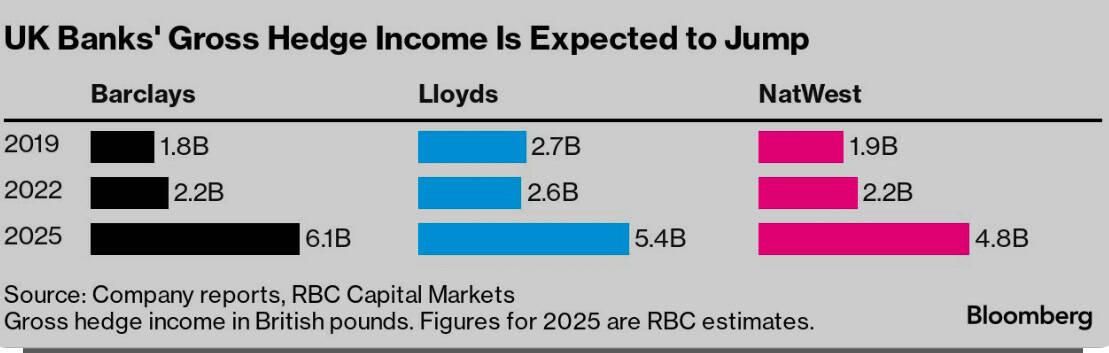
Hedging is central to the current thesis

While the share price is seriously elevated versus two years ago, there’s good reason for it. The UK emerged from a period of very high inflation in potentially the best possible way, and we’re now experiencing a slow unwinding of monetary policy.

Barclays actively manages interest rate fluctuations through a combination of product and structural hedges. The product hedge involves fixed-rate products like mortgages and term deposits, where interest rate risk is mitigated by swapping fixed cash flows to floating rates using interest rate swaps. 

The structural hedge, on the other hand, targets rate-insensitive products like current accounts and instant access savings accounts, which are behaviourally stable but exposed to rate fluctuations. Barclays swaps these to floating rates, ensuring income stability and protection against sharp declines in interest rates.

Source: RBC via Bloomberg

The structural hedge’s average duration is around 2.5 years, balancing income protection with responsiveness to rate changes. During periods of falling rates, such as the 2008-2009 financial crisis, this hedge strategy limited income declines to less than 5%, compared to a potential 90% drop without hedging.

Looking forward, this hedging should deliver significant benefit and often unappreciated income as the Bank of England cuts rates. What’s more, the recent pullback has seen the price-to-earnings ratio fall to a relatively attractive seven times. It’s one of the reasons why I’m considering adding to my Barclays position.

£10,000 invested in the FTSE 250’s Kier Group 2 years ago is now worth…

Kier Group (LSE:KIE) shares are up 102% over two years. But they plummeted 11% in early trading on 11 March after disappointing investors. As such, a £10,000 investment in the infrastructure and construction group two years ago would be worth around £20,500 now. That’s when dividends are accounted for. This is a very strong return on investment.

This FTSE 250 stock hasn’t really been on my radar in recent years. And while I don’t typically invest in companies that aren’t surpassing earnings expectations, I do find Kier Group to be an interesting proposition.

What half-year results told us

Kier Group’s shares fell 11% despite posting a rise in first-half profit and revenue, as well as lifting its dividend. For the six months to December 2024, adjusted pre-tax profit increased by 3% to £50.6m. Meanwhile revenue grew 5% to £1.98bn. The company highlighted solid growth in its infrastructure services and construction segments. Its order book reached a record £11bn, securing 98% of expected FY25 revenue.

Average month-end net debt dropped significantly to £37.6m from £136.5m the previous year, reflecting strong operational cash flow. Despite these positive results, investors responded cautiously, likely due to weaker-than-anticipated earnings combined with profit-taking after a strong run.

Kier’s CEO,Andrew Davies expressed confidence in the company’s ability to sustain cash generation and benefit from UK government infrastructure spending, but the share price decline suggests lingering uncertainty in the sector. This confidence also saw management raise the interim dividend by 20% to 2p per share.

Valuation is enticing

Kier Group’s current valuation has some attractive feature, with improving earnings per share (EPS) and a declining price-to-earnings (P/E) ratio. This signals enhanced profitability and relative value. The P/E ratio is projected to fall from 13.9 times in 2024 to 8.5 times in 2025, and then 7 times by 2027, reflecting strong earnings growth as EPS rises from 0.09p in 2024 to 0.19p in 2027. 

The dividend yield stood at 3.9% for 2024, supported by a largely sustainable payout ratio of 50.3%. Dividends per share are expected to grow steadily, reaching 0.08p by 2027 with the payout ratio falling to 40%. Financially, Kier has strengthened its balance sheet, achieving net cash of £58m, bolstered by robust operational cash flow.

The bottom line

The UK’s economic outlook for 2025 remains subdued, with forecasts suggesting GDP growth of 1.3-1.7% amid persistent geopolitical risks and trade uncertainties. While a technical recession is unlikely, fears of a US downturn — driven by weakened consumer demand and tightening monetary policy — could spill over into global markets, exacerbating the UK’s fragile recovery. 

Historically, governments have turned to infrastructure spending to stimulate growth during slowdowns, a strategy reinforced by Labour’s recent Budget, which relaxed fiscal rules to enable £100bn in capital investment over five years.

However, risks linger. The company’s heavy reliance on public-sector contracts leaves it exposed to potential delays in government spending or shifts in political priorities. Additionally, while infrastructure spending may cushion against domestic stagnation, Kier remains vulnerable to broader macroeconomic shocks, including inflationary pressures or a US-induced global recession that could derail fragile UK growth projections. It also appears to be very UK focused, having seemingly retreated from markets like the Middle East.

Personally, I’m keeping my powder dry, but I’ll be watching closely.

Financial News

Daily News on Investing, Personal Finance, Markets, and more!

Financial News

Policy(Required)