Coinbase is the best-performing stock in the S&P 500 in June, and may have even more room to run

foreground of header

Watch Daily: Monday – Friday, 3 PM ET

  • Coinbase is on track for its best month since November and third straight monthly gain — its first three-month rally since late 2023.
  • The surge this month comes as investor attention shifts away from Coinbase’s core business, trading, to stablecoins and other ways crypto can provide utility.
  • Even with a 43% gain in June, shares have further to run if the market remains bullish on Circle Internet Group, according to Citizens.
People watch as the logo for Coinbase, the biggest U.S. cryptocurrency exchange, is displayed on the Nasdaq MarketSite jumbotron at Times Square in New York on April 14, 2021.
Shannon Stapleton | Reuters

Coinbase is the top performer in the S&P 500 in June, boosted by positive regulatory updates, product launches and, of course, its very inclusion in the benchmark stock index at the end of May.

The crypto exchange’s outperformance in the S&P 500 extends back to the April 8 market low, just after President Donald Trump’s initial sweeping tariffs announcement sent stocks sinking.

Coinbase is now on pace for its best month since November, third straight monthly gain — 43% in June alone — and its first three-month rally since the end of 2023. On Thursday, the stock hit its highest level since the day of its initial public offering in 2021.

“The S&P 500 inclusion, the Senate’s passage of the GENIUS Act and very strong performance of Circle negated the false narratives for Coinbase and people are waking up,” Oppenheimer analyst Owen Lau told CNBC.

Restraints lifted

“The two things holding Coinbase back were the issues of fee compression — it hasn’t happened and in fact, Coinbase has been generating positive earnings consistently, which is why they were included in the S&P 500 — and regulatory uncertainty,” he said. “Many people don’t believe there will be any consensus coming out of Congress … the fact is we’re seeing the passage of the GENIUS Act.”

The GENIUS Act establishes the first federal framework for dollar-pegged stablecoins, granting sweeping authority to the Department of Treasury and opening the door to banks, fintechs, and retailers.

Even with Coinbase’s 44% run this month, the stock has room to appreciate further, according to Devin Ryan, head of financial technology research at Citizens. He said the market isn’t fully connecting the dots around Coinbase’s close relationship with Circle Internet Group. Circle debuted on the New York Stock Exchange June 5 and has soared more than 500% since.

According to a revenue share agreement, Coinbase keeps 100% of the revenue generated on all USDC held on Coinbase, plus nearly 50% of all other USDC revenues, “which is 99% of Circle’s current revenue,” Ryan said.

USDC is the stablecoin issued by Circle. Stablecoins are a subset of cryptocurrencies pegged to the value of real-world assets. About 99% of all stablecoins are tethered to the price of the U.S. dollar.

Another way to play

“Yet, Coinbase doesn’t incur any of the operating costs borne by Circle,” Ryan said. “If the market is right on the current bullish view for Circle, Coinbase is another way to play that — and with the financial connection described, it would seem there’s a lot more value left in Coinbase.”

Coinbase, whose core business is crypto trading, has been expanding its suite of crypto services over the past several quarters to include areas like custody, staking, wallet services and stablecoins.

This month, the company beefed up its subscription plan by offering it with its first crypto-backed credit card in partnership with American Express. It also introduced a partnership with Shopify and debuted a stablecoin payments service for e-commerce. JPMorgan also partnered with the crypto company to launch its own version of a stablecoin, which it’s calling a “deposit token” on Coinbase’s in-house built blockchain, Base.

“There’s clearly a sentiment trade occurring in crypto as institutional investors are looking at the space, many for the first time, and want to express a positive view on crypto evolving from a speculative asset class to one of utility — with legislative clarity as the key catalyst — and Coinbase is the most direct way to invest in that thesis,” Ryan said.

Volume concern

If there’s one concern, it’s in trading volume, said Oppenheimer’s Lau. The average daily volume of crypto transactions on the Coinbase platform has been trending lower since April, which could be a risk for the company and other crypto trading providers heading into the second half of the year.

The analyst is optimistic the regulatory outlook can turn that around though, specifically if the industry gets market structure legislation on top of stablecoin legislation.

“If the GENIUS Act brought us to ‘stablecoin summer’ then I believe that the eventual passage of the CLARITY Act can bring us into altcoin summer,” Lau said. “So at the end of this year, I do see another catalyst that can reverse this trend because there will be animal spirits, people will be buying altcoins like crazy if we get past the market structure bill.”


Don’t miss these cryptocurrency insights from CNBC Pro:

Generator stock Generac heads for best week since November amid heat wave, looming storm threats

  • Investors have been snapping up shares of Generac amid heat wave and start of hurricane season.
  • The company is on track for its sixth straight day of gains and best week since November 2024.
  • Shares are up nearly 12% this week.
A worker inspects a 24-kilowatt Generac home generator at Captain Electric in Orem, Utah, on Feb. 18, 2021.
George Frey | Getty Images News | Getty Images

With hurricane season underway and an oppressive heat wave rolling across parts of the nation, investors have been snapping up shares of Generac.

The backup-generator maker is on track for its sixth straight day of gains and best week since November 2024. It is up nearly 12% this week.

High temperatures blanketed areas through the central and eastern United States starting last weekend, resulting in reported power outages in states such as New York, New Jersey and Illinois. Extreme heat warnings and advisories are still in effect for parts of the Mid-Atlantic, Ohio Valley and Southeast, affecting 130 million people, the National Weather Service said.

On top of that, this Atlantic hurricane season is expected to be above normal, according to the National Oceanic and Atmospheric Administration. The agency expects 13 to 19 total named storms, with six to 10 expected to become hurricanes. Of those, three to five are anticipated to be “major hurricanes,” which are categories 3, 4 or 5.

This week, tropical storm Andrea became the first of the season, albeit briefly, according to AccuWeather. It quickly returned to a tropical rainstorm when winds subsided, the weather service said.

The heat and storms are putting strain on the United States’ already stressed and aging power grid — and it is expected to get worse. The risk of power outages caused by hurricanes could jump by 50% or more in some parts of the nation due to climate change, which could affect future storm characteristics, according to research from the Pacific Northwest National Laboratory and the Electric Power Research Institute last year.

Generac CEO Aaron Jagdfeld addressed the issue in October with CNBC’s Jim Cramer. The severe weather, plus the new crop of data centers, is putting a strain on the system, he said.

“This has become a massively critical discussion point,” Jagdfeld said on “Mad Money.” “This is only going to get worse.”

Bank of America is forecasting electrical load growing at a 2.5% compound annual growth rate over 2024 through 2035.

Other names to watch include Trane Technologies, which makes cooling systems for residences and businesses — including data centers. The stock currently has an average rating of hold by the analysts that cover it, according to FactSet.

Utility stocks are also expected to benefit from the increase in power demand. Bank of America said it expects “significant” tailwinds in the second half for the power sector, with data centers deals helping improve margins for names like Constellation Energy and Vistra.

Still, with the utilities sector outperforming the S&P 500 this year, the bank is being selective.

“Versus that sector outperformance we would prefer laggards that have catalysts to drive outperformance in the second half,” analyst Ross Fowler wrote.

His preferred opportunities include Sempra, Northwestern Energy and Alliant Energy.

—CNBC’s Adrian van Hauwermeiren contributed reporting.

Top Wall Street analysts like these three stocks for long-term growth

Silas Stein | Picture Alliance | Getty Images

The Middle East conflict and macro uncertainty are expected to keep global stock markets volatile, so it would be prudent for investors to ignore short-term noise and pick names with solid growth prospects.

To this end, top Wall Street analysts’ research can be a key consideration for investors who are picking out stocks and seeking names with long-term potential.

Here are three stocks favored by the Street’s top pros, according to TipRanks, a platform that ranks analysts based on their past performance.

Chewy

We start this week with online pet retailer Chewy (CHWY). The company recently delivered solid revenue and earnings for the first quarter of fiscal 2025. However, investors were concerned about some aspects, including the decline in free cash flow.

Reacting to the Q1 FY25 performance, JPMorgan analyst Doug Anmuth increased his price target for CHWY stock to $47 from $36 and reiterated a buy rating, saying that the post-earnings sell-off in the stock seems overdone. TipRanks’ AI analyst has an outperform recommendation on CHWY stock, with a price target of $46.

Anmuth stated that he remains bullish on Chewy stock due to its strong execution, growth in active customers, and profitability ramp. He expects sponsored ads, product mix and fixed cost leverage to drive a multi-year profitability ramp.

“We believe CHWY is capturing share from AMZN/WMT supported by hardgoods, product mix shift, consumables, AutoShip, & efficient marketing, while improving industry trends would be a tailwind,” the analyst said.

Anmuth views Chewy’s full-year revenue outlook as conservative, given that the company is tracking towards the upper half of its guidance range. He highlighted that the 240,000 sequential increase in Q1 2025 Active Customer marked the fourth consecutive quarter of growth. He also pointed out improvements in other metrics like gross additions, reactivations and retention. 

Anmuth ranks No. 42 among more than 9,600 analysts tracked by TipRanks. His ratings have been profitable 65% of the time, delivering an average return of 21.9%. See Chewy Ownership Structure on TipRanks.

Pinterest

Next on this week’s list is social media platform Pinterest (PINS). Recently, the company entered into a partnership with Instacart, under which advertisements on Pinterest will become directly shoppable via Instacart.

Reacting to the collaboration, Bank of America analyst Justin Post reaffirmed a buy rating on PINS with a price target of $41. TipRanks’ AI analyst has assigned an outperform rating on PINS stock, with a price target of $37.

Post said that advertisers can capitalize on Instacart’s first-party purchase data to target Pinterest users. The analyst highlighted that in the initial phase, select brands can reach Pinterest users based on real-world retail purchase behavior captured by Instacart. The second phase will introduce a “closed-loop measurement,” enabling advertisers to see how Pinterest ads lead to product sales across Instacart’s network of over 1,800 retail partners.

Overall, this partnership will provide more precise ad campaign insights and performance tracking. Post noted the rise in PINS stock in reaction to this deal and potentially favorable Q2 ad data. The top-rated analyst thinks that the partnership is a “good fit as CPG [consumer packaged goods] is one of Pinterest’s largest verticals (cooking and recipes also popular), and the closed loop attribution on campaigns will likely be valued by advertisers.”

If successful, Post thinks that the partnership could drive incremental ad spend by CPG clients. He remains constructive on Pinterest due to artificial intelligence (AI) enhancements that seem to be fueling user engagement and improved ad performance, with AI ramp still in the early stage.

Post ranks No.23 among more than 9,600 analysts tracked by TipRanks. His ratings have been successful 69% of the time, delivering an average return of 22.9%. See Pinterest Insider Trading Activity on TipRanks.

Uber Technologies

We move to Uber Technologies (UBER), a ride-sharing and delivery platform. Recently, Stifel analyst Mark Kelley initiated a buy rating on UBER stock with a price target of $110. The analyst stated that he views UBER as a “super app” offering multiple reasons to use its platform, like commuting, ordering food and delivery.

Commenting on whether the emergence of autonomous vehicles (AVs) is a risk or opportunity, Kelley said that AVs present minimal risk to Uber’s business over the near-to-medium term due to some hurdles, like safety, clarity on regulatory framework, cost of manufacturing AVs and large investments needed to support an AV fleet. In fact, the analyst thinks that the long-term risk from AVs is also unclear currently due to a wide range of potential outcomes.

Kelley is optimistic that Uber is well-positioned to meet or surpass the financial targets set in 2024, thanks to its solid execution. He expects gross bookings growth of 16% each in 2025 and 2026, supported by continued expansion into non-urban areas and internationally, with persistent adoption of UberOne. Moreover, Kelley expects earnings before interest, taxes, depreciation and amortization growth to be higher than gross bookings and revenue growth in 2025 and 2026.

Finally, Kelley is confident that Uber will eventually be successful in Delivery, which also facilitates customer acquisition, mainly in less dense/non-urban areas. He expects initiatives like Uber One and increased supply to boost Delivery bookings ahead. Kelly is also bullish on the greater retail media sub-segment of digital ads, as Uber has several advantages, like access to location data. Like Kelley, TipRanks’ AI analyst is also bullish on UBER stock, with a price target of $108.

Kelley ranks No.119 among more than 9,600 analysts tracked by TipRanks. His ratings have been successful 67% of the time, delivering an average return of 25.3%. See Uber Technologies Statistics and Valuation on TipRanks.

Top Wall Street analysts suggest these dividend stocks for stable income

A sign is posted on the exterior of a Verizon store in Daly City, California, on Sept. 30, 2024.
Justin Sullivan | Getty Images News | Getty Images

Trade negotiations and heightened geopolitical conflict are weighing on market sentiment, but investors seeking stable income can solidify their portfolios through the addition of dividend stocks.

Tracking the recommendations of top Wall Street analysts could inform investors as they hunt for attractive dividend stocks, given that the investment thesis of these experts is backed by an in-depth analysis of a company’s fundamentals.

Here are three dividend-paying stocks, highlighted by Wall Street’s top pros, as tracked by TipRanks, a platform that ranks analysts based on their past performance.

Verizon Communications

Telecom giant Verizon Communications (VZ) is this week’s first dividend pick. The company recently declared a quarterly dividend of $0.6775 per share, payable on Aug. 1. VZ stock offers a dividend yield of 6.3%.

Following a meeting with Verizon management, Citi analyst Michael Rollins noted that the company is upbeat about bolstering its leadership in broadband and converged services over the next few years. The company aims to double its converged wireless subscriptions (customers having both wireless and broadband subscriptions) from the current level of 16% to 17% of its customer base over the next three years.

Given the ongoing promotional backdrop in the wireless space, Rollins noted that competitive data points are still mixed. Nonetheless, Verizon is highly focused on customer retention and improving churn to rebound to its BAU (business as usual) levels in the second half of this year, partly supported by its new upgrade program.

Rollins noted that Verizon is optimistic about improvement in its performance in the second half of the year and continues to expect to add more postpaid phone subscriptions in 2025 compared to the previous year. The analyst sees the possibility of Q3 results, and not the Q2 performance, acting as a catalyst for Verizon stock, if the loss of postpaid phone customers starts to recede. Rollins continues to expect Verizon to lose 75,000 postpaid phone customers in the second quarter.

Overall, Rollins is bullish on VZ’s long-term growth potential, noting the “under-appreciated value for its financial prospects.”  The analyst reaffirmed a buy rating on Verizon stock with a price target of $48. Interestingly, TipRanks’ AI analyst has a buy recommendation on VZ stock, with an expectation of a 14.3% upside.

Rollins ranks No. 249 among more than 9,600 analysts tracked by TipRanks. His ratings have been profitable 69% of the time, delivering an average return of 12.7%. See Verizon Insider Trading Activity on TipRanks.

Restaurant Brands International

Let’s move to the next dividend stock: Restaurant Brands International (QSR). This is a quick-service restaurant chain that owns iconic brands like Tim Hortons and Burger King. QSR offers a quarterly dividend of 62 cents per share. At an annualized dividend of $2.48 per share, QSR’s dividend yield stands at about 3.7%.

In May, Restaurant Brands said that it still expects to achieve its long-term algorithm, which projects 8% organic adjusted operating income growth on average between 2024 and 2028.

Evercore analyst David Palmer said that the company can deliver on-algorithm 8% profit growth in both 2025 and 2026, despite his estimates indicating below-algorithm systemwide sales growth of 5% and 6% in 2025 and 2026, respectively. He explained that despite lower sales, the company could achieve its profitability target in 2025 due to its cost management and lower stock-based compensation.

Palmer added that with QSR stock trading at significant discount to Yum Brands and McDonald’s, he sees the company’s earnings delivery as “step one to upside.”  He also highlighted other catalysts for QSR stock, including ongoing above-consensus International same-store sales growth, positive same-store sales growth for Burger King U.S. and Tim Hortons Canada, and a resale of the China business, which is expected to drive improved income in 2026.

Overall, Palmer is bullish on QSR stock and reiterated a buy rating with a price target of $86, which reflects a P/E (price-to-earnings) multiple of 23x and 22x based on 2025 and 2026 earnings estimates, respectively. The analyst contends that QSR commands a valuation multiple closer to rivals that are currently trading at 24x or higher.

Palmer ranks No. 632 among more than 9,600 analysts tracked by TipRanks. His ratings have been successful 63% of the time, delivering an average return of 7.1%. See Restaurant Brands International Technical Analysis on TipRanks.

EOG Resources

Finally let’s look at EOG Resources (EOG), a crude oil and natural gas exploration and production company with proved reserves in the U.S. and Trinidad. The company recently announced a deal to acquire Encino Acquisition Partners for $5.6 billion.

The company highlighted that this deal’s accretion to its free cash flow supports its commitment to shareholder returns. Notably, EOG announced a 5% increase in its dividend to $1.02 per share, payable on Oct. 31. EOG stock offers a dividend yield of 3.1%.

Reacting to the Encino acquisition, RBC Capital analyst Scott Hanold said, “Encino’s assets makes sense from a strategic and value adding perspective, in our view.” The analyst reiterated a buy rating on EOG stock with a price target of $145. TipRanks’ AI analyst has a buy rating on EOG Resources with a price target of $132.

Hanold highlighted that the deal increases EOG’s Utica position to a combined acreage of 1.1 million acres, producing 275 Mboe/d (million barrels of oil equivalent per day). The analyst expects the combined acreage in Utica to surpass 300 Mboe/d by early 2026, which is second only to EOG’s Permian position. Hanold expects scaled development to begin in 2026.

The analyst added that following the acquisition, EOG’s net debt to book capital stands at 0.3x, with the company still boasting a peer-leading leverage ratio and balance sheet. Hanold pointed out management’s commentary about shareholder returns remaining similar to those of recent quarters at 100% of free cash flow, with buybacks continuing to be a priority. He also noted the 5% rise in EOG’s fixed dividend.

Hanold ranks No. 15 among more than 9,600 analysts tracked by TipRanks. His ratings have been profitable 69% of the time, delivering an average return of 29.6%. See EOG Resources Stock Buybacks on TipRanks.

Don’t miss these insights from CNBC PRO

Vance joins Trump in bashing Powell, says Fed committing ‘monetary malpractice’ by not cutting rates

  • In a social media post Wednesday morning on X, Vice President JD Vance echoed his boss’s urging that the central bank ease monetary policy.
  • The statement followed a Bureau of Labor Statistics report showing that the consumer price index increased just 0.1% both on the all-items reading and the core.
U.S. Vice President JD Vance speaks, during a tour of Nucor Steel Berkeley in Huger, South Carolina, U.S., May 1, 2025.
Kevin Lamarque | Reuters

President Donald Trump and Vice President JD Vance are now double-teaming the Federal Reserve in an effort to get lower interest rates.

In a social media post Wednesday morning on X, Vance echoed his boss’s urging that the central bank ease monetary policy, after the latest inflation readings showed that tariffs are yet to exert any substantial upward pressure on inflation.

“The president has been saying this for a while, but it’s even more clear: the refusal by the Fed to cut rates is monetary malpractice,” Vance wrote.

The statement followed a Bureau of Labor Statistics report showing that the consumer price index increased just 0.1% both on the all-items reading and the core that excludes food and energy. On an annual basis, the respective inflation levels stood at 2.4% and 2.8%, both above the Fed’s 2% goal.

While Trump had yet to address the CPI numbers himself Wednesday, the president has been badgering Chair Jerome Powell and his cohorts on the Federal Open Market Committee to cut rates. The Fed last eased in December, and officials lately have expressed concern over the longer-term impacts that tariffs will have on prices. Trump has said he wants a full percentage point cut from the current target level for the fed funds rate at 4.25%-4.5%.

The FOMC will release its interest rate decision in a week, and markets are assigning zero probability of a rate cut following the two-day meeting. Traders expect the Fed to ease in September, according to CME Group data.

Administration officials have emphasized the easing inflation data as well as a moderating labor market as reasons to lower rates.

“To me, that combination says it may be time for another rate cut, but I expect the Fed to emphasize the ongoing uncertainty and a desire to not act too early. It’s a tough spot,” said Elyse Ausenbaugh, head of investment strategy at J.P. Morgan Wealth Management.

Op-Ed: Wall Street needs to develop its own AI systems, not rely on Big Tech

Wall Street, Manhattan, New York
Andrey Denisyuk | Moment | Getty Images

In the feverish race to adopt artificial intelligence, the financial world stands at a critical juncture. The allure of general-purpose AI, the kind championed by tech giants, is undeniable. But for finance, a realm of intricate regulations and specialized jargon, this approach is a dangerous mirage.

It’s time for a reality check: finance needs its own AI, not a one-size-fits-all solution.

The idea that a generalized large language model (LLM) can seamlessly navigate the complexities of wealth management, asset management, or insurance is fundamentally flawed. These are domains with their own jargon, private data, specialized workflows and intermediaries, akin to healthcare or law.

A model trained on broad internet data will struggle with the precision required for financial calculations and regulatory compliance. Nor will it infer the multi-step process to navigate decision trees unless provided a framework.

Models fine tuned using private, public and user generated real world data and further enhanced by synthetic or simulated data using foundational large (and sometimes small) language models, for specific use cases using knowledge graphs and detailed workflow schemas to enable reasoning will soon determine the quality of your AI application in finance.

Extracting language from a document is one thing; reasoning and interacting with a specialist in a finance context, with its unique methodologies and schemas, is another. This leads to a natural inference: even the hyperscale horizontal players — the Microsofts and Amazons — and the application developers — the Salesforces and Palantirs of the world — need specialized collaborators in finance. Their generalist AI platforms, while powerful, lack the necessary domain expertise.

Specialized AI

The depth required in areas like wealth management and asset management is simply too granular. These leaders will inevitably need to collaborate with industry specialists who possess the intimate knowledge of workflows, regulations, and user experiences in finance.

The era of bulldozing LLMs through domains is over. The future lies in verticalization, where specialized AI is built in collaboration with experts who understand the intricacies of the financial world. This vertical of complex financial services is also large enough to justify these partnerships. At the same time, traditional financial service firms need to abandon the hubris of using these general platforms to build in-house. The initial impulse to build and own the technology due to domain expertise is understandable — sometimes because vendors are not mature or stable enough in an emerging industry. But this is a costly and often futile endeavor.

The AI landscape is evolving at breakneck speed. What’s cutting-edge today is outdated tomorrow. This requires repeated reassessments, a culture of clean sheet thinking and an organizational design that rewards speed. Financial institutions risk getting trapped in a perpetual cycle of development and maintenance, diverting resources from their core business. If a use case is common to the industry, chances are that a fintech focused on that use case will build, scale, learn and maintain its way to a better product faster than an internal team can.

A relevant parallel is the early evolution of CRM systems: trying to build your own in-house solution in the early 2000s when specialized partners emerged is now clearly proven to have been shortsighted. In some cases, where the firm is large — e.g. a JPMorgan or a Morgan Stanley — and has the resources to deploy towards building internal teams tackling use cases unique to them, this may make sense. It may also make sense if the platform is being used to generate and enhance their core intellectual property. Assuming that they can move fast.

As a result, for the generalist technology players as well as for the incumbent financial service firms, the smart move is to embrace partnerships. Firms should focus on what makes them unique — their special sauce — and let emergent fintechs handle the complementary heavy lifting.

In conclusion, the financial world must recognize that its AI needs are distinct. It needs specialized solutions. It needs more strategic partnerships between tech giants and finance experts. It needs traditional firms to resist an isolationist go-it-alone approach. The stakes are high. Generalist technology firms and specialized financial incumbents: beware.

Dr. Vinay Nair is the founder and CEO of TIFIN, a fintech wealth platform using AI and investment intelligence to serve the wealth and asset management industries. Previously, Nair was the founder 55ip, which was acquired by JPMorgan Chase.

Top Wall Street analysts believe in the potential of these stocks despite macro woes

CFOTO | Future Publishing | Getty Images

Macro uncertainty is keeping the market volatile, but investors ought to keep their focus on stocks that can provide compelling long-term returns.

Top Wall Street analysts’ recommendations can help inform investors as they pick the right stocks that can weather short-term pressures with solid execution and generate impressive returns over the long term.

With that in mind, here are three stocks favored by the Street’s top pros, according to TipRanks, a platform that ranks analysts based on their past performance.

Nvidia

Semiconductor giant Nvidia (NVDA) is this week’s first stock pick. The company reported market-beating results for the first quarter of fiscal 2026. Despite chip export restrictions, Nvidia remains confident about the demand for its artificial intelligence infrastructure.

Following the Q1 print, JPMorgan analyst Harlan Sur reiterated a buy rating on Nvidia stock with a price target of $170. The analyst noted that the company delivered solid revenue despite lost sales related to the H20 chip export restrictions on shipments to China. However, NVDA’s margins and EPS were hit by the $4.5 billion write-down related to H20 inventory write-downs.

Excluding H20 shipments, Sur projects that the July quarter data center revenue is growing at about 16% quarter over quarter, driven by continued robust spending by customers on their AI/accelerated compute projects and persistent strength in production and deployment ramp of Nvidia’s Blackwell platform. 

The analyst added that the demand for Nvidia’s Blackwell platform is very strong and is expected to continue to surpass supply for many quarters. Sur believes that management has good visibility for solid growth through calendar year 2026, backed by recent mega data center deals (including those with UAE, Saudi Arabia, and Taiwan) and the end of the diffusion rule.  

Overall, Sur concluded that Nvidia is staying ahead of competitors with its silicon, hardware and software platforms and an impressive ecosystem, “further distancing itself with its aggressive cadence of new product launches and more product segmentation over time.” 

Sur ranks No. 38 among more than 9,600 analysts tracked by TipRanks. His ratings have been profitable 66% of the time, delivering an average return of 23.4%. See Nvidia Ownership Structure on TipRanks.

Zscaler

We move to cybersecurity company Zscaler (ZS). The company’s results for the fiscal third quarter surpassed expectations, fueled by the demand for its Zero Trust Exchange platform and the growing need for AI security.

In reaction to the upbeat results, JPMorgan analyst Brian Essex reaffirmed a buy rating on Zscaler stock and boosted the price target to $292 from $275, saying, “We are encouraged by the strength in the quarter, particularly when off-calendar peers seemed to struggle with macro headwinds a bit more than expected.”

The analyst noted that Zscaler raised its full-year outlook for revenue, profitability and billings. He explained that the company’s performance was backed by encouraging contributions from emerging products like Zero Trust Everywhere, Data Security Everywhere and Agentic Operations. In fact, these emerging products are approaching $1 billion in annual recurring revenue (ARR).

Essex noted that large customer momentum continued to be solid in Q3 FY25, with the number of customers with over $1 million of ARR increasing 23% year over year, keeping Zscaler on track to exceed $3 billion of ARR in the fiscal fourth quarter. He emphasized that macro commentary was better than anticipated, as management stated that the company didn’t witness a “softer April,” though IT budgets remain tight.

Commenting on Zscaler’s Red Canary acquisition, Essex views this deal as encouraging, given that it is expected to enable the company to leverage the IP (intellectual property) and threat intel capabilities of Red Canary.

Essex ranks No. 652 among more than 9,600 analysts tracked by TipRanks. His ratings have been successful 58% of the time, delivering an average return of 12.6%. See Zscaler Hedge Fund Trading Activity on TipRanks.

Salesforce

Customer relationship management software provider Salesforce (CRM) recently reported better-than-projected revenue and earnings for the first quarter of fiscal 2026 and raised its full-year forecast. The company also announced the acquisition of data management company Informatica for $8 billion.

Following the results, TD Cowen analyst Derrick Wood reiterated a buy rating on CRM stock with a price target of $375. Wood noted that the company’s Q1 FY26 revenue and current remaining performance obligations surpassed expectations.

“We think its renewed focus on accelerating sales capacity growth is a strong demand signal & should unlock higher growth next year,” said Wood.

The analyst highlighted that AI adoption is ramping for Salesforce, with Data Cloud and AI ARR rising more than 120% year over year and reflecting strong early traction for the company’s Agentforce offering. Wood noted that 30% of net new Agentforce bookings came from existing customers expanding their usage. The analyst stated he is encouraged by the scale and velocity of Data Cloud, which he considers to be a leading indicator of Agentforce adoption as customers gear up to power agentic workflows.

Wood contends that with margins now in the mid-30% range, Salesforce is focusing more on growth by re-deploying AI cost savings. Notably, the company is increasing its workforce more aggressively, following a flat sales headcount in the last two to three years. The analyst sees this as a signal of positive demand, with management indicating that pipelines are growing by the double-digits.

Wood ranks No. 176 among more than 9,600 analysts tracked by TipRanks. His ratings have been profitable 62% of the time, delivering an average return of 14.8%. See Salesforce Technical Analysis on TipRanks.

Morgan Stanley upgrades this mining stock as best pick to play rare earths

A wheel loader operator fills a truck with ore at the MP Materials rare earth mine in Mountain Pass, California, January 30, 2020.
Steve Marcus | Reuters

The rare-earth miner MP Materials will enjoy growing strategic value to the U.S., as geopolitical tensions with China make the supply of critical minerals more uncertain, according to Morgan Stanley.

The investment bank upgraded MP Materials to the equivalent of a buy rating with a stock price target of $34 per share, implying 32% upside from Friday’s close.

MP Materials owns the only operating rare earth mine in the U.S. at Mountain Pass, California. China dominates the global market for rare earth refining and processing, according to Morgan Stanley.

“Geopolitical and trade tensions are finally pushing critical mineral supply chains to top of mind,” analysts led by Carlos De Alba told clients in a Thursday note. “MP is the most vertically integrated rare earths company ex-China.”

Beijing imposed export restrictions on seven rare earth elements in April in response to President Donald Trump’s tariffs. It has kept those restrictions in place despite trade talks with U.S.

Trump removed some restrictions Wednesday on the Defense Production Act, which could allow the federal government to offer an above market price for rare earths. MP Materials is the best positioned company to benefit from this, according to Morgan Stanley. Its shares rose more than 5% on Thursday.

MP Materials is developing fully domestic rare earth supply chain in the U.S. and plans to begin commercial production of magnets used in most electric vehicle motors, offshore wind wind turbines, and the future market for humanoid robots, according to Morgan Stanley.

The investment bank expects MP Materials to post negative free cash flow this year and in 2026, but the company has a strong balance sheet should accelerate positive free cash flow from 2027 onward.

Top Wall Street analysts prefer these dividend stocks for consistent returns

The Home Depot logo is displayed outside a store on March 10, 2025 in San Diego, California.
Kevin Carter | Getty Images

Earnings of major U.S. companies and the uncertainty around tariffs continued to impact investor sentiment this week. While the stock market remains volatile, investors seeking consistent returns could add some attractive dividend stocks to their portfolios.

In this regard, stock picks of top Wall Street analysts can be helpful, as the recommendations of these experts are based on in-depth analysis of a company’s financials and ability to pay dividends.

Here are three dividend-paying stocks, highlighted by Wall Street’s top pros, as tracked by TipRanks, a platform that ranks analysts based on their past performance.

Home Depot

This week’s first dividend pick is Home Depot (HD). The home improvement retailer reported mixed results for the first quarter of fiscal 2025 but reaffirmed its full-year guidance. The company expressed its intention to maintain its prices and not increase them in response to tariffs.

Home Depot declared a dividend of $2.30 per share for the first quarter of 2025, payable on June 18, 2025. At an annualized dividend of $9.20 per share, HD stock offers a dividend yield of 2.5%.

Following the Q1 FY25 results, Evercore analyst Greg Melich reiterated a buy rating on HD stock with a price target of $400. The analyst thinks that the risk/reward profile of Home Depot stock is one of the best in Evercore’s coverage. 

Melich contends that while Home Depot’s headline results appear ordinary, he believes that a notable inflection has begun. The analyst highlighted certain positives in Home Depot’s Q1 performance, including stabilizing traffic, improving shrink (inventory lost due to theft or other reasons) rates, and acceleration in online sales growth to 8% after staying lower than 5% since Q3 FY22.   

“HD remains a benchmark retailer, investing in technology, multichannel and stores, even while current demand remains low,” concluded Melich. He continues to believe that once the macro environment improves, Home Depot could be the “next great Consumer/Retail breakout multiple stock” like Costco in 2023 and Walmart in 2024.

Melich ranks No. 607 among more than 9,500 analysts tracked by TipRanks. His ratings have been profitable 68% of the time, delivering an average return of 12%. See Home Depot Ownership Structure on TipRanks.

Diamondback Energy

Next on this week’s list is Diamondback Energy (FANG), an independent oil and gas company that is focused on onshore reserves, mainly in the Permian Basin in West Texas. FANG delivered better-than-expected first-quarter results. However, given the ongoing commodity price volatility, Diamondback reduced its full-year activity to maximize free cash flow generation.

Meanwhile, the company returned $864 million to shareholders in Q1 2025 through stock repurchases and a base dividend of $1.00 per share. FANG’s Q1 2025 capital return represented roughly 55% of adjusted free cash flow. Based on the base and variable dividends paid over the past 12 months, FANG stock offers a dividend yield of nearly 3.9%.

In a recent research note, RBC Capital analyst Scott Hanold reaffirmed a buy rating on FANG stock with a price target of $180. Hanold noted that while the company lowered its 2025 capital budget by $400 million or 10% to $3.4 – $3.8 billion, the production outlook was cut by only 1%.

The analyst stated that Diamondback’s move to reduce its capital spending plan increased his free cash flow estimate by 7% over the next 18 months. Hanold thinks that the company’s decision will not weigh on its operational momentum or the ability to efficiently return to its 500 Mb/d productive capacity.

Commenting on FANG’s free cash flow priorities, Hanold noted that the company is tracking ahead of its 50% minimum shareholder return target, thanks to stock buybacks amid the pullback in shares, mainly during early April. He expects the company to use the remaining free cash flow to pay down the $1.5 billion term loan related to its Double Eagle-IV acquisition in the Midland Basin, which was announced in February.

Overall, Hanold’s bullish thesis on FANG stock remains intact, and he believes that “FANG has one of the lowest cost structures in the basin and a corporate cash flow break-even (including dividend) that is among the best in the industry.”

Hanold ranks No. 17 among more than 9,500 analysts tracked by TipRanks. His ratings have been profitable 67% of the time, delivering an average return of 29.1%. See Diamondback Energy Insider Trading Activity on TipRanks.

ConocoPhillips

Another dividend-paying energy stock in this week’s list is ConocoPhillips (COP). The oil and gas exploration and production company reported market-beating earnings for the first quarter of 2025. Given a volatile macro environment, the company reduced its full-year capital and adjusted operating cost guidance but maintained its production outlook.

In Q1 2025, ConocoPhillips distributed $2.5 billion to shareholders, including $1.5 billion in share repurchases and $1.0 billion via ordinary dividends. At a quarterly dividend of $0.78 per share (annualized dividend of $3.12), COP stock offers a yield of about 3.7%.

Following investor meetings with management in Boston, Goldman Sachs analyst Neil Mehta reiterated a buy rating on COP stock with a price target of $119. Mehta highlighted that management sees significant uncertainty in oil prices in the near term due to concerns about economic growth and voluntary production cuts by OPEC+. That said, the company is bullish about long-term gas prices.

Meanwhile, the analyst expects COP’s breakeven to shift lower in the times ahead, with major growth projects on track. Mehta stated that while the benchmark price of West Texas Intermediate crude oil – also known as WTI – breakeven (before dividend) is in the mid $40s in 2025, he sees the breakeven heading towards the low $30s once COP’s LNG spending comes down and production at its Willow project in Alaska comes online in 2029.

Commenting on COP’s shareholder returns, Mehta stated that management acknowledged that their decision not to stick with the $10 billion capital return target led to short-term volatility in COP stock. That said, COP still offers a “compelling” return, which Mehta estimates will be 8%.

Mehta ranks No. 568 among more than 9,500 analysts tracked by TipRanks. His ratings have been successful 59% of the time, delivering an average return of 8.6%. See ConocoPhillips Hedge Fund Trading Activity on TipRanks.

Palantir teams up with Fannie Mae in AI push to sniff out mortgage fraud

  • An early test showed that Palantir’s technology, which includes elements of artificial intelligence, could identify fraud in seconds that took human investigators two months, Fannie Mae CEO Priscilla Almodovar said.
  • Shares of Palantir have jumped more than 140% since President Donald Trump’s election win in November.
  • The announcement comes as there is a push to potentially bring Fannie Mae and Freddie Mac out of conservatorship.
Alex Karp, CEO of Palantir Technologies, speaks during the Digital X event in Cologne, Germany, on Sept. 7, 2021.
Andreas Rentz | Getty Images

Quasi-governmental financial firm Fannie Mae on Wednesday announced a partnership with defense tech player Palantir to detect mortgage fraud, deepening ties between the federal government and a company that has been a big winner in the second Trump administration.

Priscilla Almodovar, Fannie Mae CEO, said Wednesday at a press event that the goal is for the firm to “identify fraud more proactively” with the help of Palantir, starting with its multi-family housing business. An early test showed that Palantir’s technology, which includes elements of artificial intelligence, could identify fraud in seconds that took human investigators two months to find, she said.

Shares of Palantir have jumped more than 140% since President Donald Trump’s election win in November. The technology stock has roles in both modernizing the U.S. military and helping to cut costs in government, making it a seemingly strong fit for the administration’s stated priorities. CEO Alex Karp said Wednesday that the mortgage fraud detection can be done in a way that “protects the underlying data and protects the privacy of the people submitting their forms.”

Stock chart icon

hide content
Shares of Palantir have dramatically outperformed the broader stock market since the November election.

Fannie Mae and Freddie Mac are government-sponsored enterprises that have been under the conservatorship of the Federal Housing Financing Agency since 2008. The official names of the two enterprises are the Federal National Mortgage Association and the Federal Home Loan Mortgage Corporation, respectively.

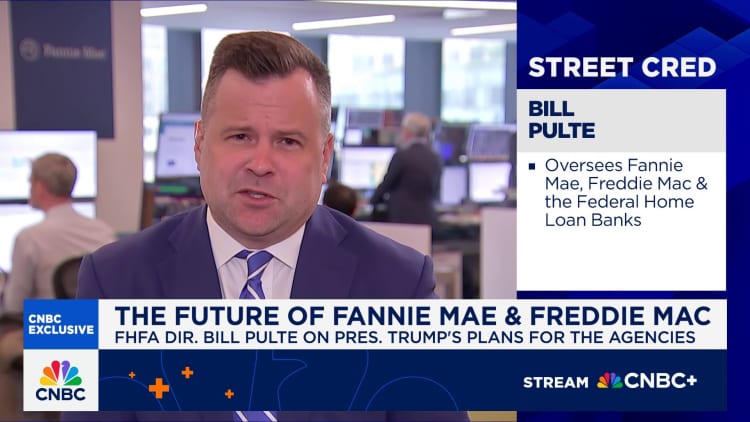
FHFA director William Pulte said Wednesday the Palantir program could be expanded to Freddie Mac in the future and that the agency is also talking to Elon Musk’s xAI firm about a potential partnership.

“The sky’s the limit. We’re not just limited to fraud. If there are ways to pull cost out of the system, we want to do it,” Pulte said.

The press release did not include a dollar amount that Fannie Mae would pay to Palantir for this service.

The announcement comes as there is a push to potentially bring Fannie and Freddie out of conservatorship and re-establish them as something closer to independent companies.

“Our great Mortgage Agencies, Fannie Mae and Freddie Mac, provide a vital service to our Nation by helping hardworking Americans reach the American Dream — Home Ownership,” Trump said in a Truth Social post on Tuesday. “I am working on TAKING THESE AMAZING COMPANIES PUBLIC, but I want to be clear, the U.S. Government will keep its implicit GUARANTEES, and I will stay strong in my position on overseeing them as President. These Agencies are now doing very well, and will help us to, MAKE AMERICA GREAT AGAIN!”

The “implicit guarantee” mentioned by Trump refers to the idea among investors that the government won’t let Fannie and Freddie default on their mortgage-backed securities. That concept is not legally binding but does help that massive market function and, in theory, lead to lower mortgage rates by reducing the perceived risk to investors in the housing market.

Pulte, who is the grandson of the founder of homebuilding firm PulteGroup, said on CNBC’s “Money Movers” that an exact plan for bringing Fannie and Freddie public is still undetermined and could even involve the companies remaining in conservatorship.

“Whether the president decides to sell a small piece, or what have you, that’s entirely up to the president,” he said.

There are equity shares of the two firms that trade over the counter, and those shareholders could conceivably see a large profit if Fannie and Freddie are taken public. One such shareholder is Bill Ackman’s Pershing Square, and the hedge fund manager has publicly called for IPOs of the two firms.

Financial News

Daily News on Investing, Personal Finance, Markets, and more!

Financial News

Policy(Required)