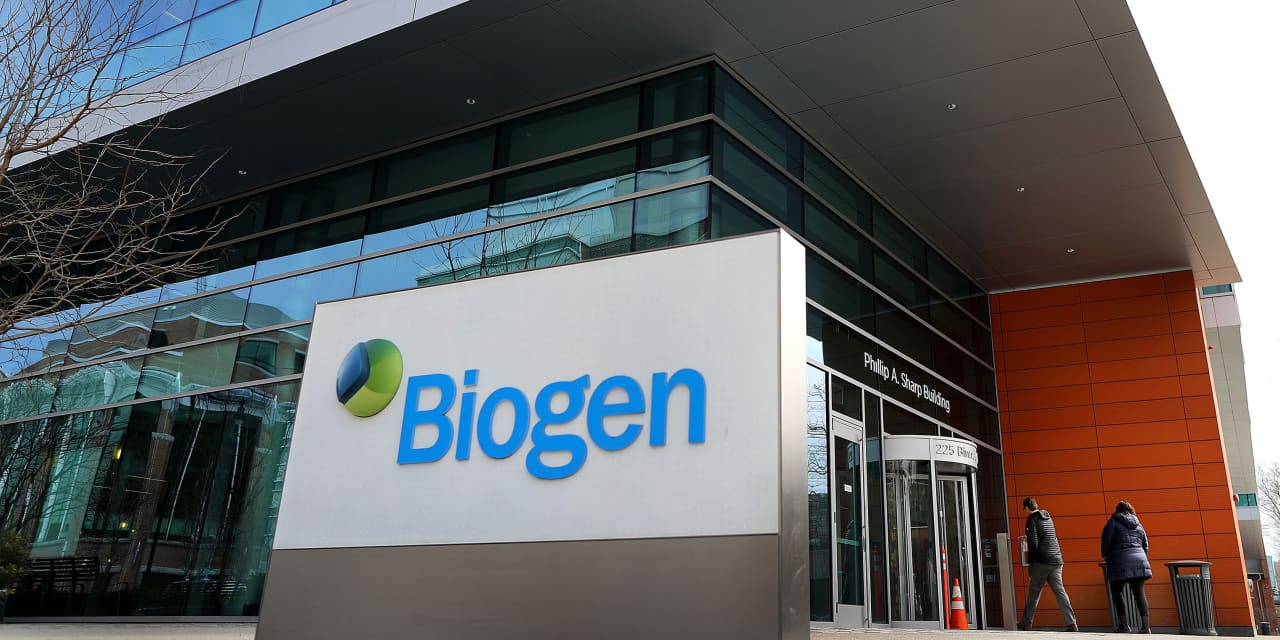
Biogen Inc.
BIIB,
on Tuesday reported fourth-quarter results that fell short of Wall Street expectations as uptake of its newer drugs failed to offset declining multiple-sclerosis product sales.
The biotech company reported net income of $249.7 million, or $1.71 per share, down from $550.4 million, or $3.79 per share, a year earlier. Adjusted earnings per share came to $2.95, missing the FactSet consensus of $3.18. Revenue in the quarter totaled $2.386 billion, down 6% from a year earlier and falling short of the FactSet consensus of $2.466 billion.
The costs of unwinding Biogen’s involvement in the controversial Alzheimer’s drug Aduhelm weighed down profits in the quarter, the company said, negatively impacting earnings by 35 cents per share. Biogen said late last month that it is dropping the development and commercialization Aduhelm, redeploying most of those resources within its Alzheimer’s business.
For the full year 2024, Biogen expects adjusted earnings per share of $15.00 to $16.00, the company said Tuesday, and anticipates total revenue to decline by a low- to mid-single-digit percentage versus 2023.
Biogen has been looking to shift its focus from older multiple-sclerosis drugs to fresh sources of growth, including recently approved drugs like Alzheimer’s treatment Leqembi, postpartum depression treatment Zurzuvae and Friedreich’s ataxia treatment Skyclarys.
Multiple sclerosis product sales fell 8% from a year earlier, to $1.168 billion in the fourth quarter. Sales of multiple sclerosis drugs Tysabri and Tecfidera beat analysts’ expectations, however, generating $464.7 million and $244.3 million in sales in the quarter, respectively.
Biogen stock has struggled over the past year, largely due to the relatively slow launch of Alzheimer’s treatment Leqembi, analysts say. There are now about 2,000 patients on the drug, which is jointly developed and commercialized by Biogen and Eisai Co. Ltd.
ESALF,
was granted full U.S. regulatory approval last year, CEO Chris Viehbacher said on a call with reporters Tuesday. The drugmakers had previously aimed to get about 10,000 patients on Leqembi by the second quarter of this year, but the drug’s rollout has faced some challenges, including limited capacity at large infusion centers and lengthy wait times to see neurologists, analysts say.
The drugmakers are also working on a new version of Leqembi that would take the form of an under-the-skin injection, whereas the current version is a twice-monthly intravenous infusion. The convenience of the subcutaneous formulation could help Leqembi maintain an edge over Eli Lilly & Co.’s
LLY,
potential competitor donanemab, which is expected to get FDA approval in the coming weeks, analysts say. Eisai, which is taking the lead on Leqembi regulatory matters, has said that it plans to submit an application for U.S. regulatory approval of the subcutaneous formulation by the end of March.
Biogen reiterated on Tuesday that its cost-cutting program, announced last year, is expected to generate about $1 billion in gross annual savings by 2025.
Biogen shares are down 5.4% in the year to date, while S&P 500
SPX
has gained 5.3%.