Economic Report: U.S. economy added 534,000 private-sector jobs in November, ADP says

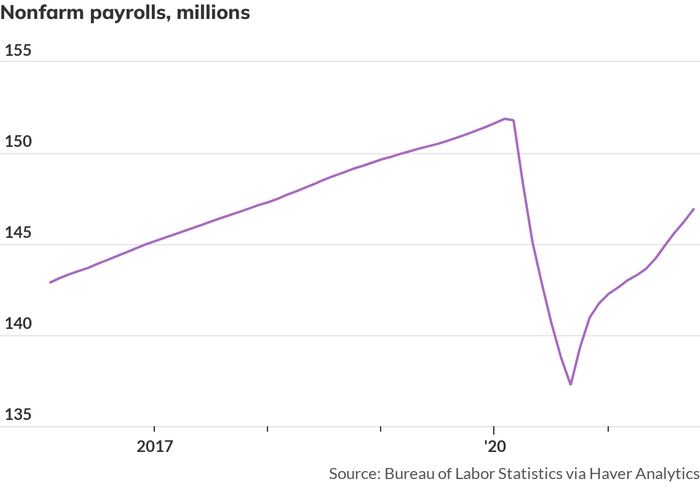
The numbers: Private payrolls rose by 534,000 in November, according to the ADP National Economic Report released Wednesday. 

Economists polled by the Wall Street Journal had forecast a gain of 506,000 private-sector jobs in November.

The ADP report is produced with Moody’s Analytics.

Big picture:  The data may offer a preview of the Labor Department’s monthly employment report to be released Friday. Economists are forecasting another strong job report in November. According to the Wall Street Journal survey, economists anticipate a gain of 573,000 jobs last month after 531,000 jobs were added in October. The unemployment rate is expected to inch lower to 4.5% from 4.6% in the prior month.

Market reaction: Stocks
DJIA,
-1.86%

SPX,
-1.90%

were expected to open higher on Wednesday after a selloff in the prior day’s trading session triggered by expectations of a faster Federal Reserve taper.

Bond Report: Treasury yields bounce back as investors assess Powell’s hawkish pivot, omicron variant

Treasury yields bounced Wednesday as haven-related buying inspired by worries over the omicron variant of the coronavirus faded and investors continued to assess Federal Reserve Chairman Jerome Powell’s signal that the central bank was prepared to speed up its wind-down of monthly asset purchases.

What are yields doing?
  • The yield on the 10-year Treasury note
    TMUBMUSD10Y,
    1.480%

    rose to 1.489%, up from 1.44% at 3 p.m. Eastern Tuesday. Yields and debt prices move in opposite directions.

  • The 2-year Treasury yield
    TMUBMUSD02Y,
    0.602%

    rose 0.599%, compared with 0.524% Tuesday afternoon.

  • The 30-year Treasury bond yield
    TMUBMUSD30Y,
    1.819%

    was 1.814%, up from 1.784% late Tuesday.

What’s driving the market?

Financial markets have been on a roller-coaster ride in recent sessions as investors attempt to come to grips with the implications of the omicron variant. Powell on Tuesday surprised market participants by opening the door to speeding the tapering process when policy makers meet later this month.

Long-dated Treasury yields fell Tuesday on renewed omicron worries, while short-term rates rose, continuing a flattening of the yield curve. Haven-related buying helped buoy Treasury prices, pushing down yields, as stocks and other risky assets tumbled. Stock-index futures pointed to a bounce for equities on Wednesday, while oil futures, which have also been hit hard by omicron worries, also took back a portion of the previous session’s slide.

Powell is slated to deliver a second day of testimony before lawmakers on Wednesday.

Data on private-sector payrolls from ADP is due at 8:15 a.m. Eastern, while the final November Markit purchasing managers index reading on manufacturing activity is due at 9:45 a.m., while the Institute for Supply Management’s manufacturing index for November comes out at 10 a.m.

October construction-spending data is also set for release at 10 a.m. The Fed’s so-called Beige Book of economic anecdotes across the central bank’s regions is set for release at 2 p.m.

What are analysts saying?

The problem for the bond market posed by the omicron variant “is to know not only how big this threat is, but whether it is deflationary or inflationary,” said Steve Barrow, head of G-10 strategy at Standard Bank.

“So far bond yields have tumbled and forward inflation measures, like the five-year inflation swap starting in five years have fallen as well,” he wrote. “But most policy makers who have talked about this, like Fed Chair Powell or Catherine Mann from the Bank of England, seem to be skewing the risks towards higher inflation and we think this is correct. So, while there’s no doubt that bonds will rally and yields fall if risk aversion takes an even firmer grip, bond bulls have to remember that the cost of omicron could be higher inflation — and higher yields — over the longer term.”

How to Prepare for a Natural Disaster on Vacation

As if the pandemic hasn’t done enough to disrupt travel this year, the weather only made things worse.

2021 has been a particularly bad year for natural disasters in the United States. As of Oct. 8, the National Centers for Environmental Information reports that 18 weather and climate events have caused over a billion dollars each in damage so far this year, well over the 7.1 average number of such events per year from 1980 to 2020 (adjusted for inflation).

Climate change will likely make these natural disasters only more frequent and intense in coming years, according to Climate.gov. So what can you do to prepare for them on your next trip? Although there’s no way to avoid disasters altogether, whether at home or on vacation, there are some straightforward steps you can take to minimize travel disruption.

Know the risks

Pop quiz: When is typhoon season in Japan?

Unless you’re a trivia buff or planning a trip there, you probably don’t know that Japan’s typhoon season peaks in August and September. But if you’re booking a trip to the Pacific, you should familiarize yourself with typhoons, their potential impact and other natural hazards. A few minutes of researching online before you plan your trip can save you a big hassle during it.

Don’t know what you don’t know about where you’re visiting? A quick search for “weather [place] [month]” or “natural disasters [place]” should reveal any potential trip-disrupting events. Fair warning: This task can feel like searching for medical questions online, leaving you worried about the worst-case scenarios. Yes, volcanoes sometimes erupt in Iceland. No, one will probably not destroy your vacation rental.

In other words, don’t cancel your trip to Japan in August because of typhoon season (or not visit Oregon during wildfire season). But do learn the risks and what impact they could have on your safety. For one thing, you’ll know what to pack. You can also determine whether you need a backup plan and better understand how flexible to keep your bookings.

Maximize flexibility when appropriate

Natural disasters are unpredictable, so there’s no use overpreparing for them even during peak season. The most important step you can take to prepare for the unpredictable is to keep your travel bookings as flexible as possible.

Thankfully, booking flexible travel is easier than it used to be. Most airlines have eliminated change and cancellation fees on most fares (other than basic economy ones). This doesn’t mean you can change your flights willy-nilly, as you’ll still have to pay the fare difference, which can be quite high for last-minute changes. But you’ll have more breathing room in case of natural disasters or other unforeseen events.

Look for hotel and car rental bookings that maximize flexibility if you’re traveling when natural disasters are more common. Avoid prepaid and nonrefundable rates when possible, and make sure to double-check the cancellation policy before you hit “book.”

Check your insurance plan(s)

Unexpected disasters are exactly what insurance is meant to protect you against, so make sure you’re covered well on your trip. Although travel insurance is important, there are other types of coverage you should keep in mind. Each will affect the other.

  • Travel insurance. This is actually an umbrella term for several types of short-term insurance coverage, including emergency room visits and missing baggage, that can affect your trip. Choose a travel insurance plan that will cover the biggest liabilities in the event of a disaster. Note: You can get “cancel for any reason” insurance that will allow last-minute changes to your itinerary, but it might be redundant if you already have flexible tickets.

  • Health insurance. If you’re traveling domestically, make sure your health insurance provides meaningful coverage for out-of-network care, especially if the restrictions on “in-network” are highly local. Many health insurance plans, including Medicare, do not cover international travel, so supplementary travel insurance health coverage may be your best bet for overseas trips.

  • Rental car insurance. Will you be held liable if your rental car is damaged by gale-force winds? Make sure your rental is covered by insurance provided by the rental car company, as part of your travel insurance package or through a credit card that offers rental car protection.

Make a simple plan

Just as creating a disaster preparedness plan for your home is a good idea, it’s wise to create at least a basic plan for your trip. Check out resources on Ready.gov for making a plan that can be tailored to your trip.

  • Communication. If the power goes out or your phone dies, how will you get in touch with your family or trip mates?

  • Emergency alerts. How will you receive these if you’re traveling abroad without an international phone plan?

  • Evacuation. You don’t need to scout an elaborate escape plan for every hotel, but at least note the emergency exits.

Again, there’s no need to go overboard with planning for every possible scenario. But a little preparation can avert the worst, and may even come in handy during normal travel hiccups, like fire drills and dead phone batteries.

The bottom line

Disasters are, by their nature, unpredictable. On the one hand, that means you shouldn’t build your trip around them or try to foresee every worst-case scenario. On the other hand, it’s easy to build a simple plan that can take potential disasters into account.

Familiarize yourself with the risks in the area you’re visiting, create a basic plan in case of emergency and make sure your bookings are flexible and insured enough to avoid financial issues if disaster strikes. You might not be able to avoid travel disruptions — they come with the territory — but you can be ready when they happen.

How to maximize your rewards

You want a travel credit card that prioritizes what’s important to you. Here are our picks for the best travel credit cards of 2021, including those best for:

Has Omicron created the biggest buying opportunity for cheap UK shares?

Finding cheap UK shares is often top of an investor’s priority list. After all, buying a business at a discount is a proven strategy of generating enormous wealth – just look at billionaire investor Warren Buffett. Uncovering these opportunities can be a long and arduous process.

However, since last Friday, the market has been in a bit of a downward spiral, potentially making things a lot easier.

5 Stocks For Trying To Build Wealth After 50

Markets around the world are reeling from the coronavirus pandemic… and with so many great companies trading at what look to be ‘discount-bin’ prices, now could be the time for savvy investors to snap up some potential bargains.

But whether you’re a newbie investor or a seasoned pro, deciding which stocks to add to your shopping list can be a daunting prospect during such unprecedented times.

Fortunately, The Motley Fool UK analyst team have short-listed five companies that they believe STILL boast significant long-term growth prospects despite the global upheaval…

We’re sharing the names in a special FREE investing report that you can download today. And if you’re 50 or over, we believe these stocks could be a great fit for any well-diversified portfolio.

Click here to claim your free copy now!

After discovering a new strain of Covid-19 emerging from southern Africa, fears of another Christmas lockdown are on the rise. Apart from being frustrating for families eager to celebrate the holidays, the re-introduction of restrictions could be very disruptive to businesses.

2020 serves as a perfect example of the worst-case scenario if the Omicron variant proves to be as nasty as some people are currently speculating. So I’m not surprised to see some investors selling off their positions to try and mitigate potential losses. But has this market adjustment caused some UK shares to be too cheap? Let’s explore.

The power of rising uncertainty

Despite what the sharp drop in share prices would indicate, there’s little known information about the new variant. Having only been recently discovered, scientists are still trying to work out whether this is something to worry about.

As it stands, knowledge surrounding its transmissibility, symptom severity, and the effectiveness of vaccines are unknowns. And it’s possible that this variant, like several others before it, could simply fade away within a few months. Of course, the opposite could also be true, and it may be the worst strain yet.

Uncertainty and the stock market don’t exactly get along. And with some investors fearing the worst, volatility is on the rise as they rush to the exit gates. But as unpleasant as it is to see my portfolio move in the wrong direction, the panic may have created some substantial buying opportunities. Why? Because many UK shares caught in the selling crossfire are now looking rather cheap.

Finding the best cheap UK shares

Simply throwing my money at the businesses that suffered the largest drops these past few days is not a prudent strategy, in my opinion. After all, some of the biggest fallers are travel stocks. And most have a pretty unhealthy balance sheet after using debt to stay afloat during 2020. Not to mention that if Omicron turns out to be a disaster, the sector is likely to get pummelled.

Instead, I’m searching for cheap UK shares that may actually profit from another round of lockdowns, but can still thrive in a post-pandemic world. And one that might fit this description is Learning Technologies Group (LSE:LTG).

This tech stock hasn’t had the best run in the last six months. And the past few days have only continued this downward decline. But despite what the falling share price would indicate, the business could generate some explosive long-term growth.

LTG provides a remote learning platform for employees to complete training for almost any profession from the comfort of their homes. In a post-pandemic world, it’s possible that the demand for such solutions could fade away. However, given the cost-saving benefits for employers and the convenience factor for employees, I don’t think that will be the case.

But there’s also another UK share that looks too cheap in my mind…

One FTSE “Snowball Stock” With Runaway Revenues

Looking for new share ideas?

Grab this FREE report now.

Inside, you discover one FTSE company with a runaway snowball of profits.

From 2015-2019…

  • Revenues increased 38.6%.
  • Its net income went up 19.7 times!
  • Since 2012, revenues from regular users have almost DOUBLED

The opportunity here really is astounding.

In fact, one of its own board members recently snapped up 25,000 shares using their own money…

So why sit on the side lines a minute longer?

You could have the full details on this company right now.

Grab your free report – while it’s online.


Zaven Boyrazian owns shares of Learning Technologies. The Motley Fool UK has recommended Learning Technologies. Views expressed on the companies mentioned in this article are those of the writer and therefore may differ from the official recommendations we make in our subscription services such as Share Advisor, Hidden Winners and Pro. Here at The Motley Fool we believe that considering a diverse range of insights makes us better investors.

Outside the Box: The quick and easy way to lose your life savings

This isn’t my favorite topic. But it’s a necessary one these days, when a seemingly endless number of companies and individuals are intent on separating us from our money. Some of them will use any means, fair or foul.

I’m going to share a story about a longtime friend (I’ve changed his name) whose kindness and generous nature were used against him when he was vulnerable.

This could be you

As much as anyone I’ve ever known, my friend (I’ll call him Bill) was a gentle man and a gentleman. He treated everybody with respect; he was honest and trustworthy. And he was always willing to help somebody in need.

A few years ago his wife passed away, and Bill came to regard opening his mail as a daily highlight.

We all know the usual content of the mail. If you separated your mail into two piles, one for people or organizations sending you money and the other for people or organizations wanting your money, almost everything would go on the second pile.

Now imagine that reality from Bill’s point of view: The mail is an important regular event, you read every piece of mail, and you never want to say no.

Bill’s generosity was his ticket to a growing number of mailing lists that charitable organizations bought and sold.

Fortunately, Bill made friends with a woman who we’ll call Anita, a nurse he had met at a hospital during his wife’s last illness. Anita lived near Bill and eventually became his caregiver.

One day when Anita stopped by his house, Bill told her he had just gone to the bank. What she heard prompted her to offer to help with his bills and finances.

Bill always answered the phone, and the previous day he had said yes to somebody who asked him to wire money directly from his bank account.

Bill wired $1,600. The following day, the same person called back to say that the wire transfer had not gone through. He asked Bill to send the $1,600 again.

Bill went to the bank and (fortunately for him but not for the scammer), the teller knew Bill. She not only stopped him from making that transaction, but also helped him report a fraud claim.

Anita soon learned that in just one month, Bill had written 108 checks to 14 charities and political organizations. The checks were small, usually $10 to $25 each. But they added up to a hefty financial outflow.

Then she found that Bill had somehow signed up for monthly withdrawals from his bank account for things like “internet repair services,” extended warranties on items he no longer owned, and undefined technical support. He was unaware of these “services” he had been buying.

At his bank’s suggestion, Bill closed his account, though he didn’t want to because he had memorized the account number.

Anita suspected that he was being taken advantage of in other ways. Oh, was she ever right.

She noticed he was receiving large boxes filled with materials that apparently were part of a “start your own business from home” scheme he had signed up for, thinking it would give him something to do. She opened one of the boxes and discovered it contained an invoice for $325 for “supplies and pamphlets.”

The damage from that particular scam was much larger, as I discovered when I got involved. All told, Bill’s efforts to keep busy and be useful cost him more than $100,000.

Fortunately, Bill completely trusted Anita, and soon she got his financial affairs under control. Among other things, she persuaded him to let her review whatever checks he wrote before he put them in the mail. And she set up a laptop in a way that made it easy for them to monitor his bank account.

Unfortunately, many other seniors don’t have somebody like Anita to help them.

With a friend like this, do you need an enemy?

Sometimes, the “helper” turns out to be the scoundrel.

I knew a retired couple who relied on the choir director at their church for investment advice. When they inherited $50,000 — a very substantial sum to them — they turned to this “friend.”

The choir director was not a fiduciary adviser, and he had become very good at gaining the trust of parishioners. (Maybe you can sense where this is going.)

From any objective viewpoint, this couple had a pretty low risk tolerance; they could not afford to lose this money.

Nevertheless, once he learned of the inheritance, the choir director persuaded this couple to invest in limited partnerships, thus earning himself some hefty sales commissions.

One limited partnership was invested in a coal-mining venture. Another was financing a grove of palm trees in South America.

If I hadn’t intervened, the couple most likely would have lost all their money while the choir director kept his commissions. But after we threatened legal action against the choir director and the firm he worked for, the couple recovered all their money.

Another story comes from a friend who worked for a moving and storage company.

An elderly man living in a downtown Seattle hotel, with daily visits from a paid caregiver, occasionally ordered things online. He received packages that, with the hotel’s blessing, were delivered directly to his room.

Read: Beware of lottery and sweepstakes scams

One day a UPS driver realized she was delivering six to eight packages a day to this man, and she sensed something might be amiss. It didn’t take long for the driver to determine that most of the deliveries were things the caregiver had ordered for herself, of course charging them to the man’s credit card. 

Fortunately, the solution was simple: a new credit card number — and a new caregiver.

There are countless other ways older people fall victim to those who want their money, any way they can get it. COVID-19 scams. Banking scams. Phone scams. IRS scams. Charity scams. Investment scams. Pyramid schemes.

Read: Watch out for these holiday scams

The U.S. government has created an excellent online resource to help identify these and more, and to protect yourself or somebody you care about.

If you use email, you are a target. You may get messages asking you to confirm “account information” including your phone number and shipping address. Maybe there’s “a problem with your bank account” — even a bank where you don’t have an account.

Protect yourself

What to do: Maybe the No. 1 all-purpose suggestion I have is to simply slow down. No transaction you’re likely to make is so urgent that it can’t wait for you to think about it or get a second opinion from someone who has earned your trust.

Educate yourself at the government’s website. Don’t give out personal information by phone unless you initiated the call.

I hate the need to give blanket advice to be suspicious. But as too many people have learned the hard way, that can be very good advice. In fact, that advice could save you more dollars than you care to think about.

 Richard Buck contributed to this article.

Paul Merriman and Richard Buck are the authors of We’re Talking Millions! 12 Simple Ways To Supercharge Your Retirement.

Need to Know: The liquidity wave carrying stocks will continue even after the Powell Pivot, this analyst argues. Here’s why.

That was a quite one-two punch that caused a 652-point nosedive in the Dow Jones Industrial Average
DJIA,
-1.86%

on Tuesday.

First there was Moderna’s
MRNA,
-4.36%

chief executive saying the omicron variant of coronavirus might really put up a tough fight versus its COVID-19 vaccine. Then Federal Reserve Chair Jerome Powell stunned markets — and the traders who read his dovish-sounding opening remarks the night before — with what has been described as a hawkish pivot, as he threw the word ‘transitory’ to the dustbin of history, said the central bank is likely to accelerate the pace of tapering and cast the new variant as an inflationary risk.

“The takeaway is simple: the Fed has changed their tune very significantly, and realized that in the last month there was plenty of evidence that they were far behind the inflation curve. The shift in view then has some conviction behind it. It would be no surprise to see the markets quickly price in at least three 25bp hikes for 2022 (instead of the two we currently have), if the main downside risks as related to omicron are ruled out,” said Alan Ruskin, macro strategist at Deutsche Bank.

Thomas Kee Jr., the president and chief executive of Stock Traders Daily, agreed that Powell made a pivot, and suggested the pace of tapering may double to $30 billion a month. But he said the driving force behind equity infusions is the European Central Bank, not the Fed.

The ECB is also battling inflation — prices in November surged by the fastest in 30 years — but central bank officials there are wary of repeating the mistake of premature tightening. The ECB has to decide whether to let the €68 billion ($77 billion) a month Pandemic Emergency Purchase Programme expire as planned in March and whether to increase the Asset Purchase Programme as it offers its first staff inflation forecast for 2024.

“Ultimately, the ECB is the wild card, and the decision of the ECB comes in just two weeks,” said Kee. Liquidity will remain robust, and that will keep the “bid in equities that exists now going.” The free money, he said, hasn’t dried up yet.

The buzz

It’s a big day on the economics front: the ADP estimate of private-sector employment, the Institute for Supply Management manufacturing report, and the Fed’s Beige Book of economic anecdotes are due for release as auto makers release their monthly sales reports. Powell and Treasury Secretary Janet Yellen go before the House Financial Services Committee to discuss the same topic as Tuesday, the pandemic response at their respective agencies.

The White House is set to announce increased testing requirements for international travelers. Conservatives are trying to force a shutdown Friday over the Biden administration’s vaccine mandate, Politico reported.

The Jerusalem Post cited a local television report as saying the Pfizer
PFE,
+2.54%

COVID-19 vaccine, which is used in Israel, had 90% effectiveness versus omicron versus 95% versus delta in preventing infection.

Dow component and tech giant Salesforce.com
CRM,
-3.97%

offered fourth-quarter guidance below expectations as it also named Bret Taylor to be its co-chief executive alongside Marc Benioff.

Hewlett Packard Enterprises
HPE,
-1.78%

beat earnings expectations but just missed revenue estimates, as its high-performance computing and artificial-intelligence unit recorded sales growth of just 1%. Information security firm Zscaler
ZS,
-2.51%

raised its revenue outlook for the year.

The market

The market zigs and it zags. Futures on the Dow industrials
YM00,
+0.90%

rose more than 300 points as risky assets gained ground.

The yield on the 10-year Treasury
TMUBMUSD10Y,
1.487%

was around 1.50%, and oil futures
CL.1,
+4.52%

jumped, as strategists at Goldman Sachs said the pullback from nearly $85 a month early in November was overdone.

Random reads

A lawyer goes viral with her story describing an attempt to rent a car at Hertz
HTZ,
-4.51%
.

Tesla
TSLA,
+0.68%

hasn’t rolled out the Cybertruck yet, but fans snapped up a $50 Cyberwhistle in the mean time.

Roses? This man went a bit further and built a one-third sized Taj Mahal replica for his wife.

Need to Know starts early and is updated until the opening bell, but sign up here to get it delivered once to your email box. The emailed version will be sent out at about 7:30 a.m. Eastern.

Want more for the day ahead? Sign up for The Barron’s Daily, a morning briefing for investors, including exclusive commentary from Barron’s and MarketWatch writers.

4 ways I can get a head start on stock investing in 2022

We’re now in the last month of the year. Although we’ll have plenty of time to look back on 2021 in the coming weeks, I want to focus on 2022 as well. My key aim is how I can get ahead with stock investing. Whether I’m new to investing or if I’ve been active in the market for many years, having a good plan for the New Year is important. So here are several ways I’m trying to get a head start on next year.

Good planning

Cash flow planning sounds like a complicated term. In reality, it refers to managing my money so that I have cash available to fund needed expenses and investment opportunities as they come around. One way I can get ahead for next year is sitting down now and looking ahead at what I expect to make and when I expect to receive it.

5 Stocks For Trying To Build Wealth After 50

Markets around the world are reeling from the coronavirus pandemic… and with so many great companies trading at what look to be ‘discount-bin’ prices, now could be the time for savvy investors to snap up some potential bargains.

But whether you’re a newbie investor or a seasoned pro, deciding which stocks to add to your shopping list can be a daunting prospect during such unprecedented times.

Fortunately, The Motley Fool UK analyst team have short-listed five companies that they believe STILL boast significant long-term growth prospects despite the global upheaval…

We’re sharing the names in a special FREE investing report that you can download today. And if you’re 50 or over, we believe these stocks could be a great fit for any well-diversified portfolio.

Click here to claim your free copy now!

After all, there’s no point having a stock that I want to buy early next year only to realise that I won’t have any free cash until the spring. So good cash flow planning now can allow me to have some spare funds during (ideally) each month next year to take advantage of any stock investing opportunities.

Following on from this, it’s equally important to know what I want to achieve with my investing. It’s a bit pointless having the free cash to put to work if I don’t know what I’m trying to do with it. Am I looking to try and build a retirement pot? Do I need to invest in dividend stocks to supplement my other income? If I can plan ahead and understand what my aim is for 2022, it can help to clarify where I need to be investing.

Stock investing via key themes

Even though we go into January, the relevant themes and what’s hot in the market right now in December will stay the same. So I can get a head start on next year by understanding what’s going to be in focus in early 2022.

For example, the Bank of England meeting is on December 16. This is important, as the committee will decide whether to raise interest rates or not. After the recent appearance of the new Covid variant, this could make the bank pause and not raise rates. The decision will impact the share price of many stocks within the FTSE 100 index.

And regardless of the action in December, the impact of any decision will spill over into next year. 

A fourth way to get a head start is to think beyond the next few months and consider what the big issues will be later in 2022. This could be environmental, political or something else. But if I have conviction that something is likely to be big next year, I can consider buying shares in key companies now. That way, I can hopefully jump in before the rest of the crowd.

Overall, there should be a lot of twists and turns in 2022, especially with stock investing. So thinking ahead now should allow me to have the best shot at making it a successful year.

FREE REPORT: Why this £5 stock could be set to surge

Are you on the lookout for UK growth stocks?

If so, get this FREE no-strings report now.

While it’s available: you’ll discover what we think is a top growth stock for the decade ahead.

And the performance of this company really is stunning.

In 2019, it returned £150million to shareholders through buybacks and dividends.

We believe its financial position is about as solid as anything we’ve seen.

  • Since 2016, annual revenues increased 31%
  • In March 2020, one of its senior directors LOADED UP on 25,000 shares – a position worth £90,259
  • Operating cash flow is up 47%. (Even its operating margins are rising every year!)

Quite simply, we believe it’s a fantastic Foolish growth pick.

What’s more, it deserves your attention today.

So please don’t wait another moment.

Get the full details on this £5 stock now – while your report is free.


Jon Smith and The Motley Fool UK have no position in any share mentioned. Views expressed on the companies mentioned in this article are those of the writer and therefore may differ from the official recommendations we make in our subscription services such as Share Advisor, Hidden Winners and Pro. Here at The Motley Fool we believe that considering a diverse range of insights makes us better investors.

Budget Christmas dinner for under £50

Image source: Getty Images


It’s fair to say that 2021 is proving to be an expensive year. It seems that everything is going up in price, including food. So I’ve taken on a challenge to see if it’s still possible to have a budget Christmas dinner for under £50.

The good news is that my budget Christmas dinner, mainly from Asda and with a little bit from Tesco, just sneaks in at £48.28. And that’s including two bottles of wine, a Christmas pudding and six Christmas crackers.

How to cook a budget Christmas dinner

The biggest cost of a traditional Christmas meal is the Turkey. And the best way to get the price down is to buy frozen. Frozen meat is just as nutritious as fresh meat as it is frozen immediately after it’s prepared for sale. The main thing to remember is to allow plenty of time for it to defrost before you cook it. A medium frozen turkey takes up to 52 hours to defrost in the fridge.

It’s always possible to go to town on all the Christmas dinner trimmings and feel you need to buy everything from the premium ranges. But I’m sure I’m not alone in having several family members with very traditional tastes. There’s nothing wrong with good old Paxo stuffing and Colman’s bread sauce, especially if you’re on a tight budget.

I’ve chosen my basket of budget Christmas dinner food mainly from Asda. That’s because many of us will be shopping from home this Christmas. If you want to brave the Christmas crush at Aldi or Lidl, then you may be able to get your Christmas dinner even cheaper.

Don’t buy too much

It’s easy to be seduced by all the offers in the supermarkets at Christmas time. But if you’re on a tight budget, remember that’s it’s only possible to eat so much on Christmas Day. My daughter loves to eat herself silly, but even she often can’t manage a mountain of veg and a second helping of Christmas pudding!

My top picks for a budget Christmas dinner

Main course

I’ve chosen a medium size turkey simply because a medium turkey offers plenty of meat for the average family. You’ll still have lots of leftovers. I’ve picked Maris Piper potatoes because they make good roasts and excellent mash. Of course, other potatoes are available that may be even cheaper! 

  • Tesco frozen basted medium British turkey (5.3kg) £16 
  • Asda Maris Piper potatoes (2kg) £1.18
  • Asda pigs in blankets (16) £3
  • Asda grower’s selection carrots (1kg) 43p
  • Asda grower’s selection parsnips (500g) 50p
  • Asda grower’s selection brussel sprouts (500g) 85p
  • Asda yorkshire puddings (12) 62p
  • Paxo sage and onion stuffing (100g twin pack) £2 
  • Colman’s bread sauce 65p
  • Asda cranberry sauce (200ml) 59p
  • Asda Extra Special turkey gravy granules (100g) £1.49

Dessert

I’ve included a Christmas pudding and cream, but I didn’t have enough in the budget Christmas dinner pot to stretch to brandy butter. If you have some brandy and sugar knocking about in the cupboard, then it’s easy to make your own.

  • Asda Christmas pudding (800g) £4
  • Double cream (600ml) £1.99

Drinks and crackers

I’ve chosen the cheapest crackers. I mean, what’s the point of expensive crackers? They might have a slightly nicer novelty paper clip, but no one ever keeps them anyway. The hats and the jokes are the same in the cheap crackers.

  • White wine: Black Tower fruity white wine £4.99
  • Red wine: Hardy’s stamp shiraz £4.99
  • Asda Home premium silver crackers (6) £5

Total cost £48.28

Was this article helpful?

YesNo


Some offers on The Motley Fool UK site are from our partners — it’s how we make money and keep this site going. But does that impact our ratings? Nope. Our commitment is to you. If a product isn’t any good, our rating will reflect that, or we won’t list it at all. Also, while we aim to feature the best products available, we do not review every product on the market. Learn more here. The statements above are The Motley Fool’s alone and have not been provided or endorsed by bank advertisers. John Mackey, CEO of Whole Foods Market, an Amazon subsidiary, is a member of The Motley Fool’s board of directors. The Motley Fool UK has recommended Barclays, Hargreaves Lansdown, HSBC Holdings, Lloyds Banking Group, Mastercard, and Tesco.


Brett Arends's ROI: How the Marx Brothers beat your 401(k) — again

Paging Chico Marx.

“Who are you gonna believe—me or your own eyes?,” the comedian famously asked in “Duck Soup.” And we investors are facing a similar challenge from the experts and regulators who are here to look after us.

Today’s topic is the famously crazy “3X” retirement portfolio that we are repeatedly told we Must Not Buy because sooner or later it will wipe us out.

It’s over a decade since the Securities and Exchange Commission warned Mom and Pop investors not to put their investment funds into leveraged mutual funds that are designed to give them two or three times the daily performance of stocks and bonds, up and down.

It’s over a year since I reported that investors who ignored this wise advice had since made more money than Croesus and were laughing all the way to the bank.

The latest news: They are still making out like bandits, even though they are not supposed to.

Look, I’m not making recommendations, I’m just telling you what’s happening.

The basic portfolio in question is 50% in ProShares UltraPro S&P 500
UPRO,
-5.67%
,
which is designed to give you three times the performance of the S&P 500 stock index, and 50% in DirexionDaily 20+ Year Treasury Bull 3X
TMF,
+4.60%
,
which is designed to give you three times the performance of long-term U.S. Treasury bonds. 

So far this year this portfolio, rebalanced quarterly, is up a stunning 29% — even though it shouldn’t be. The bond and stock markets have been volatile, with bonds especially tanking and then rallying, and that’s supposed to be poison to these funds.

By contrast the much more sensible portfolio that ignored these volatile funds, and instead split its money equally between a plain U.S. stock market fund and a plain long-term Treasury bond fund, is up just 9%.

Oops.

This isn’t new.

Last decade this 3x portfolio, rebalanced quarterly, would have turned an initial $1,000 investment into $15,100.

The simple, 1x equivalent: $2,760, or less than a fifth as much.

So much for the wisdom of the experts!

It’s adding to my growing suspicion that one can get better financial advice watching old Marx Brothers movies than you can from, say, reading economics textbooks. (Oh, and trust the Communists to get their economic analysis from the wrong “Marx”.)

Theoretically, these leveraged funds are a disaster waiting to happen for long-term investors. These funds are designed only to give you 3x the performance of the underlying assets—stocks and bonds—per day. They do this by trading in derivatives. Once you hold them for longer than a day you are starting to play the financial equivalent of Russian roulette. If, say, the stock market rises one day and tanks the next, you could in theory end up much worse off than you started. You get hit by trading costs. And you can suffer from the famous paradox of percentages—it takes a 100% gain simply to recover from a 50% loss.

The ultra bond fund UPRO fell 40% in the first three months of this year during the bond market rout, and it is still down about 15%.

I’m not offering a view here, though I wouldn’t take this risk with my own money. But I was drawn to take another look at this portfolio after Friday’s sharp stock market selloff.

When the stock market tanks, the one asset that tends to do well are U.S. Treasury bonds—and the longer-dated the better. That’s arguably the main reason for investors to own some Treasury bonds, no matter what view they take of the economy or the stock market. Treasurys offer a form of “insurance” in case the stock market tanks and things go to hell in a handcart.

On Friday PIMCO’s 25+ Year Zero Coupon ETF
ZROZ,
+1.98%

and Vanguard’s Extended Duration Treasury ETF
EDV,
+1.96%

rose 3% or more, offering a helpful cushion for portfolios while their stocks fell. But the TMF offered more than twice the cushion, rising more than twice as much or 7%.

(If you really wanted to be clever, so-called “call options” on the TMF, which gives you a toehold on the fund’s shares in case they rise a long way, jumped as much as 50%.)

No, of course we shouldn’t take a long-term position in this 3x Treasury Bond fund as a way to insure the rest of our portfolios. It may have worked in practice, and it may carry on working in practice for all I know, but it doesn’t work in theory.

Or, as Chico might say, who you gonna believe—experts, or the market?

Is this one of the best ESG investments for 2022?

Environmental, social, and corporate governance (ESG) investing has taken the market by storm in 2021. With increased awareness about businesses’ societal and environmental impacts, many investors have begun retargeting their capital to support the firms looking to make the world a better place.

Since climate change and other issues aren’t going to be solved overnight, ESG investing looks like it’s here to stay. But apart from the moral side of this strategy, can it generate substantial returns for my portfolio? I certainly think so.

5 Stocks For Trying To Build Wealth After 50

Markets around the world are reeling from the coronavirus pandemic… and with so many great companies trading at what look to be ‘discount-bin’ prices, now could be the time for savvy investors to snap up some potential bargains.

But whether you’re a newbie investor or a seasoned pro, deciding which stocks to add to your shopping list can be a daunting prospect during such unprecedented times.

Fortunately, The Motley Fool UK analyst team have short-listed five companies that they believe STILL boast significant long-term growth prospects despite the global upheaval…

We’re sharing the names in a special FREE investing report that you can download today. And if you’re 50 or over, we believe these stocks could be a great fit for any well-diversified portfolio.

Click here to claim your free copy now!

And there’s one business that has come back onto my radar that could be one of the best ESG investments of 2022 and beyond.

Saving the world… one fish at a time

Global warming is often foremost in people’s thoughts regarding the environment. Yet there are plenty of other areas where rapid change is needed. One, in particular, is the fishing industry. With humanity’s insatiable appetite to consume marine wildlife, conservationists are increasingly concerned about dwindling fish populations, water pollution, and habitat degradation.

To put in perspective how serious the problem has become, an estimated 70% of the global fish population has been depleted. That poses a serious threat to the global food supply over the long term. But Benchmark Holdings (LSE:BMK) claims to have found a solution.

This biotechnology company operates in a rising industry called aquaculture. This sector specialises in breeding fish specifically for human consumption. And, in turn, reduces the reliance on capturing wild fish from the oceans.

Benchmark has been using its scientific expertise in genomics to breed fish that are resistant to most diseases. At the same time, the group has developed its own specialised feed that improves mortality, as well as researching new medicines for treating infected fish.

The end result is a higher quality food source for humans without depleting and damaging the ocean environment. To me, that sounds like an excellent candidate for an ESG investment. But while the cause is noble, is this a high-quality business?

An ESG stock worthy of investment in 2022?

Benchmark recently released its full-year results. And, in my opinion, there is reason to be excited. Revenue over the last 12 months grew 18%, reaching £125.1m. Meanwhile, ignoring the effects of exceptional items, adjusted operating profits shot up 37% to £10.8m.

Needless to say, that’s quite an impressive level of growth. And with the demand for the group’s solutions bound to increase exponentially in 2022 and beyond, I don’t think this upward trend will be slowing down anytime soon.

However, like all investments, this ESG stock is far from risk-free. While underlying earnings may be in the black, the bottom line isn’t. And it hasn’t been for several years. An unprofitable young enterprise is hardly an uncommon sight.

And to stay afloat, management has racked up a considerable amount of debt. A good chunk of the firm’s outstanding obligations is maturing within the next two years. And while the company has outlined a plan to renew or replace these credit facilities, additional capital might need to be raised through equity, causing dilution.

But even with this caveat, Benchmark looks like it’s perfectly positioned to benefit from some solid future tailwinds in the aquaculture industry. That’s why I think it could be one of the best ESG investments for my portfolio in 2022.

But it’s not the only one, that caught my attention…

Our 5 Top Shares for the New “Green Industrial Revolution”

It was released in November 2020, and make no mistake:

It’s happening.

The UK Government’s 10-point plan for a new “Green Industrial Revolution.”

PriceWaterhouse Coopers believes this trend will cost £400billion…

…That’s just here in Britain over the next 10 years.

Worldwide, the Green Industrial Revolution could be worth TRILLIONS.

It’s why I’m urging all investors to read this special presentation carefully, and learn how you can uncover the 5 companies that we believe are poised to profit from this gargantuan trend ahead!

Access this special “Green Industrial Revolution” presentation now


Zaven Boyrazian has no position in any of the shares mentioned. The Motley Fool UK has no position in any of the shares mentioned. Views expressed on the companies mentioned in this article are those of the writer and therefore may differ from the official recommendations we make in our subscription services such as Share Advisor, Hidden Winners and Pro. Here at The Motley Fool we believe that considering a diverse range of insights makes us better investors.

Financial News

Daily News on Investing, Personal Finance, Markets, and more!

Financial News

Policy(Required)