The outlook: While the economy was growing at a moderate pace in November, businesses were raising price at a rapid clip across a broad swath of the economy , according to the Fed’s latest Beige Book survey released Wednesday.
“Prices rose at a moderate to robust pace, with price hikes widespread across sectors of the economy,” the survey found.
Input costs increases were “wide-ranging” due to strong demand for raw materials, logistical challenges and labor market tightness, the report said.
Tight labor markets meant wages were also rising at a “robust” pace across most of the Fed’s 12 districts, according to the report.
One silver lining was that some inputs were becoming more widely available, easing some of the pressure.
“Strong demand generally allowed firms to raise prices with little pushback, though contractual obligations held back some firms from increasing prices,” the report concluded.
Big picture: Fed Chairman Jerome Powell has sounded a hawkish note in two days of testimony on Capitol Hill, perhaps after reading a draft of this Beige Book report. Powell opened the door to ending the Fed’s asset purchases a few months sooner than planned.
“The Fed is making a clear policy pivot to a focus on inflation,” said Tim Duy, chief U.S. economist at SGH Macro Advisors.
The Centers for Disease Control and Prevention (CDC) is not altering its definition of what a “fully vaccinated” individual means to include COVID boosters, according to the organization’s director.
“The definition of fully vaccinated has not changed,” CDC Director Rochelle Walensky said during a White House COVID-19 Response briefing on Tuesday.
“We are absolutely encouraging those who are eligible for a boost six months after those mRNA doses to get your boost, but we are not changing the definition of fully vaccinated right now,” Walensky continued.
Currently, a person is considered fully vaccinated by the CDC two weeks after receiving the second dose of either the Pfizer PFE, +2.48%
/BioNTech BNTX, -3.05%
or Moderna MRNA, -7.53%
vaccine, or two weeks after receiving the single dose the Johnson & Johnson JNJ, +1.95%
shot.
Walensky’s comments indicate that a change to the organization’s fully-vaccinated designation could happen in the future, but this isn’t in its plans at the moment. The CDC has asked all eligible people to get boosted as SARS-CoV-2 variants like the Omicron and delta variants have appeared.
Chief medical advisor to the president Dr. Anthony Fauci echoed similar sentiments on COVID vaccine boosters last week during an interview with Reuters.
“Right now, officially, ‘fully vaccinated’ equals two shots of the mRNA and one shot of the J&J, but without a doubt that could change. That’s on the table for discussion,” Fauci said.
The Omicron variant, which was first reported by scientists in South Africa, was declared a “variant of concern” by the World Health Organization (WHO) last week. The Omicron variant’s transmissibility and its resistance to vaccines and other treatments are still being studied.
The global tally for confirmed cases of COVID-19 reached 263 million on Tuesday, and the death toll rose to 5.21 million, according to data from Johns Hopkins University.
The CEOs of several major cryptocurrency companies and foundations will testify before the House Financial Services Committee on Dec. 8 at 10 a.m., Democratic Chairwoman Maxine Waters of California announced Wednesday.
The hearing, titled “digital assets and the future of finance” will explore the “challenges and benefits” of cryptocurrency innovations in the U.S., according to a press release.
Witnesses will include Jeremy Allaire, CEO of Circle, issuer of the stablecoin USD Coin USDCUSD, ,
Sam Bankman-Fried, CEO of crypto exchange FTX, Brian Brooks, former acting comptroller of the currency and CEO of Bitfury, Chad Cascarilla, CEO of Paxos, Danelle Dixon, CEO of Steller XLMUSD, -2.63%
Development Foundation and Alesia Haas, CEO of Coinbase Inc. and CFO of Coinbase Global Inc. COIN, -3.38%
Gary Black and business partner David Kalis established the technology-oriented Future Fund Active ETF FFND, -0.56%
in August, and made Tesla its top holding, representing more than 10% of the portfolio’s assets.
Tesla Inc. TSLA, -1.60%
shares had already surged 15-fold in the previous two years, giving the electric-vehicle maker a market capitalization that would eventually eclipse all other car companies combined.
Black, a former investments chief at Goldman Sachs and CEO of what is now Janus Henderson mutual funds, said in an interview Nov. 30 that he still thinks Tesla is a bargain for long-term investors.
By traditional measures, shares of Tesla appear to be very expensive. The stock closed at $1,145 on Nov. 30, and was up 62% for 2021, following a 743% increase during 2020. Tesla trades for 136 times the consensus 2022 earnings estimate of $8.43 a share among analysts polled by FactSet. In comparison, the price-to-earnings ratio of the benchmark S&P 500 Index, of which Tesla is a member, is 20.8.
Amazon.com Inc. AMZN, -0.77%
provides an instructive example of a stock that many investors had steered clear of for decades because of its high P/E valuation. Here’s a chart showing the internet retailer’s forward P/E ratio (based on rolling 12-month consensus earnings estimates) over the past 20 years:
FactSet
Amazon’s average forward P/E during that time is 99.5. The S&P 500 is also included on the chart, with what appears to be a flat line at the bottom. The scale reflects Amazon’s valuation spikes when analysts expected the company to show low profits as it plowed its cash flow into business expansion, including industry-leading delivery times for its ecommerce platform and Amazon Web Services.
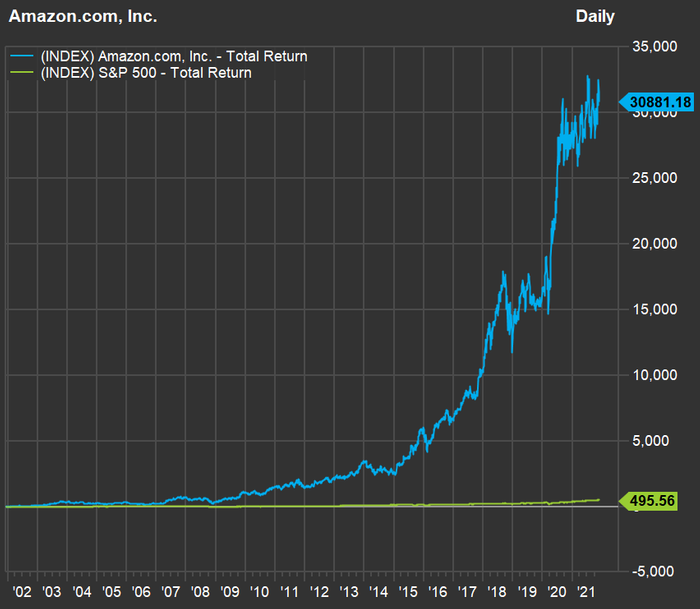
Now look at 20-year total returns for Amazon and the index:
FactSet
That’s a 30,881% return for Amazon. You can see plenty of dips or weak periods in the chart, when investors had to be patient, such as the period between the peak late in September 2018 and April 2020, when the stock finally pushed ahead.
The bottom line is that continued expansion at a rapid pace can help a company “grow into its valuation,” to use Black’s words.
Even now, Amazon trades at nearly 69 times the consensus forward earnings estimate. It’s still a high P/E and maybe some of the same naysayers from five, 10, 15 or 20 years ago continue to believe it’s too late to jump on the bandwagon.
The Tesla ‘controversy’
Black said he likes stocks with “controversy.”
In the case of Tesla, he said the debate is whether the company can maintain its electric-vehicle market share while global EV adoption grows. He expects Tesla to increase its total addressable market (TAM) because of new products, including the Cybertruck, expected in late 2022, and a new Tesla compact model expected in 2023, along with increased production in existing factories and the opening of new factories in Texas and Germany.
All the numbers that follow are for battery electric cars, or BEVs. That means plug-in hybrids are excluded.
Tesla sold an estimated 386,000 electric cars during the first half of 2021, according to EV-Volumes.com, which estimates sales of BEVs will total 4 million for all of 2021. If Tesla were to maintain the same pace of sales for the second half of 2021, its BEV market share for the year would be an estimated 19.3%.
Black’s case for Tesla’s value today
Based on his own estimates, which incorporate third-quarter numbers provided to the Future Fund team by Bloomberg, EV-Volumes.com and other industry sources, Black expects the world BEV adoption rate to climb to 6% in 2021 from 3% in 2020, and continue rising to 30% by 2025. Meanwhile, he expects Tesla to hold a 21% market share.
Those estimates point to a 56% compound annual growth rate (CAGR) for industry BEV sales, with a 55% CAGR for Tesla’s sales. Black also estimates a 59% CAGR for Tesla’s earnings per share through 2025.
Black’s estimate for Tesla’s market share is higher than EV-Volumes’ numbers for the first half of 2021 indicate because of supply constraints.
“You will wait six months now if you order a new Tesla. When the new factories come online, they can gain more share,” he said.
These Twitter postings include data backing Black’s estimates:
Going further, Black estimates Tesla will earn $12 a share in 2022, which is well ahead of the consensus EPS estimate of $8.43. More controversy, but this underlines his investment thesis. He expects EPS to keep growing to $40 in 2025. Based on the closing price of $1,145 on Nov. 30, that would make for a P/E of 28.6 — not very high for such a rapidly growing company.
The expectation of continued rapid growth for Tesla explains not only Black’s enthusiasm for the stock but that of other money managers.
Deeper long-term thesis
Stepping back from the numbers, Black listed what he called four “ingredients” for electric vehicles: battery range, performance, technology and safety.
While the competition is catching up on battery range, he said that for performance and technology, Tesla is still ahead of the competition. He added that Tesla has, by far, the highest number of fast-charging stations available, and that drivers of competing EVs can buy low-cost adapters to use Tesla’s stations and possibly feel envious of Tesla owners while waiting.
Finally, Black addressed concerns that increasing competition in the EV space would hurt Tesla’s market share or make it less profitable.
Black cited Amazon as an example, citing skeptical investors years ago who had expected traditional competitors to take back market share from Amazon as they built-out their on online sales capabilities. We all know this didn’t happen.
One thing we can all be sure of is that the world will continue to change rapidly for all vehicle manufacturers as buying habits change and governments continue to push for a rapid transition to EVs.
Black cited the Chinese government’s cooperation with Tesla, which opened its factory in Shanghai in 2019, as a long-term boon not only for Tesla, but for China’s entire EV market.
“You throw a catfish in with all the competitors to keep them aggressive,” he said, referring to this New York Times article.
A new catalyst for Tesla and its competitors in the U.S. market might be just around the corner. President Biden’s “Build Back Better” spending package, if passed by Congress, is likely to lift the 200,000-vehicle limit on $7,500 per-vehicle tax credits for EVs. Tesla and GM have exceeded that limit.
Black expects the two new factories to double Tesla’s production capacity. Near term, the completion of Tesla CEO Elon Musk’s sale of 10% of his Tesla shares may relieve pressure on the share price. Black also expects bond-ratings agencies to raise Tesla’s credit rating to investment-grade because of its strong cash flow and relatively low level of debt.
Hey “Home Alone” fans — Airbnb is gonna give you to the count of 10 to get your ugly, yella, no-good keisters on this property, which is a piece of Christmas movie history.
Yes, the home rental service’s latest publicity stunt gift-wrapped as a headline-grabbing listing is the Chicago-area house that Kevin McCallister (played by Macaulay Culkin) famously booby-trapped to terrorize two bumbling burglars (played by Joe Pesci and Daniel Stern) in the 1990 slapstick comedy “Home Alone.”
The Airbnb ABNB, -0.15%
listing — which claims to have been posted by bullying big brother Buzz McCallister, the oldest of Kevin’s siblings in the movie — invites guests to get in touch with their own inner 8-year-olds and indulge in the antics that Culkin’s character did in the movie. This includes “eating junk and watching rubbish” (such as the film franchise’s latest flick, “Home Sweet Home Alone,” streaming on Disney+, which the Airbnb listing is also promoting), or slapping on aftershave and screaming into the bathroom mirror.
The halls of the Winnetka, Ill. mansion will be decked for Christmas, including a “perfectly trimmed tree” and twinkling holiday lights. Guests also get a Lego Ideas “Home Alone” kit to take home, and a fridge stocked with 1990s junk food and Chicago pizza. Plus, visitors will be given booby traps that they can set around the house.
The listing is just $25 for the night, and booking opens at 2 p.m. ET on Dec. 7 for a stay on Dec. 12. The lucky guests will have to arrange their own transportation to Chicago, however, and comply with any local COVID-19 guidelines.
Check out the listing at airbnb.com/homealone, and brace for some stiff competition to land the once-in-a-lifetime reservation.
Last month, Airbnb reported its highest quarterly revenue and net income ever as pent-up travel demand during the pandemic drove customers toward the travel-booking company. Indeed, the company saw 79.7 million nights and experiences booked during the third quarter, which was a 29% increase year over year.
“’Stop the president from leaving. He just tested positive for COVID.’”
— Sean Conley, White House doctor, to Mark Meadows
On Sept. 26, 2020, just three days before the first Trump-Biden debate — and less than a week before then-President Donald Trump was hospitalized with COVID-19 — he tested positive for the novel coronavirus, leading to the plea above from White House doctor Sean Conley. This revelation comes from the latest insider tell-all book about the Trump presidency, written this time by Mark Meadows, the former president’s fourth and final chief of staff.
Conley’s test result came as the president was heading to a campaign rally in Middletown, Pa., and had already departed Washington. Here was how Meadows carefully phrased Trump’s response, per the Guardian:
“‘Trump’s reply, the devout Christian writes, “rhyme[d] with ‘Oh spit, you’ve gotta be trucking lidding me.’ ” ’”
— Mark Meadows, paraphrasing Donald Trump, as quoted in The Guardian
A second test was done after the first one, and when that one produced a negative result, the White House continued with the president’s campaign schedule — despite the Trump’s reportedly displaying indications to those around him of being under the weather.
In the days between the positive test and his hospitalization, the president had a number of in-person events that led to a number of cases that were traced back to the White House. One such event, just a few hours prior, was a Rose Garden event celebrating the nomination of Amy Coney Barrett to the Supreme Court. That outdoor ceremony, and the indoor events immediately after, led to infections in a number of guests and White House staffers, including former New Jersey Gov. Chris Christie, who, like Trump, had to be hospitalized as he fought the virus.
Trump also held a Sept. 27 indoor event with Gold Star families — and later pointed to that as a source of his infection. “They come within an inch of my face sometimes. They want to hug me and they want to kiss me. And they do. And frankly, I’m not telling them to back up. I’m not doing it. But I did say it’s obviously dangerous. It’s a dangerous thing, if you go by the COVID thing,” he told Fox Business after he was released from Walter Reed National Military Medical Center.
But the then-incumbent also showed up as scheduled to the first presidential debate — and was not tested before sharing a stage with Joe Biden. Trump arrived late, and was allowed to proceed under an “honor system.” Biden was 77 at the time and Trump 74.
Trump responded to the Guardian report — drawn directly from his former chief of staff’s book — with apparent obfuscation. Trump wrote that “a test revealed that I did not have COVID prior to the debate,” likely pointing to the follow-up, negative test that Meadows wrote about.
“‘The story of me having COVID prior to, or during, the first debate is Fake News. In fact, a test revealed that I did not have COVID prior to the debate.’”
— Donald Trump, in an email response
On Wednesday, President Biden responded to the reports of being put in possible jeopardy, telling reporters, “I don’t think about the former president.”
CAMBRIDGE, Mass. (Project Syndicate)—An elder statesman, a retired Big Tech CEO, and a computer scientist meet in a bar. What do they talk about? Artificial intelligence, of course, because everyone is talking about it—or to it, whether they call it Alexa, Siri, or something else. We need not wait for a science-fiction future; the age of AI is already upon us. Machine-learning, in particular, is having a powerful effect on our lives, and it will strongly affect our future, too.
That is the message of this fascinating new book by former U.S. Secretary of State Henry A. Kissinger, former Google GOOG, +1.51%
CEO Eric Schmidt, and MIT dean Daniel Huttenlocher. And it comes with a warning: AI will challenge the primacy of human reason that has existed since the dawn of the Enlightenment.
“They have produced a wonderfully readable introduction to issues that will be critical to humanity’s future and will force us to reconsider the nature of humanity itself.” — Joseph S. Nye
Can machines really think? Are they intelligent? And what do those terms mean? In 1950, the renowned British mathematician Alan Turing suggested that we avoid such deep philosophical conundrums by judging performance: If we cannot distinguish a machine’s performance from a human’s, we should label it “intelligent.” Most early computer programs produced rigid and static solutions that failed this “Turing test,” and the field of AI went on to languish throughout the 1980s.
But a breakthrough occurred in the 1990s with a new approach that allowed machines to learn on their own, instead of being guided solely by codes derived from human-distilled insights. Unlike classical algorithms, which consist of steps for producing precise results, machine-learning algorithms consist of steps for improving upon imprecise results. The modern field of machine-learning—of programs that learn through experience—was born.
“AI is increasingly deciding what is important and what is true, and the results are not encouraging for the health of democracy.”
The technique of layering machine-learning algorithms within neural networks (inspired by the structure of the human brain) was initially limited by a lack of computing power. But that has changed in recent years. In 2017, AlphaZero, an AI program developed by Google’s DeepMind, defeated Stockfish, the most powerful chess program in the world. What was remarkable was not that a computer program prevailed over another computer program, but that it taught itself to do so. Its creators supplied it with the rules of chess and instructed it to develop a winning strategy. After just four hours of learning by playing against itself, it emerged as the world’s chess champion, beating Stockfish 28 times without losing a match (there were 72 draws).
AlphaZero’s play is informed by its ability to recognize patterns across vast sets of possibilities that human minds cannot perceive, process, or employ. Similar machine-learning methods have since taken AI beyond beating human chess experts to discovering entirely new chess strategies. As the authors point out, this takes AI beyond the Turing test of performance indistinguishable from human intelligence to include performance that exceeds that of humans.
Algorithmic politics
Generative neural networks also can create new images or texts. The authors cite OpenAI’s GPT-3 as one of the most noteworthy generative AIs today. In 2019, the company developed a language model that trains itself by consuming freely available texts from the internet. Given a few words, it can extrapolate new sentences and paragraphs by detecting patterns in sequential elements. It is able to compose new and original texts that meet Turing’s test of displaying intelligent behavior indistinguishable from that of a human being.
I know this from experience. After I inserted a few words, it scoured the internet and in less than a minute produced a plausible false news story about me. I knew it was spurious, but I do not matter that much. Suppose the story had been about a political leader during a major election? What happens to democracy when the average internet user can unleash generative AI bots to flood our political discourse in the final days before people cast their ballots?
“The promise of AI is profound: translating languages, detecting diseases, and modeling climate change are just a few examples of what the technology could do.”
Democracy is already suffering from political polarization, a problem exacerbated by social media algorithms that solicit “clicks” (and advertising) by serving users evermore extreme (“engaging”) views. False news is not a new problem, but its fast, cheap, and widespread amplification by AI algorithms most certainly is. There may be a right to free speech, but there is not a right to free amplification.
These fundamental issues, the authors argue, are coming to the fore as global network platforms such as Google, Twitter TWTR, +0.61%,
and Facebook FB, -2.07%
employ AI to aggregate and filter more information than their users ever could. But this filtration leads to segregation of users, creating social echo chambers that foment discord among groups. What one person assumes to be an accurate reflection of reality becomes quite different from the reality that other people or groups see, thus reinforcing and deepening polarization.
AI is increasingly deciding what is important and what is true, and the results are not encouraging for the health of democracy.
Cracking new codes
Of course, AI also has huge potential benefits for humanity. AI algorithms can read the results of a mammogram with greater reliability than human technicians can. (This raises an interesting problem for doctors who decide to override the machine’s recommendation: will they be sued for malpractice?)
The authors cite the case of halicin, a new antibiotic that was discovered in 2020 when MIT researchers tasked an AI with modeling millions of compounds in days—a computation far exceeding human capacity—to explore previously undiscovered and unexplained methods of killing bacteria. The researchers noted that without AI, halicin would have been prohibitively expensive or impossible to discover through traditional experimentation.
As the authors say, the promise of AI is profound: translating languages, detecting diseases, and modeling climate change are just a few examples of what the technology could do.
The authors do not spend much time on the boogeyman of AGI—artificial general intelligence—or software that is capable of any intellectual task, including relating tasks and concepts across disciplines. Whatever the long-term future of AGI, we already have enough problems coping with our existing generative machine-learning AI. It can draw conclusions, offer predictions, and make decisions, but it does not have self-awareness or the ability to reflect on its role in the world. It does not have intention, motivation, morality, or emotion. In other words, it is not the equivalent of a human being.
But despite the limits of existing AI, we should not underestimate the profound effects it is having on our world. In the authors’ words:
“Not recognizing the many modern conveniences already provided by AI, slowly, almost passively, we have come to rely on the technology without registering either the fact of our dependence or the implications of it. In daily life, AI is our partner, helping us to make decisions about what to eat, what to wear, what to believe, where to go, and how to get there… But these and other possibilities are being purchased—largely without fanfare—by altering the human relationship with reason and reality.”
The AI race
AI is already influencing world politics. Because AI is a general enabling technology, its uneven distribution is bound to affect the global balance of power. At this stage, while machine-learning is global, the United States and China are the leading AI powers. Of the seven top global companies in the field, three are American and four are Chinese.
Chinese President Xi Jinping has proclaimed the goal of making China the leading country in AI by the year 2030. Kai-Fu Lee of Sinovation Ventures in Beijing notes that with its immense population, the world’s largest internet, vast data resources, and low concern for privacy, China is well placed to develop its AI. Moreover, Lee argues that having access to an enormous market and many engineers may prove more important than having world-leading universities and scientists.
But the quality of data matters as much as the quantity, as does the quality of chips and algorithms. Here, the U.S. may be ahead. Kissinger, Schmidt, and Huttenlocher argue that with data and computing requirements limiting the development of more advanced AI, devising training methods that use less data and less computer power is a critical frontier.
Arms and AI
In addition to the economic competition, AI will have a major impact on military competition and warfare. In the authors’ words, “the introduction of nonhuman logic to military systems will transform strategy.” When AI systems with generative machine-learning are deployed against each other, it may become difficult for humans to anticipate the results of their interaction. This will place premiums on speed, breadth of effects, and endurance.
“AIs that drive cars should be subjected to greater oversight than AIs for entertainment platforms like TikTok.”
AI thus will make conflicts more intense and unpredictable. The attack surface of digital networked societies will be too vast for human operators to defend manually. Lethal autonomous weapons systems that select and engage targets will reduce the capability of timely human intervention. While we may strive to have a human “in the loop” or “on the loop,” the incentives for pre-emption and premature escalation will be strong. Crisis management will become more difficult.
These risks ought to encourage governments to develop consultations and arms-control agreements; but it is not yet clear what arms control for AI would look like. Unlike nuclear and conventional weapons—which are large, visible, clunky, and countable—swarms of AI-enabled drones or torpedoes are harder to verify, and the algorithms that guide them are even more elusive.
It will be difficult to constrain the development of AI capabilities generally, given the importance and ubiquity of the technology for civilian use. Nonetheless, it may still be possible to do something about military targeting capabilities. The U.S. already distinguishes between AI-enabled weapons and autonomous AI weapons. The first are more precise and lethal but still under human control; the latter can make lethal decisions without human operators. The U.S. says it will not possess the second type.
Moreover, the United Nations has been studying the issue of a new international treaty to ban such weapons. But will all countries agree? How will compliance be verified? Given the learning capability of generative AI, will weapons evolve in ways that evade restraints? In any event, efforts to moderate the drive toward automaticity will be important. And, of course, automaticity should not be allowed anywhere near nuclear-weapons systems.
The leadership lag
For all the lucidity and wisdom in this well-written book, I wish the authors had taken us further in suggesting solutions to the problems of how humans can control AI both at home and abroad. They point out that AI is brittle because it lacks self-awareness. It is not sentient and does not know what it doesn’t know. For all its brilliance in surpassing humans in some endeavors, it cannot identify and avoid blunders that would be obvious to any child. The Nobel laureate novelist Kazuo Ishiguro dramatizes this brilliantly in his novel Klara and the Sun.
Kissinger, Schmidt, and Huttenlocher note that AI’s inability to check otherwise clear errors on its own underscores the importance of developing testing that allows humans to identify limits, review proposed courses of action, and build resilience into systems in case of AI failure. Societies should permit AI to be employed in systems only after its creators demonstrate its reliability through testing processes.
“Developing professional certification, compliance monitoring, and oversight programs for AI—and the auditing expertise their execution will require—will be a crucial societal project,” the authors write.
To that end, the rigor of the regulatory regime should depend on the riskiness of the activity. AIs that drive cars should be subjected to greater oversight than AIs for entertainment platforms like TikTok.
The authors conclude with a proposal for a national commission comprising respected figures from the highest levels of government, business, and academia. It would have the dual function of ensuring that the country remains intellectually and strategically competitive in AI, while also raising global awareness of the technology’s cultural implications.
Wise words, but I wish they had told us more about how to achieve these important objectives. Meanwhile, they have produced a wonderfully readable introduction to issues that will be critical to humanity’s future and will force us to reconsider the nature of humanity itself.
Joseph S. Nye, Jr., a former U.S. assistant secretary of defense for international security, former chair of the U.S. National Intelligence Council, and former under secretary of state for security assistance, science and technology, is a professor at Harvard University. He is the author, most recently, of “Do Morals Matter? Presidents and Foreign Policy from FDR to Trump,” Oxford University Press, 2020.
GlobalFoundries Inc. shares walked back some of their 50% in gains since their initial public offering a month ago as a few analysts raised price targets following a strong first earnings report and outlook given the ongoing global chip shortage.
Late Tuesday, GlobalFoundries GFS, -3.25%
topped Wall Street expectations in its first earnings report as a public company and forecast low supply and high demand was still a factor amid a global chip shortage. Shares on Wednesday declined about 2% to around $68, but they’re still 45% above their IPO pricing of $47 from late October.
Of the 16 analysts who initiated coverage just recently, 13 have buy ratings, two have hold ratings, and one has a sell rating, according to FactSet. Of those, six analysts raised their price targets resulting in an average target price of $78.66, up from a previous $77.41, according to FactSet data.
Jefferies analyst Mark Lipacis, who has a buy rating and a $87 price target, underscored comments from GlobalFoundries Chief Executive Thomas Caulfield that while the chip industry has made some progress in closing the gap between supply and demand, that supply is “nowhere near” where it should be, blunting concerns that demand may soften.
Malta, N.Y.-based GlobalFoundries — known as a fabrication plant, or “fab,” in industry parlance — makes silicon wafers for the majority of chip makers who do not have their own fabs. Since the COVID-19 pandemic, customer waiting lists at third-party fabs like GlobalFoundries have been backlogged for several months owing to the global chip shortage.
Cowen analyst Krish Sankar, who has an outperform rating and a $80 price target, said that “fab tool and materials supply chain logistics appear on track to support 18%+ revenue growth next year,” and that the company “is well positioned in the pervasive semis foundry market to convert its $20B+backlog into strong revenue growth in the coming years while realizing material operating leverage.”
“Capex plans have been prescient and necessary to support LT demand,” Sankar said, noting that he still believes shares are undervalued.
Morgan Stanley analyst Joseph Moore, who has an equal weight rating and a $68 price target on the stock, remarked there were no big surprises in the earnings report.
“While we really like the company’s long term direction, the significant appreciation in the stock price since the IPO leaves us somewhat limited upside in the next 12 months unless either earnings can break out well above our estimates, or legislation adds more to strategic value that we have forecast,” Moore said.
Citi Research analyst Christopher Danley, who has a buy rating and a $75 price target, said the company keeps on bringing in more long-term supply agreements with upfront payments.
“There are no signs of slowdown as GFS received an additional $597 million in prepayments and additional long-term supply agreements,” Danley said.
Warren Buffett is one of the world’s richest people, worth over $100bn today. He’s also been investing for over 80 years, ever since he turned 11 years old. What the ‘Oracle of Omaha’ doesn’t know about investing isn’t worth me knowing. Here are 10 investing tricks I learnt from Warren Buffett’s wise words that have made me a far better investor today.
1. “Do not save what is left after spending, but spend what is left after saving”.
This Warren Buffett quote helped me invest directly from my monthly pay, preventing me from splurging my money and always ending up broke. After all, if I can’t save, then I can’t invest, right?
Markets around the world are reeling from the coronavirus pandemic… and with so many great companies trading at what look to be ‘discount-bin’ prices, now could be the time for savvy investors to snap up some potential bargains.
But whether you’re a newbie investor or a seasoned pro, deciding which stocks to add to your shopping list can be a daunting prospect during such unprecedented times.
Fortunately, The Motley Fool UK analyst team have short-listed five companies that they believe STILL boast significant long-term growth prospects despite the global upheaval…
We’re sharing the names in a special FREE investing report that you can download today. And if you’re 50 or over, we believe these stocks could be a great fit for any well-diversified portfolio.
2. “The worst investment you can have is cash. Cash is going to become worth less over time”.
Here, I learnt from Warren Buffett that I would never get rich by squirrelling every bit of cash away in deposit accounts. I have to risk some of my money in order to earn higher returns. And that means investing in assets such as shares, bonds, and property.
3. “Just buy something for less than it’s worth”.
This Buffett saying helped mould me as a value investor. These wise words taught me it’s okay to pay premium prices to invest in excellent companies. After all, quality costs more, right? Hence, after 35 years, I’m still searching out lowly rated stocks with high earnings/dividend yields.
4. “If you aren’t willing to own a stock for 10 years, don’t even think about owning it for 10 minutes”.
Here, I learnt from Buffett that investing is about buying shares for the long term, not gambling or trading on short-term price movements.
5. “It’s far better to buy a wonderful company at a fair price, than a fair company at a wonderful price”.
This is one of the most important things that I learnt from Warren Buffett. These days, I aim to buy into world-leading businesses with great growth prospects. Gone are the days when I would buy beaten-down stocks, only to watch them take more beatings!
6. “Never invest in a business you cannot understand”.
In my early years as an investor, I used to buy stakes in all kind of weird and wonderful businesses. Most of these ‘scattergun’ investments lost money one way or another. Today, I would far rather invest in established companies selling great products/services and led by good managers.
7. “Never bet against America”.
As a proud American, Warren Buffett has witnessed nine decades of US global dominance. Today, the US is still the world’s largest economy, with the richest population and the biggest stock markets. That’s why, like Buffett himself, my family’s wealth is largely invested in US stocks.
8. “The best chance to deploy capital is when things are going down”.
This Buffett maxim helped me deal with my fear of stock market crashes. In the depths of the 2007-09 stock market meltdown, Buffett invested 100% of his personal wealth into US equities. Since March 2009’s low, the S&P 500 index has gone from 666 to 4,650 today. That’s almost exactly a seven-fold return.
As the master also said, “Be fearful when others are greedy, and be greedy when others are fearful”. Nowadays, I happily take profits by selling when stock prices have soared. Likewise, I always keep a chunk of cash in reserve, ready to deploy when the next stock market crash arrives!
It was released in November 2020, and make no mistake:
It’s happening.
The UK Government’s 10-point plan for a new “Green Industrial Revolution.”
PriceWaterhouse Coopers believes this trend will cost £400billion…
…That’s just here in Britain over the next 10 years.
Worldwide, the Green Industrial Revolution could be worth TRILLIONS.
It’s why I’m urging all investors to read this special presentation carefully, and learn how you can uncover the 5 companies that we believe are poised to profit from this gargantuan trend ahead!
Views expressed on the companies mentioned in this article are those of the writer and therefore may differ from the official recommendations we make in our subscription services such as Share Advisor, Hidden Winners and Pro. Here at The Motley Fool we believe that considering a diverse range of insights makes us better investors.
Bipartisan agreement is hard to come by in Washington, but there’s little daylight between Democrat Gary Gensler and his predecessor as Chairman of the Securities and Exchange Commission, Republican Jay Clayton, on the issue of cryptocurrency regulation.
The two colleagues discussed the necessity for cryptocurrency trading platforms to register with the SEC so the agency could bring better investor protection to these venues, during a fireside chat at the the Digital Asset Compliance & Market Integrity Summit on Wednesday.
“Platforms, whether they’re trading platforms, lending platforms, whether they call themselves centralized or they call themselves decentralized….are an important place for public policy and investor protection,” Gensler said at the event, staged by Solidus Labs, a company that offers crypto market surveillance services.
He added that when the SEC and trading platforms cannot come to an understanding, “we’re going to use the enforcement tool,” suing entities that fail to register with the agency. “But I think a better approach for these platforms…is to work to get registered within the law.”
The largest U.S.-based cryptocurrency exchanges, including Coinbase Global Inc. COIN, -1.06%,
Kraken Inc. and FTX US are regulated by various federal and state authorities, but not as securities exchanges. Advocates say that regulating crypto exchanges similarly to the way public stock exchanges or alternative trading systems are currently would bring greater protection for investors against fraud and manipulation.
Coinbase, Kraken and FTX did not immediately respond to requests for comment.
Critics of the SEC’s approach argue that the regulatory framework for overseeing traditional securities exchanges are not suitable for venues where cryptocurrencies are traded.
Former SEC Chairman Clayton, who was appointed by President Trump in 2017 and served in the role through December of 2020 agreed with his successor that crypto exchanges and issuers must work harder to comply with existing securities laws, and that there as been a concerted strategy on the part of some in the industry to flout those laws during his tenure.
“In this marketplace, there were a lot of people who…thought they could throw a fastball by the regulators and decided that they were going to take their chances of pushing the regulatory envelope with the hope that regulation would come in that direction,” he said.
Perianne Boring, founder and president of the Chamber of Digital Commerce, a blockchain trade association, said on Twitter that the summit audience remained confused as to what Gensler and Clayton were asking exchanges and issuers to do.
In October, Coinbase issued a proposal for a new regulatory framework for cryptocurrency exchanges that would create a new category called “marketplaces for digital assets,” overseen by a entirely new agency or a separate division within one of the existing regulators.
Coinbase’s proposal posits that this new financial regulator would primarily be responsible for registering and supervising marketplaces for digital assets, or MDAs, to ensure against fraud and manipulation and to mandate that issuers of digital assets disclose relevant information to market participants. The new regulator would also oversee so-called initial coin offerings, which are often used to raise money for new ventures, similar to how public companies raise money by issuing stock.
Dan Gallagher, the chief legal officer of the online broker Robinhood Markets Inc. HOOD, -3.32%,
which offers cryptocurrencies including bitcoin BTCUSD, +2.28%
and ether ETHUSD, +1.53%, criticized the idea of a new regulator as unrealistic in remarks last month.
Meanwhile, Marco Santori, chief legal officer for Kraken Digital Asset Exchange told Bloomberg in September that “you’re just living in a fantasy world if you don’t believe that the industry is going to face heavier, more Wall Street-like regulation from governments in the U.S. and abroad.”
Financial News
Daily News on Investing, Personal Finance, Markets, and more!