First-Time Home Buyers Find Slowing Prices, Inventory Uptick in Q3

Price growth slowed a skosh and inventory ticked up slightly across the nation’s biggest metros in the third quarter. And while many potential first-time buyers have found their savings bolstered during the pandemic, those who haven’t squirreled away a surplus will find these modest improvements underwhelming.

National averages provide a good big-picture look at what’s happening in the housing market, and in the third quarter, that story is a slight improvement over the last: Prices were down a smidgen (1%) and inventory up 22% nationwide, quarter over quarter. But homes were listed at 5.3 times the median first-time home buyer income, when three times your income is a long-standing affordability rule of thumb.

To be sure, some first-time buyers are making a successful go of it, in spite of the strong seller’s market we’ve been in for more than a year. These inaugural buyers made up 34% of all buyers from July 2020 to June 2021, compared with 31% in the year prior, according to the National Association of Realtors’ 40th annual buyer survey.

Some buyers have likely found higher personal savings rates, increased work location flexibility and super-low interest rates over the pandemic fodder for staking a claim in this seller’s market. But for those potential first-timers who haven’t reaped similar benefits, the third quarter represented yet another where prices were too high and affordable homes scant.

Affordability across the nation’s biggest metros

Across the nation’s largest metro areas, affordability remained stable in the third quarter; homes were listed at 5.5 median first-time buyer income for the second quarter in a row. This is notably higher than one year ago, when homes were listed at 4.8 times first-time buyer income. Over the past year, prices have risen considerably, though that rate of growth has begun to level off.

Click here for a table containing affordability data for all 50 metros analyzed.

The most affordable metro areas in the third quarter, as usual, are in the Midwest and Rust Belt regions. They include Pittsburgh, where homes are listed at 3.1 times first-time buyer income, Cleveland (3.3), St. Louis (3.4), Buffalo (3.6) and Baltimore and Minneapolis (3.9).

The least affordable metro areas for first-time buyers are, once again, all in California. They include Los Angeles (12.1), San Diego (9.2), San Jose (8.3), Sacramento (7.6) and Riverside (7.4).

First-time buyer guidance: Some mortgages can make homeownership dreams more attainable for first-time buyers who may have less set aside for down payments and shakier credit histories. But they aren’t a sure thing. A recent analysis shows denials among FHA applicants — federally backed loans popular among first-time buyers — were up in 2020, as lenders tightened standards to control the flow of funds amid high demand. FHA applicants can reduce their debt-to-income ratio and improve their credit with on-time payments to better their chances for approval. Also, they can explore other first-time home buyer programs — FHA loans aren’t the only option.

Prices dip ever so slightly

Across the largest metro areas, prices dipped a hair (1%) from the second quarter to the third, on average. This tiny decrease is one sign that breakneck price growth is slowing, though many potential buyers won’t have felt the shift. Some metros, however, saw price drops that were likely noticeable.

Prices fell double digits from the last quarter in three metros analyzed: Pittsburgh (down 12%), Cincinnati (dropped 10%) and Milwaukee (down 10%), and when compared with last year, the decreases were even more significant. Prices fell double digits, year over year, in 10 metros, including a 21% drop in Milwaukee.

It’s important to note that prices have been incredibly high for over a year now, so even these double-digit drops are making up for only a small portion of the extreme increases.

Click here to see a table showing year-over-year price changes for all 50 metros analyzed.

Not all areas experienced the same relief. Warmer-climate markets, such as Las Vegas; Tampa, Florida; and Austin, Texas; all experienced price increases, when compared with last quarter and last year at the same time. As a matter of fact, home prices increased another 29% year over year in Austin, one of most sizzling markets in the country.

First-time home buyer guidance: Knowing what’s happening in your local market — not the national headlines — is crucial to setting expectations as you begin to shop for a home. While prices have been up and supply down across the nation, on average, your city or neighborhood may be one of many exceptions. Or, at minimum, one where these constricting extremes aren’t as severe. Talk with local real estate agents about what they’re seeing in the areas you’re eyeing. Ask specifically about homes for sale in your price range — how long they’re staying on the market and how many offers they’re getting, on average.

Inventory up, in many markets

The high list prices are no doubt luring home sellers into the market, and we saw the number of active listings climb 31% compared with last quarter. This is particularly notable as we typically see home listings begin to wane in the third quarter, as home-buying season subsides and cooler weather moves in. However, for the second year in a row, the homebuying season was anything but typical.

Some metros saw quarterly increases big enough that hopeful buyers would notice their options expanding. Thirteen metros saw inventory rise 40% or more. Available homes in Austin, known for topping lists in this analysis, rose 73%. Hartford, Connecticut, is the only metro that saw a double-digit decrease; the number of active listings there fell 25% on the quarter. 


Click here to see a table with quarter-over-quarter and year-over-year supply data for all 50 metros analyzed.

First-time home buyer guidance: We’re still in a heavily tilted seller’s market, so buyers shouldn’t get overly optimistic if they’re seeing more active listings in their area. But when there are more houses on the market, competition eases slightly. As a first-time buyer, you still can’t expect to have your first offer accepted — supplies are still at a deficit. However, if you can stomach going elbow to elbow with other buyers — moving quickly and making competitive offers — you may get under contract somewhat sooner than you would’ve last year, or even a few months ago.

Milwaukee: Climbing the affordability chart

If you’re shopping for a home in Milwaukee, you’re better off than most urban house hunters. This metro area has consistently gotten more affordable in 2021, moving from the 16th most affordable metro in the first quarter, to the ninth most affordable in the third. Homes were listed at four times the median first-time buyer income in this most recent quarter, at a time when inventory climbed significantly.

List prices fell 10% from Q2 and 21% from Q3 2020, more than any other metro analyzed. While the number of active listings is roughly on-par with last year at this time — growing just 3% — they’re up 69% over last quarter. For home shoppers, this means seeing a noticeable increase in the listings returned when they search their favorite app, compared with what they saw in early summer.

Economic Report: Jobless claims climb 28,000 to 222,000 in Thanksgiving week

The numbers: The number of people who applied for unemployment benefits around Thanksgiving jumped by 28,000 to 222,000, partly reversing a big plunge in the prior week that had pushed new jobless claims down to 52-year low.

The big ups and downs in the past two weeks, however, are tied to the timing of Thanksgiving. The government’s process of adjusting jobless claims for changes in seasonal employment patterns sometimes produces unusual results around the holidays.

Still, the raw or actual number of new jobless claims also showed a sharp drop. They totaled just 211,896 last week vs. 253,518 two weeks ago.

Whatever the case, jobless claims are extremely low and expected to fall further in coming months toward precrisis levels. New filings for unemployment benefits were in the low 200,000s before viral outbreak.

Companies are laying off a record-low number of workers in response to the worst labor shortage in decades. Unless as a last resort, they don’t want to create open positions that they might not be able to fill.

Big picture: Most companies are willing to hire to fill a near-record number of open jobs. But it’s likely to be slower going until more people rejoin the labor force.

Read: Big business is making last-ditch effort to kill Biden tax increases

Many people are too afraid to go back to work, economists say, because they still fear the coronavirus or worry about schools closing again and having to be home with their kids. The omicron variant of the coronavirus could add to their angst.

An unusually high number of people also retired during the pandemic.

Companies have responded by paying more money to lure workers back and wages are rising at the fastest rate in years, but that hasn’t been enough to ease the labor crunch.

Read: ‘My business faces a dire shortage of workers,’ owner tells Congress

 Market reaction: The Dow Jones Industrial Average
DJIA,
-1.34%

and S&P 500
SPX,
-1.18%

were set to open higher in Thursday trades. Stocks have fallen from record highs on worries about omicron and high U.S. inflation.

Europe Markets: Here’s where Citi strategists say a ‘buyback boom’ is coming

Corporate profits are set to surge next year in Europe, and along with them a big jump in stock buybacks, according to strategists at Citi.

Strategists led by Beata Manthey expect a 60% jump in European company earnings per share, which will help drive a 30% gain in stock buybacks.

That’s not a typical use of cash by European companies, that are more likely than their U.S. peers to return cash in the form of dividends. In 2021, Citi estimates the typical company has spent 39 cents on every euro in dividends and 9 cents on dividends. (About 46% is spent on capital expenditure, and 14% on acquisitions.)

“The overall story is that dividends picked up sharply this year, but buybacks should rise most next. Our forecasts suggest the European dividend:buyback ratio will be 2.6 :1 in 2022, down from 3.3 :1 in 2021. But this is still very different to the US 0.7:1 dividend:buyback ratio,” said the analysts.

European stocks traded lower Thursday, as traders priced in the late-session swoon on Wall Street on Wednesday.

The Stoxx Europe 600
SXXP,
-1.46%

fell 1.5% to 463.72.

Of the major regional indexes, the German DAX
DAX,
-1.53%

declined 1.6%, the French CAC 40
PX1,
-1.24%

declined 1.3% and the U.K. FTSE 100
UKX,
-0.76%

fell 0.9%.

Vifor Pharma
VIFN,
+17.87%

jumped 19% after the Australian newspaper reported CSL
CSL,
-1.26%

is in exclusive talks to buy the Swiss company.

The food delivery sector took a beating, with shares of Deliveroo
ROO,
-7.79%
,
Just Eat Takeaway.com
TKWY,
-6.29%

and Delivery Hero
DHER,
-7.26%

each retreating.

Futures Movers: Oil futures trade mixed as investors watch for OPEC+ decision amid omicron

Crude-oil futures were switching between gains and losses Thursday morning, as investors awaited an policy update from major oil producers and wrestled with concerns about the impact to supplies and demand resulting from the emergence of the omicron variant of coronavirus that causes COVID-19.

West Texas Intermediate crude for January delivery
CLF22,
-0.02%

CL00,
-0.02%

was up 6 cents, or 0.1%, at $65.68 a barrel on the New York Mercantile Exchange after declining 0.9% on Wednesday.

WTI, the U.S. oil benchmark, was down nearly 4% for the week as persistent concerns about crude uptake and the near-term strategy of the Organization of the Petroleum Exporting Countries and its allies, a group known as OPEC+, have undercut values.

OPEC+ are scheduled to decide later Thursday on a plan to adhere to an earlier plan to release additional oil into the market as had been previously planned.

Reuters reported that members of OPEC+ didn’t yet have a unified strategy in place, with some producers considering a pause to a planned January increase, while others advocating for the previously agreed upon increase of 400,000 barrels a day to continue and select view promoting a reduction in output as a result of the steady downtrend in oil values.

Indeed, November marked the biggest monthly declines for front-month WTI — down 21%.

Meanwhile, February Brent crude
BRNG22,
-0.07%

BRN00,
-0.07%
,
the global benchmark, was down 6 cents, or 0.1%, at $68.77 a barrel on ICE Futures Europe, following a 0.5% decline a day ago and a 5.5% tumble on Tuesday.

Fears are that fresh restrictions imposed by countries to combat the new strain of coronavirus will hurt appetite for energy products.

“The new omicron variant of Covid-19 could cost the global oil market as much as 2.9 million barrels per day (bpd) of demand in the first quarter of 2022, bringing total expected demand down from 98.6 million bpd to 95.7 million bpd, if it triggers more lockdowns or restrictions,” according to estimates from Rystad Energy, released in a report on Thursday.

“If the variant spreads rapidly, causing a rise in Covid cases and the reintroduction of lockdowns, Rystad Energy predicts that oil demand could fall from an expected 99.1 million bpd to 97.8 million bpd in December 2021 alone – a drop of 1.3 million bpd,” Rystad projects.

Meanwhile, OPEC held technical a meeting on Wednesday and was scheduled to hold another on Thursday, just ahead of the OPEC and non-OPEC ministerial meeting, which is also set for Thursday.

The Energy Information Administration reported on Wednesday that U.S. crude inventories fell by 900,000 barrels for the week ended Nov. 26.

On average, analysts had forecast a 2.7 million-barrel decline, according to a poll conducted by S&P Global Platts. The American Petroleum Institute on Tuesday reported a 747,000-barrel decrease, according to sources.

The EIA also reported weekly inventory increases of 4 million barrels for gasoline and 2.2 million barrels for distillates. The S&P Global Platts survey expected supply climbs of 900,000 barrels gasoline and 1 million barrels for distillates.

Metals Stocks: Gold prices softer as investors continue to monitor omicron variant

Gold prices fell modestly on Thursday, after a volatile few days of trading since the announcement of a new omicron variant of COVID late last week.

The most active February gold contract 
GCG22,
-0.29%

GC00,
-0.29%

slipped 0.2%, or $2.70, to $1,782.10 an ounce. The contract rose $7.80, or 0.4%, to settle at $1,784.30 an ounce. Gold has seen about a 0.4% drop for the week so far, according to FactSet.

Silver futures
SIH22,
+0.52%

rpse 10 cents, or 0.4% to $22.40 an ounce, following a drop of 48 cents, or 2.1%, at $22.339 an ounce on Tuesday.

Investors are waiting for weekly jobless claims data, which come a day ahead of key November nonfarm payrolls. Friday’s jobs data will be closely watched after Fed Chairman Jerome Powell on Tuesday told a Senate Banking hearing that a speeding up of tapering of monthly asset purchases could be warranted amid higher inflation and stronger growth.

The Federal Open Market Committee will meet Dec. 14-15.

Gold softness came as the dollar, as gauged by the ICE U.S. Dollar Index 
DXY,
-0.15%
,
slipped 0.2% to 95.8636. Meanwhile the 10-year Treasury note yields 
TMUBMUSD10Y,
1.424%

slipped 1 basis point to 1.42%.

Changes in the dollar and Treasury yields can influence gold because the metal is priced in U.S. dollars and doesn’t bear any interest.

Among other metals traded on Comex, March copper 
HGF22,
+0.14%

rose 0.3% to $4.262 a pound. January platinum 
PLF22,
+0.78%

 added 0.5% to $940.10 an ounce and March palladium 
PAH22,
-1.14%

fell 1.1% to $1,734 an ounce.

Cramer versus Minervini: should we buy, sell or hold stocks?

CNBC’s Jim Cramer has been prompting investors not to waste the market volatility created by the arrival of the Omicron variant of Covid-19. In other words, he reckons we should lean more towards buying shares than selling them.

However, successful stock trader Mark Minervini has been urging caution. He recently Tweeted charts of today’s US stock indices pointing out how similar they look to the charts in 1987 — immediately before their massive plunge that year. He said: “No one expected the ’87 crash and many were buying ‘bargains’ just before hell broke loose.” 

5 Stocks For Trying To Build Wealth After 50

Markets around the world are reeling from the coronavirus pandemic… and with so many great companies trading at what look to be ‘discount-bin’ prices, now could be the time for savvy investors to snap up some potential bargains.

But whether you’re a newbie investor or a seasoned pro, deciding which stocks to add to your shopping list can be a daunting prospect during such unprecedented times.

Fortunately, The Motley Fool UK analyst team have short-listed five companies that they believe STILL boast significant long-term growth prospects despite the global upheaval…

We’re sharing the names in a special FREE investing report that you can download today. And if you’re 50 or over, we believe these stocks could be a great fit for any well-diversified portfolio.

Click here to claim your free copy now!

It’s all just ‘noise’

Two wealthy American stock operators with opposing opinions. So, what should I do? And to answer my own question, the first thing I’m going to do is tune out the ‘noise’. And those two talking heads are part of it. The only opinion that counts for my investment strategy is my own. And I’m going to make decisions based on the most important factors — what individual stocks are doing, and what the companies behind them are saying.

That means I’m focusing on the stocks already in my portfolio and those on my watch list. It doesn’t matter much whether an index goes up or down because such moves often don’t correlate with the stocks on my radar. 

For example, a good-quality business could see its stock price marked down before any crashing index catches up. So, it could be that the optimum buy point is already here. Or a decent stock could fall after the indices have plummeted, or not at all. And one of the best ways for me to make decisions is by examining a company’s valuation.

A proven strategy

There’s nothing groundbreaking about that approach. Warren Buffett has been doing it for years to great effect. He buys the stocks of excellent businesses at the best valuations he can and then holds on to his stocks for decades. Meanwhile, the underlying businesses tend to compound their rising earnings to create wealth for Buffett as the stock price and the dividends rise.

But it takes economic worries, wars, pestilence, plagues, droughts, famines and all manner of events to sink the stock market. And when such things happen, the last thing I feel like doing is buying shares. But Buffett focuses on valuation and the quality of an underlying enterprise, and so must I. No matter how uncomfortable I feel because of worrisome headlines such as those peppering the media channels now regarding the Omicron variant.

So right now, I’m looking for keener valuations and reassuring trading updates from my watchlist shares. When valuations make sense of a long-term investment, I’ll likely pull the trigger and buy those stocks to hold for the long term. And that will be regardless of whatever the main market indices happen to be doing. Meanwhile, I’m holding on to my existing long-term investments.

And here’s a stock I’ve got my eye on…

“This Stock Could Be Like Buying Amazon in 1997”

I’m sure you’ll agree that’s quite the statement from Motley Fool Co-Founder Tom Gardner.

But since our US analyst team first recommended shares in this unique tech stock back in 2016, the value has soared.

What’s more, we firmly believe there’s still plenty of upside in its future. In fact, even throughout the current coronavirus crisis, its performance has been beating Wall St expectations.

And right now, we’re giving you a chance to discover exactly what has got our analysts all fired up about this niche industry phenomenon, in our FREE special report, A Top US Share From The Motley Fool.

Click here to claim your copy now — and we’ll tell you the name of this Top US Share… free of charge!


Kevin Godbold has no position in any of the shares mentioned. The Motley Fool UK has no position in any of the shares mentioned. Views expressed on the companies mentioned in this article are those of the writer and therefore may differ from the official recommendations we make in our subscription services such as Share Advisor, Hidden Winners and Pro. Here at The Motley Fool we believe that considering a diverse range of insights makes us better investors.

How to Maximize Your ‘Health Span’

We’re living longer on average, but the number of years we’re healthy hasn’t kept up. This lagging “health span” translates into more time living with serious illness and disabilities at the end of our lives.

This can have significant repercussions for our retirements. Some of us will have our working lives cut short by ill health, reducing how much money we can save for our futures. Others will face big bills for medical and nursing home care. Then there is the emotional toll of struggling with poor health rather than traveling, visiting the grandkids and engaging in all the other activities we’d planned for our golden years.

It doesn’t necessarily have to be this way. Many of the biggest risk factors for poor health are within our power to modify, prevent or control, says R. Dale Hall, managing director of the Society of Actuaries Research Institute, which provides research on managing risks. But as with retirement saving, the earlier we get started, the better.

Learn the 5 health span risk factors

The institute commissioned Vitality, a company that partners with insurers and employers to promote healthier living, to conduct a study that identified five lifestyle risk factors with the largest impact on health span: tobacco use, obesity, high blood sugar, poor diet and high blood pressure.

The researchers also highlighted ways to modify those risks, including quitting smoking, engaging in physical activity, eating a healthy diet and taking medications as prescribed.

The study relied on data from the Global Burden of Disease, a resource maintained by the University of Washington’s Institute for Health Metrics and Evaluation that tracks the prevalence of diseases and risk factors worldwide, along with the relative harm they cause. The GBD shows average remaining life expectancy at age 65 in the U.S. rose from 17.6 years in 1990 to 19.6 years in 2019, a two-year gain. Healthy life expectancy, on the other hand, rose less than one year, from 12.2 years to 13.1 years.

That echoes similar statistics from the World Health Organization, which found that U.S. life expectancy at age 60 rose nearly 8% between 2000 and 2019, but healthy life expectancy rose less than 5%.

Recognize the other barriers to healthier living

The GBD has some limitations: It doesn’t track the impact of well-established prevention strategies such as immunizations and screenings, or account for risk factors such as stress, depression, lack of sleep, loneliness and lack of purpose, the Vitality researchers said.

It’s also important to acknowledge that there can be huge systemic barriers to healthier living. If you live in an area with limited access to fresh fruits and vegetables, it’s harder to eat well. If you live in crowded housing in an unsafe neighborhood, getting enough exercise can be tough. If you must choose between buying medication and food, you’re unlikely to fill the prescription your doctor wrote for you — assuming you can afford to visit a doctor. The more money you have, the better access you have to the key health interventions that help people live a longer life in good health.

Even when we have enough money, our behavioral biases can get in the way — particularly our tendency to value present gratification over future gain.

“I’d honestly rather sit on the couch and eat the bag of crisps rather than go for the run,” says Tanya Little, Vitality’s chief growth officer. “And yet future me would thank me for going for the run now.”

Identify one area for change

Similarly, we may choose inaction over action if we’re asked to change too much, Little says. Instead, Vitality’s programs identify one change that would have the biggest impact based on each person’s health and lifestyle profile.

“This idea of an endless list is totally overwhelming and demotivating,” Little says. “Whereas if I say to you, ‘If you just did this one thing’ … you are much more likely to do it.”

Once people make progress on a single goal, they’re often inspired to change others, Little says. People who get more exercise often start to eat healthier, for example.

Healthy habits don’t make us immune to illness and disability, of course. But minding our health improves the odds we’ll have many more years to enjoy.

If you’d like to see what Vitality recommends for you, as well as its estimate of your life and health spans, you can visit the company’s calculator.

This article was written by NerdWallet and was originally published by the Associated Press.

The return of the credit card! Post-lockdown life is slashing our savings

Image source: Getty Images.


Have you found yourself spending more money over the last few months than you did throughout the entire lockdown? If so, you’re definitely not alone! Around the UK, consumers have once again been reaching for the trusty credit card as their spending habits have changed.

A survey by Hargreaves Lansdown reveals that over the last few months, Brits have borrowed £700 million in consumer credit! Furthermore, £600 million of this was borrowed on credit cards, which means that credit card debt is down just 3.2% this year.

Could this mean that the savings habits we adopted over lockdown are out of the window? Here’s how UK money habits have changed post-lockdown.

Credit cards have made a comeback

Over the last few months, credit cards have made a significant comeback with Brits borrowing £600 million in September and October 2021. This is in stark contrast to what was seen during lockdown when Brits managed to pay off credit card debts at the fastest rate since records began.

As well as this, new savings in the UK have dropped to £5.5 billion. This signals a sharp turn away from the saving habits we adopted during the height of Covid-19. During this time, Brits built up the second-highest savings levels since 1963.

It seems that the costs of post-lockdown life are taking their toll. Brits who previously preached budgeting and saving money are now relying on borrowed credit to fund their newfound freedom.

Causes of the spike in consumer credit

It is no coincidence that the popularity of credit cards has shot up over the last few months. According to Sarah Coles, Senior Personal Finance Analyst at Hargreaves Lansdown, it is the ‘spending squeeze’ that has thrown saving habits out of the window.

The spending squeeze refers to the huge increases in the cost of living that Brits have faced since emerging from lockdown. 

Rising inflation

In October, CPI inflation rose to 4.2%. This means that the average price of goods consumed by each household in the UK rose by 4.2%. As a result, Brits have found themselves spending more than they did previously on everyday essentials.

Most people don’t factor inflation into their budget plan. Because of this, many Brits who used to save each month can quickly find themselves at a loss and unable to make monthly savings.

Post-lockdown temptations

No one can deny feeling a little caged-up during lockdown. For this reason, it is understandable that much of our recent spending has been on social activities that were put on hold during the pandemic.

The nationwide lockdown sparked a serious wave of FOMO, which has caused many Brits to fill their social schedules with as many activities and opportunities as possible. This all comes at a price! The average night out with friends in the UK can cost anywhere between £60 and £100 and many Brits are doing this two or three times a week.

Christmas came early this year!

If the toilet roll panic of 2020 taught us anything, it’s that stock can sell out quickly! As a result of concerns over shelf shortages, many people have started their Christmas shopping early this year.

While these keen shoppers may have been saved from stock issues, the early Christmas shopping saw a surge in credit card purchases. As well as this, one in 10 Brits will be using ‘buy now pay later’ schemes to fund their buying splurge as Christmas approaches.

Unappealing savings accounts

Perhaps a big part of the problem is that UK savings accounts are experiencing a slump. According to Hargreaves Lansdown, the average easy access savings rate is stuck at a record low of 0.09%.

For many, this makes saving into an account seem pointless. Instead, Brits would rather get instant gratification by purchasing consumer goods or spending their money on social activities.

The financial demands of post-Covid life outweigh the interest that is offered by savings accounts. This has made it appealng for Brits to ditch their savings and spend, spend, spend!

Was this article helpful?

YesNo


Some offers on The Motley Fool UK site are from our partners — it’s how we make money and keep this site going. But does that impact our ratings? Nope. Our commitment is to you. If a product isn’t any good, our rating will reflect that, or we won’t list it at all. Also, while we aim to feature the best products available, we do not review every product on the market. Learn more here. The statements above are The Motley Fool’s alone and have not been provided or endorsed by bank advertisers. John Mackey, CEO of Whole Foods Market, an Amazon subsidiary, is a member of The Motley Fool’s board of directors. The Motley Fool UK has recommended Barclays, Hargreaves Lansdown, HSBC Holdings, Lloyds Banking Group, Mastercard, and Tesco.


: The omicron panic is overdone. Buy the dips in these stocks, says JPMorgan.

Stock futures are pointing to a rebound, after reports of the first U.S. omicron coronavirus case clobbered Wall Street in a wild day of trading.

For our call of the day, we’re back at the JPMorgan house, which suggested markets have been overreacting to the new variant. “What if ‘nu’ variant omicron ends up as positive for risk?” strategists asked, concluding that investors should be buying market dips among some key stocks. Note JPM recently released a fairly bullish outlook for stocks in 2022.

“Over the last several days markets have been in turmoil over the new COVID variant omicron. However, data on omicron is sparse, information contradictory, and some media has been exaggerating risks and highlighting worst case scenarios,” chief global strategist Marko Kolanovic and quant strategist Bram Kaplan wrote in a note to clients.

They pointed fingers at a “media blitz” on Thanksgiving evening, one of the lowest market liquidity points in a year, that sent growth-sensitive assets crashing. They took issue with a selloff sparked by Moderna’s CEO, who dashed hopes that current vaccines will work against omicron. They argued his comments have been “invalidated by reports from Pfizer, Oxford, the WHO and the Israeli Health Ministry.”

Kolanovic and Kaplan said their clients are less worried about the variant and more about flight restrictions, which have included barring South African flights, but not European ones, where cases have also been spotted.

They described assessments of omicron’s potential transmissibility as confusing at best. “In simple terms, when older variants are spreading via breakthrough infections, new variants will always appear to be significantly more transmissible than older ones.” They backed this up with a tweet by biomathemetician Gabriela Gomes.

Early reports suggest it may be less deadly, and if confirmed in coming weeks, that could turn omicron into a positive for markets, said the pair. Kolanovic and Kaplan raised the possibility that a less severe and more contagious variant may crowd out more severe variants, potentially speeding up the end of the pandemic and turning it into more of a seasonal flu. That’s amid vaccines and a growing list of treatments to tackle COVID, said the strategists.

“If the market were to anticipate that scenario — omicron could be a catalyst for steepening (not flattening) the yield curve, rotation from growth to value, selloff in COVID and lockdown beneficiaries and rally in reopening themes,” said the team.

“Also, if that scenario were to happen, instead of skipping two letters and naming it omicron, the WHO could have skipped all the way to omega. As such, we view the recent selloff in these segments as an opportunity to buy the dip in cyclicals, commodities and reopening themes, and to position for higher bond yields and steepening,” said the bank’s strategists.

Here’s hoping they’re right.

Read: Tesla’s stock is still cheap, says manager of new ETF who made Musk’s EV company its No. 1 holding

The buzz

Apple
AAPL,
-0.32%

has reportedly warned suppliers that demand may be softer into 2022. Wedbush analysts lifted shares to $200 from $185, on optimism headed into 2022. They also see the “tech stalwart” as a “safety blanket” in a near-term COVID market storm.

GlaxoSmithKline
GSK,
-0.31%

GSK,
+0.61%

says its COVID-19 Sotrovimab antibody treatment is effective against the omicron variant, but based on lab test tubes. The U.S. has unveiled its plan for stricter COVID-19 testing on international travelers.

Meanwhile, infections in South Africa, which raised the alarm over the variant last week, were at 8,561 on Wednesday, doubling in 24 hours. A top scientist in South Africa has warned that “more severe complications may not present themselves for a few weeks.”

WeWork shares
WE,
-2.65%

are down after the co-working space group said it will restate financials and admitted a material weakness.

A “clerical error” is to blame for a mysterious batch of GameStop
GME,
-8.34%

shorts listed at Fidelity that infuriated the Reddit crowd this week.

Weekly jobless claims, and a few Federal Reserve speakers, including Atlanta Fed President Raphael Bostic and Fed. Gov. Randal Quarles, are on tap for Thursday.

The markets

Stock futures
ES00,
+0.37%

YM00,
+0.66%

NQ00,
-0.05%

are pointing higher after that selloff, but Europe equities are still playing catch up and underwater. Asia was a mixed bag. Oil prices
CL00,
+0.31%

CLF22,
+0.31%

are rising on hopes OPEC+ will decide to pause monthly output increases at Thursday’s meeting. Gold
GC00,
-0.24%

is down and Treasury yields
TMUBMUSD10Y,
1.440%

are creeping higher.

The chart

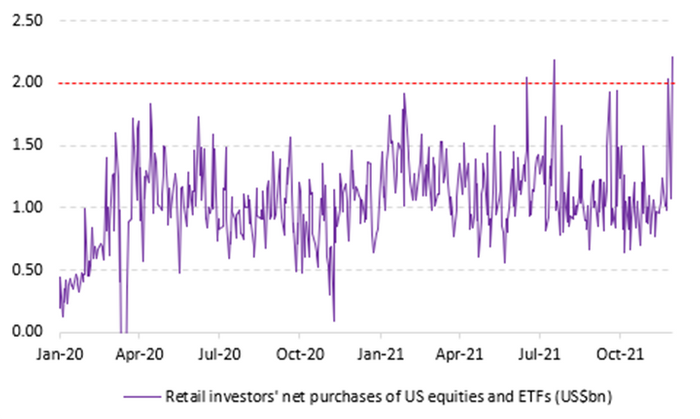
Retail purchases of U.S. equities hit a fresh all-time high of $2.2 billion on Tuesday, as shown in this chart by Vanda Research. Total retail volumes, though were “materially lower than in the early stages of the pandemic,” writes senior strategist Ben Onatibia and analyst Giacomo Pierantoni.


Vanda Research

Random reads

Reddit explains some cute Gen. Z sayings such as “OK, Boomer” — to a millennial (and Gen. Xer’s, this reporter can confirm).

It’s the year of the raunchy Christmas movie.

Why Walmart
WMT,
-2.48%

pulled a rapping, dancing cactus off its online stores.

Just in time for the holidays, Tesla
TSLA,
-4.35%

rolls out a $1,900 Cyberquad for kids.

Need to Know starts early and is updated until the opening bell, but sign up here to get it delivered once to your email box. The emailed version will be sent out at about 7:30 a.m. Eastern.

Want more for the day ahead? Sign up for The Barron’s Daily, a morning briefing for investors, including exclusive commentary from Barron’s and MarketWatch writers.

Financial News

Daily News on Investing, Personal Finance, Markets, and more!

Financial News

Policy(Required)