Homeownership plummets: will house prices crash in 2022?

Image source: Getty Images


A new report reveals that high house prices are significantly impacting the number of young people owning their own homes. Over the past 30 years, homeownership among those aged 25-34 has almost halved.

So, will 2022 be the year that house prices finally crash, giving young people some respite? Let’s take a look.

What did the report reveal about high house prices?

According to the Resolution Foundation, the number of people aged 25-34 owning their own homes has plummeted since 1989.

During the final year of the 1980s, a massive 51% of this age group owned their own home. This compares to just 25% reported in 2016, and 28% in 2019, when the data was last compiled. This means that homeownership among young people has almost halved in the past 30 years.

While the consumption of avocados on toast has increased since the 1980s, the report reveals the main reason why young people can’t afford to buy a home is that they don’t earn enough. The report also says many young people lack sufficient savings to put down a deposit.

According to the Office for National Statistics, the average house price is now £270,000, having grown almost £30,000 in the space of a year. This means someone buying an average home with a 10% deposit will need to have saved £27,000.

While it should be noted that some young people choose to rent by choice, the vast majority do not. According to the report, a massive 80% of 25-34 year old’s would rather buy than rent through a landlord.

The report also rubbishes the suggestion that high house prices are limited to London and the South East. It clearly states that young people are affected by high house prices in all regions of the UK. 

What is the government doing to help young people afford a home?

Government supporters will point to a number of schemes available to help young people get on the property ladder. Such schemes include Help to Buy, Shared Ownership and the First Homes scheme, as well as the recently introduced 5% Mortgage Guarantee scheme

To support the housing market during the pandemic the government also axed Stamp Duty. However, most first time buyers didn’t benefit as Stamp Duty doesn’t apply to first home purchases up to £300,000.

Despite the array of support schemes available, the fact is that house prices have continued to accelerate over the past few years. As a result of this, many feel the government isn’t doing enough to support young people to buy their first homes.

In fact, some critics suggest the government is only keen to support the demand for housing and not address supply issues. They believe government support schemes only help to increase house prices due to the fact they essentially boost the number of people able to buy property and not much else.

It is for this reason that the government’s Help to Buy scheme has been nicknamed ‘Help to Sell’ given that it has been shown to boost the prices of new build properties

Many also blame high house prices on the Bank of England. That’s because its ultra-low base rate has widened access to cheap credit. This belief was echoed by Peter Beaumont, CEO of The Mortgage Lender, who, after the Bank’s most recent base rate decision, said this would likely push up prices.

He explained: “The Bank of England’s decision to keep the base rate at 0.1% will keep the market frenetic for at least another month.” 

Whether or not the government is contributing to high house prices is debatable. However, it is a fact that homeowners are more likely to vote than renters.

Will house prices crash in 2022?

Due to soaring house prices, young people may feel a house price crash presents their only hope of owning property.

While the housing market is notoriously difficult to predict, it is possible that house price inflation will cool in 2022. This theory is supported by the fact that mortgage approvals have plummeted over the past few weeks, indicating that lenders are tightening their criteria.

On a similar note, the Bank of England is under pressure to increase its base rate to cool inflation. If this happens, then mortgage costs will likely increase too, potentially reducing house prices.

Whatever your views on the housing market, if you’re looking for a mortgage, take a look at The Motley Fool’s top-rated mortgage deals.

Products from our partners*

Top-rated credit card pays up to 1% cashback

With this top-rated cashback card cardholders can earn up to 1% on all purchases with no annual fee. Plus, there’s a sweet 5% welcome cashback bonus (worth up to £100) available during the first three months!

Those are just a few reasons why our experts rate this card as a top pick for those who spend regularly and clear their balance each month. Learn more here and check your eligibility before you apply in just 2 minutes.

*This is an offer from one of our affiliate partners. Click here for more information on why and how The Motley Fool UK works with affiliate partners.Terms and conditions apply.

Was this article helpful?

YesNo


Some offers on The Motley Fool UK site are from our partners — it’s how we make money and keep this site going. But does that impact our ratings? Nope. Our commitment is to you. If a product isn’t any good, our rating will reflect that, or we won’t list it at all. Also, while we aim to feature the best products available, we do not review every product on the market. Learn more here. The statements above are The Motley Fool’s alone and have not been provided or endorsed by bank advertisers. John Mackey, CEO of Whole Foods Market, an Amazon subsidiary, is a member of The Motley Fool’s board of directors. The Motley Fool UK has recommended Barclays, Hargreaves Lansdown, HSBC Holdings, Lloyds Banking Group, Mastercard, and Tesco.



Economic Report: Jekyll-and-Hyde U.S. jobs report not as ugly as it looks

Sometimes the U.S. jobs report is like Dr. Jekyll and Mr. Hyde. One part of the report can look great, but another is ugly.

The November jobs report also has a split personality, but Wall Street is giving more credibility to the good doctor.

Let’s look at Mr. Hyde first. The ugly part of the report was the tepid 210,000 gain in new jobs — the smallest in 11 months. Wall Street had expected an increase more than double that size.

The weak headline number — taken from a survey of businesses — suggests the worst labor market shortage in decades is holding back the economy.

Businesses simply can’t find enough workers, the story goes, to produce all the goods and services that customers demand.

But maybe it’s not as bad as it looks. Now let’s turn to the handsome Dr. Jekyll.

Another part of the November jobs report showed a whopping 1.13 million people found work last month, based on a separate survey of households. That’s great news.

The household survey also showed nearly 600,000 people entering the labor force and unemployment falling to a pandemic low of 4.2%.

“This report is a tale of two surveys,” said Nick Bunker,” the economic research director at Indeed Hiring Lab.

What to believe? Here’s where it gets dicey.

The 210,000 increase in payrolls comes from a regular survey of businesses and government agencies that is seen as very reliable. The survey queries almost 700,000 work sites each month to gauge how many people are employed.

Another survey of households is used to determine the unemployment rate. The same survey also showed that more than 1 million people obtained work in November.

Yet because the household survey only polls 60,000 households each month, it’s not nearly as accurate. Its margin of error is about five times larger than the payroll survey.

Which is why the payroll number — 210,000 in this instance — gets the lion’s share of attention each month.

That’s not the case with the November report. Most economists think the household survey told a more accurate tale of the jobs market. More people are entering the labor force, they believe, and more people are finding jobs.

One possibility, some economists say, is that the government’s seasonal adjustments that produced the 210,000 payroll number have been thrown out of whack. The raw figures showed that hiring was much stronger.

The seeds of the problem may have originally early in the pandemic, when the Labor Department changed how it adjusts the payroll figures for seasonal employment patterns.

Now its revamped method might actually be producing more erratic results for the payroll survey than the household poll. The payroll figures have been all over the map since last summer.

“Historically, the household survey has been more volatile and thus less reliable,” said chief economist Aneta Markowska of Jefferies LLC.

“But if people are truly shifting from employment to gig work — as many have during the pandemic — then the household survey might actually be painting a more accurate picture of the labor market because it captures all workers.”

How will we know for sure? Stay tuned. The next several months of jobs reports should give a clearer answer.

Crypto: number of female investors rises by almost 200% in 2021

Image source: Getty Images


Studies have shown that there is a significant gender divide when it comes to cryptocurrency investing. For example, a survey conducted by financial website Finder.com in February revealed that nearly twice as many men as women invest in crypto (24% of men vs 13% of women).

However, according to data from one cryptocurrency exchange, the number of women investing in cryptocurrency is growing. Here’s the lowdown.

Why do fewer women invest in cryptocurrency than men?

It is likely that female crypto investors lag behind their male counterparts for the same reasons that women have historically lagged behind men in more traditional investments.

For example, it could be because of the gender pay gap, which has traditionally left women with less disposable income. This translates to less financial security. As a result, women are more likely to protect their money and save what they can for the future rather than try to grow it through investments.

Another factor is that women are more risk-averse than men in general. Given that cryptocurrencies are among the riskiest investments, it’s no surprise that many women prefer to avoid them.

Lack of knowledge and confidence could also be holding women back from investing in crypto and other investments. Research shows that far more men than women express confidence and adequate knowledge about investments.

What’s happening with female crypto investors?

Recent data from Bitstamp, a leading European crypto exchange, shows that the number of women investing in cryptocurrency via the platform rose by 198% in the first three quarters of 2021 compared to the same period in 2020.

Further, the data shows the share of trading volume generated by female investors rose by 58% over the same period.

Age-wise, the biggest percentage of Bitstamp’s female traders were women aged 30 to 35. Meanwhile, the greatest volume generated came from women aged 55 to 60. These were found to be trading larger amounts of crypto than any other age category.

Commenting on these figures, Bitstamp’s chief commercial officer, Mel Tsiaprazis, said, “It is a great step forward to see increasing numbers of women participating both as individual investors, and founding their own trading firms.”

She added that the increased number of female investors in crypto is an indicator that “cryptocurrencies are becoming increasingly mainstream and they are here to stay, with more and more people wanting to access the benefits of crypto.”

What do you need to know before investing in crypto?

Cryptocurrencies seem destined to become an important part of the global financial system in the future. 

However, for now, the big problem with crypto is volatility. Wild swings in prices are quite common in the crypto market. The Bank of England has previously warned that anyone who buys digital assets should be prepared to lose their money. In some countries, like China, crypto has been banned completely. 

When it comes to crypto, you should only invest what you are willing to lose. If you are looking for a less risky way to invest your cash, then consider alternatives such as investing in stocks and shares.

Investing in Cryptocurrency is extremely high risk and complex. The Motley Fool has provided this article for the sole purpose of education and not to help you decide whether or not to invest in Cryptocurrency. Should you decide to invest in Cryptocurrency or in any other investment, you should always obtain appropriate financial advice and only invest what you can afford to lose.

Was this article helpful?

YesNo


Some offers on The Motley Fool UK site are from our partners — it’s how we make money and keep this site going. But does that impact our ratings? Nope. Our commitment is to you. If a product isn’t any good, our rating will reflect that, or we won’t list it at all. Also, while we aim to feature the best products available, we do not review every product on the market. Learn more here. The statements above are The Motley Fool’s alone and have not been provided or endorsed by bank advertisers. John Mackey, CEO of Whole Foods Market, an Amazon subsidiary, is a member of The Motley Fool’s board of directors. The Motley Fool UK has recommended Barclays, Hargreaves Lansdown, HSBC Holdings, Lloyds Banking Group, Mastercard, and Tesco.


Want to make a passive income? Here are some of the best REITs

I think a real estate investment trust (REIT), is a good way to make a passive income for my portfolio. By investing in REITs, I can tap into the property market without having to buy property myself. I have identified three REITs on the London Stock Exchange I would add happily add to my portfolio at current levels. But first, a little more about REITs.

REIT details

A REIT is an investment trust that specialises in property investment. It invests capital in a diverse array of property assets, and then pays a dividend to investors to reward them for the risk. The properties can be residential, commercial, or property developments. The REIT scheme launched in 2007 and there are currently over 50 REITs in the UK. 

5 Stocks For Trying To Build Wealth After 50

Markets around the world are reeling from the coronavirus pandemic… and with so many great companies trading at what look to be ‘discount-bin’ prices, now could be the time for savvy investors to snap up some potential bargains.

But whether you’re a newbie investor or a seasoned pro, deciding which stocks to add to your shopping list can be a daunting prospect during such unprecedented times.

Fortunately, The Motley Fool UK analyst team have short-listed five companies that they believe STILL boast significant long-term growth prospects despite the global upheaval…

We’re sharing the names in a special FREE investing report that you can download today. And if you’re 50 or over, we believe these stocks could be a great fit for any well-diversified portfolio.

Click here to claim your free copy now!

Here are some of the rules a REIT must follow:

  • Be listed on a recognised stock exchange with at least 35% of quoted shares held by the wider public, and not a closed group of five or fewer people
  • Distribute 90% of its tax-exempt property income profit each year as a dividend — this is the part that makes investors a passive income
  • Be diversified across at least three properties with each representing less than 40% of the total trusts’ assets
  • Invest 75% of gross assets into property rental assets, which can include buy-to-rent property projects

In return for following the rules mentioned above, REITs are offered tax advantages compared to an ordinary investment firm. This relates to the way profits are taxed.

I believe there are some significant advantages to investing in a REIT. First, there is an element of double taxation when investing in ordinary firms and receiving a dividend. Firms’ profits are subject to corporation tax and then the dividend income I receive as an investor is also taxed. In addition to this, earning rent as an individual directly investing into property would also be liable for tax.

A REIT receives a corporate tax exemption for rental income. This allows net rental income to pass through to me as the investor without the double taxation mentioned earlier. Furthermore, I would not have to raise lots of capital to invest in a rental property myself. I could buy shares in a REIT and have access to a diverse portfolio of property investment without the hard work of managing anything myself. REITs also provide a higher shareholder return than any standard form of investment trust. REITs are popular investment vehicles, especially to make a passive income.

Risks of investing

The risks of investing in REITs that could threaten any passive income are similar for most right now. Of course, risks will differ slightly from firm to firm, such as size and diversity of portfolios. 

More common risks currently affecting REITs are macroeconomic pressures and Covid-19. Rising inflation and cost of rent could affect portfolios and any dividends that REITs can distribute. The pandemic was a tough time for REITs especially as growth slowed and rent was tougher to collect. The threat of new variants is not good news and could affect growth and profitability once more. This could affect the level of payout to me as a investor. 

Passive income opportunity #1

I would buy shares in Land Securities Group (LSE:LAND) for my portfolio. Often known as Landsec, it is one of the largest REITs in the UK and has a diverse portfolio of properties on its books. Diversity in a REITs portfolio is important for me as it means the risk is spread out. Landsec has property in the retail, leisure, workspace, and residential sectors. Currently its portfolio is worth £11bn.

As I write, shares in Landsec are trading for 733p. A year ago shares were trading for 712p, which is a 2% return. It is worth noting shares have not reached pre-crash levels of over 900p, making me think there is room for shares to continue upward.

I like Landsec for a few reasons. Firstly, its size, footprint, and diversity are positive. Next, recent half-year results showed me that recovery after the height of the pandemic is underway. Profit was up to £275m and further acquisitions for growth worth £616m had been purchased. Finally, it has a track record of success too, which I use as a gauge to review investment viability. I understand the past does not guarantee future success. From a passive income perspective, Landsec’s dividend yield is close to 4%, which is an attraction for my portfolio.

REIT #2

I would buy shares in British Land (LSE:BLND) for my portfolio. British Land has roots back to 1856, making it one of the oldest property firms in the UK. It owns close to £10bn of its own assets as well as managing a further £2bn worth of assets too with a 95% occupancy rate. British Land owns property throughout the UK but focuses on what it calls “London campuses” which is a mixture of work, living, and retail spaces in London.

As I write, shares in British Land are trading for 511p. A year ago, shares were trading for 496p, which is a 3% return.

I like British Land for a few key reasons. in my opinion, one of the best characteristics of a REIT is longevity. British Land ticks that box. Next, it is one of the largest landlords in the country. It has also been moving with the market recently in selling struggling retail assets and buying better yielding assets. Finally, it is currently undertaking a redevelopment scheme in Canada Water, London. This is one of the largest redevelopments in the country, which will boost performance and growth. From a passive income perspective, a dividend yield of over 3% is attractive too.

REIT #3

I would also buy shares in Big Yellow Group (LSE:BYG) for my portfolio. It is one of the largest self-storage firms in the UK. It has benefitted from the recent e-commerce boom that resulted from the changing face of retail and the pandemic.

As I write, shares in Big Yellow are trading for 1,644p. A year ago, shares were trading for 1,146p, which is a 47% return! At current levels shares look cheap with a price-to-earnings ratio of just eight. I like BYG as it is a bit different to other REITs. It specialises in self-storage solutions only, unlike than British Land or Landsec, which have a mixture of other properties. I like a bit of diversity in my portfolio.

Big Yellow has a successful track record of growth and success, which is positive. From a passive income perspective it has a dividend yield of close to 3% which is also attractive for me.

FREE REPORT: Why this £5 stock could be set to surge

Are you on the lookout for UK growth stocks?

If so, get this FREE no-strings report now.

While it’s available: you’ll discover what we think is a top growth stock for the decade ahead.

And the performance of this company really is stunning.

In 2019, it returned £150million to shareholders through buybacks and dividends.

We believe its financial position is about as solid as anything we’ve seen.

  • Since 2016, annual revenues increased 31%
  • In March 2020, one of its senior directors LOADED UP on 25,000 shares – a position worth £90,259
  • Operating cash flow is up 47%. (Even its operating margins are rising every year!)

Quite simply, we believe it’s a fantastic Foolish growth pick.

What’s more, it deserves your attention today.

So please don’t wait another moment.

Get the full details on this £5 stock now – while your report is free.


Jabran Khan has no position in any shares mentioned. The Motley Fool UK has recommended British Land Co and Landsec. Views expressed on the companies mentioned in this article are those of the writer and therefore may differ from the official recommendations we make in our subscription services such as Share Advisor, Hidden Winners and Pro. Here at The Motley Fool we believe that considering a diverse range of insights makes us better investors.

The Fed: Fed’s Bullard, not fazed by disappointing job headline, still wants faster taper

St. Louis Fed President James Bullard said Friday he wasn’t fazed by the relatively small gain in jobs in November and wants the central bank to taper its asset purchases at a faster pace than had been planned only a month ago.

“Except for the headline number, that [jobs] report seemed quite strong across the board,” Bullard told reporters after a speech to the Missouri Bankers Association.

“It certainly seems consistent….that this is a very tight labor market,” Bullard added.

The St. Louis Fed president, who is a voting member of the Fed’s interest-rate committee next year, said his “base case” is for two interest-rate hikes in 2022.

He declined to say what month the Fed would first “lift-off” from the current level of zero.

Bullard, the first on the Fed to support ending asset purchases in March, said he still supports the move.

At the last meeting in November, Bullard lost that argument, and the Fed decided to go relatively slowly and taper by $15 billion per month — a pace that would end the taper program in June.

But economic data since the Fed meeting in early November has raised concern that higher inflation won’t go away anytime soon.

On Tuesday, Fed Chairman Jerome Powell opened the door for a faster taper and many of Bullard’s colleagues now say they support ending the program in March, which translates into tapering at a $30 billion-per-month-pace.

Bullard dismissed fears of some economists that the U.S. economy will slump in 2022 as massive government assistance to households comes to an end.

While growth is surely going to slow next year from this year’s strong pace, the economy will still expand at “what would normally be considered a super rapid pace,” he said.

The St. Louis Fed president said it was too soon to predict how the omicron variant would impact the U.S. economy.

He added that the economy has already adapted to the pandemic and earlier variants and the U.S. “will be able to handle this one as well.”

Stocks
DJIA,
-0.51%

SPX,
-1.19%

moved lower on Friday as markets have been volatile since the omicrom variant was discovered and the shift in Fed policy became apparent.

Mansion Global: Elon Musk officially ‘owns no home’

Elon Musk has fulfilled his pledge made last year to “own no home.”

The Tesla boss and billionaire sold his 16,000-square-foot mansion in Hillsborough, California, a wealthy Silicon Valley enclave just south of San Francisco. The property sold for $30 million, after initially listing for $37.5 million, when Mr. Musk announced the sale via Twitter in June, and eventually relisting for $31.99 million in October, according to  records on the MLS.

See also: Home-price growth slows for the first time since May 2020

The identity of the buyer has not been made public, and the property’s listing agents, Brent & Mary Gullixson of Compass, did not immediately respond to a request for comment.

Mr. Musk, 50, has previously announced that the 47-acre property was his “last remaining house” in California after selling off his other properties in the state.

The 100-year-old estate, known as Guignécourt, had a colorful history even prior to Mr. Musk’s ownership, and was originally built in 1912 by Count Christian de Guigné, a member of French nobility who moved to the state after marrying a California Gold Rush heiress. 

From Mansion Global: The EV Tech Industry Is Boosting Real Estate in Secondary Cities in the U.S.

The European-style estate is one of the largest parcels of land in the area, and includes hiking trails and a reservoir. The property remained in the de Guigné family for over a century before being listed for an eye-popping $100 million in 2013. In 2016, the asking price was reduced to $29.85 million.

Mr. Musk purchased the home for $23.4 million in 2017, according to public records.

This report originally appeared on MansionGlobal.com.

: Biden touts ‘sharpest 1-year decline in unemployment ever’ after jobs report

President Joe Biden on Friday played up the drop in the country’s unemployment rate but didn’t mention a disappointing headline number, as he gave a brief speech on a monthly jobs report.

Biden said it was “incredible news” that the U.S. unemployment rate had fallen to 4.2% in November.

“At this point in the year, we’re looking at the sharpest one-year decline in unemployment ever,” he said, adding that the jobless rate “has now fallen by more than two percentage points since I took office.”

The president’s speech at the White House came after the November release for nonfarm payrolls showed the country gained 210,000 new jobs last month, well below forecasts for 573,000. But on the plus side, the unemployment rate fell to a new COVID-19 pandemic low of 4.2% and the labor force grew substantially.

“Because of the extraordinary strides we’ve made, we can look forward to a brighter, happier new year ahead in my view, but I also know that despite this progress, families are anxious,” Biden said.

“That’s why every day my team and I are working to deliver consistent, determined, focused action to overcome the challenges we still face.”

In response to a question from a reporter about his health following his speech, the president said he has “just a cold,” suggesting he got it from his “1½-year-old grandson who had a cold who likes to kiss his pop.”

U.S. stock gauges
SPX,
-0.90%

DJIA,
-0.36%

lost ground Friday as traders assessed the jobs report.

How Much is 40,000 Miles Worth?

Ever wondered about frequent flyer programs? These programs, created as a way to ensure customer loyalty, have since allowed travelers to fly around the world for very little money. You can earn airline miles in various ways, including through credit card welcome offers, air travel, spending on co-branded credit cards and more.

But at the end of the day, what are these miles actually worth? Below, we examine the value of each airline’s award miles and its valuation of 40,000 miles.

An overview of airline miles to dollars

Estimated value of 40,000 miles

Alaska Airlines

American Airlines

Delta Air Lines

Frontier Airlines

Hawaiian Airlines

Southwest Airlines

Spirit Airlines

United Airlines

Here, we’ll look closer at each airline — highlighting sweet spots where you could get even more value per point or mile than on average.

Nerdy tip: You can use NerdWallet’s calculator to determine if you should book a flight with points or miles.

Alaska Airlines

Although it isn’t one of the big three U.S. airlines, Alaska Airlines operates a comprehensive route network with more than 115 total destinations. In addition, due to its membership in Oneworld and a strong group of individual partnerships, you’ll find your miles redeemable with plenty of airlines, including American Airlines, British Airways, Cathay Pacific, Icelandair and more.

The cost to redeem your Alaska miles will depend on your carrier; you’ll find different rates hinging on whether you’re flying Alaska or one of its partners. Overall, we value Alaska Mileage Plan miles at 1.1 cents each, which means 40,000 miles will be equal to $440 worth of travel.

When flying with Alaska Airlines, you’ll pay a range of pricing depending on demand, distance and fare class.

For example, you can fly nonstop from San Francisco to Orlando for 12,500 miles on a low-demand day.

You can also flip the same flight, paying just 12,500 miles to return from Orlando. At these rates, you would be able to take three one-way flights across the country for 37,500 miles — with 2,500 miles left over.

However, you may find better results when flying with some of Alaska’s partners. For example, consider this one-way flight from San Francisco to Fiji, which will cost you 40,000 miles.

Eleven hours is a long time to spend on a plane, but it’s an excellent deal when you consider that the cash price for this flight is over $800.

Nerdy tip: You can often find better value redeeming your miles for premium cabins rather than economy.

American Airlines

American Airlines, also a member of Oneworld, is a popular airline with nearly 6,700 daily flights. American ties the cost of its flights to a semi-fixed award chart based on demand. We value American Airlines AAdvantage miles slightly higher than Alaska, at a rate of 1.2 cents each. This means that 40,000 miles with American will be equal to roughly $480 worth of travel.

Take a look at a San Jose to Orlando flight booked through American Airlines.

This flight contains a connection compared to Alaska’s nonstop option and departs from San Jose instead of San Francisco, but Bay Area-based travelers could be saving 6,000 miles on a cross-country flight. Return flights can also be found for as low as 6,500 miles, which means you can snag three round-trip flights for 39,000 miles.

Delta Air Lines

Delta is a member of Skyteam and therefore has access to flights with airlines such as Air France, AeroMexico, China Eastern and more. We value Delta SkyMiles at a rate of 1.3 cents each, which means 40,000 miles is worth about $520.

Nerdy tip: Delta is one of the only carriers to sell basic economy award tickets that come with fewer perks. For example, this ticket type doesn’t include advanced seat selection.

Delta ties its award rates pretty closely to the cash price of its tickets and demand. So, for example, a basic economy ticket will cost $138 in cash or 9,000 SkyMiles for a flight from San Francisco to Orlando.

A one-way flight from San Francisco to New York-John F. Kennedy or vice versa can be booked for as little as 6,000 miles or $102 in cash.

At this rate, you’ll be able to take three round-trip flights across the country with 4,000 miles to spare.

Frontier Airlines

Famous for its low-cost fares, Frontier Airlines operates flights to over 100 different cities. You’ll be able to redeem your miles based on demand and a region-based award chart, with redemptions starting as low as 10,000 miles each way. We value Frontier miles at a rate of 0.7 cent each, which means 40,000 miles will be worth around $280.

One-way domestic U.S. flights — no matter where you go — will either cost you 10,000 miles, 20,000 miles or 22,500 miles, depending on the number of seats that are left.

Though you’ll have two connections on your Newark to San Francisco flight, you’re still redeeming just 10,000 miles. This means your 40,000 miles can stretch out to two round-trip tickets anywhere in the country.

  • More than 180+ days before travel: Free.

  • Between 21-179 days before travel: $15.

  • Between 7-20 days before travel: $50.

  • Fewer than six days before travel: $75.

Hawaiian Airlines

Although Hawaiian Airlines isn’t a member of any airline alliance, it does have a few different partnerships, including those with JetBlue and Japan Airlines. When redeeming your HawaiianMiles, you’ll be using a region-based award chart with varying price levels based on demand. Inter-island flights, for example, can run as low as 7,500 miles but as much as 20,000.

We value HawaiianMiles at a flat 1 cent each, so 40,000 miles will be equal to $400 in flights.

Flights to Hawaii from the West Coast start at 20,000 miles each way, as you can see on this trip from San Diego to Honolulu.

That means you could book a round-trip flight between the West Coast and Hawaii using your entire 40,000 miles.

JetBlue

JetBlue is a growing airline with services throughout North America, the Caribbean, Central and South America and Europe (London). The airline ties its award flights directly to the cost of a cash ticket, which means you aren’t likely to find any “sweet spots” when redeeming your miles. Still, you can get pretty decent value from them; we consider TrueBlue points to be worth 1.5 cents each, so 40,000 points will be valued at $600.

The trick for finding good redemptions with JetBlue is locating inexpensive cash flights and using your points to pay for them. For example, consider a flight from New York-JFK to the Bahamas. It’s $122 in cash or 6,900 points.

Return trips can be even cheaper, costing as few as 5,700 points.

In this case, you would be able to fly round-trip from New York-JFK to the Bahamas three times, with a remainder of 2,200 miles.

Southwest Airlines

Renowned for allowing two free checked bags and never charging change fees, Southwest has been steadily growing its market for years. Like JetBlue, Southwest ties the amount of Rapid Rewards points you’ll need for an award flight to its cash cost. NerdWallet found Southwest points to be valued at ​​1.4 cents each, making 40,000 points worth roughly $560 in flights.

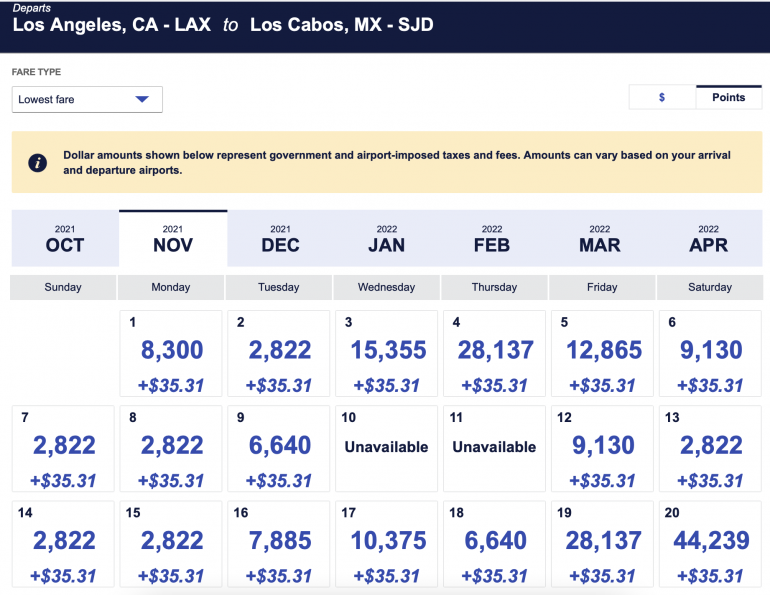
To find the best redemption rates for your points, you’ll want to check out inexpensive fares. Fortunately, Southwest has a Low Fare Calendar that will display an entire month’s worth of flights at once.

In this example, from Los Angeles-LAX to Los Cabos, you’ll find the cheapest rates for just 2,822 points. Return flights can be had for the same amount, but note that the higher taxes and fees.

At the lowest rates, you can fly round-trip between Cabo and Los Angeles seven times for a total of 39,508 points.

Spirit Airlines

Another low-cost carrier, Spirit revamped its rewards program in early 2021 to offer new benefits, such as points pooling with family members and points that don’t expire. We value Spirit points at 1.1 cents each; 40,000 miles will be worth around $440 in value.

As with Southwest and JetBlue, Spirit operates on a fare-based redemption system, which means the cost of your award ticket will depend on cash rates. You may also get better value on some redemptions than others.

Here’s an excellent example with a one-way flight from Denver to Las Vegas.

Fares for this flight vary from at least $25, with standard rates costing more than Saver$ Club fares. However, many of these flights can be redeemed for just 2,500 points, even the $50 fare.

Redemptions for Spirit start at a base of 2,500 points one-way. At this rate, you’ll be able to take eight round-trip flights and completely use your 40,000 points.

Like Frontier, however, Spirit may charge you a redemption fee based on when you’re booking your flight:

  • Less than 28 days to departure: $50.

  • At least 28 days before departure: Free.

United Airlines

United is a member of Star Alliance, which contains more than two dozen members, including Air Canada, Avianca, Lufthansa, All Nippon Airways and more. Like many other airlines, United charges dynamic pricing for its award fights. We value United MileagePlus miles at 1 cent each, so your 40,000 miles will be worth roughly $400.

United operates an extensive network of flights, and combined with its robust alliances, redeeming United miles is easy. Although these aren’t the most valuable miles, you can still find some pretty decent award flights, including this one-way option from Denver to London-Heathrow for 30,000 miles.

You can see from the above example that redemption rates indeed are dynamic; one nonstop flight will cost 30,000 miles while the other is 50,000.

Other good options for United miles include short-haul flights, where awards can drop as low as 6,500 miles.

By choosing the flexible dates option while searching for an award flight, you can see the best rates for your miles in a calendar view. But assuming you travel on those 6,500-mile flights, you can get three round-trip flights with your 40,000 miles, which will cost 39,000 miles.

If you’re looking to use 40,000 miles

Not all airline miles are created equal. The best way to figure out what options are suitable for you will depend on where you live and the type of travel you prefer. Regardless, 40,000 miles is a good chunk of miles and can get you far — no matter where you’re going or which airline you’re flying.

How to maximize your rewards

You want a travel credit card that prioritizes what’s important to you. Here are our picks for the best travel credit cards of 2021, including those best for:

What is Oneworld Connect and How Does It Work?

Smaller airlines may not have the resources or ability to join a major, global airline alliance. This is why some airline groups have created alternative alliances to piggy back off large alliances via partial membership. Oneworld Connect is exactly this: It is a small airline alliance designed so that regional airlines can join an alliance, but without the price tag.

How alliances are formed

Airlines around the world are only as strong as their network of destinations and the markets they serve. This is why many airlines codeshare with each other, that is — airlines sell seats on each other’s flights to expand their overall offerings (or “footprint”). In the late 1990s, a second type of partnership — beyond codeshares — was created: airline alliances.

These groups include airlines that partner together on a variety of functions, from selling tickets to handling baggage, while also sharing loyalty program perks and privileges, including the ability for frequent flyer members to earn and redeem miles on each other’s flights. An airline alliance’s purpose is to create a more seamless experience for the flyer by aligning systems and policies.

Generally speaking, alliances exist to fill geographic gaps in their networks, as well as work with airlines that share similar philosophies. This is why you don’t see low-cost or budget airlines typically joining an alliance with full-service airlines — their operating models are quite different.

They can also be expensive to join. These substantial membership costs are often a barrier to airlines with smaller footprints.

What airlines are in Oneworld Connect?

As of now, Oneworld Connect has only one member airline: Fiji Airways. This airline doesn’t have a vast network around the globe. However, it does fill a particular hole in other Oneworld member airline route maps. Fiji Airways is based in Fiji, a country in the Pacific Ocean, and it flies to many smaller Pacific Island nations. These destinations tend to not have scheduled service from larger carriers.

By being a member in Oneworld Connect, Fiji Airways customers can tap into the larger Oneworld network of airlines.

How the reciprocal benefits work

Participating airlines

Oneworld Connect’s partial membership provides some of the flyer-friendly benefits of full alliance member airlines, but not all of them. It comes down to which airlines are sponsors of Fiji Airways in the alliance.

Fiji Airways is currently sponsored by:

  • British Airways.

  • Cathay Pacific.

American Airlines has plans to join in the near future.

Perks for frequent flyers

As a result, frequent flyers from these sponsor airlines receive benefits when flying Fiji Airways that other Oneworld flyers do not. Example perks include:

  • Easy connections between sponsor airline flights to Fiji Airways flights on the same ticket.

  • The ability to check bags all the way through.

  • The ability to earn and redeem miles when flying Fiji Airways.

  • Priority check-in for all Oneworld elite status members.

  • Access to priority boarding on Fiji Airways for Emerald and Sapphire elite status members (Oneworld’s two highest tiers).

How lounge access differs

When it comes to lounge access for Oneworld elite members, things get a bit more complicated.

If you’re flying in business class on Fiji Airways, you already get lounge access in many cities. But if you’re flying in economy class and relying on your Oneworld elite status to get lounge access, you’re granted access based on rules that are specific to the type of ticket purchased. Oneworld has a drop down menu on its website that outlines which ones are available for different mileage program members.

Only Emerald and Sapphire elite members in Fiji Airways’ sponsor airline programs can take advantage of lounge access when flying economy and using Oneworld elite status. For instance, if you’re a Qantas elite member, your Fiji Airways flight needs to have a QF-marketed flight code to be able to use the lounge.

These types of confusing rules and restrictions are what constitute the difference between being a full Oneworld member airline versus a partial member.

Is Oneworld Connect worth it for flyers?

Since you’re assured more benefits, it’s generally wiser to fly a full Oneworld alliance member instead of a Oneworld Connect partner. But Fiji Airways’ unique route network in the Pacific region means that there are often few other airline choices. That’s why even this limited Oneworld Connect partnership from Fiji Airways is better than none at all.

It is wise to review your flight itinerary before heading to the airport to understand what benefits you’ll be entitled to when traveling.

How to maximize your rewards

You want a travel credit card that prioritizes what’s important to you. Here are our picks for the best travel credit cards of 2021, including those best for:

Financial News

Daily News on Investing, Personal Finance, Markets, and more!

Financial News

Policy(Required)